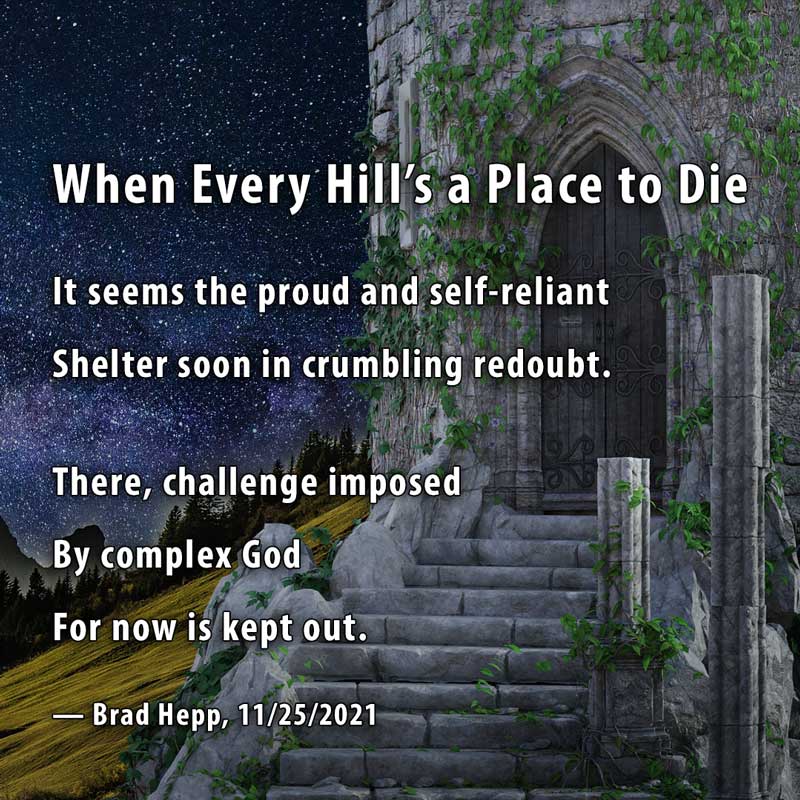
When Every Hill’s a Place to Die

Background image is a mashup of three images from Pixabay. Mountain scene by Jörg Peter; tower by “Jazella”; night sky by Felix Mittermeier.

Commentary

This morning, I watched a YouTube video in which a professor of “Christian Psychology” explained various approaches that he and Christian peers take to secular insights. He went a long way toward helping me categorize and understand a complex subject. I especially appreciated the irenic tone he takes toward approaches that differ from his own.

Shortly afterwards, I learned that professor had been ousted from Southern Seminary because the rest of the faculty in his department are of the mind that Scripture is all we need for counseling, and that no secular insights are welcome or allowed. Not so irenic on their part!

The Title: When Every Hill’s a Place to Die
A certain gentleman once complained to me about people who say things like, “That’s not a hill worth dying on.” I should say he was a “very certain gentleman.” When I asked him if there aren’t some secondary issues in Christianity for which he wouldn’t die, he answered, “I’d die for everything I believe.” I know he probably considers himself brave and loyal. Perhaps he is. But I suspect he’s also inordinately proud of his ability to fully comprehend all those issues. God is not simple; the world he created is not simple. We need to be humble about our understanding. Ask Job!

Shelter in Redoubt
In warfare, a “redoubt” is a fortification to which combatants can retreat. It is often their final resort, their last defence. I picture a theological combatant (unlike the irenic professor described above) retreating to a simple structure that he thinks he fully understands. The complexities of others’ thoughts cannot defeat him as long as he is in his theological redoubt. “God said it; I believe it; that settles it,” yells the proud, combative theologian from within his little fort. He forgets that what God said isn’t always so easy to understand!

“Change” Poems:

Previous: Song of the God-Danglers
Next: Hatred, the Squatter

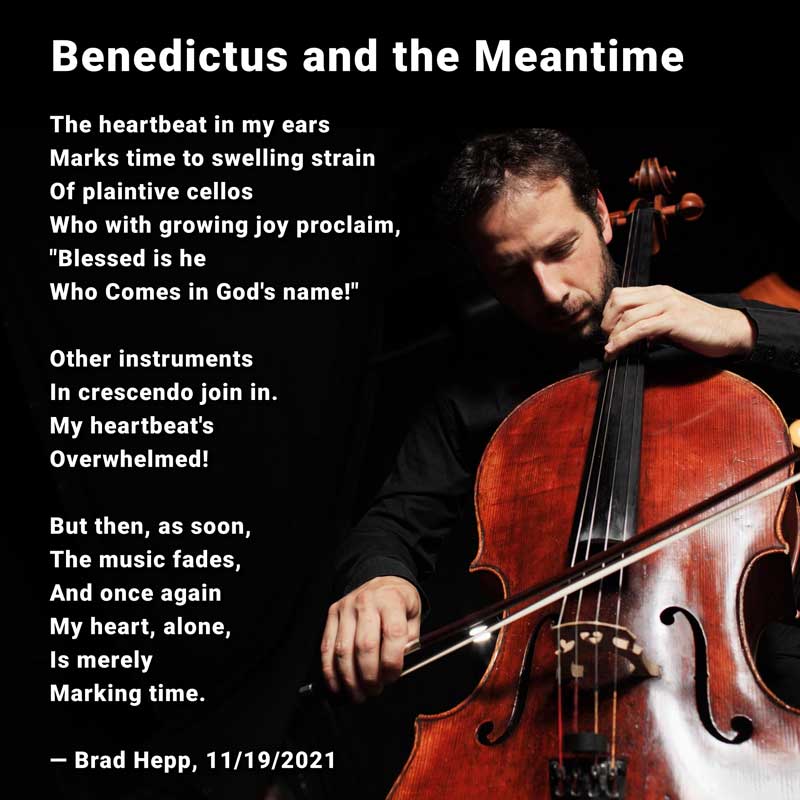
Benedictus And The Meantime

Commentary

This poem came to mind as I listened to a performance of “Benedictus” by 2Cellos. I had heard the tune many times in the past, but never paid attention to its title.

This time was different. I was starting into a nap, being soothed by beautiful music. I had just returned from a public event where I felt horribly alienated. Frankly, a friendless freak.

As the tune started playing through my ear buds, I literally heard a slow faint beat, not of drums, but perhaps of cello bows changing direction as they sustained and grew the opening strain. Perhaps it was the bows, or perhaps it was the pulse in my ears from elevated blood pressure. I’ll have to listen with good speakers to figure that out. In any case, my heart was attuned to the playing of the cellos.

What is “Benedictus”?
Since I was listening on my smart phone, I did a quick search for what this Latin word might reference. There were two answers, both from excruciatingly beautiful passages in the Gospels. The first is from Zechariah’s words “Blessed be…” when Zechariah was moved by the birth of his son, John. We know him as “John the Baptist,” who prepared the way for Jesus:

Blessed be the Lord God of Israel, for he has visited and redeemed his people and has raised up a horn of salvation for us in the house of his servant David…

Luke 1:68-69

Such high expectations!

The next “benedictus” is from Matthew 21, where the story is told of Jesus’ “triumphal entry” to Jerusalem, just as his Passion Week began:

And the crowds that went before him and that followed him were shouting, “Hosanna to the Son of David! Blessed is he who comes in the name of the Lord! Hosanna in the highest!”

Matthew 21:9

Such high expectations!

The Meantime
Jesus’ first coming was full of hope, both at its beginning, and at its end. But he ascended to the Father, and has not finished putting things in order, restoring His creation. Now, as we await his second coming, we are in the meantime. Someone has referred to it as the “in-between time.” I thought of using that phrase in the title, but opted for “meantime.” This is a time in-between, but it is also a time of meanness, a very mean time. Even those whom Jesus has brought into his family can feel rejected and lonely. As George MacDonald said somewhere, “The end of the Maker’s dream is not this.”


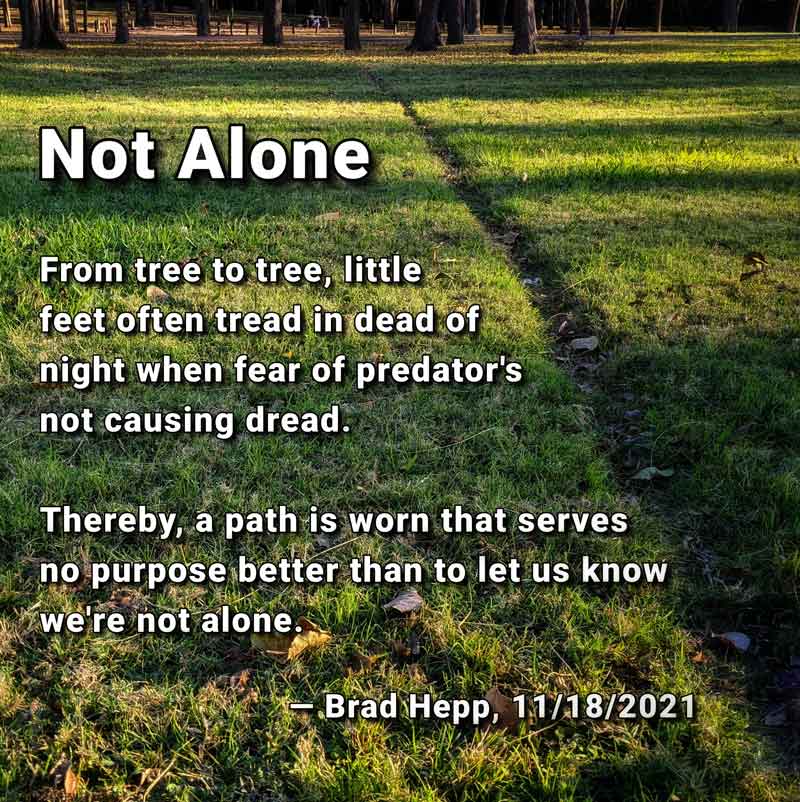
Not Alone

Commentary

These little trails have always intrigued me, be they in the mountains or in a local park. Why do they evoke such strong emotion?

Seriously… I took the photo, walked another 200 yards, and sat down on a park bench to edit the photo and pen a few words. Then, as I continued walking home, I felt a tremendous lump in my throat. Why?

As I have revealed before, I’m seeing a counselor to help me explore what may be some deep-seated emotional “problems.” I don’t say that with shame. Frankly, I think we all have deep-seated emotional “problems.” I just have the luxury right now of exploring mine.

One of the things my counselor has encouraged me to do is to try to figure out what relationship some of my poetry has to my life story. Now that’s a good challenge for a poet!

Really a problem?
Is it really a problem that I get inexplicably emotional? After all, what do we expect of someone God crafted to be a poet? If a poet cannot feel deeply, and desire with determination to express that emotion, what hope is there for any of us? God is an intelligent designer. We are not random results of happenstance. God has a purpose for making us as He did.

I can’t read this out loud now. Maybe tomorrow….


A related poem: “Not Alone

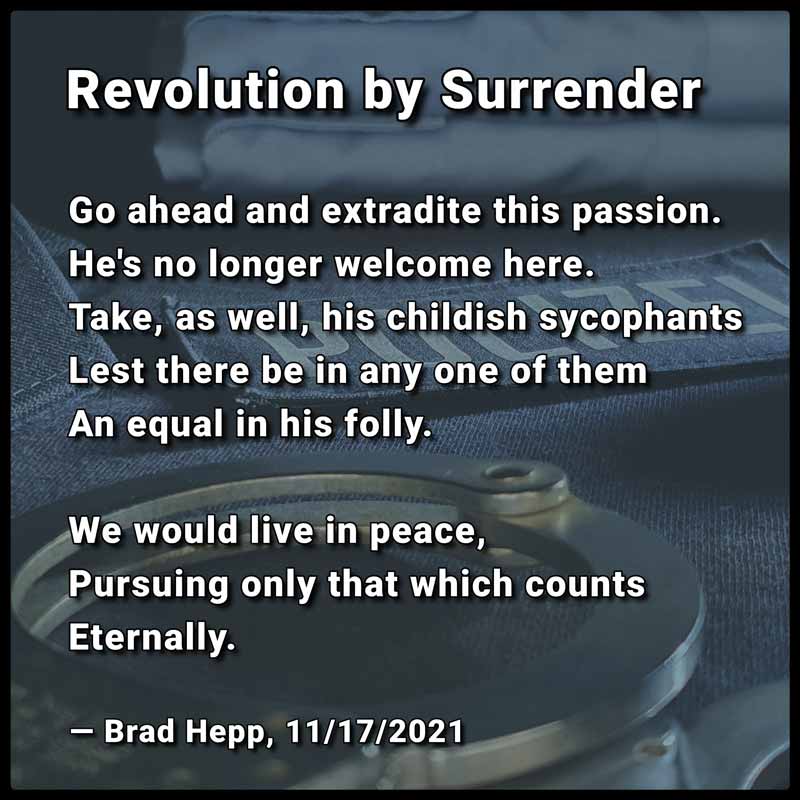
Revolution By Surrender

Commentary

This was one of those middle-of-the-night poems that I felt compelled to write AND publish when I should have been sleeping. So, I woke up this morning and looked at my phone with a little bit of fear. “What did I write last night?”

Was I drunk when I wrote this poem? No. In fact, my thinking was remarkably clear. Last night, I had just seen someone’s Facebook post in which they revealed how worked up they are about politics in the United States. I thought, “Yeah, I used to get worked up about that….” Then I confessed to myself that for all my equanimity regarding politics, I still do get worked up. My irritation at politicians has been replaced with irritation at people who care about politicians. This is not much of an improvement!

In a moment of clarity, I visualized a coming time when the equanimity I now feel toward politicians will extend to people who get worked up about politicians. I sat up in bed and jotted down this convoluted thought, which had to be worked out in other, better words:

Will I someday care as little
That YOU care now so much
About the things for which
I now no longer care?

the convoluted beginning of a poem

Irritableness & My Efforts
Irritableness (irritability?) is a trait I have lived with far too long. I’m working on it. I think about it. I read about it. New understanding comes by way of counseling and books. New concepts fill my mind: “attachment theory,” “affect regulation,” “interpersonal neuro-biology.”

Here’s what I expect to happen, based on past experience…. The Holy Spirit will take all my efforts, grind them into a powder, and sprinkle a dash of them in his delicious, surprising feast of provision. God made me with my penchant for problem-solving. He honors it, but not without poking fun at my self-reliance.

extradite this passion
In case the above background didn’t open up the poem for you, here it is in plain words: Just as a nation, or an embassy, gets tired of harboring someone who is wanted as a criminal by some other nation, I am tired of harboring passions that God would be more than glad to take off my hands. There are better things to do with my remaining energy in my remaining years, things that will make a difference forever.

Revolution
That’s a strong word. It describes a thorough change. That’s what I desire.

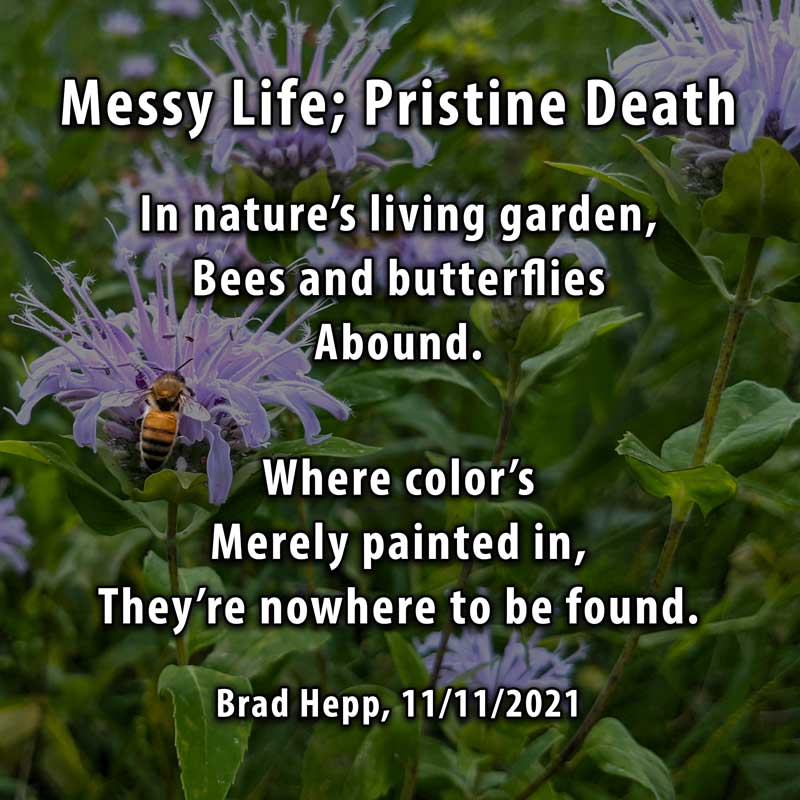
Messy Life; Pristine Death

MORE FROM MY BRAIN’S LEFT SIDE…

This poem is about healthy authenticity.

I’m not going to beat up on a certain tourist attraction here in Dallas. My wife walks there most mornings. But when I join her there, I do sometimes wonder, “Where are the mosquitoes?” “Where are the bees, and the butterflies?” And, “How much pesticide are we breathing in here?”

Oh, the flowers there are gorgeous, all sterile in their fruitless prime. They’re a sea of brilliant colors. None of them is disfigured by caterpillars. None of them is dying off or producing those awful, unsightly things called seeds.

The place is designed to attract tourists, after all. Not pollinators.

This applies to more than plants…

Healthy, life-giving interactions occur when we care more about honoring God-given processes than we do about the honor of managed appearances. That’s dense, I know; think about it….

What’s true in cultivating gardens is also true in cultivating friendships. Be honest with flowers and with friends.


A closely-related poem: False Flourishing.

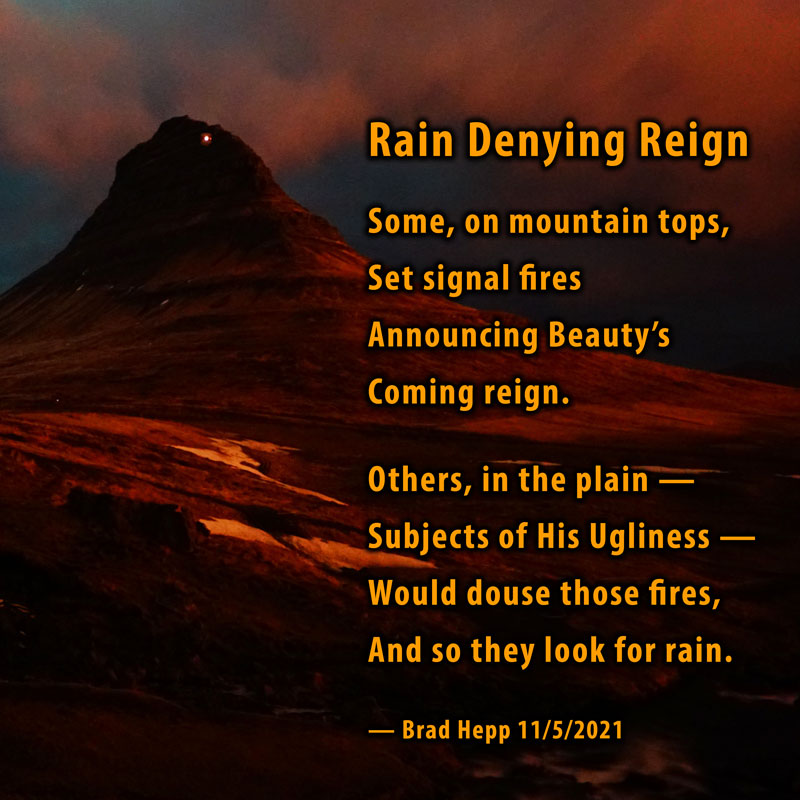
Rain Denying Reign

Commentary

I wrote this out of intense frustration. Recently, I’ve seen a silencing or muting of pointers to God’s amazing goodness and grace. It’s not prudent for me to go into details, to trot out examples. But I could.

On Mountain Tops
It’s probably no accident that my imagery is reminiscent of the giving of the Law (Exodus 19-20), and Israel’s response. To be honest, I haven’t worked out what this poem has to do with that historical event, but I sense that they are related. [NB: for “beauty” in the Law, see this article].

Subjects of His Ugliness
That may be a little harsh. “His Ugliness” refers to Satan (conversely, “Beauty” refers to Jesus). Am I suggesting that some who claim to be followers of Jesus Christ are actually subjects of Satan? Not necessarily, although it is possible. Even genuine followers of Jesus do sometimes wander off the path. In Matthew’s account, shortly after Peter had acknowledged that Jesus is the Messiah (Matthew 16:16), Jesus had to rebuke him:

But he turned and said to Peter, “Get behind me, Satan! You are a hindrance to me. For you are not setting your mind on the things of God, but on the things of man.”

Matthew 16:23

The Ambiguous Title
I’m not really enthusiastic about the title. Maybe I’ll come up with something better. For what it’s worth, “Denying” is ambiguous. It can refer to being intellectually opposed to a proposition, and it can refer to successfully thwarting something. With respect to Jesus’ present reign, both senses of denial are currently in operation to one extent or another. But His coming reign cannot be stopped; it will not be denied! Every knee will bow (Rom. 14:11).

[The background photo of Kirkjufell in Iceland is by Hans Braxmeier on Pixabay (I moved the fire)].

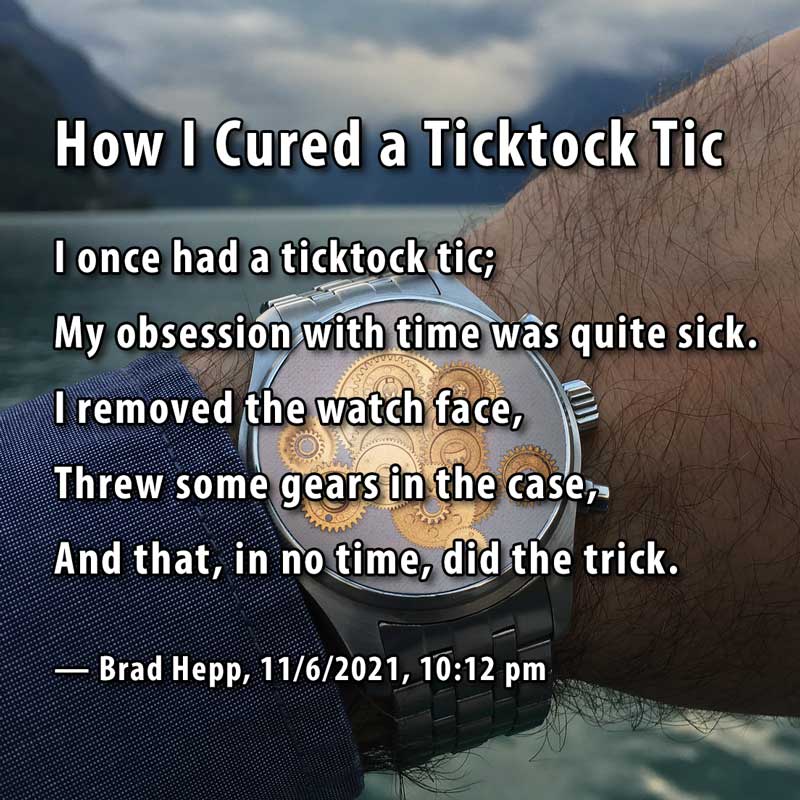
How I Cured a Ticktock Tic

True Story!

Back in college, I developed a nervous habit of looking at my watch every minute or so. I doubt anyone else noticed the habit, but I sure did!

My wristwatch was a cheap old Timex, so here was my solution…. I took the back off and removed the movement and face. Then I disassembled the movement, threw the loose gears in the case, and closed it up. The useless watch went back on my left wrist.

True to form, I’d look down at the watch every minute or so. Every time I looked, I had to laugh at myself. There, under the crystal, were a bunch of loose gears, telling me absolutely nothing. Nothing except, “Hey dumb dumb. Stop looking down here!”

The Background Image
That’s not my watch. Who knows where my “Hey dumb dumb” watch got off to. Somewhere between college and now, I lost it (I really did). I’m tempted to buy a cheap old watch to recreate the college timepiece. Its photograph would replace the background image, created in Photoshop from a couple of Pixabay downloads.

The Limerick
When I first thought of writing this limerick, I immediately came up with lines 1, 2, and 5 (the “A A… A” lines). That left me lines 3 and 4 (the “B B” lines) to tell the whole “how I fixed it” story. Believe it or not, that was the hard part. In the prose above, it took me thirty-six words to say what the limerick says in twelve words! That’s one of the main things I love about writing poetry: the challenge and charm of compression.

Have you ever read the most compressed poem of all? Even I can remember this one:

Fleas
Adam
Had’em

Ogden Nash

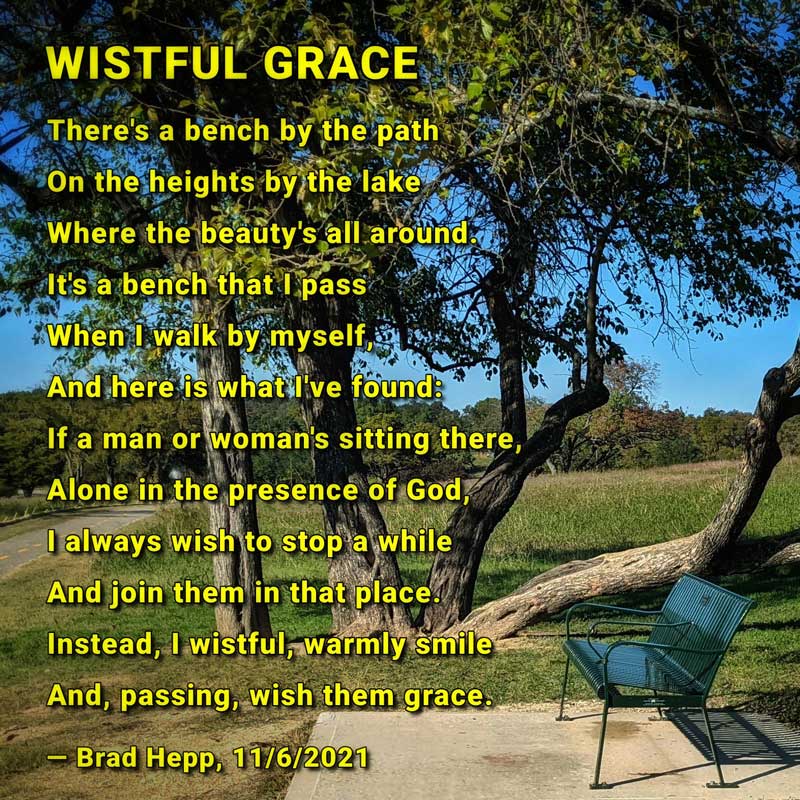
Wistful Grace

Commentary

A few years ago, when I went full-time with my web business and suddenly had plenty of time on my hands, I began taking walks around White Rock Lake. Sometimes it was from a parking lot (a 9 miles hike) and sometimes from home (a 12 miles hike). That was the beginning of one of the best periods in my life. Here’s why….

Paying Attention
On those long hikes, one of the things I did was pay close attention to how I was responding to people I encountered along the way: “The site of that elderly lady elicited warm feelings. Why? When I saw that young man, I felt disgust. Why? Why am I so ready to love some people, but not others?” Even after years of paying attention to my responses, it’s often still a mystery. But at least I’m a little more attuned to my emotional state now than I was before.

So I Asked Myself….
Yesterday, I walked by the bench in the background photo. Thanks to the habit of paying attention to my emotional state, I knew there was something I feel every time I pass by a person sitting on that bench. Could I put that feeling in words? Here’s what I initially wrote:

Often, when I’m walking at White Rock Lake and find someone sitting on this bench, I wish to sit with them, to share their experience. People taking in the beauty of a place like this are close to God, whether they realize it or not. But usually I just smile and walk on by.

Is it So?
What I want to do (sit with them) is something I can report with more confidence than why I want to do so. In the prose explanation and subsequent poem, I connect my desire to a sense that God is somehow involved in the experience. That’s still just a theory of what’s going on in my head and heart. This theory may get support from a book I started into last night: “The Soul of Desire: Discovering the Neuroscience of Longing, Beauty, and Community,” by Curt Thompson.

Why Wistful?
It makes me sad that I either cannot or do not always act on my good impulses. To sit and talk with a stranger? There’s nothing wrong with that impulse. But something usually stops me. What?


RELATED POST:The Man From Valladolid” (based on meeting a fellow just yards from this bench).

Magnifying Glasses

Influenced by Your Surrounding Culture? Duh!

Recently, I have been listening to American historians who specialize in the Civil War: Gary Gallagher, Allen Guelzo, Ty Seidule, Stephanie McCurry. Listening to them, I begin to see the lies that I have bought. It comes as no surprise that I’ve been influenced by a false narrative, one that exonerates and glorifies my surrounding culture.

What am I referring to?
I’m referring to the myth that the Confederate States of America were led by noble generals (esp. Robert E. Lee) in pursuit of noble causes (“States Rights!”). It was always a face-saving, sin-excusing myth on the part of slave-owning states, and a nation-unifying accommodation by still largely racist non-slave-owning states. Too many in the North, and way too many in the South bought the distortions of history. Why? In many cases, because it suited them: privileged whites were thereby excused in their continued oppression of blacks.

Still an Issue 160 Years Later?
You bet. Look at the furor over the removal of monuments to Confederate generals and the renaming of military bases, schools, roads, etc. that were erected and named in the 20th Century in reaction to desegregation and the civil rights movement. Racists desperately wanted then to assert their continued privilege. They still do. We’re on to them. We’re on to US. I’m on to ME!

I’m a sinner, saved by grace. How about you?


Below are some of the lectures I have been listening to:

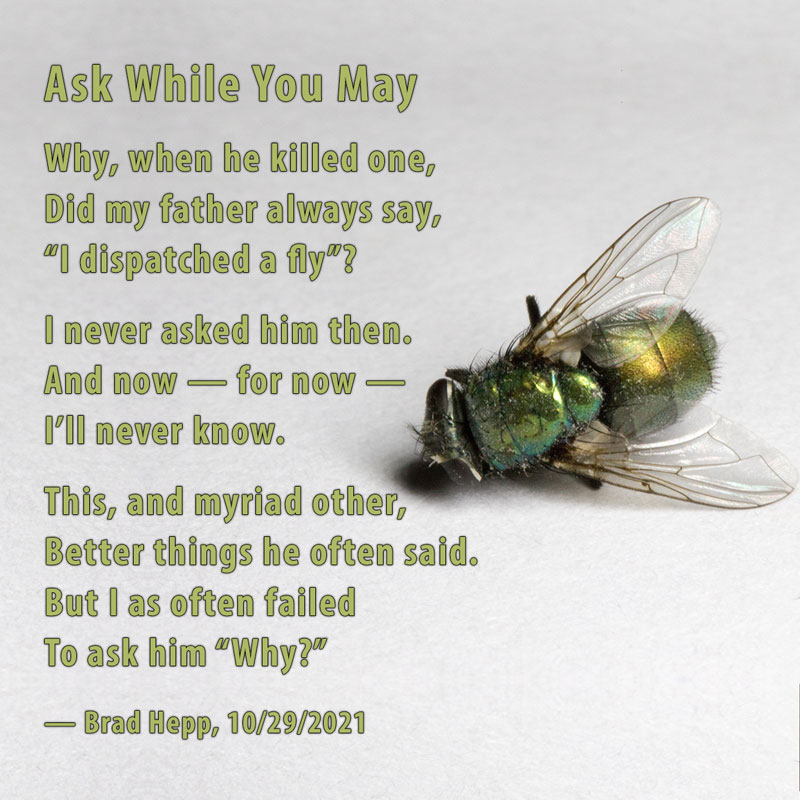
Ask While You May

Commentary

The Title
Okay, okay…. I know that “may” should probably be “can.” But that wouldn’t rhyme with “say,” would it?! The title is a reminder that we should make the most of the relationships God gives us in this lifetime.

“Dispatch”
Dad was a theologian, writer, and editor. During much of his life, he wrote Bible study courses that were used by people for whom English is a second language. So, he was keenly aware that he needed to practice what he preached as an editor: “Don’t use big words when little words will do.”

This morning, for some reason, this random memory popped in my head. When speaking of killing insects, Dad always used the big word “dispatch” when he could have used the little word “kill.” Why did he do that? I assumed it was a bit of humor. But I never asked him. In itself, this is not an important question. But my failure to ask him points to something that is important….

Uncharted Memories
Lately, I have been working through painful memories throughout my life, but especially from the formative childhood years. I’m realizing that my parents tended to not discuss the emotional impact of tragic events. I’m told that wasn’t unusual for people of their generation. But it bled over to me in the way that I interact with loved ones to this very day. Often, I’m not curious — or don’t act on what curiosity I do have — about others’ emotional state. There’s much that I miss of all I could love, lament, or celebrate.

(background image by Rob Slaven on Pixabay)

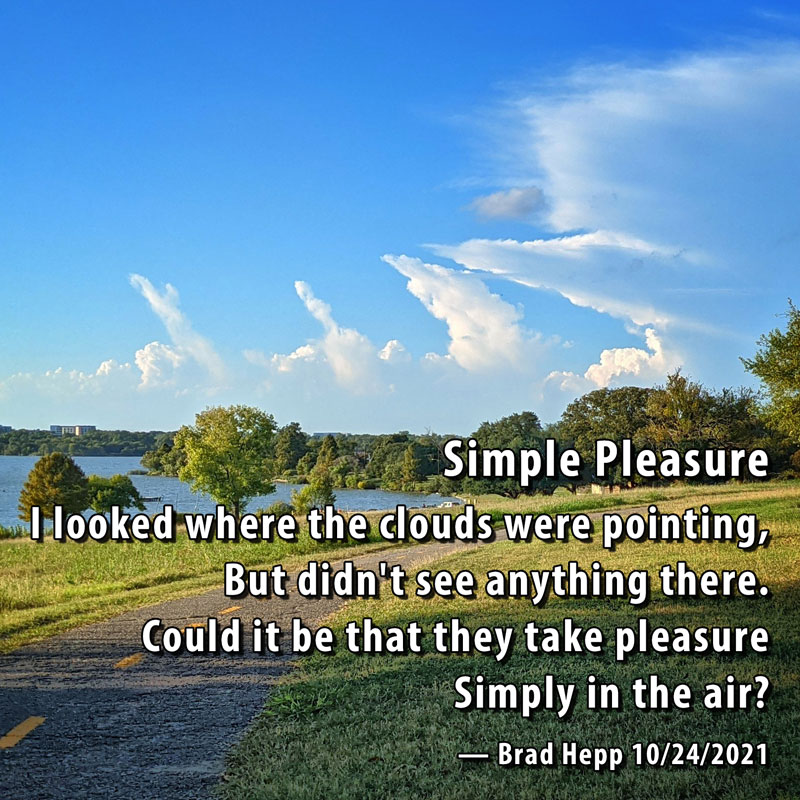
Simple Pleasure

Commentary

There must have been some interesting conditions in the sky over Dallas yesterday. A little after I took this photo of clouds with finger-like extensions, I noticed the formation of mammatus clouds* a little to the East.

So, I wanted to share the photograph, and to confess that I actually looked to where the clouds seemed to be pointing.

Is that silly?
I suspect most adults would have looked for where the lines converged just as I did. But only if they haven’t killed off a God-given imagination and sense of the transcendent. We expect nature to communicate something — for very good reasons.

The heavens declare the glory of God, and the sky above proclaims his handiwork.

Psalm 19:1

Disappointed?
So, I didn’t see a rider in the sky. But the conclusion of my little poem is not anti-supernatural. Rather, it’s based on a notion that creation is continually celebrating the pleasure and provision of a good Creator. Are you? Am I?

Related Poem
I’m not sure HOW this poem is related, but I thought of it when writing the above: “A Meditation.” Also, see “Voice Lessons.”


*From www.whatisthiscloud.com: “Mammatus clouds are formed the same way cumulus clouds are formed, but in reverse. They are formed by sinking cold air that form pouch-like figures as they’re carried into a warmer layer of air, contrary to the puffs of clouds rising through the convection of warm air.”

Sad Pronouncement

Commentary

I heard this put another way: “Hurt people hurt people; we’re all hurt.” Anger displaces far more productive emotions like sadness, sorrow, pity.

The Title: “Here’s a Tip For You…”
We make pronouncements against people. We accuse. We express anger. It would often be better if we recognized that the offender is more to be pitied than resented. We could sadly pronounce them fellow sinners, like us in desperate need of a Savior.

Of course there was another reason I chose “pronouncement.” I wanted to introduce “pronouncement’s” sister: “pronunciation.” This little two-liner depends on the reader pronouncing T-E-A-R two different ways.

Tear Down and Tear Up
I actually had to look up these phrases to make sure I wasn’t confused! Two words are spelled the same: “tear” as in rend, and “tear” as in cry.

Some readers won’t notice that I’m using two different words. They’ll wonder how I’m differentiating the “up” and “down” forms of tearing=rending. Oh well. Maybe there’s something positive about their puzzling. There often is.

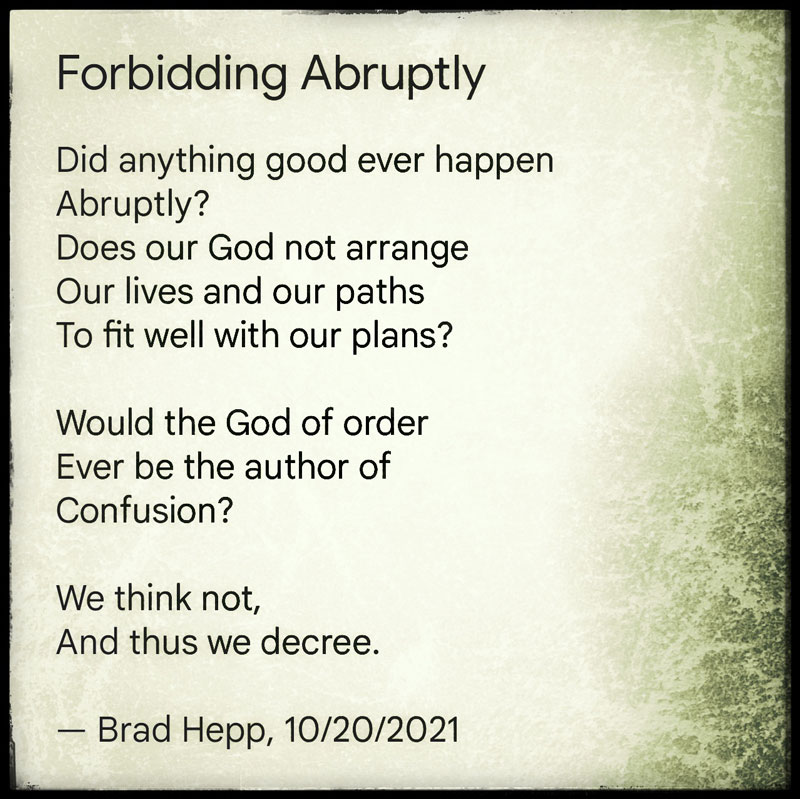
Forbidding Abruptly

Commentary

I keep encountering this notion that abrupt changes cannot possibly be God’s will. I’ve encountered it in others, but also in myself! Run your mind across the testimony of Scripture. Does the notion hold up? I don’t think so.

Abruptly
“Abruptly” has a negative connotation. It’s used when people are inconvenienced. One might say, “Because she changed her mind abruptly, all my careful plans were brought to nothing! I had to scramble!” One would never say, “My fondest wishes were fulfilled abruptly!” So, the speaker of the poem is complaining. His words should be read with a whiny voice. Notice the repetition of “our.” He feels entitled. Finally, he offers biblical allusions as self-serving platitudes.* He’s confused, and a sinner somewhere is surely to blame!

We Think Not
Based on his own thinking — or is it his lack of thinking!? — the speaker arrogantly decrees that nothing can be done abruptly. He speaks for all who consider themselves worthy judges of how life should unfold.

*How often I have heard 1 Corinthians 14:33 used as a proof text supporting mere personal preference!

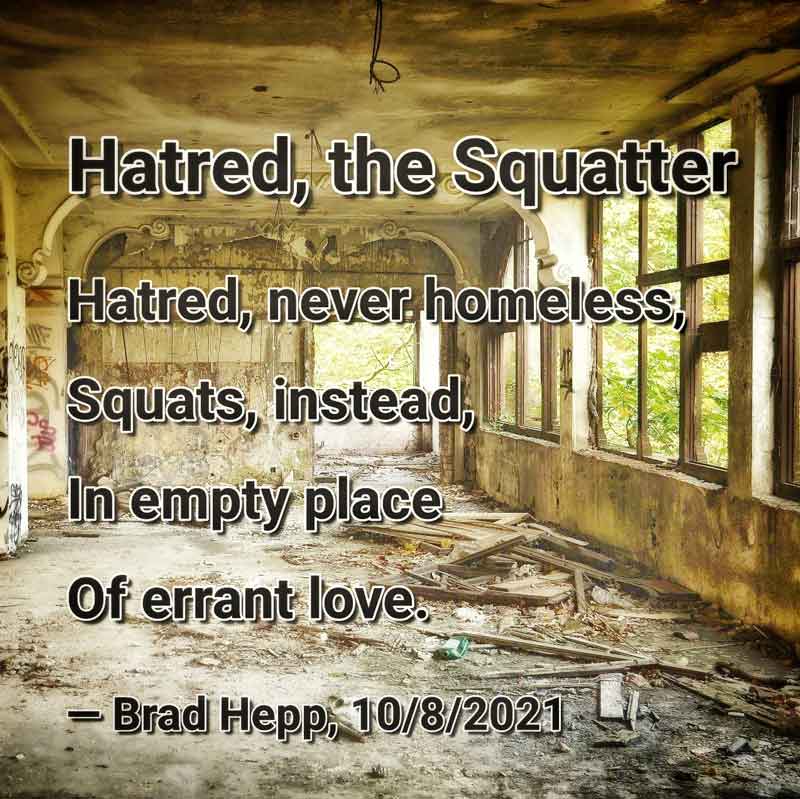
Hatred, The Squatter
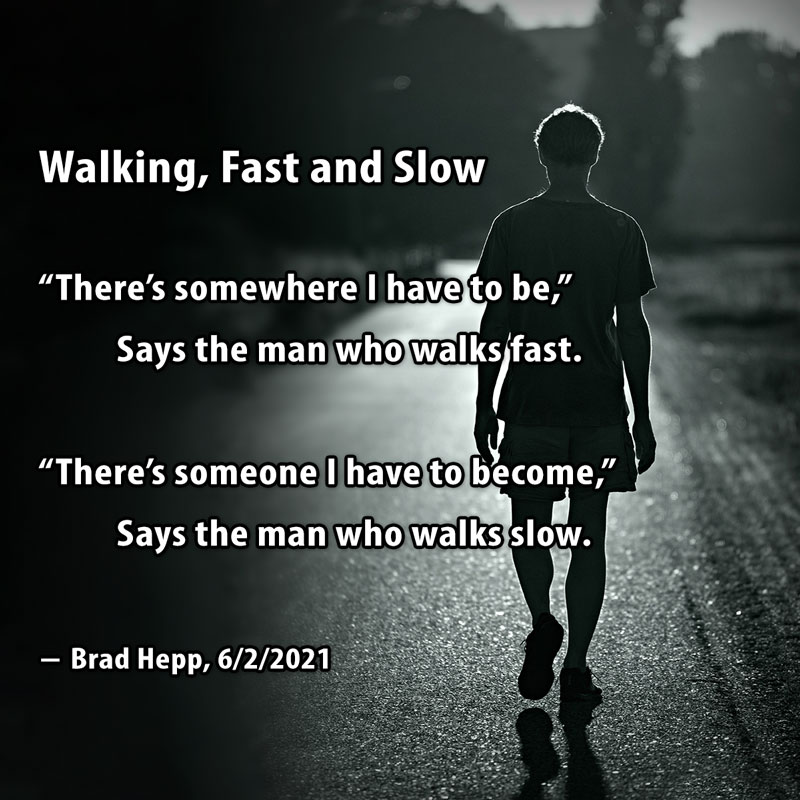
Commentary

I wrote this first thing this morning, after giving up on a restless night. About 2 or 3 am, I woke up, and could tell I wouldn’t be getting to sleep soon. So I used my monthly credit at Audible and downloaded “The End of The Affair” by Graham Greene. That title intrigued me ever since a theologian I respect recommended it to a fellow writer in response to the request, “…name one (and only one) novel that you recommend I should read?” The Audible version has the bonus of being read by Colin Firth.

So, by 7 am, I had listened to at least half of the novel. Admittedly, I dozed off during parts, but a check on synopsis sites tells me I didn’t miss much….

“Errant Love”
This is the only line I’ll expand on in this commentary. “Errant” usually means something like “erring or straying from the proper course or standards.” That definitely describes the illicit affair referred to in the book’s title. I won’t describe that here. In fact, I wouldn’t want to make a regular diet of this kind of material.

But “errant” has a more archaic meaning of something like being “out on an adventure.” When the thrill seeker wanders from home, he vacates his usual place… leaving it empty. Thus, the “empty place of errant love.”

The main character in the book — Maurice Bendrix — says very early on that “This is a record of hate far more than of love.” While I don’t know much about affairs (thank God!), I do know about hatred. I have felt it. I see it, almost daily, in the most unlikely places. It occurs to me that it only takes up residence where love has abandoned its rightful place, or where love is disordered.

The Background Image
The background image (adapted from a photo by Susann Mielke on Pixabay) was suggested by the setting of Greene’s novel: 1944 London, during the German blitz. The V-1 “robot” bombs buzz in from the South and make a mess of Bendrix’s apartment. In the process, they change everything, including Bendrix’s relationship with his love interest, Sarah.

“Change” Poems:

Previous: When Every Hill’s a Place to Die
Next: The Most Important War

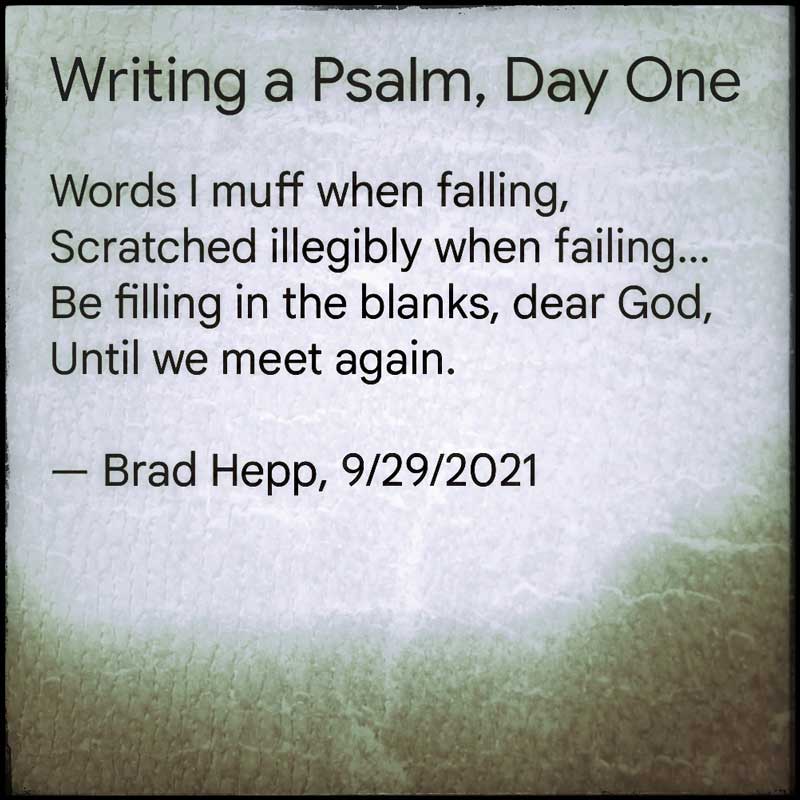
Writing a Psalm, Day One

Commentary

I’m not very good at understanding poetry (feel free to join me in laughing at this ironic weakness). But I’ll give this one a try….

I woke up early this morning, my mind churning about what seem to be intractable problems. I say “churning.” It was not productive thought. It seemed that no matter how hard I tried, I could not state the problems in a way that would suggest solutions. I was flailing: “falling… failing.”
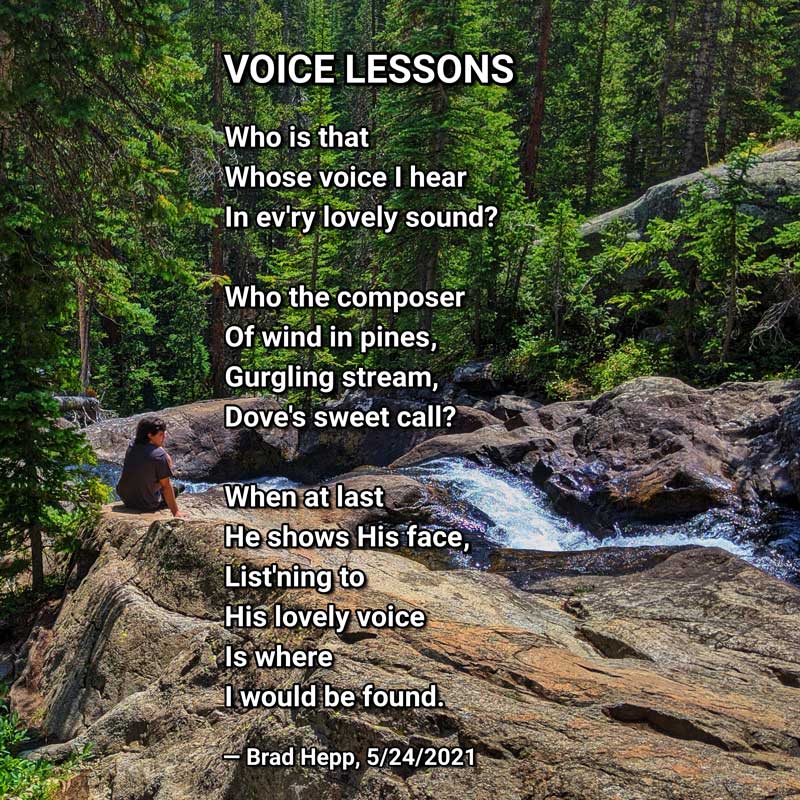
Falling, Failing… Filling
The pictures in my mind as I wrote the first two lines were first of a man falling off a cliff, crying out indistinctly; and second, of a man trapped and dying (failing) in a pitch-black cave, blindly scratching words on the cave wall. In both cases, the words seem to be of no use.

But words are sometimes more useful than they seem. In the writing of this poem, the words “falling” and “failing” led my little poet brain to another gerund: “filling.” Call it serendipity; I call it poetry: following words where they lead. Try as I may to be intentional, sometimes I’m just accidental.

So… “filling.” There was no distance between landing on that word and landing on the phrase “filling in the blanks.” And who could fill in the blanks? Who knows me through and through? Who knows the end from the beginning? God, of course.

Sometimes we simply don’t know what to ask of God. That’s when we’d do well to remember something that’s probably happening more of the time than we realize:

Likewise the Spirit helps us in our weakness. For we do not know what to pray for as we ought, but the Spirit himself intercedes for us with groanings too deep for words.

Romans 8:26

“Until we meet again”
This line may disturb the reader. It’s trite, something we’d say to a mere fellow human. But it gave me great comfort to write the words. God doesn’t require our undivided attention. He generously works in our behalf while we go about our day, and even while we sleep at night:

Unless the Lord builds the house, the builders labor in vain. Unless the Lord watches over the city, the guards stand watch in vain. In vain you rise early and stay up late, toiling for food to eat—for he grants sleep to those he loves.

Psalm 127:1-2

Writing a Psalm, Day One
Since we can finish reading most Psalms in a matter of minutes, it’s tempting to imagine that the Psalmist went through the experience he describes in the same short amount of time. But it seems more likely to me that the Psalms are a record of what happened over several days, or even months. The first few verses of a given Psalm may describe what the Psalmist was struggling with in summer. The last few verses may describe the joyful resolution that came in autumn.
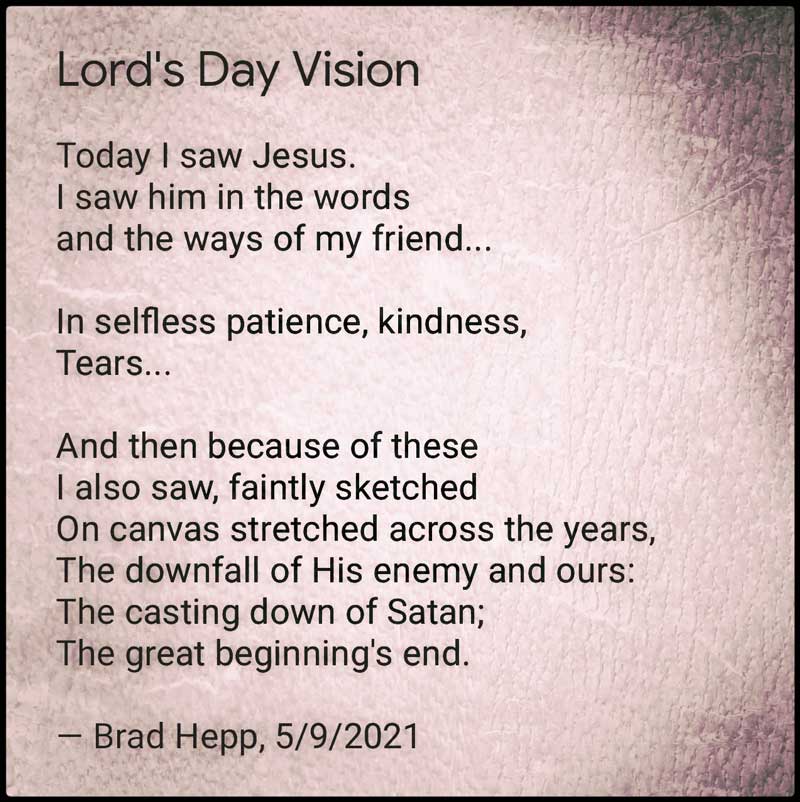
My intractable problems? Perhaps they’ll be solved tomorrow, or next week, or next month. Then I can finish the Psalm.

Imagine If At Night

Commentary

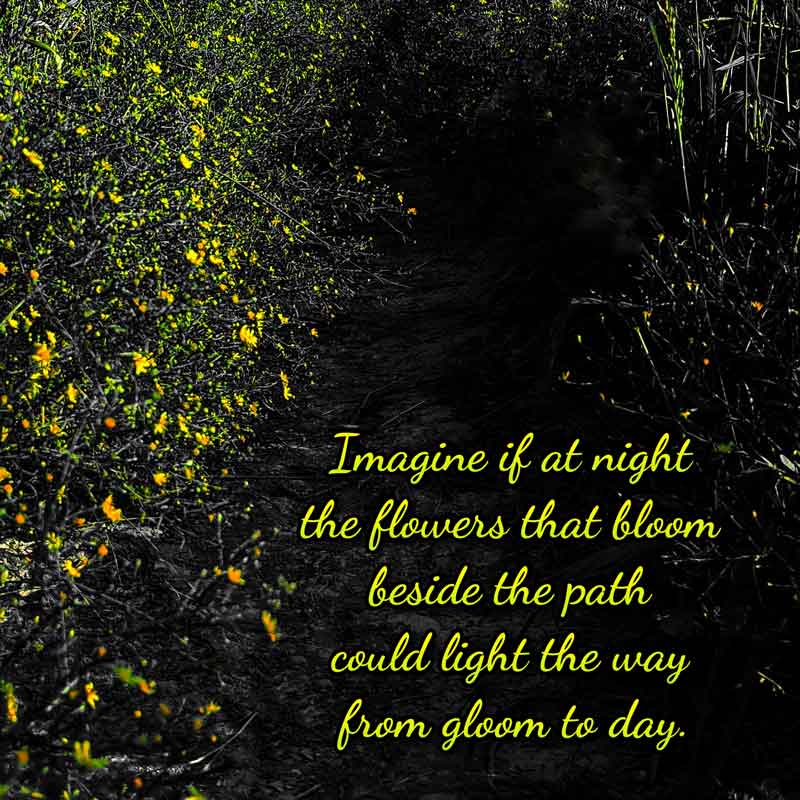
I’m not aware of any deep meaning in this.* I had taken a photo of broomweed by the path and began editing it, trying to help the viewer see the yellow flowers standing out as much in the photograph as they did in my eye. Stereoscopic vision is a magnificent gift. With it, we isolate objects from their background. Flowers stand out from foliage. That’s what we SEE. But most photographs fail to convey their subject in three dimensions — photographic images are flat.** In this photograph, there was little separation between the yellow flowers and the green foliage, especially in the yellow light of late afternoon.

So…. I was editing. And the more that I edited, the more I isolated the yellow flowers from their background. Eventually, I pushed all but yellow to black. That’s when I thought of the line, “Imagine if at night….” Phosphorescent flowers…. Wouldn’t THAT be something?!

THE ORIGINAL, AND A MEMORY
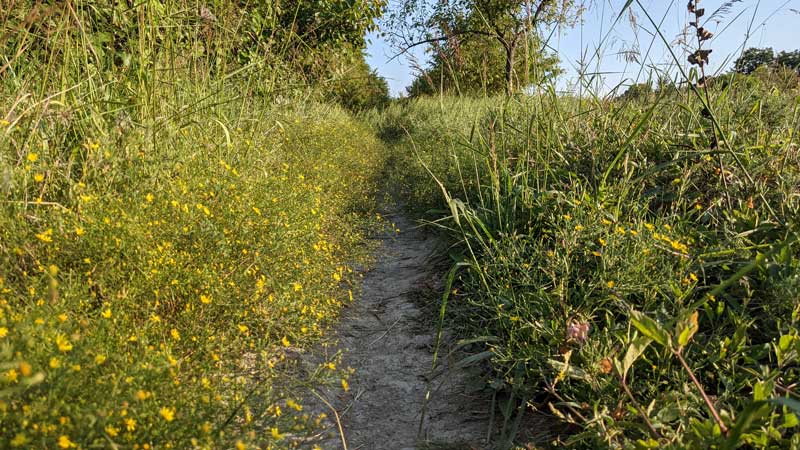
Below is the original photograph. And here’s a memory about broomweed:
When I was a teenager, I got to help the gardener at a camp I was working at in Mexico. One day we drove to the other side of the lake where Cayo gathered stiff little bushes that we fashioned into brooms and rakes. I recall that they worked better than the store-bought ones.
The original photo

*On the other hand, one could easily make the case that all beauty in creation illumines our path to understanding a beautiful Creator.


**Incidentally, this is part of why I insist that in editing photographs, “you have to lie to tell the truth.” That is, you have to lie about what the camera captured in order to tell the truth of what our magnificent vision captured.

How We Became the So-So Cake-Eaters Club

Background Image by Christel SAGNIEZ from Pixabay

In the glory days, we called ourselves The Better Batter Beaters. We were the best cake club in town. That was back before Betty and Beatrice got all humble on us.

Betty’s cakes were to die for… without fail. But then, Betty up and quit. “That’s it,” she said. “This cake-making is a source of pride I really must live without.”

Beatrice was our best judge and critic. “That cake is not as good as Betty’s” she’d say. “You need a better butter.” And Beatrice was always right. We’d bring our always-inferior cakes, and Beatrice could always identify just where we’d gone wrong. But then Beatrice came up with some nonsense about “taking inordinate pride” in her role as the Better Batter Beaters’ chief critic. “No more!” she said, “From now on, I’ll just eat cake. No more judging!”

Naturally, things went downhill. When we get together these days, we just eat so-so cake with our so-so coffee and talk about our so-so lives. Even Betty and Beatrice tell so-so stories.

All this mediocrity has me thinking…. Maybe we should start a Stellar Story-Tellers Club! That’s something I could really sink my teeth into! Who would serve as club president? I’d proudly run!

— Bouche Grande, 9/21/2021

Can you tell this is self-deprecating? It is!

Ledge of Gratitude

Commentary

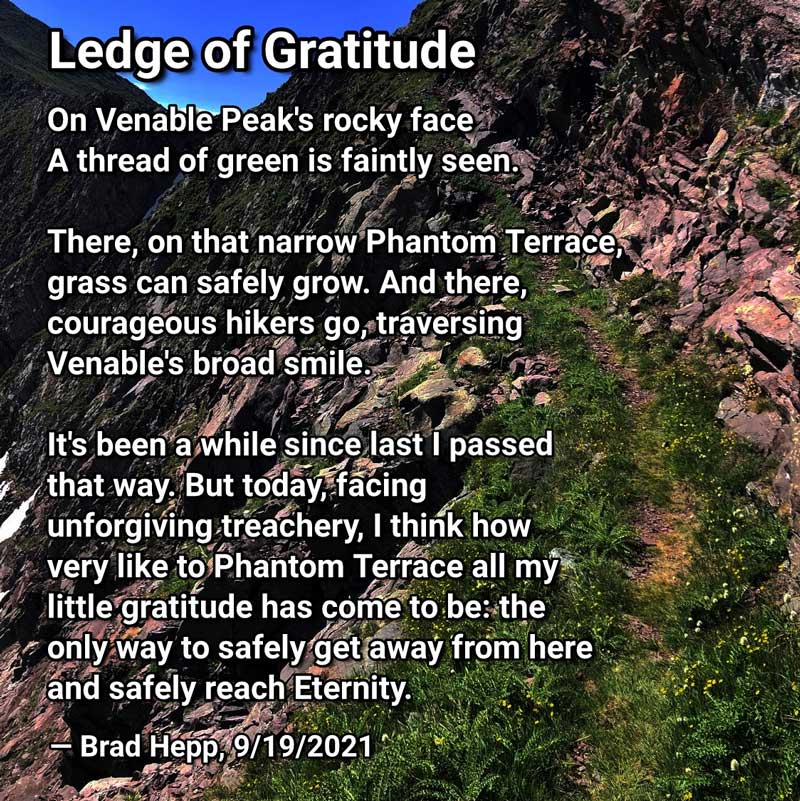
When I sent this to a friend, he said “I have questions.” Yes. I imagine that this “poem” raises questions. Perhaps my friend has more questions than the ones I’ll try to answer here….

First, let me include what I wrote on social media when I posted this, along with the hashtags:

The Phantom Terrace is a real place. I’ve been there. And gratitude’s a real grace. I’ve been there too. Both are narrow ways.
#remembrance #gratitude #hope

As you can probably guess from the hashtags, this is more about the positive emotion of gratitude than it is about other, negative emotions.

Don’t read too much into the first two stanzas. I was mainly establishing the setting of a real place. One thin line of grass, growing on the ledge, stretches from one side of the mountain’s rock face to the other. Thus the “smile” imagery.

There’s a lot of ambiguity in the third stanza. The greatest ambiguity is in the phrase “unforgiving treachery.” Traversing the steep face of a mountain — even on a ledge like the Phantom Terrace — is treacherous. One slip and the fall could be fatal. It’s treacherous terrain. That is an unforgiving treachery. So, in one sense, it refers to the real danger of a real place.

“Unforgiving treachery” could also refer to what we experience interacting with fellow sinners. I was especially low when I wrote this. I was thinking about how little I can rely on some people some of the time.

“Unforgiving treachery” is also a backwards way of referring to how I can be unforgiving, and how treacherous that unforgiving attitude can be.

Regardless of what “unforgiving treachery” refers to, it is dangerous. But when I think of things and people for which I’m grateful… there is safety in that emotion. Today, I was grousing to my wife about the many disappointments I had experienced in the last 48 hours. She was patient. She let me grouse. But all that grousing was unproductive. In the midst of my complaints I did remember a fellow who this very morning demonstrated thoughtfulness, patience, kindness, reliability: Joe. What an uplifting thing to think of that brother’s attitudes and actions! Being grateful for him is definitely NOT a treacherous emotion. It gives me hope. It gives me incentive to persevere, to myself become more thoughtful, more patient, more kind… even more reliable. In short, gratitude is an emotion that safely takes me from this place of anger and disappointment to the place I long for: the fulfillment of Jesus’ intentions for us in Eternity. Gratitude is a long Phantom Terrace. Thank God it’s there!

NOTE: I did not take the background photo, but “borrowed” it from a website. If/when I publish this in a book, I’ll need to get permission to use it. Or maybe I’ll just drive up to Colorado and take my own photo of the Phantom Terrace.

PP. AS IN PNEUMATIC PTERODACTYL

I just heard Susan telling someone on the phone that our last name is spelled with two Ps, “as in pretty.” I sure am glad that works for her.

Once, when I was buying running shoes at Luke’s Locker, I told the ladies behind the counter, “That’s two Ps, as in ‘pneumatic pterodactyl’.” One of the ladies, my equal in smart aleckry, shot back: “You just don’t want to say ‘peepee’.”

I guess not. Shame is a silly game.

By the way, SHAME is something I am starting to learn about. Several people whom I respect have pointed out that this is important to understand as we try to help people who are struggling emotionally. So it isn’t all silly.

Master of None; Mastered by One

Commentary

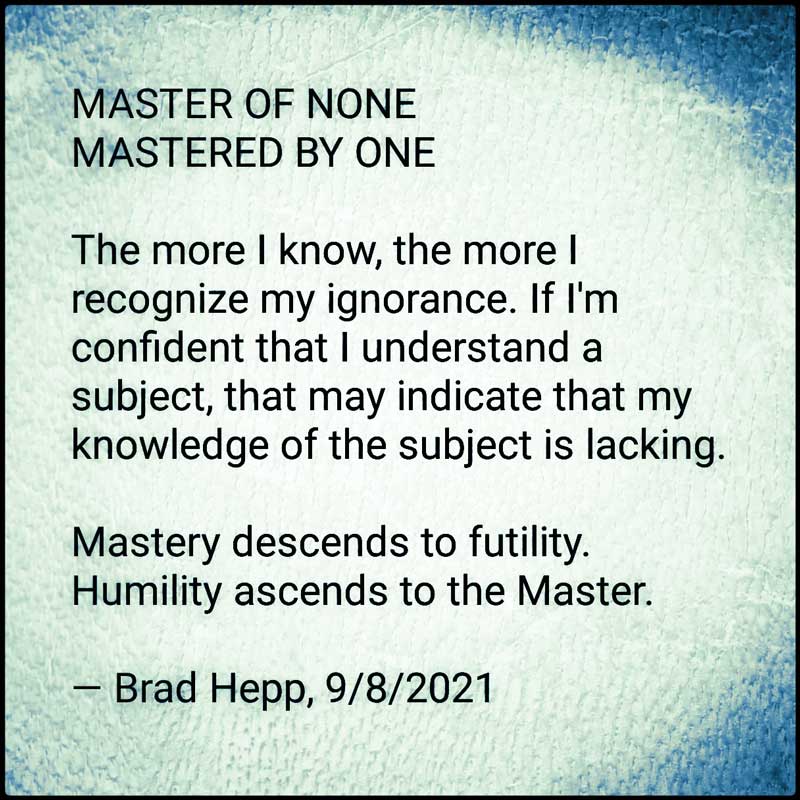
The morning that I wrote this, I had read a post on the meaning of “headship” in the Bible (https://juniaproject.com/5-myths-of-male-headship/). The subject of egalitarianism versus patriarchy or complementarianism is one of several that I am revisiting now that I recognize how much my thinking has been tainted by selfishness. I haven’t changed my opinion yet, but I’m more prepared than ever before to do so, if the evidence pushes me that way.

I RECOGNIZE MY IGNORANCE
Anyway, while the article was well written, some of its greatest value was in the — mostly — intelligent and respectful debate carried on in the long comments section. I have enough training in hermeneutics and linguistics to recognize when someone else has far deeper knowledge than I do. Several such people showed up in this conversation. All the years I have spent learning about language… and still there are people whose expertise makes all my learning look like so much Play-Doh.

IF I’M CONFIDENT THAT I UNDERSTAND
One fellow in the comments basically said, “You’re wrong little woman. You don’t know much. I’m an expert. Now shut up.” To the extent that I ever respond with such hubris, may God have mercy on me. May I always remember how foolish that little, little man appears.

DESCENDS… ASCENDS
When I recognize my limitless limitations (the futility of mastering anything), the appropriate response is to acknowledge that my Savior and Master is all-wise, all-knowing, and all-good.

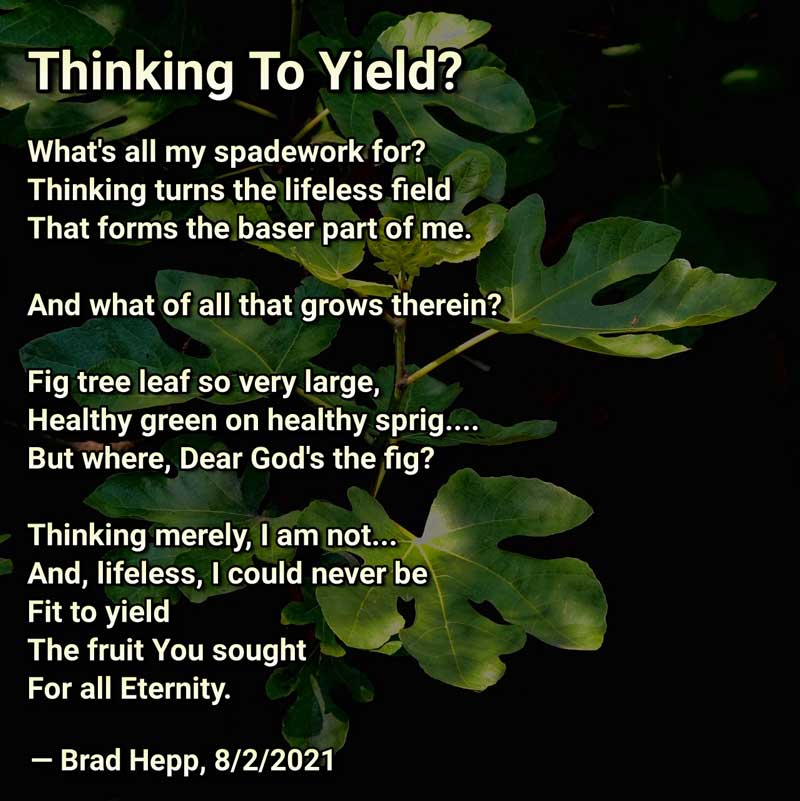
Thinking to Yield?

Commentary

Let me try to recap this in one sentence: Instrospection and merely thinking about doing right don’t bring about the purpose for which God created us.

“Lifeless Field” and “baser part”
Prisoners on death row are sometimes spoken of as “dead men walking.” They’re still alive, but they’re headed for death. Because of our belief in Resurrection of the body and of “progressive sanctification,” we Christians could refer to ourselves as “resurrected men walking.” Jesus isn’t through removing deadwood, cultivating the otherwise sterile soil of our hearts just yet. For now, we’re still partly dead, but we’re headed for thorough life, especially when we experience the Resurrection that Jesus experienced after His crucifixion.

Counseling
These days, I’m working with a counselor to help me understand why I have been an irritable man most of my adult life. The work I’m doing now could be compared to using a spade to turn over the dead parts of my life: my disordered affections and stupid coping mechanisms. The aim is to replace irritability with joy and equanimity.

But if I were of the opinion that merely THINKING about what needs to change, or “getting my head on straight” would effect the desired change (“the fruit”), I’d be mistaken. Only God can breathe life into dust and bring it to life.

My counselor has twice suggested something that would really turn away a person who doesn’t believe in God’s active work in our lives. He has said that God seems to have arranged human relationships in such a way that all our attempts at peace and reconciliation lead us to the realization that OUR ATTEMPTS won’t work. We need God. We need the Holy Spirit. We need His intervention and His life-giving work in our lives. At least that’s how I’m understanding the counselor at this point. In one sense, I’m paying the counselor to help me understand that counseling alone is worthless.

“Fig tree leaf so very large”
I’m an elder in my church. It’s a position of esteem and responsibility. It suggests that I am spiritually mature. If I were compared to a tree, one might say that I SEEM to be healthy. But appearance isn’t everything. Who am I really blessing? Who do I comfort? Who do I inspire? Who do I correct? What do people learn about Jesus by looking at my behavior? Just yesterday, I asked one of our deacons to pray for me: “Pray that I’ll actually spend time with people.” No amount of merely thinking right and diligence in administrative work will achieve what God intends for me to achieve: the fruit of being/looking more like Jesus and helping others to do the same.

And then, of course, there’s my family… my wife and boys. Am I blessing them? Or do the dead parts of me — my baser parts — just bring misery to them? Thankfully, they’re walking together with me in this journey.

(background image by Schwoaze on Pixabay)

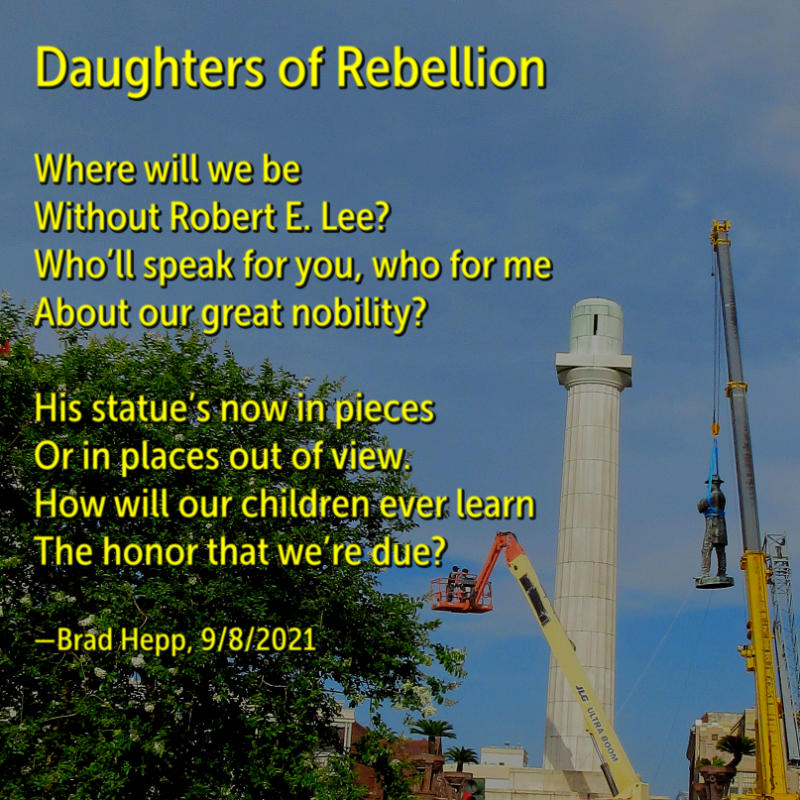
Daughters of Rebellion

Commentary

This one is likely to lose me some “friends.” It is sarcastic and appeals to a sense of justice that not all share.

Whenever I see the complaint that removal of Confederate monuments will result in people not being able to learn history, I just about lose it. People who object to removal of Confederate monuments would NEVER object to the removal of statues to Saddam Hussein in Iraq. Those people would NEVER have said, “If our Marines take down statues to Saddam Hussein, how will the Iraqi people learn history?!” Why would they appeal to the “history” argument in the one case, but not in the other? Ask them. I suspect that if they’re honest they’d tell you that they’re proud of their Confederate history. In my opinion, they should be ashamed of it.

I used to defend the “States’ Rights” cause of the South.* Regardless of the extent to which States’ Rights was the real motivation for the South’s rebellion, it doesn’t fly with me anymore. RIGHTS. First of all, that’s not what followers of Christ should dedicate themselves to obtaining or retaining for themselves. See Philippians, chapter 2. In Augustine’s “Confessions” he asked, “How do I know that God is changing me, that I have made progress?” His answer: “I have learned to give up my rights.”

Securing rights for others? Well that’s surely more justified for the follower of Christ. But in the case of the Confederacy, the “rights” that the Rebels fought for was the “right” to enslave, to oppress. That’s certainly not the kind of right a follower of Christ should secure. No, that “right” is just wrong.

This poem was prompted by today’s headlines.

*”States’ Rights” is something I still hold to at a conceptual level in that I prefer decentralization of power. But when decentralized power uses its rights to cause harm (e.g., slavery), something higher kicks in. How would one define that higher principle?

“Change” Poems:

Previous: Please All-Powerful God
Next: Reductionist

Waiting, Not Alone

Commentary

When I woke up this morning, one of the first things I did was read a post from someone I follow on social media: Daniel Hanson. As is often the case, Daniel’s post was long. As is always the case, his post was intellectually stimulating, largely because it was intellectually honest. Daniel struggles with depression.

Daniel drew on the painful experience of several remarkable people: Robert Frost, W.H. Auden, Mother Teresa, T.S. Eliot, Robert Browning, the prophet Habakkuk. The leading quote was written to him by his personal friend, Michael Novak: “Often enough, faith leads one to feel abandoned to darkness, isolated in inner dryness, undermined by a fear of having been seduced into an illusion. It is not at all hard for a person with faith to understand why one would walk away.” Daniel then told one of the stories that explain Novak’s “particular brooding depression.”

So, Daniel would conclude, “I know that I am not alone in these feelings. I know that others carry the weight of staggering pains that every day threaten to make them stumble and fall.”

As I processed what I had read, I thought especially of Michael Novak and Mother Teresa. Michael Novak spoke hopefully of suffering as a “sign of spiritual adulthood.” Daniel quoted Mother Teresa as saying “how sweet and merciful is the lord” despite being in “the place where she must only wait — a place where no hope would appear.”

My mind turned to this very short but very long (“so close to/Here so far from”) wait for resolution. I pictured Mother Teresa in a doctor’s waiting room like the one I recently visited, and set out to write this poem.

THE LAST LINE
The last line is ambiguous. In what sense are we not alone? Other mortals experience the same grief we do. Knowing that brings a little comfort. But some of them point us to a greater comfort: the Immortal One stepped into our experience of time and space and suffered with us. Jesus personally understands grief. Moreover, He is willing and able to effect all necessary change, to bring relief.

False Flourishing

Commentary

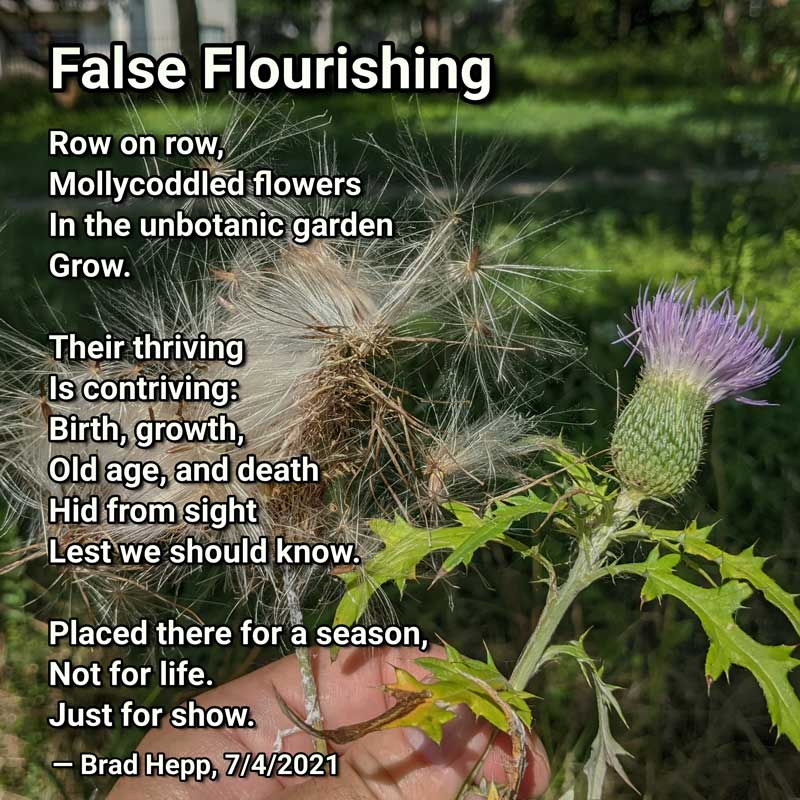
The photo in the background of this poem is of two stages in the full life of a thistle. On the right is the bloom that people admire. On the left is something less admired… what the same bloom will look like when it has gone to seed, and the wind begins tearing it apart.

This full life cycle is something I have been observing on my long walks. One late-summer day, I was lamenting that there were no more flowers to photograph. Then, I began looking more closely at the seeds that those flowers had produced. Their shapes, textures, even colors are every bit as fascinating as — and far more promising than — the blooms that preceded. Nowadays, while I enjoy walking with my wife at the Botanical Gardens, there’s something sad there about not seeing this great achievement of flowers: their seed.

Flourishing
This poem arises from something I have been considering lately: the nature of flourishing. What does it mean to thrive, to prosper, to flourish? Here’s one hypothesis…. Flourishing is wrongly viewed as a short-term concentration of obvious vitality: the plant in bloom, never gone to seed; a dash, not the trek of a million miles; something exhausted in 80 years… or even less, in a life ‘cut short.’

I recently watched a conversation between Miroslav Volf and David Brooks. A friend had referred me to Volf’s “Joy and Human Flourishing,” in response to my question, “Who does a good job of tracing the concept of ‘flourishing’ through the Bible?” If I understood Brooks correctly, he objected that Volf needs to better account for suffering as a possible component of flourishing. That objection resonates with me.

In the Genesis 1 account, the first organisms are created on day three. Notice the prominence of “seed” in their description:

And God said, ‘Let the earth sprout vegetation, plants yielding seed, and fruit trees bearing fruit in which is their seed, each according to its kind, on the earth.’ And it was so.

Genesis 1:11

We tend to be so fixated on the blossom that we ignore what comes as a result: seed. But it was in reference to “plants yielding seed” that “God saw that it was good.” Who can seriously say that the thistle, gone to seed, then torn and scattered by the wind is not flourishing?

What’s Next?
Where I seem to be going with this line of thought is that true flourishing requires eternity.

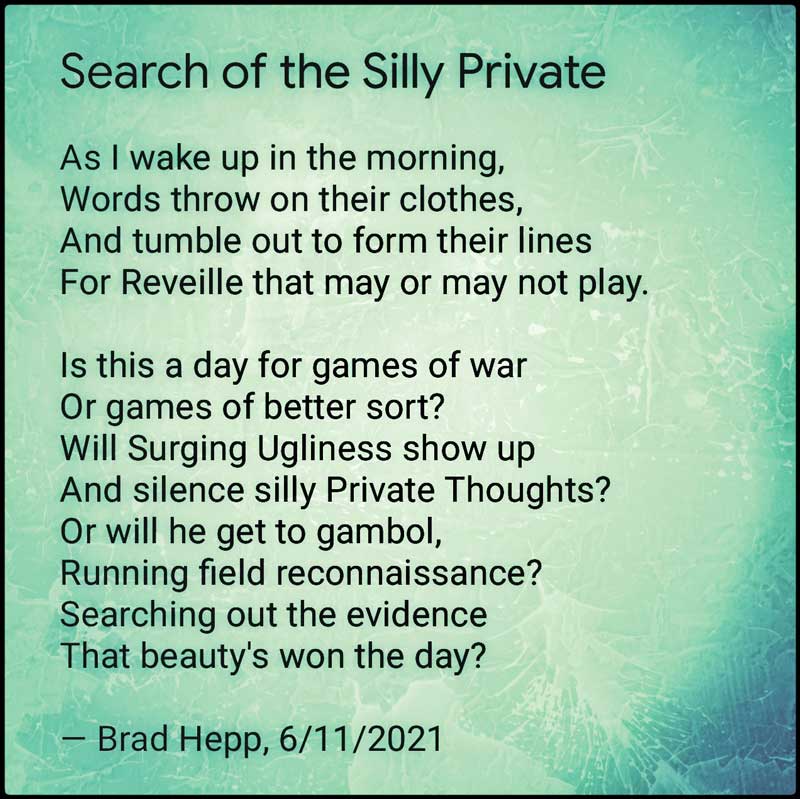
Search of the Silly Private

Commentary (needs work)

This poem is a defense of how I often wake up in the morning. My brain starts the day by trying to dress thoughts in presentable words. The thoughts may be silly. They may be as bizarre or disordered as the dreams from which I woke. But I clothe those thoughts with orderly words: poems, if you like.

“Surging Ugliness” is like a sergeant who barks out orders, the duties of the day. He isn’t interested in the silly private’s search for beauty and meaning. I mistakenly thought that “sergeant” was etymologically related to “surging” (my French isn’t that good). Nevertheless, “surging” does suggest the nature of a real conflict, a real battle between ugliness and beauty. We’re easily fooled by which of these combatants is winning. Beauty seems often to be overwhelmed by surging ugliness. It takes careful reconnaissance to find the truth. Sometimes it takes the silliness that I call poetry.

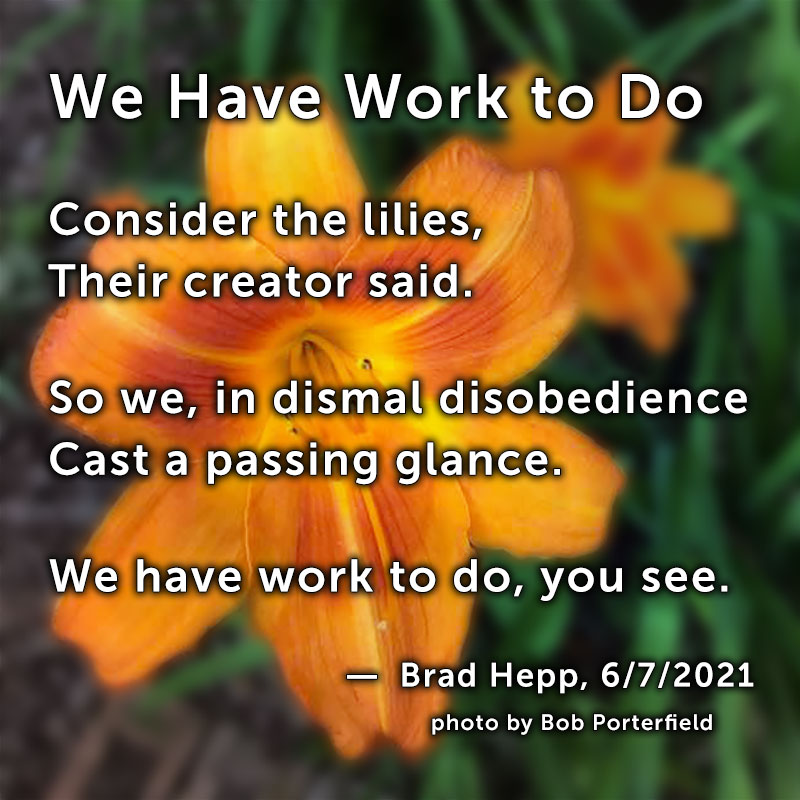
We Have Work to Do

Commentary

The final line of this poem is intentionally ambiguous. First, it could serve as an excuse: given the amount of “work” we have to do, there is little time for the leisurely activity of “considering” things like flowers. Second, it could — and does — serve as an indictment: the “work” most of us really have to do is work on our own hearts, being more obedient to God. He instructs us to be reflective, but we often are not. We’re too busy to take a few hours of the week — much less a whole day — to cease from labor and gain new perspective. You see?

So, have you ever stopped to consider the lilies? Do it! Look not only at how they bloom, but how they grow, and how they prepare for new growth when the bloom is spent. Pick off a spent blossom and untwist the drying petals. Ask yourself why they twisted. Are they protecting something precious? Or is ugliness all you can see?

September 14, 2021… A friend told me today that his friend, Dr. Carisa Ash, had passed away at a young age. I didn’t know her, so I looked her up, and found this video. Carisa got it. I look forward to meeting her.

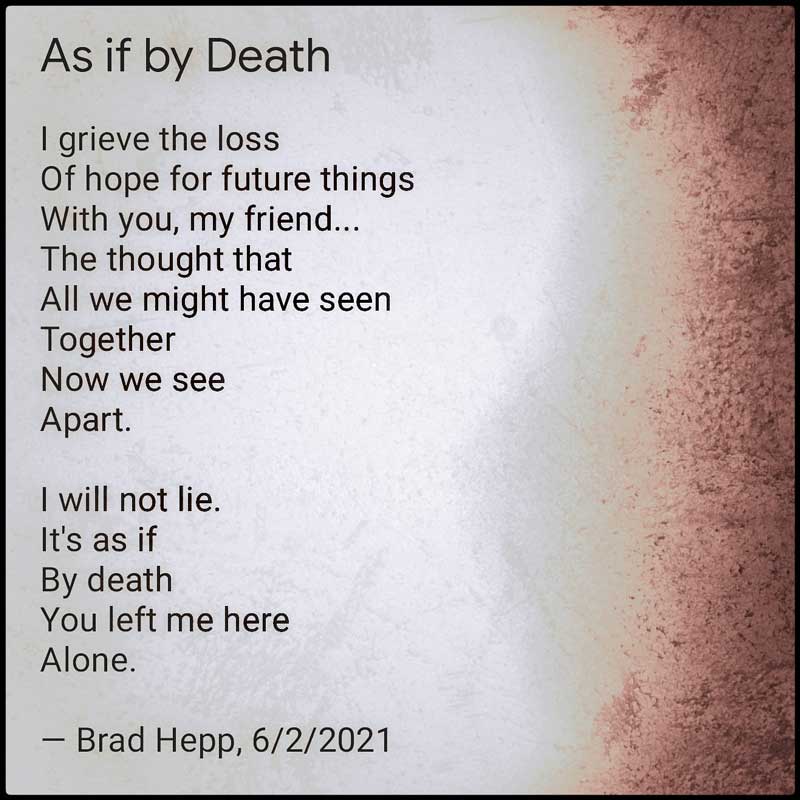
As If By Death

Commentary

This poem is a companion to one I wrote almost a month ago. It arises from a growing recognition of what it means to continue serving in a ministry when a close partner in ministry has left. What’s true in this case is probably true wherever close friends work together on something difficult and then one of them leaves. Picture soldiers in war, or parents in the child-rearing years. Even triumphs that follow that separation can feel hollow.

TWO INTERPRETATIONS
From the introductory paragraph, and from the way that I recorded the poem, it should be clear that “as if” introduces a comparison to a death that has not actually occured. It just feels like death. Going separate ways feels especially like death when the friendship is deeply valued. I’d guess most of us experience only a handful of such friendships in our lifetimes.

But the simile gains its power from something we all experience: the loss of friends and families through actual death. So, if it helps you draw out an emotion, read the poem in that second way. Turn it on its head. Let the “as if” introduce a comparison of actual death to abandonment. When a loved one dies, do they leave us alone? It’s as if they do! They’re gone for now. We need to acknowledge that emotion, to be honest about it, even if we live in hope of the Resurrection. One comfort of that hope is this: if stories of what we experience while separated by death are worth remembering and relating, I imagine we’ll be able to share those stories hundreds — or billions — of years from now.

AN EXAMPLE OF THE SECOND INTERPRETATION
Over the last two years, I have grown in the direction of kindness, something I pray for almost daily. God is using current events to soften my unkind heart. I have come to care for things that I didn’t care for in years past, and to not care for things that I cared for too much in years past. In this process, I often wonder how my father would have responded to the same current events. Would he have grown bitter, as I see some growing? He was making progress — looking more like Jesus — right up to his death in late 2016. Had he still been living, would we have seen together what I now see alone? I imagine so. But because he and I share another Friend, and because that Friend secures our eternal life, we may some day look back together on what we now see apart. Oh, the stories that — reunited — we’ll share!

Eternal life. That’s my hope. Is it yours?

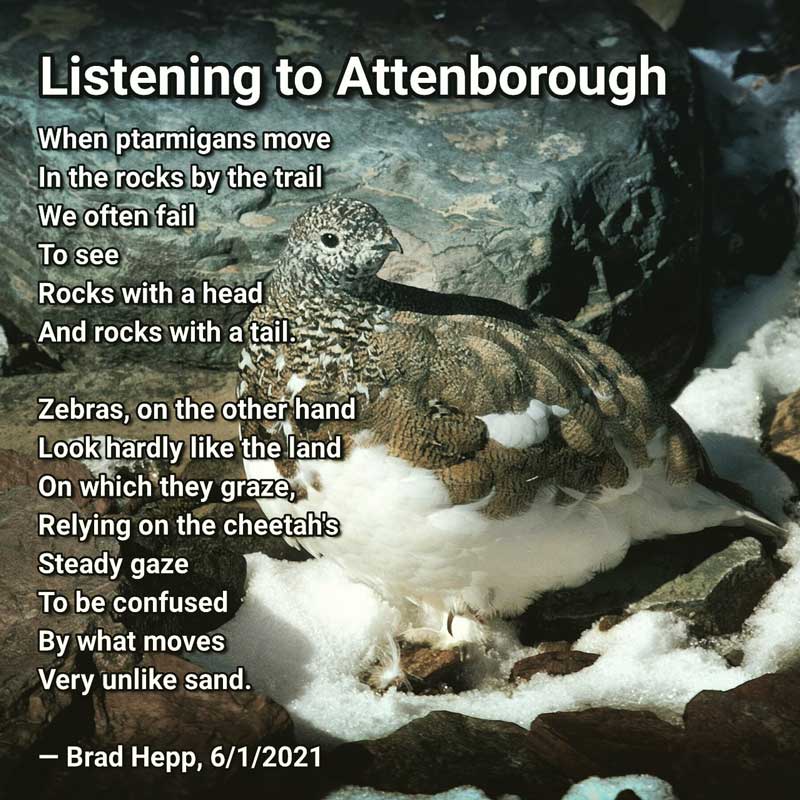
Listening to Attenborough

Commentary

This is my second silly poem in one day. When I was young, that’s the only kind of poem I wrote.

The inspiration was watching one of the beautiful nature documentaries that David Attenborough put together. While I have never seen Zebras in the wild, I HAVE seen — or barely seen — ptarmigans on mountain climbs in the Rockies. It’s amazing how close you can get to these birds before you recognize that they are birds, and not just rocks!

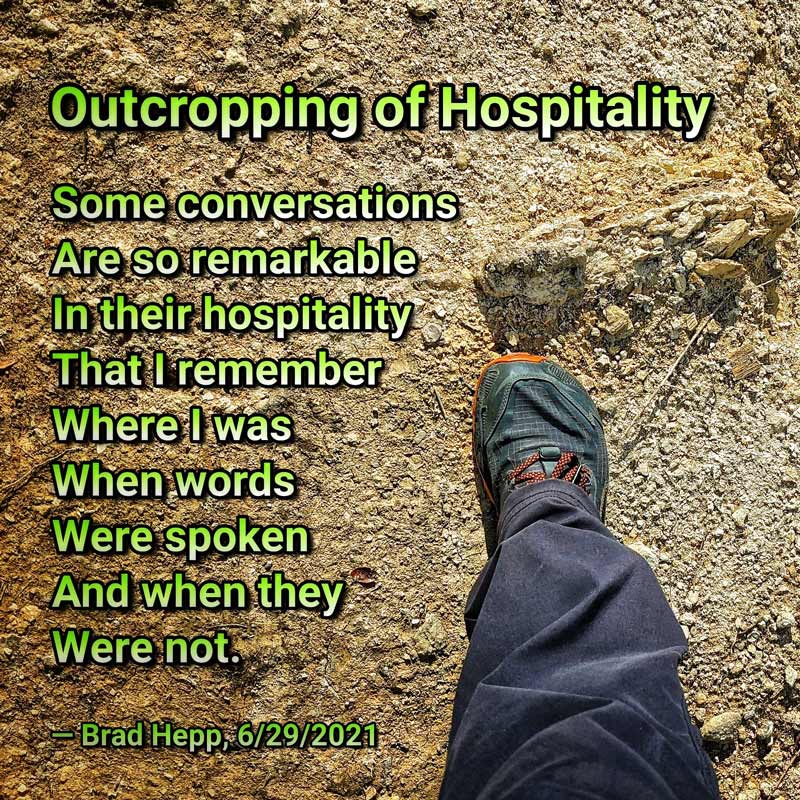
Outcropping of Hospitality

Commentary

About four miles into my hike, I called one of the ladies in our church. I rely on her for advice.
“Do you have time to talk?”
“Yes,” she answered.
For the next two miles, we talked about hospitality. By the time I reached my half-way point, we had thought through several options for how our church can practice hospitality in this lingering pandemic. We wrapped up the conversation.
“Thanks,” I said, hung up the call, and began retracing my steps to home.

As I walked, I reflected on how hospitable my friend had been to me in our conversation about hospitality. “Here, where the weeds give way to a mowed meadow… it’s one of several places in the path where she suddenly grew silent, yielding to my impetuous mind.” There, where rainwater recently rushed through the grass, “I was babbling, while she listened politely.” Up the white rock path a ways, I remembered what solid footing I felt when we shared a memory of Amor Towles’ A Gentleman in Moscow. There, where petrified wood sticks out of the limestone… “That’s where I was stepping when she recalled how Count Rostov arranged the seating at dinner parties, thus insuring a perfect evening for everyone.”

These weeds, that grass, this petrified wood in a limestone path…. Insignificant, except when they mark moments in a good conversation, an outcropping of hospitality.

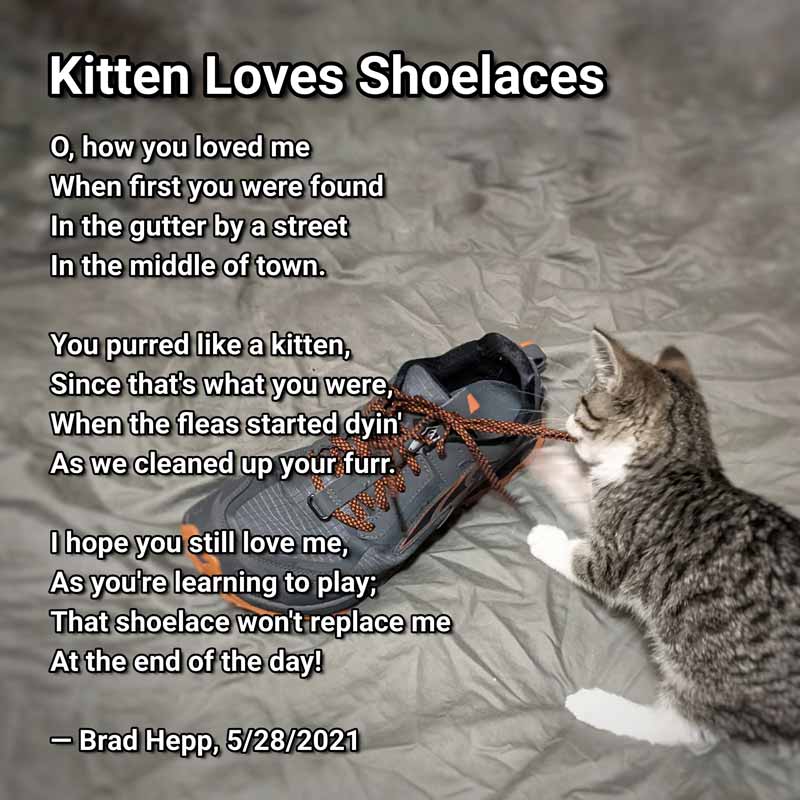
Kitten Loves Shoelaces

Back in late May, Joshua rescued a kitten that he found on Ferguson Road. Here’s what I wrote a day or two after:

Jonathan promptly renamed him Furrgie. I’m going with Furrguson. So far, he understands that friends check you for fleas, and that purring melts hearts.

As the days and weeks passed, Furrguson seemed to forget all about his “early life.” He got his first kitten vaccination. All the fleas are gone, and he is fattening up. Now he pounces on anything and everything, often terrorizing the older cats despite their hissing and powerful bat-downs. But when he has expended all his kitten energy, he does still like to curl up as close to our faces as possible. He purrs his little heart out, and occasionally reaches up to gently touch our lips or noses with his velveted paws.

Voice Lessons

This poem comes out of struggling with what constitutes love for the Creator. Is it only fixation on signs of his return? Will we even recognize his voice then if we cannot recognize it now?

[NOTE: the following may be gobbledygook. Perhaps I’ll wake up early tomorrow morning and do major edits to the post, or even take it offline. That occasionally happens. Let’s just say for now that I’m “thinking out loud.” I’m trying to put words to something I sense more than understand]

Not Just an Expression

Nature expresses the majesty of the Creator. King David spoke of that in Psalm 19:

1 The heavens declare the glory of God;
the sky displays his handiwork.
2 Day after day it speaks out;
night after night it reveals his greatness.
3 There is no actual speech or word,
nor is its voice literally heard.
4 Yet its voice echoes throughout the earth;
its words carry to the distant horizon.

Creation and the Creator are not the same thing. That would be pantheism. HOWEVER, let me suggest that creation bears the same relationship to God as the soundwaves of speech bear to the speaker: they are his expression. When a child hears her father say, “I love you,” she doesn’t look around and say, “How curious… sound waves emanated from somewhere and landed in my ears.” If she separates the sound waves from the speaker at all, it’s only to say, “Those sound waves tell me that Daddy loves me.”

Nature expresses the majesty of our loving Father. Perhaps it would be better to say that in creating the universe, our Father spoke to us, He expressed his glory (intelligence, kindness, power, beauty, love), and creation is the “sound waves” of His voice.

Are we impressed by what He has expressed? That’s not an idle question.

“They’re Just Flowers”

Long ago and far away, I accompanied two friends on a long hike. Our path entered and followed an arroyo. At one place the walls of the arroyo were covered with tropical flowers. “How beautiful!” said one friend. I agreed. “They’re just flowers!” said the other friend. To this day, I think of that second friend’s response with pain and sadness. God’s beauty was there speaking to us in those flowers, expressing His powerful love. But the second friend was not impressed. He seemed to make no connection between creation and the Creator, between the expression — the “words” — and the Speaker. For him, it seems, Daddy wasn’t saying “I love you.” It was just flowers, random sound waves from who knows where.

RELATED POST: The Day Trees Became Weeds.

Lord’s Day Vision

As I catch up with posting my poems on this blog, here’s one that I am especially eager to get “out there.” It was written on the day that my dear friend announced that he was resigning as our senior pastor. I had known for a couple of days that this was coming. I knew it was going to be painful. I knew that my friend would have other duties on that Sunday. It was Mother’s Day. This day was not all about him. In his typical humble fashion, he carried off his duties for the morning with graciousness. Then, at the end of the service, after he had concluded by announcing his resignation, I and the other elders stood with him and his wife on the stage and prayed for them. The tears came at last — I was close enough to see. And since I know what lead up to this resignation, it was especially painful for me. Here and there, my friend made strategic errors as a senior pastor. WHO DOESN’T?! But any such errors were dwarfed by his faithfulness to God, by all he had put in motion to make our church a place where shepherding and spiritual growth really happen. Let’s just say that two years of extremely painful personal circumstances were exacerbated by the pandemic and a handful of implacable opponents who made my friend their lightning rod.

My pastor’s benediction that day was the old Anglican “Go into the world in peace….” That afternoon, I took a long walk. This poem came to mind as I walked. Here’s how I introduced it on Facebook:

This poem was the fruit of a tearful Sunday walk. It refers to real friends and real expectations. We live now in a long, painful beginning. Someday, that beginning will have reached its end, in terms of time and purpose. For now, “Go into the world in peace; have courage; hold on to what is good.”

Hope
Do you see the hope? It’s real. There’s something about selflessness that reminds me: Jesus triumphed over the grave. When a brother acts like Jesus, I’m reminded of what Jesus’ actions have put in motion. “Have courage. Hold on to what is good.”

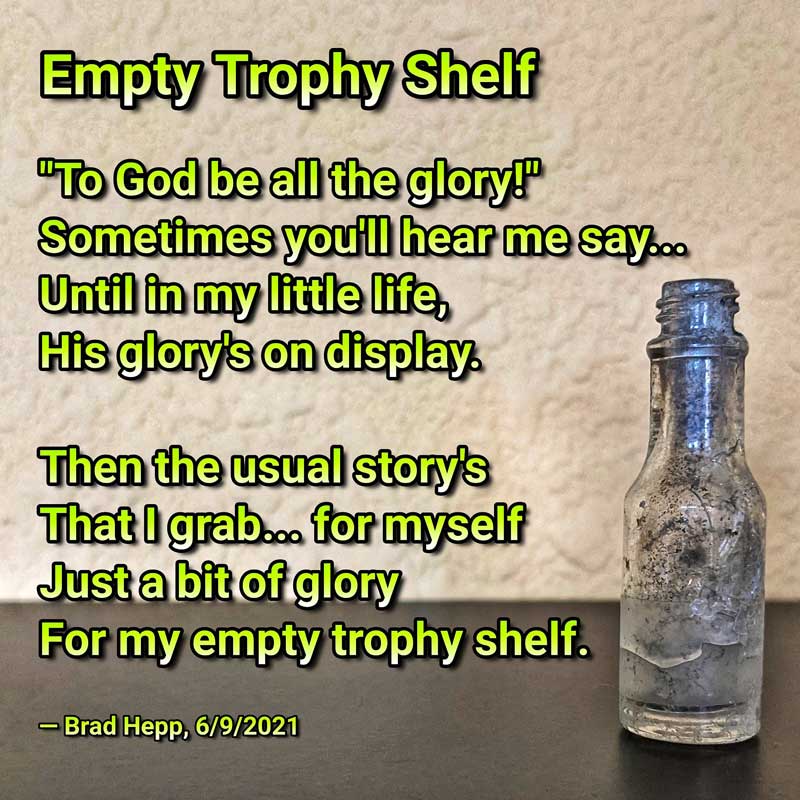
Empty Trophy Shelf

If this NEVER happens to you, please spend time with me. Perhaps you can pull me up, and I won’t pull you down.

Commentary

It’s almost impossible to write this commentary without doing the very thing I do NOT want to do: to claim credit for something God has empowered me to do. But I’m tempted, over and over. I’ve succumbed often enough to know the short-lived intoxication.

Is it wrong to feel affirmed in our exercise of God’s gifts, even to revel in them? I don’t think so. Don Regier and I talk about this occasionally. As a fellow creative, he knows what it’s like to create something and then to enjoy the creation. Don points out that we are made in the image of the One who looked on His creation and concluded that “it was very good.”

Where does appropriate affirmation and pleasure bleed over into inappropriate pride? I’m still trying to figure this out, to put my finger on just when I go astray. But I sense it when I’m overstepping. Perhaps the Holy Spirit makes me aware.

The empty trophy shelf…
I do have a sort of trophy shelf in my office. There are two actual trophies that I won back when I was running competitively. Everything else on the shelf is a memento: rocks from mountain climbs, a music box I made for my grandmother, a fun photo edit I collaborated on with Glenn Clark. The actual shelf is not empty. In fact it’s overcrowded:

While the shelf is not empty, I find that some of the trophies I’d like to display there and elsewhere ARE empty, vapid, vanishing as soon as displayed. The substance of those trophies is like whatever was in that little bottle I found in the firepit at high camp below Blanca Peak. It meant something to someone long ago. What’s left now is just a little broken bottle. As far as trophies go, it’s quite empty.

HOW WAS I NEVER CURIOUS ENOUGH TO EXPLORE THIS?

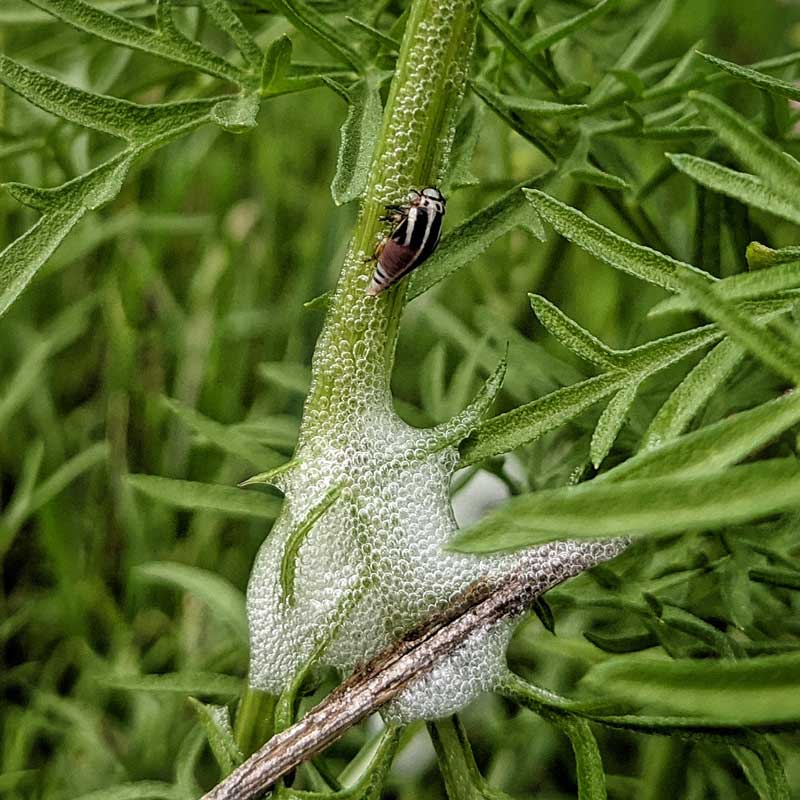
All my life, I have seen these globs of spit on plants in the Spring, but I never stopped to explore until today. As though I were a normal little boy, I took twigs and poked around in several of the globs. In each case, a little bug emerged. I thought, “That must be called a “‘spitbug’.” Close. I’ve learned that it’s called the “spittlebug.” There are some great videos out there that tell all about them.