(if you are viewing this via email, the website has a recording of this poem and commentary; click the title above)
Commentary
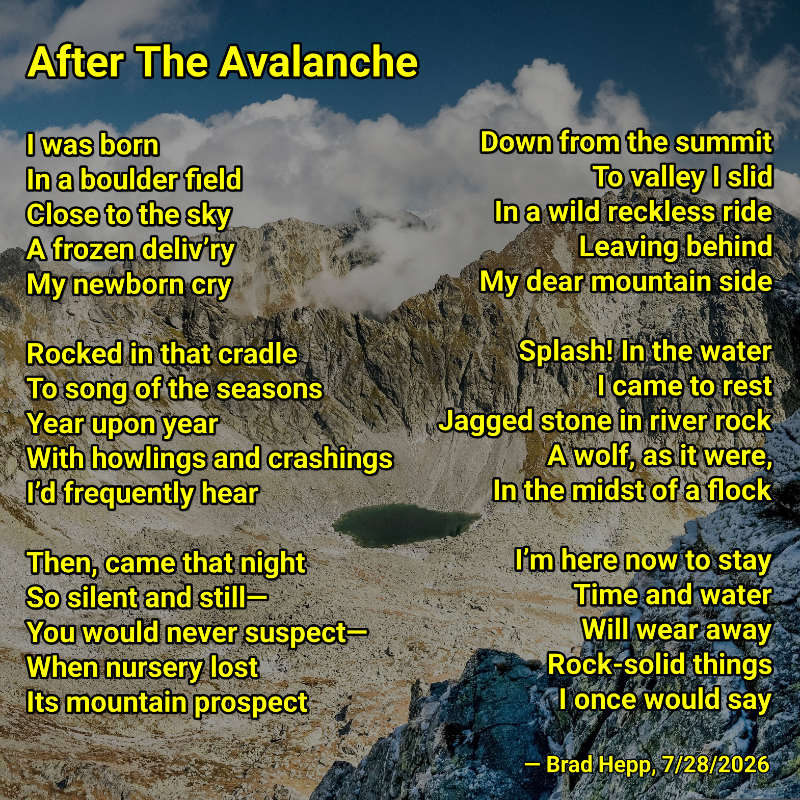
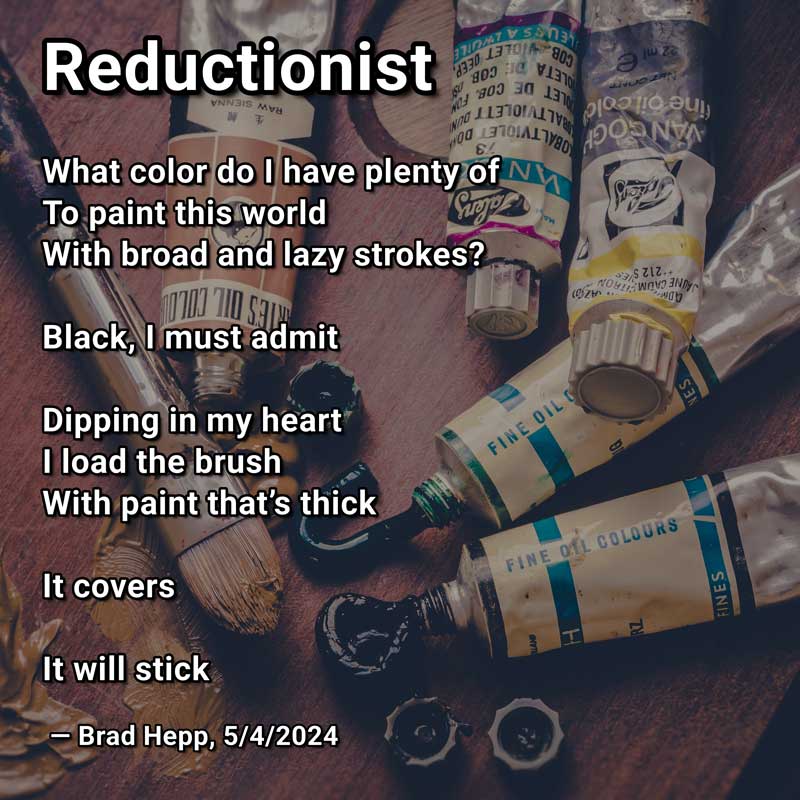
I APOLOGIZE This poem took on a silly, maudlin tone as I forced the rhyme pattern. That’s unfortunate. The inspiration was serious contemplation of how slowly I conform to new ways of thinking. The picture I meant to develop was of sharp granite being smoothed by running water after leaving its “birthplace.”
Here’s a case in point…. The more I write poetry, the more I realize I have tended to interpret Scripture with wooden-headed literalism. I wish to be more thoroughly poetic in my reading, as in my writing. But—and here’s my main point—I recognize that the necessary mental transformation is inevitably slow. So, I must be patient with myself.
(if you are viewing this via email, the website has a recording of this poem and commentary; click the title above)
Commentary
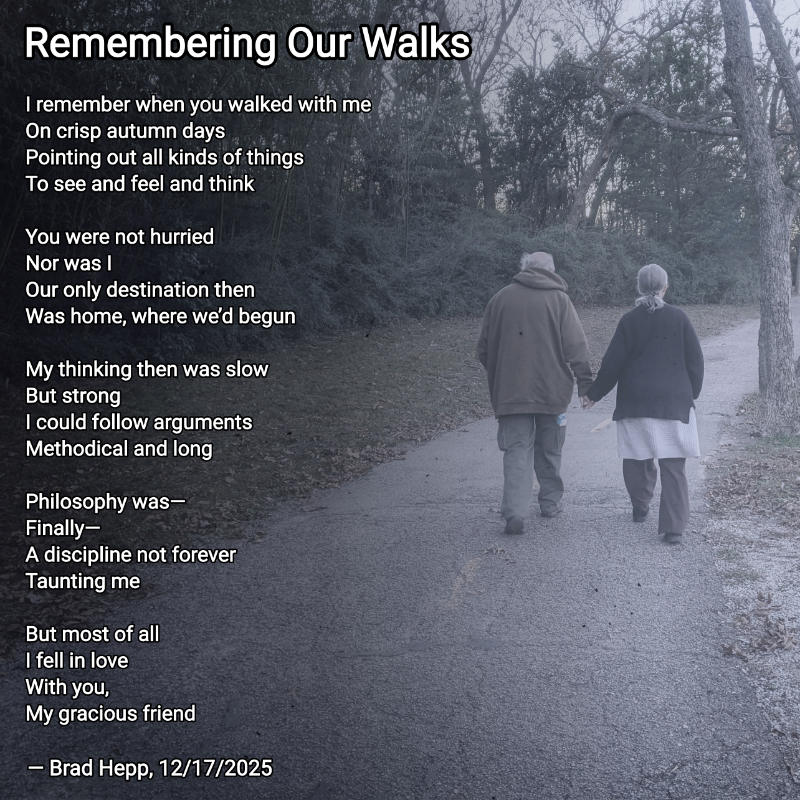
Something’s gotta change. My brain is turning to mush, and my heart isn’t far behind. Fortunately, I recall better days, so I know what’s possible. The One who walked with me then is merciful and kind. So, to Him goes this heartfelt prayer…. (the photo is one I took back in 2019, on one of my frequent long hikes)
(if you are viewing this via email, the website has a recording of this poem and commentary; click the title above)
Commentary
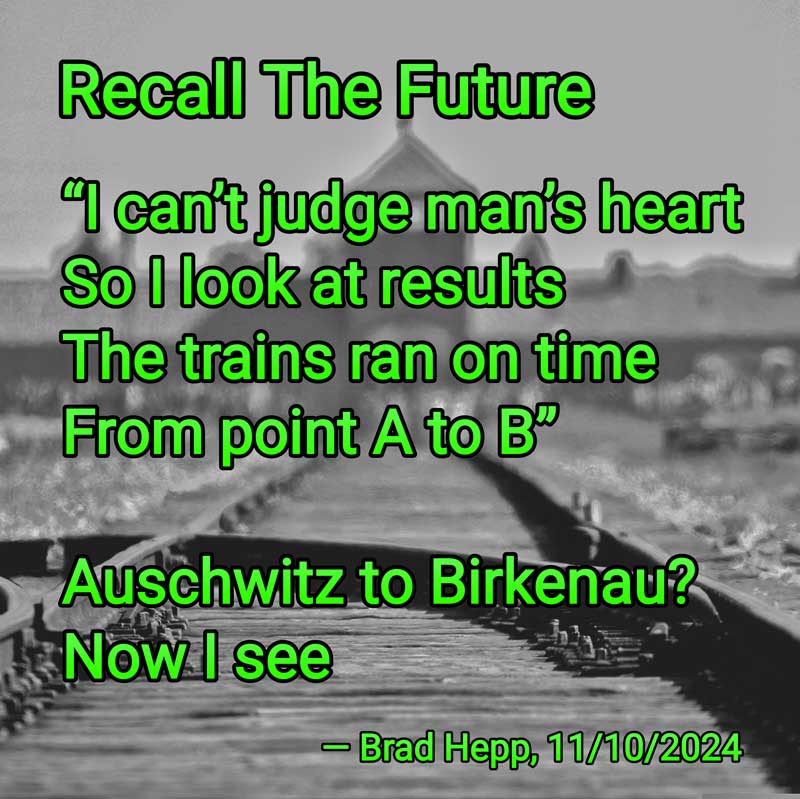
This is a bit of conflation, and I’m not going to apologize for that. It’s what we poets do.
[NOTE: I am truly sorry that the following will likely offend some of my friends. If it helps, let me say that this post is NOT about Democrats versus Republicans, or even about Liberals versus Conservatives. Both sides have serious problems!]
I am extremely disappointed that the United States just elected Donald Trump for a second time. The man is a narcissist, rapist,* felon, and shameless liar with fascistic tendencies. I cannot erase the picture of him twiddling his thumbs for three hours while his violent minions brutalized police and ransacked our nation’s Capitol on January 6, 2021. I cannot forget his juvenile insults of everyone who opposes him. I cannot forget how he claims that everything is rigged against him unless he prevails. I cannot forget how he denigrates immigrants (especially if they are people of color), always appealing to our latent racism. I cannot forget the number of times he has claimed that he knows more about any number of things than anyone else. I cannot forget how many cabinet members from his first administration warned us that the man does not belong in the White House. But we know better, right?!
The Poem He’s a bully, and a wannabe “strong man” like those who ruled Germany, Italy, and the Soviet Union in the 1930s. But what percentage of our population know even the basics of pre-World War II history? What percentage of our population recognize how history is repeating itself as we give up freedom and pave the way for tyranny?
I suspect many, if not most politicians DO know the relevant history. But they turn a blind eye to how history is repeating itself. It is their duty to stand up for the rule of law, to uphold the Constitution. But how can they stand up when they are spineless in their self-seeking exercise of power?
*While he was convicted of “sexual abuse,” Federal Judge Lewis Kaplan ruled that E. Jean Carroll’s rape allegation was “substantially true.”
(background image from a photo by Ron Porter on Pixabay)
(if you are viewing this via email, the website has a recording of this poem and commentary; click the title above)
Commentary
Isolation and alienation have probably affected my outlook on life far more than I consciously understand. Consider the following from my youth:
My first ten years, I was a gringo living in Mexico; I connected with the handful of other Anglo missionary kids far more than with the surrounding culture
When we moved to a little East Texas town, I didn’t connect with that culture either; my different life experience, religious and academic orientations were off-putting to others and a barrier to fitting in
In the advanced English course in my first semester of college, there were only three of us guys in a classroom of young ladies; that may sound wonderful for the guys, but it continued my theme of not fitting in (to this day, I find few men who appreciate poetry; even fewer who write poetry)
In the decades since, I got along fairly comfortably in white evangelical culture… until my late 50s. Beginning in 2016, and then rapidly accelerating in 2020, I began to distance myself from that culture. Now, I once again feel the isolation and alienation of my youth.
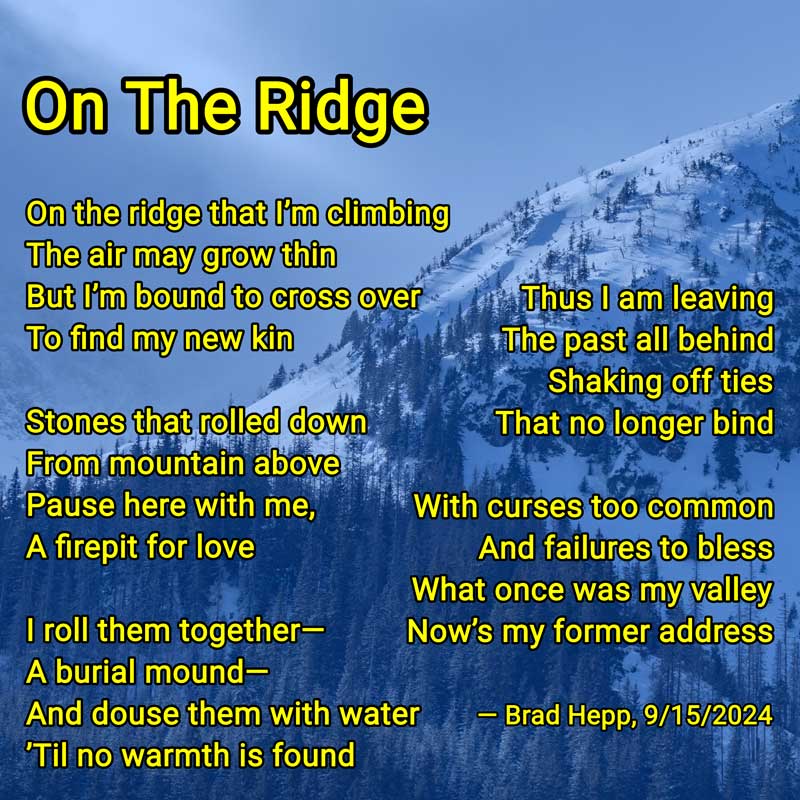
Here’s how that came about…. At the very time I began to recognize selfishness and racism in my own heart, a large majority of white evangelicals began to embrace and trumpet these sins.* When terrible events of 2020 and 2021 afforded opportunities to inspect our hearts and to repent and reform, too many doubled down instead on their love of power and privilege. Their hard hearts led them to hate good men and to love evil men. (Here’s a poignant poem I wrote at that time: “Lord’s Day Vision.”)
Am I blameless in all this? NO! I played a small part in promoting the drive for power and privilege until I saw what I had been doing. Even now, I keep having to bury my former affections, to douse the flame of former loves.
Does this poem make more sense to you now if you read it again with that background? I’d love to know! Comment below (click the poem title if you’re seeing this on email; there’s a comment form on the blog).
A related poem, especially with regard to God’s mercy in reforming us is “To A Misguided Cedar.“
__________
*I say “began to embrace and trumpet….” A better word may be “revealed.”
(background image cropped and tinted from a photograph by Peter Balog on Pixabay)
(if you are viewing this via email, the website has a recording of this poem and commentary; click the title above)
Commentary
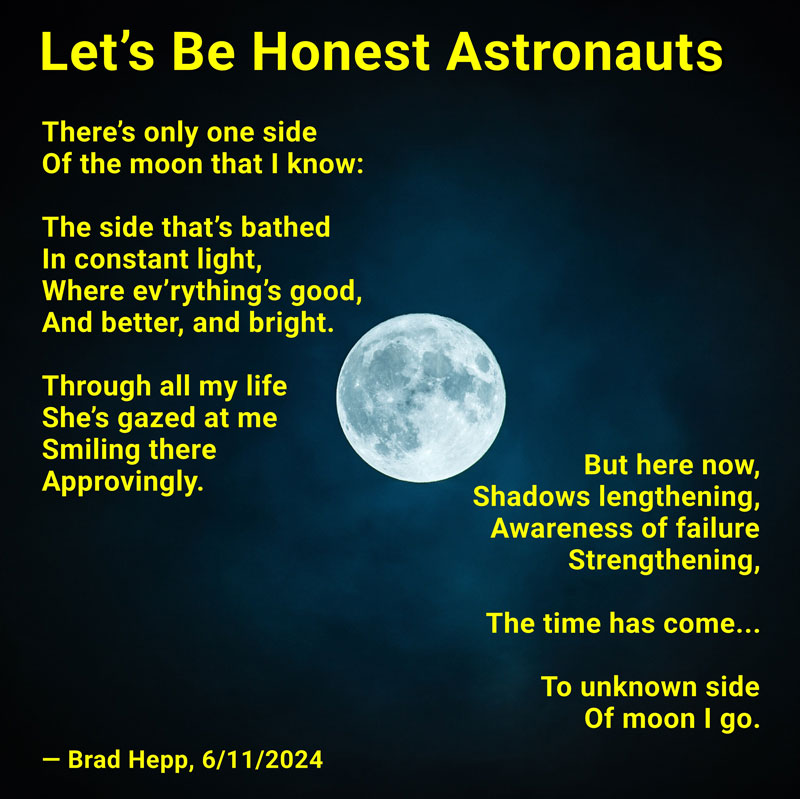
This may appear to be a depressing poem. Let me explain why it isn’t really….
A dear friend treated me to supper last night. This morning, I woke up and immediately wrote down what I had said to him, except that I put it in verse. Here goes:
TO UNKNOWN SIDE OF MOON I GO Over the last several years, slowly at first, but gathering speed as time passes, I have been changing. At least I have been examining my life more carefully, and laying myself open to change.
RACISM First, I became aware of my own racism. In 2016, I was being considered for a job that would have involved ministering in the Hispanic world. But even though I am a missionary kid born in Mexico, I had by my mid-fifties developed significant antagonism toward the growing population of Hispanics in the U.S. We can all thank God that job didn’t pan out. Imagine the hypocrisy!
Just after that, I went full-time with my web design business. In all the spare time I had, I began taking long daily walks. On those walks, I listened to many books, including all of the Bible (several times through). I’d walk around White Rock Lake, listening, and pondering. I also began observing how I responded to each person that I encountered on the trail. Why was my heart immediately warm toward this person, but cold and distrustful toward that person? I noticed–once again–that racism was definitely involved.
SELFISHNESS Acknowledging and inspecting my antagonism toward Hispanics revealed a deep vein of selfishness in me. At one point, I had to admit, “I don’t like this influx of Hispanics in the US because it’s a drag on the economy.” In other words, I was thinking with my wallet–how a group of people affect my wealth–not with Jesus’ welcoming, hospitable love. (By the way, I wasn’t thinking very well in any case). It seemed obvious to me that I had to either follow Jesus or give up that way of thinking.
As the years passed, I began to see how that vein of selfishness was influencing my politics, my view of history, even my theology. It’s hard to be an honest interpreter of Scripture when you are motivated to find God giving you every advantage while denying it to others!
A SENSE OF SUPERIORITY This brings me to something I was finally able to articulate to myself last night just as I walked across the parking lot to meet my friend in the restaurant. One of my biggest struggles in life is the temptation and tendency to think of myself as superior to many others in many ways: smarter, wiser, healthier, more discerning, more talented. Not, of course, superior to everyone around me… I’m arrogant, not stupid!
A LONG SLOW COURSE OF MEDICATION When I recognized my selfishness and racism, I began reading extensively about the history of white supremacy in the US. There’s simply no way that I escaped inheriting some of the rottenness in that pervasive ideology! Talking with my friend at supper, I listed some of the authors I have read. As you read this list, you may be tempted to jump down my throat. But hear me out. The authors included Robin DiAngelo (White Fragility), Abram X Kendi (Stamped From the Beginning), Bryan Loritts (Insider Outsider), Jemar Tisby (How to Fight Racism), Luke Bobo (Race, Economics, and Apologetics), and Ta Nehisi Coates (We Were Eight Years in Power). With the exception of DiAngelo, these authors are all black men and skilled writers. Even if I question their analysis or solutions, I deeply appreciate their ability to articulate their perspective. Some of them are my brothers, and all are my friends in that regard. Reading these authors, and imbibing many related documentaries and podcasts has been like taking a long slow course of medication. I’m getting better, largely by understanding how bad off I am.
BACK TO THE POEM The dark side of the moon is a hostile, unfamiliar environment. If the moon we see every night is smiling on us approvingly, the dark side of the moon is indifferent at best, scowling murderously at worst. In its metaphorical eyes, we are not great. In its metaphorical eyes, any notion that I am superior to anything or anyone is laughable.
HAVE I SAID ENOUGH? If you go back and read the poem now, does it start to make sense? Can you see that it is hopeful, and not depressing? Let me know by commenting below!
[Note to my future self: I wrote this a day or two after watching an episode of The Crown, in which Prince Philip has a private interview with the Apollo 11 astronauts. Philip was experiencing a crisis at that point in his life, and he hoped that the astronauts would have some serious, helpful observations about life and faith. Alas, they were at that point just men of action, not contemplation.]
(if you are viewing this via email, the website has a recording of this poem and commentary; click the title above)
Commentary
OOF. I took a long walk with a wise friend yesterday. I tried out my interpretations of the world on him. Some of them he found wanting. For his intelligent honesty and other reasons he remains a VERY GOOD FRIEND.
On the other hand…. It is sometimes essential for me to strip away the excuses and alternate explanations for what strikes me as evil. I’m a poet, after all, not an apologist or diplomat.
(if you are viewing this via email, the website has a recording of this poem and commentary; click the title above)
Commentary
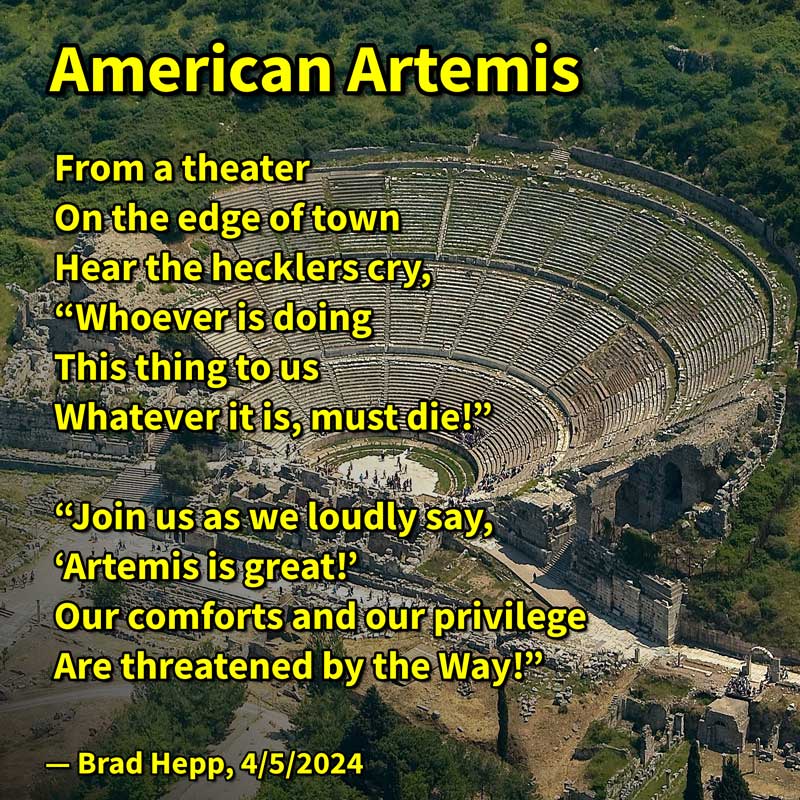
This poem comes out of reading Acts 19 (the riot in Ephesus), and contemplating what 21st-century white evangelical Christians could glean from the story.
Wouldn’t it be something if the Way actually threatened OUR comforts and privilege as it did the pagans in first-century Ephesus!
Consider this last paragraph from a 2019 piece by Washington Post columnist Michael Gerson:
Many white evangelical Christians hold a faith that appeals to the comfortable rather than siding with the afflicted. They have allied themselves with bigots and nativists, risking the reputation of the gospel itself. And, in some very public ways, they are difficult to recognize as Christians at all.
(if you are viewing this via email, the website has a recording of this poem and commentary; click the title above)
Commentary
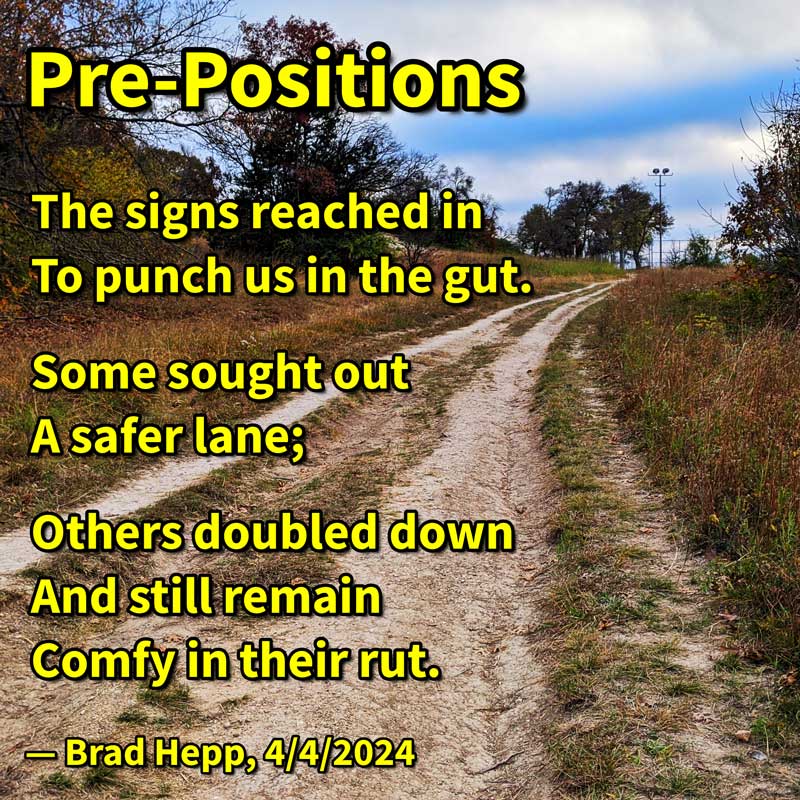
Susan sometimes urges me to be patient with people who have not evolved in their thinking over the last few years. After all, I was in my late fifties before I even started examining and adjusting some major facets of my life….
But is that fair? Have the past few years really not shown us enough selfishness, inhospitality, and bigotry in ourselves and our neighbors that DEMANDS reformation?
(Background image: the trail above Norbuck Park. I took many a contemplative walk on this trail after being introduced to it by a man who wouldn’t change his ways.)
(if you are viewing this via email, the website has a recording of this poem and commentary; click the title above)
Commentary
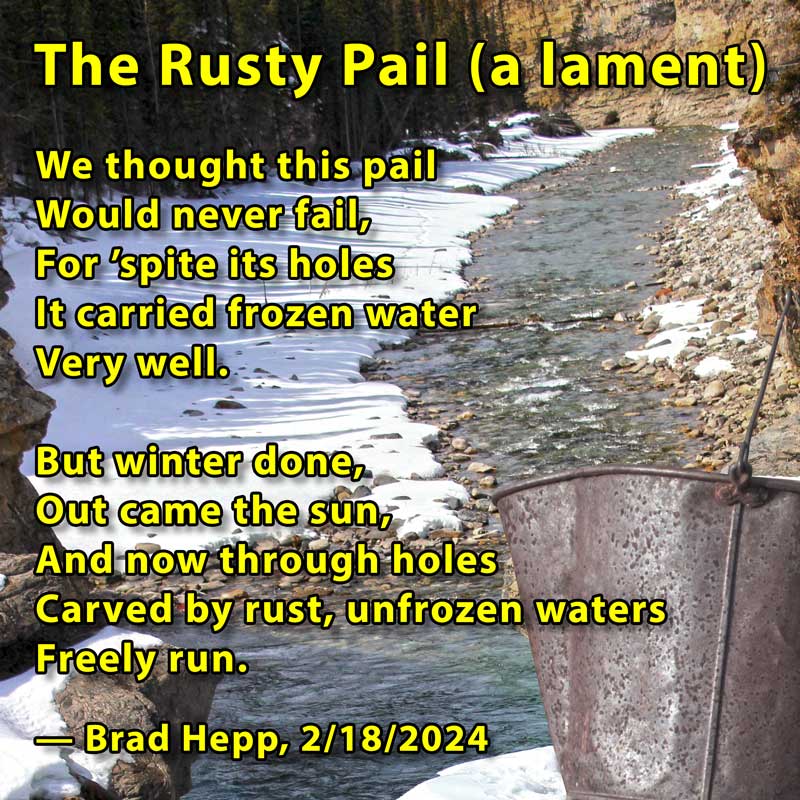
This poem may sound playful, but it really is a lament.
I listen to the podcasts of an Evangelical pastor who is working through his former allegiance to Evangelical beliefs and practice. He, like many of us, is distressed by the behavior of Evangelicals–make that White Evangelicals–in the past few years. Since our behavior has been so horrible, we’re forced to question our beliefs. One of his recent podcasts examined a belief that I still hold somewhat dear. Somewhat. Frankly, I am conflicted. The image of a leaky bucket came to mind as I considered my loss of confidence in this cherished belief.
I’m not going to go into details about the particular belief. Nor am I going to argue with anyone about what I perceive as horrible behavior by White Evangelicals. I’ll leave arguing for people who are good at it. The Holy Spirit is probably more convincing than I am. Right?
(background image is a mashup of the pail, by omnigrapher2016, and the stream, by lalami78, both on Pixabay)
(if you are viewing this via email, the website has a recording of this poem and commentary; click the title above)
Commentary
This morning, after I awoke, and long before I got out of bed, I began imagining a travel guide for people visiting my island. In this guide, I would introduce travelers to three groups of people they’re likely to encounter: God-deniers, God-fearers, and God-danglers.
You’ve probably never heard of God-danglers. These people may or may not utter the curse “God dangle it!” In fact, many of them would be far too proper for something so close to profanity. The term “God-dangler” originally* referred to people who wear a chain with some form of religious pendant. And—this is important—they wear it AS a talisman. In other words, they think of God as their magic charm.
But a pendant is close to the heart, and it’s important to understand that God isn’t really close to the heart of God-danglers. That’s when it occurred to me that God-danglers sometimes dangle swords at their sides. Swords, like talismans, are something people rely on to get their way.
So there you have the complete history of the term “God-danglers.” These are people who don’t technically DENY God. They also don’t really FEAR God. Rather, they see God as someone they’d better dangle along to insure they get their way while getting’s to be got.
(if you are viewing this via email, the website has a recording of this poem and commentary; click the title above)
Commentary
Some conversations serve as a warning: “Make sure you’re not on this path!”
This poem was inspired by a conversation I had with an elderly patron at the library where I work. Ever since that conversation, I have avoided him. Otherwise, I’d have to deflect his political jibes, misogyny, and racism. It would be terrible if other patrons thought I agree with him!
(if you are viewing this via email, the website has a recording of this poem and commentary; click the title above)
Commentary
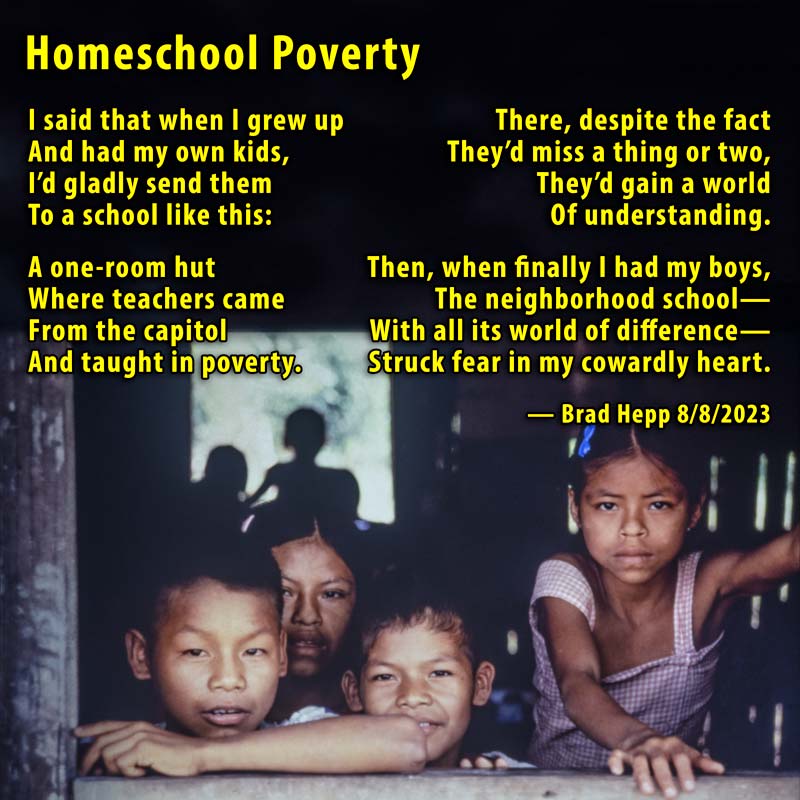
My younger son Joshua just moved to New York City. I am almost ecstatic for the growth he’s poised to experience. Recently, I have been taking measure of the fathering I did when my boys were young. My sinfulness—including cowardice and racism—affected them negatively. HOWEVER, I am convinced that God can restore, even where we deprive and waste.
There’s more than one side to the homeschooling issue, especially in our circumstances. But I must be honest about my mixed motives. One of the beautiful things Joshua did for me is to help me see my racism (as well as some other failings).
(background image is a photograph I took of kids in a one-room school in Peru, when I was there on a missions internship in 1986)
(if you are viewing this via email, the website has a recording of this poem and commentary; click the title above)
Commentary
I love it when a poem gets shorter and shorter, ’til all that’s left is one sentence.
I have asked one thing from the Lord; it is what I desire: to dwell in the house of the Lord all the days of my life, gazing on the beauty of the Lord and seeking him in his temple.
(if you are viewing this via email, the website has a recording of this poem and commentary; click the title above)
Commentary
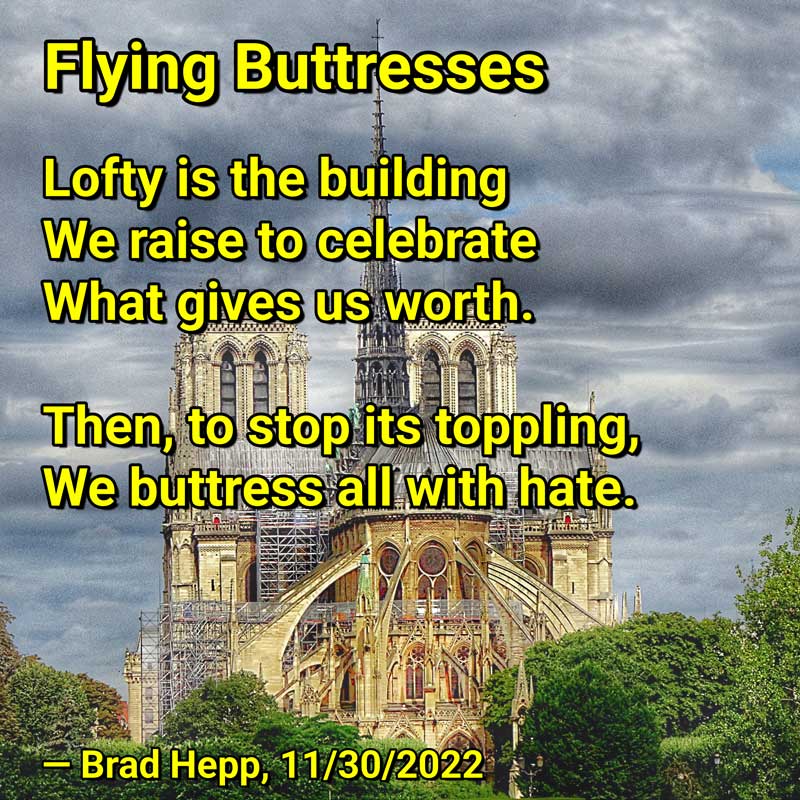
I mean no disrespect to Notre-Dame. I chose the background photo for this little poem because when I think of flying buttresses, I can’t imagine any more prominent than those that support Notre-Dame’s vaulted ceiling.
As a side note, surely I’m not the first person to say that when I view a photo of Notre-Dame taken from the southeast (the view in the photo above), I see the flying buttresses as streams of tears flowing from the old lady’s eyes. Her eyes have seen a lot.
The Poem This morning, I was reflecting on how much my thinking has been–and is being–recalibrated. Over the last few years, I’ve had to rethink much of what I formerly thought of as good and noble in politics, religion, national and state history. Almost daily, I learn more and more about flaws in what I once thought was practically flawless. There’s a lot of sadness in this realization. On the other hand, the very low view–verging on hatred–that I had for many opposing institutions and ideologies has practically disappeared. I can now see virtue in people I once despised. I can hear what they say with an open mind. They no longer threaten me. That’s because I no longer count on the institutions they oppose. My honor is not wrapped up in a political party, or nation, or state. More and more, I’m simply a follower of Jesus. More and more, my worth is wrapped up in his worth.
Something VERY Cool Go to this link, hover over the pin for the Notre-Dame cathedral and watch a 360-degree fly-around of the beautiful building.
(background image adapted from photo by Jacques Gaimard on Pixabay)
Despite the silly sound effects in my recording of this poem (and on the video version), it’s a serious poem. I promise you, it is!
I get very frustrated with narrow-mindedness, and with people who don’t develop intellectually over their lifetimes. Hopefully it’s obvious that the speaker in this poem has spent his (or her) entire lifetime defending a narrow, and tired point of view.
Looming Open Door This is the sad conclusion of the poem. Opportunity has existed at every point since the speaker’s feet touched the floor to go out and explore. Instead, he considers the world “out there” a threat.
I think most people have at one time or another experienced pain that feels strangely pleasant. For instance, when you find a way — perhaps with a friend’s help — to apply pressure to that knot in your back. For some, there is pleasure in the pain of a red-hot pepper. Well, recently, I have noticed that I am strangely drawn to sadness, and feel a certain pleasure in its presence.
In one of my recent poems, I depicted sadness as a lady who has me sabbath in her house. She feeds me and urges me to “rest and weep.” In the commentary for that poem, I suggested that the process I am in is one of becoming more compassionate. I’m pretty sure that’s fundamentally true.
But in the poem above, I ask if the reason for this phase (I guess it’s a phase) is that I need to fully recognize and steel myself against Satan’s lies. The emotion of sadness helps me better comprehend what I’m looking at in a fallen world. Things are not the way they’re supposed to be, no matter what anyone might say.
When I contemplate oppression, poverty, and death, it’s hard to imagine a future world where these are eradicated. It seems that everywhere I look in this current world, wealth is amassed at someone else’s expense. In a generally prosperous culture, that’s not always easy to see, but I’m learning to connect the dots.
How could it work any other way? I believe it will some day, but how? That’s what the last stanza of my poem addresses. When the all-powerful Creator has restored the world to its original design, then my questions will be answered.
February 26, 2023 Additional Comments:
[This part I barely understand, so bear with me. If it’s too dense, skip to the last paragraph]
In “The Crucifixion,” Fleming Rutledge writes about a “PARADOX: THE KNOWLEDGE OF SIN AS JOYFUL GOOD NEWS.” It’s a startling claim, but Rutledge makes a good case for it. Later in that chapter, she writes the following: “The action of God’s grace precedes our consciousness of sin, so that we perceive the depth of our own participation in sin’s bondage, simultaneously with the recognition of the unconditional love of Christ, which is perfect freedom. We recognize that love, moreover, not from the depths of the hell we were bent on creating for ourselves, but from the perspective of the heaven that God is preparing for us.”
Over the last few years, I have increasingly felt this strange pleasure at recognizing what a wretch I am, not only on the basis of my own sinfulness, but also on the basis of my being PART of a sinful humanity. This strange sensation is something I tried to explain with the attached poem, which I wrote exactly one year ago. The reason that I offered then was surely right in part. But it didn’t fully account for the pleasant sadness.
So, Rutledge—and other wise souls—are helping me understand the pleasant sadness.
[This part may be easier to understand, as it relies on imagination more than on theology.]
I picture myself on a long hike with Jesus. Naturally, the trail we’re on is along the sides of some mountain in the Rockies. We can see forever. Conversation turns to why Jesus had to die for me. It was my sin. He goes into detail. But we keep walking. He’s with me on the trail because he loves me. It’s obvious. He’s telling me these things because he loves me. Otherwise, we wouldn’t be here. He wants me to know that he knows fully well what kind of rotten friend I am. Amazingly, it doesn’t feel like scolding. Through talking with me about my sin, Jesus produces in me a pleasant sadness. He reassures me I need not fear his rejection some day when the truth comes out. He took care of everything. Everything.
Background image is a mashup of three images from Pixabay. Mountain scene by Jörg Peter; tower by “Jazella”; night sky by Felix Mittermeier.
Commentary
This morning, I watched a YouTube video in which a professor of “Christian Psychology” explained various approaches that he and Christian peers take to secular insights. He went a long way toward helping me categorize and understand a complex subject. I especially appreciated the irenic tone he takes toward approaches that differ from his own.
Shortly afterwards, I learned that professor had been ousted from Southern Seminary because the rest of the faculty in his department are of the mind that Scripture is all we need for counseling, and that no secular insights are welcome or allowed. Not so irenic on their part!
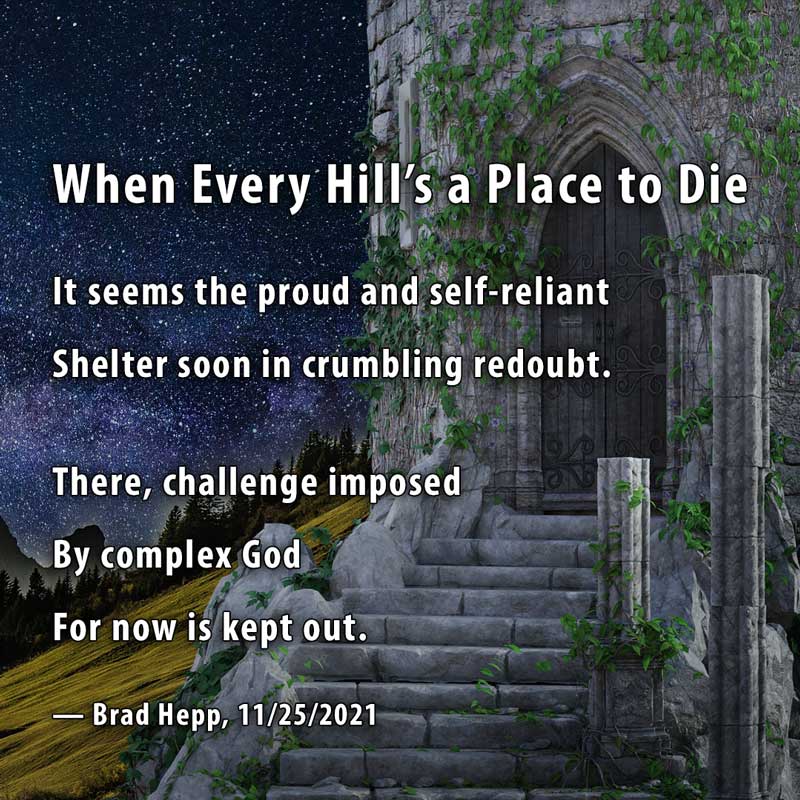
The Title:When Every Hill’s a Place to Die A certain gentleman once complained to me about people who say things like, “That’s not a hill worth dying on.” I should say he was a “very certain gentleman.” When I asked him if there aren’t some secondary issues in Christianity for which he wouldn’t die, he answered, “I’d die for everything I believe.” I know he probably considers himself brave and loyal. Perhaps he is. But I suspect he’s also inordinately proud of his ability to fully comprehend all those issues. God is not simple; the world he created is not simple. We need to be humble about our understanding. Ask Job!
Shelter in Redoubt In warfare, a “redoubt” is a fortification to which combatants can retreat. It is often their final resort, their last defence. I picture a theological combatant (unlike the irenic professor described above) retreating to a simple structure that he thinks he fully understands. The complexities of others’ thoughts cannot defeat him as long as he is in his theological redoubt. “God said it; I believe it; that settles it,” yells the proud, combative theologian from within his little fort. He forgets that what God said isn’t always so easy to understand!
I wrote this first thing this morning, after giving up on a restless night. About 2 or 3 am, I woke up, and could tell I wouldn’t be getting to sleep soon. So I used my monthly credit at Audible and downloaded “The End of The Affair” by Graham Greene. That title intrigued me ever since a theologian I respect recommended it to a fellow writer in response to the request, “…name one (and only one) novel that you recommend I should read?” The Audible version has the bonus of being read by Colin Firth.
So, by 7 am, I had listened to at least half of the novel. Admittedly, I dozed off during parts, but a check on synopsis sites tells me I didn’t miss much….
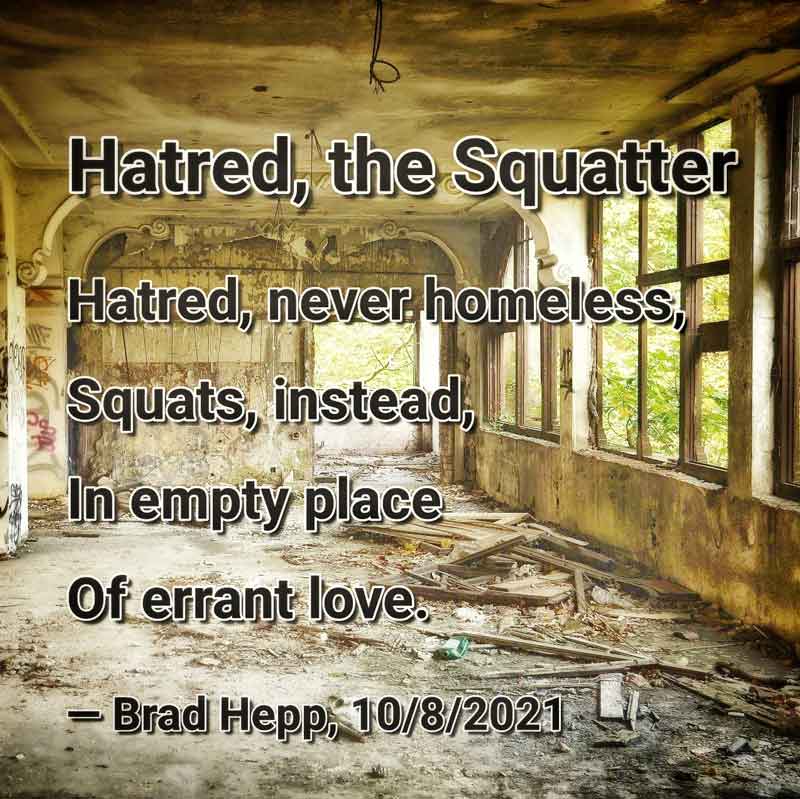
“Errant Love” This is the only line I’ll expand on in this commentary. “Errant” usually means something like “erring or straying from the proper course or standards.” That definitely describes the illicit affair referred to in the book’s title. I won’t describe that here. In fact, I wouldn’t want to make a regular diet of this kind of material.
But “errant” has a more archaic meaning of something like being “out on an adventure.” When the thrill seeker wanders from home, he vacates his usual place… leaving it empty. Thus, the “empty place of errant love.”
The main character in the book — Maurice Bendrix — says very early on that “This is a record of hate far more than of love.” While I don’t know much about affairs (thank God!), I do know about hatred. I have felt it. I see it, almost daily, in the most unlikely places. It occurs to me that it only takes up residence where love has abandoned its rightful place, or where love is disordered.
The Background Image The background image (adapted from a photo by Susann Mielke on Pixabay) was suggested by the setting of Greene’s novel: 1944 London, during the German blitz. The V-1 “robot” bombs buzz in from the South and make a mess of Bendrix’s apartment. In the process, they change everything, including Bendrix’s relationship with his love interest, Sarah.
This one is likely to lose me some “friends.” It is sarcastic and appeals to a sense of justice that not all share.
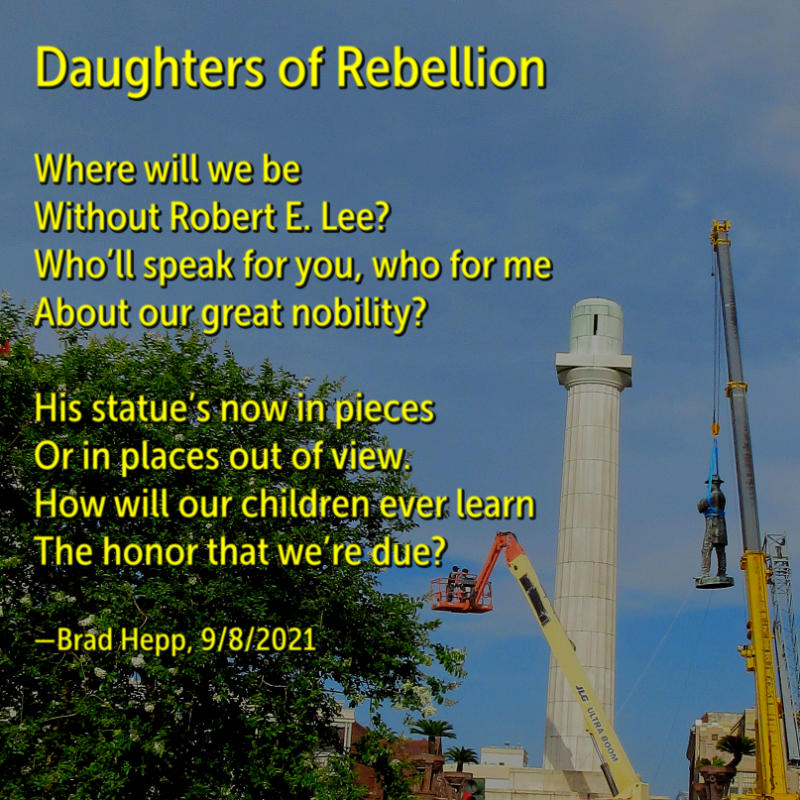
Whenever I see the complaint that removal of Confederate monuments will result in people not being able to learn history, I just about lose it. People who object to removal of Confederate monuments would NEVER object to the removal of statues to Saddam Hussein in Iraq. Those people would NEVER have said, “If our Marines take down statues to Saddam Hussein, how will the Iraqi people learn history?!” Why would they appeal to the “history” argument in the one case, but not in the other? Ask them. I suspect that if they’re honest they’d tell you that they’re proud of their Confederate history. In my opinion, they should be ashamed of it.
I used to defend the “States’ Rights” cause of the South.* Regardless of the extent to which States’ Rights was the real motivation for the South’s rebellion, it doesn’t fly with me anymore. RIGHTS. First of all, that’s not what followers of Christ should dedicate themselves to obtaining or retaining for themselves. See Philippians, chapter 2. In Augustine’s “Confessions” he asked, “How do I know that God is changing me, that I have made progress?” His answer: “I have learned to give up my rights.”
Securing rights for others? Well that’s surely more justified for the follower of Christ. But in the case of the Confederacy, the “rights” that the Rebels fought for was the “right” to enslave, to oppress. That’s certainly not the kind of right a follower of Christ should secure. No, that “right” is just wrong.
*”States’ Rights” is something I still hold to at a conceptual level in that I prefer decentralization of power. But when decentralized power uses its rights to cause harm (e.g., slavery), something higher kicks in. How would one define that higher principle?
BACKGROUND Recently, I have been trying to imagine what it might look like to be in a church that welcomes people from all kinds of backgrounds. Would I be willing to give up my comfort for their sake? What if they’re REALLY different? What if their politics are different than mine, different than the politics of most others in the church? Would we be able to keep things in perspective, or would we chase them off because their politics make them feel like pariahs?
Which is more valuable: a soul, or my opinion?
I was once part of a church plant where my chief motivation was comfort: I wanted to be comfortable with the style of worship, and the kind of people I’d be worshipping with. Now, I recognize comfort as an idol. Doubtless, I retain — and am even now creating — other idols, things that are more important than God’s glory. May He have mercy on me.
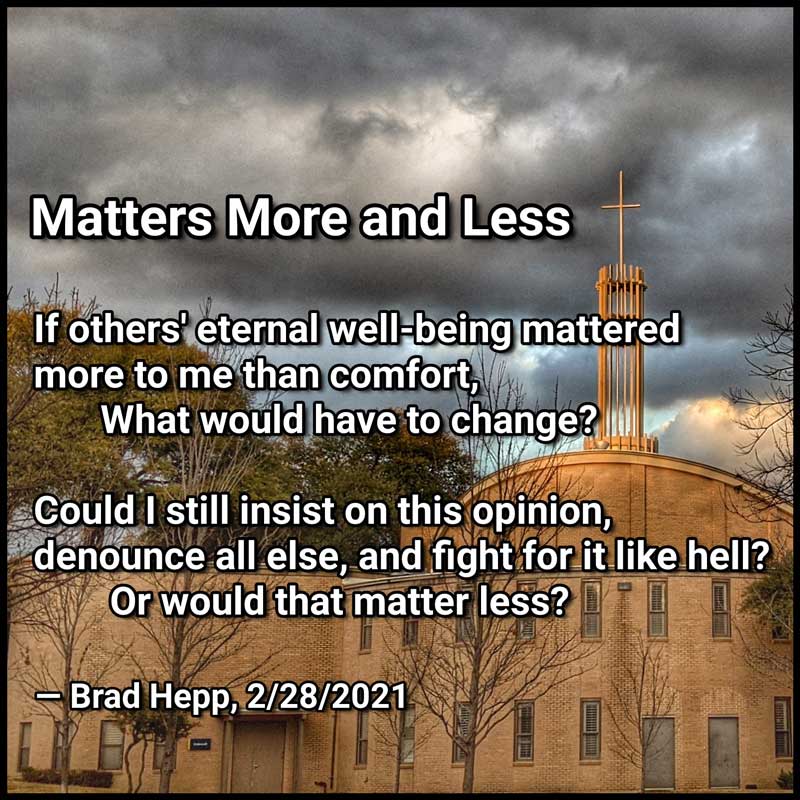
SEE THE DARK IRONY? I’m not smart enough to have intended the searing irony in the next-to-last line. “Like hell” was drawn lightly from recent events. But there is a reality darker than current darkness, infinitely more consequential than current comfort.
THE PHOTOGRAPH The background photo is of St. John’s Episcopal Church, which I pass by on my walks from home to Flag Pole Hill. One evening, the clouds were threatening. I confess: “HDR Scape” in Snapseed accentuated the drama. Do I feel bad about editing a photo? Not in the least…. It’s part of artistic expression. I’m not a mimeograph!
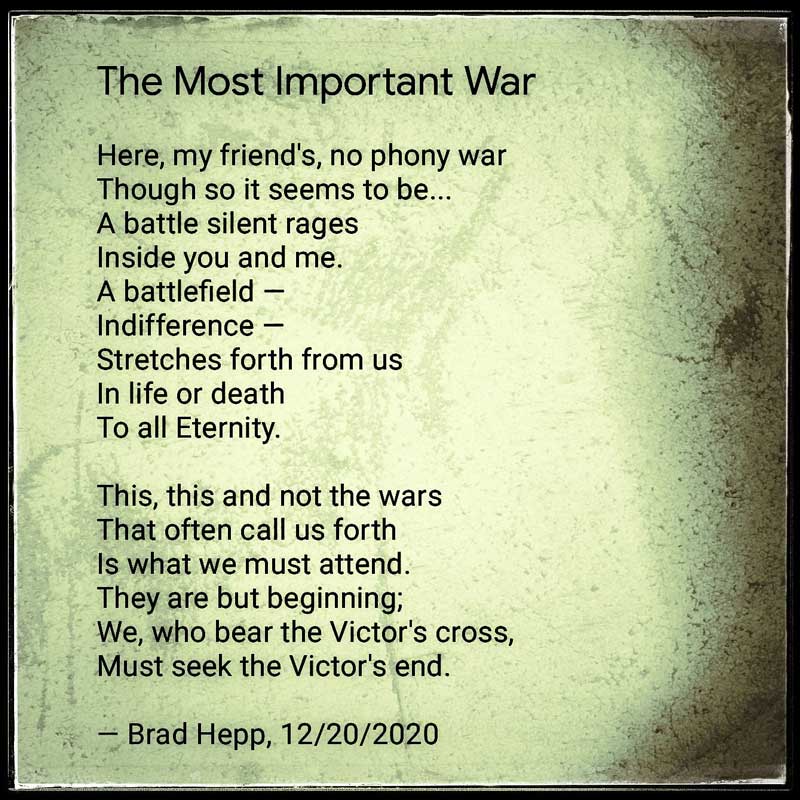
Depressed tonight, I recognize a silent battle — THE silent battle — that rages in me and friends. We occupy ourselves with any conflict at hand rather than the conflict at heart. We are intended by God’s merciful will to be fully won over in the battle to be reconciled, to be transformed into children worthy of fellowship with our Elder brother, Jesus Christ.
Jesus is the Victor. He won over sin that enslaves, weakens, and demoralizes us. He knows how we began; He also knows how we’ll end. Getting us there is His kind purpose (the Victor’s end).
So, why am I depressed? Largely because I see a problem in truly dear friends, a problem that probably afflicts me as well. They are — perhaps I am as well — occupied with silly, worthless conflicts. They are living in echo chambers that reinforce their perception that what they occupy themselves with is important. I sometimes despair of getting through to them. I don’t want to argue with them. They sometimes “like” what I write, apparently not realizing that it is completely antithetical to the trivial pursuits, the phony wars that call them forth. Some undoubtedly see me in the same sad light.
I wrote on Facebook that we need to pray for one another. God alone is able to rescue us from meaningless, hollow lives. He alone can replace depression with love, hope, and commitment.
I wrote this partly in response to Mary’s wise and beautiful poem in Luke 1:46-55.
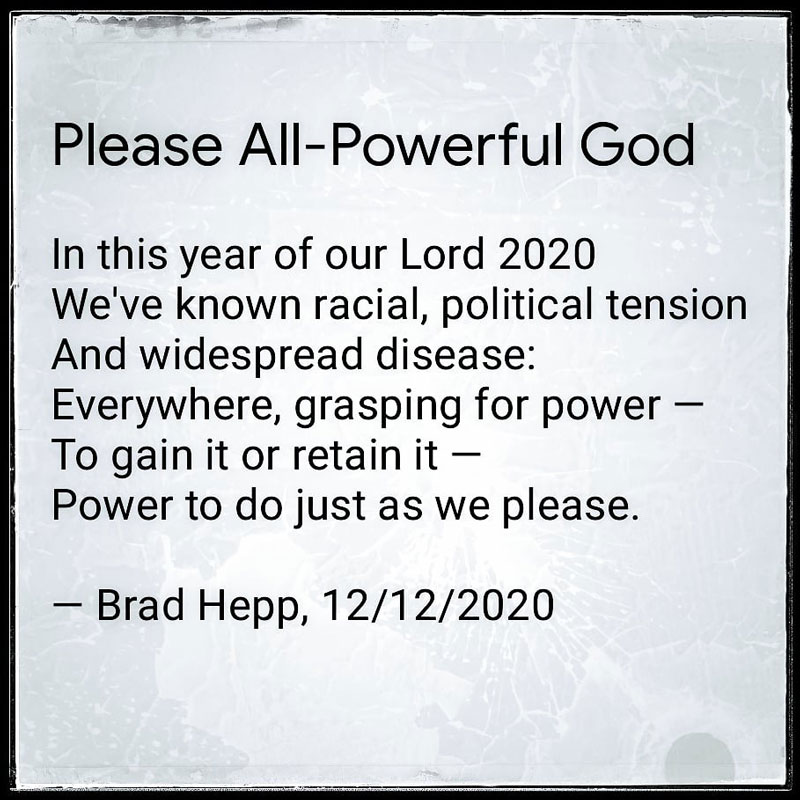
The subject of POWER has been much on my mind, in part because I have been reading Robert Greene’s entertaining but amoral “The 48 Laws of Power.”
I have been thinking about how God-fearers should relate to power. Of all God’s attributes that we can and should reflect, since He made us in His image, this seems to be one of the most dangerous.
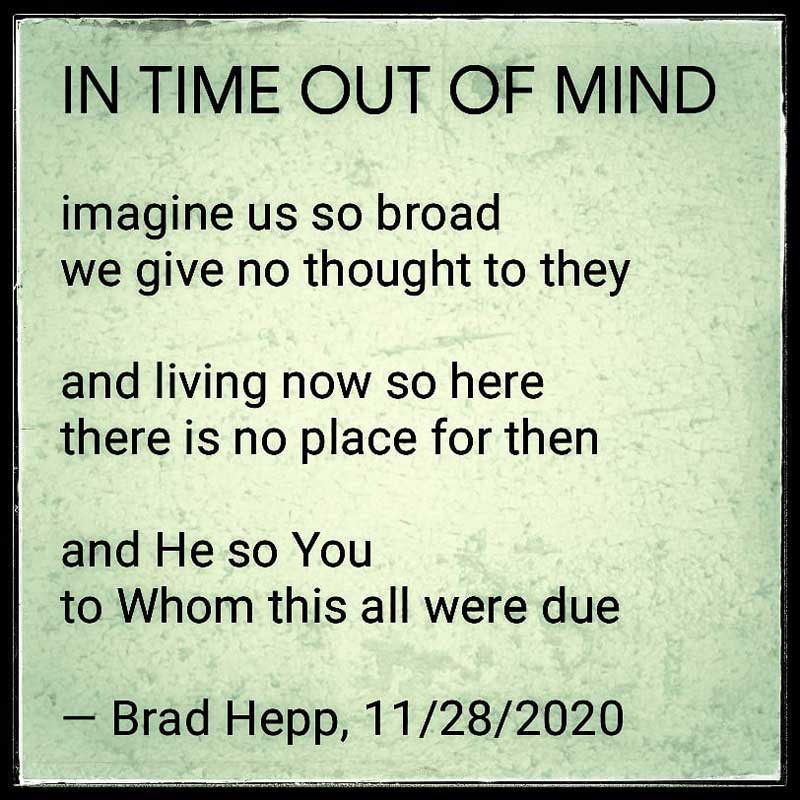
[NOTE: I was very intentional with my punctuation, even in introducing ambiguity to the title]
A friend asked me if there should be a comma after time. Here’s what I told him:
The absence of a comma opens this up to at least three interpretations. I know this style’s not everyone’s cup of tea. Are you familiar with ee cummings’ “my father moved through dooms of love“? That poem brings me to tears whenever I read it.
The slight effort of getting past the absence of punctuation in cummings may add to its emotional impact. Speaking of tea…. Coffee is better than tea precisely for its body, that it slides down not so easily.
So, here are some pointers to meaning:
“In time” can mean “eventually”
“Time out of mind” is unimaginably long, think Eternity.
In a polarized world, it is always “us” versus “they” (deeper in grammar, “us” receives the malevolence that “they” inflict — objective vs subjective). I like to think of a time when there is such peace between a broad diversity of people, that all of us are “WE,” and we never even think of “THEM.”
Currently, things are not as they should be. Even at home, we know we are not where we wish to be. A time is coming when we’ll be where we long to be. Then and there, we’ll be at ease. Then and there we’ll be content with here and now.
Where will we be? In the presence of the One who is making all things new, the One who will satisfy our hopes and dreams. Now, He often seems distant. We refer to Him in second person, as “He.” Then we’ll address Him face-to-face as “You.”
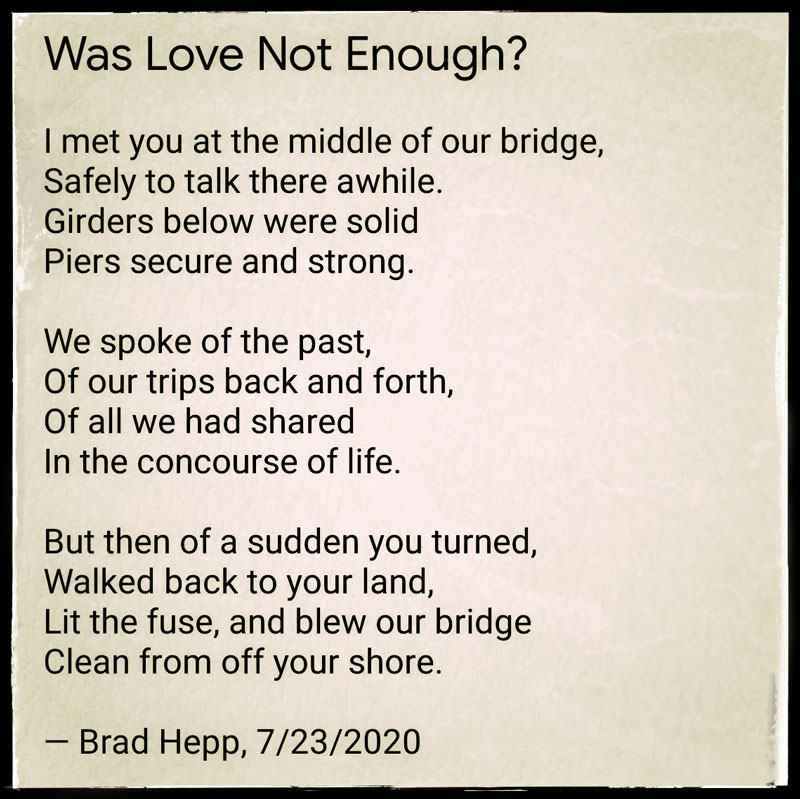
I read that a writer comes alive by telling dead men’s tales. Here’s one such tale, though it’s not the *men* who died. This little poem was a lament. A dear friend had tried to persuade someone that his even-handedness in politics is NOT a retreat from righteousness. But the opponent was trapped in his or her allegiance to one end of the political spectrum.
December 20, 2021 Update: This problem has only grown worse over the last 17 months. I’m now reluctant to talk openly with people I once considered eminently reasonable. I fear being disappointed, and I fear opening the door to enmity where no enmity existed before. Now, more than ever, I live with this refrain: “Anything I say can and will be used against me.” I have a Christ-like friend who had to get off social media because there is someone out there — supposedly a Christian — literally building a case against him, misinterpreting anything he says, casting it in the worst possible light, and cataloging the supposed sins. Call that someone The Accuser.