(if you are viewing this via email, the website has a recording of this poem and commentary; click the title above)
Commentary
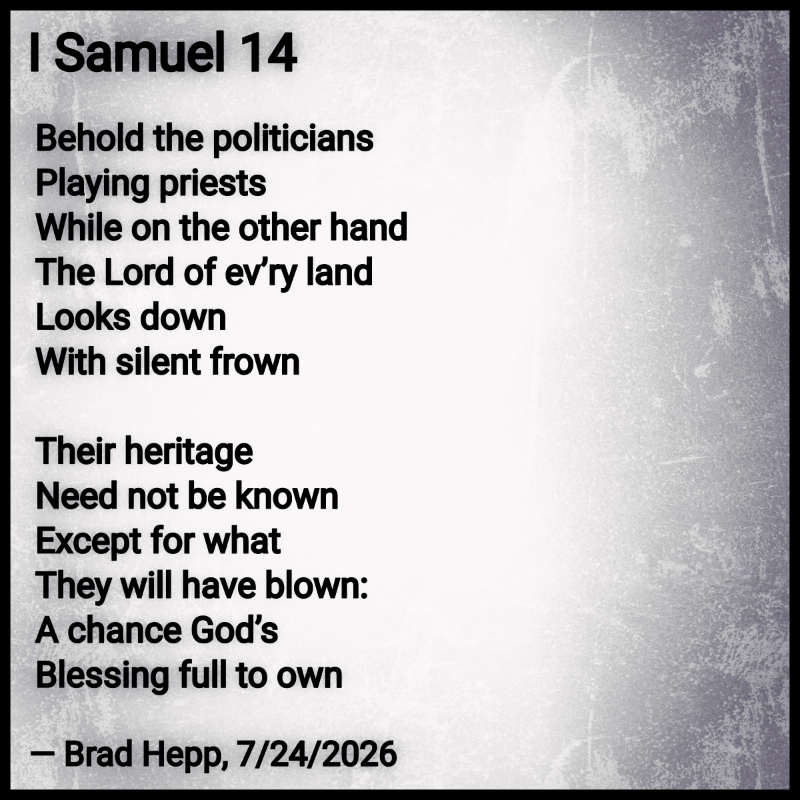
My quick response to this morning’s reading. It may be simplistic, but I could not help but think of our current moment in history while reading about the beginning of King Saul’s reign. Politicians who play priests and priests who play politicians… is one worse than the other?
(if you are viewing this via email, the website has a recording of this poem and commentary; click the title above)
Commentary
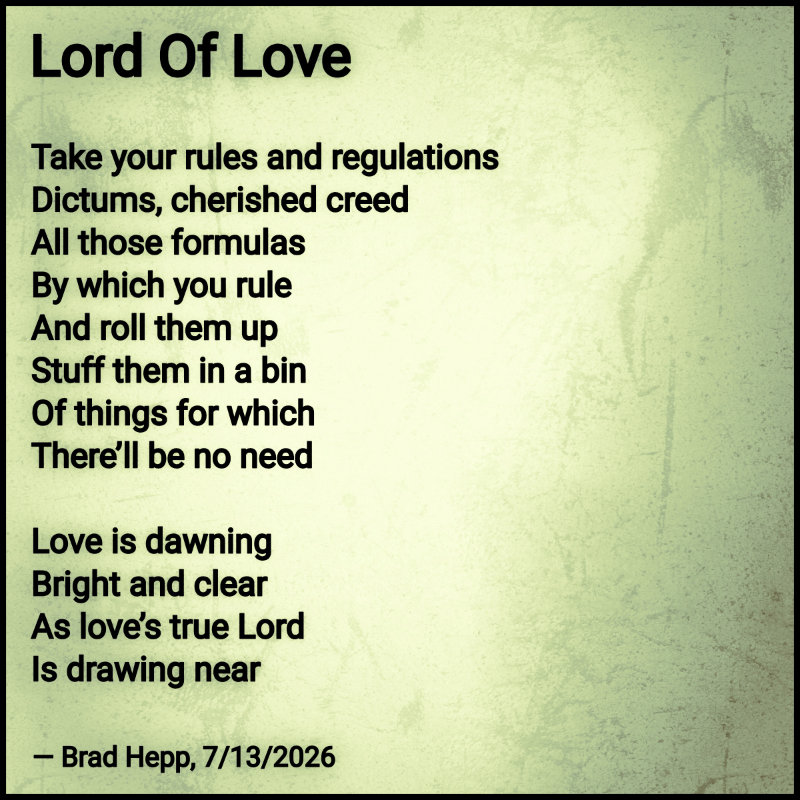
Are correct beliefs important? Yes, but they’re not everything.
This poem may be a little ahead of its time. It describes the direction history is headed. Sadly, some Christians are going the opposite direction. Their calendars are stuck in BC.
“By which you rule” expresses a theory I have about such people: they (claim to) adhere to rules not out of love for the Rulemaker, but because they think their adherence gives them the right to rule over others. Their unspoken motto: “I hold the high moral ground, so I get to call the shots.”
For further consideration…. The poem was inspired by I Corinthians 13, one of my readings this morning. There may be a little Hebrews 1:10-12 in there as well.
(if you are viewing this via email, the website has a recording of this poem and commentary; click the title above)
Commentary
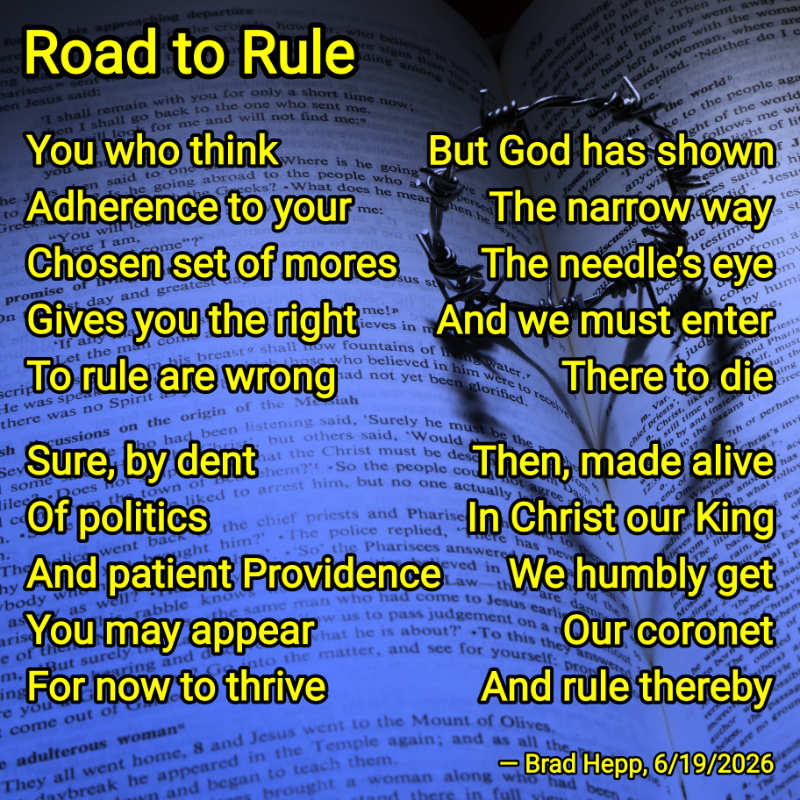
These were the first thoughts out of my head this stormy June 19 morning. I’m thankful to have seen the “in Christ” way exemplified by a few remarkable people* (though rarely in the mirror).
(if you are viewing this via email, the website has a recording of this poem and commentary; click the title above)
Commentary
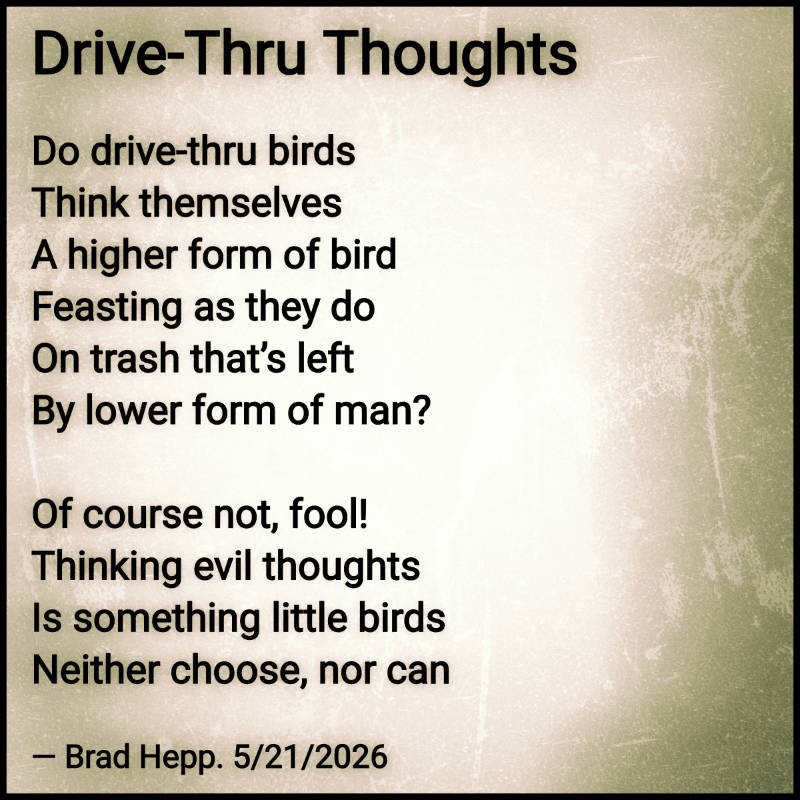
I didn’t have forethought to provide for breakfast at home (moving back in a newly restored house is complicated enough!), so I had to grab breakfast at the drive-thru today. Have you ever watched the birds at a gas station or drive-thru and thought, “There’s something remarkable or sad about what I’m witnessing”?
(if you are viewing this via email, the website has a recording of this poem and commentary; click the title above)
Commentary
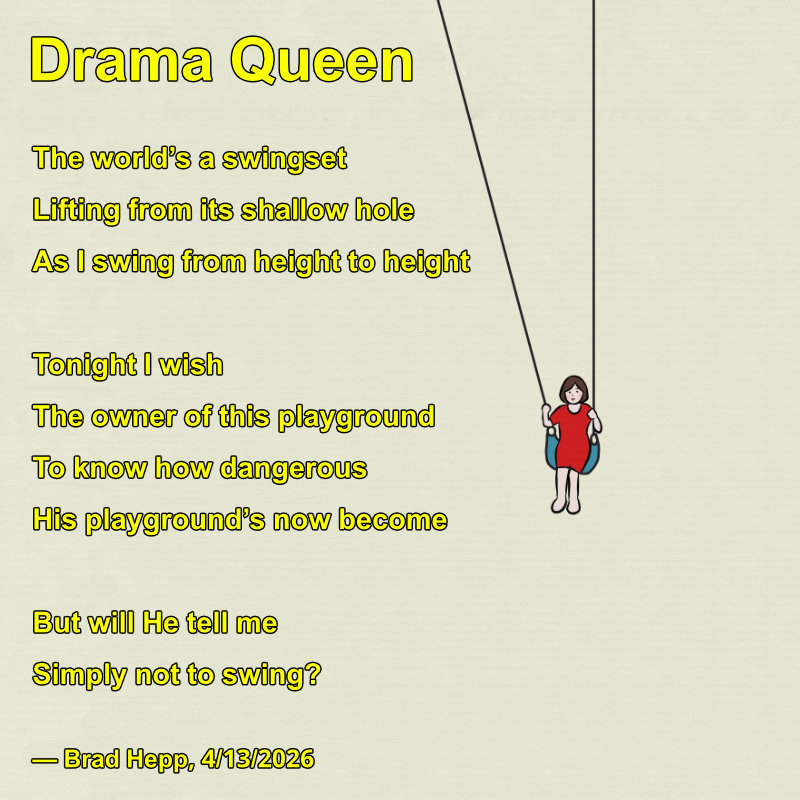
I really have no idea how to explain this poem. But I felt it must be written. Merciful God knows we are but dust.
The Title I’m probably more expressive than your average 65-year-old male. But I doubt anybody would call me a “Drama Queen.” Nevertheless, I sense (more than think) “big emotions” just under the surface as I deal with a mad world and my own stressors. (background image by 鹈鹂 夏 from Pixabay)
(if you are viewing this via email, the website has a recording of this poem and commentary; click the title above)
Commentary
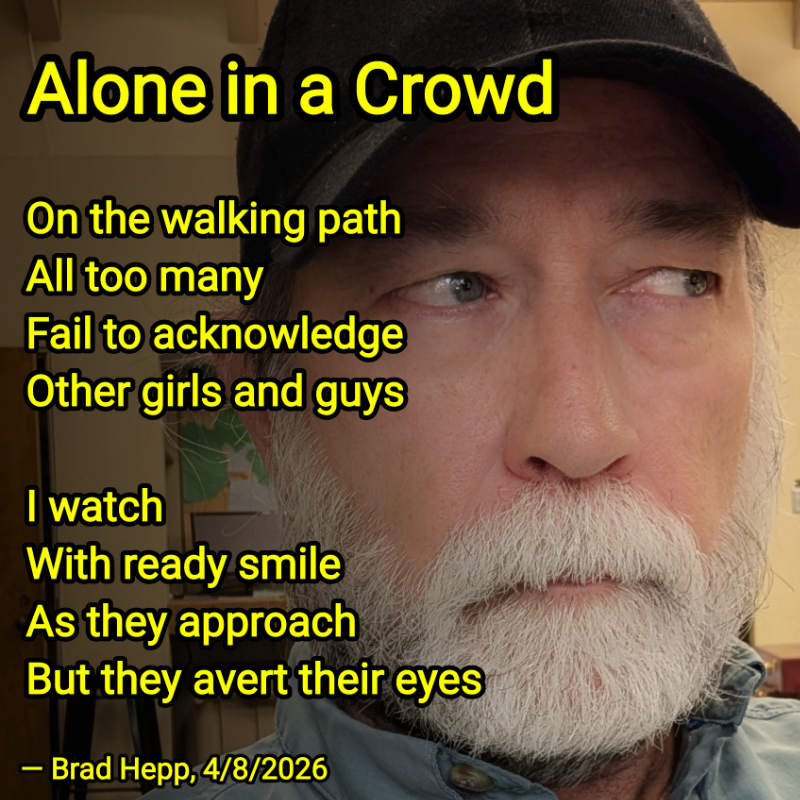
The apartments where we’re living until our house is restored (SOON!) has a great walking path around two ponds. It’s mainly young people there. The few older walkers make eye contact. The younger ones do not. Why?
(if you are viewing this via email, the website has a recording of this poem and commentary; click the title above)
Commentary
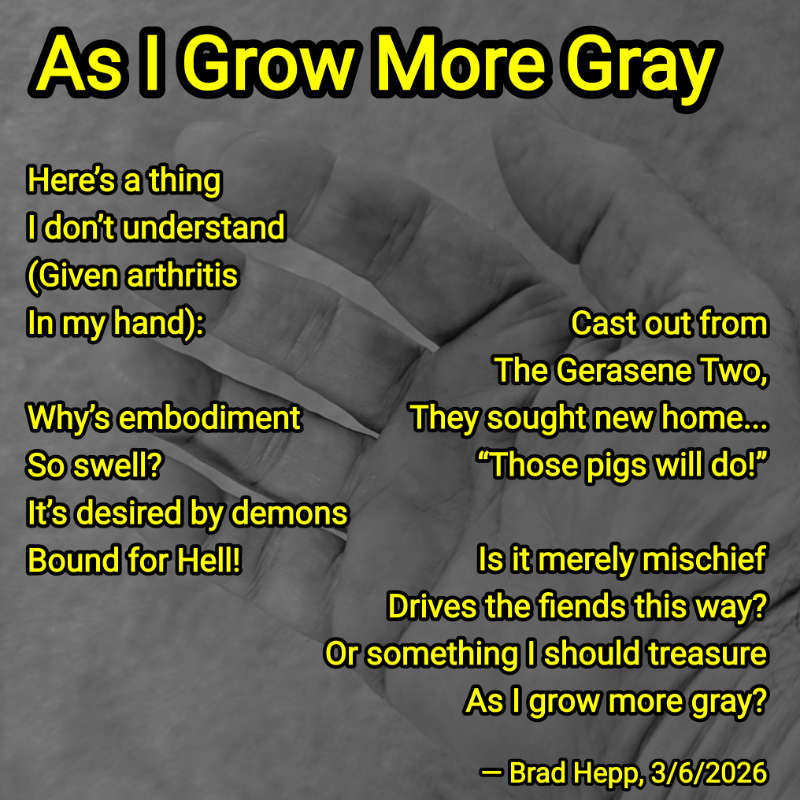
This is one of many questions I think of while listening to Michael Heiser’s “Supernatural.”*
Don’t worry too much about my hands. If I have arthritis, it hasn’t progressed very far. But there are plenty of other signs of aging!
______________ *Heiser is one of several Ancient Near East (ANE) experts I have been reading or listening to in order to better understand the Old Testament writers’ frame of reference. Some of Heiser’s ideas are “out there” but not without merit.
(if you are viewing this via email, the website has a recording of this poem and commentary; click the title above)
Commentary
THIS MAY HURT YOUR FEELINGS
A few years ago, I started recognizing—and preaching to others—how profoundly we are influenced by culture. But it still surprises me to realize how blindly I accepted this or that propaganda as a child. The latest moment of clarity dawned on me as I was reading about the Indian Removal Act of 1830. Could this nation ever have been rich AND righteous?
(if you are viewing this via email, the website has a recording of this poem and commentary; click the title above)
Commentary
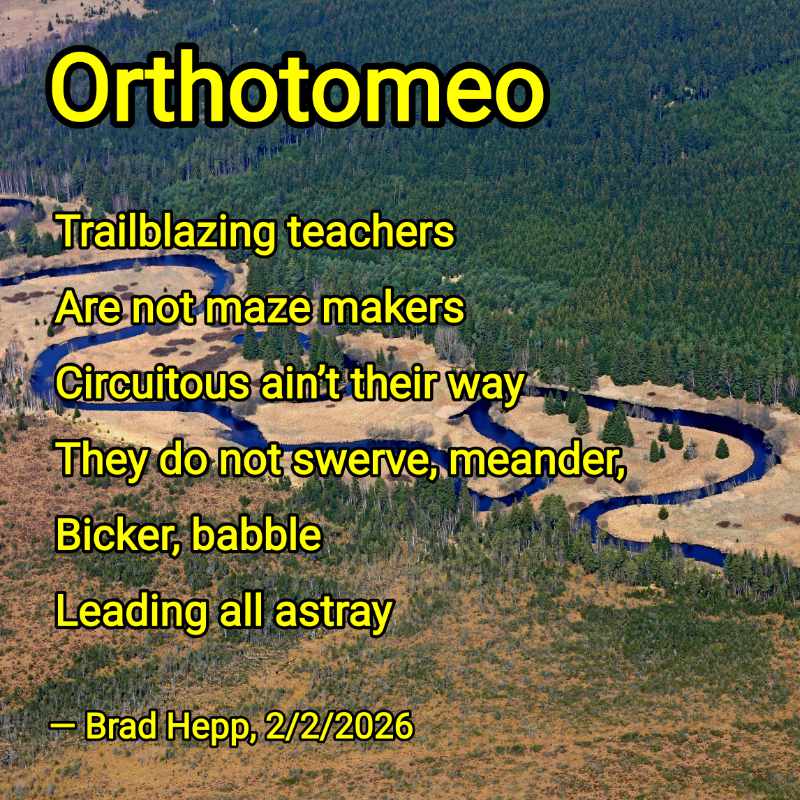
A friend was lamenting that he has met Christians who think the Sermon on the Mount does not apply to Gentile believers. Such people are sometimes emboldened by the KJV rendering of 2 Timothy 2:15, where orthotomeo is translated as “rightly dividing.” For them, that apparently suggests “chopping up” and effectively “cordoning off.” Modern translations are probably better with the idiom: “rightly handling” (ESV), “correctly handles” (NIV), “correctly teaching” (CSB).
What happens when you set aside Jesus’ teaching and example as if it doesn’t apply? We’re seeing so-called Christians in the U.S. throwing around the strangest term: “the sin of empathy.” How could anyone who claims to follow Jesus be so oxymoronic?
ABOUT THE POEM I gave some thought to the three instances of orthotomeo in the Bible. Two are in the Septuagint (Proverbs 3:6 and 11:5), and the third is in 2 Timothy 2:15. Thinking about how the word is used in its context made me break out in poem.
AN ASIDE: “trailblazing” is a word whose etymology I had to study before using it here. I was surprised what “blaze” refers to in the word. It isn’t fire; it’s marking. If you have ever hiked on a path through the woods, you likely have seen “blazes” consisting of cuts in bark. They were left there by someone who wished to lead you in the most direct path possible, NOT in a meandering, circuitous path.
(if you are viewing this via email, the website has a recording of this poem and commentary; click the title above)
Commentary
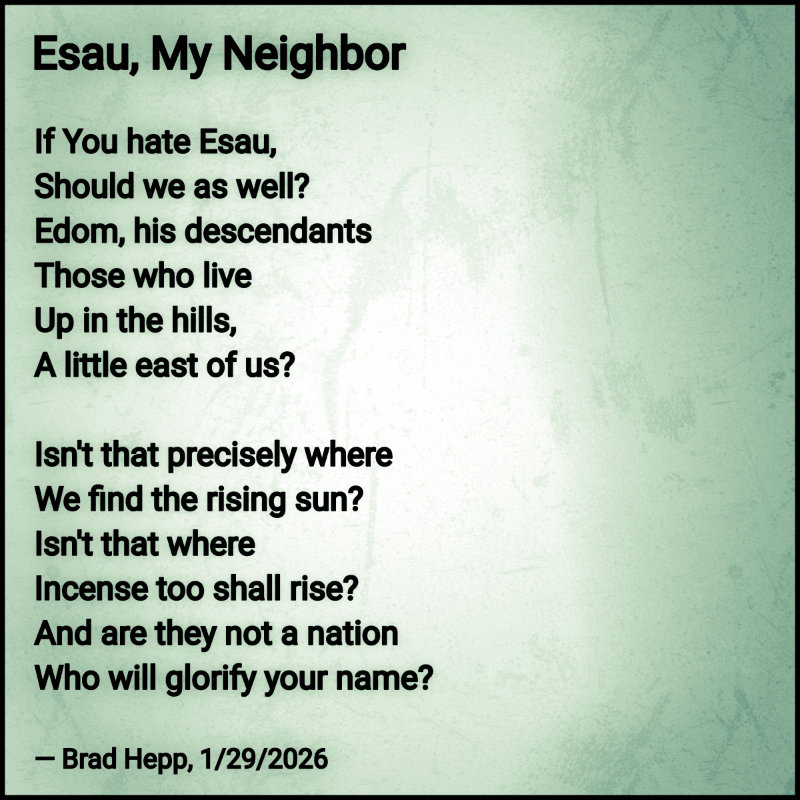
Every morning when I read the “Daily Office” (an Anglican thing I’m learning to use), I’m presented first with Malachi 1:11
For from the rising of the sun to its setting my name will be great among the nations, and in every place incense will be offered to my name, and a pure offering. For my name will be great among the nations, says the Lord of hosts.
I love passages like this, and hints in John (and elsewhere) that Jesus’ being glorified was tied to an ingathering of people from every nation.
I’m impressed that God cares for the foreigner, and wants believers to follow His example.
But nowadays, there are Christians(?) in the United States who think righteousness includes hating foreigners. I wonder if they read about God hating Esau and feel none of the tension that inspired my little poem?
NOTE: I know that teachers will generally downplay the “hating” of Esau as merely God *choosing* Jacob instead of him. But mere choice doesn’t describe what God does to Esau and his descendants (see the first few verses of Malachi).
(if you are viewing this via email, the website has a recording of this poem and commentary; click the title above)
Commentary
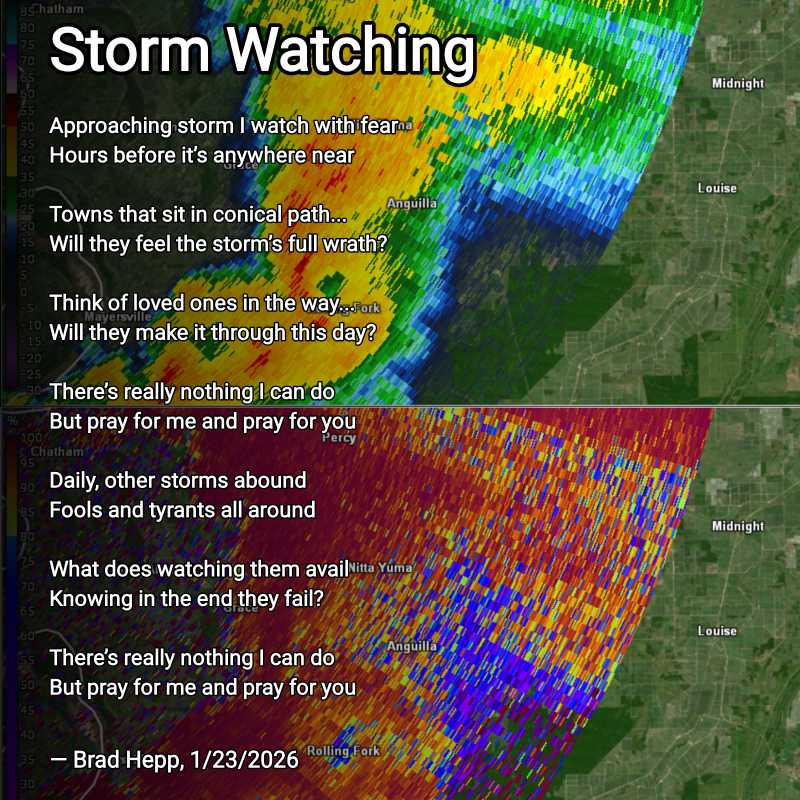
I’m struggling with mental and emotional exhaustion caused largely by being hyper aware of current events on the national and international stage. And I’m torn…. As a citizen in a representative democracy, I have some responsibility to be aware of what’s happening and to exercise what little power I have to influence the course of events. But just how much do I need to know? How often should I check the news? I strongly suspect the world—and certainly I—would be better off if I concerned myself less and prayed more, if I occupied myself more with beauty and less with ugliness.
(background image, from Wikimedia Commons, is of radar tracking of the Rolling Fork, MS EF4 tornado)
(if you are viewing this via email, the website has a recording of this poem and commentary; click the title above)
Commentary
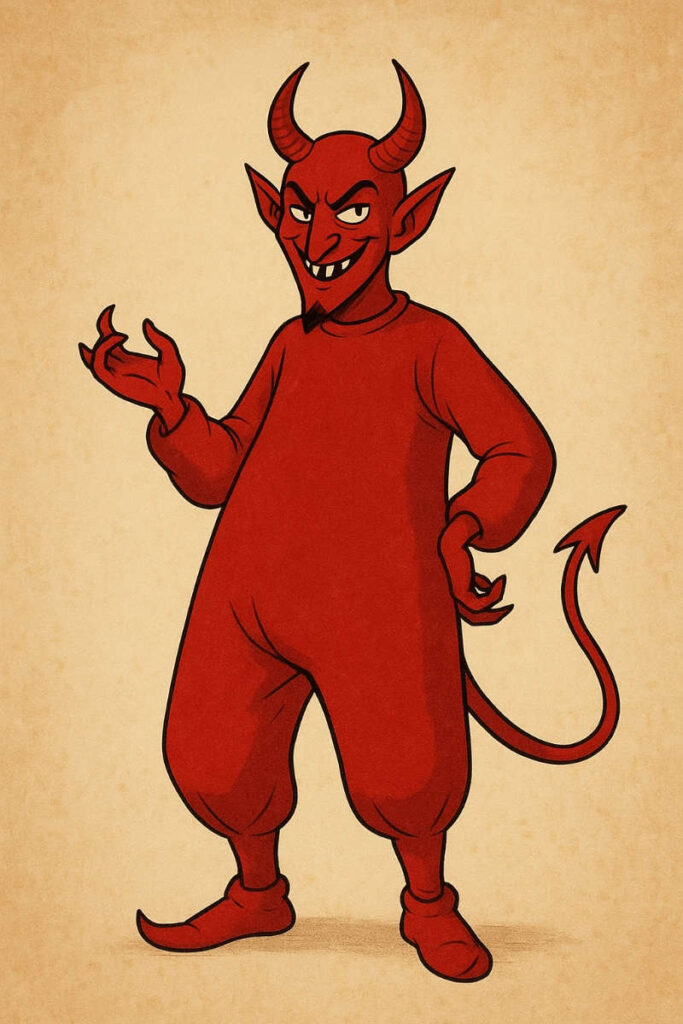
We’re being undone by a man and movement that ANYONE should recognize as unserious, undeserving, and unworthy of power. But, as Hamilton said, “The masses are _______.” Evil likes to think of itself as elegant, but even the Devil’s unitard is baggy. I’m asking ChatGPT to illustrate that…. Here you go:
(if you are viewing this via email, the website has a recording of this poem and commentary; click the title above)
Commentary
One of the most challenging, seeming non-sequiturs in the Gospels occurs in John 12. Why did Jesus care that Greeks wished to meet with Him? Do we? Or are we just looking out for “OUR PEOPLE” (“us,” but especially ME, MYSELF, and I… the unholy trinity)?
(if you are viewing this via email, the website has a recording of this poem and commentary; click the title above)
Commentary
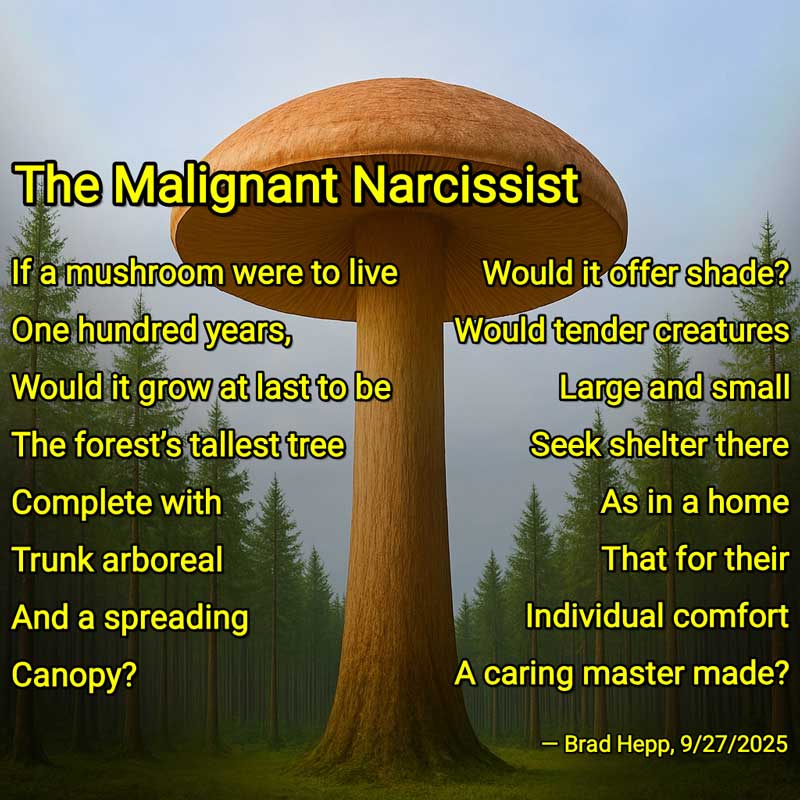
I paused a YouTube video to express this response. The psychologist in the video was talking about a certain malignant narcissist who threw rocks at babies when he was 10 years old. The psychologist lamented that there is no hope for the malignant narcissist, that one never outgrows that disorder.
No disrespect to mushrooms…. It was just the image that came to mind while I was watching the video. Probably for two reasons: 1) I associate degeneracy with fungi and 2) mushrooms have the general shape of miniature trees, but can never “grow up” to serve as trees serve.
ChatGPT obliged me with a background image (one prompt and three refinements).
(if you are viewing this via email, the website has a recording of this poem and commentary; click the title above)
Commentary
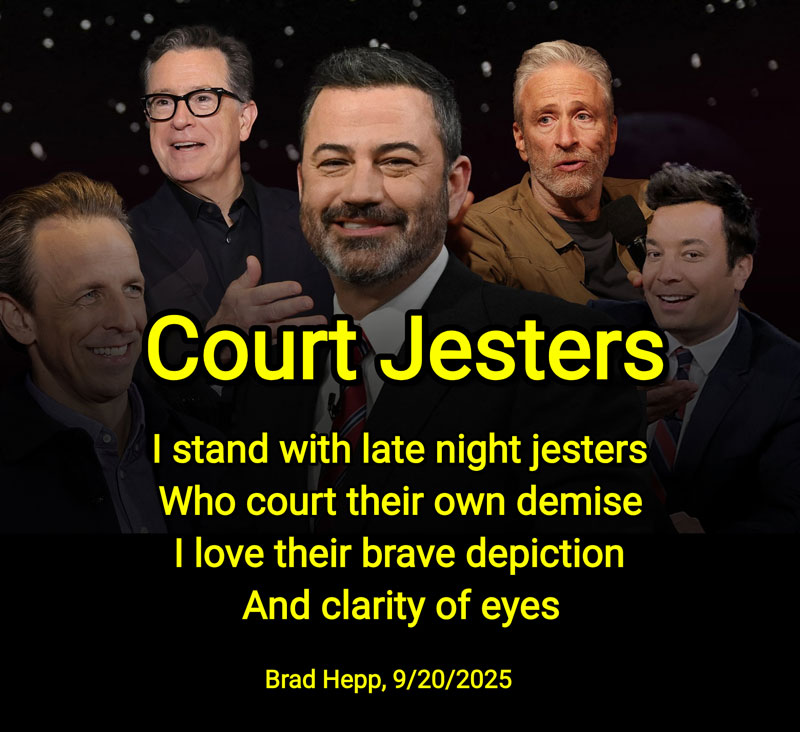
I know this will put me at odds with some friends and family. But who, better than these comedians, is telling the truth about the infantile idiocy in Washington? Prophets, poets, comedians… we have the same duty.
(if you are viewing this via email, the website has a recording of this poem and commentary; click the title above)
Commentary
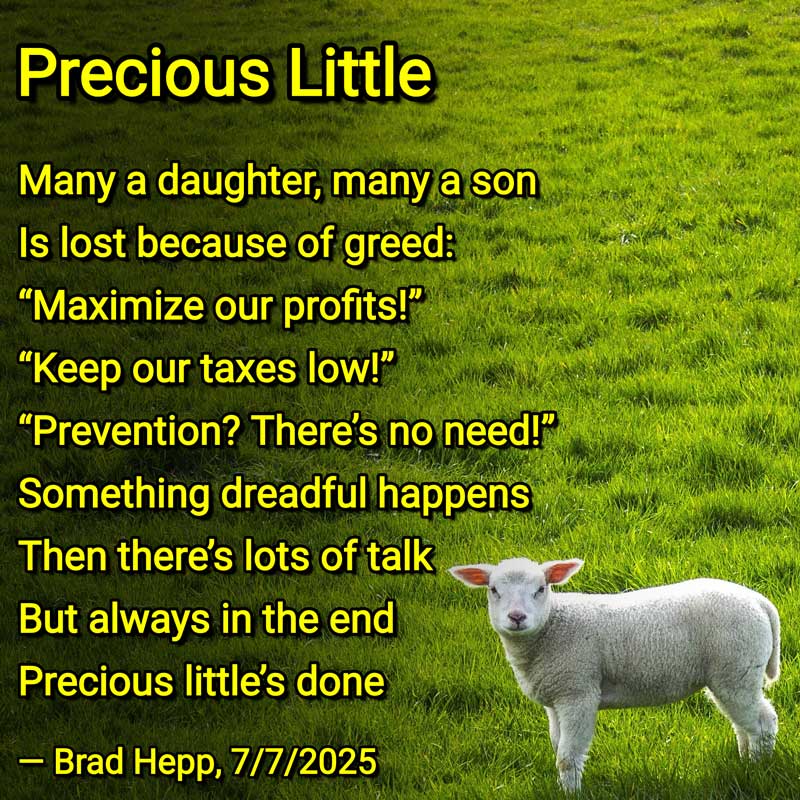
I have held off on posting this poem for two months now. When I wrote it, I was angry that 27 campers and counselors needlessly died when their Christian camp on the Guadalupe River was inundated by flood waters. I had watched news coverage and recognized flooding that happens frequently and predictably in that area of Texas. This time, the death toll rose to 135.
I have watched the response, and learned that people in the area have repeatedly refused to implement measures that would save lives. Now there’s lots of talk. State government has taken preliminary measures. Will anything change? I doubt it.
(if you are viewing this via email, the website has a recording of this poem and commentary; click the title above)
Commentary
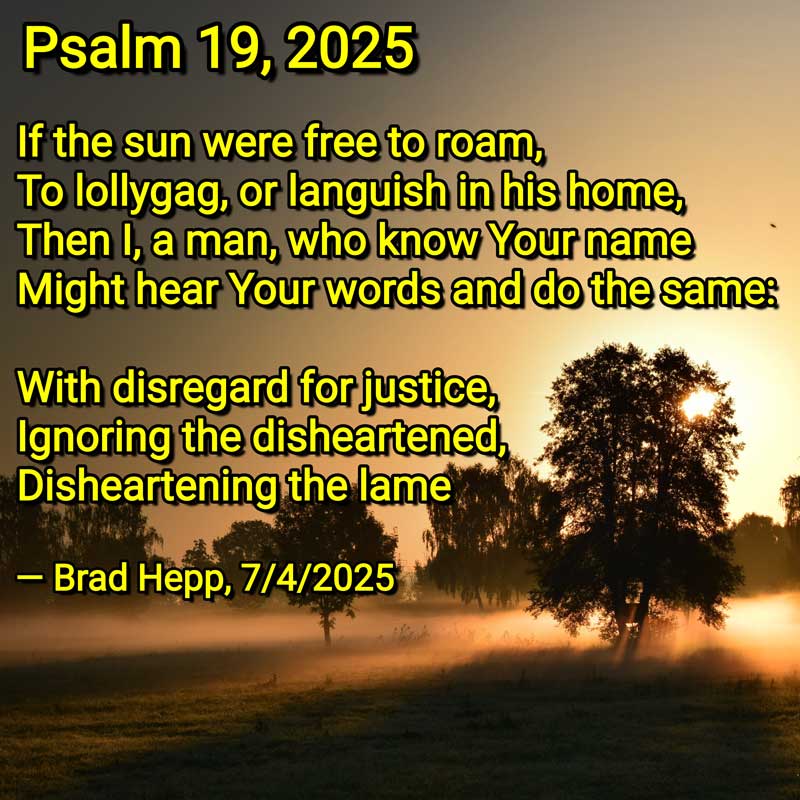
When I read Psalm 19 this morning, I was jarred by a seeming disconnect between the first 6 verses and the remaining 8 verses. What does the sun, in its dutiful, energetic, warming course across the skies have to do with us as we contemplate God’s words?
This poem expresses one possible connection between the parts of Psalm 19, namely that we could learn a thing or two from the sun. Perhaps I am just distressed by the context we’re living in right now. I see a disconnect between God’s words and the way many respond to them in the America of 2025.
(if you are viewing this via email, the website has a recording of this poem and commentary; click the title above)
Commentary
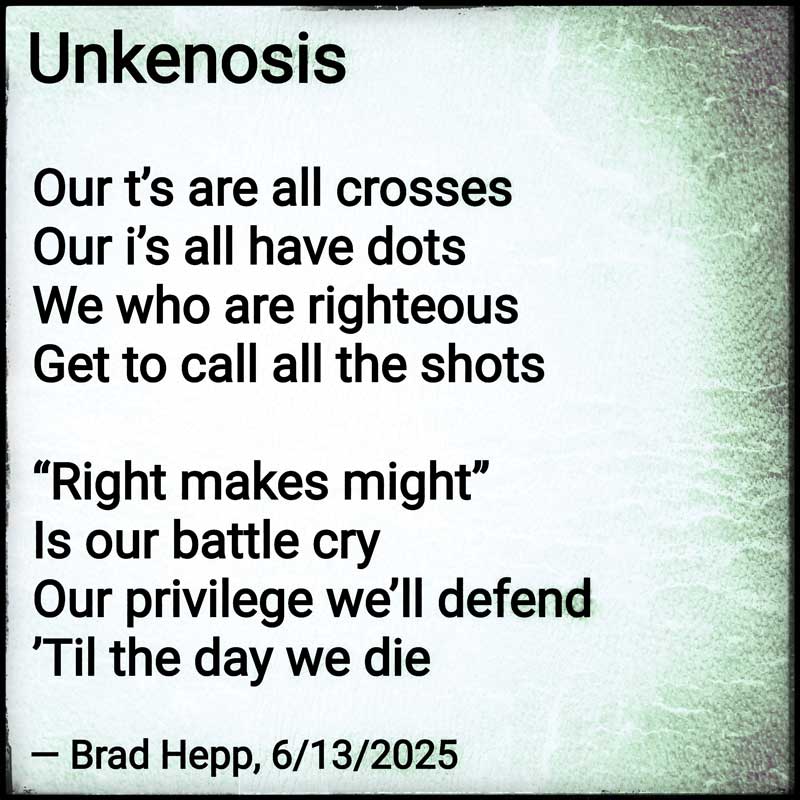
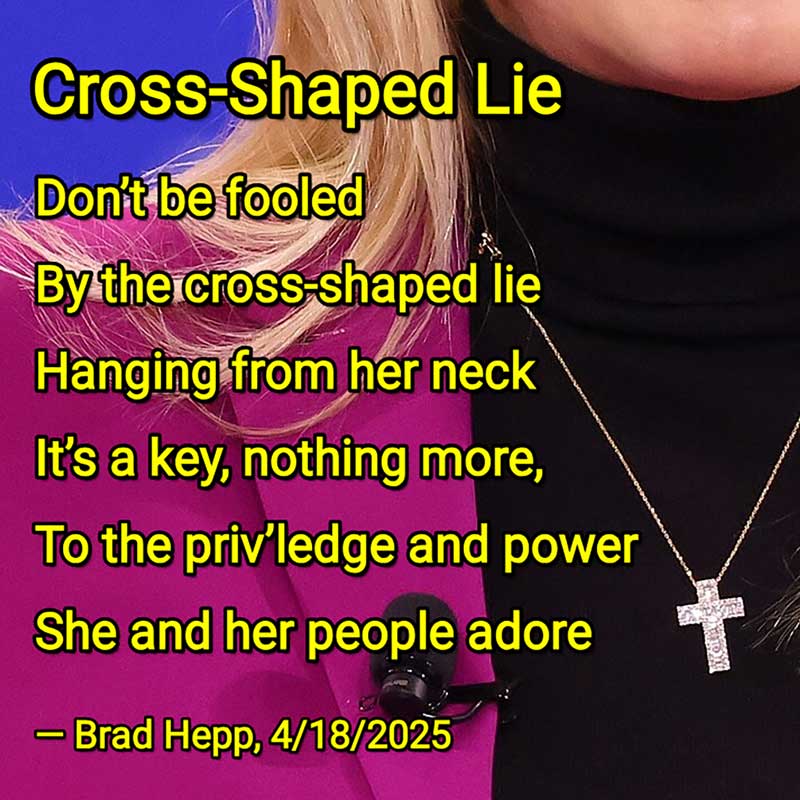
Let me say right off the bat–this poem is sarcastic. I suspect that many people identify with what they think of as good morals and right thinking NOT to please God, but because it puts them in a position of privilege and power over others.
The reason I titled the poem “unkenosis” is that the drive to attain POWER and PRIVILEGE from being “right” is the opposite of the “kenosis” that Jesus undertook in becoming a man and dying on the cross.
Do nothing out of selfish ambition or vain conceit. Rather, in humility value others above yourselves, not looking to your own interests but each of you to the interests of the others. In your relationships with one another, have the same mindset as Christ Jesus: Who, being in very nature God, did not consider equality with God something to be used to his own advantage; rather, he made himself nothing by taking the very nature of a servant, being made in human likeness. And being found in appearance as a man, he humbled himself by becoming obedient to death— even death on a cross!
Philippians 2:3-8 (NIV)
And why did Jesus’ “making himself nothing” (also translated “emptied himself” from the Greek ekenōsen heauton) result in death on a cross?
God made him who had no sin to be sin for us, so that in him we might become the righteousness of God.
2 Corinthians 5:21 (NIV)
It was for our advantage that Jesus was willing to die, taking on the mantle of guilt. We must imitate him, not power-hungry pretenders.
(if you are viewing this via email, the website has a recording of this poem and commentary; click the title above)
Commentary
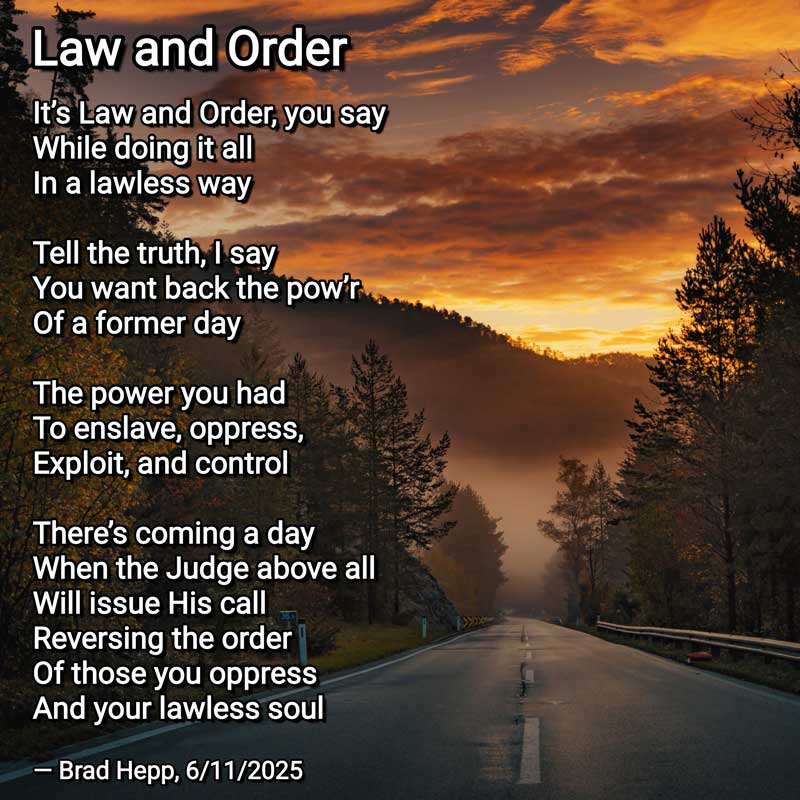
We’re headed for a great upending and reversal.
[2] and he began to teach them. He said: [3] “Blessed are the poor in spirit, for theirs is the kingdom of heaven. [4] Blessed are those who mourn, for they will be comforted. [5] Blessed are the meek, for they will inherit the earth. [6] Blessed are those who hunger and thirst for righteousness, for they will be filled. [7] Blessed are the merciful, for they will be shown mercy. [8] Blessed are the pure in heart, for they will see God. [9] Blessed are the peacemakers, for they will be called children of God. [10] Blessed are those who are persecuted because of righteousness, for theirs is the kingdom of heaven. [11] “Blessed are you when people insult you, persecute you and falsely say all kinds of evil against you because of me. [12] Rejoice and be glad, because great is your reward in heaven, for in the same way they persecuted the prophets who were before you. Matthew 5:2-12 NIV
__________________ (background image by Michael Pointner on Pixabay)
(if you are viewing this via email, the website has a recording of this poem and commentary; click the title above)
Commentary
Some people hold up protest signs. Some people march. I write poetry. This protest may resonate most with people who–unlike most Americans–speak English AND Spanish. An “idiota” is… well, I think you know what that is. There’s been a proliferation of them lately.
(if you are viewing this via email, the website has a recording of this poem and commentary; click the title above)
Commentary
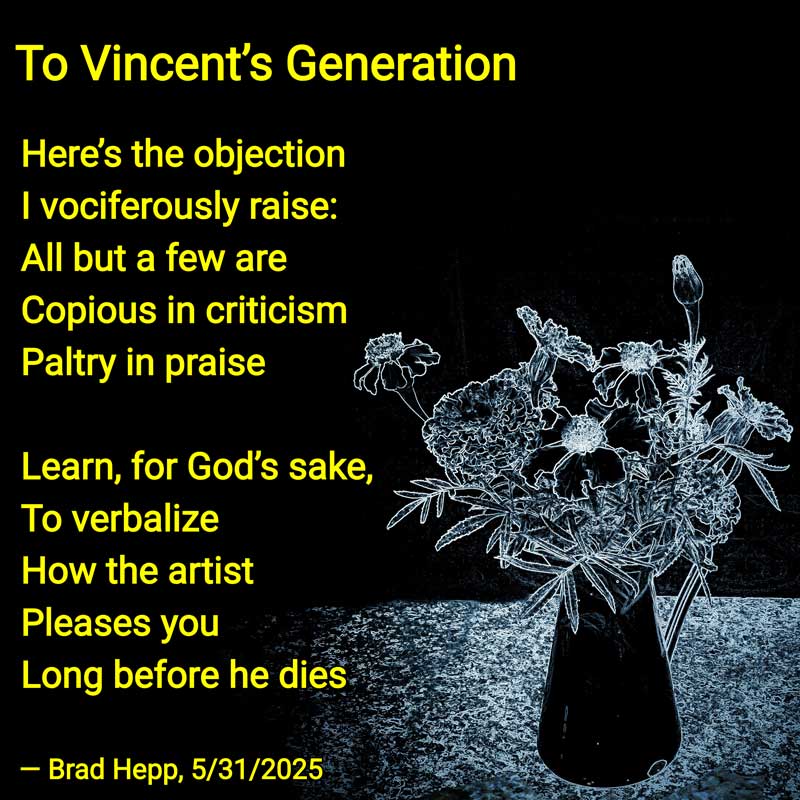
As a poet, I squeeze excess words out of sloppy speech. So my point is almost hypocritical: most of us need to EXPAND on our praise. Consider these scenarios:
The preacher crafts an insightful, well-structured, and persuasive sermon. All we can manage in response is “That was a good sermon.”
The painter captures subtle components of beauty, or depths of pain. We blurt out, “I like your picture.”
The novelist develops believable characters, who give us a mirror for our own unfinished selves. Our eloquent response: “That there’s some good writing.”
Why are we so inarticulate in our praise?
Several possibilities come to mind:
We are lazy or selfish
We don’t know much about the art form, and are afraid our ignorance will show (but we must manage appearances)
We are afraid of expectations: the artist will be sorely disappointed if we don’t lavish praise on her next effort
We are alert to ugliness, but unaware of beauty—when we say something’s good, it just barely cleared the threshold of our beauty detector
How can we do better? That’s not a rhetorical question.
(if you are viewing this via email, the website has a recording of this poem and commentary; click the title above)
Commentary
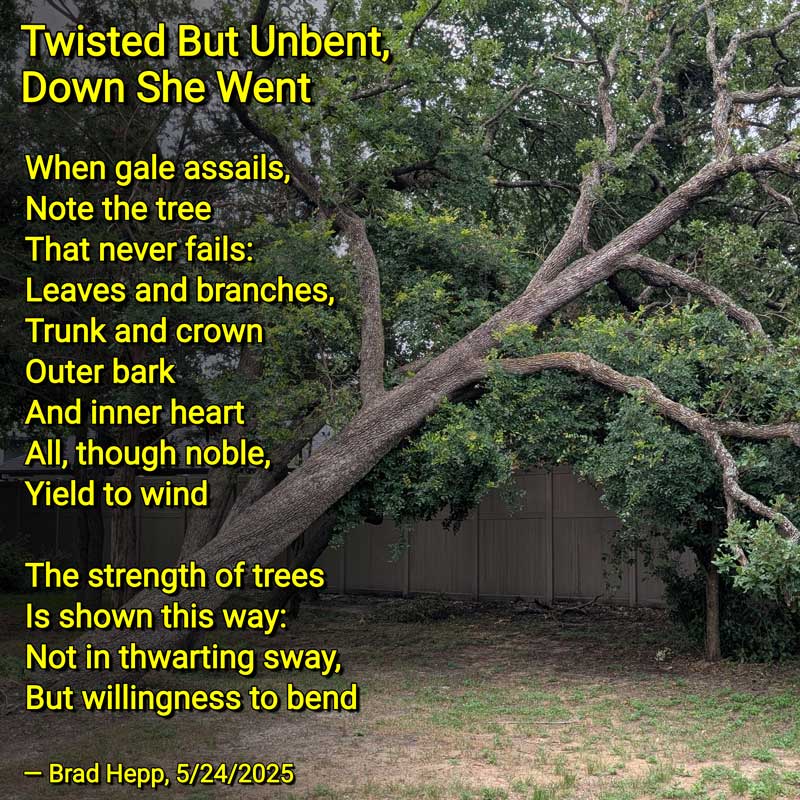
This poem is the first fruit of considering a deliciously ambiguous phrase: “make friends with compromise.”
Can I rehabilitate the various—mostly negative—meanings of “compromise”? How does one befriend it, or befriend with it?
Trees show us one way. Much of their strength is in their ability to compromise. They say, “I’m standing here. But if the wind insists, I can bend, and move over there. The wind will die down, and I will live.”
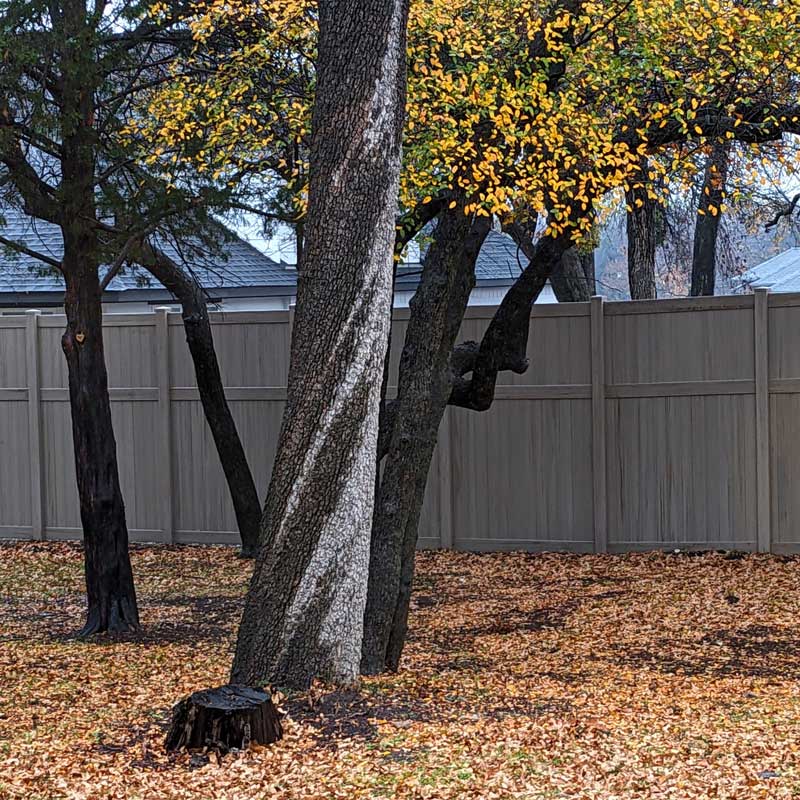
The tree that serves as this poem’s background is behind the library where I work. It got blown down by a strong wind. We’re probably right to guess that its roots were inadequate for the kind of bending it needed that stormy night.
Below is a picture I took of the tree back when it was just twisted.
(if you are viewing this via email, the website has a recording of this poem and commentary; click the title above)
Commentary
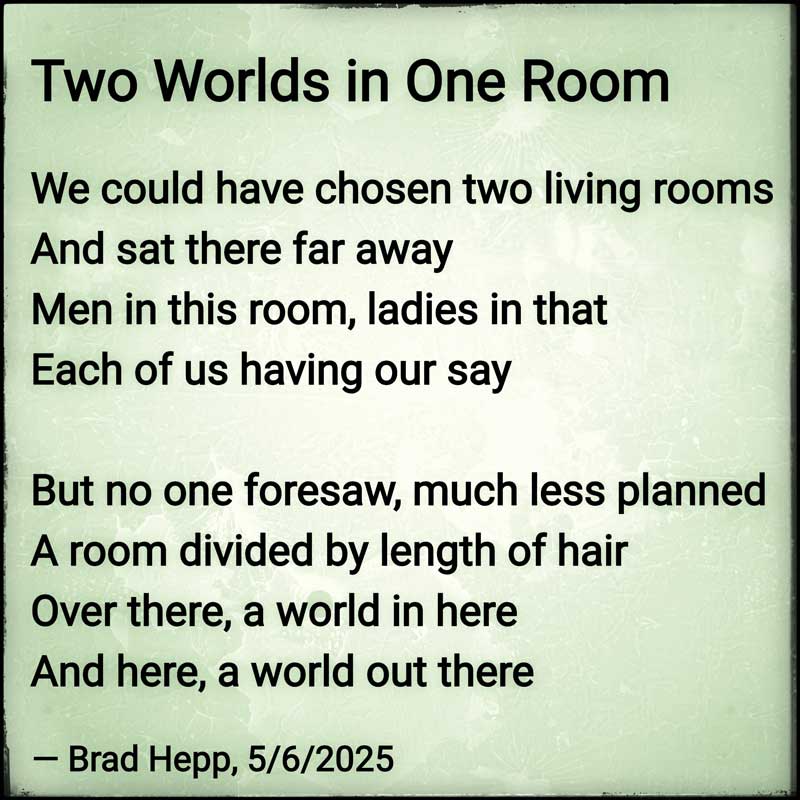
My wife and I attended a lovely party the other day. It was a gathering of dear friends, who have known, loved, and admired each other for many decades. The conversations were encouraging and inspiring. But during much of the party there were two conversations going: men talking with men on one side of the room and women with women on the other. On the drives home, the wives probably all asked their husbands, “So, what were you guys talking about?”
This is not necessarily ideal. Men need women’s wisdom and insights, and vice versa. But it IS interesting to observe how conversations sometimes differ between groups of men and groups of women. Is it nurture or nature? Or both?
(if you are viewing this via email, the website has a recording of this poem and commentary; click the title above)
Commentary
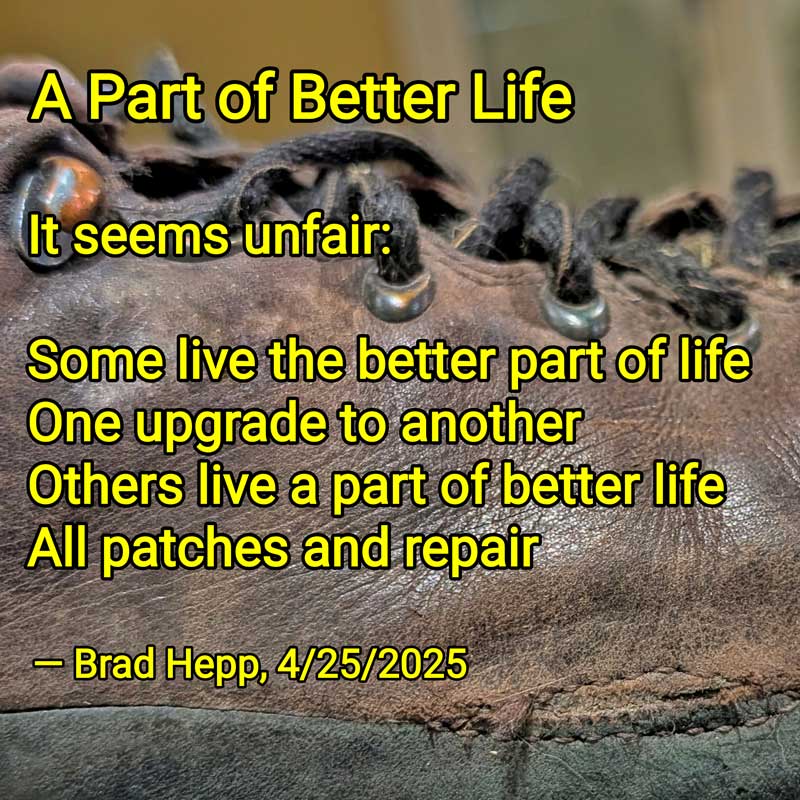
I woke up this morning with the realization that for some people, much of life–“the better part of life”–is just one upgrade after another: a new and better car, a promotion, a bigger house, more money in retirement funds…. So on and so forth. For others of us, life is not so rosy; we can feel like we got the short end of the stick. Something’s not right; something’s not fair. The Psalmist expressed this eloquently in Psalm 73, and included his resolution. I also hinted at resolution by rearranging my words from “better part of life” to “part of better life.” Was the Psalmist’s resolution the same as mine? That’s something for me to think about!
The background photo is of my patched Patagonia hiking shoes. I doubt a better shoe has ever been made! Unfortunately, they got out of the footwear business many years ago.
(if you are viewing this via email, the website has a recording of this poem and commentary; click the title above)
Commentary
“She” in this poem is “Christian” Nationalism. She was revolting to me when I first came to the United States as a ten-year-old, fresh off the mission field. She’s every bit as revolting to me now. Christianity that’s in control, that dominates society, soon ceases to be Christianity. Lord Acton explained it: “Power tends to corrupt, and absolute power corrupts absolutely.”
If you don’t know what “Christian” Nationalism really is, there’s plenty of good literature out there. I personally learned a lot from Matthew Taylor’s “The Violent Take it By Force.“
(if you are viewing this via email, the website has a recording of this poem and commentary; click the title above)
Commentary
When I posted this on Facebook, I noted that “Sadly, this poem will anger some Christians.”
A new FB friend* responded, “If it angers believers, then they don’t want to follow the words of Jesus from Matthew 5. If they aren’t okay with this truth, then they shouldn’t claim to follow the way of Jesus.”
(if you are viewing this via email, the website has a recording of this poem and commentary; click the title above)
Commentary
President Donald Trump, with his usual bombast, has declared that his second term will be a new “golden age” for the country.
CNN, January 21, 2025
One of the few comforting thoughts these days is that we’re witnessing the death throes of a dying beast.
Within a week of the recent inauguration, I wrote the following:
I’m seeing first-hand evidence that foreigners, here in the United States on a thoroughly LEGAL basis, are now hiding. One can say they’re being unreasonable. But imagine what it would be like to have to carry YOUR proof of citizenship or legal status with you everywhere and at all times lest some over-zealous authority arrest you and detain you until… until… until what?!. Wouldn’t happen to you? Why? Because of your skin color?
Have you paid attention to how the recently-installed administration has appealed to fear of the foreigner, of the stranger? How have foreigners–especially people of color–been characterized? (answer: in RIDICULOUS, OUTLANDISH WAYS that appeal to people’s unreasonable fear). Fear breeds brutality breeds fear.
(if you are viewing this via email, the website has a recording of this poem and commentary; click the title above)
Commentary
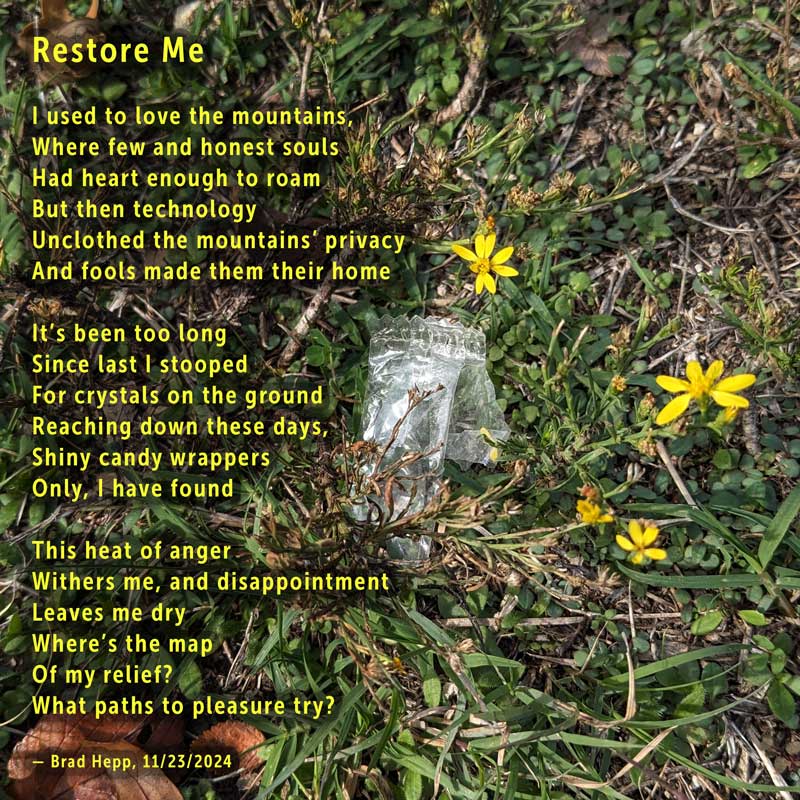
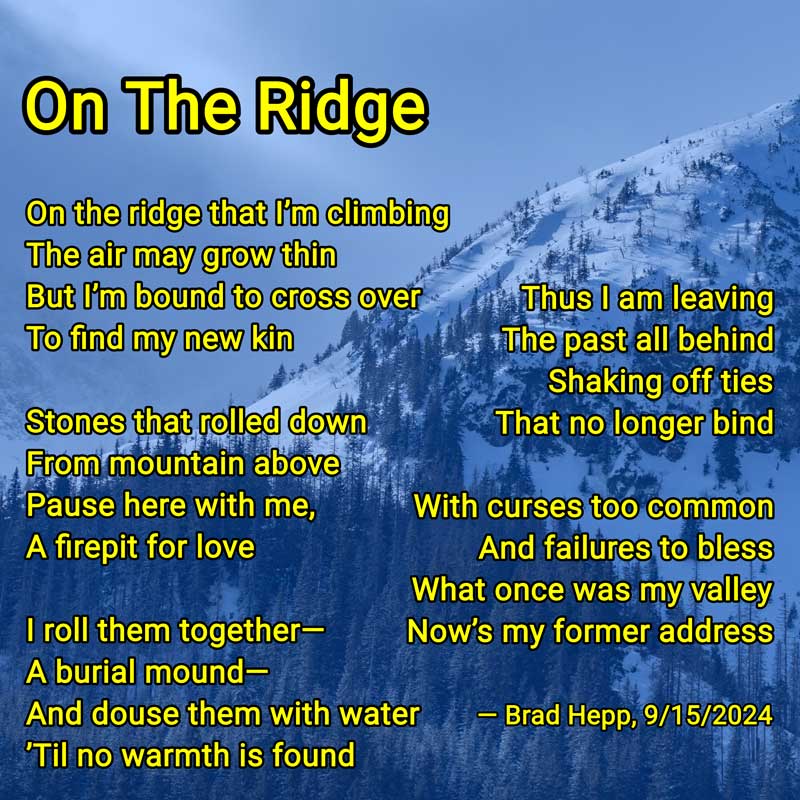
This poem is not about mountain climbing,* or litter, or relief maps. Rather, it is an indirect way of expressing the anger and disappointment that chatters persistently in my thoughts. While I do have much to be thankful for–it IS Thanksgiving morning as I write–I’m finding it hard to escape or ignore disappointments and annoyances. But let me explain the imagery in the poem….
I started climbing mountains over forty years ago. Back then, we didn’t have the Internet to help us plan routes. In the weeks before a climb, I’d take trips down to the Dallas Public Library and spend time with topo maps prepared by the U.S. Geological Survey. I’d spread several maps on the big tables, stand to the side, and view them together to familiarize myself with the general contours of the land surrounding my destination and chosen route. I’d pick out likely camping spots, based on the terrain and water supply. Then I’d mark up my own copies of the maps, circling key points, including landmarks I could use on the trail for triangulating my approximate location.
Climbing mountains was an exciting adventure. There was mystery and danger, even though I prepared in advance. When I got to the mountains–generally with two or three companions–there was also solitude. We’d find evidence of prospectors and hunters who preceded us there by many decades. But we generally had the place to ourselves. The few fellow climbers we did encounter–particularly at higher elevations–were immediately recognizable as kindred spirits. They were honest, hard-working fellow climbers.
As the years passed, the Internet, and GPS, and smart phones opened up the mountains to a whole new group of casual adventurers. When we reached the summit of mountains in latter years, it was not uncommon to encounter a gaggle of college girls in yoga gear, doing yoga poses… bless their hearts. While man–including precious young ladies–is the height of God’s creation, it was vistas of another sort I had climbed the mountain to admire.
Nowadays, the closest I get to mountain climbing is taking long hikes through neighborhoods, fording a busy stream of traffic, and cutting across the fields around White Rock Lake. Bad hearing isolates me from the few birds, but not from the ridiculous rumble and roar of traffic. A terrible floater in one eye and cataracts in both eyes have robbed me of the clear eyesight I have always treasured. Addressing these annoyances is delayed by tight finances. Maybe next year I’ll be a bionic man, but for now I am an active mind shackled in a deteriorating body.
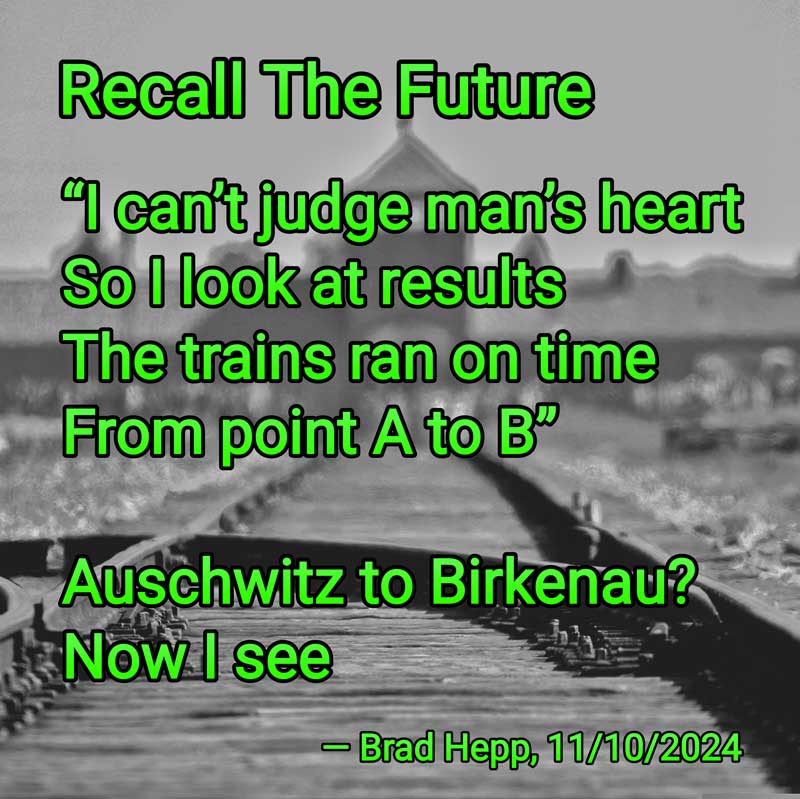
The annoyances I complained about above may be the most manageable of all my annoyances. Last week, I wrote a short poem of complaint about the direction our country seems to be taking: “Recall the Future.” The recent presidential election was extremely disappointing.
BUT BRAD… ISN’T IT THANKSGIVING?! As I mentioned above, it is Thanksgiving morning as I write this. I feel the pressure to end this lament like most of David’s Psalms, with an answer to all my complaining. But right now, I think it’s best to acknowledge where I’m “at”. Perhaps I can consider and even take consolation from a paradox that occurred to me on one of my long walks:
To be increasingly content in this world is a virtue. To be increasingly satisfied with this world, not so.
*[To understand how mountains form the backdrop of my thinking, check out some of my other poems in the category “MOUNTAINS”.]
(if you are viewing this via email, the website has a recording of this poem and commentary; click the title above)
Commentary
This is a bit of conflation, and I’m not going to apologize for that. It’s what we poets do.
[NOTE: I am truly sorry that the following will likely offend some of my friends. If it helps, let me say that this post is NOT about Democrats versus Republicans, or even about Liberals versus Conservatives. Both sides have serious problems!]
I am extremely disappointed that the United States just elected Donald Trump for a second time. The man is a narcissist, rapist,* felon, and shameless liar with fascistic tendencies. I cannot erase the picture of him twiddling his thumbs for three hours while his violent minions brutalized police and ransacked our nation’s Capitol on January 6, 2021. I cannot forget his juvenile insults of everyone who opposes him. I cannot forget how he claims that everything is rigged against him unless he prevails. I cannot forget how he denigrates immigrants (especially if they are people of color), always appealing to our latent racism. I cannot forget the number of times he has claimed that he knows more about any number of things than anyone else. I cannot forget how many cabinet members from his first administration warned us that the man does not belong in the White House. But we know better, right?!
The Poem He’s a bully, and a wannabe “strong man” like those who ruled Germany, Italy, and the Soviet Union in the 1930s. But what percentage of our population know even the basics of pre-World War II history? What percentage of our population recognize how history is repeating itself as we give up freedom and pave the way for tyranny?
I suspect many, if not most politicians DO know the relevant history. But they turn a blind eye to how history is repeating itself. It is their duty to stand up for the rule of law, to uphold the Constitution. But how can they stand up when they are spineless in their self-seeking exercise of power?
*While he was convicted of “sexual abuse,” Federal Judge Lewis Kaplan ruled that E. Jean Carroll’s rape allegation was “substantially true.”
(background image from a photo by Ron Porter on Pixabay)
(if you are viewing this via email, the website has a recording of this poem and commentary; click the title above)
Commentary
When you live in the same neighborhood for 30 years, and are moderately outgoing, you learn who’s pleasant to chat with and who you’d rather avoid. Racism is a huge turnoff, as are complaints like “the neighbor’s sprinkler is getting my grass wet.”
(if you are viewing this via email, the website has a recording of this poem and commentary; click the title above)
Commentary
Isolation and alienation have probably affected my outlook on life far more than I consciously understand. Consider the following from my youth:
My first ten years, I was a gringo living in Mexico; I connected with the handful of other Anglo missionary kids far more than with the surrounding culture
When we moved to a little East Texas town, I didn’t connect with that culture either; my different life experience, religious and academic orientations were off-putting to others and a barrier to fitting in
In the advanced English course in my first semester of college, there were only three of us guys in a classroom of young ladies; that may sound wonderful for the guys, but it continued my theme of not fitting in (to this day, I find few men who appreciate poetry; even fewer who write poetry)
In the decades since, I got along fairly comfortably in white evangelical culture… until my late 50s. Beginning in 2016, and then rapidly accelerating in 2020, I began to distance myself from that culture. Now, I once again feel the isolation and alienation of my youth.
Here’s how that came about…. At the very time I began to recognize selfishness and racism in my own heart, a large majority of white evangelicals began to embrace and trumpet these sins.* When terrible events of 2020 and 2021 afforded opportunities to inspect our hearts and to repent and reform, too many doubled down instead on their love of power and privilege. Their hard hearts led them to hate good men and to love evil men. (Here’s a poignant poem I wrote at that time: “Lord’s Day Vision.”)
Am I blameless in all this? NO! I played a small part in promoting the drive for power and privilege until I saw what I had been doing. Even now, I keep having to bury my former affections, to douse the flame of former loves.
Does this poem make more sense to you now if you read it again with that background? I’d love to know! Comment below (click the poem title if you’re seeing this on email; there’s a comment form on the blog).
A related poem, especially with regard to God’s mercy in reforming us is “To A Misguided Cedar.“
__________
*I say “began to embrace and trumpet….” A better word may be “revealed.”
(background image cropped and tinted from a photograph by Peter Balog on Pixabay)
(if you are viewing this via email, the website has a recording of this poem and commentary; click the title above)
Commentary
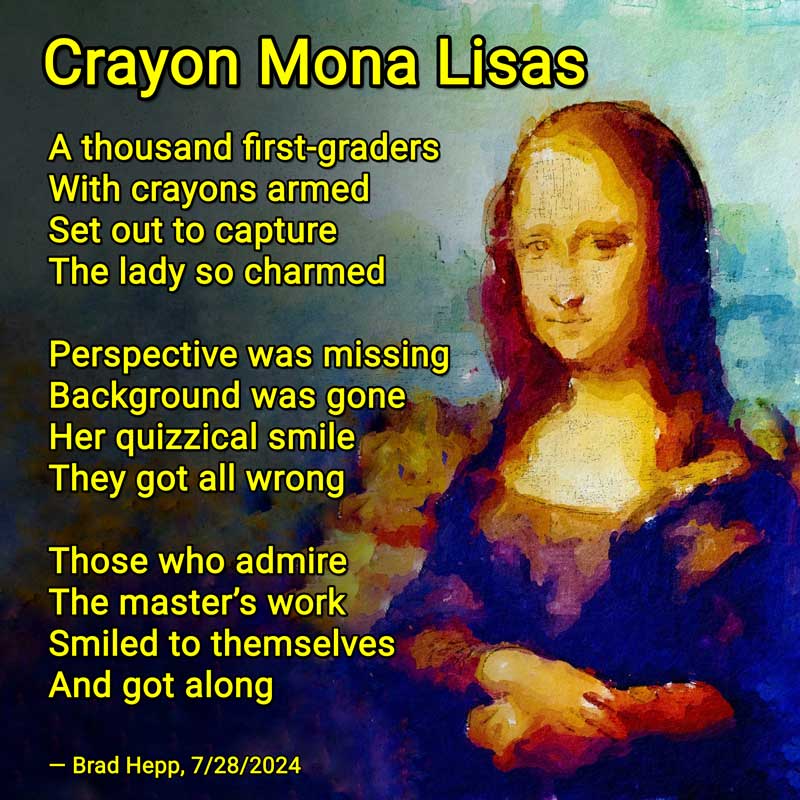
This poem was prompted by current events. There’s a debate raging right now on social media about whether or not an event at the Paris Olympics was a blasphemous depiction of the Last Supper. Apparently there were some similarities between the Paris event and Leonaro da Vinci’s painting “The Last Supper.” However, some of my sources who are most savvy concerning history and art are suggesting that the Paris tableau vivant (assuming that’s what it was–I haven’t bothered looking) was actually a depiction of Greek mythological motifs. In this post, that doesn’t matter. There’s something more important.
Having learned misdirection from my magician (and theologian) father, I thought I’d cast the question about blasphemy in a less religiously-charged da Vinci painting: “The Mona Lisa.” In this poem, I’m exploring the question, “What IF pagans misappropriate or misrepresent Christianity. Should Christians take offense? Should we wag our fingers and say ‘Don’t you DARE insult our Lord in this way!'”
GOT ALONG My answer is in the last stanza of the poem. We who know what was happening at Jesus’ last supper with his disciples should not get bent out of shape if someone misrepresents that event. The truth is not in any danger. All of eternity will vindicate Jesus’ goodness, and our decision to follow Him.
After writing the poem, I was tempted to change “got along” to “moved along.” For two reasons, I am resisting that temptation. “Moved along” would suggest that the knowing adults in the story just leave the scene. But that’s not what I wish Christians would do when we encounter supposed threats to Christianity. In the current kerfuffle, we have the opportunity to engage non-believers in a positive way–to get along with them for everyone’s benefit. Study C.S. Lewis and consider how mythology is answered by Christ, how pointers to a feast WILL be fulfilled in time and eternity. That’s the first reason. Honestly, the second reason is simply that I have to trust my subconscious when it comes to writing poetry!
NOTE: SINCE I HAVE YOU HERE, HAVE YOU CHECKED OUT MY PAGE OF “BRAD’S FAVORITE POEMS“?
(if you are viewing this via email, the website has a recording of this poem and commentary; click the title above)
Commentary
For now, I’ll just copy what I wrote on Facebook:
Susan tells me she’s glad I find comfort in writing. I think it’s called lament.
I don’t know about that last line. How can death be a disease? I tossed down this whole poem almost intuitively, not thinking deeply about my word choice. When that happens, I tend to trust my subconscious. There may be more there than meets the eye.
#changeordie #resistingchange #preferringdeath
(background image by Fernando Zhiminaicela on Pixabay)
(if you are viewing this via email, the website has a recording of this poem and commentary; click the title above)
Commentary
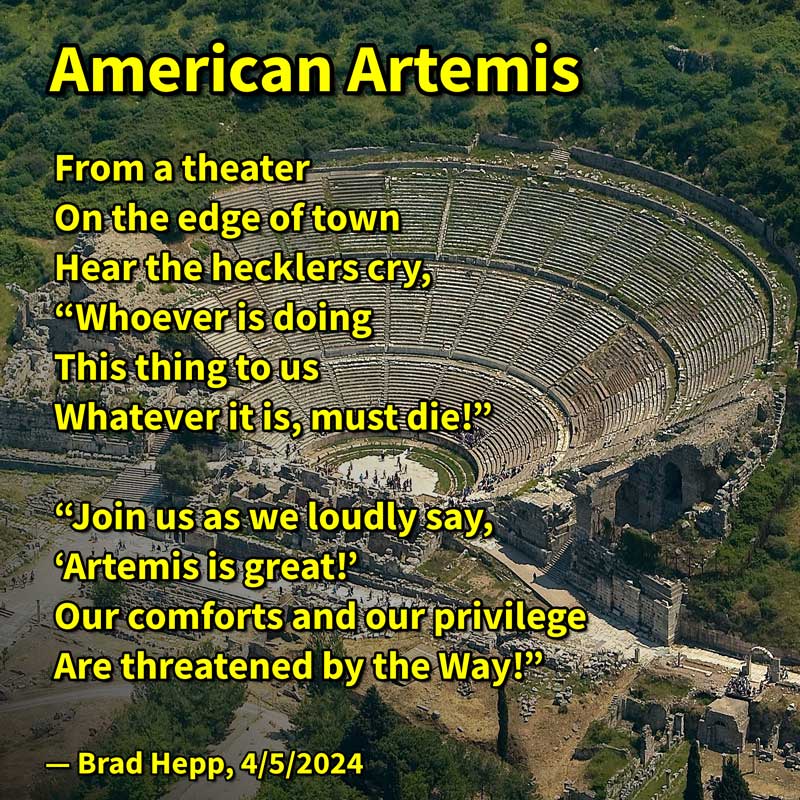
This poem comes out of reading Acts 19 (the riot in Ephesus), and contemplating what 21st-century white evangelical Christians could glean from the story.
Wouldn’t it be something if the Way actually threatened OUR comforts and privilege as it did the pagans in first-century Ephesus!
Consider this last paragraph from a 2019 piece by Washington Post columnist Michael Gerson:
Many white evangelical Christians hold a faith that appeals to the comfortable rather than siding with the afflicted. They have allied themselves with bigots and nativists, risking the reputation of the gospel itself. And, in some very public ways, they are difficult to recognize as Christians at all.
(if you are viewing this via email, the website has a recording of this poem and commentary; click the title above)
Commentary
Susan sometimes urges me to be patient with people who have not evolved in their thinking over the last few years. After all, I was in my late fifties before I even started examining and adjusting some major facets of my life….
But is that fair? Have the past few years really not shown us enough selfishness, inhospitality, and bigotry in ourselves and our neighbors that DEMANDS reformation?
(Background image: the trail above Norbuck Park. I took many a contemplative walk on this trail after being introduced to it by a man who wouldn’t change his ways.)
(if you are viewing this via email, the website has a recording of this poem and commentary; click the title above)
Commentary
My blood pressure was elevated this morning after the fitful sleep of a poet interpreting his world through metaphor. How fitting that I landed on a medical diagnosis.
THE IDEAL THAT IS SHORTCHANGED BY AUTOIMMUNE DISEASE:
So Christ himself gave the apostles, the prophets, the evangelists, the pastors and teachers, to equip his people for works of service, so that the body of Christ may be built up until we all reach unity in the faith and in the knowledge of the Son of God and become mature, attaining to the whole measure of the fullness of Christ.
(if you are viewing this via email, the website has a recording of this poem and commentary; click the title above)
Commentary
This poem may sound playful, but it really is a lament.
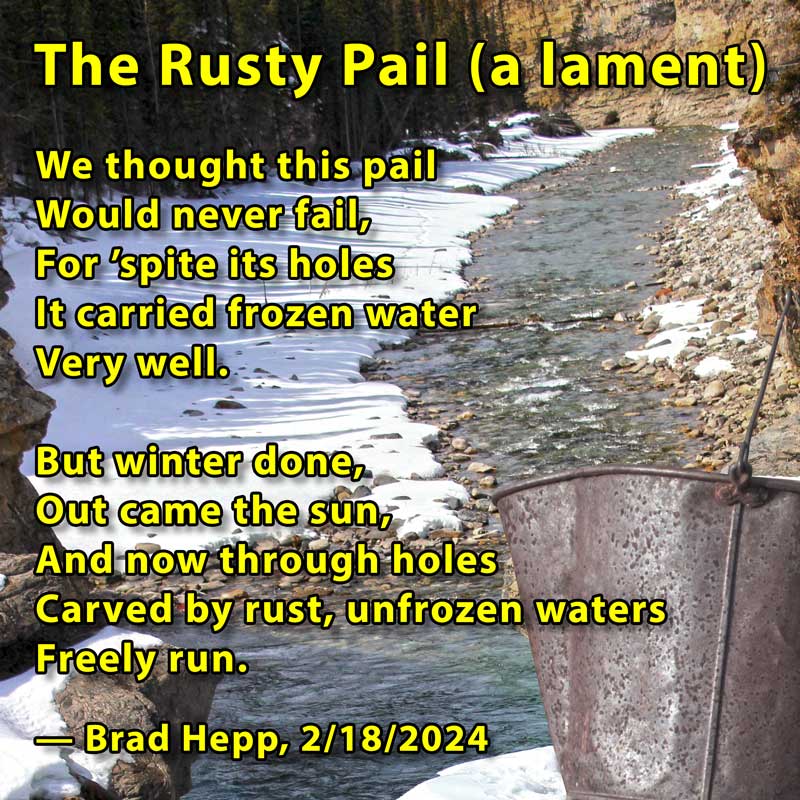
I listen to the podcasts of an Evangelical pastor who is working through his former allegiance to Evangelical beliefs and practice. He, like many of us, is distressed by the behavior of Evangelicals–make that White Evangelicals–in the past few years. Since our behavior has been so horrible, we’re forced to question our beliefs. One of his recent podcasts examined a belief that I still hold somewhat dear. Somewhat. Frankly, I am conflicted. The image of a leaky bucket came to mind as I considered my loss of confidence in this cherished belief.
I’m not going to go into details about the particular belief. Nor am I going to argue with anyone about what I perceive as horrible behavior by White Evangelicals. I’ll leave arguing for people who are good at it. The Holy Spirit is probably more convincing than I am. Right?
(background image is a mashup of the pail, by omnigrapher2016, and the stream, by lalami78, both on Pixabay)