(if you are viewing this via email, the website has a recording of this poem and commentary; click the title above)
Commentary
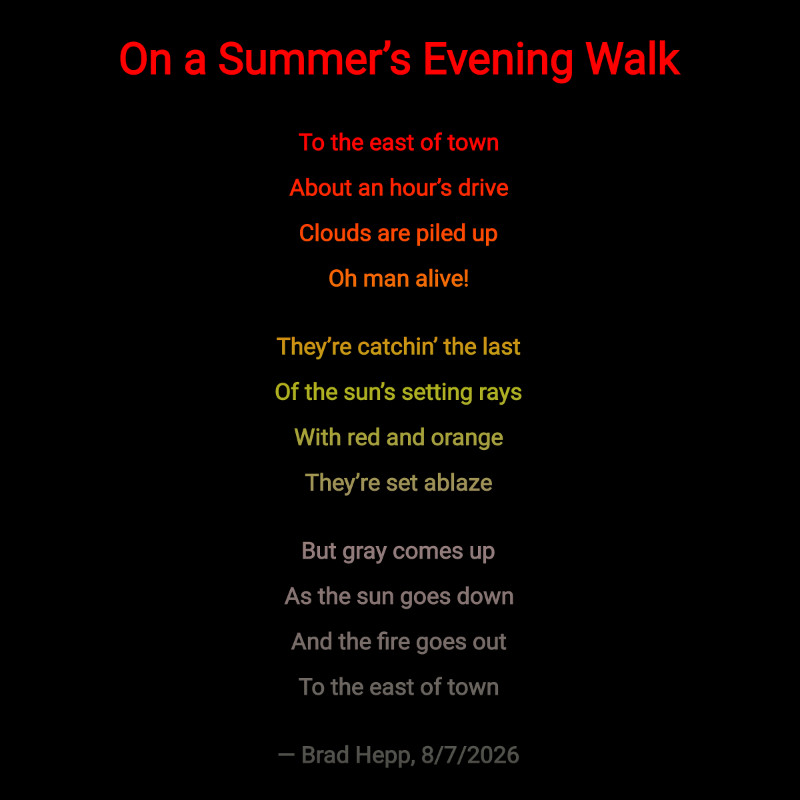
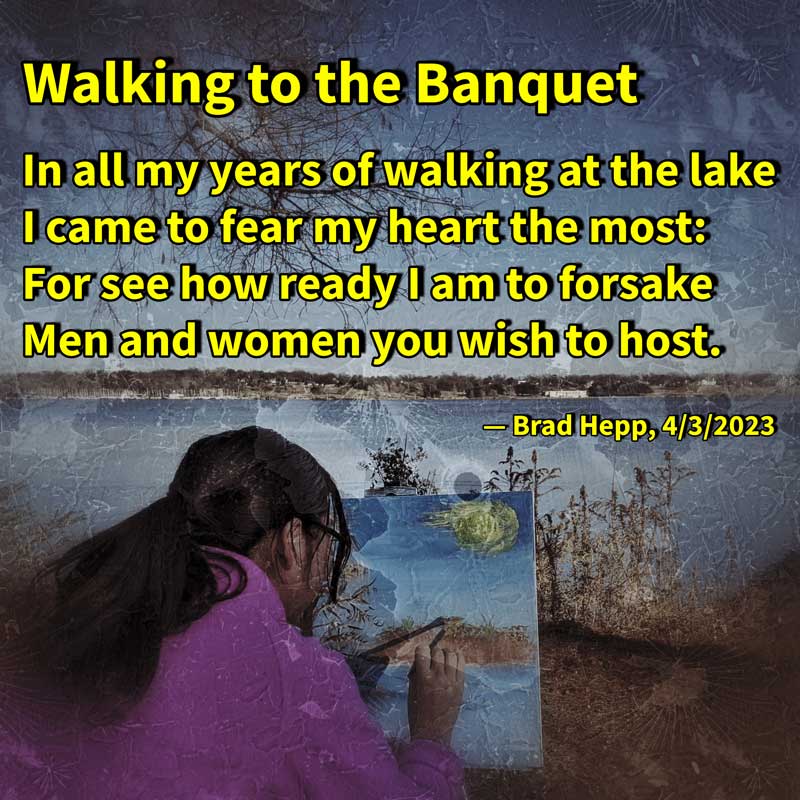
For some reason, I remember the missionary lady rebuking eight year old Bradley for exclaiming, “Man alive!“ Something about blasphemy and the Resurrection. But my own parents—who looked forward to the Resurrection more than most—never objected. This poem captures the sequence I observed on my evening walk. Gray goes to black…and then a new day!
The play of verbs and prepositions in the third stanza was reminding me of something. Turns out it’s Frost in “Nothing Gold Can Stay.”
(if you are viewing this via email, the website has a recording of this poem and commentary; click the title above)
Commentary
SOMEONE REQUESTED DOGGEREL?
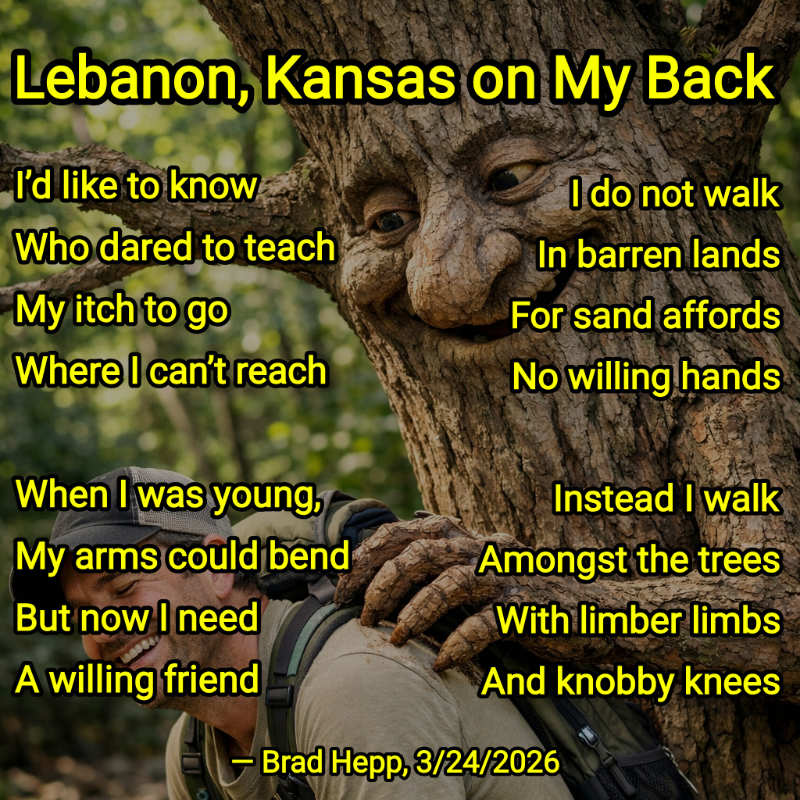
The last few times I went for a walk, I got an itch right in the middle of my back. As you can imagine, I was looking around for a sign post or someone’s tree to “give me a hand” in scratching that inaccessible itch.
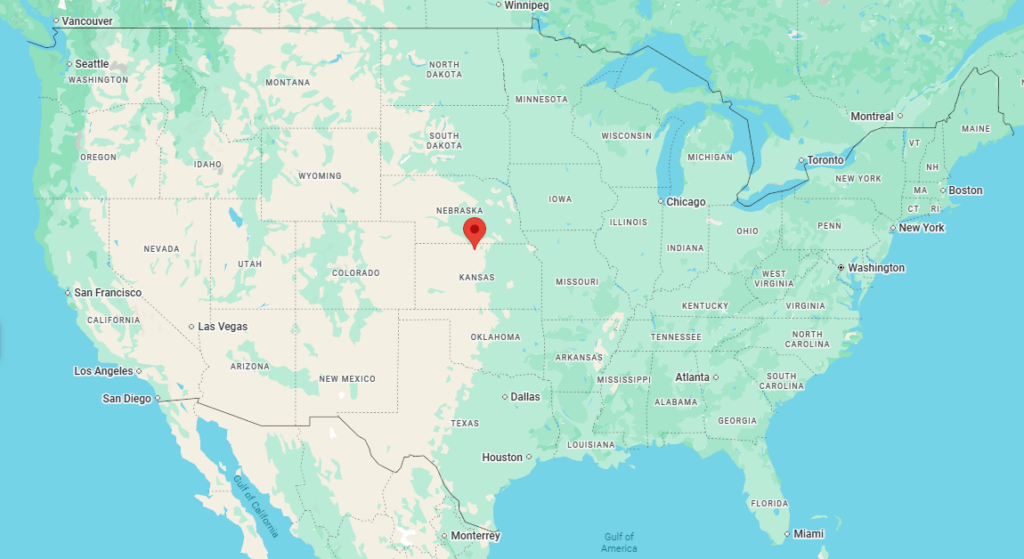
Lebanon, Kansas: geographical center of the 48 contiguous US states. If our country had an itch in Lebanon, Kansas it would have trouble reaching there to scratch.
(Image supplied by ChatGPT based on my prompt, “Make a picture of a tree scratching a hiker’s back to relieve an itch.”)
(if you are viewing this via email, the website has a recording of this poem and commentary; click the title above)
Commentary
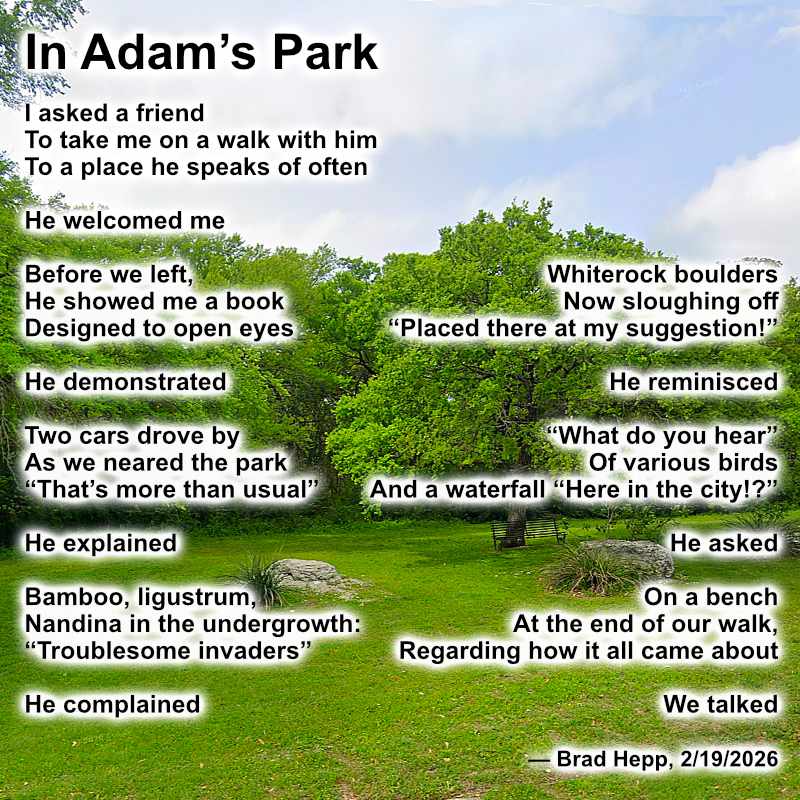
In Adam’s race It’s an honored place To see another’s world
If you know someone who has a garden, or paints, or makes music, or decorates, or writes, ask them to show you their world. You’ll be glad you did.
March 11 Addition When I sent this poem to my friend Rich Milne (“Adam” in the title), he wrote a quick response (Rich writes poetry as easily as most of us breathe). His response exemplifies friendship and hospitality. In my book, “hospitality” includes a bending of one’s mind to another’s thinking. And that is what Rich did by writing of the same occasion in a similar and complementary style. Here, with Rich’s permission, is his response:
(if you are viewing this via email, the website has a recording of this poem and commentary; click the title above)
Commentary
Something’s gotta change. My brain is turning to mush, and my heart isn’t far behind. Fortunately, I recall better days, so I know what’s possible. The One who walked with me then is merciful and kind. So, to Him goes this heartfelt prayer…. (the photo is one I took back in 2019, on one of my frequent long hikes)
(if you are viewing this via email, the website has a recording of this poem and commentary; click the title above)
Commentary
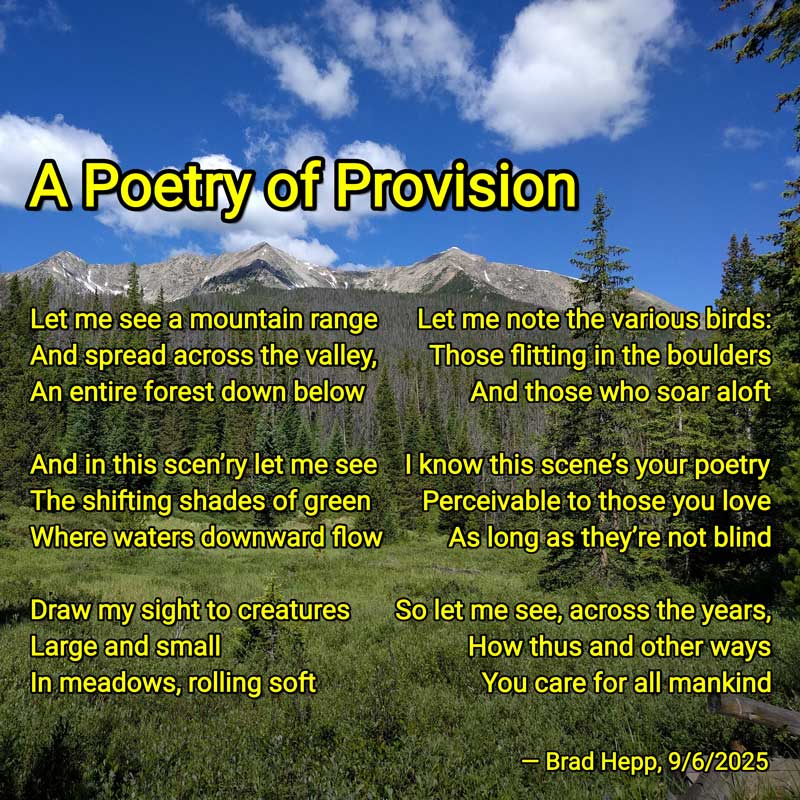
Lately, in reading the Bible and its interpreters, I have felt the need to better perceive God’s patterns of provision. In the big picture I hope to find strength for the grind of this day’s particulars.
(the background image is from a hike between Breckenridge and Frisco in Colorado)
(if you are viewing this via email, the website has a recording of this poem and commentary; click the title above)
Commentary
I think I should start a new category under Poetry Themes. I’ll call it “Experimental.” This poem belongs in that category.
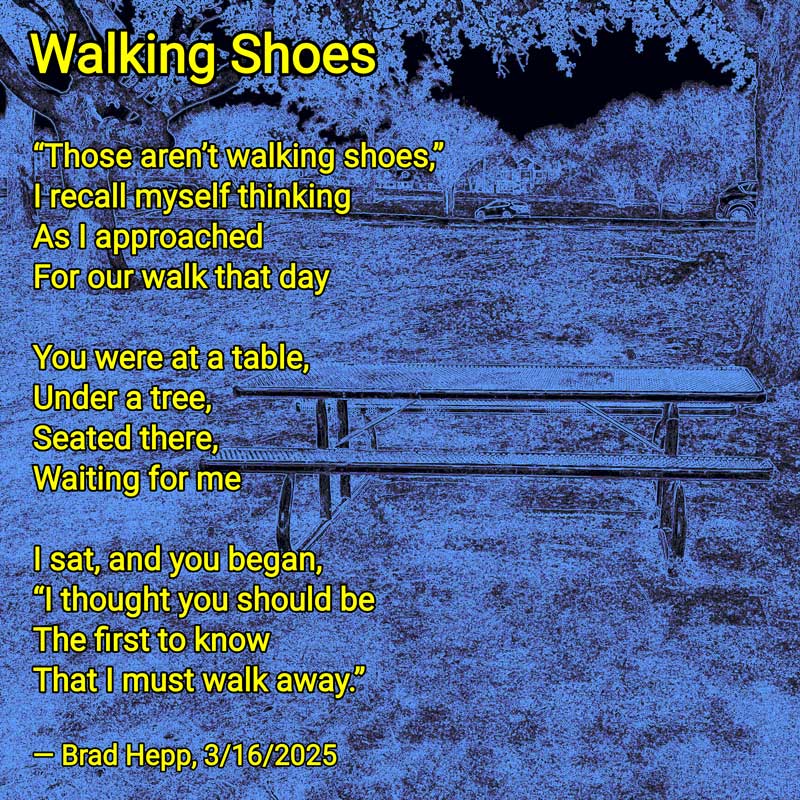
Recently, I noticed that specific locations get attached to my memory of significant conversations (see “Entertaining Possibilities“). In today’s poem, I explore how an object gets attached in the same way, in this case, “walking shoes.” There’s a particularly poignant memory I have of a conversation with a friend. He/she had come to the realization that they must leave–“walk away from”–something they loved. We were meeting for a casual stroll, but as I approached our rendezvous point, I could tell from a distance that something was amiss. My friend was wearing dress shoes, not walking shoes.
I set out to write a poem about that memory, not knowing where it was going to go, except that I must guard my friend’s privacy. By the end of the third stanza, I had told all I felt safe telling. Was it enough? Would the reader be upset that I ended so abruptly, and without resolution? I don’t know. I’m still thinking about that. Comment below, if you have an opinion.
Here’s another question that this poem raises for me: Does the mind routinely intermingle literal and figurative meanings (in this case, two uses of “walk”)?
Children explore their world and the questions it raises by playing. I’m “all grown up,” but I still explore my world by playing in a sandbox called poetry.
(if you are viewing this via email, the website has a recording of this poem and commentary; click the title above)
Commentary
Let’s see if I can explain this one to you as successfully as I explained it to my wife….
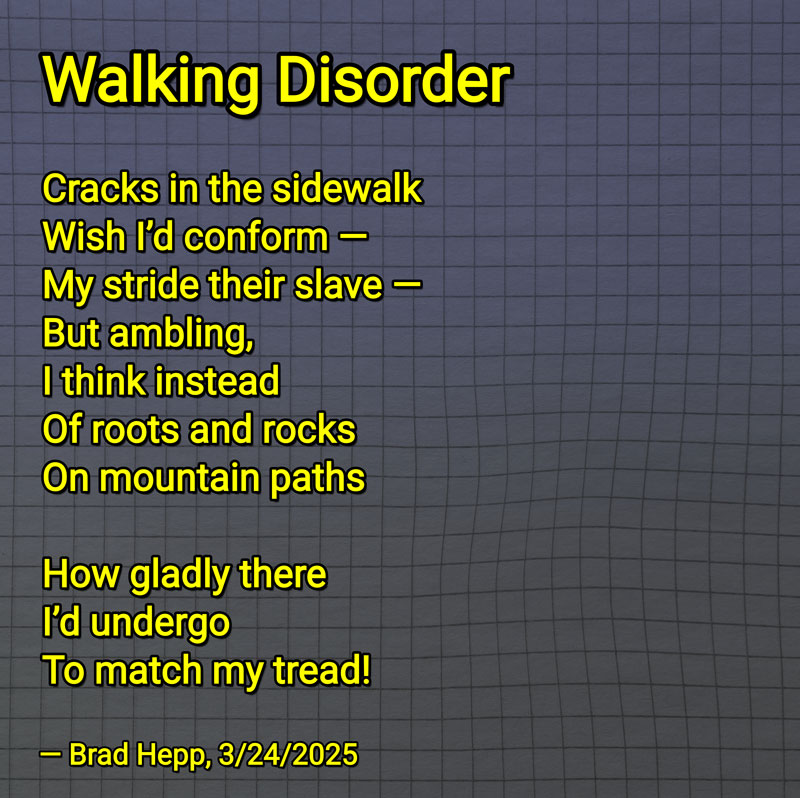
I think most of us heard this little rhyme sometime in our youth: “Step on a crack, break your mother’s back.” Of course that’s superstitious nonsense. But for some reason, it sticks in my head all these years later. It’s an intrusive thought that needles me every time I stroll down a city sidewalk. I can be listening to a narration of George MacDonald, or C. S. Lewis, or Dostoevsky. My head can be in the clouds, but my eyes don’t miss those cracks, and I’m repeatedly tempted to adjust my pace to match their spacing.
I wish I were free of this nonsense. I wish I were on a mountain path, where the disorder of roots and rocks may fix my attention, but more in the way of a friendly conversation with companions. I’d gladly go that way. I’d gladly submit to the slight difficulty they impose. There, I’d gladly undergo.
(if you are viewing this via email, the website has a recording of this poem and commentary; click the title above)
Commentary
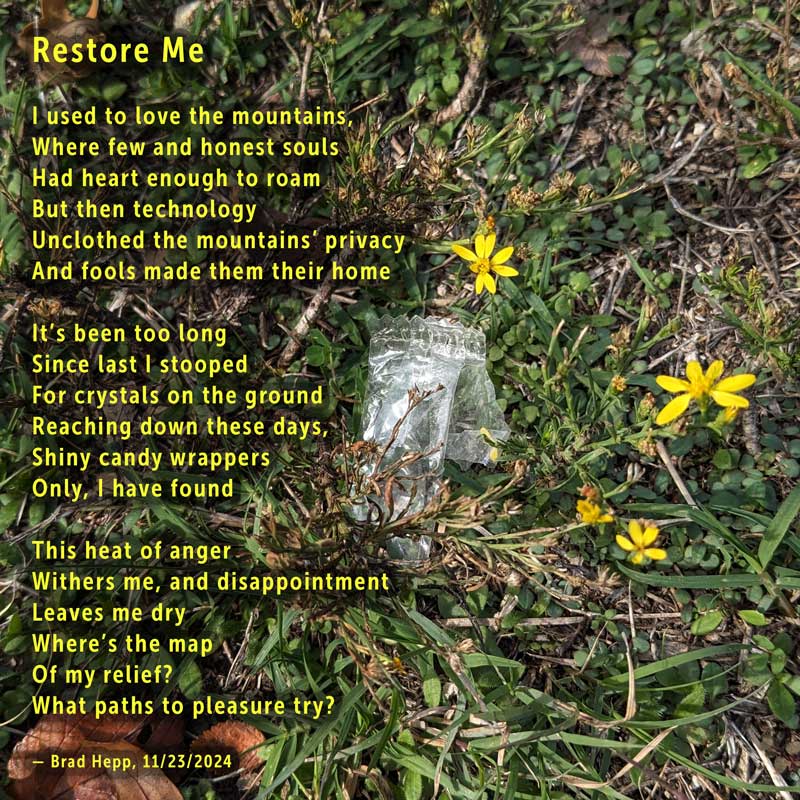
This poem is not about mountain climbing,* or litter, or relief maps. Rather, it is an indirect way of expressing the anger and disappointment that chatters persistently in my thoughts. While I do have much to be thankful for–it IS Thanksgiving morning as I write–I’m finding it hard to escape or ignore disappointments and annoyances. But let me explain the imagery in the poem….
I started climbing mountains over forty years ago. Back then, we didn’t have the Internet to help us plan routes. In the weeks before a climb, I’d take trips down to the Dallas Public Library and spend time with topo maps prepared by the U.S. Geological Survey. I’d spread several maps on the big tables, stand to the side, and view them together to familiarize myself with the general contours of the land surrounding my destination and chosen route. I’d pick out likely camping spots, based on the terrain and water supply. Then I’d mark up my own copies of the maps, circling key points, including landmarks I could use on the trail for triangulating my approximate location.
Climbing mountains was an exciting adventure. There was mystery and danger, even though I prepared in advance. When I got to the mountains–generally with two or three companions–there was also solitude. We’d find evidence of prospectors and hunters who preceded us there by many decades. But we generally had the place to ourselves. The few fellow climbers we did encounter–particularly at higher elevations–were immediately recognizable as kindred spirits. They were honest, hard-working fellow climbers.
As the years passed, the Internet, and GPS, and smart phones opened up the mountains to a whole new group of casual adventurers. When we reached the summit of mountains in latter years, it was not uncommon to encounter a gaggle of college girls in yoga gear, doing yoga poses… bless their hearts. While man–including precious young ladies–is the height of God’s creation, it was vistas of another sort I had climbed the mountain to admire.
Nowadays, the closest I get to mountain climbing is taking long hikes through neighborhoods, fording a busy stream of traffic, and cutting across the fields around White Rock Lake. Bad hearing isolates me from the few birds, but not from the ridiculous rumble and roar of traffic. A terrible floater in one eye and cataracts in both eyes have robbed me of the clear eyesight I have always treasured. Addressing these annoyances is delayed by tight finances. Maybe next year I’ll be a bionic man, but for now I am an active mind shackled in a deteriorating body.
The annoyances I complained about above may be the most manageable of all my annoyances. Last week, I wrote a short poem of complaint about the direction our country seems to be taking: “Recall the Future.” The recent presidential election was extremely disappointing.
BUT BRAD… ISN’T IT THANKSGIVING?! As I mentioned above, it is Thanksgiving morning as I write this. I feel the pressure to end this lament like most of David’s Psalms, with an answer to all my complaining. But right now, I think it’s best to acknowledge where I’m “at”. Perhaps I can consider and even take consolation from a paradox that occurred to me on one of my long walks:
To be increasingly content in this world is a virtue. To be increasingly satisfied with this world, not so.
*[To understand how mountains form the backdrop of my thinking, check out some of my other poems in the category “MOUNTAINS”.]
(if you are viewing this via email, the website has a recording of this poem and commentary; click the title above)
Commentary
This poem was inspired by a passage in Brant Pitre’s excellent “The Case for Jesus.”
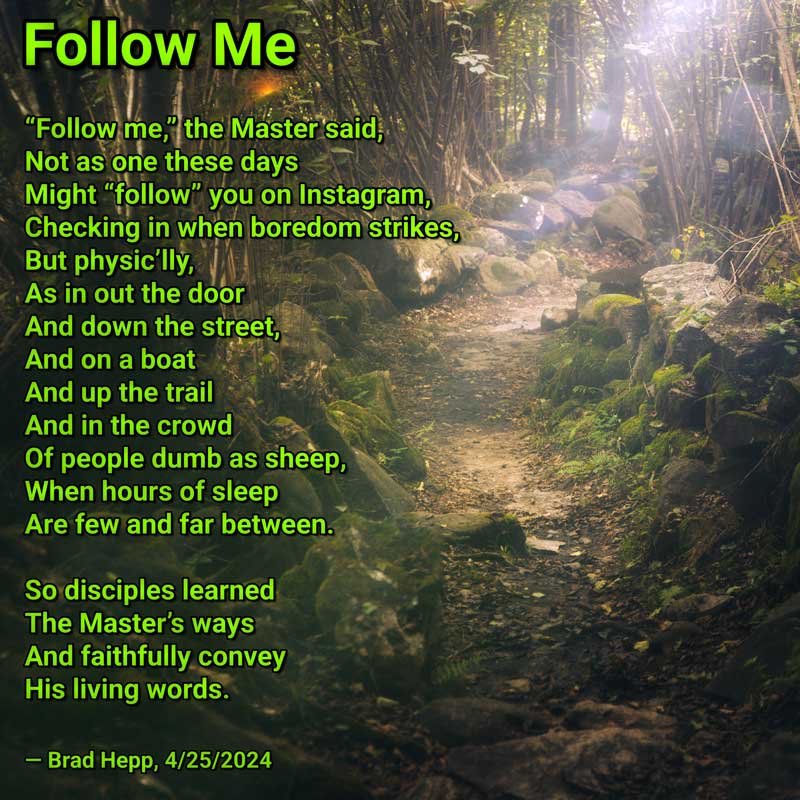
Being a student in the ancient world was radically different from what it is like today, when it simply means you may (or may not) listen to a fifty-minute lecture three times a week for a semester. Being one of Jesus’ students meant following him everywhere, and listening to him all the time, for anywhere between one and three years.
(if you are viewing this via email, the website has a recording of this poem and commentary; click the title above)
Commentary
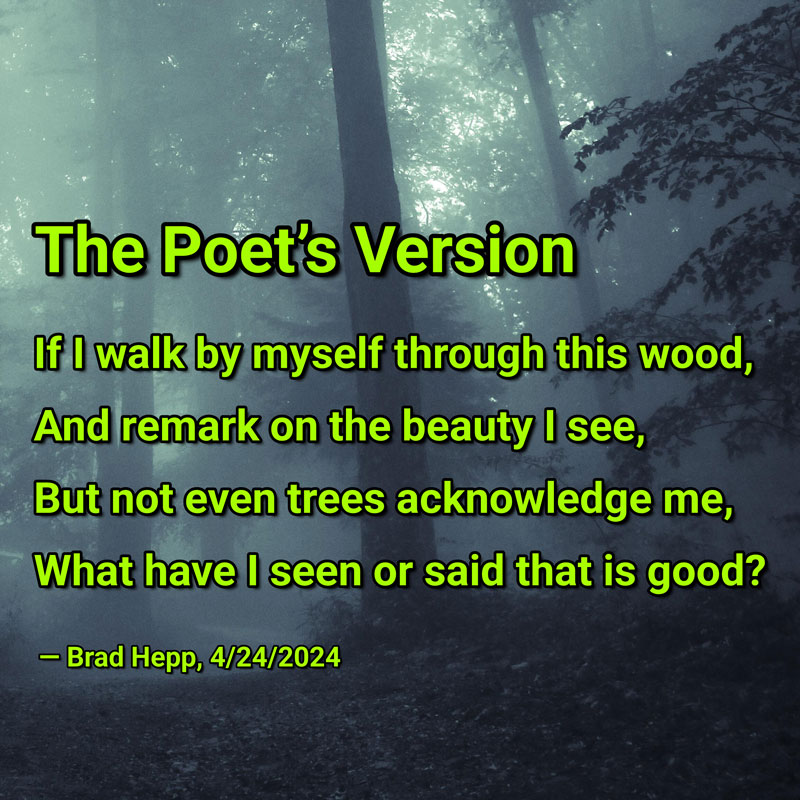
This poem is my sour grapes version of the philosophical thought experiment “If a tree falls in a forest and no one is around to hear it, does it make a sound?”
Why sour grapes? Somewhere in this big world, there’s an audience for my poetry. But aside from a handful of kind family and friends, I haven’t found that audience. Moreover, my potential audience keeps getting smaller and smaller as my thinking about this world gets more and more idiosyncratic.
(if you are viewing this via email, the website has a recording of this poem and commentary; click the title above)
Commentary
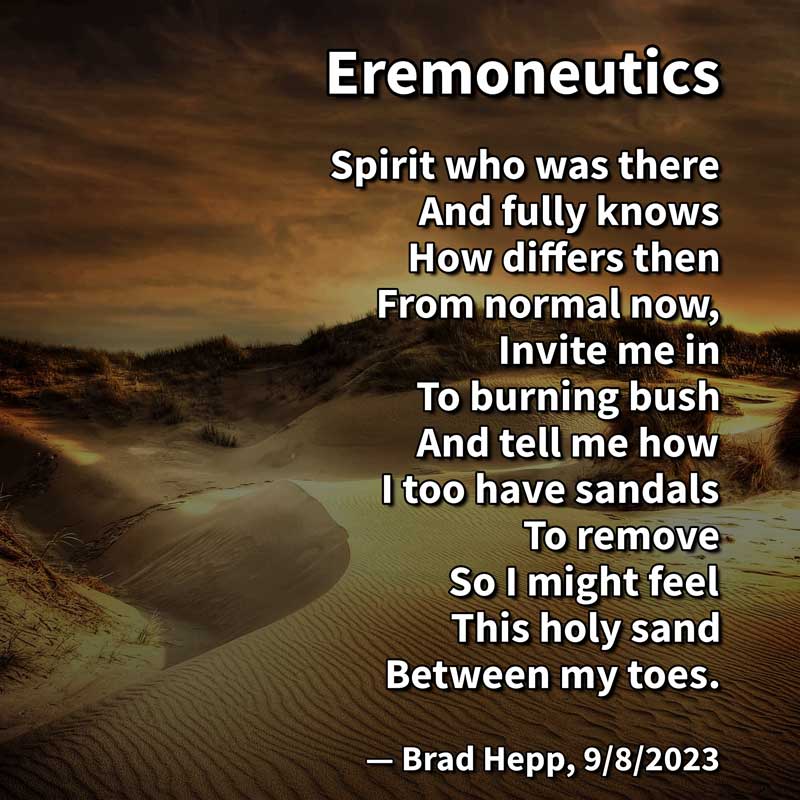
[This title is a combination of Greek erēmō (ἐρήμῳ, meaning wilderness, desert) and “hermeneutics” (the art and science of interpretation, especially of the Bible).]
These days I’m doing a lot of puzzling about the relationship of words and events in the lives of Moses, John the Baptist, and Jesus. Consider how the following words figure in the announcement of Moses’ and Jesus’ ministries: wilderness, voice, fire, sandal. Add in the fact that Jews were looking for a fulfillment of Moses’ promise that “The Lord your God will raise up for you a prophet like me from among you, from your brothers—it is to him you shall listen” (Deut. 18:15). They were bound to be looking for similarities between Moses and Jesus.
My 21st century brain wants to nail down logical, definite relationships between the men and their stories. But is that even appropriate? Is it possible that 1st century Jews were content with an unanalyzed, but harmonious gumbo of coincidence?
Please understand that the previous paragraph is not a denigration of biblical characters and writers. It’s simply that I want to really understand how they thought.
Bible students are taught “don’t make parables walk on all fours.” In other words, don’t assume that every aspect of a parable represents something in reality. But we’re tempted to ignore the advice. We get to the parable about the Rich Man and Lazarus, and we want to use that parable to map out Heaven, Hell, and eternal destiny. We need to be careful.
So, my last paragraph is a respectful pondering of the possibility that commonplace wisdom about interpreting parables may extend to interpreting other biblical forms.
(if you are viewing this via email, the website has a recording of this poem and commentary; click the title above)
Commentary
ON THE PATH This early morning poetography is too personal, too idiosyncratic to be GOOD. But, like the dream from which I just awoke, it is TRUE.
The elements don’t go together for anyone outside my head. But for me, they all belong. I know when and where I took the background photo: December 22, 2019, west shore of White Rock Lake. I know what I was thinking then: I was beginning to recognize my judgmentalism, how unreliable I am in whether people are attractive or repulsive to me.
I’m still learning my place on the trail. What I think of—or feel toward—people I encounter on our respective paths is not what’s ultimately important.
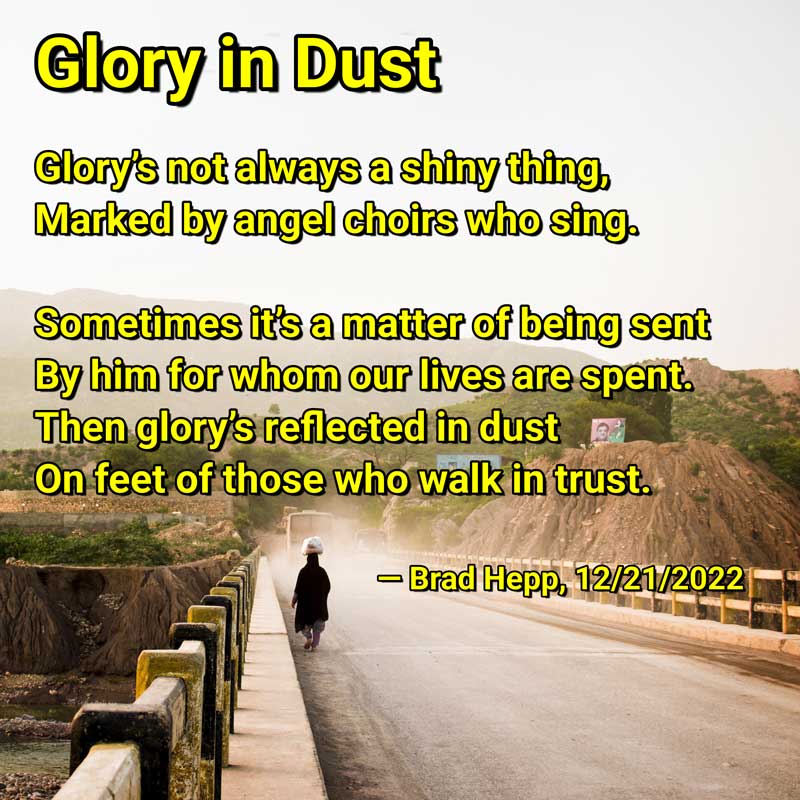
THUS, THE TITLE: Wherever we go, See ourselves as sent: Not for our pleasure, but His.
(if you are viewing this via email, the website has a recording of this poem and commentary; click the title above)
Commentary
Two things prompt this reflection.
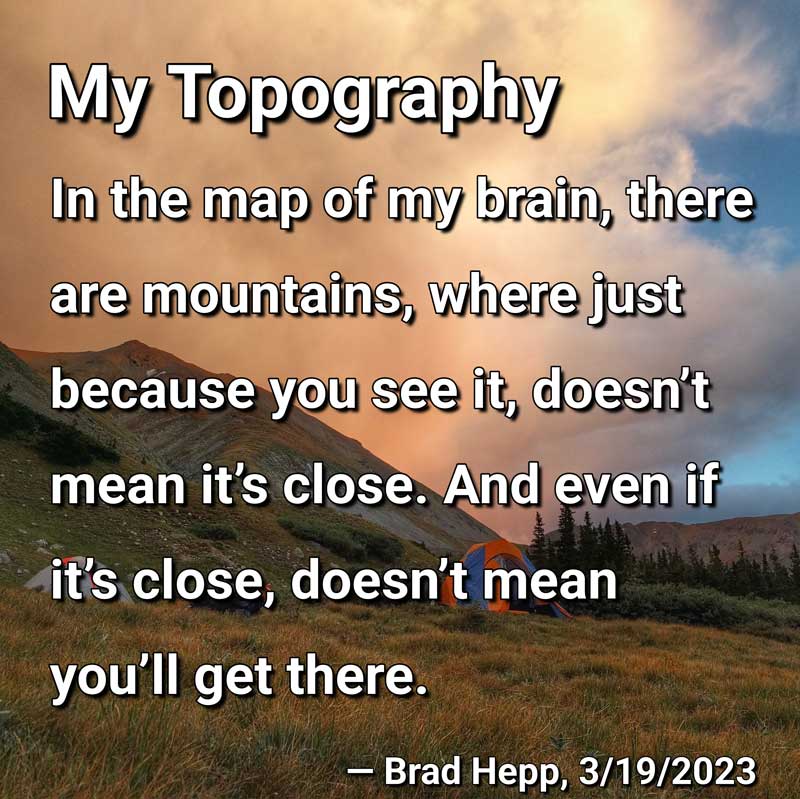
First, I am thinking and praying about participating in an organization that promotes spiritual development through outdoor adventures. So I ask myself what part outdoor adventure has played in my own development? Did hiking and climbing mountains alone and with friends lay the groundwork for spiritual growth? If so, how?
Second, I was preparing some photos to help me tell the story of “The Road of No Return.” This was a mountain climbing trip with my great friend Darol. When I was 52, he and I revisited a mountain area where we had climbed 17 years earlier. In the intervening years, wisdom had traded places with strength. To put it another way, strength had migrated from my feet to my head! I have a vivid memory of seeing our car in the valley below, and of the seemingly interminable trek down the mountain road to reach that car. How could it hurt so much to reach something we could see with our own eyes?
Note: I’m not suggesting that the reflection in the image is one of profound understanding. It’s simply a recognition that places and experiences affect how we think about the world. They form a map in our brains… sometimes, a topo map.
(if you are viewing this via email, the website has a recording of this poem and commentary; click the title above)
Commentary
GNAWING AT GLORY The other day, I was reading an article by a respected theologian. Whatever the topic was (I forget), I stopped reading when I got to a paragraph that began, “Let me explain glory….”
Why did I stop reading? I respect that author so much that I assume he’s close to understanding something I very much wish to understand. But here’s the deal: I wish to chew on this topic, not swallow it whole; to squeeze the oranges, not just drink orange juice; to assemble a jigsaw puzzle, not just admire its finished scene.
It’s in the COMING TO UNDERSTAND that I’ll be changed.
(if you are viewing this via email, the website has a recording of this poem and commentary; click the title above)
Commentary
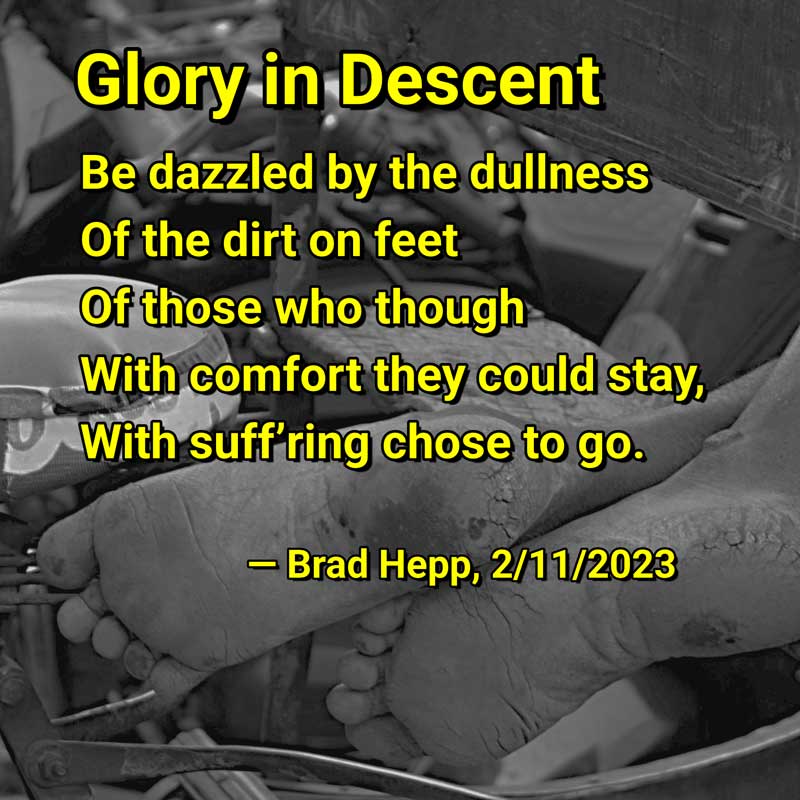
This poem is inspired by the seeming anachronism of what Jesus said just after Judas had left the Last Supper on his way out to betray him:
When he had gone out, Jesus said, “Now is the Son of Man glorified, and God is glorified in him.”
John 13:31
I held off on posting this poem for several days. Here’s what I wrote to a friend about my hesitation:
I have this niggling feeling I’m getting something wrong in the poem, that something’s off.
I believe this is what was troubling me: everything in me wants to associate God’s glory with triumph. But Jesus’ statement that “Now is the Son of Man glorified” comes just at the point in the story where Judas has gone out to help the religious leaders defeat Jesus.
How does Jesus’ putting himself in a place where his enemies could–and would–kill him constitute an instance of God’s glory–the glory of the Father and the glory of the Son?
Here’s one of several answers. I offer this one because it applies to us as it does to Jesus: our submission reveals the glory of a God who is able to make a man who cansay “No” but is willing to say “Yes.” If we go all the way back to Job, we see that this glory of God is on display to the universe.
“Sent” As I have been slowly reading through the Gospel of John, there is a word that Jesus uses frequently about himself. It is “sent.” He wants people to understand and believe that he is sent by the Father. For instance, John records this short prayer of Jesus when the stone had been taken away from Lazarus’ tomb:
So they took away the stone. And Jesus lifted up his eyes and said, “Father, I thank you that you have heard me. I knew that you always hear me, but I said this on account of the people standing around, that they may believe that you sent me.”
(if you are viewing this via email, the website has a recording of this poem and commentary; click the title above)
Commentary (A Facebook Exchange)
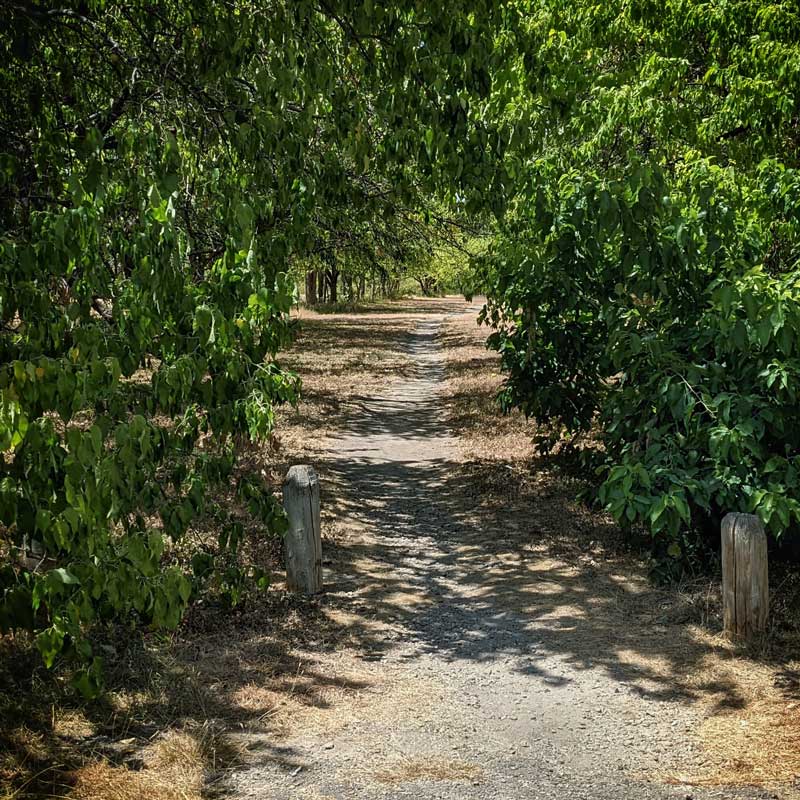
ME: (referring to the photograph above) No matter how many times I walk under these bois d’arc trees on my shortcut to the lake, it feels like I’m entering a special place, or embarking on an adventure. What are the magical places and moments in your life?
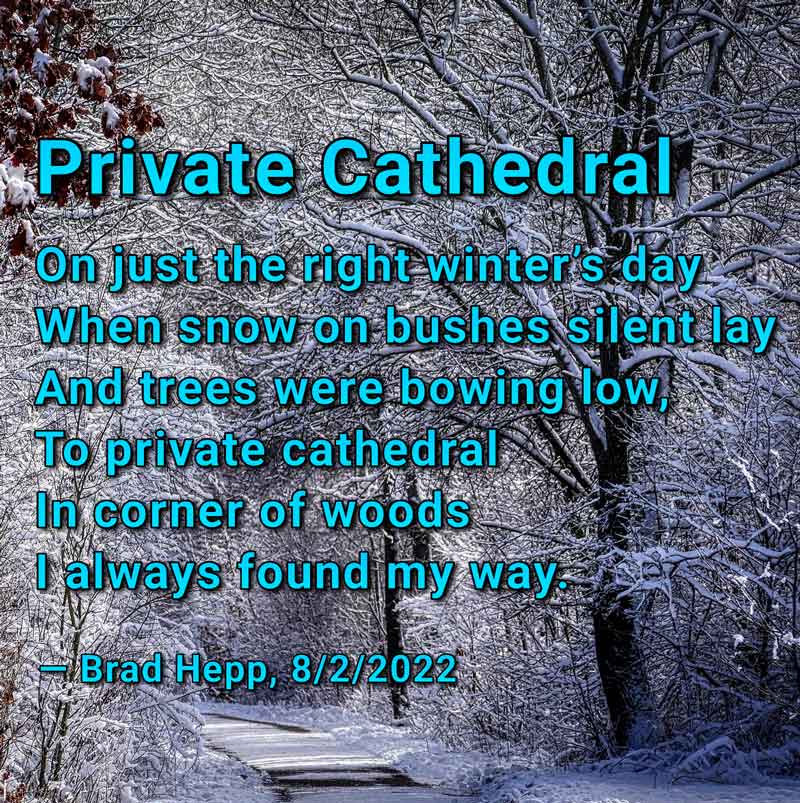
JOSH VAJDA: When I was a teen, we had 10 acres of forest and brush behind the house, with paths winding through. My favorite part of the walk was in the back corner on just the right winter’s day. After a hairpin turn in the brush, you walked along the side of a patch of older trees, which soon sharply turned right, inviting you inside, and winding so you could not see too far ahead. With a fresh blanket of heavy, wet snow, it was truly magical. The frosted pine and birch towered above, while the brush heavy laden hugged the path. The sun lit the chamber like a cathedral, and the snow smothered every sound except the crunch beneath your boots and the swish of your winter coat. Sometimes I would just stand in the center and soak it in as long as I could.
ME: Josh, you have written elsewhere about the importance of imagination. In the space set apart, the cathedral, we begin to imagine how everything could be different. As you describe that magical place from your youth, I want to map it out in my head. If I were sitting with you, I’d ask you to sketch the scene. I want to locate that cathedral and enter it myself. Those of us who have read Lewis think immediately of a wardrobe in an old professor’s house. But we should probably find our own wardrobes. Then, what is it we encounter in the set-apart space? To define it seems only to diminish it.
JOSH VAJDA: As usual, you are correct. I couldn’t help feeling it had a certain Narnian magic to it.
ME: This one’s for Josh Vajda (an echo of your elevated prose):
[Note: Josh Vajda kindly gave me permission to include our Facebook exchange in this post. Josh is an excellent thinker and writer. Check out his blog. For instance, this study of “The Sin of Sodom.”]
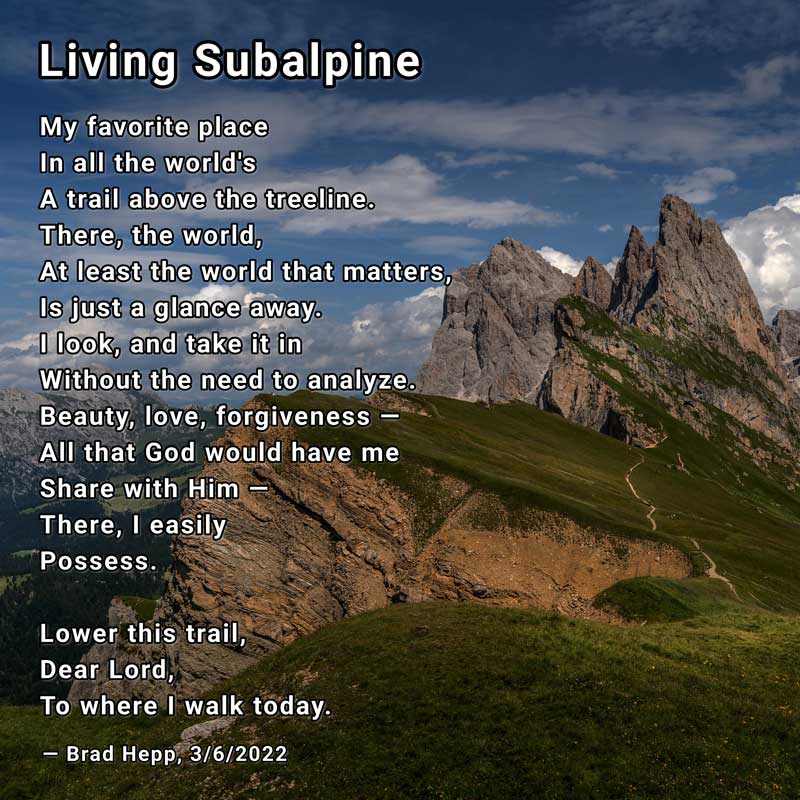
I’m not going to say this is an easy poem. I wrote it, but am still trying to understand it! This may be a clue: I suspect that what my sister likes about the beach is what I like about the alpine trail: a vista — a perspective — that heightens or broadens our hope for godliness.
Here’s another way of expressing the longing:
Won’t it be fine When refining’s done, When what we love And what He loves At last are one!
–Brad Hepp, 3/6/2022
Reality This may be a simplistic view of religious hermits…. They live out the wish expressed in this poem. Removed from the irritations and challenges of society, they may think that they are being holy. But they are just living a fantasy. It is in dealing with irritations and challenges that God refines us and in our response that we are privileged to bring Him glory.
Then, welcome each rebuff That turns earth’s smoothness rough, Each sting that bids nor sit nor stand but go! Be our joys three-parts pain! Strive, and hold cheap the strain; Learn, nor account the pang; dare, never grudge the throe!
For thence,—a paradox Which comforts while it mocks,— Shall life succeed in that it seems to fail: What I aspired to be, And was not, comforts me: A brute I might have been, but would not sink i’ the scale.
from Robert Browning’s “Rabbi Ben Ezra.” The first stanza was my Dad’s favorite; the second is my favorite
These little trails have always intrigued me, be they in the mountains or in a local park. Why do they evoke such strong emotion?
Seriously… I took the photo, walked another 200 yards, and sat down on a park bench to edit the photo and pen a few words. Then, as I continued walking home, I felt a tremendous lump in my throat. Why?
As I have revealed before, I’m seeing a counselor to help me explore what may be some deep-seated emotional “problems.” I don’t say that with shame. Frankly, I think we all have deep-seated emotional “problems.” I just have the luxury right now of exploring mine.
One of the things my counselor has encouraged me to do is to try to figure out what relationship some of my poetry has to my life story. Now that’s a good challenge for a poet!
Really a problem? Is it really a problem that I get inexplicably emotional? After all, what do we expect of someone God crafted to be a poet? If a poet cannot feel deeply, and desire with determination to express that emotion, what hope is there for any of us? God is an intelligent designer. We are not random results of happenstance. God has a purpose for making us as He did.
A few years ago, when I went full-time with my web business and suddenly had plenty of time on my hands, I began taking walks around White Rock Lake. Sometimes it was from a parking lot (a 9 miles hike) and sometimes from home (a 12 miles hike). That was the beginning of one of the best periods in my life. Here’s why….
Paying Attention On those long hikes, one of the things I did was pay close attention to how I was responding to people I encountered along the way: “The site of that elderly lady elicited warm feelings. Why? When I saw that young man, I felt disgust. Why? Why am I so ready to love some people, but not others?” Even after years of paying attention to my responses, it’s often still a mystery. But at least I’m a little more attuned to my emotional state now than I was before.
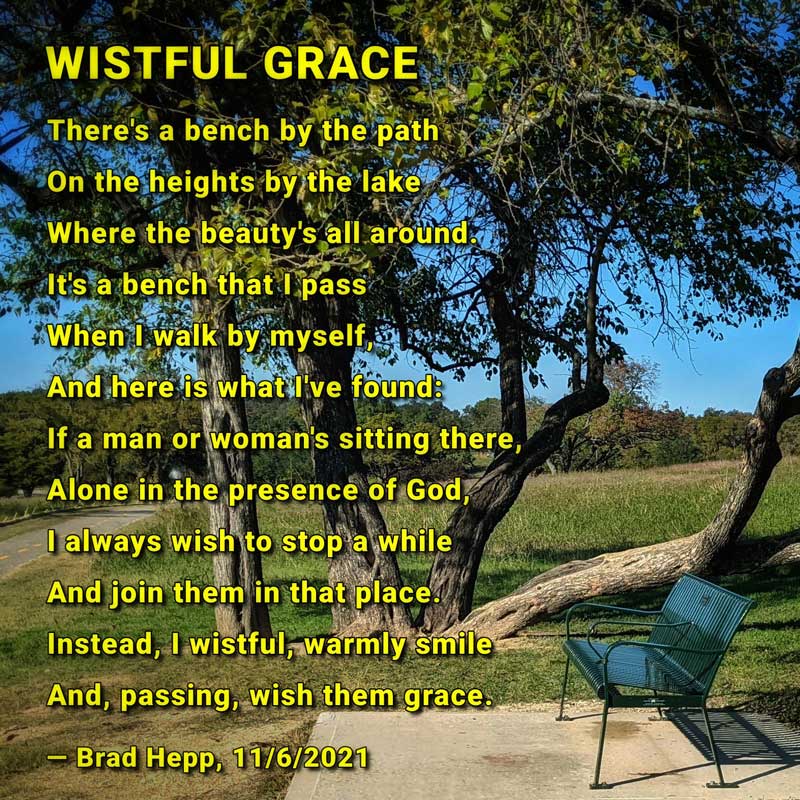
So I Asked Myself…. Yesterday, I walked by the bench in the background photo. Thanks to the habit of paying attention to my emotional state, I knew there was something I feel every time I pass by a person sitting on that bench. Could I put that feeling in words? Here’s what I initially wrote:
Often, when I’m walking at White Rock Lake and find someone sitting on this bench, I wish to sit with them, to share their experience. People taking in the beauty of a place like this are close to God, whether they realize it or not. But usually I just smile and walk on by.
Is it So? What I want to do (sit with them) is something I can report with more confidence than why I want to do so. In the prose explanation and subsequent poem, I connect my desire to a sense that God is somehow involved in the experience. That’s still just a theory of what’s going on in my head and heart. This theory may get support from a book I started into last night: “The Soul of Desire: Discovering the Neuroscience of Longing, Beauty, and Community,” by Curt Thompson.
Why Wistful? It makes me sad that I either cannot or do not always act on my good impulses. To sit and talk with a stranger? There’s nothing wrong with that impulse. But something usually stops me. What?
RELATED POST: “The Man From Valladolid” (based on meeting a fellow just yards from this bench).
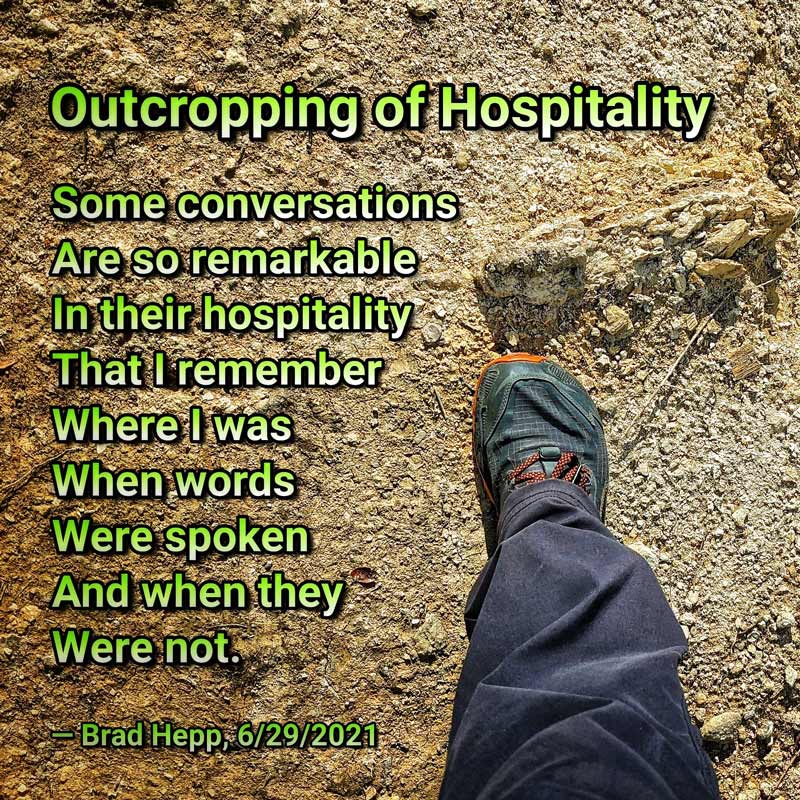
About four miles into my hike, I called one of the ladies in our church. I rely on her for advice. “Do you have time to talk?” “Yes,” she answered. For the next two miles, we talked about hospitality. By the time I reached my half-way point, we had thought through several options for how our church can practice hospitality in this lingering pandemic. We wrapped up the conversation. “Thanks,” I said, hung up the call, and began retracing my steps to home.
As I walked, I reflected on how hospitable my friend had been to me in our conversation abouthospitality. “Here, where the weeds give way to a mowed meadow… it’s one of several places in the path where she suddenly grew silent, yielding to my impetuous mind.” There, where rainwater recently rushed through the grass, “I was babbling, while she listened politely.” Up the white rock path a ways, I remembered what solid footing I felt when we shared a memory of Amor Towles’ A Gentleman in Moscow. There, where petrified wood sticks out of the limestone… “That’s where I was stepping when she recalled how Count Rostov arranged the seating at dinner parties, thus insuring a perfect evening for everyone.”
These weeds, that grass, this petrified wood in a limestone path…. Insignificant, except when they mark moments in a good conversation, an outcropping of hospitality.
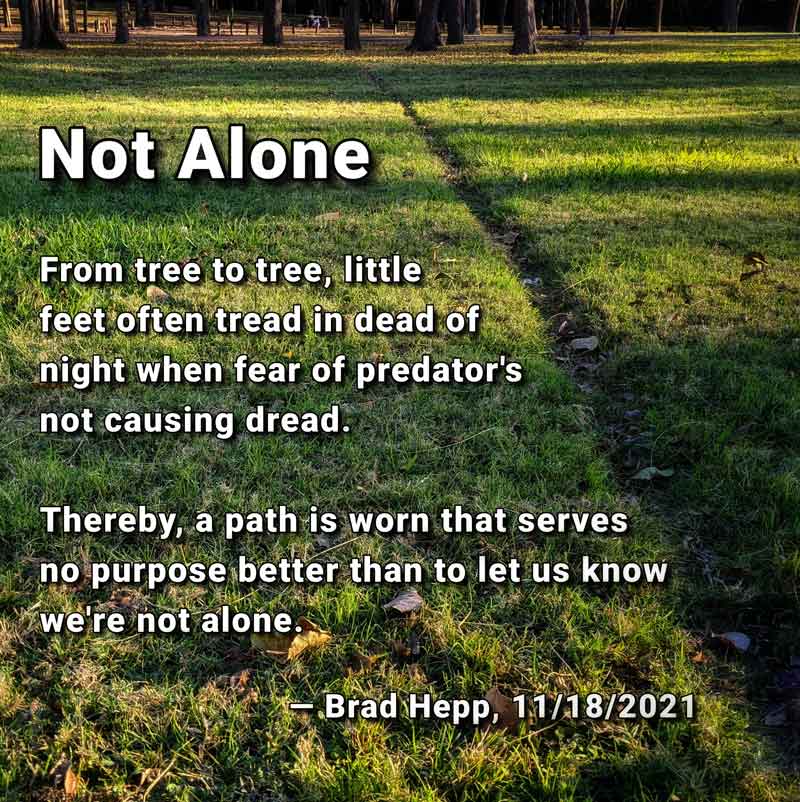
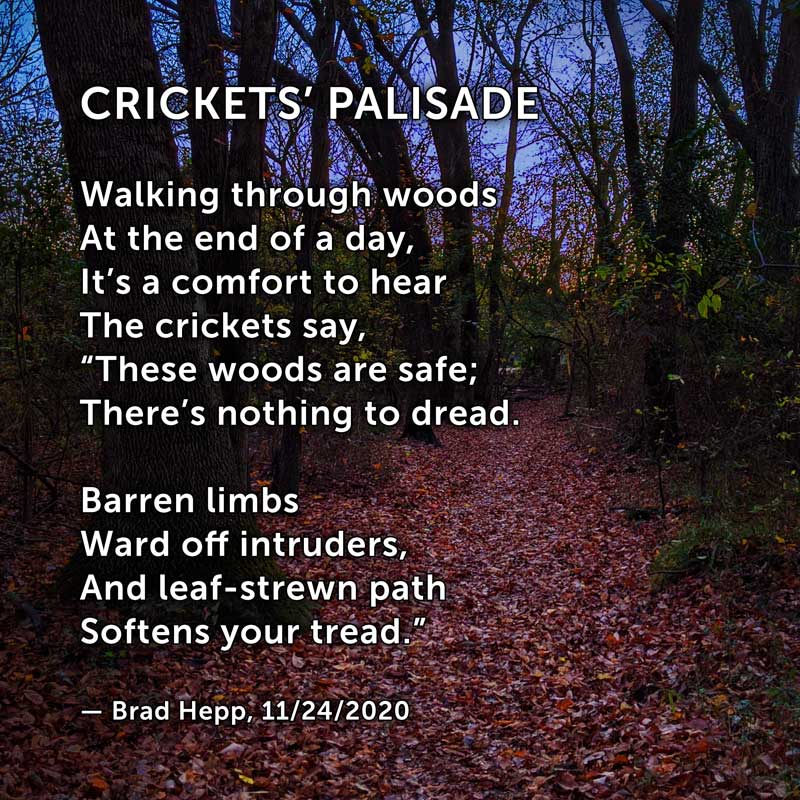
Now that the days are short, I often finish my walks at dusk. A shortcut I found through the woods can be a little creepy at that time. But the sound of forest critters is reassuring.
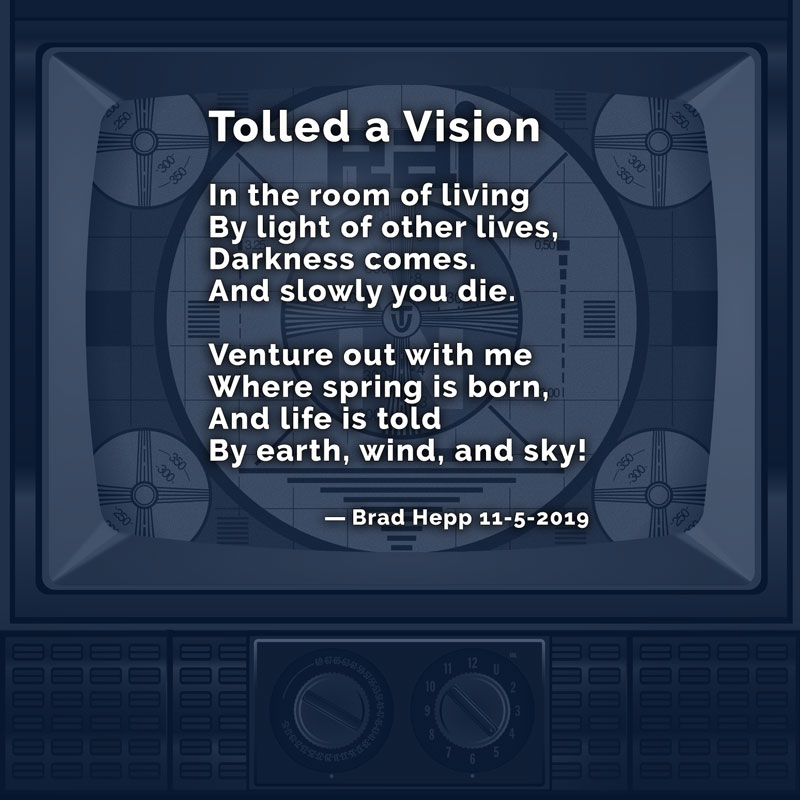
My pastor had this response: “I like it. Slowly we die as we are absorbed by the fictional lives of others dancing before our eyes when real life is just a power button and a glance away…” My riposte: “… and a good pair of sneakers if you’re so disposed!”
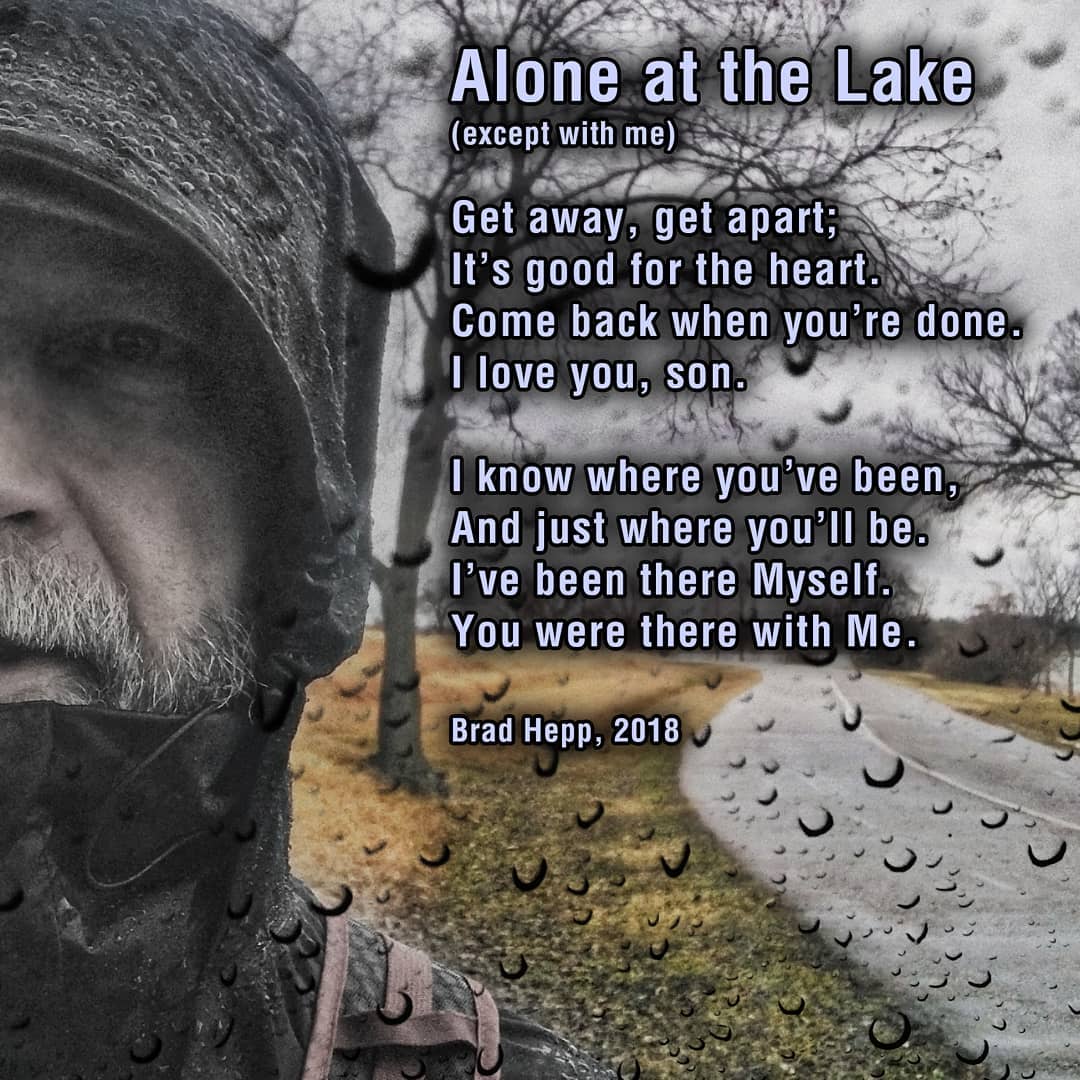
Despite my riposte, this poem is more about the first stanza than the second. Not everyone can don a pair of sneakers and join me on long hikes. But everyone can seek to live as directly as possible, fully appreciating their own God-given life and embracing God’s offer of rebirth, restoration, and eternal life. For most people, this appreciation and embracing requires a little — or a lot — of contemplation, meditation. Noise and distraction are the enemy. Compare my poem “Alone at the Lake.”
About the title: I’m not completely happy with the title. You can probably tell that I started with “Television.” From there, I started pushing on “Tele,” “Tell,” and finally landed on “Tolled.” It may be too far out there. But consider that “toll” is associated with death (“For Whom the Bell Tolls”). It also sounds like “told.” Even as the flitting and vapid* “lives” of fictional characters displayed on a television have “tolled” our dying, and have “told” us the bad news, nature itself has “told” us about better news, the hope of resurrection. A big stretch, I know! This is my blurry vision, and now I have told you.
*This needs work. I do think there is something of “the medium is the message” in this. In television, we have lives that are extinguished with the press of a button.
It was wet, cold, and windy at the lake today… almost as good as a hike in the mountains.
This is a poem that took its own shape as I wrote… NOT what I set out to write. In the small group materials that Dave Carr and Sten-Erik Armitage prepared for our church, they quoted Alvin Plantinga articulating this striking truth: “The chief difference between Christianity and the other theistic religions lies just here: the God of Christianity is willing to enter into and share the sufferings of his creatures, in order to redeem them and his world. Of course this doesn’t answer the question why does God permit evil? But it helps the Christian trust God as a loving father, no matter what ills befall him.” That’s a truth I need to reflect on more often and more deeply.
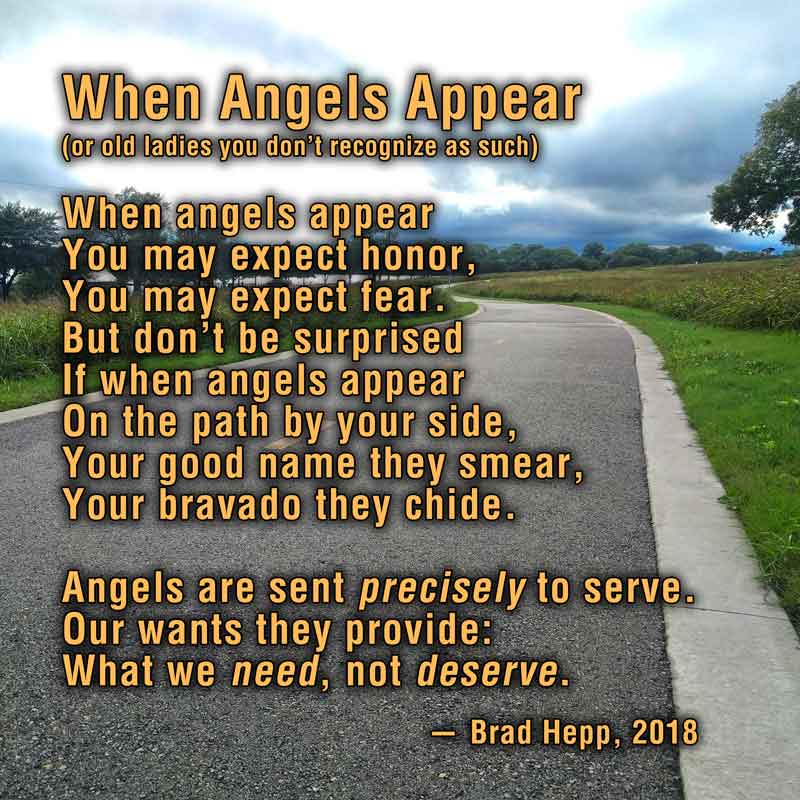
Darol Klawetter: Ha! Set the scene for me: did you almost collide with her as you walked? If she is an angel, she must still be trying to earn her wings.
Brad Hepp: I was walking down this very path, texting a friend in Ethiopia. Engrossed in the text, and with my floppy hat shielding my eyes, I never saw her coming toward me. Suddenly I heard, “You’re going to run into the elephant!” I looked up, and there she was, standing 8 feet away, immediately to my left. I said, “I rarely do this; please don’t rebuke me.” She replied, “I’m just kidding you, but I am worried about the elephant in front of you.” The way I responded, you’d think I have no sense of humor, and am easily offended (sadly, a little true). When I walked the next day, I was more conscious of all I encountered as God’s fellow image bearers.