(if you are viewing this via email, the website has a recording of this poem and commentary; click the title above)
Commentary
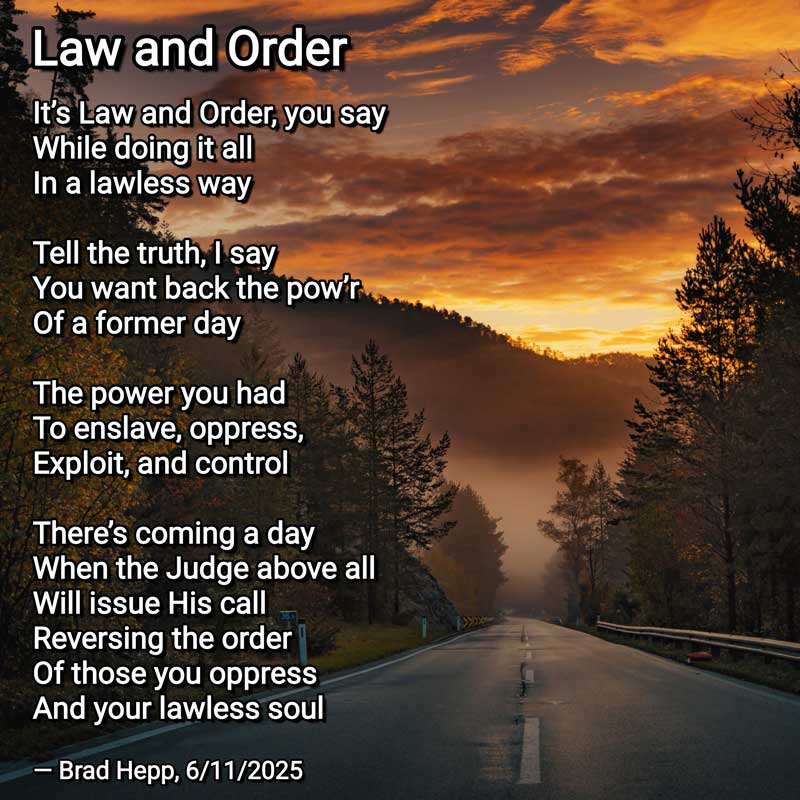
My quick response to this morning’s reading. It may be simplistic, but I could not help but think of our current moment in history while reading about the beginning of King Saul’s reign. Politicians who play priests and priests who play politicians… is one worse than the other?
(if you are viewing this via email, the website has a recording of this poem and commentary; click the title above)
Commentary
I was a little confused this morning by the ending of Ruth. Levirate marriage was intended to preserve a patrimony. In the case of Ruth, it was the patrimony of Elimelech, her father-in-law. The nearest kinsman-redeemer—Whatshisname—was too concerned with preserving his own patrimony to risk it by taking responsibility for Ruth. That opened the way for Boaz, who was willing to venture (risk) his patrimony by marrying her.
Here’s the confusing thing. The genealogy at the end of the book mentions Boaz, but not Elimelech. The preservation of Elimelech’s patrimony seems to have been subsumed in Boaz’ patrimony. Then it occurred to me: maybe that’s the point!
Venture on Him; venture wholly Let no other trust intrude
(if you are viewing this via email, the website has a recording of this poem and commentary; click the title above)
Commentary
This morning’s readings bring me to Ruth, chapter two, where Boaz says to Ruth, “May the Lord repay you for what you have done. May you be richly rewarded by the Lord, the God of Israel, under whose wings you have come to take refuge.”
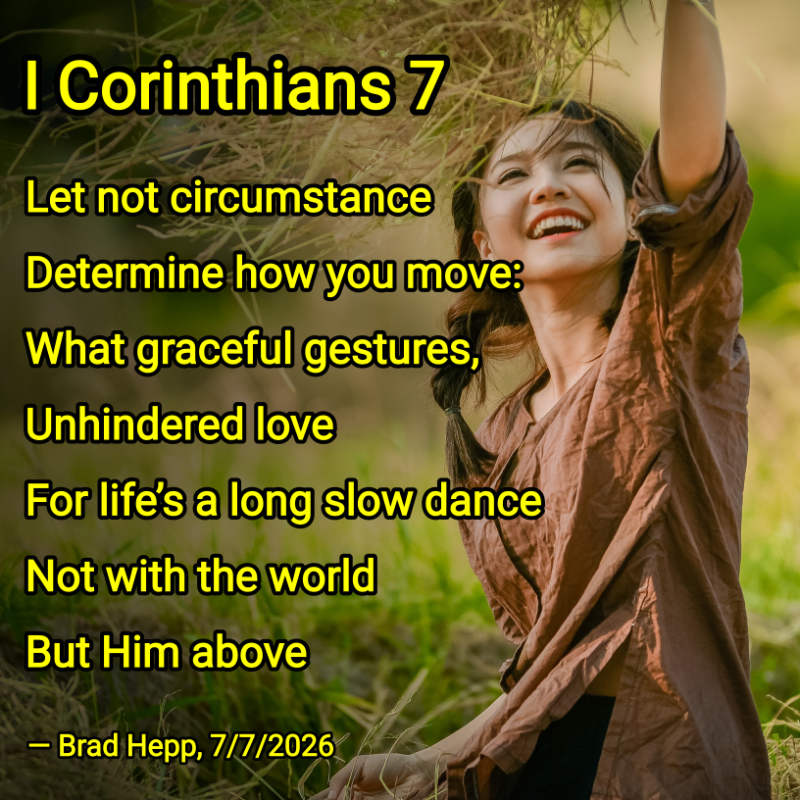
Then Paul spends a chapter (1 Corinthians 7) saying, “I want you to be free… to please the Lord.”
What’s common in both lessons is an understanding of God’s overarching care and purpose in our lives.
(if you are viewing this via email, the website has a recording of this poem and commentary; click the title above)
Commentary
The “Day’s Readings” gets me to Judges 13. I paused to jot down something worth pondering. I can imagine bitter responses. I can imagine quick, all-knowing responses. How do you respond? Is putting your finger on a thing—naming it—as important as pondering its qualities? “Why do you ask my name, seeing it is wonderful?”
One of my great Facebook friends is Laurie Pearce Mathers. She is a skilled writer and Bible student. Here is her response to the poem:
When God “names” himself, the name itself is mainly an expression of being. Then he augments (defines?) it with a description of his character traits. His name is not merely Yahweh, as if to know that word is to have the talisman in hand (likewise with the name Jesus). God’s “name” is shorthand for all that he is. And he is more marvelous than we know.
As for that woman, I’ve often wondered why she isn’t named. It’s certainly by design. Perhaps to align her with the God who chooses not to name himself. Perhaps in honor of her faithful humility.
She certainly stands in stark contrast to her husband in this story. (He was not willing to accept the word of his wife. He had to get it from the horse’s mouth, so to speak. Yet God was merciful to him still and granted his request.)
It’s striking how Manoah’s wife is always the one approached by God, never her husband, even in response to the man’s prayer. In this I think she foreshadows the future mother of the ultimate Savior.
Passages like these are a comfort to women, and no doubt were intended to be, in this world dominated by sinful men. Named publicly or not, we matter to God and play important parts in his plan.
(if you are viewing this via email, the website has a recording of this poem and commentary; click the title above)
Commentary
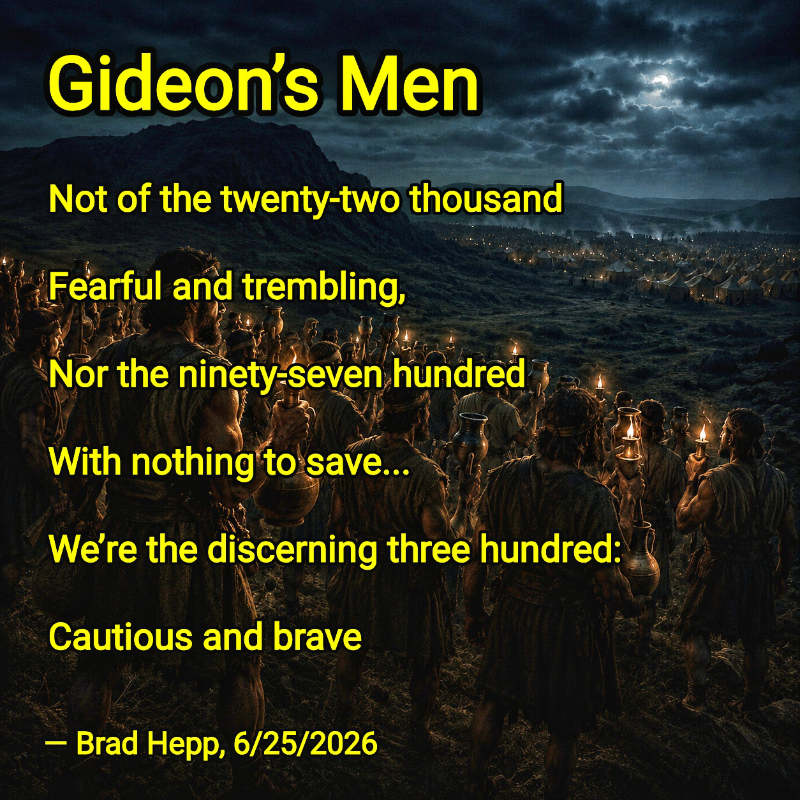
THE STORY In Judges 7, God makes it clear He doesn’t want anyone confusing their strength with His. So He has Gideon reduce his army of 32,000 to a mere 300 men. Now, are those 300 men going to win because of their strength? No. They’re going to win because they know how to shut up and follow orders. Their wisdom as soldiers begins with a healthy respect for God.
DISCERNING In writing the little poem about Gideon’s army reduction, I needed a single word to describe the select 300. For now, I’m happy with “discerning.” Their clear-eyed recognition of both the dangers and the utility of following uncommon orders made them cautious and brave. In following God’s way, they’d win the day.
A PERSONAL APPLICATION As a recovering perfectionist, I’m always torn. Getting things right is important. But success doesn’t ultimately depend on my perfect planning and execution. Rather, it sometimes relies on my willingness to “take chances.” More than the fear of failure, I must fear my independence, my smooth self-reliance, my silent perfectionism.
____________
(background image based on this prompt to ChatGPT: “Create a square-format, dark depiction of Gideon’s 300 soldiers from the Judges chapter seven story”)
(if you are viewing this via email, the website has a recording of this poem and commentary; click the title above)
Do You Find This Offensive?
Please read my partial defense below*
Commentary
On a couple of occasions recently, I have seen short videos of myself walking—in checking the footage of security cameras I was setting up or reviewing church services I participated in. Seeing myself thus elicits embarrassment: “I look so ridiculous!” That response isn’t unusual. People often cringe to hear recordings of their own voice. As a photographer, I’ve had to put up with people rejecting perfectly representative photographs of themselves (“representative” isn’t always flattering!).
As I thought about this, it dawned on me that one could find ridiculous traits in just about anyone. We’re all just a little bit clownish.
From there my thinking went to that most profound event in the history of man: Jesus’ emptying himself, “by taking the form of a servant, being born in the likeness of man” (Philippians 2:7).
This poem is a prayer that Jesus will remind me of the glory He stooped to share with us despite our ridiculous state. ____________
*Although I wrote this poem very quickly, I hesitated to publish. It contains some words and concepts that are calculated to startle, to provoke thinking–in myself first and then in my readers. I asked seven of my very smart, theologically astute friends to comment, especially on the second stanza. Here’s what I wrote to one of them:
Ben,
I’m very interested in whether or not you see theological problems in the second stanza of this poem. Another friend (DTS prof) responded to me that “There are some implications that could be drawn from the second stanza that would compromise a classical understanding of Christology.” He didn’t elaborate.
If I understand Isaiah correctly, Jesus was not a classically beautiful human specimen. Per Hebrews, He learned obedience. You can probably think of other evidence of His thorough-going Incarnation. Can we go so far as to speculate that He might even have had some quirks like the rest of us?
I write poetry to plumb the depths of my confusion about man, including the Son of Man. I must confess being double-minded about the relationship of imperfection and sin. There’s a judgmental little jackass in my brain that always wants to attribute physical imperfection to moral imperfection. (It gets worse: I then take that inferred moral imperfection and use it as a basis for assigning relative authority. But enough about this dumb sinner….).
Thoughts?
None of the seven friends condemned me as a heretic. Most of them found the poem sufficiently thought-provoking to excuse some of its questionable wording.
One of the friends–a theologian and prolific poet–said that he’d grant me poetic license for “mannerisms odd.” But “merely God“? For him, that was a bridge too far. (His objection reminded me of my father, who protested when the word “awesome” was used to describe anything other than God.) My faltering defense: before the Incarnation, Jesus was “merely” God as opposed to God-Man.
Here’s my ultimate out: late in the writing process, I turned the whole second stanza into a question, not a statement: “Can I believe…?” In other words, is it appropriate to believe what follows? I hope you struggle a little with that, and that the struggle tips your heart toward loving God and loving your neighbor. That’s certainly what I hope for myself.
(if you are viewing this via email, the website has a recording of this poem and commentary; click the title above)
Commentary
I’m trying to understand the Bible’s cosmology (esp. in Genesis, but also in the New Testament) as metaphor. Despite the fact that I’m a poet, that’s not easy for me. This poem is a pushing, a shoving, a determined attempt to see God’s loving.
Here’s the passage I was looking at when I wrote the poem:
[1] As for you, you were dead in your transgressions and sins, [2] in which you used to live when you followed the ways of this world and of the ruler of the kingdom of the air, the spirit who is now at work in those who are disobedient. [3] All of us also lived among them at one time, gratifying the cravings of our flesh and following its desires and thoughts. Like the rest, we were by nature deserving of wrath. [4] But because of his great love for us, God, who is rich in mercy, [5] made us alive with Christ even when we were dead in transgressions—it is by grace you have been saved. [6] And God raised us up with Christ and seated us with him in the heavenly realms in Christ Jesus, [7] in order that in the coming ages he might show the incomparable riches of his grace, expressed in his kindness to us in Christ Jesus. Ephesians 2:1-7 NIV
Despite how it may sound, I don’t pretend to understand much of what I wrote in this poem. I’m playing by ear, attempting to work out God’s melody. When I was younger, I despised the pompous blather of “poets who, in fact, don’t mean a thing.” But I excuse it now as a “thinking out loud.” Pondering, not so proud.
ABOUT THE THIRD STANZA I’m not real happy that I resorted to just mouthing what Scripture says as though I understand it. The already/not yet, de jure status of believers is every bit as mysterious to me as how to deal with a cosmology that is foreign.
ABOUT THE LAST LINE I’m going to just admit…. I was pushing for a rhyme to “was.” But I do like the unintended puzzle that the last line presents, and it’s always possible that my subconscious was “on to” something.
(if you are viewing this via email, the website has a recording of this poem and commentary; click the title above)
Commentary
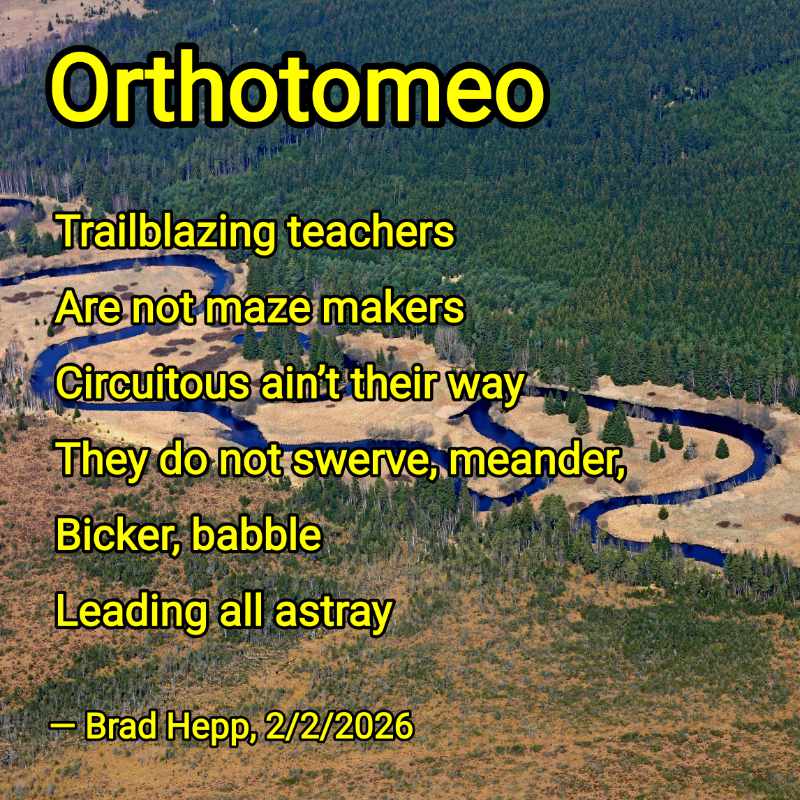
A friend was lamenting that he has met Christians who think the Sermon on the Mount does not apply to Gentile believers. Such people are sometimes emboldened by the KJV rendering of 2 Timothy 2:15, where orthotomeo is translated as “rightly dividing.” For them, that apparently suggests “chopping up” and effectively “cordoning off.” Modern translations are probably better with the idiom: “rightly handling” (ESV), “correctly handles” (NIV), “correctly teaching” (CSB).
What happens when you set aside Jesus’ teaching and example as if it doesn’t apply? We’re seeing so-called Christians in the U.S. throwing around the strangest term: “the sin of empathy.” How could anyone who claims to follow Jesus be so oxymoronic?
ABOUT THE POEM I gave some thought to the three instances of orthotomeo in the Bible. Two are in the Septuagint (Proverbs 3:6 and 11:5), and the third is in 2 Timothy 2:15. Thinking about how the word is used in its context made me break out in poem.
AN ASIDE: “trailblazing” is a word whose etymology I had to study before using it here. I was surprised what “blaze” refers to in the word. It isn’t fire; it’s marking. If you have ever hiked on a path through the woods, you likely have seen “blazes” consisting of cuts in bark. They were left there by someone who wished to lead you in the most direct path possible, NOT in a meandering, circuitous path.
(if you are viewing this via email, the website has a recording of this poem and commentary; click the title above)
Commentary
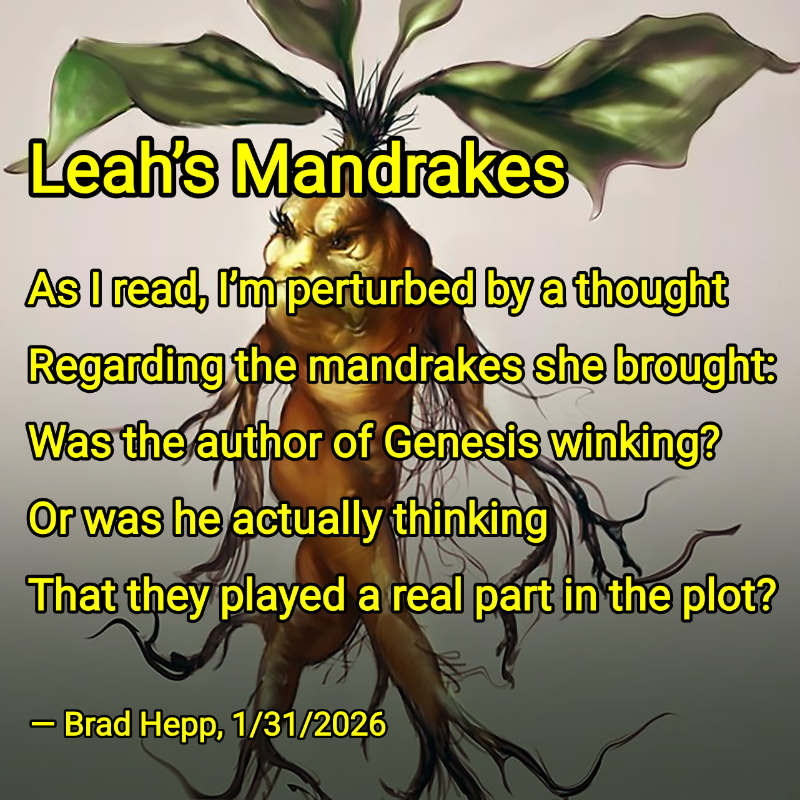
[This is an early morning response to Genesis 30]
More than likely, the author WAS winking. The mandrakes story gets us thinking how man’s devices are laughable in light of God’s sovereign choice. With or without fertility enhancers, God was going to grow Jacob’s family.
My lingering question is, where does Scripture comment on this and other stories to clearly indicate, “The moral of this story is this or that”? Some will pontificate while others will ponder where the truth is at.
(if you are viewing this via email, the website has a recording of this poem and commentary; click the title above)
Commentary
Every morning when I read the “Daily Office” (an Anglican thing I’m learning to use), I’m presented first with Malachi 1:11
For from the rising of the sun to its setting my name will be great among the nations, and in every place incense will be offered to my name, and a pure offering. For my name will be great among the nations, says the Lord of hosts.
I love passages like this, and hints in John (and elsewhere) that Jesus’ being glorified was tied to an ingathering of people from every nation.
I’m impressed that God cares for the foreigner, and wants believers to follow His example.
But nowadays, there are Christians(?) in the United States who think righteousness includes hating foreigners. I wonder if they read about God hating Esau and feel none of the tension that inspired my little poem?
NOTE: I know that teachers will generally downplay the “hating” of Esau as merely God *choosing* Jacob instead of him. But mere choice doesn’t describe what God does to Esau and his descendants (see the first few verses of Malachi).
(if you are viewing this via email, the website has a recording of this poem and commentary; click the title above)
Commentary
RETHINKING LOSS AND GENEROSITY
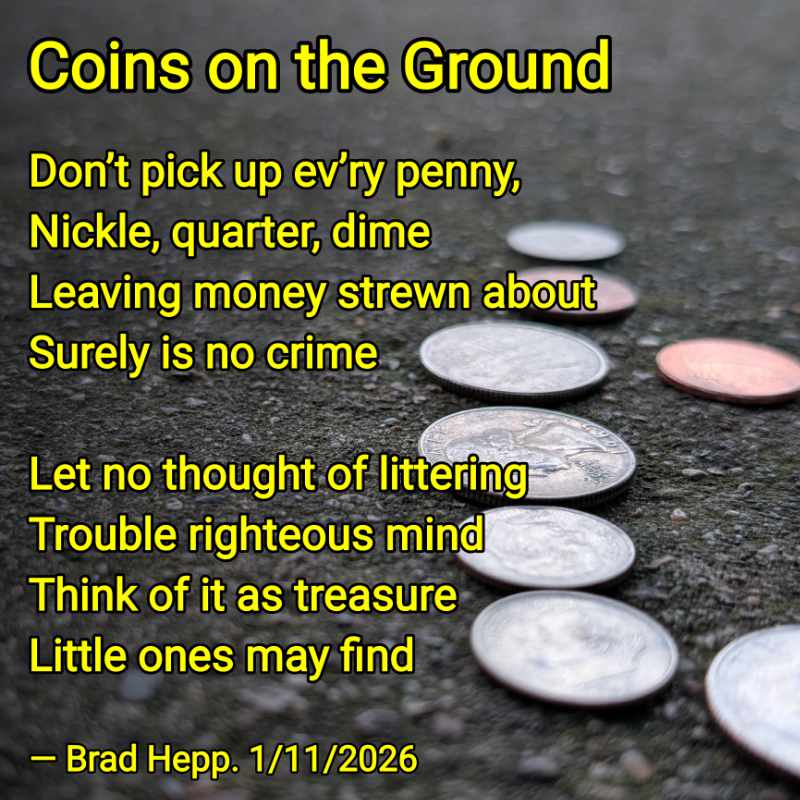
In my childhood—and somewhat to this day—I assumed that coins I found on the ground, or in a bubble gum dispenser, or in a telephone booth represented someone else’s loss. But could it be there are people who leave or drop their change not out of forgetfulness, but generosity?
My grandfather comes to mind. When he came down to visit us in Mexico, he took me on a walk to the summit of the hill where we lived. I was delighted to find money beside our path. Grandpa had been there before.
A friend–and fellow missionary kid–immediately responded with three passages from Scripture, including this one that I also had in mind:
And at your reaping the harvest of your land you must not finish reaping the edge of your field, and you must not glean the remnants of your harvest.
(if you are viewing this via email, the website has a recording of this poem and commentary; click the title above)
Commentary
I have friends whose writing I sometimes don’t understand. Nor do they always understand my writing. I can’t blame them. In some cases, they may be pushing me for more clarity. However, just because something doesn’t make sense YET, that doesn’t mean it won’t make sense some day. Is the author good? Assume he or she will one day make sense. WORK at understanding, or—if it’s too hard—just wait. Your work—or patience—will be rewarded.
I think this way about the Bible… and about myself and fellow writers. Or at least I try.
(if you are viewing this via email, the website has a recording of this poem and commentary; click the title above)
Commentary
One of the most challenging, seeming non-sequiturs in the Gospels occurs in John 12. Why did Jesus care that Greeks wished to meet with Him? Do we? Or are we just looking out for “OUR PEOPLE” (“us,” but especially ME, MYSELF, and I… the unholy trinity)?
(if you are viewing this via email, the website has a recording of this poem and commentary; click the title above)
Commentary
This poem explores implications of John Walton’s view of the “rule and subdue” mandate in the Genesis creation account. Here’s his view (from what seems like a good AI summary): “For Walton, therefore, the ‘rule and subdue’ mandate is humanity’s active participation in God’s ongoing work of bringing and maintaining order. The world is not ours to dominate, but God’s cosmic temple to be managed on his behalf.”
I like Walton’s attempt, but I’m having trouble understanding how man could be expected to bring any meaningful degree of further order to Earth, much less to the cosmos.
I suspect that Walton’s understanding of “rule and subdue” (as meaning “bring order”) leans heavily on his understanding of the context. On the other hand, I haven’t studied the Hebrew words in other contexts, so my suspicion is pretty flimsy.
When I posted the poem, two of my more savvy friends commented:
What if dominion isn’t as controlling as we like to think, but rather tending to the unique natural beauty, form, and function of God’s beautiful world. Prune here. Clear there. Thin elsewhere, taking part in how it’s shaped.
(This, of course, could apply to every sphere of authority.)
–Laurie Pearce Mathers
I agree. I think the best word is “stewardship.” And yes, our ability to steward well is surely hampered by the fall, but also, I hope, helped by the ongoing work of redemption.
Christine Renee Hand Jones
GETTING PERSONAL My interest in this subject isn’t just academic. We’re living in an apartment right now while our house is being restored after a fire broke out because a dying pecan tree dropped a limb on the electrical service. One could say I was negligent, since that pecan had dropped all its leaves. I could push back that the tree dropped all its leaves in the summer of a previous year and then roared back to life the following year, so I did not KNOW for sure that it was dying. But a look around the back yard would confirm that I am not the neat freak I once was. There is more disorder there than I’d have allowed when I was younger. Without going into details, I’m going to chalk that up to the down side of some healthy developments in my life. Put simply, I’m a recovering perfectionist. Order isn’t as important to me now as it used to be.
(if you are viewing this via email, the website has a recording of this poem and commentary; click the title above)
Commentary
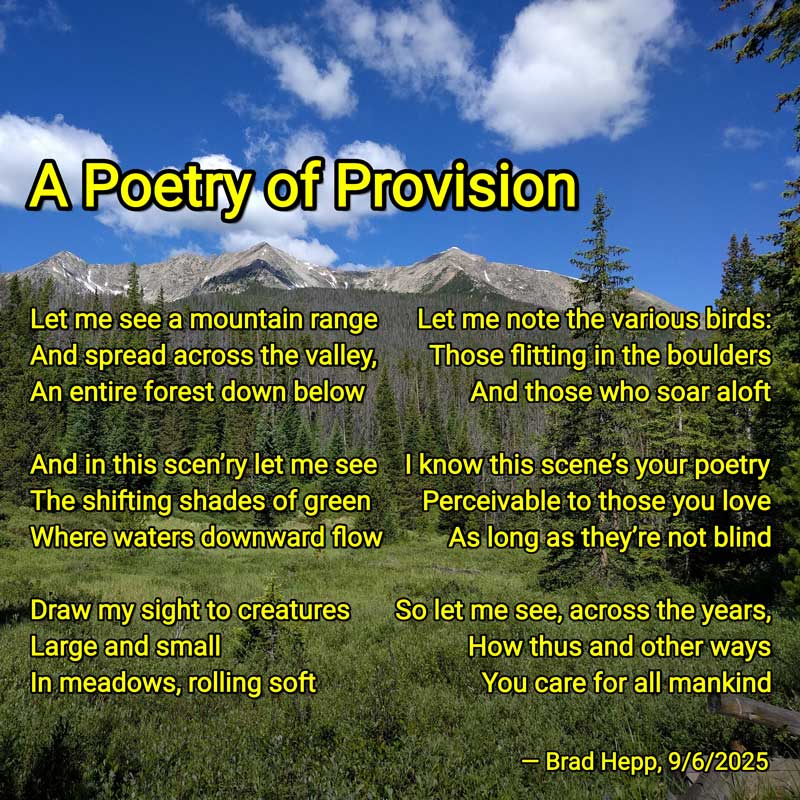
Lately, in reading the Bible and its interpreters, I have felt the need to better perceive God’s patterns of provision. In the big picture I hope to find strength for the grind of this day’s particulars.
(the background image is from a hike between Breckenridge and Frisco in Colorado)
(if you are viewing this via email, the website has a recording of this poem and commentary; click the title above)
Commentary
I sometimes joke that I’m a “wooden-headed literalist.” Well, the more I write poetry, and the more I examine myself, the more serious I get in this self-deprecation.
Lately, I have been considering the work of John Walton (Old Testament scholar and Professor Emeritus at Wheaton College). There may be others who have tried to account for metaphor in Genesis, but Walton’s is the first serious attempt that I have encountered. The hamster wheel in my cranium is spinning wildly—and wobbly—as I think through his propositions.
(if you are viewing this via email, the website has a recording of this poem and commentary; click the title above)
Commentary
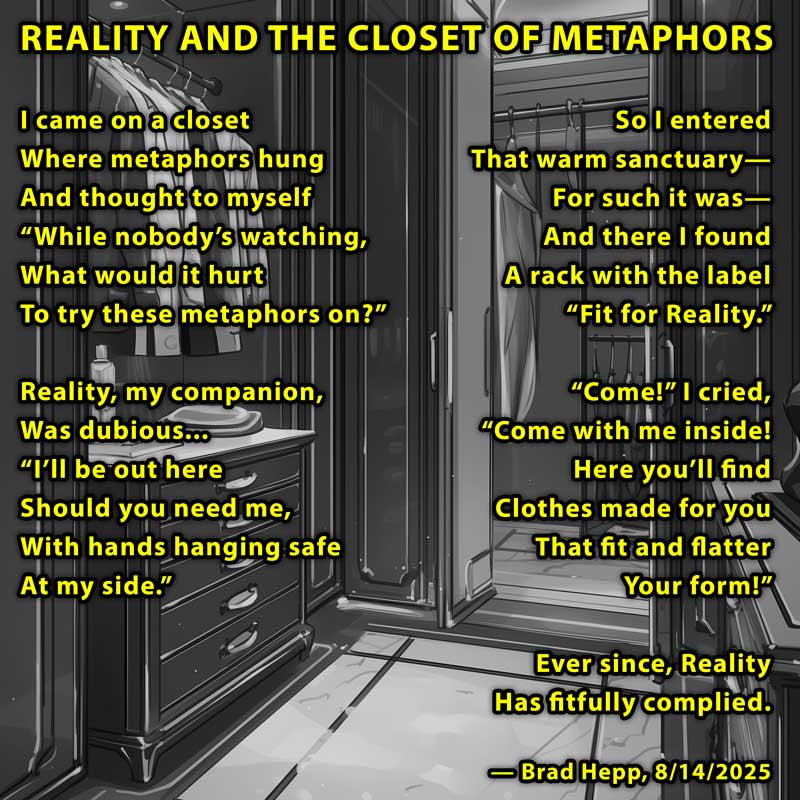
I hope that before reading this background, you will make sure you have entered the scene. Let your imagination picture my companion, Reality, and his reluctance to be clothed in metaphor.
I wrote this poem after reading various versions of Psalm 73:16-20. There must be some translation difficulties in this passage…. In the Modern English Version, verse 20 goes “Like a dream when one awakes, O Lord, when awakened, You will despise their image.” What if this translation is correct? What if Asaph really wanted to picture God having a nightmare but then waking up and scorning the characters in His nightmare?
“Oh no! Absolutely NOT,” a voice in my head insists. “God does not sleep. The Bible tells me so.” And I can imagine others–maybe you–saying the same thing. We limit how the poet is allowed to picture God. It must jibe with our systematic theology. Increasingly, I see this as a stilted and mistaken approach to understanding God’s words.
(AI-generated background image by Judas on Pixabay)
(if you are viewing this via email, the website has a recording of this poem and commentary; click the title above)
Commentary
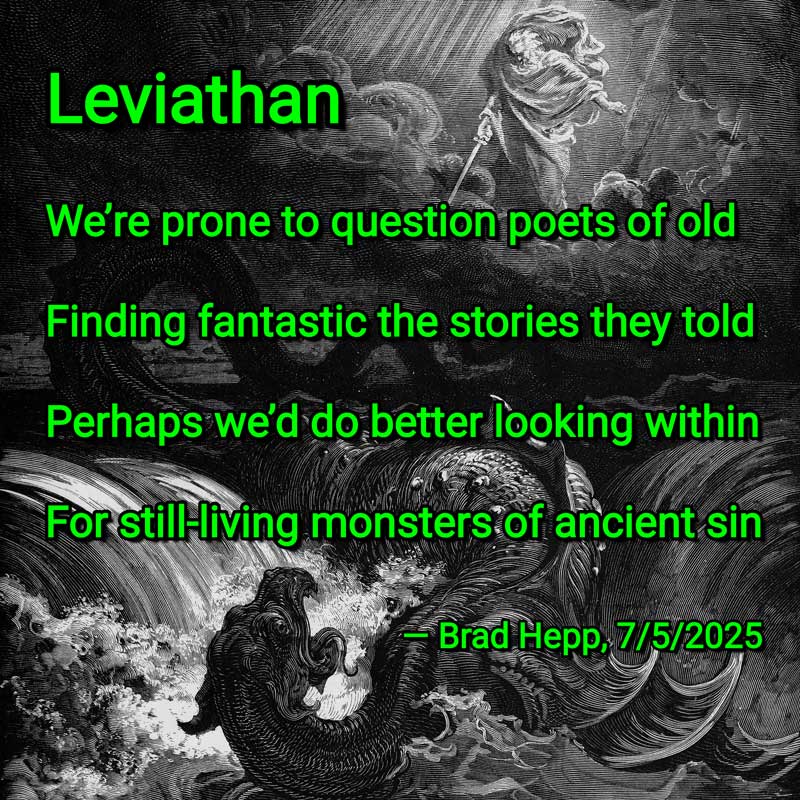
I sometimes joke that I’m a “wooden-headed literalist.” There’s some sting in the joke because it’s partly true. Combine having one foot “on the spectrum” (self-diagnosed), and another in a background of fundamentalist and dispensationalist thinking, and literalism is my unfortunate tendency. I struggle—am struggling—to properly appreciate the work of fellow poets from millennia past, as recorded in the Old and New Testaments. To correct this tendency, I have begun reading authors like Peter Enns and John H. Walton. Eventually, I’ll probably get to Walter Brueggemann.
Friends, what other authors do you recommend?
[background image: The Destruction of Leviathan by Gustave Doré (1865)]
See Job 41 (https://www.bible.com/bible/111/JOB.41.NIV)
(if you are viewing this via email, the website has a recording of this poem and commentary; click the title above)
Commentary
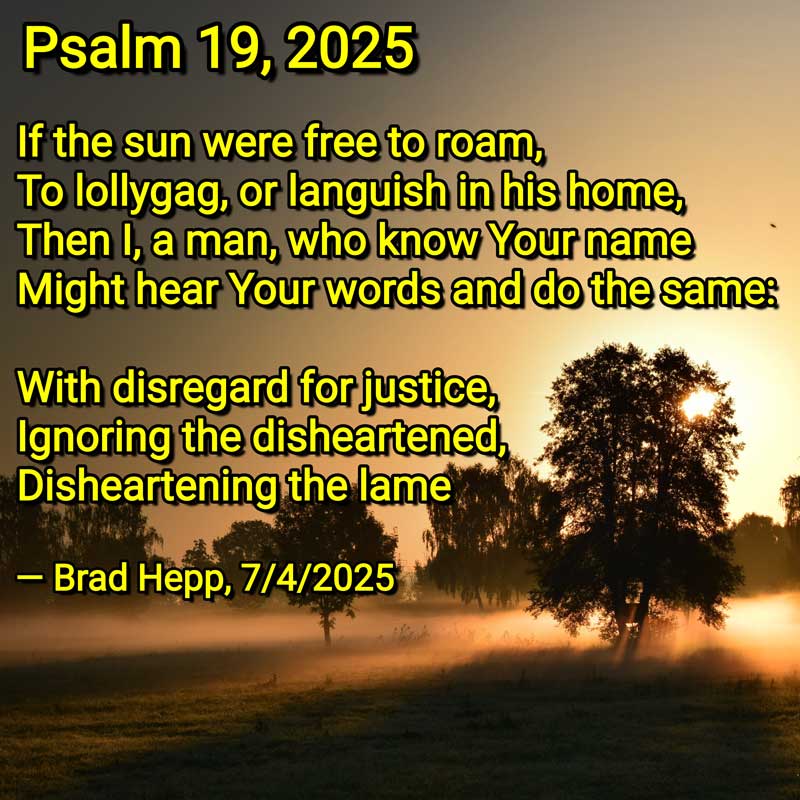
When I read Psalm 19 this morning, I was jarred by a seeming disconnect between the first 6 verses and the remaining 8 verses. What does the sun, in its dutiful, energetic, warming course across the skies have to do with us as we contemplate God’s words?
This poem expresses one possible connection between the parts of Psalm 19, namely that we could learn a thing or two from the sun. Perhaps I am just distressed by the context we’re living in right now. I see a disconnect between God’s words and the way many respond to them in the America of 2025.
(if you are viewing this via email, the website has a recording of this poem and commentary; click the title above)
Commentary
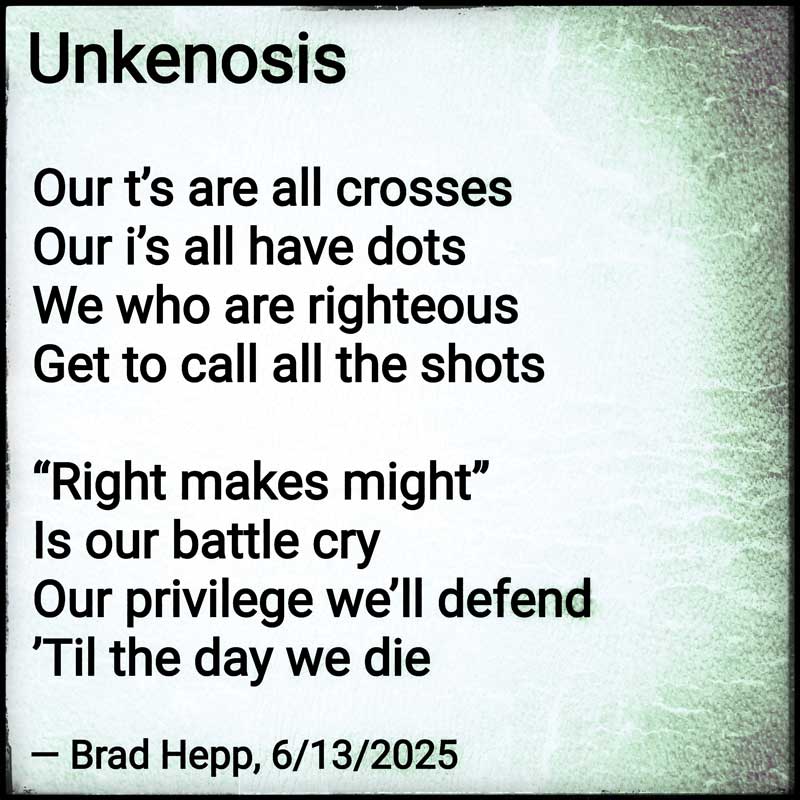
Let me say right off the bat–this poem is sarcastic. I suspect that many people identify with what they think of as good morals and right thinking NOT to please God, but because it puts them in a position of privilege and power over others.
The reason I titled the poem “unkenosis” is that the drive to attain POWER and PRIVILEGE from being “right” is the opposite of the “kenosis” that Jesus undertook in becoming a man and dying on the cross.
Do nothing out of selfish ambition or vain conceit. Rather, in humility value others above yourselves, not looking to your own interests but each of you to the interests of the others. In your relationships with one another, have the same mindset as Christ Jesus: Who, being in very nature God, did not consider equality with God something to be used to his own advantage; rather, he made himself nothing by taking the very nature of a servant, being made in human likeness. And being found in appearance as a man, he humbled himself by becoming obedient to death— even death on a cross!
Philippians 2:3-8 (NIV)
And why did Jesus’ “making himself nothing” (also translated “emptied himself” from the Greek ekenōsen heauton) result in death on a cross?
God made him who had no sin to be sin for us, so that in him we might become the righteousness of God.
2 Corinthians 5:21 (NIV)
It was for our advantage that Jesus was willing to die, taking on the mantle of guilt. We must imitate him, not power-hungry pretenders.
(if you are viewing this via email, the website has a recording of this poem and commentary; click the title above)
Commentary
We’re headed for a great upending and reversal.
[2] and he began to teach them. He said: [3] “Blessed are the poor in spirit, for theirs is the kingdom of heaven. [4] Blessed are those who mourn, for they will be comforted. [5] Blessed are the meek, for they will inherit the earth. [6] Blessed are those who hunger and thirst for righteousness, for they will be filled. [7] Blessed are the merciful, for they will be shown mercy. [8] Blessed are the pure in heart, for they will see God. [9] Blessed are the peacemakers, for they will be called children of God. [10] Blessed are those who are persecuted because of righteousness, for theirs is the kingdom of heaven. [11] “Blessed are you when people insult you, persecute you and falsely say all kinds of evil against you because of me. [12] Rejoice and be glad, because great is your reward in heaven, for in the same way they persecuted the prophets who were before you. Matthew 5:2-12 NIV
__________________ (background image by Michael Pointner on Pixabay)
(if you are viewing this via email, the website has a recording of this poem and commentary; click the title above)
Commentary
Suspecting that the Genesis creation account should not be taken literally can threaten one’s faith. I have held off thinking deeply about this threat for a long time now. Over the years, I’ve heard people I respect say something like “The Genesis creation account is poetry; don’t take it literally.” The main problem is that I have not heard a convincing exposition of the account as anything other than literal history. Rather, I have been exposed to many conservative defenses of a young-earth, somewhat literal understanding of Genesis. Since I do believe in an all-powerful, miracle-working God, the defenses often resonate, or even thrill!
Jesus and his Apostles seem to have taken the Genesis creation account literally. How are we supposed to understand their arguments if they’re wrongly based on a literal understanding of Genesis?
This poem is a naming and exploring of the threat. I want to deal with it instead of suppressing it. To that end, I’m enlisting the help of wise, intelligent, and faithful(!) friends and writers. It’ll be okay if I don’t get it all sorted out. That’s to be expected in a life of faith.
By the way…. I don’t usually say this publicly, but I’m pretty pleased with this poem. I especially like the second stanza, which tells a story in miniature. It’s odd though… being pleased with the expression of a troubling thought….
(background image adapted from one by OpenClipart-Vectors on Pixabay)
(if you are viewing this via email, the website has a recording of this poem and commentary; click the title above)
Commentary
This poem is the confluence of three streams:
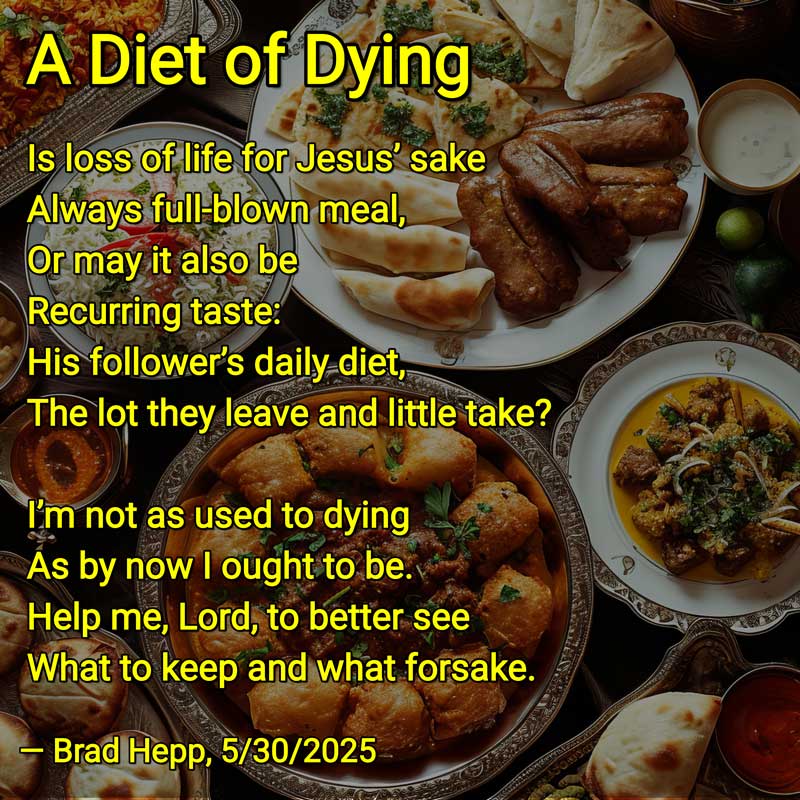
First, I woke up one morning about a week ago and–seemingly out of nowhere–a phrase popped into my mind: “I’m not accustomed to dying.” This kind of early-morning inspiration accounts for a good number of my poems. Don’t ask me to identify this muse.
Second, sometime in the following days, my daily reading of George Herbert got me to his poem “Mortification.” In the last two lines of that poem, Herbert wrote
Yet Lord, instruct us so to die, That all these dyings may be life in death.
Third, I reviewed Jesus’ words to his disciples just before the Transfiguration. Notice that he first speaks of taking up a cross and losing life. Then, as he predicts the Transfiguration, he speaks of tasting death. Are all three expressions equivalent? Do they all refer to bodily death? That’s a question I ask in the poem. Here’s the passage:
[23] And he said to all, “If anyone would come after me, let him deny himself and take up his cross daily and follow me. [24] For whoever would save his life will lose it, but whoever loses his life for my sake will save it. [25] For what does it profit a man if he gains the whole world and loses or forfeits himself? [26] For whoever is ashamed of me and of my words, of him will the Son of Man be ashamed when he comes in his glory and the glory of the Father and of the holy angels. [27] But I tell you truly, there are some standing here who will not taste death until they see the kingdom of God.” Luke 9:23-27 ESV
As you can see from the poem, I tentatively conclude that there is a kind of dying that is short of bodily death. You may recall the Apostle Paul saying that he dies daily:
[31] I protest, brothers, by my pride in you, which I have in Christ Jesus our Lord, I die every day! 1 Corinthians 15:31 ESV
There is a kind of dying that is imposed on us by age. Our strength dies. Sometimes our lust and ambitions die. As I pass through my sixties (65 on Friday), I’m certainly experiencing this kind of dying. I’m slowly getting used to it, but maybe if I had exercised more self-denial and discipline over the years, I wouldn’t find myself waking up to the thought, “I’m not accustomed to dying.”
Does the poem make more sense after that explanation? I’d love to know! Leave your answer in the comments below.
(if you are viewing this via email, the website has a recording of this poem and commentary; click the title above)
Commentary
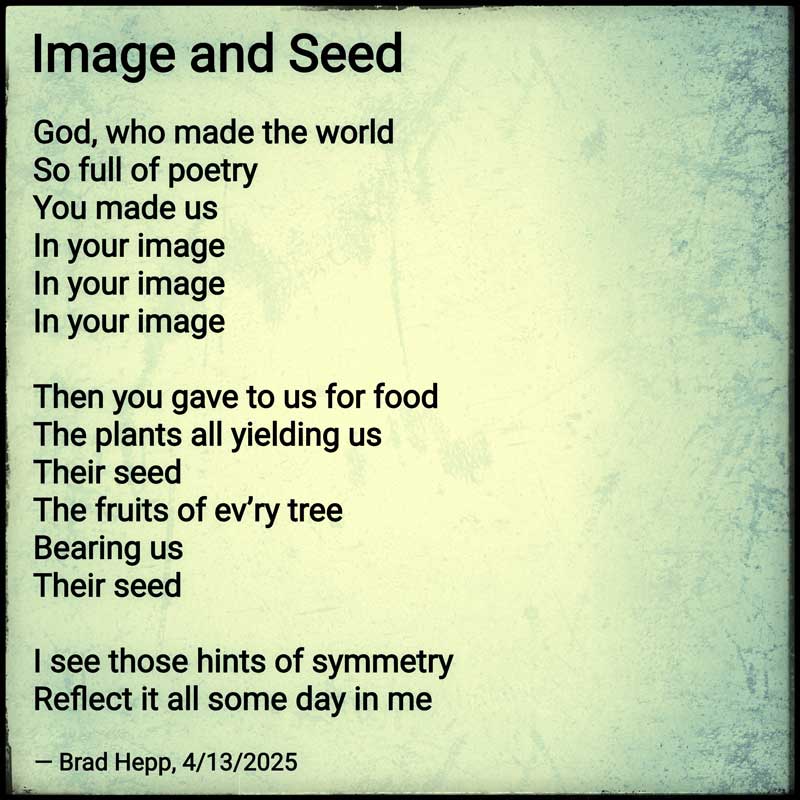
REPRODUCTION? REPLICATION? REPLENISHMENT?
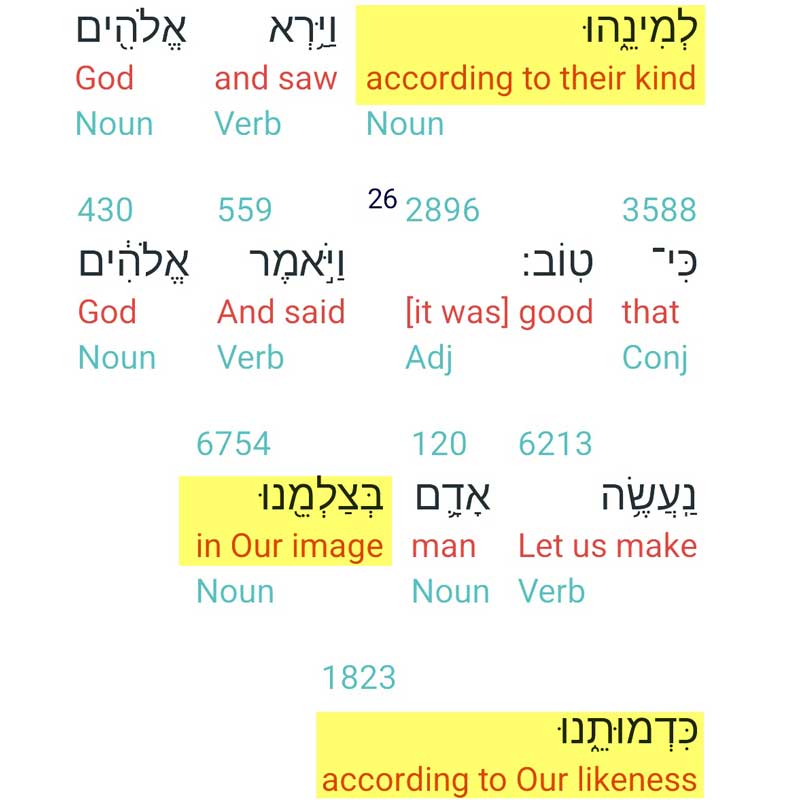
If you read the first chapter of Genesis with fresh eyes,* you may notice an insistent, almost annoying repetition of the phrase “according to its kind.” Then you get to the creation of man, and the phrase in English translations is usually “in our image.” Was the author’s intent to draw our attention to a SIMILARITY or to a DIFFERENCE in God’s creation of man vis-a-vis the creation of all other things? [Look at the Hebrew and ask yourself—or better yet, ask a Hebrew scholar—if the words are radically different]
If you look at some commentaries on the passage, you’re likely to find that they consider the mention of plants’ SEED as an indication of God’s provision for replenishment. Are they correct?
So what’s in view here? Reproduction? Replication? Replenishment? All the above? And how does this affect our behavior in the world today?
__________
*for example, eyes unclouded by a debate over creation and evolution
(if you are viewing this via email, the website has a recording of this poem and commentary; click the title above)
Commentary
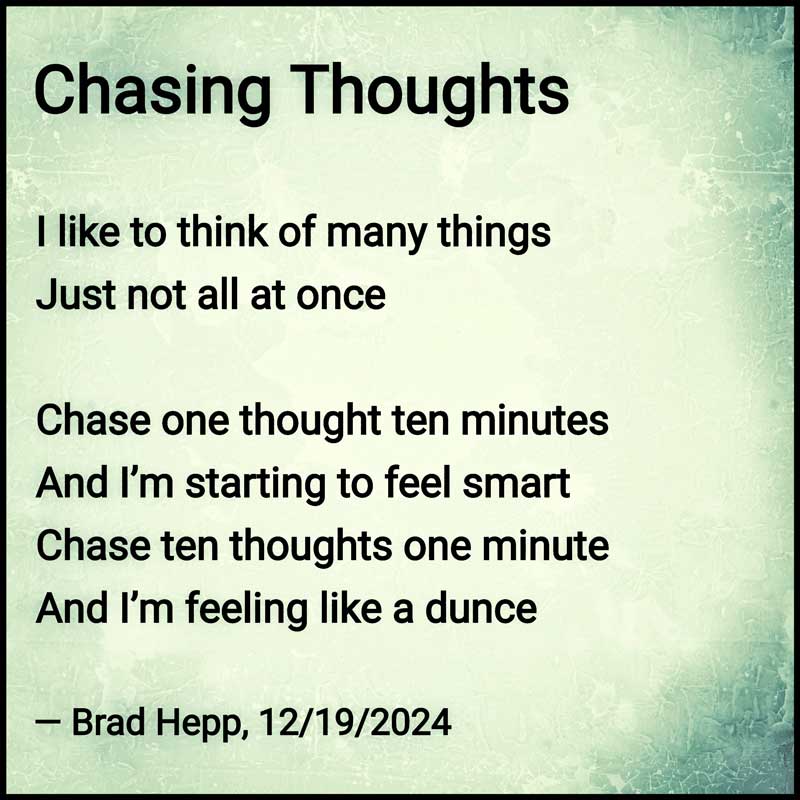
I know plenty of us experience this… at least the part about thinking of too many things at once. It may be less common to think long and deep about one thing.
(if you are viewing this via email, the website has a recording of this poem and commentary; click the title above)
Commentary
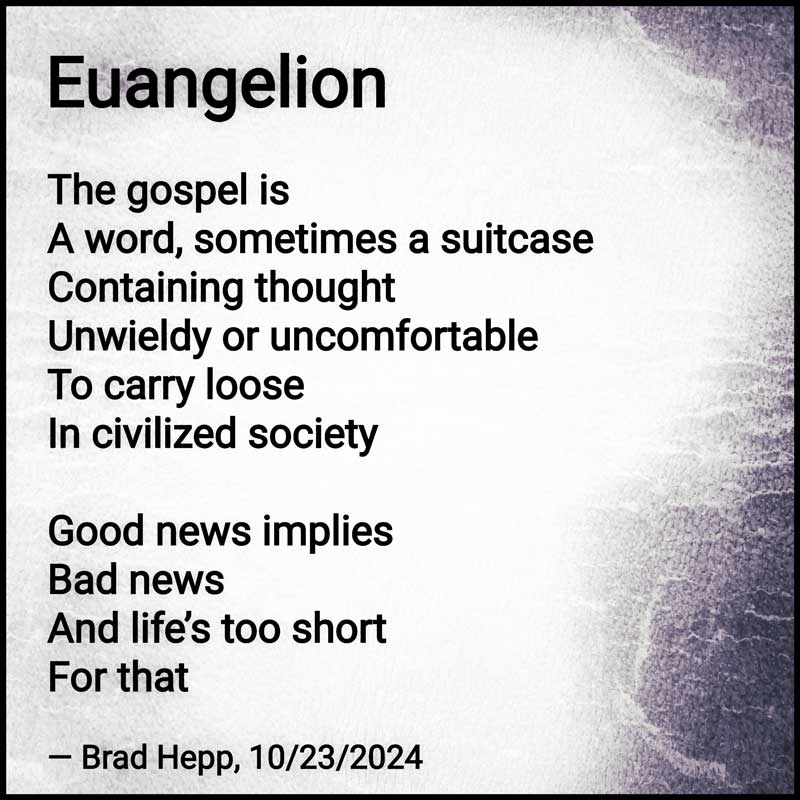
First, the occasion for this poem: I’m slowly working through Paul’s Epistle to the Romans, and I thought I should figure out if–and how–Paul actually defines the key word euangelion (usually translated “gospel” or more literally “good news”). He certainly goes a long way toward characterizing the word.
When I was a little boy, my father—ever the seminary professor—had no use for mere parroting. We’d read a passage of Scripture in family devotions, and then Dad would say, “Now put that in your own words.” I have written elsewhere how annoying that was… and how right he was!
Eugene Peterson would probably have done the same thing. He and Dad both knew that real understanding can be lost in overly familiar words.
If you do a search for “gospel” in the helpful (and FREE!) YouVersion app, you’ll find that most English versions choose that word–“gospel”–to translate euangelion (https://www.bible.com/search/bible?query=gospel). But specify Peterson’s “The Message” as the version in your query and you won’t find it used even once. Does that mean that Peterson didn’t value “the gospel”? I’m guessing the very opposite is true: It was because he valued the gospel SO MUCH that Peterson insisted on using his own words. He didn’t want its glory obscured by familiarity.
In this poem, I started out with the concept of words as suitcases of meaning. I began writing, and let the words take me where they would. As is often the case, it got a little dark.
If you ask around for people’s definition of “the gospel,” you’ll find there are different emphases concerning what the “good news” is about. Many will say it’s good news about God’s Kingdom. For some reason, I usually think of the gospel as “good news” about the availability of eternal life in a resurrected body in a restored creation. It’s very good news indeed! But that good news implies bad news, the news that apart from grateful reliance on God (my own words for “faith”), “life’s too short.”
(if you are viewing this via email, the website has a recording of this poem and commentary; click the title above)
Commentary
[22] Although they claimed to be wise, they became fools [23] and exchanged the glory of the immortal God for images made to look like a mortal human being and birds and animals and reptiles.
Romans 1:22-23 NIV
I’m slowly crawling through Romans these days. Currently, I’m pondering how and why God’s “wrath is revealed” against the unrighteousness of man (Romans 1:18). At the same time, I have perennial curiosity about what it means that man was made in God’s image. [As an aside, my current thinking is that man was fashioned to reflect God’s invisible character in the visible world. For instance, as God “sees” us metaphorically, we literally look and behold others (thus becoming aware of their needs and inherent beauty). It’s our behavior by which we image God—or fail to do so.] Given my fixation with the imago dei, it’s likely I’m unfairly injecting the concept into Paul’s exposition. You may notice the resulting conflation in my little poem.
Here are some pointers to what I’m exploring in the poem:
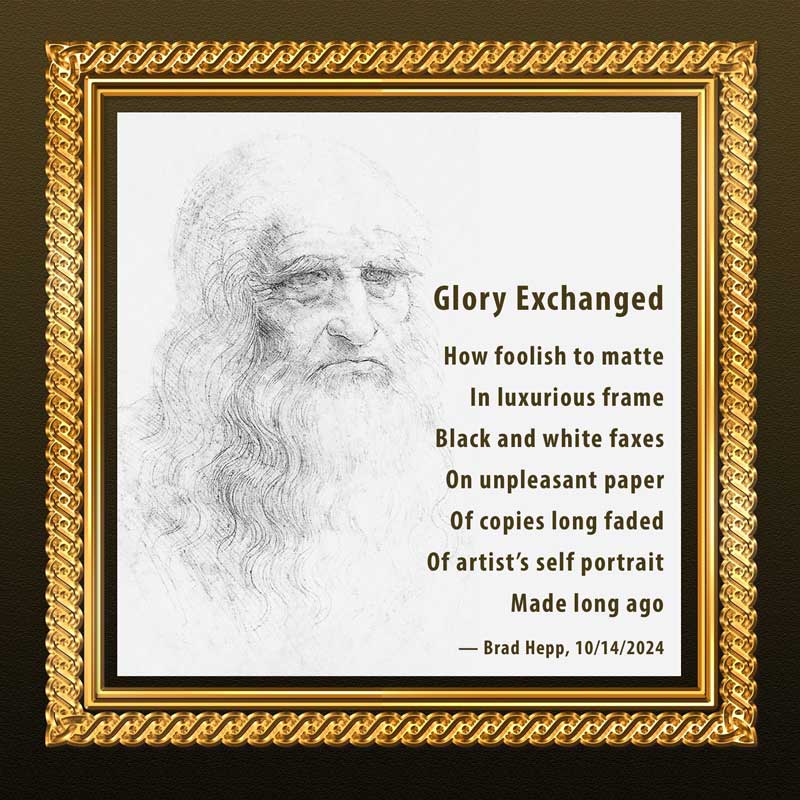
Matting and framing are how I chose to represent “worship” or “idolatry.”
“On unpleasant paper” expresses the corruption of succeeding generations. It may also reveal something laughable in my finicky nature. Does anyone remember thermal fax paper that came in rolls for use in fax machines? Maybe you have to be old and “on the spectrum” to remember how gross that paper was to the touch!
“Self portrait” serves here as a metaphor for the imago dei–man’s being created in God’s image.
Leonardo da Vinci is not to be confused with God. He just happens to have done a self portrait that suited my poem. On the other hand, one could argue that he reflected God pretty well in terms of his own creativity and of appreciating God’s creation! When it came to seeing, da Vinci saw very well.
Did these comments open up the poem for you? I’d love to get your feedback! Reply by email or comment below.
__________
(frame image adapted from one by Alexander Lesnitsky on Pixabay; da Vinci self portrait is from Wikimedia Commons)
(if you are viewing this via email, the website has a recording of this poem and commentary; click the title above)
Commentary
As I continue to struggle—and mainly fail—to understand Romans, I was struck this morning by Paul’s parallel statements about RIGHTEOUSNESS and WRATH:
[17] For in it the righteousness of God is revealed from faith to faith; as it is written, “But the righteous man shall live by faith.” [18] For the wrath of God is revealed from heaven against all ungodliness and unrighteousness of men who suppress the truth in unrighteousness,
Romans 1:17-18 NASB1995
I suspect we need to think DEEPLY about how righteousness and wrath compare and contrast.
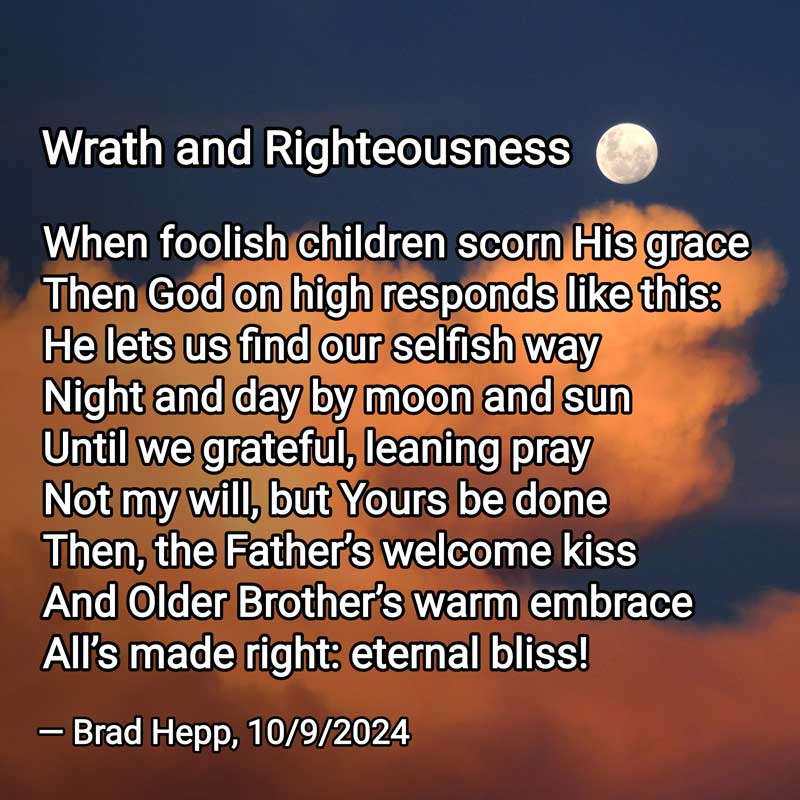
PHRASES TO NOTICE IN THE POEM: “Night and Day by moon and sun” depicts the impersonal, unending aimlessness of someone who scorns God’s guidance.
“Grateful, leaning pray” expresses my current understanding of saving faith: it is grateful reliance on God.
“Older Brother’s warm embrace” This re-imagines the story of the Prodigal Son. But in this case, the older brother is not bitter but embracing. Also, I chose “embrace” as an expression of the believer’s being IN Christ.
(background image adapted from a photo by Junior Peres Junior on Pixabay)
(if you are viewing this via email, the website has a recording of this poem and commentary; click the title above)
Commentary
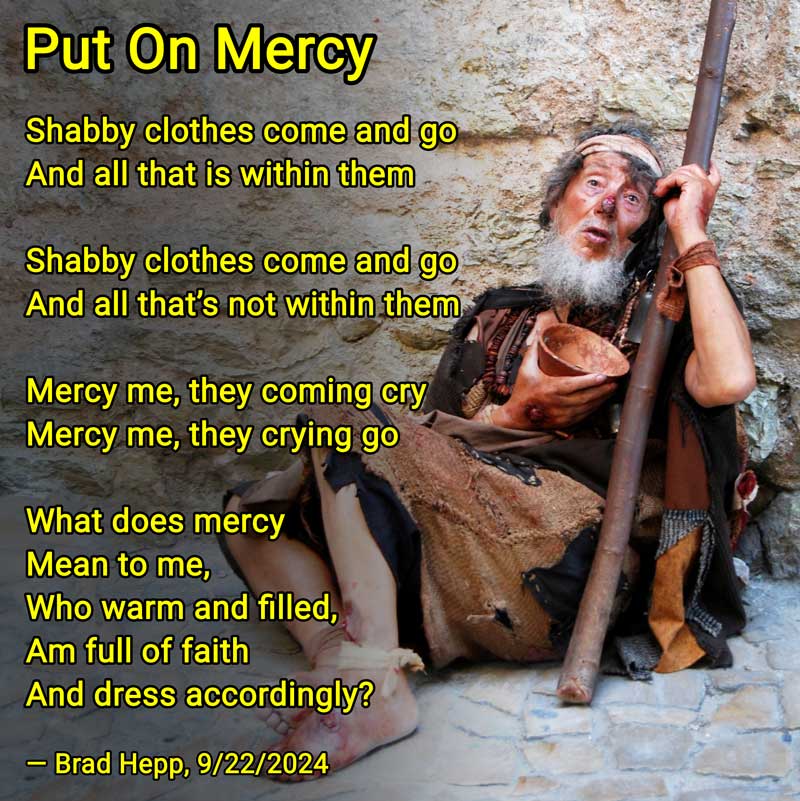
In his letter to Jewish believers scattered throughout the Roman Empire, James has his readers imagine their response to a poor man walking into their church. Something I hadn’t noticed until this morning is that James has the poor man coming in ANDgoing out in shabby clothes.
First the coming in:
For if a man wearing a gold ring and fine clothing comes into your assembly, and a poor man in shabby clothing also comes in…
James 2:2
And then the going out:
If a brother or sister is poorly clothed and lacking in daily food, and one of you says to them, “Go in peace, be warmed and filled,” without giving them the things needed for the body, what good is that?
James 2:15-16
The verses between this coming and going talk about impartiality. If you’re like me, you interpret that as “Don’t treat the rich visitor better than the poor visitor.” But James goes beyond such passive impartiality. He wants to know what you’ve done for that poor man between the welcome and dismissal, between the coming and the going. Are you sending him off just as poorly provisioned as when he came in? Notice the last of James’ examples of proper, faith-fueled hospitality:
And in the same way was not also Rahab the prostitute justified by works when she received the messengers and sent them out by another way?
James 2:25
Some Things to Notice in This Poem
First, the title “Put On Mercy” has two meanings. The Apostle Paul urges believers
Therefore, as the elect of God, holy and beloved, put on tender mercies, kindness, humility, meekness, longsuffering;
Colossians 3:12 (NKJV)
That’s the first meaning of “Put On Mercy”: be clothed in a virtuous manner of life.
But sometimes we fake it. Then our would-be virtue might just be put-on mercy: fake mercy.
In the last stanza, I cast doubt on whether or not the speaker is really putting on mercy. The speaker is assumed to have faith. Does he dress accordingly? Really? He’s warm and filled. Does merely wishing the same for the poor visitor amount to mercy?
Second, “shabby clothes” in this poem are an impersonal shell for the unloved, ignored visitor. The words don’t even acknowledge the person, but refer to him or her as “all that is–or, in poverty is not–within them.”
Third, “mercy me” is an odd phrase. We utter it to express alarm or agitation. But what if some non-standard English speaker thought that it constitutes an actual plea for mercy. Could we hear it that way? Would we respond with God’s mercy? Or would the mendicant leave without our response?
Finally, “all that is within” may serve as a faint bit of fake holy talk. It echoes a well-known Psalm:
Bless the Lord, O my soul, and all that is within me, bless his holy name!
Psalm 103:1 (ESV)
[Does that commentary help you understand the poem better? I’d love to hear from you! (If you received this poem via email, click on the poem title. That will take you to the blog where there is a comment form. If you’re shy in your response, just respond to the email!)]
(background image based on a photo by Gianni Crestani on Pixabay)
(if you are viewing this via email, the website has a recording of this poem and commentary; click the title above)
Commentary
For several weeks now, I have been camping out in the last several chapters of Acts and 1 Peter (before breakfast and on my lunch walk, respectively). Meanwhile, I am suffering some trials. This poem/prayer is a response to what I’m reading and thinking and living.
Here’s an exchange I had about this poem with someone I deeply respect:
Debbie Johnson: There is so much chaos, so much pain littering a landscape made for beauty & wonder.
Me: Well-put! And yet the suffering that results is—inscrutable to me—a major part of restoring that landscape.
Debbie Johnson: Yes! And as CS Lewis would add, recognizing the unsoothable ache is a reminder we were made for something beyond even our best here.
(if you are viewing this via email, the website has a recording of this poem and commentary; click the title above)
Commentary
I’m camping out in the last third of Acts. Here, the threat posed to unconverted Jews by Paul’s missionary project comes to a head. He has returned to Jerusalem, and he is recognized as one who has been promoting God’s Kingdom to Gentiles. At one point (in Acts 22), he is addressing a crowd that wants to kill him. They are listening quietly right up until he says, “Then the Lord said to me, ‘Go; I will send you far away to the Gentiles.’” (v. 21)
Luke writes, “The crowd listened to Paul until he said this. Then they raised their voices and shouted, ‘Rid the earth of him! He’s not fit to live!’” (v. 22)
We must ask ourselves why the listeners were so enraged by Paul’s mission. Were they afraid of some great loss? (***And what about us, in the battles WE wage?***)
I’m reminded of that strange little passage in John chapter 12 where some of his disciples inform Jesus that there are Greeks wishing to meet him. John writes, “Jesus replied, ‘The hour has come for the Son of Man to be glorified. Very truly I tell you, unless a kernel of wheat falls to the ground and dies, it remains only a single seed. But if it dies, it produces many seeds.’” (vv. 23, 24)
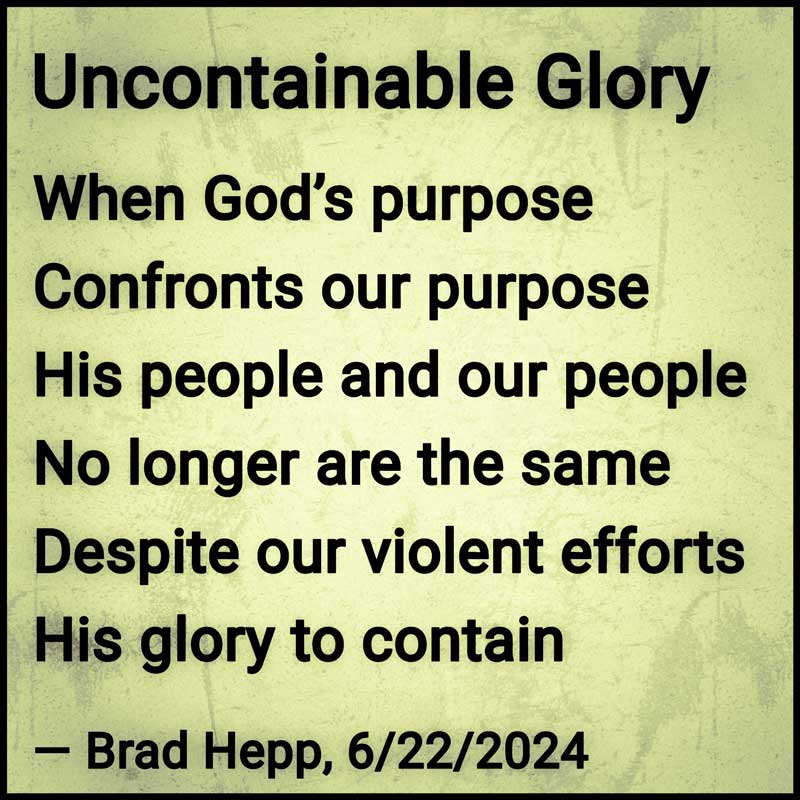
There’s a lot to unpack in that seeming non-sequitur. In short (when did a poet ever unpack anything?!), God’s glory is revealed when his self-sacrificial love for the world confronts man’s selfish tribalism.
Be on the lookout for where you oppose God’s loving purpose. The little glimmer you’re protecting WILL be put to shame by God’s glory.
(if you are viewing this via email, the website has a recording of this poem and commentary; click the title above)
Commentary
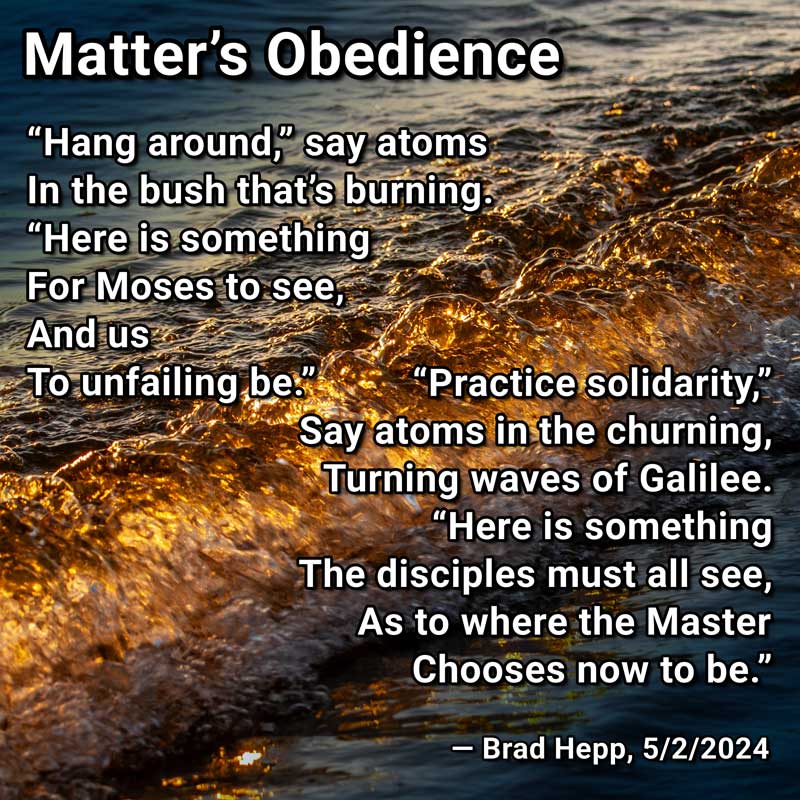
A friend pointed out to me that in this poem, as in another recent poem (“Joyful Chagrin“), I may be going beyond anthropomorphizing or personifying nature, and am now flirting with a philosophical view called panpsychism. I had to look up the term, and sure enough, I do flirt with that view. It’s hard to escape when, for your entire life you have read about trees “clapping their hands,” and how “even the wind and waves obey him.”
The Title, “Matter’s Obedience” I tried a couple of inversions in coming up with the title. The first attempt was “Matter Loves God,” which is an inversion of the recognition that “God loves matter.” Then, I inverted “Obedience Matters” to the current title: “Matter’s Obedience.” Those two attempts are related. Obedience is an evidence of love.
Can the physical universe really respond to God in loving obedience? I’ll keep saying it can, until God tells me “No, silly Brad. But I love you nonetheless.”
(background image adapted from one by “wal_172619” on Pixabay)
(if you are viewing this via email, the website has a recording of this poem and commentary; click the title above)
Commentary
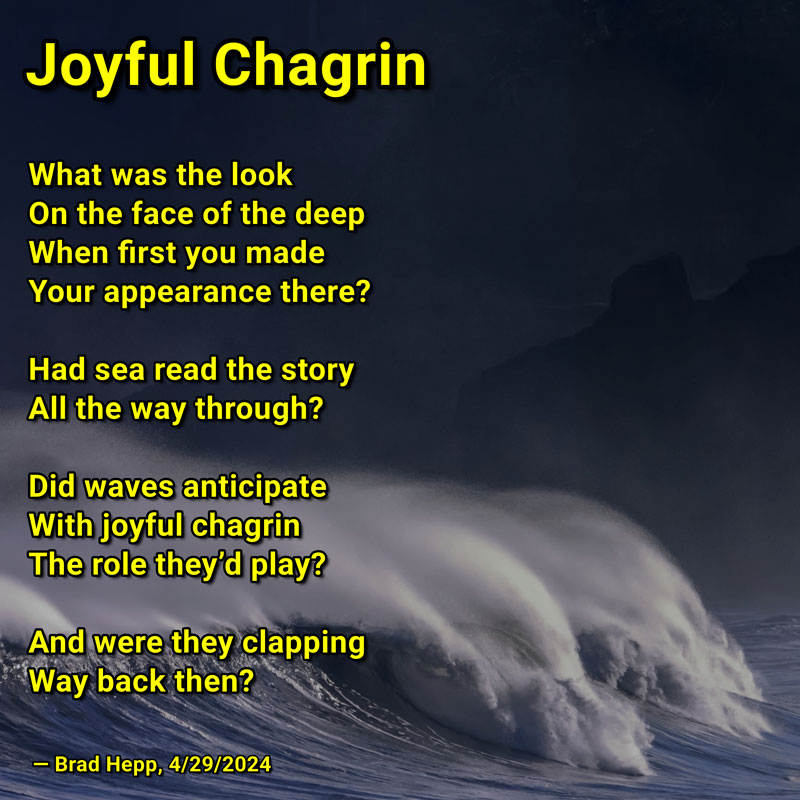
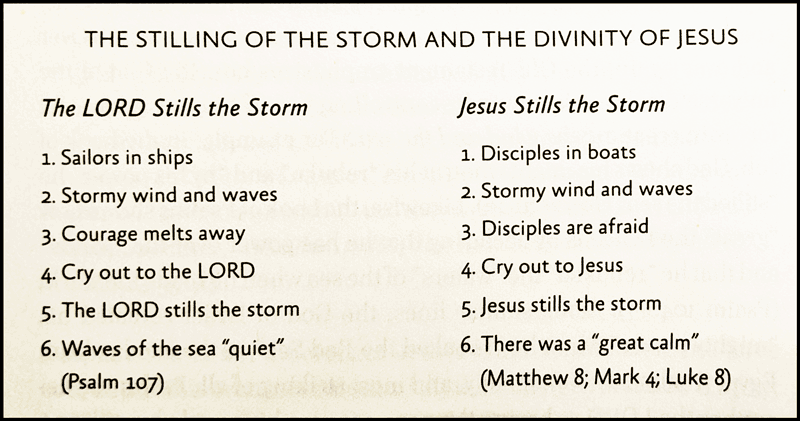
This poem springboards from reading an argument that Jesus’ divinity is present in the Synoptic Gospels (Matthew, Mark, and Luke), not just in John. In the actual argument, Brant Pitre shows that Jesus did things that his first century Jewish observers would have interpreted as implying his divinity (see the comparison below, taken from p124 of Pitre’s The Case for Jesus). So the Synoptics implied what John stated.
Face of the Deep In using the phrase “face of the deep,” I am playing with the King James Version rendering of Genesis 1, verse 2:
And the earth was without form, and void: and darkness was upon the face of the deep. And the Spirit of God moved upon the face of the waters.
(if you are viewing this via email, the website has a recording of this poem and commentary; click the title above)
Commentary
This poem was inspired by a passage in Brant Pitre’s excellent “The Case for Jesus.”
Being a student in the ancient world was radically different from what it is like today, when it simply means you may (or may not) listen to a fifty-minute lecture three times a week for a semester. Being one of Jesus’ students meant following him everywhere, and listening to him all the time, for anywhere between one and three years.
(if you are viewing this via email, the website has a recording of this poem and commentary; click the title above)
Commentary
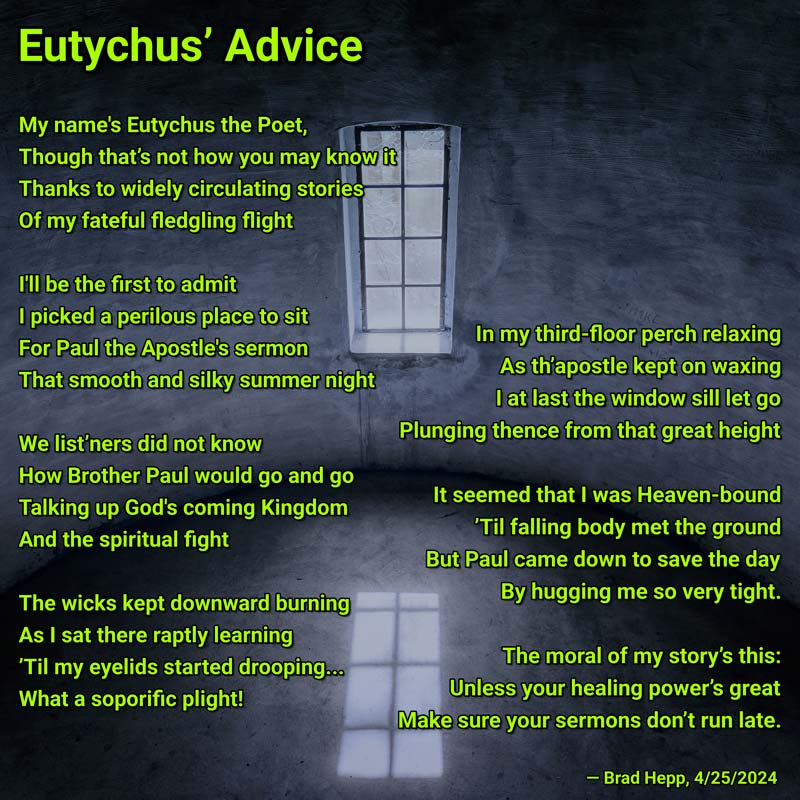
In my crawl through the book of Acts, I’m to chapter 20, and I hit this passage:
On the first day of the week we came together to break bread. Paul spoke to the people and, because he intended to leave the next day, kept on talking until midnight. There were many lamps in the upstairs room where we were meeting. Seated in a window was a young man named Eutychus, who was sinking into a deep sleep as Paul talked on and on. When he was sound asleep, he fell to the ground from the third story and was picked up dead. Paul went down, threw himself on the young man and put his arms around him. “Don’t be alarmed,” he said. “He’s alive!” Then he went upstairs again and broke bread and ate. After talking until daylight, he left. The people took the young man home alive and were greatly comforted.
Acts 20:7-12 (NIV)
What’s the point of Luke’s account? Don’t sleep in church? God’s power was displayed through the Apostle Paul? It’s probably something along those lines, not the supposed “moral of the story” I suggested in the last stanza of my poem. But I couldn’t resist. I sent the poem off to three of my preacher friends. So far, they haven’t responded. They’re probably busy crafting succinct sermons. Good luck, I say!
(if you are viewing this via email, the website has a recording of this poem and commentary; click the title above)
Commentary
There’s a Price to Passion
I respond powerfully when music is performed well. God bless good musicians!
Unfortunately, my response is equally powerful when music is performed poorly.
If you don’t share this powerful response to music, you may not understand or sympathize with the following….
Sometimes when I’m at church, I find it hard to worship. My body wants to move with the music, but doesn’t feel a groove. It may be a drummer who’s drumming to the beat of a different march. Or it may be guitarists and pianists who are stepping on each other rhythmically. My voice wants to harmonize, but harmony’s made practically impossible by off-pitch musicians or bad accompaniment. It’s a real struggle then to maintain my equanimity, much less worship.
You know who I really pity? Those with perfect pitch. How miserable is their journey through life?
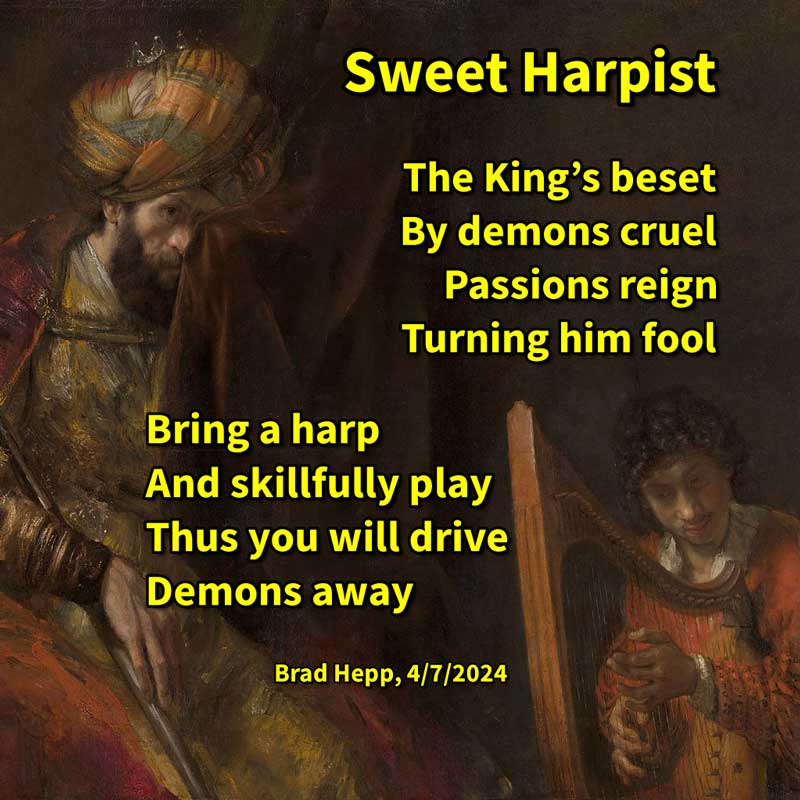
(background image is Rembrandt’s “Saul and David”)
(if you are viewing this via email, the website has a recording of this poem and commentary; click the title above)
Commentary
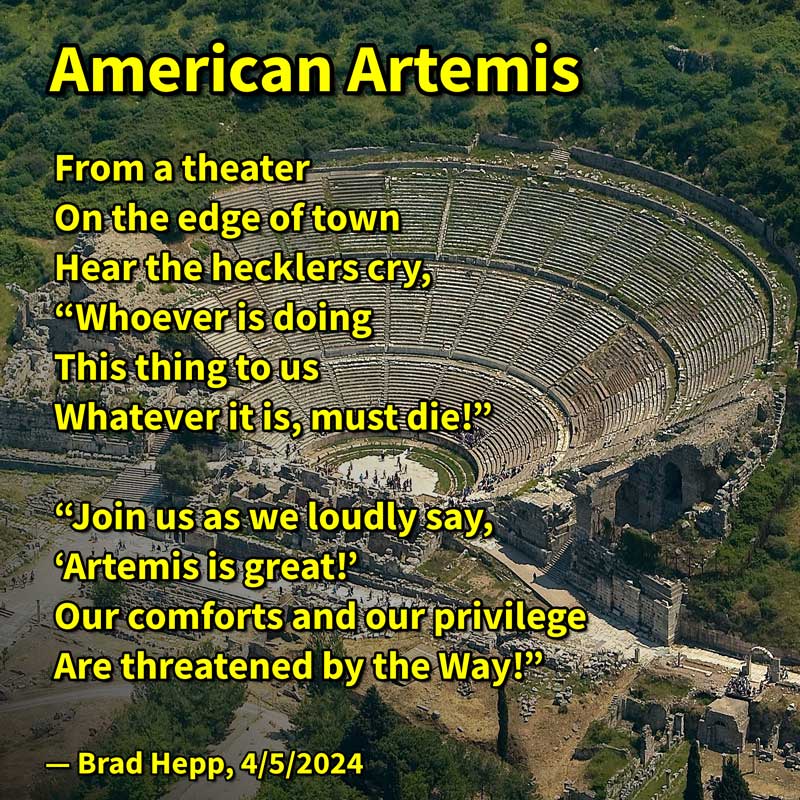
This poem comes out of reading Acts 19 (the riot in Ephesus), and contemplating what 21st-century white evangelical Christians could glean from the story.
Wouldn’t it be something if the Way actually threatened OUR comforts and privilege as it did the pagans in first-century Ephesus!
Consider this last paragraph from a 2019 piece by Washington Post columnist Michael Gerson:
Many white evangelical Christians hold a faith that appeals to the comfortable rather than siding with the afflicted. They have allied themselves with bigots and nativists, risking the reputation of the gospel itself. And, in some very public ways, they are difficult to recognize as Christians at all.
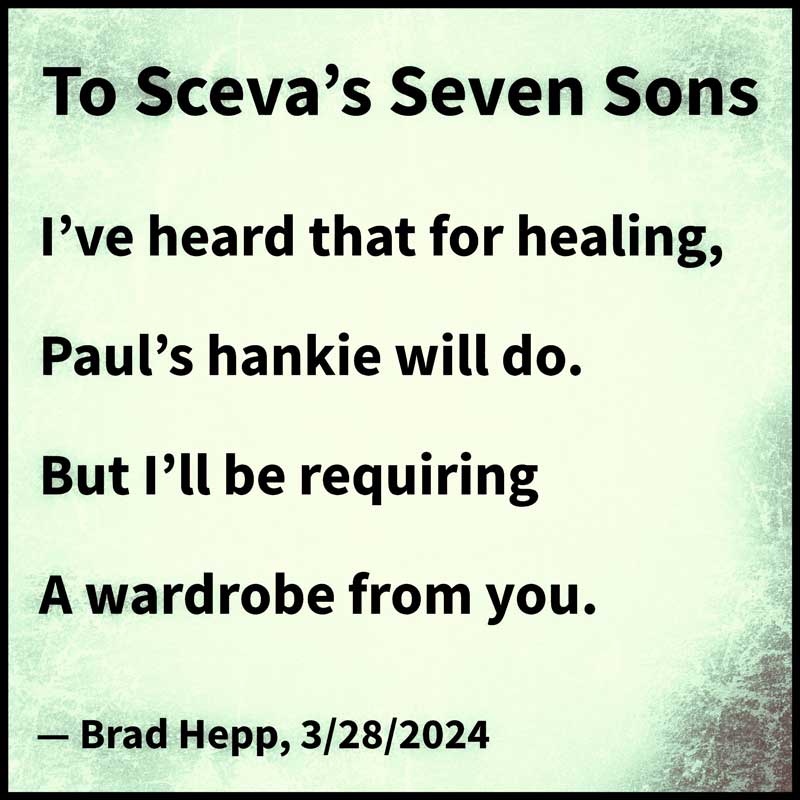
In my crawl through Acts, I’m to chapter nineteen. When you look up “Is there humor in Luke’s writing?” you’ll often be pointed to Acts 19 and the story of Sceva’s seven sons. Yes, there are serious considerations…. But in the context, this does strike me (no pun intended) as a story that amused Luke.
(if you are viewing this via email, the website has a recording of this poem and commentary; click the title above)
Commentary
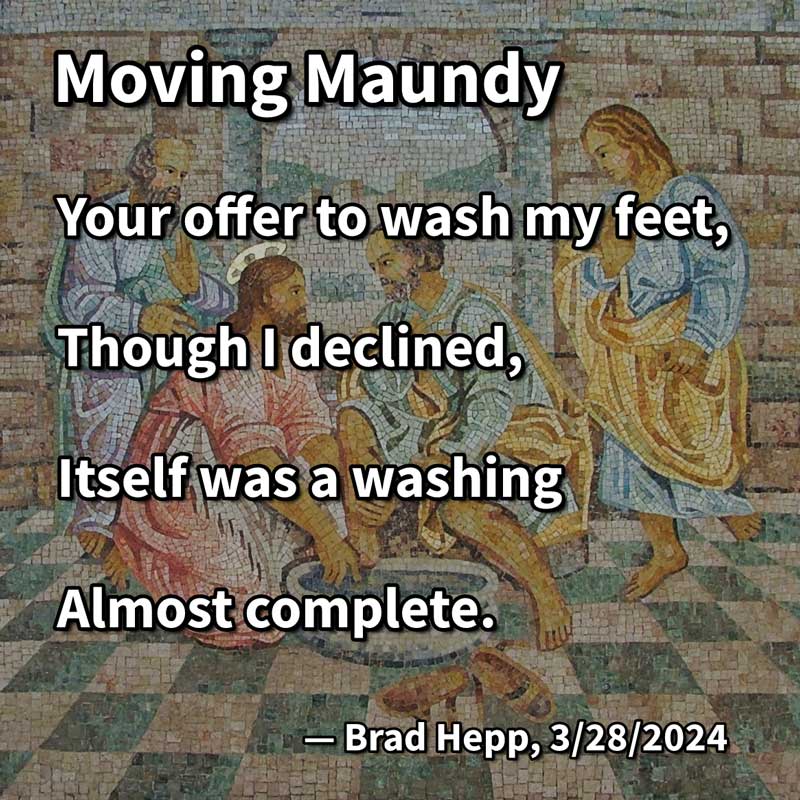
When you’re not an Anglican, but serving them in the soundbooth, and the priest comes up and says, “Just let the slides go black; come down and let me wash your feet.” Maybe next time I’ll be less duty-bound, and accept. It would have been a blessing, all around.