(if you are viewing this via email, the website has a recording of this poem and commentary; click the title above)
Commentary
My father was a theologian who spent his entire adult life thinking and writing about the Kingdom of God. Was he right or wrong about the Kingdom’s current status? I don’t know.
Maybe it’s like the Queen in “Through The Looking Glass” would put it: “You think this is the Kingdom? I could show you a Kingdom compared with which you’d call this a pile of manure.”
(if you are viewing this via email, the website has a recording of this poem and commentary; click the title above)
Commentary
In my crawl through Acts, I’m still camping in Chapter 14. As always, I’m looking for how God works and how he thinks of things.
In this chapter, Paul and Barnabas get to Lystra. Right off the bat, Paul demonstrates God’s powerful kindness by healing a man who was lame from birth. The people of Lystra think that the apostles must be gods, come down in human form. They set out to worship them. But Paul and Barnabas set them straight.
WHAT’S THE CONTRAST? I’ve learned to look for contrasts in Luke’s story-telling. What’s he contrasting in this story? Most of us probably see him contrasting the fake gods of Olympus with the real God who created everything. That’s definitely there. But I think there’s something else.
A note in the NET Bible alerted me to a contrast between how fake gods leverage FEAR and how the living God operates out of KINDNESS.
Here’s the note: “In this region there was a story of Zeus and Hermes visiting the area (Ovid, Metamorphoses 8.611-725). The locals failed to acknowledge them, so judgment followed. The present crowd was determined not to make the mistake a second time.”
This business of the Lystrans trying to worship Paul and Barnabas as though they were Hermes and Zeus…. It’s out of FEAR. In contrast, everything that Paul does and says in this passage points to God’s KINDNESS.
REFLECT AND APPLY Read the passage with God’s kindness in mind. Then think about where God’s kindness is highlighted elsewhere in Scripture. Also think about where men oppose God’s kindness. Sometimes it’s people on “our side.” I think of Jonah, who should have known better. He didn’t want to go to Nineveh because he just knew God would be kind to Israel’s mortal enemies in Assyria (see Jonah, Chapter 4).
Now look at your life with God’s kindness in mind. What does that change? Can you see God’s kindness in your own circumstances? Are there opportunities to reflect God’s kindness in how you interact with others?
(if you are viewing this via email, the website has a recording of this poem and commentary; click the title above)
Commentary
This is one of those poems that seemed pretty good in the morning, but not so good later in the day. Oh well. I think its goodness–if any–is felt most keenly when you’re seriously contemplating the long wait for Jesus’ return. Below is what I wrote when I had just penned the poem:
In my crawl through Acts, I got to chapter 14. Here, Luke surprised me with one of his occasional references to Jesus’ direct participation in the “Acts of the Apostles.” The fact that I registered surprise got me thinking about this long period now where we’re waiting for Jesus’ return. How are we to think of his seeming absence? I know the usual answer; is there more?
Please notice something…. I don’t usually capitalize “divine pronouns.” In this poem, it seemed useful for exploring relationships.
(if you are viewing this via email, the website has a recording of this poem and commentary; click the title above)
Commentary
First of all, forgive the big word at the end. “Ignominiously” means something like “with no honor,” or–more to the point–“without a great name.”
This poem is based on connections I am exploring between the story of Peter’s release from prison at the hands of Herod Agrippa I (Acts 12) and Israel’s release from slavery in Egypt (Exodus).
Luke points out that the events of Acts 12 occurred around the time of the Passover Festival.* In fact, it looks like Peter’s release from prison happened on the culminating night of Passover. That may not mean much to us, but it would have meant a lot to Peter’s contemporaries.
Maybe it should mean more to us….
(background image by Somchai Sumnow on Pixabay)
*OOPS. When I wrote this, I was assuming that Passover came at the end of the Feast of Unleavened Bread. I had it backwards. The saving grace for me is that the whole week was also called Passover. Here’s a helpful web page on the subject: https://www.lehigh.edu/~gdb0/simcha/firstf00.htm
(if you are viewing this via email, the website has a recording of this poem and commentary; click the title above)
Commentary
In this poem, I imagine how Cornelius (Acts 10) may one day tie together the promises to Abraham (Genesis 17-21) with how he himself came to be part of Abraham’s promised lineage.
THE FEAST: Here’s one of the passages that was in my mind when I was reading Acts 10:
I say to you that many will come from the east and the west, and will take their places at the feast with Abraham, Isaac and Jacob in the kingdom of heaven.
Matthew 8:11 (NIV)
“Soar” in the last line has two meanings: take flight and increase.
(if you are viewing this via email, the website has a recording of this poem and commentary; click the title above)
Commentary
WHAT’S THE DEAL WITH DORCAS?
In my crawl through Acts, I just made it through chapter 9. Here we encounter the story of a generous disciple named Tabitha. Her name is Dorcas (meaning deer or gazelle) in Greek. She dies, and her fellow disciples send for Peter, who successfully petitions the Lord to raise her back to life.
I suspect part of Luke’s point in telling this story is to highlight God’s pleasure in disciples’ generosity. Earlier in Acts, we saw the Ananias and Sapphira story, where greed resulted in death. In their case, there was no resuscitation. Peter played a part in that story as well.
By the way, my doggerel notwithstanding, I see evidence that Dorcas’ generosity was not limited to fellow believers, to those in the Lord’s “fellowship.”
(if you are viewing this via email, the website has a recording of this poem and commentary; click the title above)
Commentary
In my crawl through Acts, I’m to chapter 9. Paul had gone to Damascus to capture believers, but new plans were revealed by a blinding light. In a great reversal, he left Damascus* in the darkness of night, lowered out the city wall in a basket to avoid being captured. This was the dawn of his exciting and unexpected new life mission.
My observation of parallels with the conquest of Jericho probably doesn’t mean much. But it’s there to consider. We should always be asking, “Where have I seen this before?” God’s kingdom (realm and rule) has a long history.
SERENDIPITY (BASKET-FLAX-LINEN) I’m thinking about what kind of basket would be large enough to hold Paul when he was lowered from the wall…. I’m guessing such a basket would generally carry something light. What could that be? Grain? Flax? Naturally, the Joshua 2 account of the spies hidden under flax stalks(?) comes to mind. So I looked up flax, and found this fascinating article (is it good scholarship?): https://blog.fabrics-store.com/2022/12/25/biblical-accounts-of-linen-and-flax-seed/
(background image adapted from one by “M W” on Pixabay)
*I hate to break it to myself, but in the Luke 9 account Luke may have left out Paul’s time in the wilderness. Apparently, Paul entered Damascus blind from his conversion encounter with Jesus. He started preaching, but also went out into the wilderness for a period of three(?) years, and then returned to Damascus. It was after the return to Damascus that this escape happened. That’s what happens when you read a passage AS IT IS WRITTEN, and don’t try to bring in information from other passages (Galatians, in this case). The upside is great, but occasionally I have to backtrack. Oh well…
(if you are viewing this via email, the website has a recording of this poem and commentary; click the title above)
Commentary
In my crawl through Acts, I have just about made it through chapter 8. Once again, Luke is telling a story that contrasts GENEROSITY (God’s generosity, reflected in selfless servants) with GREED (here it is Simon the Magician’s apparent desire to exploit God’s generosity).
Question: is it possible Simon was a true believer? Was he saved in Luke’s account? Does Luke actually want us to struggle with this question? He leaves off with Simon declining to do the one thing Peter requires of him: personally repent and pray for God’s forgiveness.
(if you are viewing this via email, the website has a recording of this poem and commentary; click the title above)
Commentary
Halfway through my second year in college, I went through a period of questioning my faith. Actually, I was questioning “my inherited faith,” since Christianity was what I grew up with. The questioning was a healthy process. I came out of it with a recognition that I could not–and need not–prove anything about God definitively.
One book that I read at that time was In two minds: The dilemma of doubt & how to resolve it by Oz Guinness. Since it has been over forty years since I read the book, I can’t swear to this, but I seem to recall Guinness suggesting that doubt often arises from ingratitude. Over the years, that seems to have been borne out in my own life: stop thanking God for all He supplies, and soon I’m struggling with doubt.
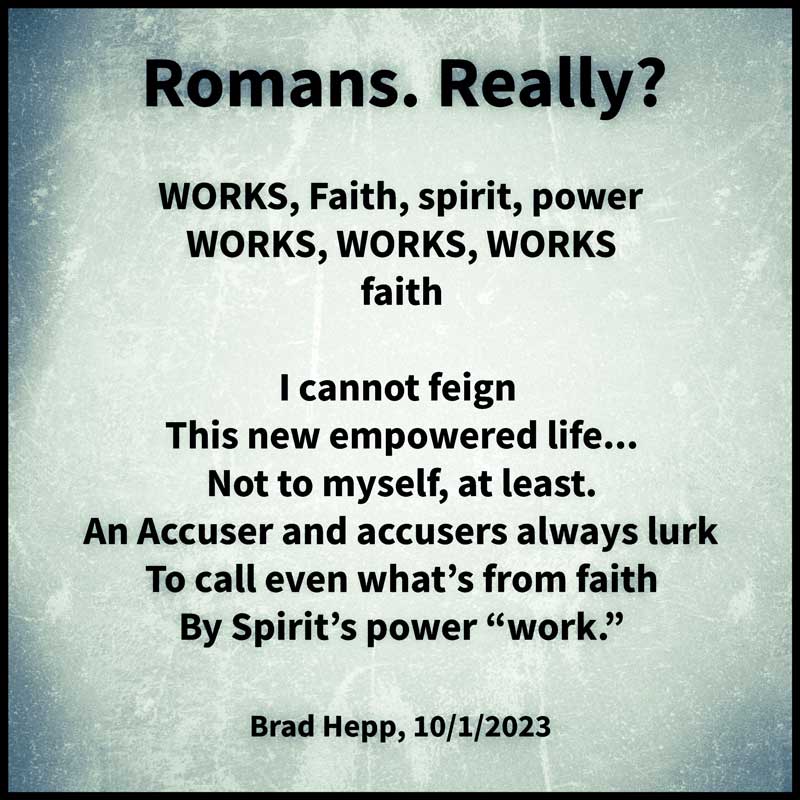
With that background, you’ll understand why, when I recently tried to throw out all my presuppositions about Romans and come to my own fresh understanding, there’s one presupposition I wasn’t willing to throw out just yet: that the kind of faith Paul is talking about could be characterized as “grateful reliance.” That’s really what this poem is about. When I posted the poem on Facebook, here’s what I wrote:
My flight through the Bible has my little plane struggling for elevation to clear the mountain range called Romans.
This little poem is me thinking “out loud” about how Abraham’s exemplary(?)* saving faith may have differed from the faith of his descendants.
*Caution: the QUALITY of Abraham’s faith may not be Paul’s point. I look at it because many of those whose condemnation Paul mentions surely had their own measure of faith. Was it different? Is that important? I don’t know yet.
(the background image combines a night sky photo by Chemnitz/Deutschland on Pixabay; a desert scene by Greg Montani, also on Pixabay; and Genesis 15:5 in Hebrew)
(if you are viewing this via email, the website has a recording of this poem and commentary; click the title above)
Commentary
Well, this is embarrassing! This is probably a lousy poem. I wrote it as flow of consciousness while studying Romans. And now, I don’t recall what I was thinking. Wow. That’s lame.
I do recognize a perennial lament of mine: that there’s always someone out there interpreting our efforts in the worst possible light.
Here, for what it’s worth, is what I wrote when I first posted the poem:
Sometime it would be nice to ask of Jesus, “Are we really friends? When you look straight through me, do you see anything of yourself?”
(if you are viewing this via email, the website has a recording of this poem and commentary; click the title above)
Commentary
GOD’S LOVE AND KINDNESS IS BEFORE AND ABOVE ALL
I have a deepening impression that our obedience and disobedience to God are the result of whether or not we believe that God is reliably loving and kind.
Most recently, this impression was strengthened as I contemplated Stephen’s sermon in Acts 7. As I see it, he’s recounting a history of Israel rejecting God’s promises and provisions.
I also think of the Sabbath. God tells Israel that they can take it easy on the seventh day, and seventh year and in the jubilee year. He will provide! Keeping the sabbath was first and foremost a matter of believing God’s amazing promise and provision. But almost immediately, Israel turned the delightful provision into a duty.*
Just now, I looked back at Genesis chapter 1. God’s first action toward man is to bless and give.
GOD IS GOOD, but large swaths of Christianity concentrate more on dos and don’ts than on God’s goodness.
*[I must confess that I understand how that could happen when the first thing out of the gate was a disobedient Israelite getting killed for picking up sticks on the Sabbath…. I’m trusting God will enable me to understand this some day]
(if you are viewing this via email, the website has a recording of this poem and commentary; click the title above)
Commentary
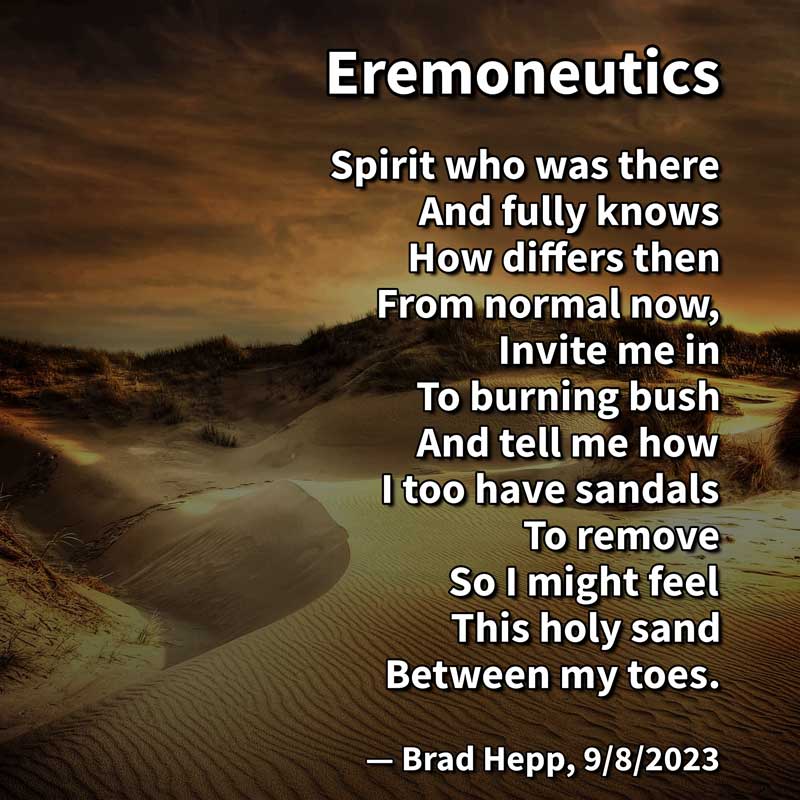
[This title is a combination of Greek erēmō (ἐρήμῳ, meaning wilderness, desert) and “hermeneutics” (the art and science of interpretation, especially of the Bible).]
These days I’m doing a lot of puzzling about the relationship of words and events in the lives of Moses, John the Baptist, and Jesus. Consider how the following words figure in the announcement of Moses’ and Jesus’ ministries: wilderness, voice, fire, sandal. Add in the fact that Jews were looking for a fulfillment of Moses’ promise that “The Lord your God will raise up for you a prophet like me from among you, from your brothers—it is to him you shall listen” (Deut. 18:15). They were bound to be looking for similarities between Moses and Jesus.
My 21st century brain wants to nail down logical, definite relationships between the men and their stories. But is that even appropriate? Is it possible that 1st century Jews were content with an unanalyzed, but harmonious gumbo of coincidence?
Please understand that the previous paragraph is not a denigration of biblical characters and writers. It’s simply that I want to really understand how they thought.
Bible students are taught “don’t make parables walk on all fours.” In other words, don’t assume that every aspect of a parable represents something in reality. But we’re tempted to ignore the advice. We get to the parable about the Rich Man and Lazarus, and we want to use that parable to map out Heaven, Hell, and eternal destiny. We need to be careful.
So, my last paragraph is a respectful pondering of the possibility that commonplace wisdom about interpreting parables may extend to interpreting other biblical forms.
(if you are viewing this via email, the website has a recording of this poem and commentary; click the title above)
Commentary
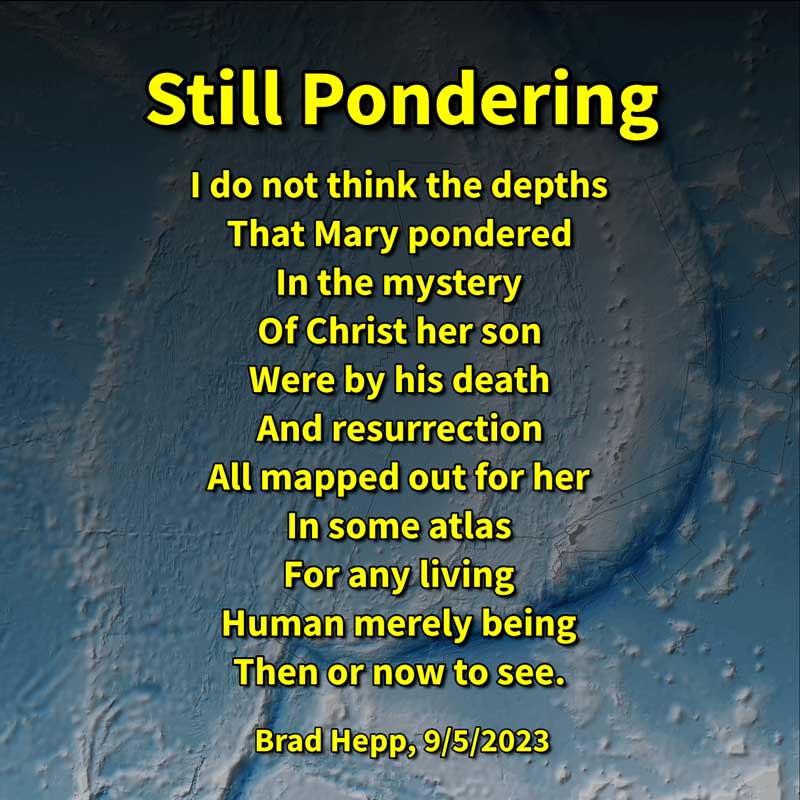
PONDERING THE UNFATHOMABLE King David’s blessed man meditated “day and night” (Psalm 1) and Mary “treasured all these things in her heart” (Luke 2). These two passages provide my model of humble, intellectually honest pondering.
I assume that we please God more by pondering his words and ways than by pontificating on them. As a man of limited intellect and porous memory, I take shelter and comfort in this assumption.
The background image for this poem is a “map” of the Mariana Trench produced by the Nasa Earth Observatory.
(if you are viewing this via email, the website has a recording of this poem and commentary; click the title above)
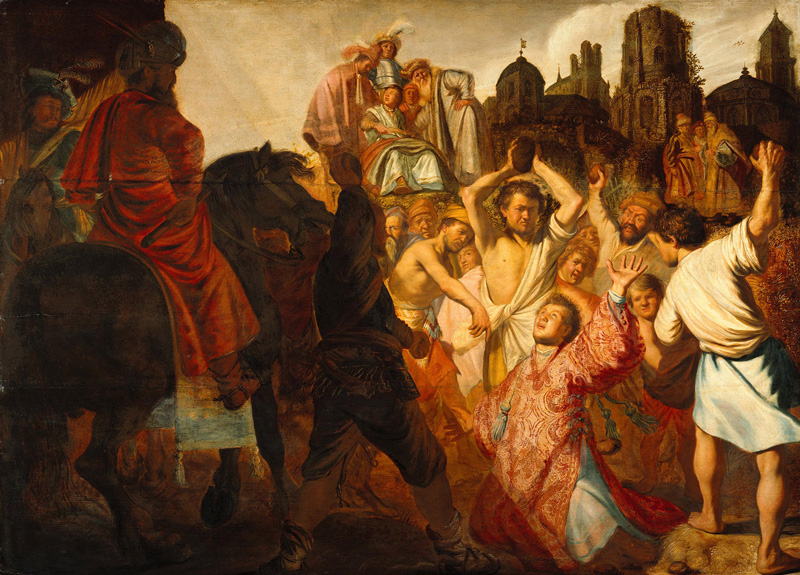
Stephen, full of faith, The Spirit, grace, and power, Served the Lord one glorious hour.
When Freedmen apprehended him, He spoke to them of Moses, Sent by God to set his people free.
He recounted how the Jewish slaves Rebuffed their would-be liberator, But let him lead them out, eventually.
Short-lived, this being led…. They got it in their head A cow could rescue them instead.
It’s no surprise, this people unwise Would not heed Moses when he said, “Watch for another like me to rise.”
Angry, the list’ners let rocks fly. Like risen Jesus, Stephen would die, A loud “Forgive them!” his final cry.
— Brad Hepp, 8/17/2023
Commentary
In my crawl through Acts, I just arrived in chapter seven, and pitched my tent there. This poem is an early reflection on what I’m seeing as I look around my new camping spot.
(background image is a photograph of Rembrandt’s “The Stoning of Saint Stephen.” That is one of Rembrandt’s earliest paintings.)
(if you are viewing this via email, the website has a recording of this poem and commentary; click the title above)
Commentary
DO I RESPOND WITH APPROPRIATE FEAR? Ananias and Sapphira both died as a result of lying to God and to the Apostles about their donation. The result, among other believers, was appropriate FEAR. Perhaps they were asking themselves, “How does my own lifetime of self-justification prepare me to respond honestly to all-seeing God?”
Then Peter said, “Ananias, how is it that Satan has so filled your heart that you have lied to the Holy Spirit and have kept for yourself some of the money you received for the land?
Acts 5:3 (NIV)
Peter said to her, “How could you conspire to test the Spirit of the Lord? Listen! The feet of the men who buried your husband are at the door, and they will carry you out also.”
Acts 5:9 (NIV)
Great fear seized the whole church and all who heard about these events.
(if you are viewing this via email, the website has a recording of this poem and commentary; click the title above)
Commentary
This little throw-away poem was my attempt to capture some of what’s being communicated by Stephen in Acts 7, especially the somewhat cryptic “uncircumcised hearts and ears” in his summary indictment:
You stubborn people, with uncircumcised hearts and ears! You are always resisting the Holy Spirit, like your ancestors did!
(if you are viewing this via email, the website has a recording of this poem and commentary; click the title above)
Commentary
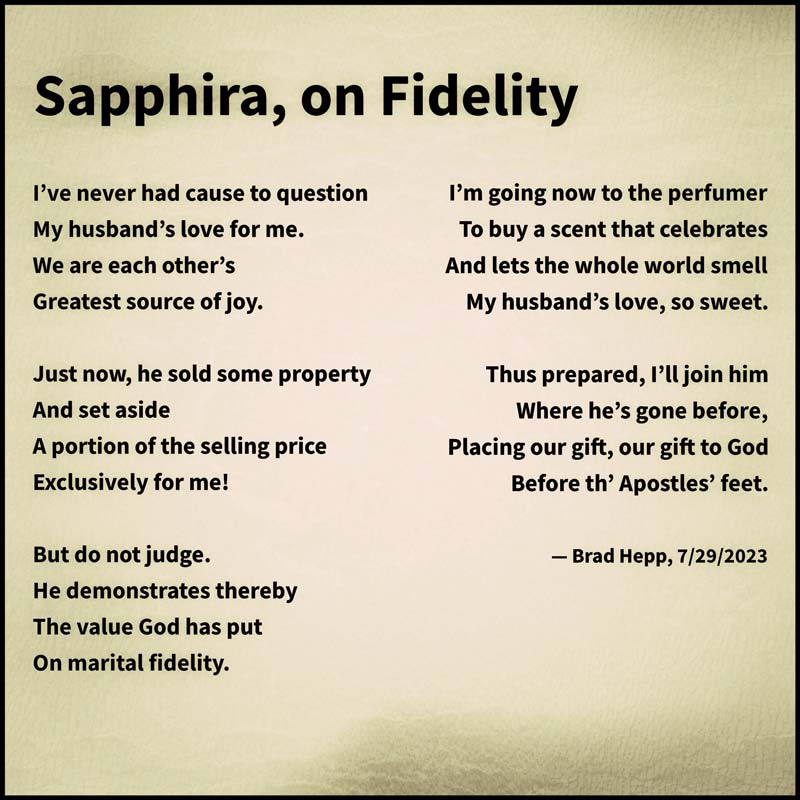
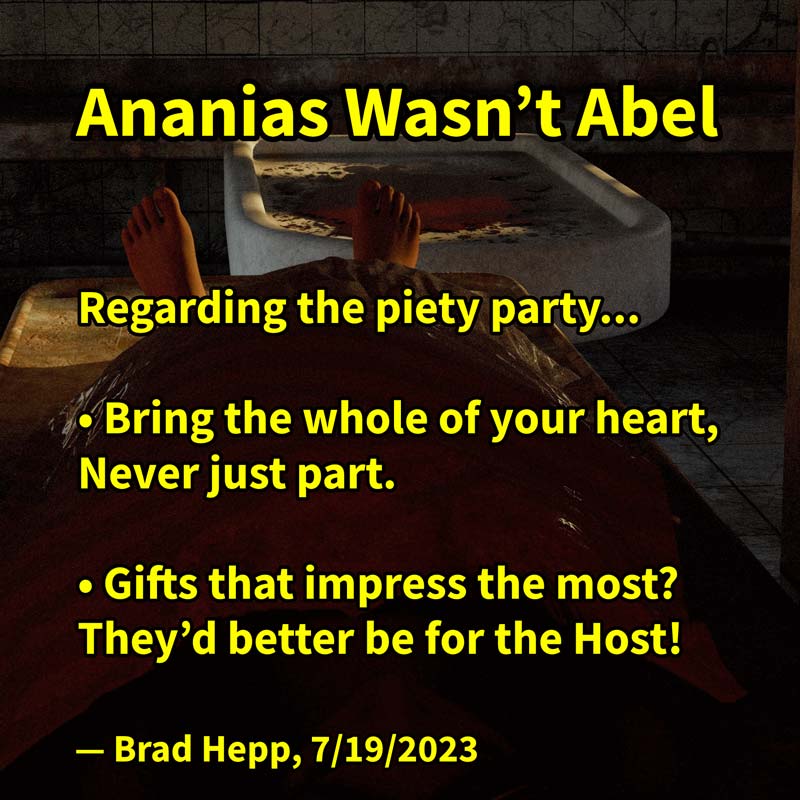
A MEMO REGARDING PIETY PARTIES In my crawl through Acts, I finally forced myself to move past chapters three and four. There we see that Jesus came to bless all people. How? By turning them from their iniquity. What does that look like in this context? The Apostles and common believers are enabled to quit the iniquity of selfishness and practice generosity instead. Even when they don’t have much in the way of material goods to give, they can be generous in other ways. For example, Peter and John interrupt prayer time to heal a lame beggar. It’s a big deal.
Then we get to Acts, chapter five. There we encounter a couple—Ananias and Sapphira—who came to the piety party, but didn’t get the memo: generosity isn’t for impressing man, but for imitating God; don’t do a bad imitation.
Hospitality and generosity were huge issues in Israel. They’re probably still important to God… don’t you think? A deep recognition of my own selfishness has begun revolutionizing how I THINK over the last few years. By Jesus’ blessing that may even reach to how I BEHAVE.
RELATED ISSUE: IDOLATRY Is it just me? Or is this common In our idolatry: We worship what we think Will get us the most.
Put to death, therefore, whatever belongs to your earthly nature: sexual immorality, impurity, lust, evil desires and greed, which is idolatry. Colossians 3:5 NIV
(if you are viewing this via email, the website has a recording of this poem and commentary; click the title above)
Commentary
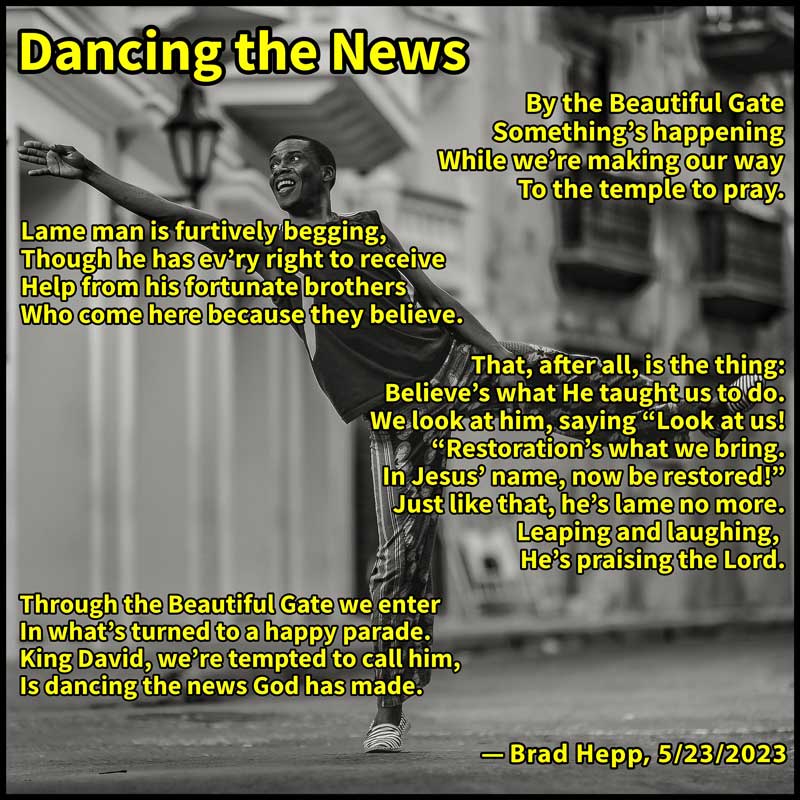
This has come to be one of my favorite poems. Maybe that’s just because of the beautiful expression of the fellow in the background image. If you haven’t read Acts 3 in a while, do yourself a favor, and let your imagination play with the story we’re told there.
ACT ONE OF A TWO-ACT PLAY IN ACTS CHAPTER THREE I’ve begun my crawl through Acts. In this morning’s passage, Luke mentions the look a lame man gives Peter and John, the look they give him in return, and the more attentive look they require of him. Is this and what follows a device to draw our attention to something Peter will tell the crowd? Who arranged this little two act play? Does the second act build on the first act? I suspect it does. We’ll have to take a closer look.
(if you are viewing this via email, the website has a recording of this poem and commentary; click the title above)
Commentary
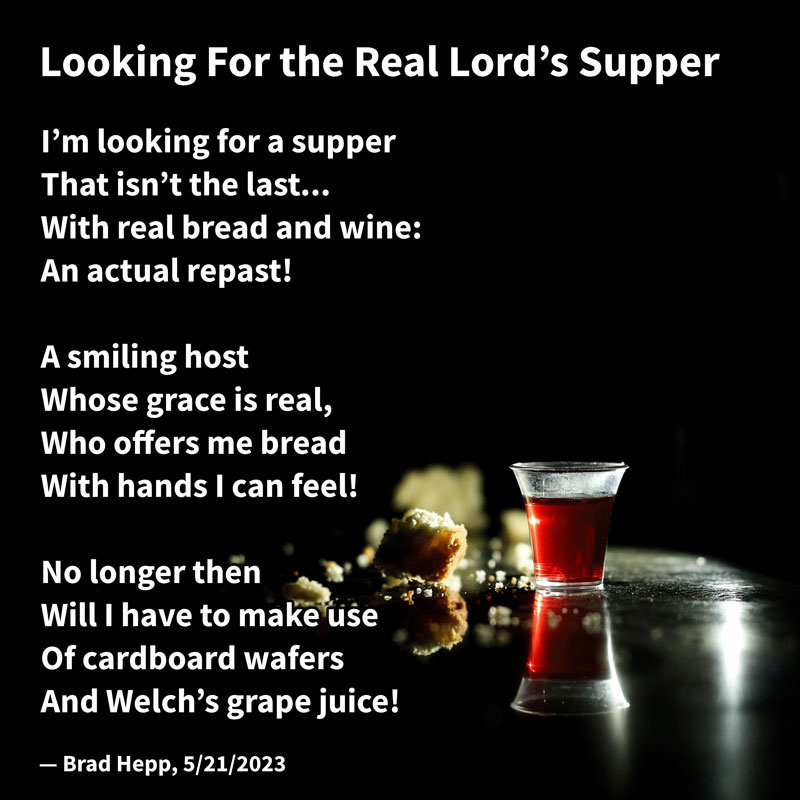
I serve two churches on Sunday mornings: a Bible church and an Anglican church. They both celebrate the Lord’s Supper each week. They do it differently. But in both cases, I think we must acknowledge—borrowing George MacDonald’s words—”the end of the Maker’s dream is not this.”
(if you are viewing this via email, the website has a recording of this poem and commentary; click the title above)
Commentary
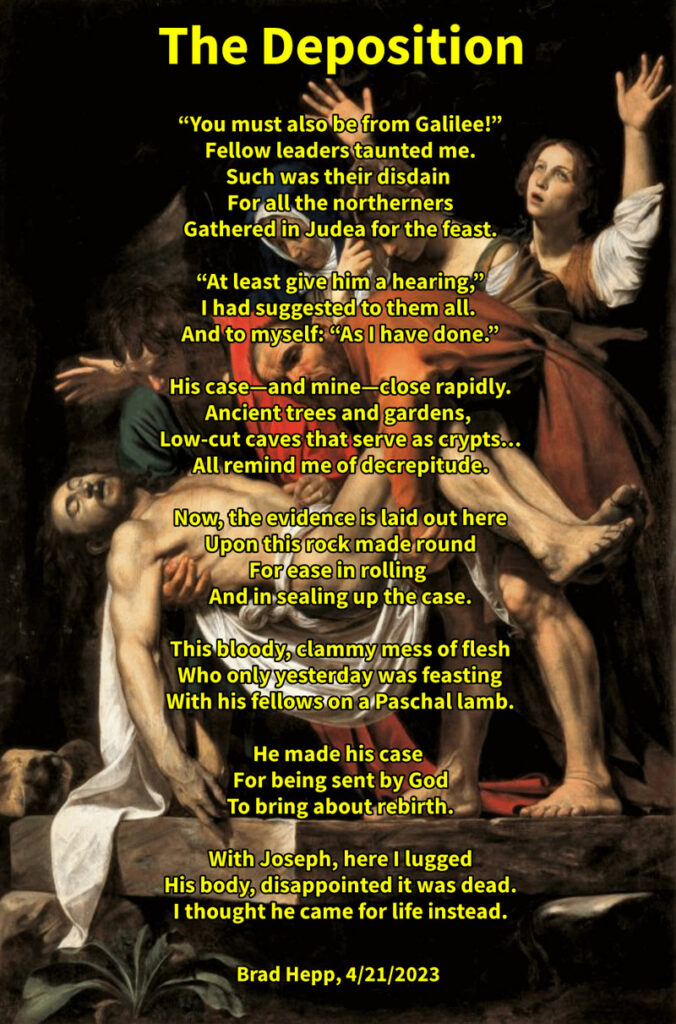
I remember like it was yesterday (it was) when I realized that Nicodemus joined Joseph of Arimathea in removing Jesus’ body from the cross, preparing it for burial, and interring him. This historical event is referred to as “The Deposition,” and it has been the subject of significant paintings and sculptures.
Being simple-minded, I read “deposition,” and think of a legal case. This poem plays with that confusion.
GOSPEL ALLUSIONS
They replied, “Are you [i.e., Nicodemus] from Galilee too? Search and see that no prophet arises from Galilee.”
John 7:52 ESV
Nicodemus also, who earlier had come to Jesus by night, came bringing a mixture of myrrh and aloes, about seventy-five pounds in weight.
John 19:39 ESV
CARAVAGGIO See Caravaggio’s painting Deposition, and what is written about it at this site. [TIP: when you get there, click the expand icon to see the whole image]
A PERSONAL RESPONSE I can’t read the last stanza without tearing up. WE know what would happen within 72 hours. But Nicodemus didn’t. And neither do some of our friends.
(if you are viewing this via email, the website has a recording of this poem and commentary; click the title above)
Commentary
I don’t know why I didn’t publish this back in April of last year. Maybe tomorrow I’ll wake up and remember why (maybe somebody will point out how knuckle-headed I am). Jesus’ radical identification with man, especially in suffering, changes everything. I love our Older Brother.
By the way, the preacher I refer to in this poem is one from long, long ago.
(if you are viewing this via email, the website has a recording of this poem and commentary; click the title above)
Commentary
[WARNING: this is me “thinking out loud.” I haven’t come to conclusions; I simply invite friends to keep pondering God’s word with me]
I just read a long sermon in which the preacher waxed eloquent about what it meant for the curtain in the temple to be torn from top to bottom at the moment of Jesus’ death. The preacher made absolutely no direct reference to scripture that might—or might not—support his interpretation. All my life, I have heard only one interpretation of the significance of the rending of the temple curtain… until yesterday. Now, I’m reading Fleming Rutledge’s excellent “The Crucifixion.” She represents a slightly different tradition of Christianity than the one in which I was raised. Her different perspective gives me much to ponder. It prompts me to observe the Gospels, and Hebrews more closely, and to tune out the echo of a lifetime of sermons.
I suspect this is the main thing I need to fully embrace: it is not my feet that carry me into the holy of holies. It is my forerunner Jesus, my relationship with him. The author of Hebrews put it this way (note the present status of the curtain):
We have this as a sure and steadfast anchor of the soul, a hope that enters into the inner place behind the curtain, where Jesus has gone as a forerunner on our behalf, having become a high priest forever after the order of Melchizedek.
(if you are viewing this via email, the website has a recording of this poem and commentary; click the title above)
Commentary
My progress through John gets slower and slower. I’m to chapter twelve. I may be too hard on the crowd in this poem, but I still wonder how Jesus was feeling as he entered Jerusalem in “triumph,” all the while knowing what awaited him, and what awaited the people he loved….
The next day the large crowd that had come to the feast heard that Jesus was coming to Jerusalem. So they took branches of palm trees and went out to meet him, crying out, “Hosanna! Blessed is he who comes in the name of the Lord, even the King of Israel!” And Jesus found a young donkey and sat on it, just as it is written, “Fear not, daughter of Zion; behold, your king is coming, sitting on a donkey’s colt!” His disciples did not understand these things at first, but when Jesus was glorified, then they remembered that these things had been written about him and had been done to him.
(if you are viewing this via email, the website has a recording of this poem and commentary; click the title above)
Commentary
Now Jesus loved Martha and her sister and Lazarus. So, when he heard that Lazarus was ill, he stayed two days longer in the place where he was.
John 11:5-6 ESV
This morning, my crawl through John got me to chapter eleven. If it has been a while since you read that chapter, I urge you to read it now. You’ll realize that Jesus was about 20 miles (a good day’s walk) from Lazarus, and his sisters. That raises the question: why did Jesus stay where he was after being told that Lazarus was sick? John’s word choice is curious. He writes, “So he stayed two days longer.” You or I might have written “But he stayed two days longer.”
What I’m beginning to explore in this poem is the relationship between Jesus’ love for Lazarus and his staying away when he was summoned by Lazarus’ sisters. The question is an old one: “How does a loving God let his creation suffer?”
You’ll see that most of my poem is pure speculation, call it sanctified imagination. What was Lazarus experiencing as he neared death? What was actually happening?
I think I know where part two will land: On the shore of glory and love (then we’ll understand)
(if you are viewing this via email, the website has a recording of this poem and commentary; click the title above)
Commentary
[Jesus] said to him, “Go, wash in the pool of Siloam” (which means Sent). So he went and washed and came back seeing.
John 9:7 ESV
This morning, in my crawl through John, I got to chapter nine, and one of my favorite passages: Jesus’ healing of the man born blind. It seems obvious to me that John was capturing Jesus’ playfulness with words, and maybe even playing along. One of the clues is that in telling us about the pool of Siloam, John inserts, “Translated, that means ‘Sent’.”
There’s a lot more going on in the passage than I understand. That prompts me to write a poem, to poke at the story and see what emerges.
Let me encourage you to read John 9. It’s really fantastic. Pay attention to words like “work, works, sent, display, light, and blind.” If you’re like me, you’ll be reading some of it and thinking, “This part looks like something John and his fellow believers put in song.” Maybe you’ll be inspired to write your own song!
(if you are viewing this via email, the website has a recording of this poem and commentary; click the title above
Commentary
These days, whenever there’s a mass shooting, one of the more poignant things afterwards is hearing what the shooter’s parents or siblings have to say. Imagine being Judas Iscariot’s father. John gives us his name. It was Simon Iscariot. Why do we know that name? Did Simon end up following Jesus? I hope so!
Here’s the passage that prompted my flight of imagination (the poem), with a little of its context:
Simon Peter answered him, “Lord, to whom shall we go? You have the words of eternal life, and we have believed, and have come to know, that you are the Holy One of God.” Jesus answered them, “Did I not choose you, the twelve? And yet one of you is a devil.” He spoke of Judas the son of Simon Iscariot, for he, one of the twelve, was going to betray him.
John 6:68-71 ESV
A friend of mine wrote this:
In Mark 3, when Jesus chooses the 12, it casually mentions that Judas would betray him. I always thought that was just a throw-in, some foreboding music to alert us about coming plot twists. But then it hit me: What if Jesus chose Judas BECAUSE he was going to betray Him? And what if he put Judas in charge of the money bag in order to keep him around, since he planned to use him as an important part of orchestrating His own death?
Bruce Beaty
“We’re on the same page,” I said, “Jesus was orchestrating events, not just responding to them. It’s amazing.”
(if you are viewing this via email, the website has a recording of this poem and commentary; click the title above)
Commentary
There’s an odd little passage in John’s account of Jesus walking on the water the night after he had fed the five thousand:
But he said to them, “It is I; don’t be afraid.” Then they were willing to take him into the boat, and immediately the boat reached the shore where they were heading.
John 6:20-21 NIV
They were willing!? That’s the translation in the NASB and NIV. I immediately ask myself, “Why would they not be willing?” The Greek verb is θελο (thelo), and some translations render that in this passage as “wanted” (NET), or “were glad” (ESV). Those translations may be correct. But I have to wonder if John could be subtly suggesting something that was at issue in the disciples’ response to their teacher: their willingness to accept the unfolding of events on his terms.
THIS IS A STRETCH, I know, but follow me for how I get to my devotional response in the poem….
After feeding the five thousand, Jesus had “wandered” off to avoid a power-hungry crowd. The disciples took off rowing across the lake without Jesus. I think that’s odd. Were they ticked off at him? Now, they were struggling on choppy waters. Is it possible that they were having second thoughts about their teacher? Is it possible that they were just barely “willing” to take him on board given their doubts about his plans?
Maybe I notice that possibility because I myself question Jesus’ plans in my life.
Thus the poem.
Another Thought John is deep. But I doubt he’s introducing any depth that wasn’t there already in Jesus. That’s part of what prompted this poem. Jesus wasn’t merely responding to circumstances in the disciples’ lives. He was orchestrating events, using his full “vocabulary” of metaphors to drive home truth. It was no accident that the sea was thrashing on that night.
(background adapted from an image by Roberto Barresi on Pixabay)
(if you are viewing this via email, the website has a recording of this vignette and commentary; click the title above)
Commentary
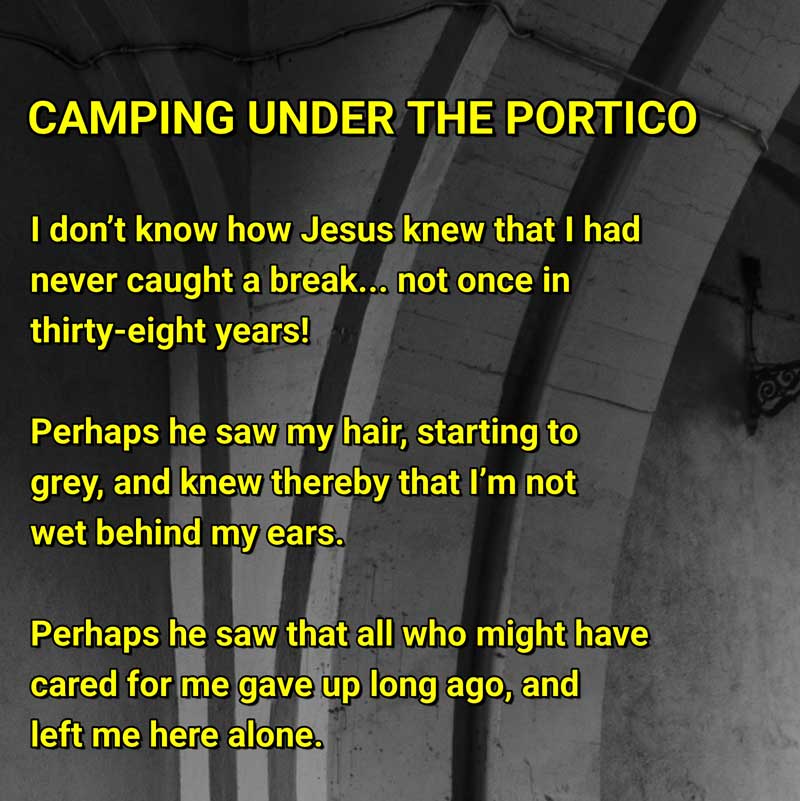
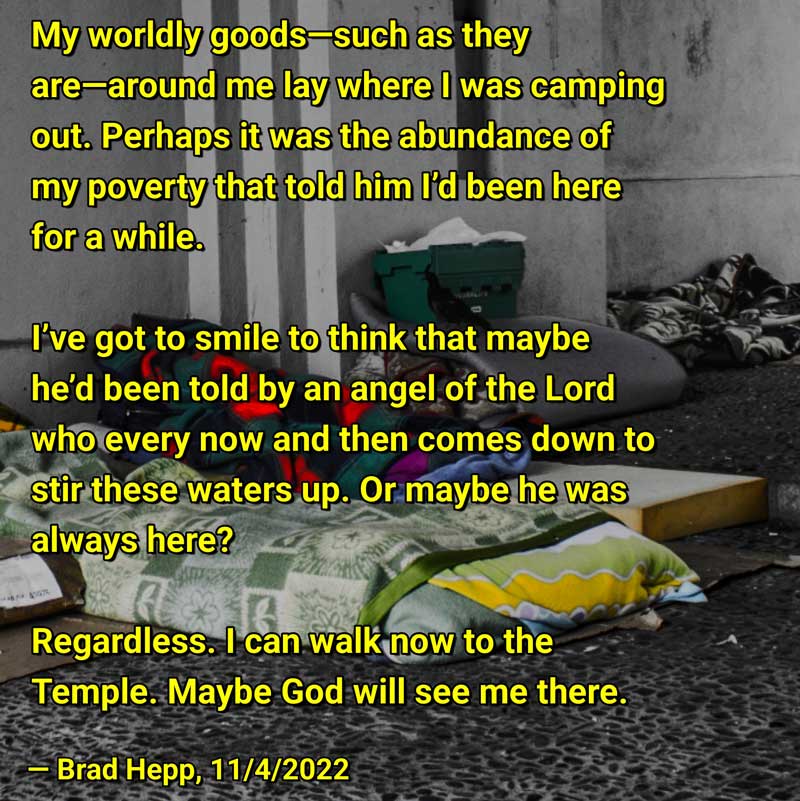
I hope you don’t consider this vignette–and others like it–an exposition of a biblical passage. It’s my emotional and imaginative response to the story of Jesus healing a lame man who had languished by the Pool of Bethesda (John 5). It makes me almost as happy to think of a reader saying “No, you got this wrong” as it would for the reader to say, “Oh yeah, that’s it. You nailed it!” I mainly want my reader to enter the scene with me, look around, and take it in, even if that means that my observations and interpretations prove to be mistaken.
A Personal Reflection You may notice that the background I chose for this vignette is a homeless camp somewhere. In growing up to be like Jesus, I often struggle with kindness and compassion. These qualities are tested by seeing beggars and homeless people. So, in considering whether or not I am growing in these qualities, I let my thoughts wander back across my life to earlier encounters. Here’s what I jotted down:
SUFFERING IS LARGELY HID FROM OUR EYES I grew up in a city where the disabled had to get out in public, so they could beg. Although a six-year-old Bradley didn’t feel the compassion that I feel now, I can still recall some of the more heart-wrenching scenes, like the legless man who got around by propping himself up on a skateboard. As with most powerful memories, I also remember the place. He hung out near the city’s one big, modern grocery store. I suppose it’s because the store’s clientele were “rich” folk like my missionary parents. And a few of those rich folk—there, like here—had compassion.
(background image by José Manuel de Laá on Pixabay)
(if you are viewing this via email, the website has a recording of this poem and commentary; click the title above)
Commentary
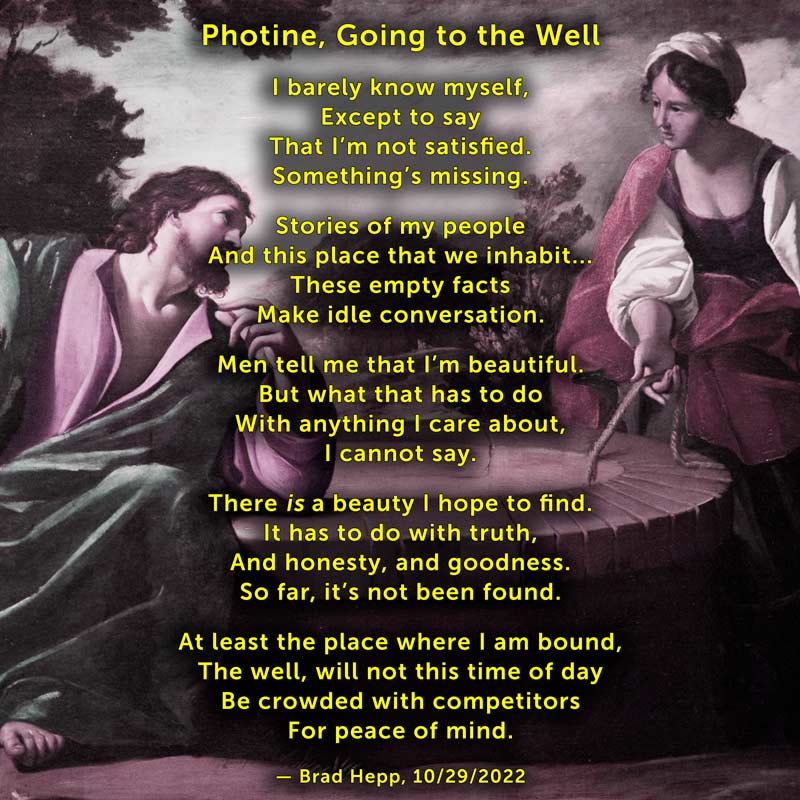
This kind of poem should probably be written by an experienced counselor, or pastor… someone who really knows the condition of hearts. As a poet, I sometimes just throw words against the wall to see if they stick. It’s like verbal spaghetti. How did Photine perceive herself? Why had she gone from man to man? I have an intuition that men and women long for beauty, especially beauty that is tied to the goodness of a person, ultimately THE Person: God.
I am working my way very slowly through the Gospel of John, and typically spend a few days translating and contemplating each chapter. I wrote the above poem the morning that I started into chapter 4. It was an attempt to imagine what the Samaritan woman might have been thinking as she trekked to the well for water. As I think about her situation in the days after I wrote the poem, I begin to second-guess myself. And that’s okay. It’s helpful to use one’s imagination, not for coming to conclusions, but for generating more questions.
A Grammatical Riddle Should the last two lines be “competitors FOR peace of mind,” or “competitors WITH peace of mind”? Even thinking through a question like this one raises other questions: 1) would Photine have said that she already had peace of mind? 2) were there false claimants to her peace of mind? 3) was peace of mind really one of Photine’s felt needs in any case? I don’t think any of us knows the answers. But maybe some day we will.
(background image adapted from a photograph by Fr. Lawrence, OP. He comments, “This painting of Christ and the Samaritan Woman is in the museum at the Dominican priory of Santa Sabina in Rome.”)
(if you are viewing this via email, the website has a recording of this poem and commentary; click the title above)
Commentary
The Setting of This Poem What was going on in Nicodemus’ mind the morning before he met Jesus at night? I think it’s useful to imagine that, and then to test the picture against John’s account. I don’t mean for this poem to suggest a radical interpretation of Nicodemus’ conversation with Jesus, or even to suggest that my imagination is borne out by what John wrote. As I think about John 3:1-21, I’m noticing a contrast of source and destiny, here and there, old and new. I’m letting those and other concepts play in my imagination as I try to picture Nicodemus’ heart.
A friend who is familiar with church history told me recently that oral tradition suggests Nicodemus was eventually born again. I sure hope so.
(if you are viewing this via email, the website has a recording of this poem and commentary; click the title above)
Commentary
I finished my crawl through Luke, and have begun my crawl through John. So far, the Greek seems easier, but John is every bit as much an allusionist as Luke.
John’s account of how Jesus called Nathanael to be one of his followers seems to be FULL of allusions. I doubt we can be definitive about what was going on in Jesus’ exchange with Nathanael. It does seem clear to me, though, that Jesus is alluding to Jacob/Israel in what he says to Nathanael. What was the condition of Nathanael’s heart? Why was he dismissive of goodness? How was he like Jacob, and how was the prospect of his own “Jacob’s ladder” a meaningful promise?
In this poem, I apply what I hope is sanctified imagination to the story. I realize that some of it is ambiguous. Let me clarify what I had in mind…. Nathanael seemed surprised that Jesus had seen him under the fig tree. I’m guessing he thought his being under the fig tree was completely private. But there’s more. Jesus welcomed Nathanael as “a true Israelite in whom there is no deceit!” Why “deceit?” And why, “a true Israelite?” Because of what Jesus says later about Nathanael seeing “heaven opened and the angels of God ascending and descending on the Son of Man,” I’m guessing that Jesus was comparing Nathanael to Jacob, who is often called “Jacob the Deceiver,” but was also called Israel. Here’s the premise of the poem: Nathanael had been under a fig tree reflecting on how he, like Jacob was a deceiver. He wondered — and doubted — how God could be merciful with him. Jesus knew all that, and showed him otherwise.
Another Possibility About Nathanael Nathanael has always fascinated me. When Jesus said of Nathanael, “Look, a true Israelite in whom there is no deceit,” was he being facetious? That’s the possibility I am currently exploring. I used to think that Jesus probably meant something like, “that Nathanael speaks his mind!” Such a guileless man appeals to me. Regardless, truthfulness was probably an important issue to Nathanael. I speculate that duplicity–whether his own, or what he experienced from others–was oppressive to him. In this poem, I also speculate that he doubted the availability of mercy. But the God who sees and knows each of us intimately sought him out. That’s amazing grace!
(if you are viewing this via email, the website has a recording of this poem and commentary; click the title above)
Commentary
DON’T TRY THIS AT HOME In this poem, I’m doing two things that are generally discouraged. First, I’m playing with the Greek idioms that Luke used in his telling of the Resurrection. “At early dawn” in Luke 24:1 is literally “at deep dawn” (ορθρου βαθεωσ, orthou batheos). “In dazzling clothing” in 24:4 is literally “in clothing flashing like lightning” (εν εσθητι αστραπτουση, en estheti astraptouse). I pushed lightning to its root: aster = star. OF COURSE, THIS IS GENERALLY FOOLISHNESS. Translating idioms is not a matter of dissecting phrases down to their literal components. Imagine how “knock your socks off” would be translated into another language if the translator were translating word-for-word!
The second thing I’m doing — more successfully in my head than in the poem — is relating New Testament events to Old Testament events. Where, in the Old Testament, was a stone removed for a woman by a man? One place is Jacob’s initial meeting with his bride-to-be Rachel (Genesis 29:1-10). Does that story have anything to do with the Resurrection account? PROBABLY NOT. However, probably not isn’t the same as definitely not.
I say “don’t try this at home.” Don’t make too much of literal meanings of words, or of slight coincidence. But DO THIS: read the Bible with heightened vigilance and imagination. When you encounter stories with wells, or stones, or swords, or angels, or fire remember: the Author was there; often, if not always, He was a character in the story. And He has a long memory.
(if you are viewing this via email, the website has a recording of this poem and commentary; click the title above)
Commentary
As I try to get caught up with posting poems here on my blog, I’m encountering some poems written so long ago that I don’t recall what I was thinking! I do remember that this poem was an emotional response to Luke 7. One of the questions that’s often on my mind when I read the Gospels is “What did Jesus and his listeners think that salvation means?” Of course we can read the accounts with the benefit of systematic theology, but I’m uneasy about that process. A theological grid can obscure as much as it reveals.
(if you are viewing this via email, the website has a recording of this poem and commentary; click the title above)
Commentary
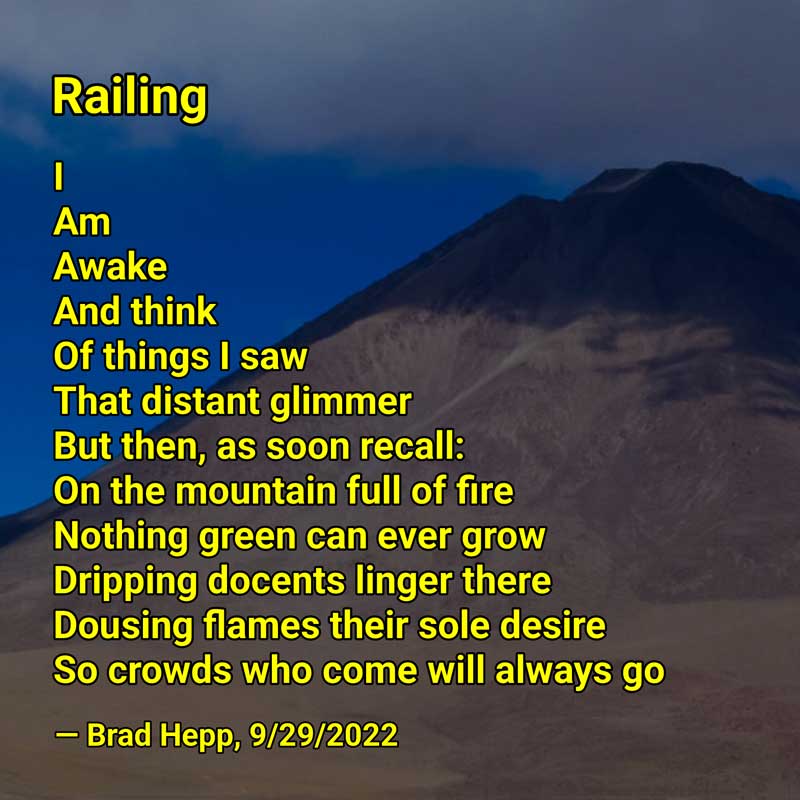
On my walk yesterday, listening through Exodus, I heard this fascinating snippet:
And they saw the God of Israel. There was under his feet as it were a pavement of sapphire stone, like the very heaven for clearness. And he did not lay his hand on the chief men of the people of Israel; they beheld God, and ate and drank.
Exodus 24:10-11
When I encounter passages like this one, I want to explore, to stop and study. Not necessarily to study in an academic way… more to gaze intently until my senses have taken in the scene, so that like Mary I may ponder in my heart. But there are voices—do I only imagine them?—who murmur “Move along, and stay behind the railing.”
The Poem’s Structure I woke up this morning and initially wrote the last five lines. As often happens with me, something subconscious was giving the poem physical structure by creating a pattern of line lengths. When I see that happening, I try to follow through. The poem was taking the form of a mountain, but it needed a summit. So I inserted the first seven lines.
Docents I have toured many a museum, and been thankful to many a docent for guiding me there. I mean no disrespect by picturing them in this poem as dripping clouds who live only to put out sparks of curiosity. What am I actually picturing? Dull, strangling systematic theology, at least as practiced by some.
(if you are viewing this via email, the website has a recording of this poem and commentary; click the title above)
Commentary
My commentary here is in two parts.
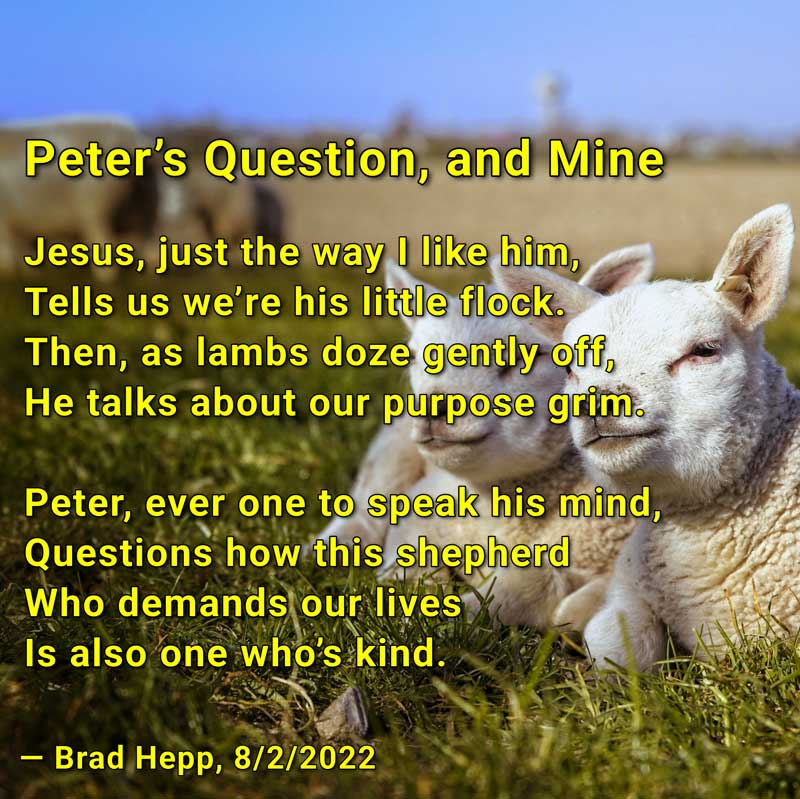
My Original Confusion (what I was thinking when I wrote the poem) In Luke 12, the tone of Jesus’ parables switches from reassuring to threatening. Just as the tone changes, Luke throws in a question from Peter:
Peter said, “Lord, are you telling this parable for us or for all?”
Luke 12:41
This is one of those seeming non-sequiturs that makes me sit up and ask, “What’s going on here!?” Luke doesn’t give us Jesus’ answer. Or does he? I don’t know yet. But I know that the passage makes me uncomfortable. Perhaps that’s exactly as it should be.
On Further Reflection (what I wrote on a subsequent day) You know, as I read through Luke 12 again this morning, I am getting a really different picture. How does Jesus describe the master (Himself) who returns at an unexpected hour and finds his servants being good to one another?
Blessed are those servants whom the master finds awake when he comes. Truly, I say to you, he will dress himself for service and have them recline at table, and he will come and serve them.
Luke 12:37 ESV
The picture is grim not for those good, Christ-like servants but for those who selfishly look out only for themselves.
Jesus doesn’t ask us to do anything more than He has done… or anything less.
(if you are viewing this via email, the website has a recording of this poem and commentary; click the title above)
Commentary
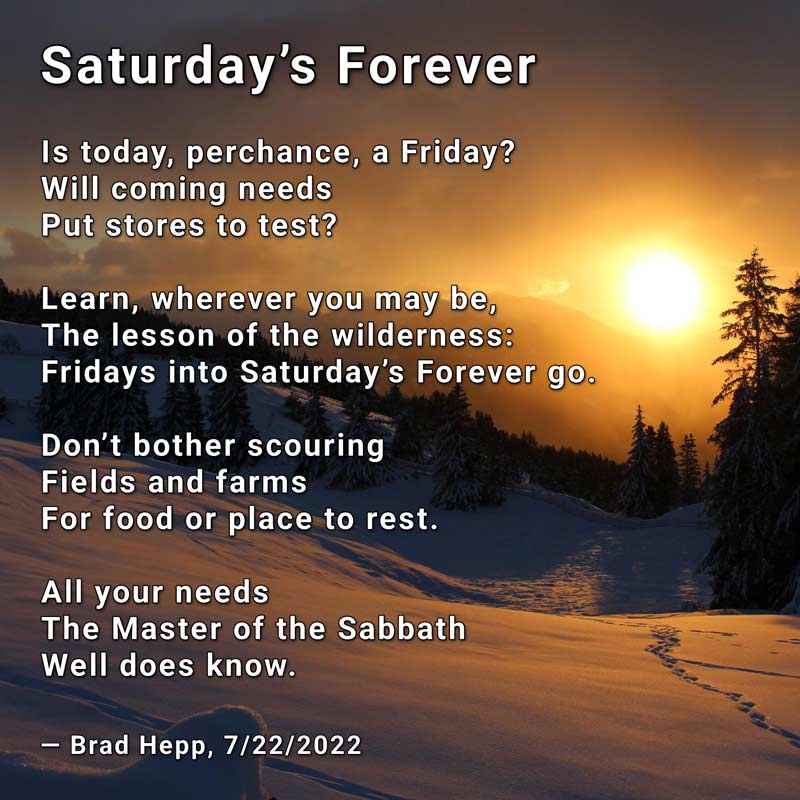
IT’S FRIDAY
My crawl through Luke brings me this morning to chapter nine. As everywhere in Luke, this passage is replete with metaphor, allusions, and strong undercurrents.
Although the word “sabbath” is not even mentioned in Luke 9, I am reminded of it in reading the account of the feeding of the five thousand.
On their return the apostles told him all that they had done. And he took them and withdrew apart to a town called Bethsaida. When the crowds learned it, they followed him, and he welcomed them and spoke to them of the kingdom of God and cured those who had need of healing. Now the day began to wear away, and the twelve came and said to him, “Send the crowd away to go into the surrounding villages and countryside to find lodging and get provisions, for we are here in a desolate place.” But he said to them, “You give them something to eat.” They said, “We have no more than five loaves and two fish—unless we are to go and buy food for all these people.”
Luke 9:10-13
People seem to generally think of Sabbath merely as a time of rest. Sometimes, they think of it as a time to get rested up for coming labor. I like to think of it as a celebration of God’s miraculous provision, a time when you relax and receive God’s bounty.
The Sabbath seems to be an inexhaustible subject. One thing I puzzle about is whether and how the Sabbath is supposed to inform everything that comes before. How does knowing that God will provide color the time before His provision?
AS FOR THIS FRIDAY
I’m glad that life’s challenges are not — and will not be — wasted on me. The Teacher brings those lessons lovingly.
(if you are viewing this via email, the website has a recording of this poem and commentary; click the title above)
Commentary
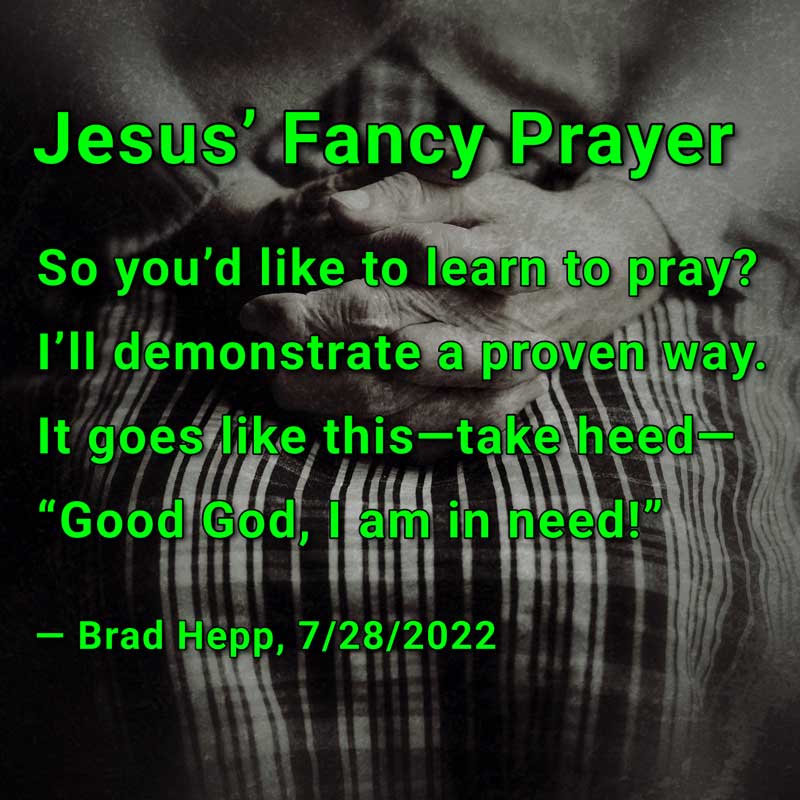
In my crawl through Luke, I got to chapter eleven today. Jesus’ disciples seem a little concerned that they might miss out on God’s blessing if they don’t have the right technique. They say to Jesus, “Lord, teach us to pray, like John taught his disciples.” We sometimes concentrate on the components of “the prayer” that Jesus taught them, but the bigger point (as seen in the illustrations Jesus follows up with) seems to be, “God is good; just do it!”
(if you are viewing this via email, the website has a recording of this poem and commentary; click the title above)
Commentary
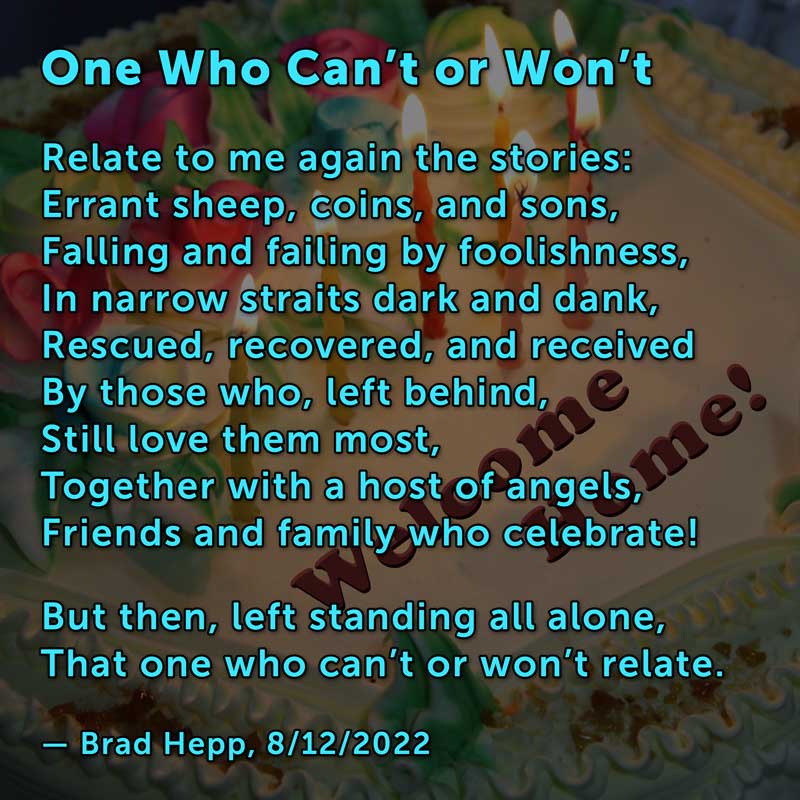
FROM SASSY BOY TO CAKE DECORATOR
In my crawl through Luke, I’m to chapter fifteen. There are several celebrations in this section—and some people who don’t care to celebrate.
This morning, I’m reminded of family devotions at the Hepp house in Puebla. Before heading off to the seminary to teach, Dad would lead us in considering a portion of the Bible. We took turns reading. Then Dad would often say, “Now tell us what you just read in your own words.” If it was my turn, I’d just as often sass, “Why should I do that, given that it’s already in the best possible words?!”
Now, I’m grown up. I’m forever trying to put things in my own words, often in the form of poetry. Much of what I hear, read, or experience gets compressed and squeezed through the piping cone of my poetic mind. I’m like a cake decorator in training, looking for celebrations, looking for something to squeeze decoratively into my own words.
(if you are viewing this via email, the website has a recording of this poem and commentary; click the title above)
Commentary
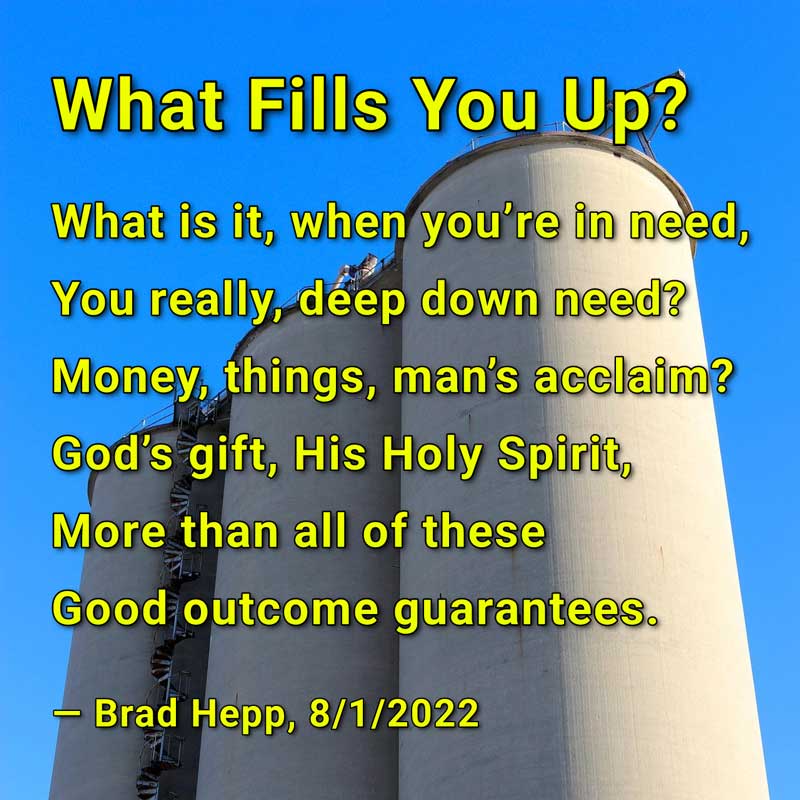
I wrote this poem in response to what I was seeing in Luke chapter twelve.
Luke wants us to pay attention to several things. Some of them I haven’t figured out (e.g., Luke’s repeated mention of the growing crowds). Some of them, I THINK I’m starting to figure out, like how Jesus valued the anticipated gift of the Holy Spirit. How much do I value—and rely on—that gift? What outcomes do I seek to ensure by other means? What storehouses am I foolishly building?