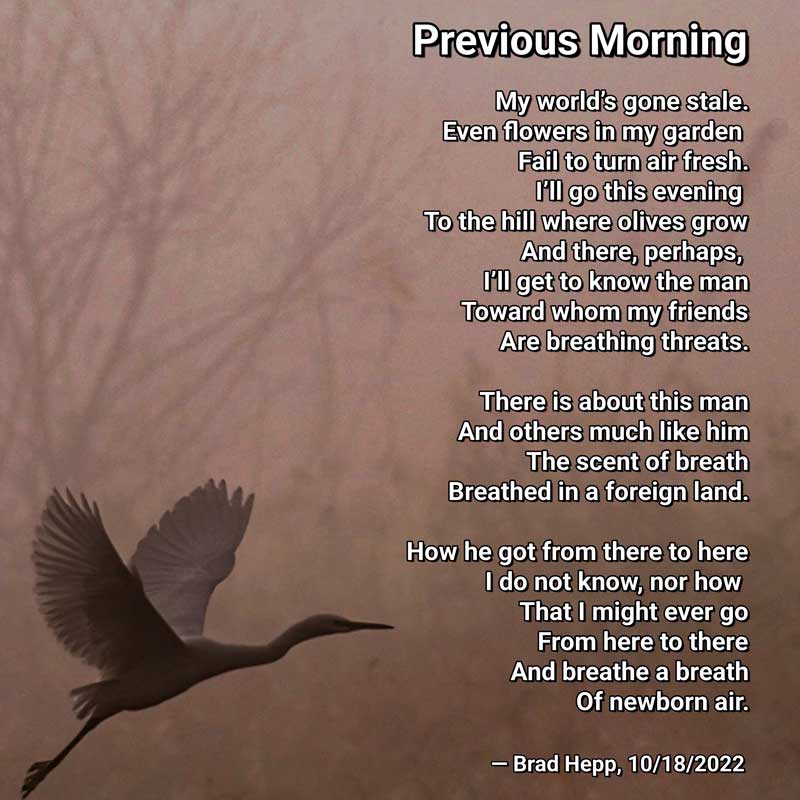
(if you are viewing this via email, the website has a recording of this poem and commentary; click the title above)
Commentary
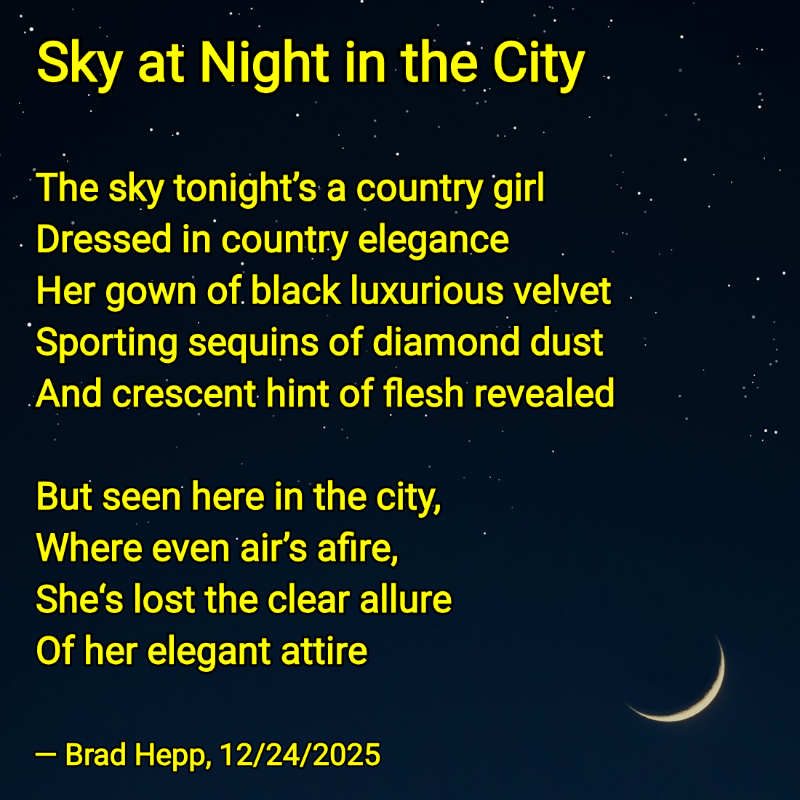
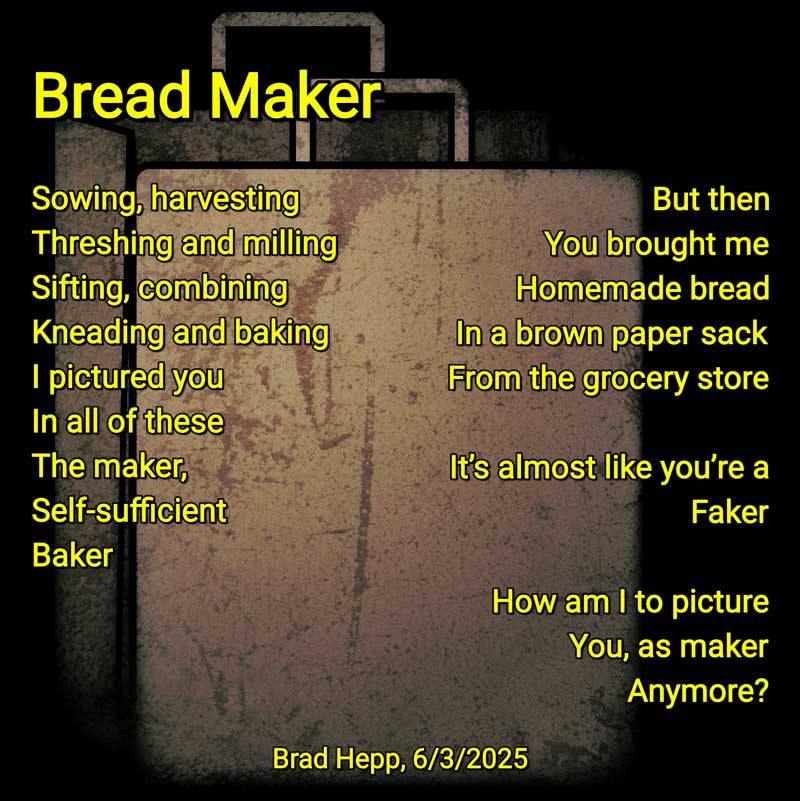
Last night, I worked late. Driving home on a busy road through this sprawling city, I saw the crescent moon low and big in the sky. It was fuzzy, which made me think there must be some high thin clouds. As I drove, I thought, “I have to describe this.” My first attempt was horrible: “A thin slice of moon, poking through the herniated sky.” Lovely, right?! That was clearly NOT going to do. How to describe the sky in a tasteful way?
Once I got home, I parked and stepped out to take a better look at the sky. It was cloudless! Here and there was a clear, but lonely star. It was just the light pollution of a big city that had given me the impression of clouds.
So I slept on it.
This morning, while I was waking up before sunrise, I thought of the night sky, and set out to describe it in this poem.
I suspect the last line of the first stanza is going to throw some people. Don’t settle too quickly on one picture in your mind. It’s the moon I’m describing, comparing it to that little flash of shoulder or leg showing through an elegant and modest gown.
By the way…. I wrote this quickly, trusting my brain to choose words well. That’s my approach to becoming a better poet: not belaboring any one poem, but pumping out many poems quickly. My theory is that I’ll become fluent in poetry, simply by speaking the language.
(if you are viewing this via email, the website has a recording of this poem and commentary; click the title above)
Commentary
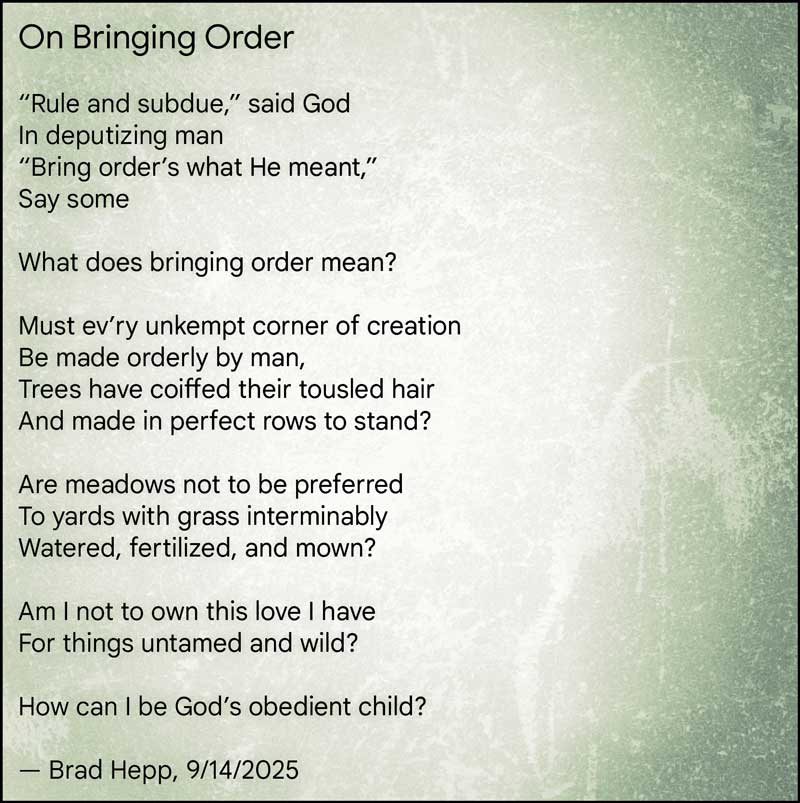
This poem explores implications of John Walton’s view of the “rule and subdue” mandate in the Genesis creation account. Here’s his view (from what seems like a good AI summary): “For Walton, therefore, the ‘rule and subdue’ mandate is humanity’s active participation in God’s ongoing work of bringing and maintaining order. The world is not ours to dominate, but God’s cosmic temple to be managed on his behalf.”
I like Walton’s attempt, but I’m having trouble understanding how man could be expected to bring any meaningful degree of further order to Earth, much less to the cosmos.
I suspect that Walton’s understanding of “rule and subdue” (as meaning “bring order”) leans heavily on his understanding of the context. On the other hand, I haven’t studied the Hebrew words in other contexts, so my suspicion is pretty flimsy.
When I posted the poem, two of my more savvy friends commented:
What if dominion isn’t as controlling as we like to think, but rather tending to the unique natural beauty, form, and function of God’s beautiful world. Prune here. Clear there. Thin elsewhere, taking part in how it’s shaped.
(This, of course, could apply to every sphere of authority.)
–Laurie Pearce Mathers
I agree. I think the best word is “stewardship.” And yes, our ability to steward well is surely hampered by the fall, but also, I hope, helped by the ongoing work of redemption.
Christine Renee Hand Jones
GETTING PERSONAL My interest in this subject isn’t just academic. We’re living in an apartment right now while our house is being restored after a fire broke out because a dying pecan tree dropped a limb on the electrical service. One could say I was negligent, since that pecan had dropped all its leaves. I could push back that the tree dropped all its leaves in the summer of a previous year and then roared back to life the following year, so I did not KNOW for sure that it was dying. But a look around the back yard would confirm that I am not the neat freak I once was. There is more disorder there than I’d have allowed when I was younger. Without going into details, I’m going to chalk that up to the down side of some healthy developments in my life. Put simply, I’m a recovering perfectionist. Order isn’t as important to me now as it used to be.
(if you are viewing this via email, the website has a recording of this poem and commentary; click the title above)
Commentary
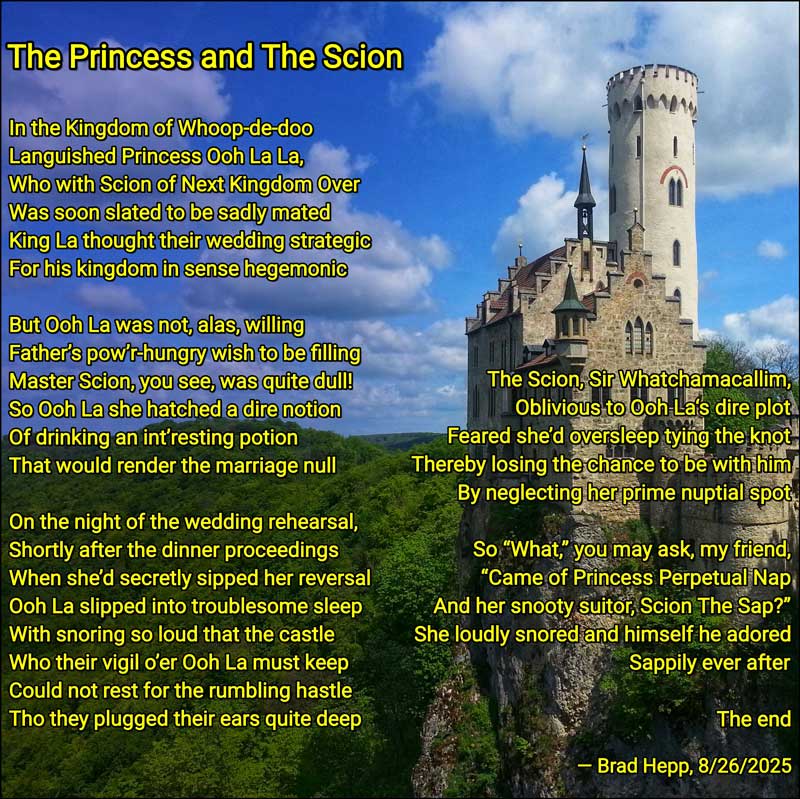
The other morning, while I was driving to work and listening to NPR, I had a bad reaction to some fantasy. An author of children’s books began reading his latest work, and it was too full of names for my liking. In protest–to nobody listening–I blurted out “In the Kingdom of Whoop-de-doo….” Then and there, I knew I had just saddled myself with writing a poem. It has taken several days. How was I going to get myself out of this? With one last night’s sleep, I figured out how to bring it to a swift and merciful end. So here you go.
(if you are viewing this via email, the website has a recording of this poem and commentary; click the title above)
Commentary
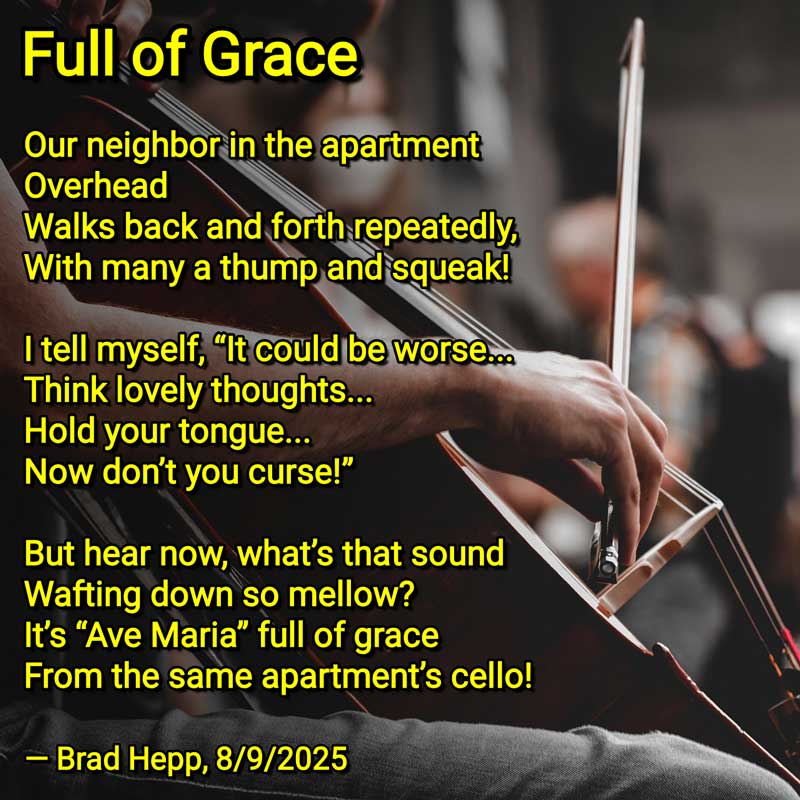
At this rate, my first chapbook will be titled “After The Fire.” The last time I lived in an apartment was 1983. It takes getting used to. And it’s prompting some poetry!
(if you are viewing this via email, the website has a recording of this poem and commentary; click the title above)
Commentary
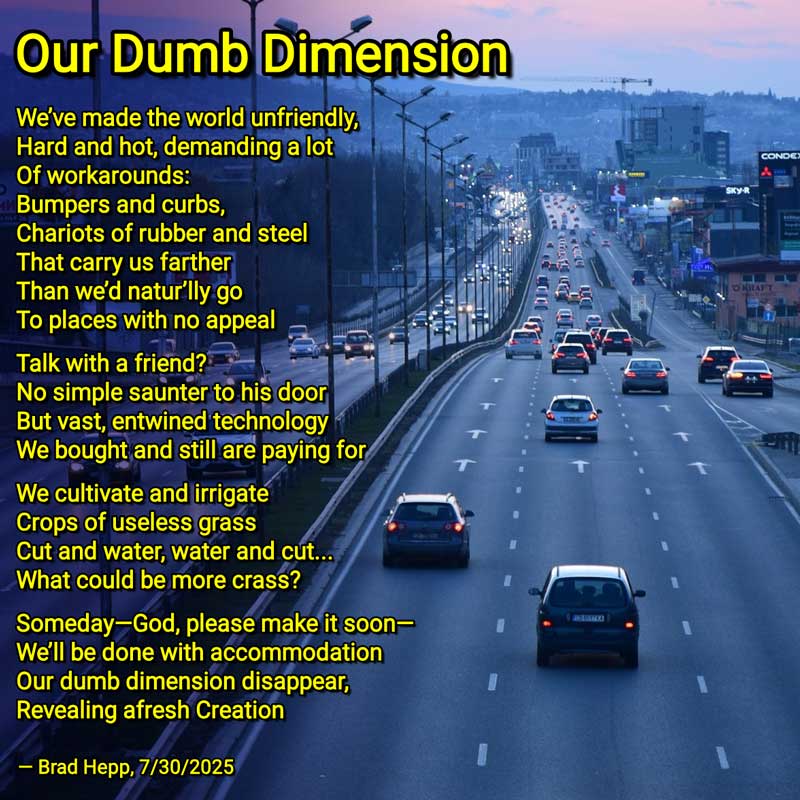
The view out the living room window of our temporary housing* is parked cars, the pavement, other apartments, and above it all a hint of sky. This is my view as today’s reading takes me to the pastoral scene of young David—ruddy, with beautiful eyes, and a handsome appearance (1 Samuel 16:12). I can imagine him walking in soft meadows, cajoling the sheep, and strumming his harp. I can imagine the scene because I have been there—as a child in Mexico and as a man in the alpine meadows of Colorado mountains. THAT is my Father’s world. Not this.
“DIMENSION” Here I am playing with an idea that intrigues me. One prominent proponent of the idea is the Anglican theologian N.T. Wright. From an AI Overview:
N.T. Wright proposes that heaven and earth are not two separate locations, but rather two different dimensions of God’s creation. He suggests that heaven is not a distant realm to escape to, but rather an aspect of our present reality, the “God-dimension” that is interwoven with our earthly existence. The biblical vision, according to Wright, is the restoration of all things, with heaven and earth united in a new creation.
I don’t know enough about the concept and it strengths or weaknesses to say any more just yet. So I’ll leave it there….
___________ *this is another poem born of my experience living in temporary housing after our house fire earlier this month
(background image by Zdravko Shishmanov on Pixabay)
(if you are viewing this via email, the website has a recording of this poem and commentary; click the title above)
Commentary
This was the first draft of an experimental stream-of-consciousness poem. So, don’t work too hard at making sense of the metaphors, unless you’re a therapist and really relish such puzzles!
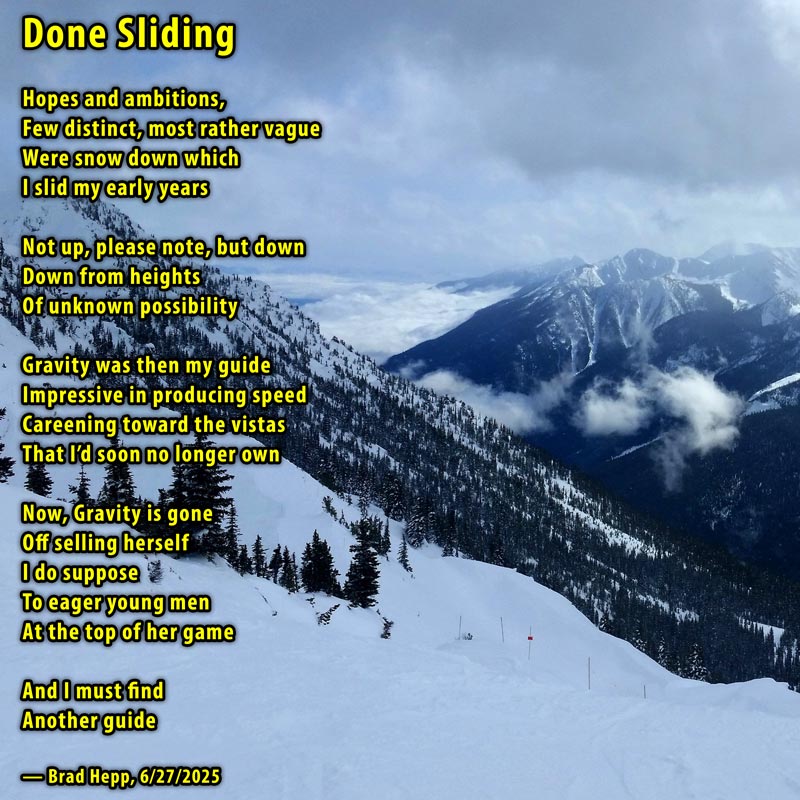
The Occasion I wrote this poem the morning after an encouraging, highlight-of-the-year conversation with Darol, my mountain-climbing buddy of many decades, and after thinking about how young George Herbert was when he wrote his short poem “Hope.”
The Mood There is definitely some melancholy in recognizing that the myriad prospects of youth have dwindled down with the passing of years. But there is also a growing recognition that the number of prospects is far less important than the quality and reasonableness of prospects. If you know me well, you know what comes next: some lines from Robert Browning’s “Rabbi Ben Ezra” ….
What I aspired to be, And was not, comforts me: A brute I might have been, but would not sink i’ the scale.
Another Guide A few years ago, when I was already in my 60s, I wrote a poem and commentary that serve as the antidote to this melancholy. In that post, I suggest that even in old age, we can be “full of promise,” and we’re “never too old to grow.” But mere inertia, mere sliding, is an inadequate guide for this precious autumn of life.
Understand a Little Better? When I explain my poems to family and friends in person, I can see when the lights of understanding go on. But writing, I never know. That’s why I often ask for feedback. Did my commentary open any windows into this poem?
(if you are viewing this via email, the website has a recording of this poem and commentary; click the title above)
Commentary
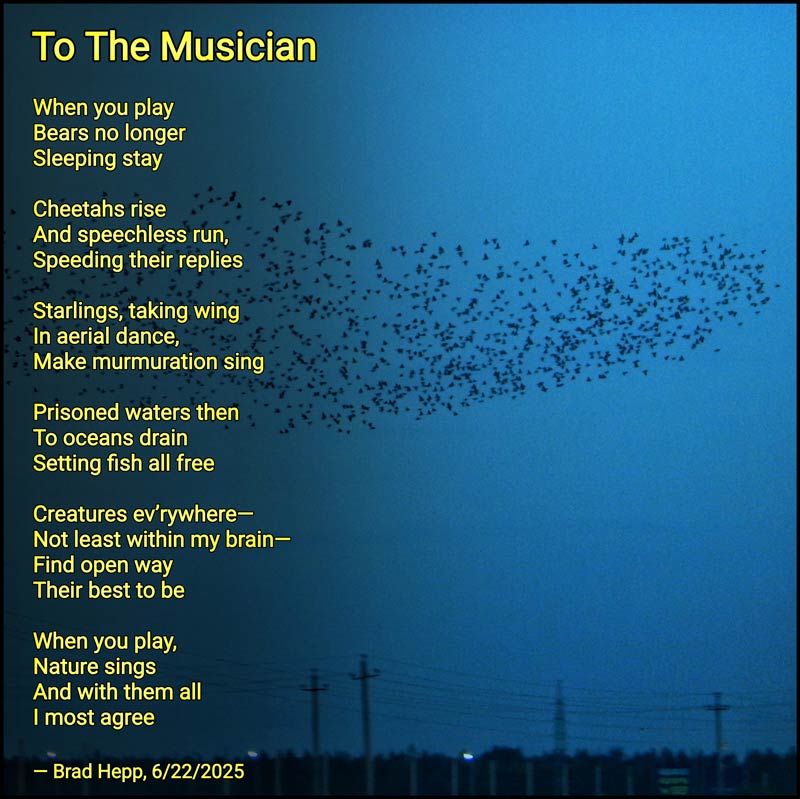
On Sunday mornings, I get up early to project lyric slides as instrumentalists and singers at St. Bart’s Anglican Church prepare for their service. My favorite Sundays are those rare ones when singers are accompanied only by the pianist Kevin Howard. While there are other exceptionally talented musicians, my old ears are happiest when I can clearly pick out Kevin’s playing. I don’t know how he does it, but his style opens doors to harmony—and I respond in worship. Today—during practice and in the service itself— this all struck me as a picture of Creation responding appropriately to God under the care of God’s vice-regent, man. Awake, and free to all do what we do best, and that harmoniously—it’s how we’re meant to be.
This poem is for Kevin, who opens the way to harmony.
NOTE: If you’re not accustomed to e. e. cummings’ odd syntax, you may find the last two stanzas especially difficult. So here’s a gloss: I couldn’t agree more with nature in its untrammeled and joyous response to a fine musician’s accompaniment.
About the “prisoned waters….” A fellow poet initially thought I might mean “poisoned waters.” I can’t blame him, since the word should actually be “imprisoned” or “imprisoning.” For what it’s worth, I was thinking about fish in aquariums, and wanted a quick way to suggest that when the musician plays, fish in a constraining environment find their own “open way” to swim free and thus be all the fish they’re meant to be.
(if you are viewing this via email, the website has a recording of this poem and commentary; click the title above)
Commentary
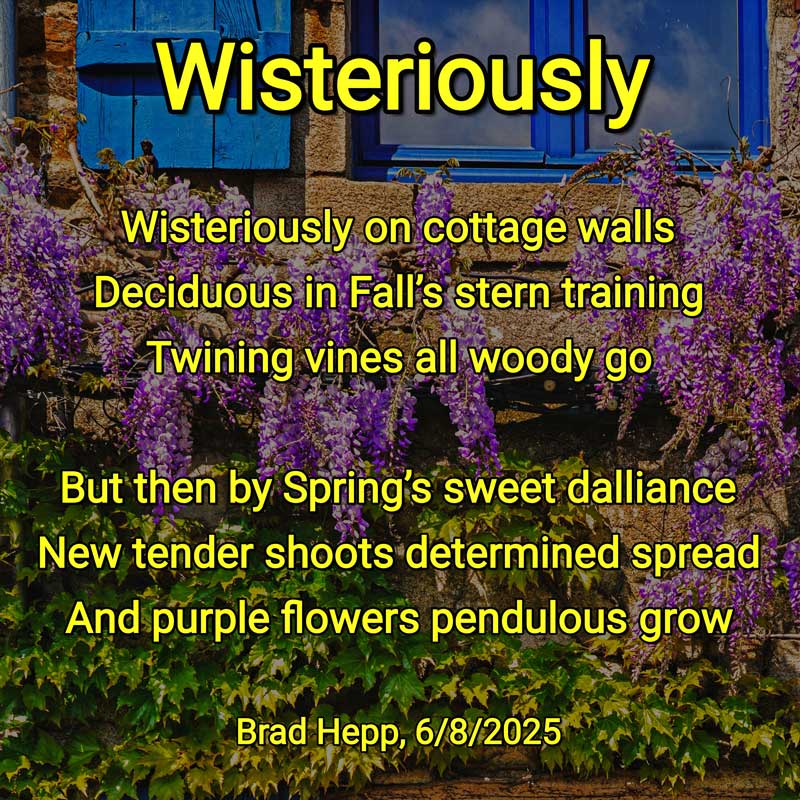
I had to write a few silly lines just to stake my claim on the neologism “wisteriously.” It popped into my weird brain as we watched the tortured romance Howard’s End. I wasn’t following all the story, but the flowers sure were pretty!
Scientific descriptions have amused me and inspired doggerel since I was a boy. For instance, there was that line in a Peterson field guide: “mantids are predacious.” Makes you want to write a poem, doesn’t it? No? Maybe it’s just me.
So, here’s the inspiring description: “Wisteria is a genus of woody, twining vines known for their long, fragrant, pendulous clusters of flowers, often purple or blue, but also white or pink. They are deciduous, meaning they lose their leaves in the fall. Wisteria is a popular ornamental plant, often used to decorate porches, walls, and arbors.”
The neologism, big words and odd syntax in this poem may remind you of Lewis Carroll’s Jabberwocky. That poem begins and ends with these enlightening words:
’Twas brillig, and the slithy toves Did gyre and gimble in the wabe: All mimsy were the borogoves, And the mome raths outgrabe.
(if you are viewing this via email, the website has a recording of this poem and commentary; click the title above)
Commentary
Suspecting that the Genesis creation account should not be taken literally can threaten one’s faith. I have held off thinking deeply about this threat for a long time now. Over the years, I’ve heard people I respect say something like “The Genesis creation account is poetry; don’t take it literally.” The main problem is that I have not heard a convincing exposition of the account as anything other than literal history. Rather, I have been exposed to many conservative defenses of a young-earth, somewhat literal understanding of Genesis. Since I do believe in an all-powerful, miracle-working God, the defenses often resonate, or even thrill!
Jesus and his Apostles seem to have taken the Genesis creation account literally. How are we supposed to understand their arguments if they’re wrongly based on a literal understanding of Genesis?
This poem is a naming and exploring of the threat. I want to deal with it instead of suppressing it. To that end, I’m enlisting the help of wise, intelligent, and faithful(!) friends and writers. It’ll be okay if I don’t get it all sorted out. That’s to be expected in a life of faith.
By the way…. I don’t usually say this publicly, but I’m pretty pleased with this poem. I especially like the second stanza, which tells a story in miniature. It’s odd though… being pleased with the expression of a troubling thought….
(background image adapted from one by OpenClipart-Vectors on Pixabay)
(if you are viewing this via email, the website has a recording of this poem and commentary; click the title above)
Commentary
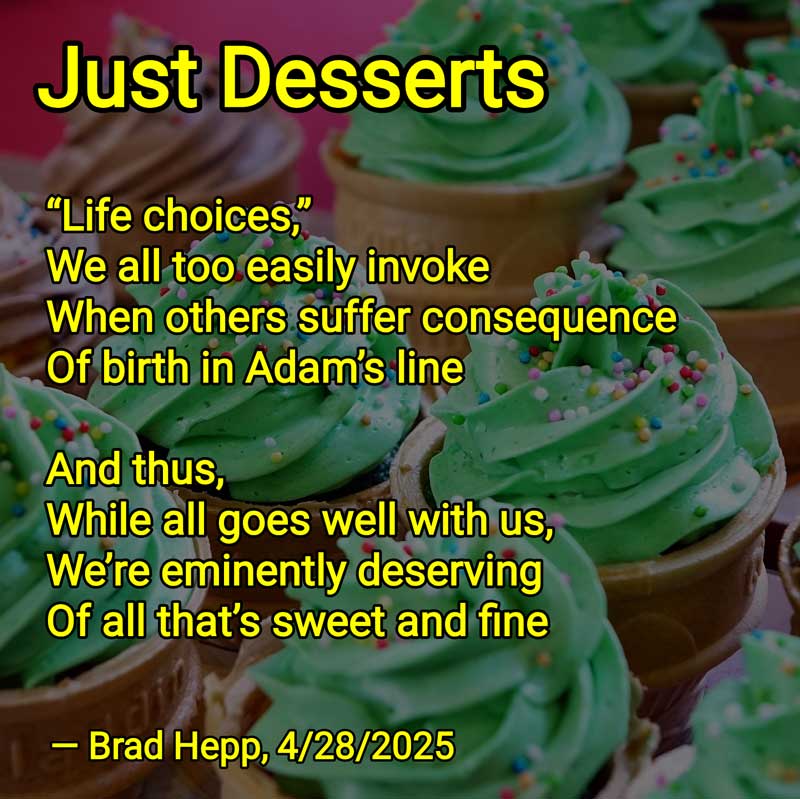
GRACE, ANYONE?
I was telling someone how striking it is that some live life from upgrade to upgrade while others live a life of patches and repairs. Their immediate response: “Life choices.” Now, honestly, I don’t know if that response was made with disdain or compassion, but it felt like an accusation, one that so-called friends leveled at Job.
Here’s what I’m suggesting in this poem: accounting for all our circumstances as something we deserve treads dangerously on grace.
The title is intentionally misspelled… and deliciously ambiguous.
See my comment below for more poetry with this theme.
(if you are viewing this via email, the website has a recording of this poem and commentary; click the title above)
Commentary
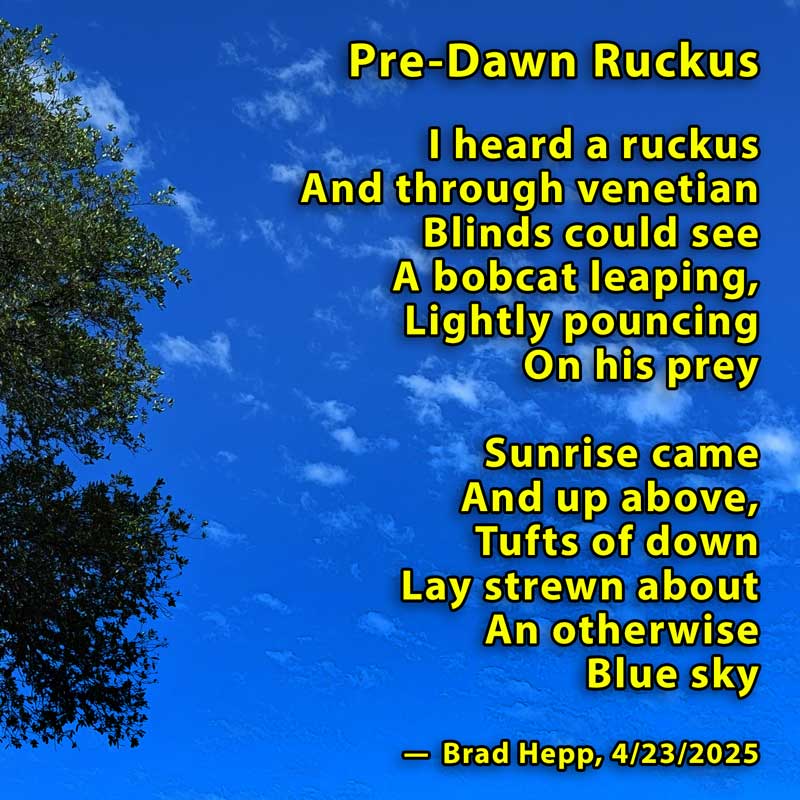
How long has it been since you read Carl Sandburg’s “Fog”:
The fog comes on little cat feet.
It sits looking over harbor and city on silent haunches and then moves on.
I’m no Sandburg, but my poem was probably inspired by his. Last night, we had a thunderstorm, and on my walk today, the sky reminded me of the many times I have seen wool or downy feathers scattered where some predator had supper the night before.
Do you hear the thunder in that first stanza? Do you see the lightning? And with my explanation above, can you see the remains of the bobcat’s meal in the sky above?
Does it bother you that I didn’t try harder to rhyme in this poem? It would have been fairly easy to rhyme “prey” and “day” or “die” and “sky.” But I didn’t want to do that here. I’m ornery that way, and refuse to comply.
(if you are viewing this via email, the website has a recording of this poem and commentary; click the title above)
(background image by WikiImages on Pixabay)
Commentary
Robert Frost wrote that, “A poem begins as a lump in the throat, a sense of wrong, a homesickness, a lovesickness.” I think he meant that literally. The connection between a strong emotional state and the urge and inspiration to write poetry is palpable. But it isn’t just negative emotions that set us poets off! Euphoria will also do it. Oh yeah… speaking of Frost: for inspiring, euphoria’s also great and will suffice.
Enough generalities! The other night, I was sipping some whiskey. One ounce in and working on a second, I suddenly recognized this euphoric urge to write poetry. It’s a feeling that “Suddenly the world looks different; suddenly I see with new eyes. I must capture these realizations, I must net these butterflies!”
Trust me: very little of my poetry is whiskey-induced. In fact, most of it starts in the early-morning fog soon after rising. Perhaps my brain would like to go back to bed where it’s free to spin dreams.
Anyway, there it was… that feeling of euphoria, and the confidence that I could see new connections, find new analogies, devise new metaphors…. But I sensed danger: this is how writers turn into alcoholics. So I jotted down two lines and gave my thought a possible title:
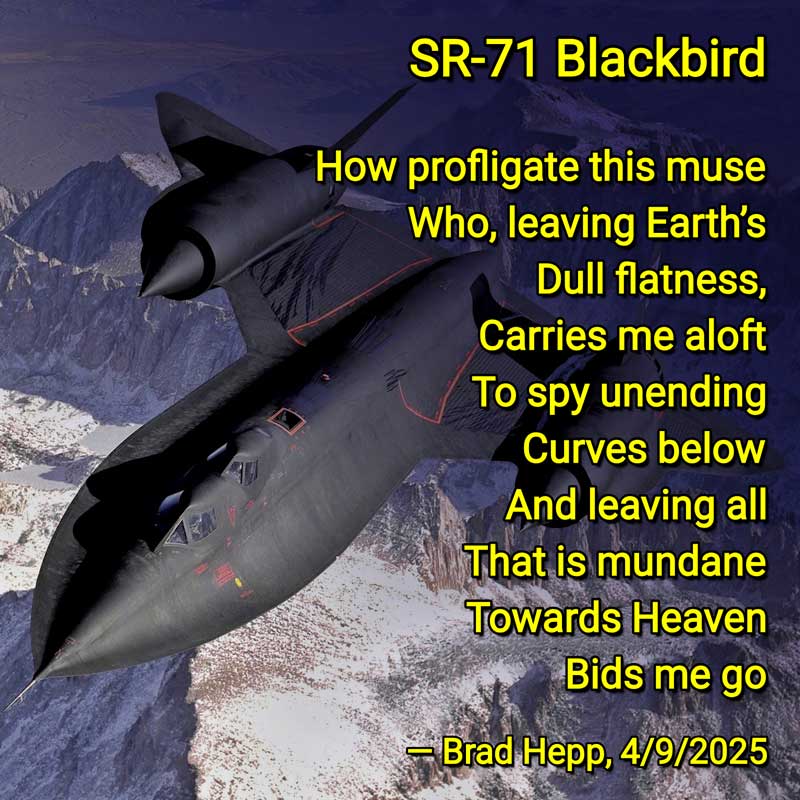
SR-71 Blackbird I really can’t afford this muse Who leaves my troubles all behind
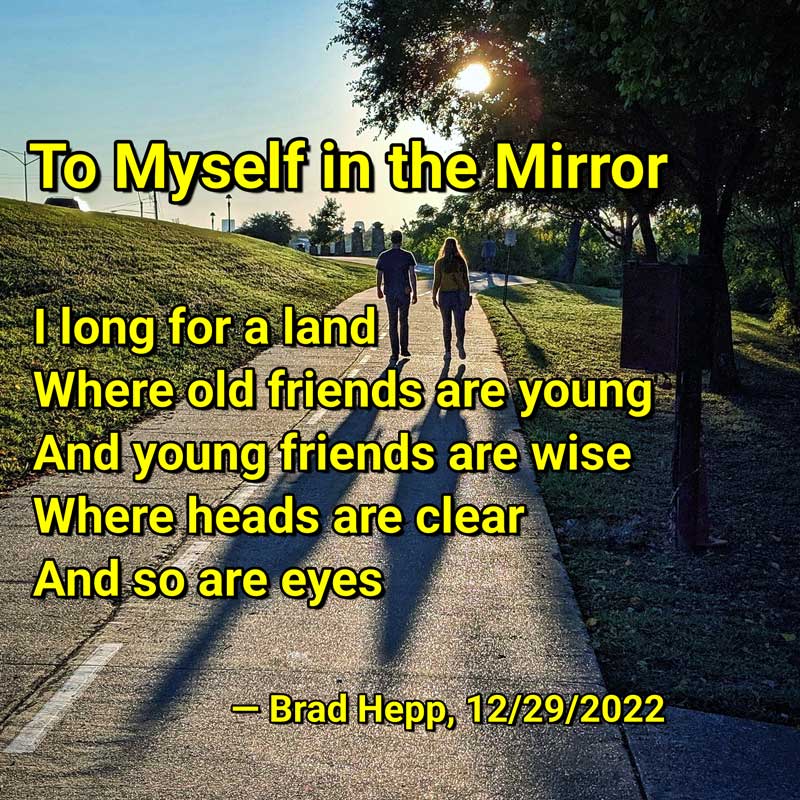
TOWARDS HEAVEN BIDS ME GO How can I write that line about something as dangerous as whiskey? Well, I’m convinced that God gives us many glimpses of Heaven, including intoxicants. I do long for a time when I can see things anew, with eyes unclouded by the cataracts of trouble and worry. As I said once before to myself in the mirror,
(if you are viewing this via email, the website has a recording of this poem and commentary; click the title above)
Commentary
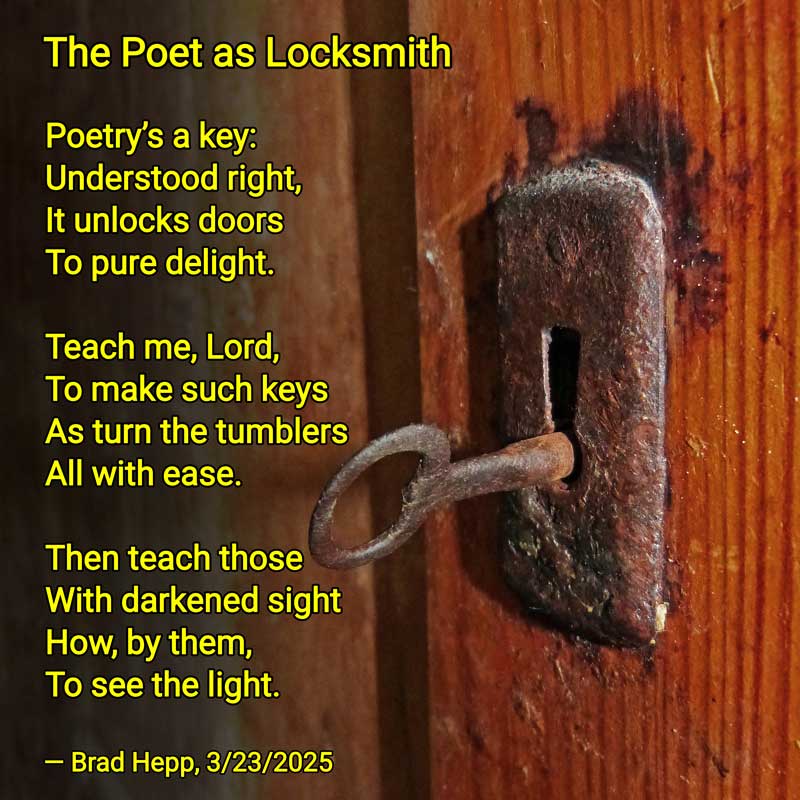
I try to always write poetry quickly, sign my name, and NOT go back to edit. My official, virtuous-sounding excuse is that I believe that to be the way I’ll become more fluent as a poet. If I’m always questioning my muse, she’ll become shy and hesitant. Right? It doesn’t hurt that this approach perfectly fits with my laziness! See another poem where I do some other self-justifying: “Socks Like Poetry.”
Today’s poem is one that I edited TWICE after publishing it on social media. In some respects, it’s better… otherwise I wouldn’t have bothered. But it has one downside: it runs the risk of suggesting that I think of myself as more enlightened than some who read my poetry. That’s generally not the case. When I write poetry, I’m usually grasping at things I barely understand! We’re all benighted, to one degree or another. We all need each other’s help to see the light, and experience God’s delight.
As for the overall concept…. The revelatory power of poetry is something I am increasingly experiencing in other poets (George Herbert comes to mind!), and hereby pray for regarding my own poetry.
(if you are viewing this via email, the website has a recording of this poem and commentary; click the title above)
Commentary
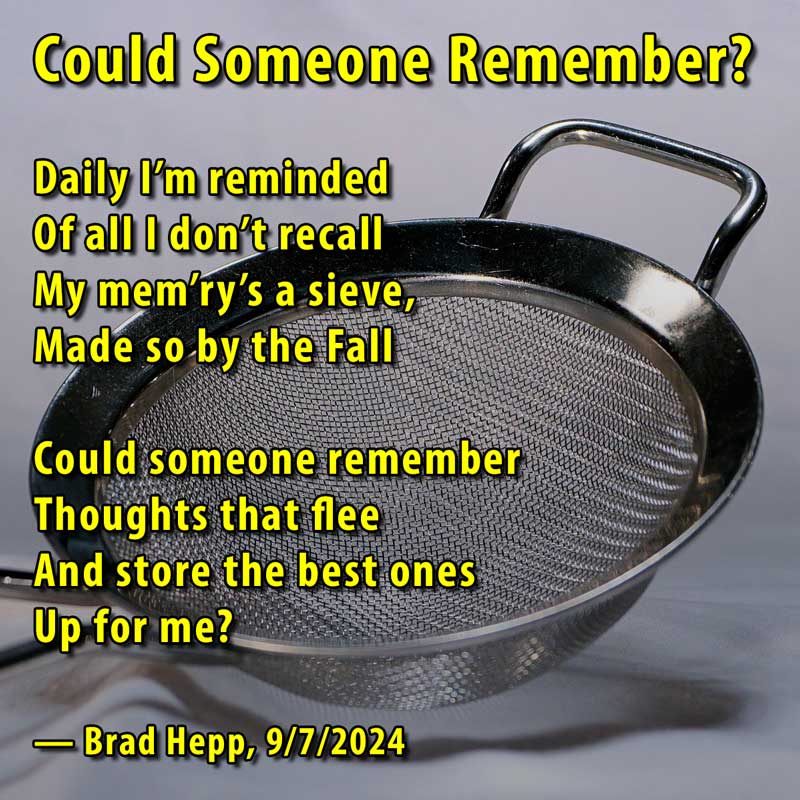
I don’t have the energy right now for yet another essay on the frustrations stemming from my leaky memory. But here are some bullet points. Is there a pattern?
One or another of my very good friends will occasionally astound me by quoting something I said to them twenty or thirty years ago
Of the 400+ poems that I have published on this website, I could quote only one or two from memory; generally, I forget my poems within 5 minutes of writing them
I tend to remember names of people and flowers
I tend not to learn or remember things unless I think they’re true
I remember ideas, not their specific formulation
Sometimes I’m glad that I forget things that aren’t necessarily true; I suspect some people consider anything they remember ipso facto true
How about you? I’d love to hear your bullet points!
(if you are viewing this via email, the website has a recording of this poem and commentary; click the title above)
Commentary
This may appear to be a depressing poem. Let me explain why it isn’t really….
A dear friend treated me to supper last night. This morning, I woke up and immediately wrote down what I had said to him, except that I put it in verse. Here goes:
TO UNKNOWN SIDE OF MOON I GO Over the last several years, slowly at first, but gathering speed as time passes, I have been changing. At least I have been examining my life more carefully, and laying myself open to change.
RACISM First, I became aware of my own racism. In 2016, I was being considered for a job that would have involved ministering in the Hispanic world. But even though I am a missionary kid born in Mexico, I had by my mid-fifties developed significant antagonism toward the growing population of Hispanics in the U.S. We can all thank God that job didn’t pan out. Imagine the hypocrisy!
Just after that, I went full-time with my web design business. In all the spare time I had, I began taking long daily walks. On those walks, I listened to many books, including all of the Bible (several times through). I’d walk around White Rock Lake, listening, and pondering. I also began observing how I responded to each person that I encountered on the trail. Why was my heart immediately warm toward this person, but cold and distrustful toward that person? I noticed–once again–that racism was definitely involved.
SELFISHNESS Acknowledging and inspecting my antagonism toward Hispanics revealed a deep vein of selfishness in me. At one point, I had to admit, “I don’t like this influx of Hispanics in the US because it’s a drag on the economy.” In other words, I was thinking with my wallet–how a group of people affect my wealth–not with Jesus’ welcoming, hospitable love. (By the way, I wasn’t thinking very well in any case). It seemed obvious to me that I had to either follow Jesus or give up that way of thinking.
As the years passed, I began to see how that vein of selfishness was influencing my politics, my view of history, even my theology. It’s hard to be an honest interpreter of Scripture when you are motivated to find God giving you every advantage while denying it to others!
A SENSE OF SUPERIORITY This brings me to something I was finally able to articulate to myself last night just as I walked across the parking lot to meet my friend in the restaurant. One of my biggest struggles in life is the temptation and tendency to think of myself as superior to many others in many ways: smarter, wiser, healthier, more discerning, more talented. Not, of course, superior to everyone around me… I’m arrogant, not stupid!
A LONG SLOW COURSE OF MEDICATION When I recognized my selfishness and racism, I began reading extensively about the history of white supremacy in the US. There’s simply no way that I escaped inheriting some of the rottenness in that pervasive ideology! Talking with my friend at supper, I listed some of the authors I have read. As you read this list, you may be tempted to jump down my throat. But hear me out. The authors included Robin DiAngelo (White Fragility), Abram X Kendi (Stamped From the Beginning), Bryan Loritts (Insider Outsider), Jemar Tisby (How to Fight Racism), Luke Bobo (Race, Economics, and Apologetics), and Ta Nehisi Coates (We Were Eight Years in Power). With the exception of DiAngelo, these authors are all black men and skilled writers. Even if I question their analysis or solutions, I deeply appreciate their ability to articulate their perspective. Some of them are my brothers, and all are my friends in that regard. Reading these authors, and imbibing many related documentaries and podcasts has been like taking a long slow course of medication. I’m getting better, largely by understanding how bad off I am.
BACK TO THE POEM The dark side of the moon is a hostile, unfamiliar environment. If the moon we see every night is smiling on us approvingly, the dark side of the moon is indifferent at best, scowling murderously at worst. In its metaphorical eyes, we are not great. In its metaphorical eyes, any notion that I am superior to anything or anyone is laughable.
HAVE I SAID ENOUGH? If you go back and read the poem now, does it start to make sense? Can you see that it is hopeful, and not depressing? Let me know by commenting below!
[Note to my future self: I wrote this a day or two after watching an episode of The Crown, in which Prince Philip has a private interview with the Apollo 11 astronauts. Philip was experiencing a crisis at that point in his life, and he hoped that the astronauts would have some serious, helpful observations about life and faith. Alas, they were at that point just men of action, not contemplation.]
(if you are viewing this via email, the website has a recording of this poem and commentary; click the title above)
Commentary
When I first posted this on social media, I could barely contain my excitement:
I can hardly wait to write this up and post it on my blog. I haven’t fully figured out my own poem(!), but it has something to do with gratitude for having been cradled in metaphor. It rocks me still, many years after Mother’s passing.
Like the title, the poem is admittedly confusing. I appear to be talking about three entities: a boy, my mother, and my muse. Let me try to sort it out….
“MUSE“ When I set out to write this poem, I was simply thinking about how to explain those dry times when there’s no inspiration for poetry. Basically, my “muse” (my inspiration) is recharging, often by reading and resting. I think my reader can see that in the poem. And of course it is actually I who am recharging, not some external, mythical influence.
“MOTHER“ For some reason (Freud would have theories), my thinking shifted from an impersonal inspiration—my “muse”—to the most personal inspiration of all: my mother.
Once my focus shifted from an imaginary, impersonal “muse” to my mother, the first stanza came to me full-formed and finished, with one exception…. Once I had found a suitable background photograph, I substituted “ran” for what I had there originally: “wandered.” By the way, I do actually, literally remember my mother starting a story with these curious words.
“BOY“ That brings me to the most confusing part…. My mother was never a little boy. But in an effort to connect with me in my boyhood, she told me about her early life AS THOUGH she too had once been a little boy. That may have been easy and natural for her, since she was an only child, a self-proclaimed tomboy, and she lived out in the country. In any case, my kind, creative mother employed a giant metaphor to communicate her solidarity with me. As I wrote above, I am grateful for having been cradled in metaphor. Elements of poetry–metaphor, creativity, beauty–surrounded me in my youth.
“DANCING THE NEWS” The fourth line of the second stanza changed repeatedly. Instead of “the news,” I tried various adverbs to describe how my muse acts when she’s not off recharging. I had her “dancing playfully,” “…energetically,” and “…gracefully.” None of those satisfied me. Finally, I decided that I should bypass all those adverbs and point instead to the reason behind her dancing: “good news.” (By the way, this is a line I’m borrowing from one of my own favorite poems: “Dancing The News.”) Although much of my poetry is complaint, or lament, I think it is all written in the context of hope for eventual resolution and restoration. Ultimately, I am inspired to write poetry by the “Good News” of the Gospel. My mother–more than anyone else–enabled me to see that good news.
(if you are viewing this via email, the website has a recording of this poem and commentary; click the title above)
Commentary
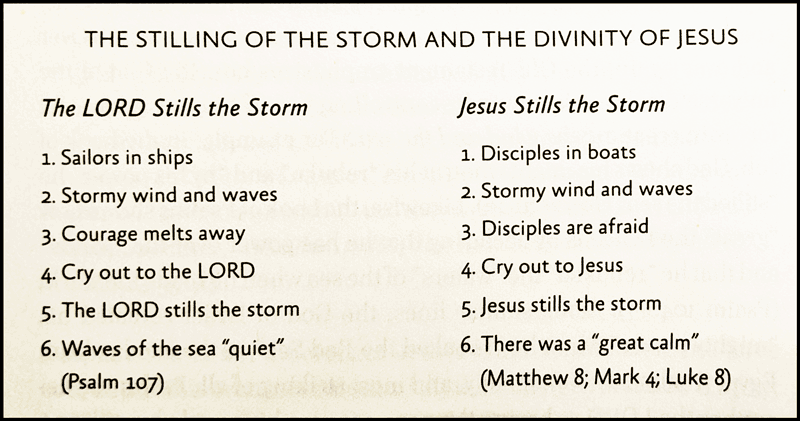
This poem springboards from reading an argument that Jesus’ divinity is present in the Synoptic Gospels (Matthew, Mark, and Luke), not just in John. In the actual argument, Brant Pitre shows that Jesus did things that his first century Jewish observers would have interpreted as implying his divinity (see the comparison below, taken from p124 of Pitre’s The Case for Jesus). So the Synoptics implied what John stated.
Face of the Deep In using the phrase “face of the deep,” I am playing with the King James Version rendering of Genesis 1, verse 2:
And the earth was without form, and void: and darkness was upon the face of the deep. And the Spirit of God moved upon the face of the waters.
(if you are viewing this via email, the website has a recording of this poem and commentary; click the title above)
Commentary
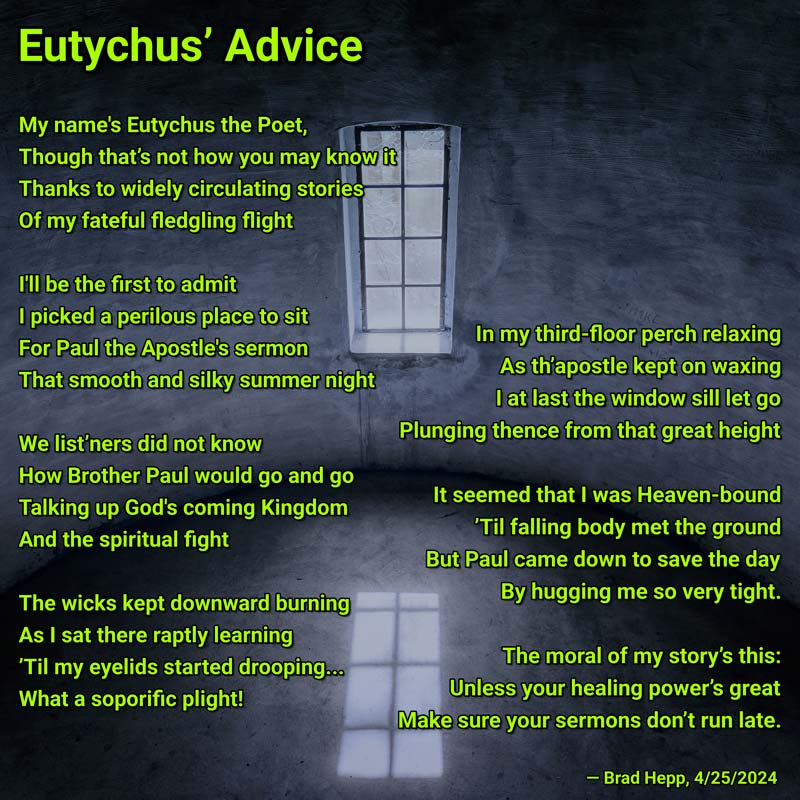
In my crawl through the book of Acts, I’m to chapter 20, and I hit this passage:
On the first day of the week we came together to break bread. Paul spoke to the people and, because he intended to leave the next day, kept on talking until midnight. There were many lamps in the upstairs room where we were meeting. Seated in a window was a young man named Eutychus, who was sinking into a deep sleep as Paul talked on and on. When he was sound asleep, he fell to the ground from the third story and was picked up dead. Paul went down, threw himself on the young man and put his arms around him. “Don’t be alarmed,” he said. “He’s alive!” Then he went upstairs again and broke bread and ate. After talking until daylight, he left. The people took the young man home alive and were greatly comforted.
Acts 20:7-12 (NIV)
What’s the point of Luke’s account? Don’t sleep in church? God’s power was displayed through the Apostle Paul? It’s probably something along those lines, not the supposed “moral of the story” I suggested in the last stanza of my poem. But I couldn’t resist. I sent the poem off to three of my preacher friends. So far, they haven’t responded. They’re probably busy crafting succinct sermons. Good luck, I say!
(if you are viewing this via email, the website has a recording of this poem and commentary; click the title above)
Commentary
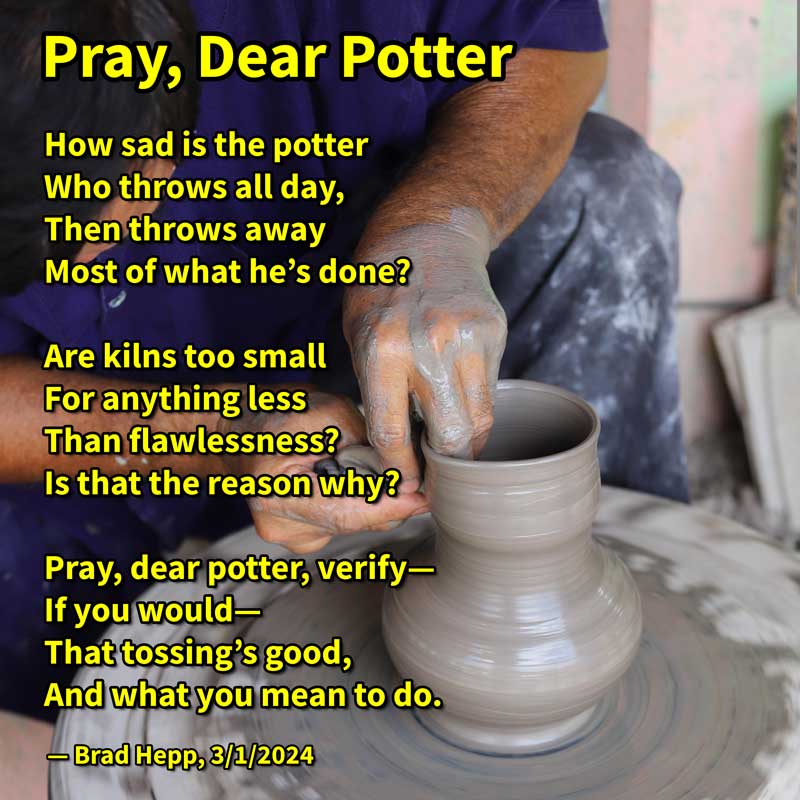
This is a poem in search of a theodicy. It asks, “How is God good if only a small percentage of the men and women he created are to be saved from destruction?”
Let me put that more personally… This poem is an actual prayer. I want God, the Potter, to answer. I trust his goodness, but I wish for him to verify that his goodness is displayed even in pots being made for destruction.
(if you are viewing this via email, the website has a recording of this poem and commentary; click the title above)
Commentary
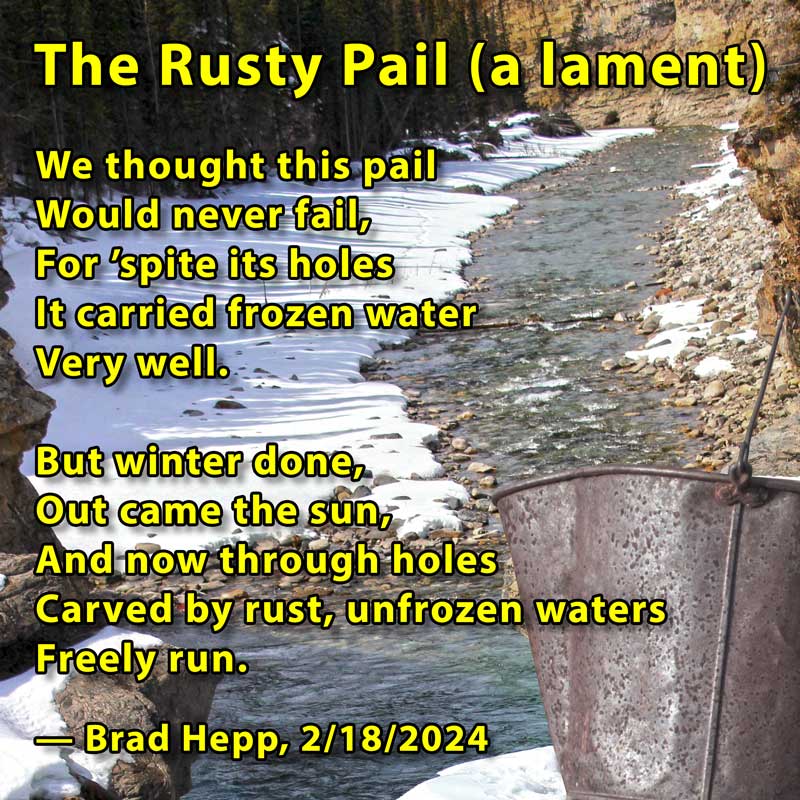
This poem may sound playful, but it really is a lament.
I listen to the podcasts of an Evangelical pastor who is working through his former allegiance to Evangelical beliefs and practice. He, like many of us, is distressed by the behavior of Evangelicals–make that White Evangelicals–in the past few years. Since our behavior has been so horrible, we’re forced to question our beliefs. One of his recent podcasts examined a belief that I still hold somewhat dear. Somewhat. Frankly, I am conflicted. The image of a leaky bucket came to mind as I considered my loss of confidence in this cherished belief.
I’m not going to go into details about the particular belief. Nor am I going to argue with anyone about what I perceive as horrible behavior by White Evangelicals. I’ll leave arguing for people who are good at it. The Holy Spirit is probably more convincing than I am. Right?
(background image is a mashup of the pail, by omnigrapher2016, and the stream, by lalami78, both on Pixabay)
(if you are viewing this via email, the website has a recording of this poem and commentary; click the title above)
Commentary
Someday I’ll learn how to ask thought-provoking questions. I want people to join me in a quest for answers, to brainstorm with me.
Unfortunately, prompting thoughtful responses is a tricky thing. My father was a seminary professor in Mexico. He got in trouble with fellow professors for provoking students to think. Apparently he didn’t get the memo that he was only supposed to spoon-feed those poor, defenseless students. The really good ones loved him. He set them up for a life of productive thinking.
(if you are viewing this via email, the website has a recording of this poem and commentary; click the title above)
Commentary
On a friend’s post, my sister wrote, “I love that photography can help us really SEE the world. My mom taught us to look for those tiny bits of beauty that are often overlooked. Brad Hepp, you took that lesson to heart!”
My sister says, “I think of you, Of what you took to heart.” What she says is right in part; God make it wholly true!
(if you are viewing this via email, the website has a recording of this poem and commentary; click the title above)
Commentary
IN PROCESS IN PUBLIC Occasionally, I run into someone clearly wiser and more spiritually mature than me who says something like “I read all that you write.”
When I hear that, fear momentarily grips my heart.
Such people smile, and don’t judge. But if I can see my own foolishness in the recent past, such people can see it in my present condition. Being seen can be scary.
This poem is an attempt to deal with the embarrassment of being in process in public.
(if you are viewing this via email, the website has a recording of this poem and commentary; click the title above)
I sit on a rock on the bank of the stream, by the light of the moon methodically washing my midnight snack.
I’m thinking back to an earlier time, when darkness fell on the farmer’s shack….
Seated on a well-worn balustrade, I watched the farmer through slits in a dusty window shade. He sat on a chair at the kitchen table. By light of a lantern, he methodically penned. Poetry, I suppose.
With far less writing than scratching of head, he’d occasionally put pencil to paper and thoughtful compose.
Finally, he set down his pencil, snuffed out the lantern, and waddled to bed.
My careful ablutions are now complete.
It’s “Good night” to you, and to me, a pensive “Bon appétit.”
— Brad Hepp, 8/9/2023
(image adapted from original by Wolfgang Deckers on Pixabay)
(if you are viewing this via email, the website has a recording of this poem and commentary; click the title above)
Commentary
I sent this poem to a dear friend, saying “I think of you when I write this, with thankfulness that you use my guilelessness FOR me, and not AGAINST me.”
Having strong emotions is a blessing. Not being able to fully control them or mask them can be a curse.
MY FRIEND’S RESPONSE My friend wrote: “You are allowed to have feelings and initial reactions. I would hope people would understand that and give you time to process.”
“That said, stay away from the poker tables. 😂 “
ALSO MY FRIEND’S RESPONSE My friend also sent this shirt…
(if you are viewing this via email, the website has a recording of this poem and commentary; click the title above)
Commentary
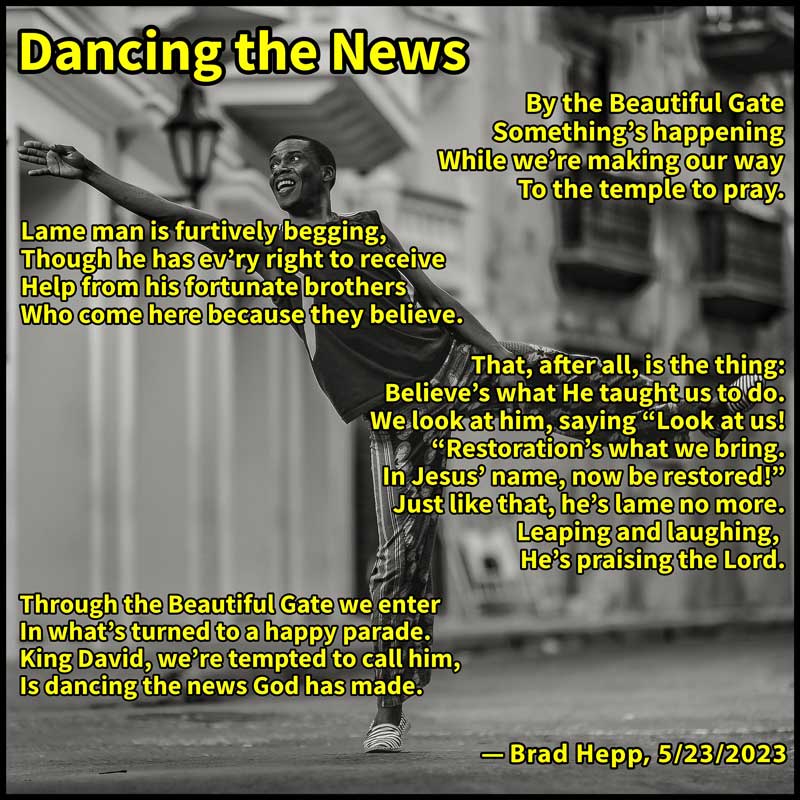
This has come to be one of my favorite poems. Maybe that’s just because of the beautiful expression of the fellow in the background image. If you haven’t read Acts 3 in a while, do yourself a favor, and let your imagination play with the story we’re told there.
ACT ONE OF A TWO-ACT PLAY IN ACTS CHAPTER THREE I’ve begun my crawl through Acts. In this morning’s passage, Luke mentions the look a lame man gives Peter and John, the look they give him in return, and the more attentive look they require of him. Is this and what follows a device to draw our attention to something Peter will tell the crowd? Who arranged this little two act play? Does the second act build on the first act? I suspect it does. We’ll have to take a closer look.
(if you are viewing this via email, the website has a recording of this poem and commentary; click the title above)
Commentary
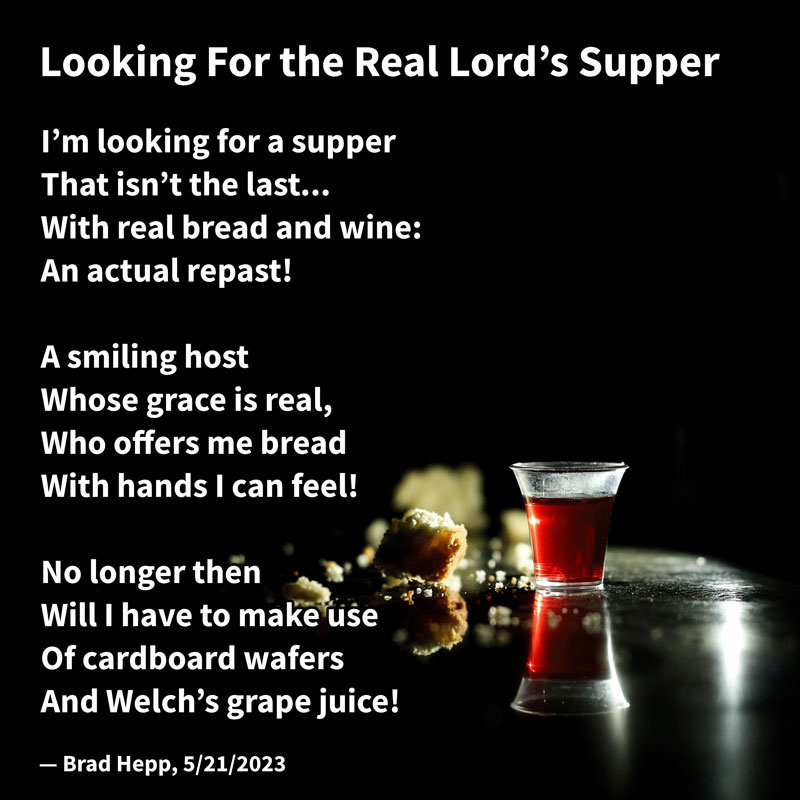
I serve two churches on Sunday mornings: a Bible church and an Anglican church. They both celebrate the Lord’s Supper each week. They do it differently. But in both cases, I think we must acknowledge—borrowing George MacDonald’s words—”the end of the Maker’s dream is not this.”
(if you are viewing this via email, the website has a recording of this poem and commentary; click the title above)
Commentary
I had a lot of this the last several years. And I’m better for it.
I suspect one reason God prescribed the Sabbath is so He can demonstrate HIS faithful provision. We tend to make it transactional: “Take this time off, and the reward is that you’ll be able to provide better for yourself by working harder and/more efficiently afterwards.” We say, “Here’s how I justify Sabbath….” I hear a murmur from the clouds: “They don’t get it yet!”
(if you are viewing this via email, the website has a recording of this poem and commentary; click the title above)
Commentary
ON THE PATH This early morning poetography is too personal, too idiosyncratic to be GOOD. But, like the dream from which I just awoke, it is TRUE.
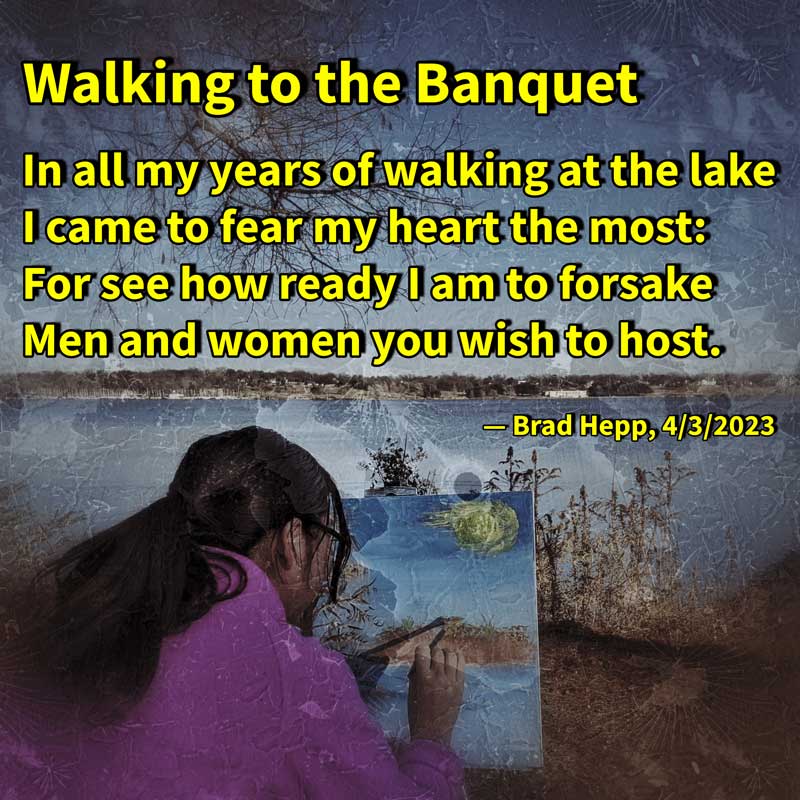
The elements don’t go together for anyone outside my head. But for me, they all belong. I know when and where I took the background photo: December 22, 2019, west shore of White Rock Lake. I know what I was thinking then: I was beginning to recognize my judgmentalism, how unreliable I am in whether people are attractive or repulsive to me.
I’m still learning my place on the trail. What I think of—or feel toward—people I encounter on our respective paths is not what’s ultimately important.
THUS, THE TITLE: Wherever we go, See ourselves as sent: Not for our pleasure, but His.
(if you are viewing this via email, the website has a recording of this poem and commentary; click the title above)
Commentary
FIRST, MY STATE OF MIND IN WRITING THIS POEM Occasionally, I lie awake for hours, struggling with the consequences of being an obvious sinner. Then, the sun rises and I must go forth, in hope that the Spirit will channel this expressive energy God gave me.
The sins of some people are obvious, going before them into judgment, but for others, they show up later. Similarly good works are also obvious, and the ones that are not cannot remain hidden.
1 Timothy 5:24-25 NET
NOW THE EXCELLENT FEEDBACK OF TWO WISE FRIENDS First, from Jim Powell: “You probably already know this, but Tony Campolo famously began one of his sermons by saying: ‘I have three things I’d like to say today. First, while you were sleeping last night, 30,000 kids died of starvation or diseases related to malnutrition. Second, most of you don’t give a shit. What’s worse is that you’re more upset with the fact that I said shit than the fact that 30,000 kids died last night.'”
Jim added, “For the record, I do not use profanity, though I occasionally will quote it if there is a reason to do so. I probably wouldn’t even use it the way that Tony Campolo did, however, he is right about his priorities. While we sleep tonight, thousands of children will die of hunger, malnutrition, and curable diseases. And we don’t get as energized about doing something about it, because we don’t see any angle in which we would be fighting against sin. In fact, too many Christians would turn away those very children if they showed up at our southern border. Because right-wing news media have convinced many that they are a grave threat to our national security.”
Then, this from David Lewis: “I read in a (now out-of-print) book a line about a woman who was poisoning her husband little-by-little. She distilled the poison out of sweet words, loving words, gentle words, all of them withheld.”
(if you are viewing this via email, the website has a recording of this poem and commentary; click the title above)
Commentary
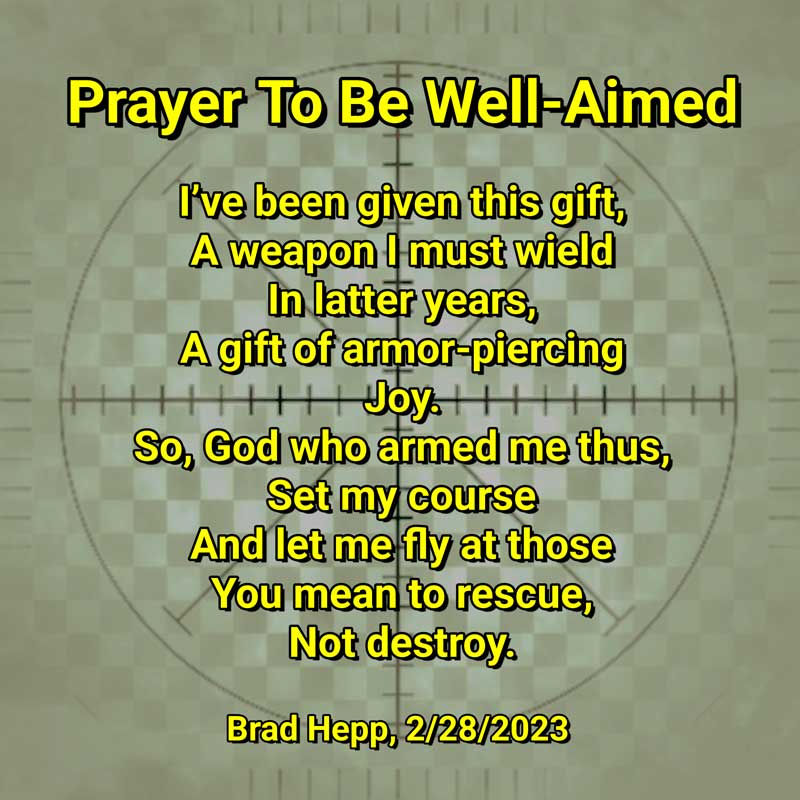
I initially wrote this about the gift of poetic expression. But as soon as I had called that “joy,” I realized that what I was writing applies to all of us who have been gifted in some way by God. Each person can work out how his or her gift can be an expression of God’s loving intent.
(if you are viewing this via email, the website has a recording of this poem and commentary; click the title above)
Commentary
In some ways, this is the prayer of my life. Once, long ago, I told a teacher and friend, “There’s little I feel compelled to say.” With age, that is changing. Considering how much I have learned about the need for reformation in my life, it’s a good thing I was taciturn in my youth!
By the way, this is coming to be one of my favorite poems–in case anyone ever wonders….
(if you are viewing this via email, the website has a recording of this poem and commentary; click the title above)
Commentary
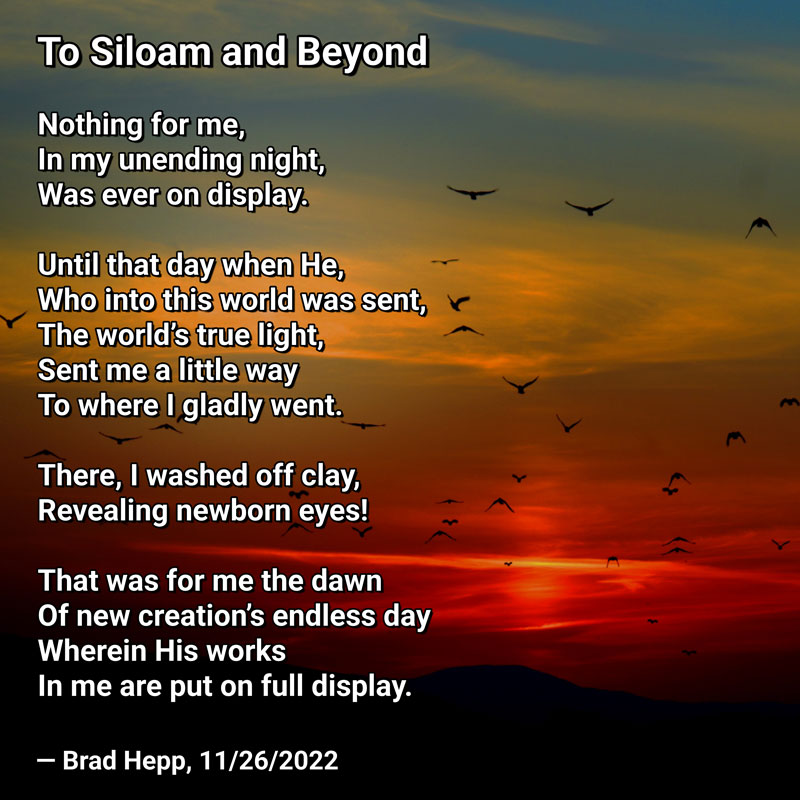
[Jesus] said to him, “Go, wash in the pool of Siloam” (which means Sent). So he went and washed and came back seeing.
John 9:7 ESV
This morning, in my crawl through John, I got to chapter nine, and one of my favorite passages: Jesus’ healing of the man born blind. It seems obvious to me that John was capturing Jesus’ playfulness with words, and maybe even playing along. One of the clues is that in telling us about the pool of Siloam, John inserts, “Translated, that means ‘Sent’.”
There’s a lot more going on in the passage than I understand. That prompts me to write a poem, to poke at the story and see what emerges.
Let me encourage you to read John 9. It’s really fantastic. Pay attention to words like “work, works, sent, display, light, and blind.” If you’re like me, you’ll be reading some of it and thinking, “This part looks like something John and his fellow believers put in song.” Maybe you’ll be inspired to write your own song!
(if you are viewing this via email, the website has a recording of this vignette and commentary; click the title above)
Commentary
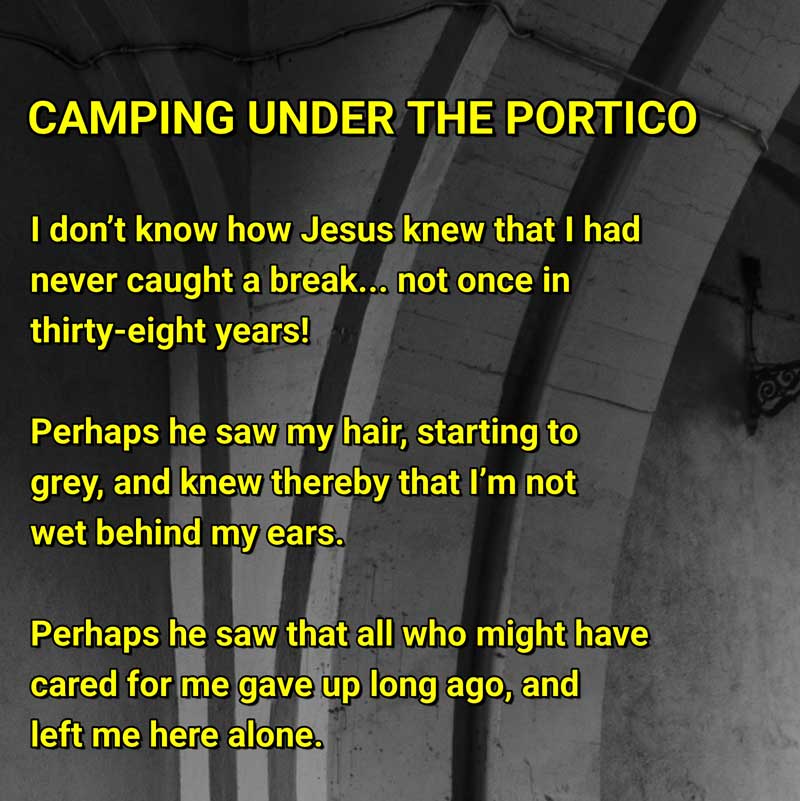
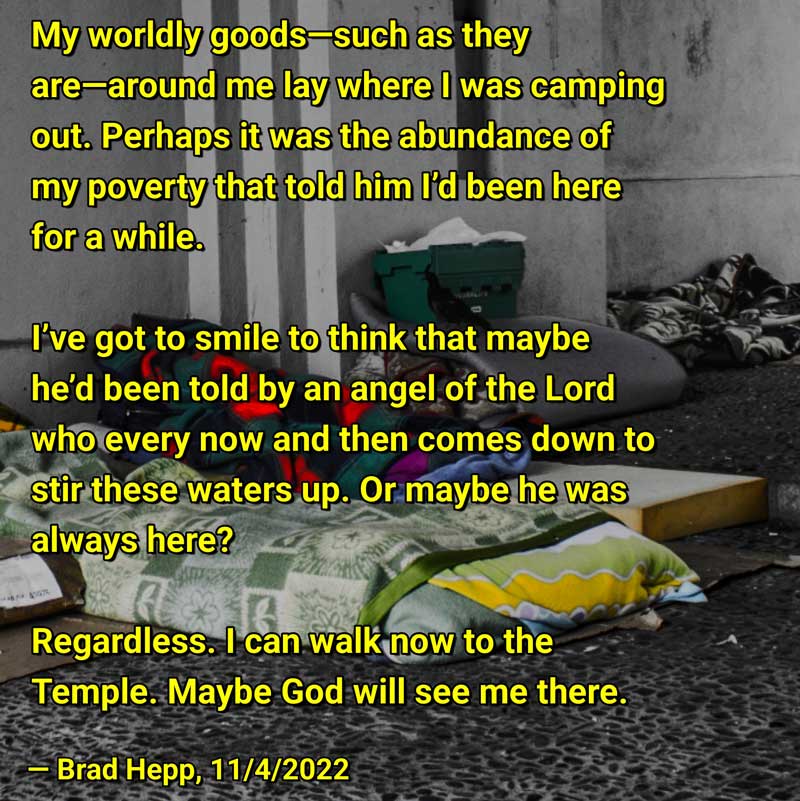
I hope you don’t consider this vignette–and others like it–an exposition of a biblical passage. It’s my emotional and imaginative response to the story of Jesus healing a lame man who had languished by the Pool of Bethesda (John 5). It makes me almost as happy to think of a reader saying “No, you got this wrong” as it would for the reader to say, “Oh yeah, that’s it. You nailed it!” I mainly want my reader to enter the scene with me, look around, and take it in, even if that means that my observations and interpretations prove to be mistaken.
A Personal Reflection You may notice that the background I chose for this vignette is a homeless camp somewhere. In growing up to be like Jesus, I often struggle with kindness and compassion. These qualities are tested by seeing beggars and homeless people. So, in considering whether or not I am growing in these qualities, I let my thoughts wander back across my life to earlier encounters. Here’s what I jotted down:
SUFFERING IS LARGELY HID FROM OUR EYES I grew up in a city where the disabled had to get out in public, so they could beg. Although a six-year-old Bradley didn’t feel the compassion that I feel now, I can still recall some of the more heart-wrenching scenes, like the legless man who got around by propping himself up on a skateboard. As with most powerful memories, I also remember the place. He hung out near the city’s one big, modern grocery store. I suppose it’s because the store’s clientele were “rich” folk like my missionary parents. And a few of those rich folk—there, like here—had compassion.
(background image by José Manuel de Laá on Pixabay)
(if you are viewing this via email, the website has a recording of this poem and commentary; click the title above)
Commentary
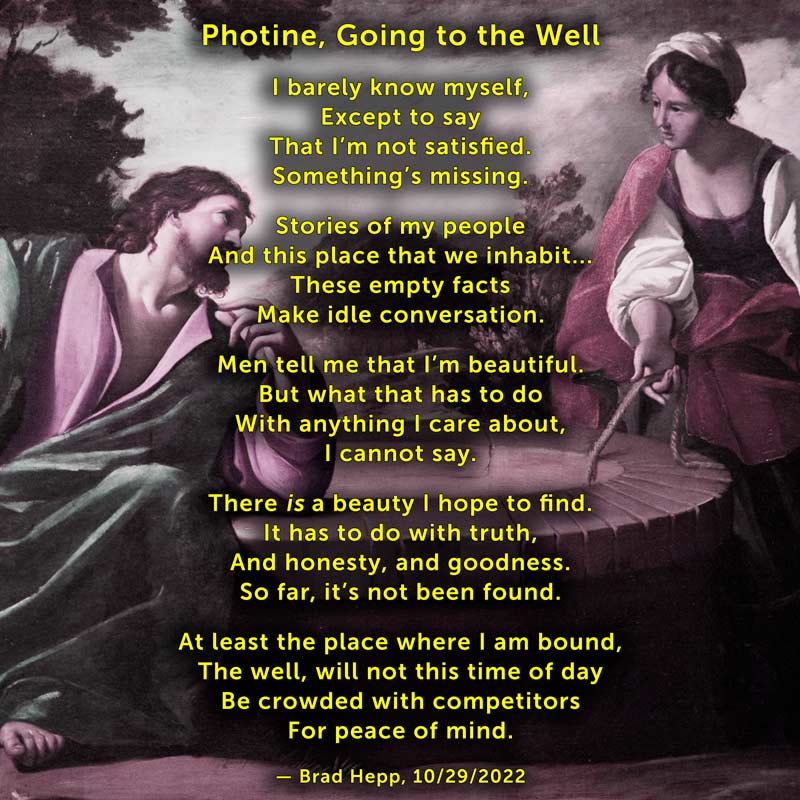
This kind of poem should probably be written by an experienced counselor, or pastor… someone who really knows the condition of hearts. As a poet, I sometimes just throw words against the wall to see if they stick. It’s like verbal spaghetti. How did Photine perceive herself? Why had she gone from man to man? I have an intuition that men and women long for beauty, especially beauty that is tied to the goodness of a person, ultimately THE Person: God.
I am working my way very slowly through the Gospel of John, and typically spend a few days translating and contemplating each chapter. I wrote the above poem the morning that I started into chapter 4. It was an attempt to imagine what the Samaritan woman might have been thinking as she trekked to the well for water. As I think about her situation in the days after I wrote the poem, I begin to second-guess myself. And that’s okay. It’s helpful to use one’s imagination, not for coming to conclusions, but for generating more questions.
A Grammatical Riddle Should the last two lines be “competitors FOR peace of mind,” or “competitors WITH peace of mind”? Even thinking through a question like this one raises other questions: 1) would Photine have said that she already had peace of mind? 2) were there false claimants to her peace of mind? 3) was peace of mind really one of Photine’s felt needs in any case? I don’t think any of us knows the answers. But maybe some day we will.
(background image adapted from a photograph by Fr. Lawrence, OP. He comments, “This painting of Christ and the Samaritan Woman is in the museum at the Dominican priory of Santa Sabina in Rome.”)
(if you are viewing this via email, the website has a recording of this poem and commentary; click the title above)
Commentary
The Setting of This Poem What was going on in Nicodemus’ mind the morning before he met Jesus at night? I think it’s useful to imagine that, and then to test the picture against John’s account. I don’t mean for this poem to suggest a radical interpretation of Nicodemus’ conversation with Jesus, or even to suggest that my imagination is borne out by what John wrote. As I think about John 3:1-21, I’m noticing a contrast of source and destiny, here and there, old and new. I’m letting those and other concepts play in my imagination as I try to picture Nicodemus’ heart.
A friend who is familiar with church history told me recently that oral tradition suggests Nicodemus was eventually born again. I sure hope so.
(if you are viewing this via email, the website has a recording of this poem and commentary; click the title above)
Commentary
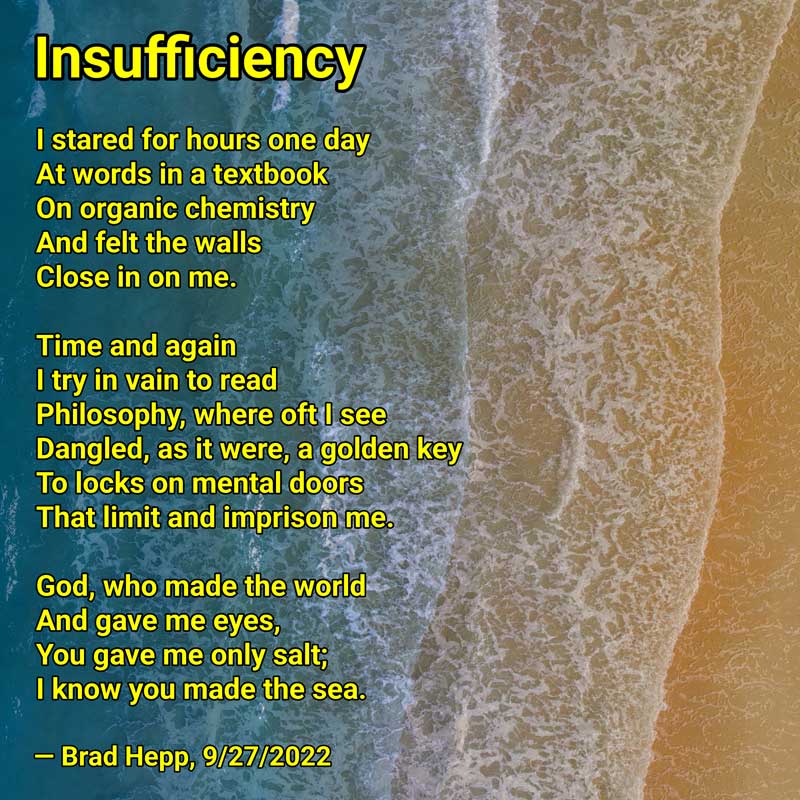
I don’t think I’ve ever written a poem that stirred up as much emotion as this one stirs up in me. Today, I began reading a book* about a theologian who wrote extensively about beauty. This is a subject whose extreme importance I sense but cannot intellectually grasp. I thought maybe an introduction to Hans Urs Von Balthasar would help. So far, this book only serves to remind me once again how far my reach exceeds my grasp. I want to understand something essential in God, but the mind he has given me is insufficient for the task.
On the flip side of that frustration, there is this: Our beautiful Savior imprisoned himself in our limitations for a time in order to remove the worst of those limitations forever.
*The Cambridge Companion to Hans Urs Von Balthasar. It looks like I may have better luck with another book once I get my hands on a copy: A Key to Balthasar: Hans Urs von Balthasar on Beauty, Goodness, and Truth by Aidan OP Nichols