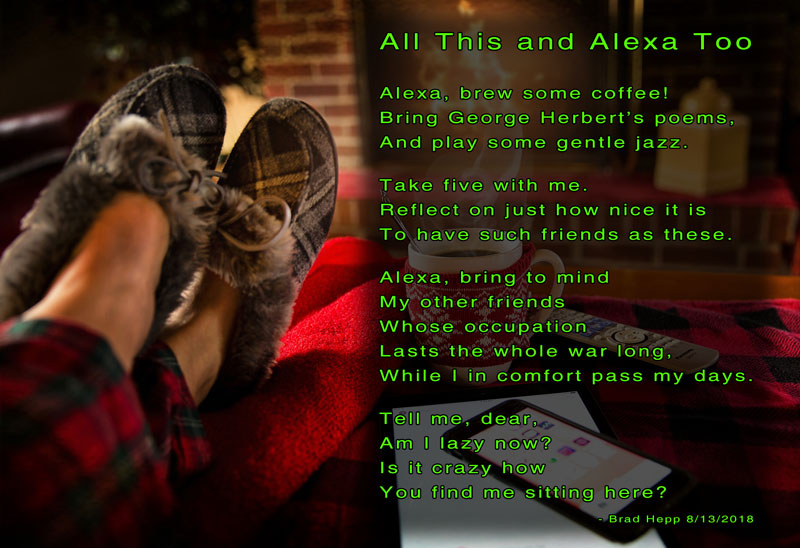
Unconscionable Poet

(if you are viewing this via email, the website has a recording of this poem and commentary; click the title above)
Commentary

This poem may not age well. Ten years from now, I may look back and laugh at the troglodyte I was in 2025. That has happened before. I recall complaining to my brother-in-law Don back in the late 1990s or early 2000s that clients were pressuring me to accept 50 MB files OVER THE INTERNET! Why couldn’t they just drive over with their files on portable media? Don was in a business that benefited from–and enabled–growth of the Internet. He wisely–and correctly–advised me to crawl out from under my rock.

So now, we are witnessing the rapid emergence of Artificial Intelligence. This poem is an expression of my struggle with how AI threatens a creative like myself. When AI can write three versions of a poem in the time it takes me to set down the first line of my own poem, I have to question the relevance of my work.

The poem is a protest. AI’s power comes at great expense. The data centers where AI performs its magic require vast resources–especially in terms of electricity and water for cooling. This is an expense born by all, but possibly rewarding just a few.

Artificial Intelligence pumps out poems with no regard for the costs. But we human poets work within limitations guided by decency and compassion. We have a conscience. Here’s some good news: in the exercise of that conscience, we can bring glory to the God who made us as we are. Our very limitations have value.

(CONFESSION: the background image was produced by AI based on my prompts)
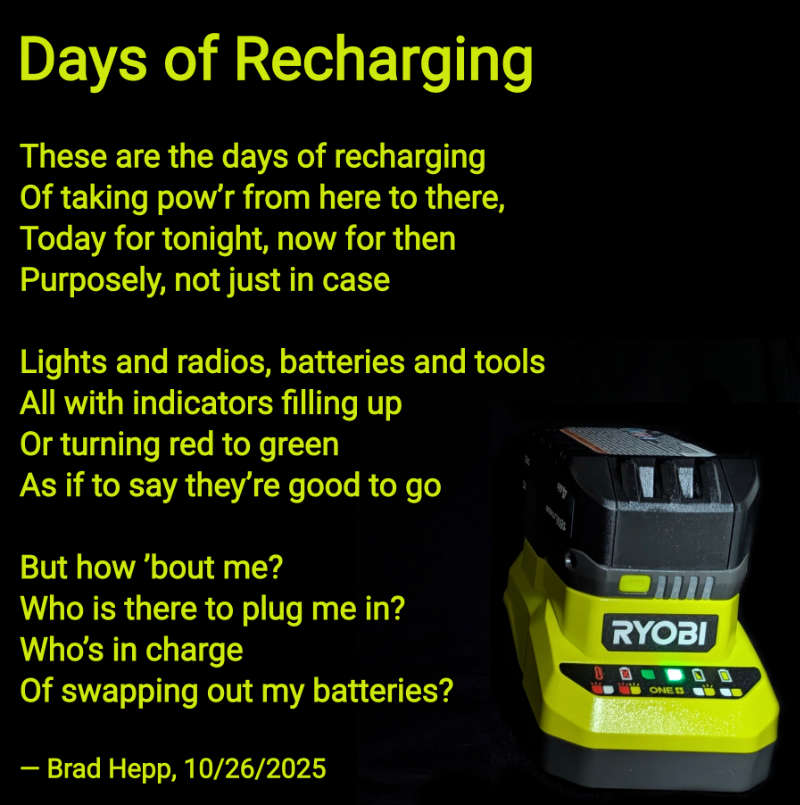
Days of Recharging

(if you are viewing this via email, the website has a recording of this poem and commentary; click the title above)

Commentary

[I have written this up, but decided it’s unwise to post the full explanation at this time; suffice it to say that this belongs in my “After The Fire” collection]

In my poem, I leave the question hanging out there: who is recharging ME? An unanswered question makes some people feel uncomfortable. I’m sure the day of answers will come.

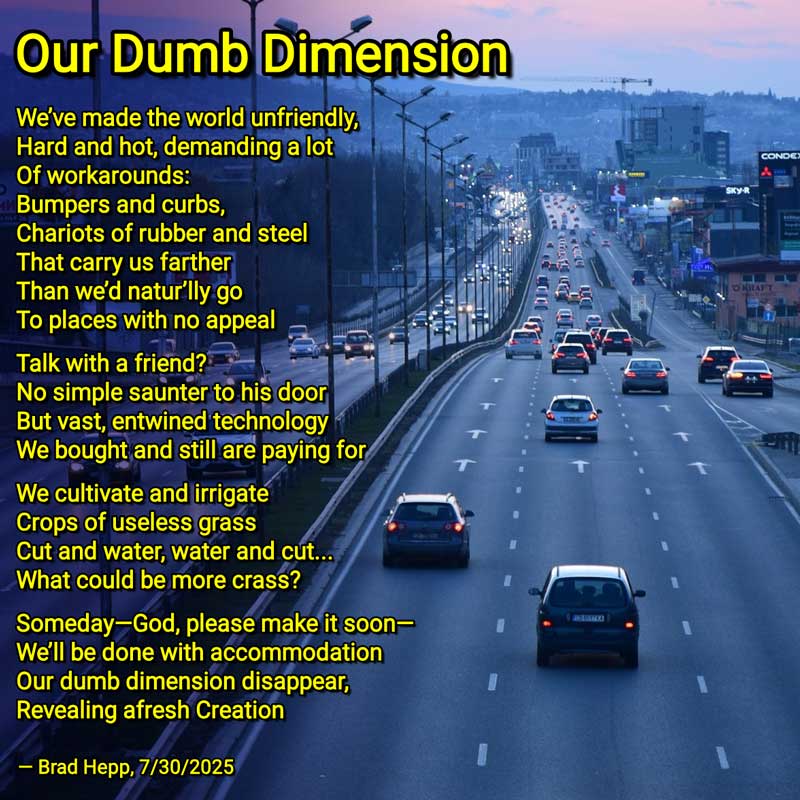
Our Dumb Dimension

(if you are viewing this via email, the website has a recording of this poem and commentary; click the title above)

Commentary

The view out the living room window of our temporary housing* is parked cars, the pavement, other apartments, and above it all a hint of sky. This is my view as today’s reading takes me to the pastoral scene of young David—ruddy, with beautiful eyes, and a handsome appearance (1 Samuel 16:12). I can imagine him walking in soft meadows, cajoling the sheep, and strumming his harp. I can imagine the scene because I have been there—as a child in Mexico and as a man in the alpine meadows of Colorado mountains. THAT is my Father’s world. Not this.

“DIMENSION”
Here I am playing with an idea that intrigues me. One prominent proponent of the idea is the Anglican theologian N.T. Wright. From an AI Overview:

N.T. Wright proposes that heaven and earth are not two separate locations, but rather two different dimensions of God’s creation. He suggests that heaven is not a distant realm to escape to, but rather an aspect of our present reality, the “God-dimension” that is interwoven with our earthly existence. The biblical vision, according to Wright, is the restoration of all things, with heaven and earth united in a new creation.

I don’t know enough about the concept and it strengths or weaknesses to say any more just yet. So I’ll leave it there….

___________
*this is another poem born of my experience living in temporary housing after our house fire earlier this month

(background image by Zdravko Shishmanov on Pixabay)

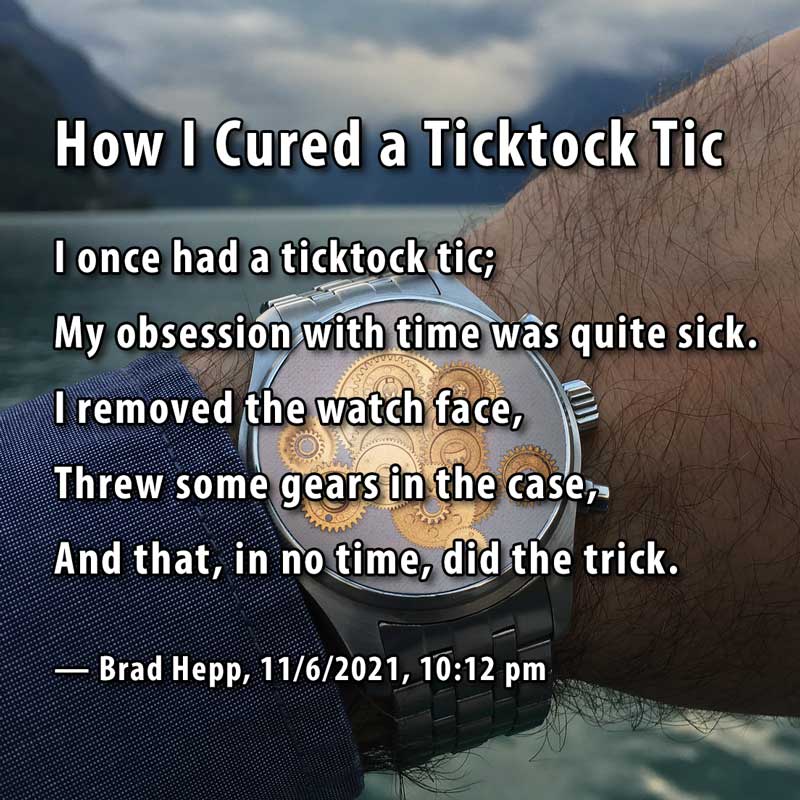
How I Cured a Ticktock Tic

True Story!

Back in college, I developed a nervous habit of looking at my watch every minute or so. I doubt anyone else noticed the habit, but I sure did!

My wristwatch was a cheap old Timex, so here was my solution…. I took the back off and removed the movement and face. Then I disassembled the movement, threw the loose gears in the case, and closed it up. The useless watch went back on my left wrist.

True to form, I’d look down at the watch every minute or so. Every time I looked, I had to laugh at myself. There, under the crystal, were a bunch of loose gears, telling me absolutely nothing. Nothing except, “Hey dumb dumb. Stop looking down here!”

The Background Image
That’s not my watch. Who knows where my “Hey dumb dumb” watch got off to. Somewhere between college and now, I lost it (I really did). I’m tempted to buy a cheap old watch to recreate the college timepiece. Its photograph would replace the background image, created in Photoshop from a couple of Pixabay downloads.

The Limerick
When I first thought of writing this limerick, I immediately came up with lines 1, 2, and 5 (the “A A… A” lines). That left me lines 3 and 4 (the “B B” lines) to tell the whole “how I fixed it” story. Believe it or not, that was the hard part. In the prose above, it took me thirty-six words to say what the limerick says in twelve words! That’s one of the main things I love about writing poetry: the challenge and charm of compression.

Have you ever read the most compressed poem of all? Even I can remember this one:

Fleas
Adam
Had’em

Ogden Nash

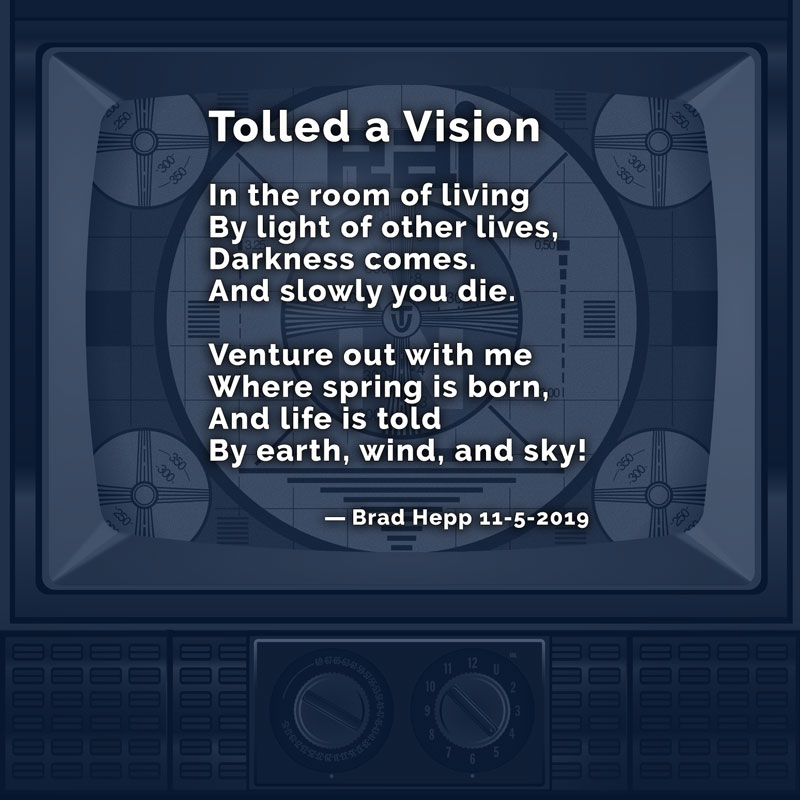
Tolled a Vision

Commentary

My pastor had this response: “I like it. Slowly we die as we are absorbed by the fictional lives of others dancing before our eyes when real life is just a power button and a glance away…”
My riposte: “… and a good pair of sneakers if you’re so disposed!”

Despite my riposte, this poem is more about the first stanza than the second. Not everyone can don a pair of sneakers and join me on long hikes. But everyone can seek to live as directly as possible, fully appreciating their own God-given life and embracing God’s offer of rebirth, restoration, and eternal life. For most people, this appreciation and embracing requires a little — or a lot — of contemplation, meditation. Noise and distraction are the enemy. Compare my poem “Alone at the Lake.”

About the title: I’m not completely happy with the title. You can probably tell that I started with “Television.” From there, I started pushing on “Tele,” “Tell,” and finally landed on “Tolled.” It may be too far out there. But consider that “toll” is associated with death (“For Whom the Bell Tolls”). It also sounds like “told.” Even as the flitting and vapid* “lives” of fictional characters displayed on a television have “tolled” our dying, and have “told” us the bad news, nature itself has “told” us about better news, the hope of resurrection. A big stretch, I know! This is my blurry vision, and now I have told you.

*This needs work. I do think there is something of “the medium is the message” in this. In television, we have lives that are extinguished with the press of a button.