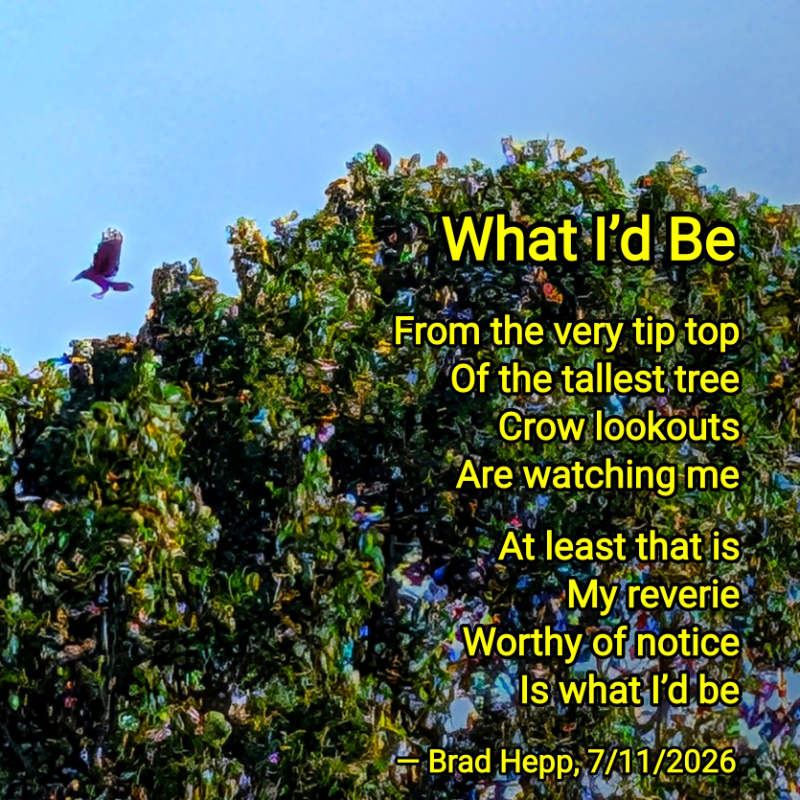
(if you are viewing this via email, the website has a recording of this poem and commentary; click the title above)
Commentary
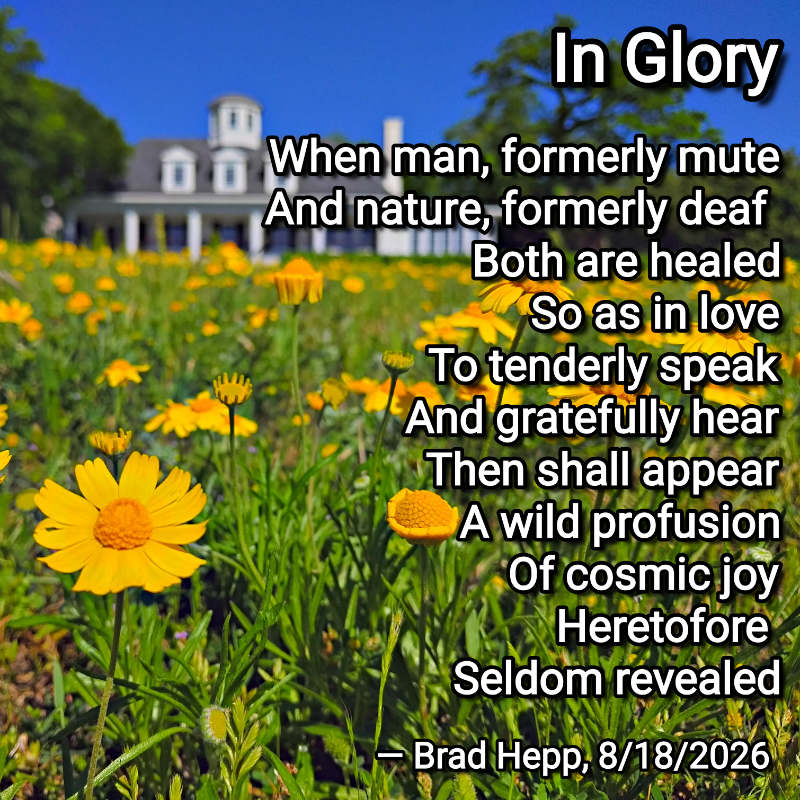
Recently, I have been observing my interaction—man’s interaction—with nature. I’m trying to think creatively about what will change—in us and in nature—when “creation itself will be liberated from its bondage to decay and brought into the freedom and glory of the children of God” (Romans 8:21).
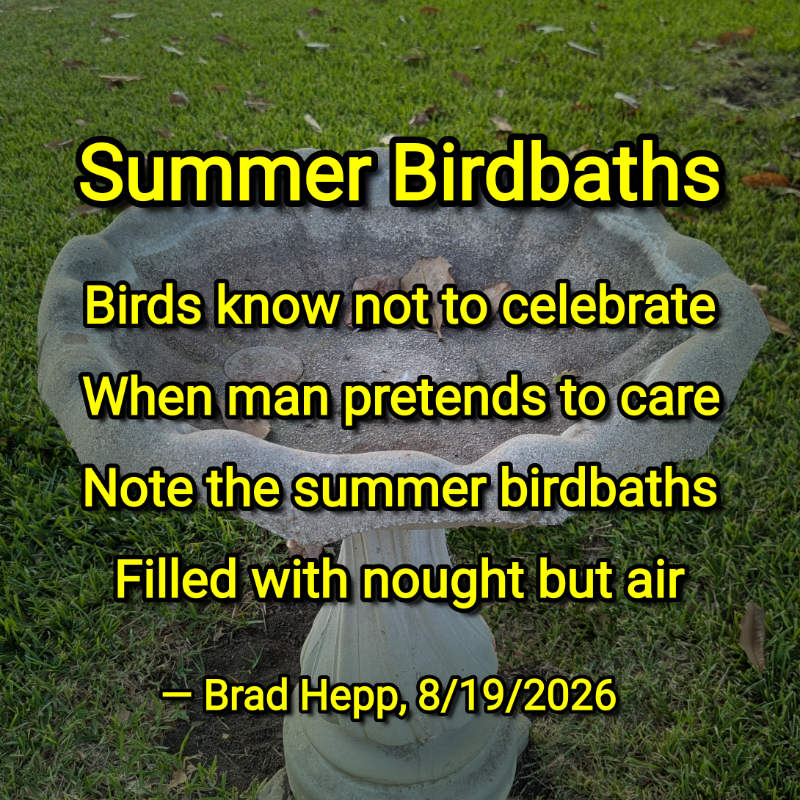
One of my birdbaths was bone dry; it had no water at the very time when birds need it most. Now I’m trying to fill it every day. I have to ask myself: “Was this birdbath merely a decoration for my property, or was it a provision for the creatures in my care?”
(if you are viewing this via email, the website has a recording of this poem and commentary; click the title above)
Commentary
I’m starting to think that we have a terribly stunted imagination when it comes to man’s relationship to nature in the Restoration (i.e., what Heaven will be like). Perhaps teachers and preachers are justified in their refusal to speculate in this area where the Bible is mostly silent. But we have a solid base for some speculation. We know what Jesus was like before and after his Resurrection. We know what abilities and authority he granted to the Apostles and other disciples (e.g., the 72 of Luke 10). Both Jesus and his disciples interacted powerfully with nature, not just with the spiritual realm.
I’ll develop this idea more as I have time to ponder.
Can you guess what scriptures I have in mind? Here’s one very important passage:
I consider that our present sufferings are not worth comparing with the glory that will be revealed in us. For the creation waits in eager expectation for the children of God to be revealed. For the creation was subjected to frustration, not by its own choice, but by the will of the one who subjected it, in hope that the creation itself will be liberated from its bondage to decay and brought into the freedom and glory of the children of God.
(if you are viewing this via email, the website has a recording of this poem and commentary; click the title above)
Commentary
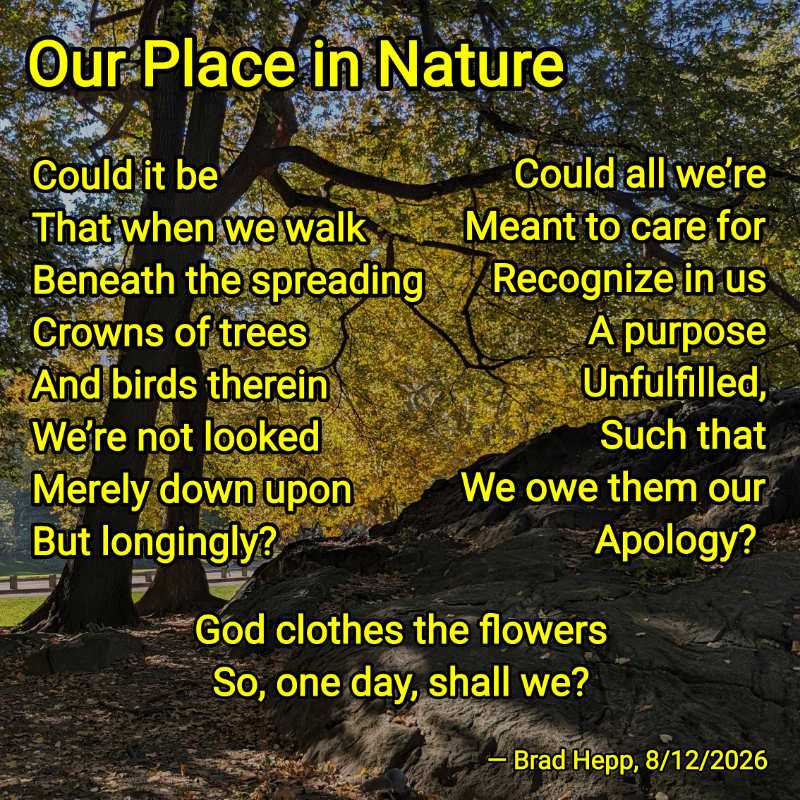
Believe it or not, my imagination was moved to this while listening to N.T. Wright’s book “Into the Heart of Romans” on my walk this evening. The background image is one that Susan took in Central Park when we visited Joshua and Emma in New York City.
(if you are viewing this via email, the website has a recording of this poem and commentary; click the title above)
Commentary
I got a call late last night from a friend who—like me—struggles with righteous anger. When is it appropriate? What do we do with it? To what extent can we cooperate with vile men?
So this morning, I got up and re-read Psalm 37, which strikes me as one likely inspiration for Jesus’ statement that the meek will inherit the earth. That Psalm may clarify what it means to be meek. It doesn’t mean giving up on justice; rather, it means knowing by whom justice will surely be secured.
Psalms 37:10-11 NIV:
[10] A little while, and the wicked will be no more; though you look for them, they will not be found. [11] But the meek will inherit the land and enjoy peace and prosperity.
(if you are viewing this via email, the website has a recording of this poem and commentary; click the title above)
Commentary
I’ve gotten into poison ivy three or four times in my life. This last time (about a month ago) was the worst. The intense itching on my arm would start up shortly after I went to bed each evening, and I really was desperate! As it turns out, that was one of several recent experiences that highlight the need for self-control—and for assistance in achieving it.
(if you are viewing this via email, the website has a recording of this poem and commentary; click the title above)
Commentary
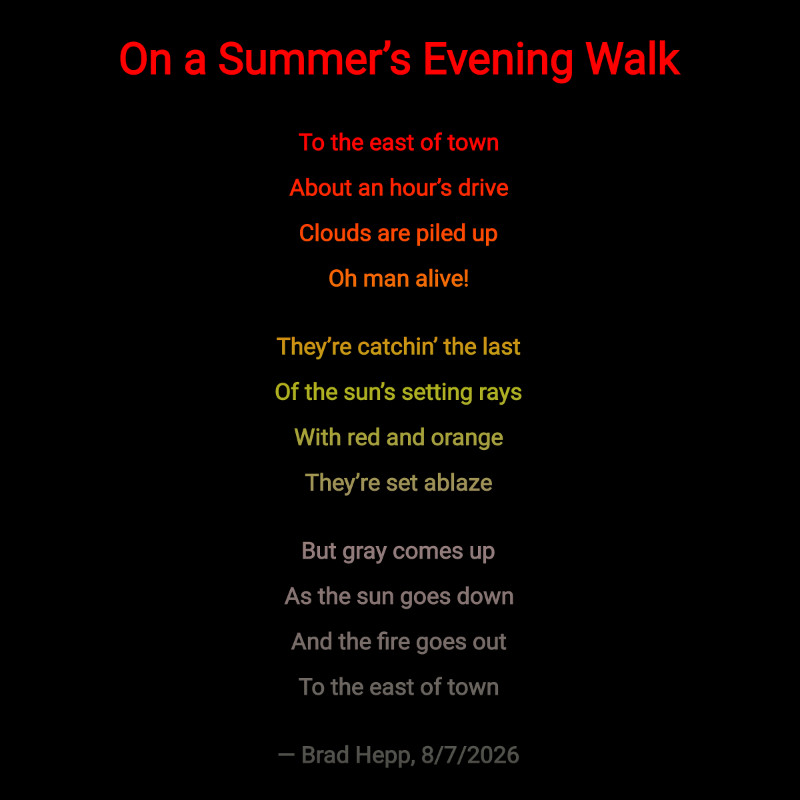
For some reason, I remember the missionary lady rebuking eight year old Bradley for exclaiming, “Man alive!“ Something about blasphemy and the Resurrection. But my own parents—who looked forward to the Resurrection more than most—never objected. This poem captures the sequence I observed on my evening walk. Gray goes to black…and then a new day!
The play of verbs and prepositions in the third stanza was reminding me of something. Turns out it’s Frost in “Nothing Gold Can Stay.”
(if you are viewing this via email, the website has a recording of this poem and commentary; click the title above)
Commentary
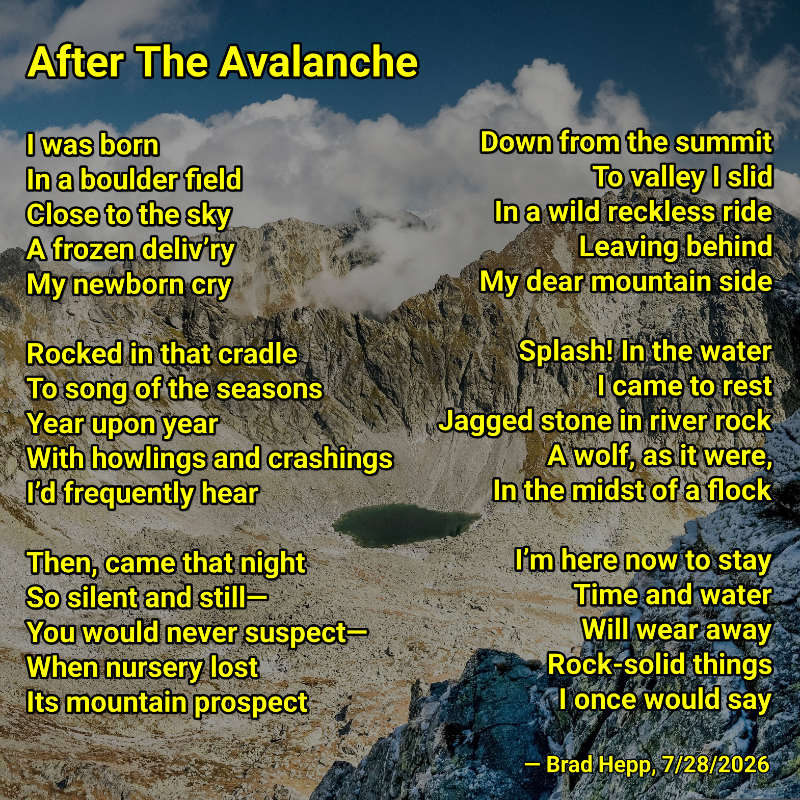
I APOLOGIZE This poem took on a silly, maudlin tone as I forced the rhyme pattern. That’s unfortunate. The inspiration was serious contemplation of how slowly I conform to new ways of thinking. The picture I meant to develop was of sharp granite being smoothed by running water after leaving its “birthplace.”
Here’s a case in point…. The more I write poetry, the more I realize I have tended to interpret Scripture with wooden-headed literalism. I wish to be more thoroughly poetic in my reading, as in my writing. But—and here’s my main point—I recognize that the necessary mental transformation is inevitably slow. So, I must be patient with myself.
(if you are viewing this via email, the website has a recording of this poem and commentary; click the title above)
Commentary
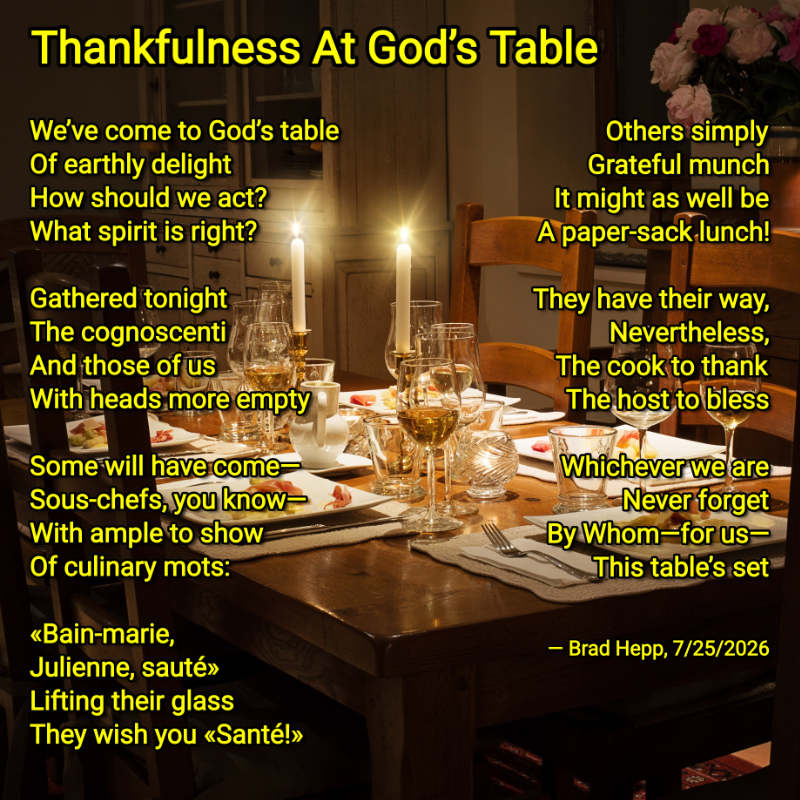
Two things prompted this poem: First, I’ve been contemplating God’s pleasure in us regardless of our current abilities. Second (not well reflected in the poem), I’m sad about someone who has lost much of his curiosity, his hunger for knowledge, his taste for life.
I had to look up some of these words:
“bain-marie”—a hot water bath used to gently cook delicate foods
“Cognoscenti”—people who possess expert knowledge, refined taste, or a deep understanding of a particular subject
I’m reminded of a TERRIFIC movie: “Babette’s Feast.” Do yourself a favor, and watch that movie!
(if you are viewing this via email, the website has a recording of this poem and commentary; click the title above)
Commentary
My quick response to this morning’s reading. It may be simplistic, but I could not help but think of our current moment in history while reading about the beginning of King Saul’s reign. Politicians who play priests and priests who play politicians… is one worse than the other?
(if you are viewing this via email, the website has a recording of this poem and commentary; click the title above)
Commentary
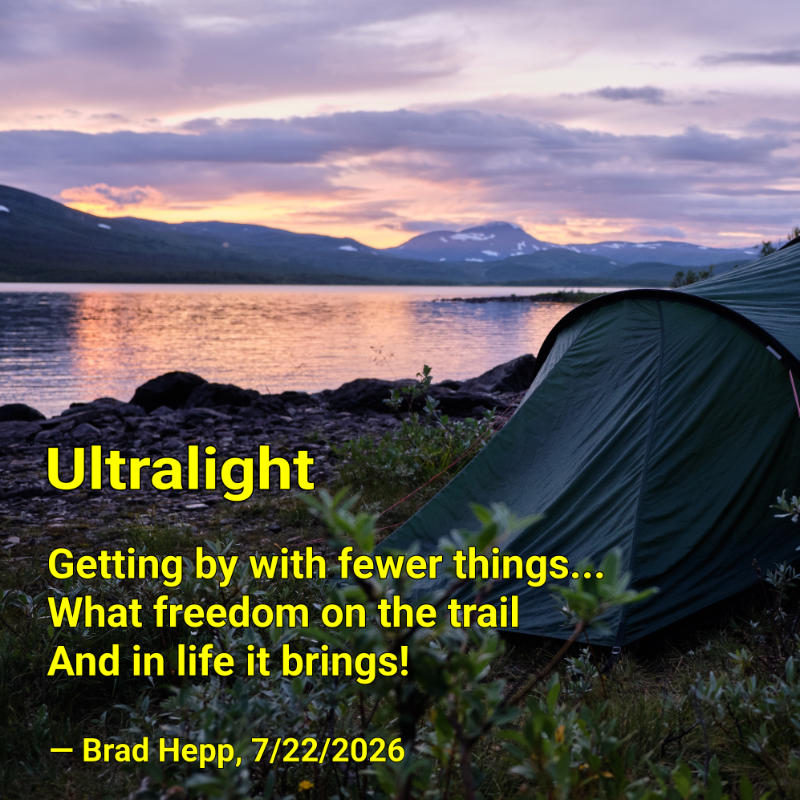
I’ll chalk this thought up to settling back into our house after the fire and 10-month restoration. Having lots of “stuff” can be convenient, but most of the time it’s a burden.
If more of our possessions had been destroyed, I doubt I’d have missed them. On the other hand, it’s convenient that insurance would have paid for necessary replacements. A thankful spirit is the appropriate response.
(if you are viewing this via email, the website has a recording of this poem and commentary; click the title above)
Commentary
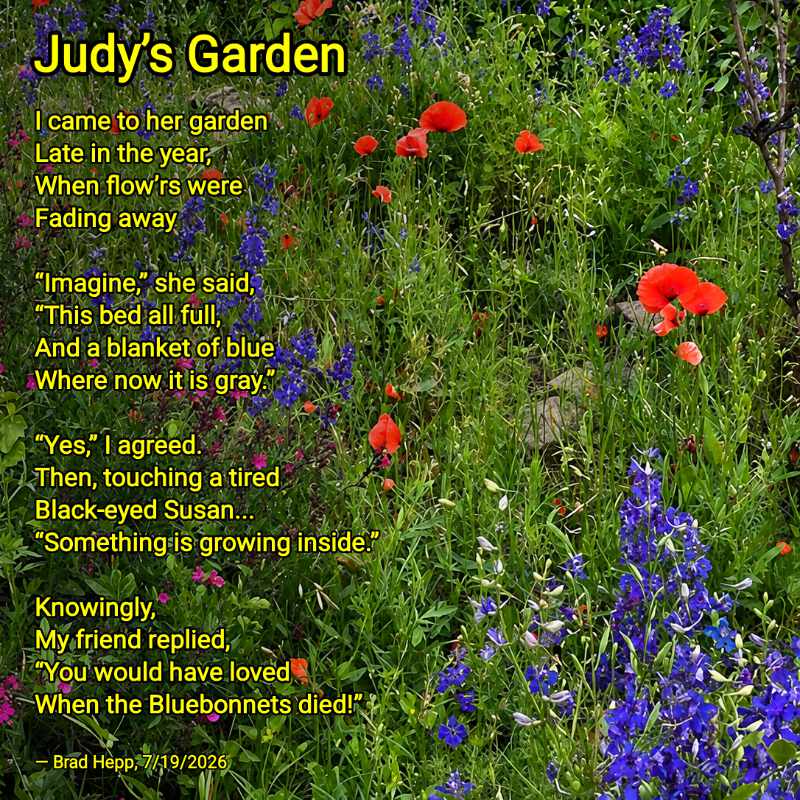
“You would have loved when the Bluebonnets died!” Those words amused my muse. Now let me bring you inside….
Judy’s back yard flower beds are a free-flowing, colorful mirror of life in her beloved church family. I was privileged to tour the back yard with her when our Bible study shared a meal at her house. We talked about what the flowers looked like in their prime. (Others had told me how spectacular the flowers were earlier in the year). At one point, I told Judy how fascinated I am by seeds: how plants prepare, protect, and disperse them. That’s when Judy told me how closely she observed this process in her patch of Bluebonnets last year. Her account began with, “You would have loved when the Bluebonnets died!” She’s right! I have never observed their life cycle closely. Maybe next year….
(if you are viewing this via email, the website has a recording of this poem and commentary; click the title above)
Commentary
Are correct beliefs important? Yes, but they’re not everything.
This poem may be a little ahead of its time. It describes the direction history is headed. Sadly, some Christians are going the opposite direction. Their calendars are stuck in BC.
“By which you rule” expresses a theory I have about such people: they (claim to) adhere to rules not out of love for the Rulemaker, but because they think their adherence gives them the right to rule over others. Their unspoken motto: “I hold the high moral ground, so I get to call the shots.”
For further consideration…. The poem was inspired by I Corinthians 13, one of my readings this morning. There may be a little Hebrews 1:10-12 in there as well.
(if you are viewing this via email, the website has a recording of this poem and commentary; click the title above)
Commentary
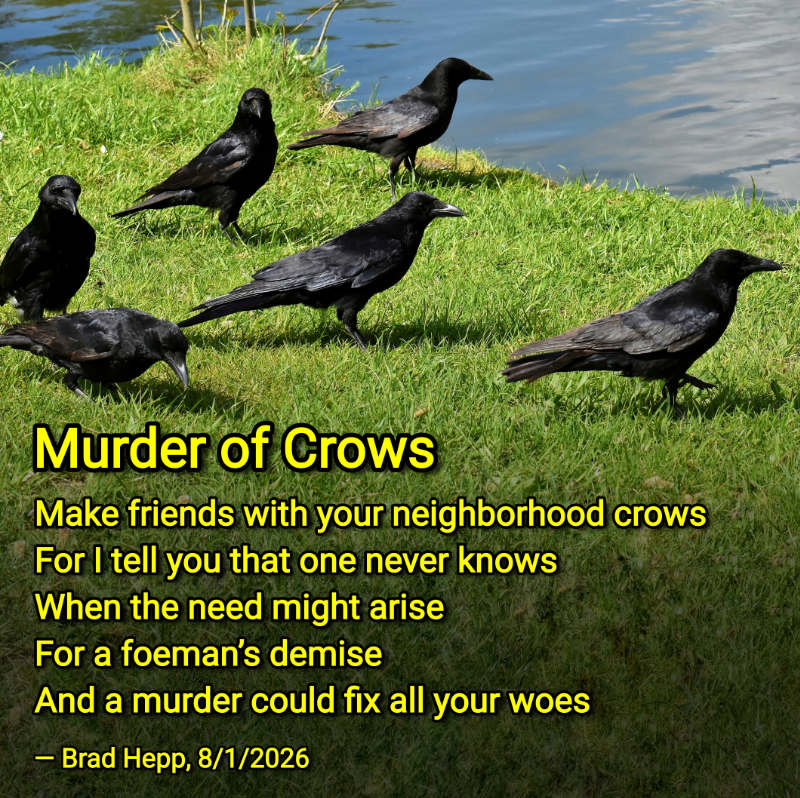
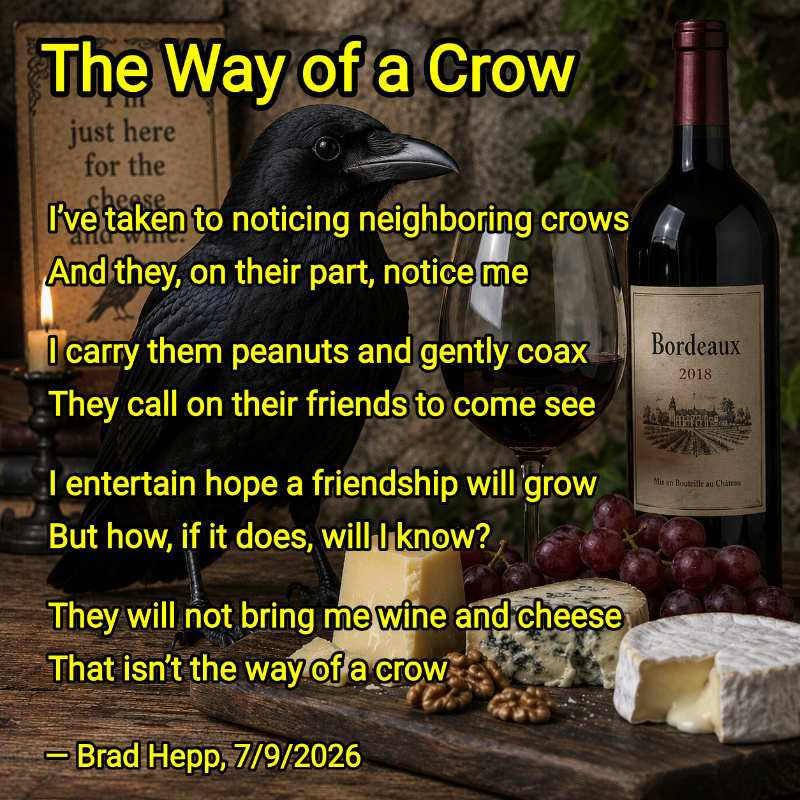
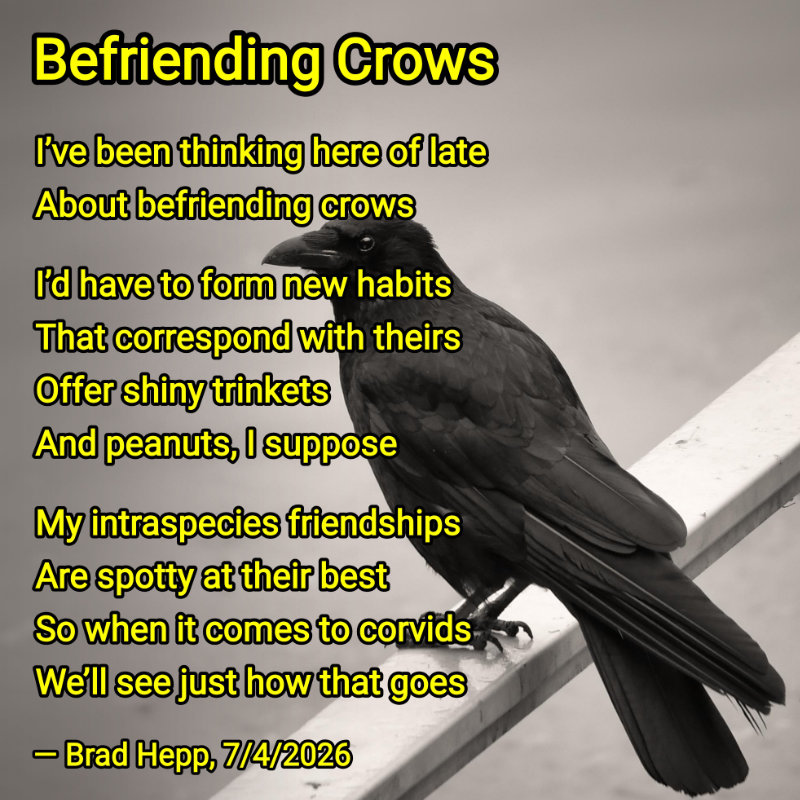
You’ve got to laugh at yourself… before others do. This passing(?) fancy I have of befriending crows has me watching myself as much as I watch them. Am I being silly? Why do I, a human with important things to do, take time for this? Am I desperate for attention—from crows if nothing else? Or are there deeper, inherently human drives?
(if you are viewing this via email, the website has a recording of this poem and commentary; click the title above)
Commentary
I was a little confused this morning by the ending of Ruth. Levirate marriage was intended to preserve a patrimony. In the case of Ruth, it was the patrimony of Elimelech, her father-in-law. The nearest kinsman-redeemer—Whatshisname—was too concerned with preserving his own patrimony to risk it by taking responsibility for Ruth. That opened the way for Boaz, who was willing to venture (risk) his patrimony by marrying her.
Here’s the confusing thing. The genealogy at the end of the book mentions Boaz, but not Elimelech. The preservation of Elimelech’s patrimony seems to have been subsumed in Boaz’ patrimony. Then it occurred to me: maybe that’s the point!
Venture on Him; venture wholly Let no other trust intrude
(if you are viewing this via email, the website has a recording of this poem and commentary; click the title above)
Commentary
I’m not investing a great deal in this novelty. The most I can honestly hope for is that I’ll observe the world more carefully.
(background image from ChatGPT based on the prompt “Create a square-format picture of a crow standing beside wine and cheese,” followed by the correction, “Change the quote in the background; this is a crow, not a raven.”)
(if you are viewing this via email, the website has a recording of this poem and commentary; click the title above)
Commentary
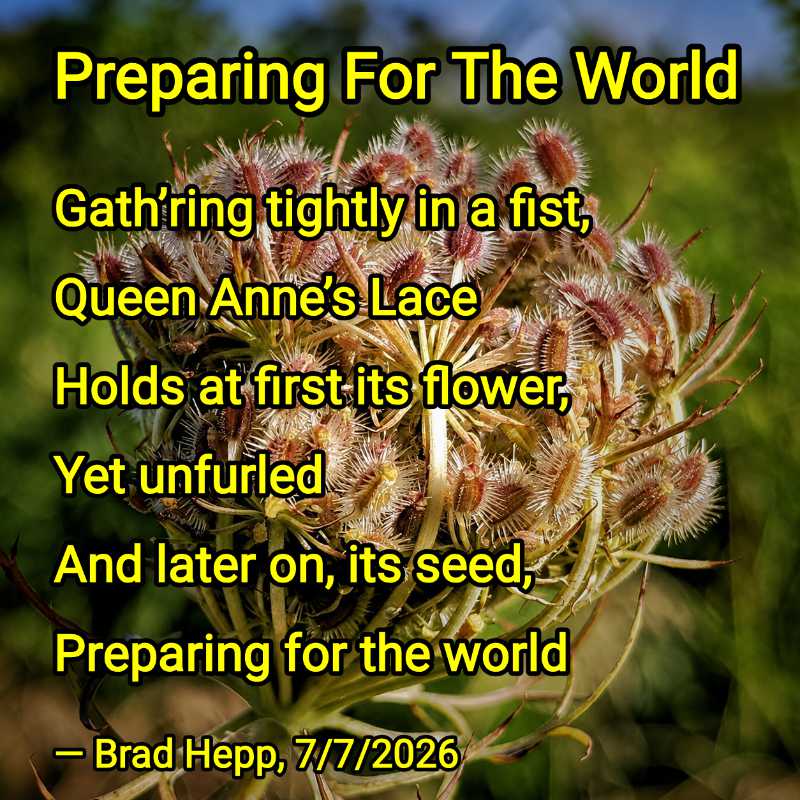
I made the mistake once of sowing Queen Anne’s Lace seed in our flower bed. I wanted a convenient way of documenting the flower’s fascinating life cycle. I’ve been pulling up Queen Anne’s Lace ever since. When I miss one, it’s clingy little seeds attach to my clothing and find their way into our house.
(if you are viewing this via email, the website has a recording of this poem and commentary; click the title above)
Commentary
This morning’s readings bring me to Ruth, chapter two, where Boaz says to Ruth, “May the Lord repay you for what you have done. May you be richly rewarded by the Lord, the God of Israel, under whose wings you have come to take refuge.”
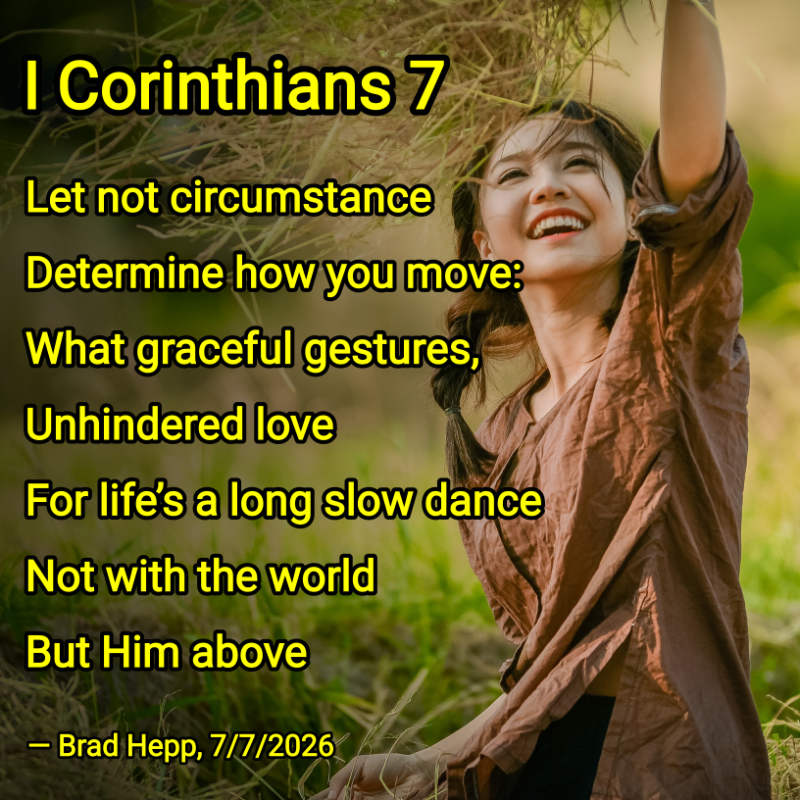
Then Paul spends a chapter (1 Corinthians 7) saying, “I want you to be free… to please the Lord.”
What’s common in both lessons is an understanding of God’s overarching care and purpose in our lives.
(if you are viewing this via email, the website has a recording of this poem and commentary; click the title above)
Commentary
This is autobiography in every sense. And I know what you’re thinking. ”Brad,” you might counsel me…. “If you have not been the best of friends to fellow men and women, why would you even consider befriending crows?”
That’s a good question. You’re very wise (and very kind to assume I really meant “INTRA-” not “INTER-”). Maybe YOU could be my friend, and we’d exchange our shiny bits of wisdom….
(if you are viewing this via email, the website has a recording of this poem and commentary; click the title above)
Commentary
The “Day’s Readings” gets me to Judges 13. I paused to jot down something worth pondering. I can imagine bitter responses. I can imagine quick, all-knowing responses. How do you respond? Is putting your finger on a thing—naming it—as important as pondering its qualities? “Why do you ask my name, seeing it is wonderful?”
One of my great Facebook friends is Laurie Pearce Mathers. She is a skilled writer and Bible student. Here is her response to the poem:
When God “names” himself, the name itself is mainly an expression of being. Then he augments (defines?) it with a description of his character traits. His name is not merely Yahweh, as if to know that word is to have the talisman in hand (likewise with the name Jesus). God’s “name” is shorthand for all that he is. And he is more marvelous than we know.
As for that woman, I’ve often wondered why she isn’t named. It’s certainly by design. Perhaps to align her with the God who chooses not to name himself. Perhaps in honor of her faithful humility.
She certainly stands in stark contrast to her husband in this story. (He was not willing to accept the word of his wife. He had to get it from the horse’s mouth, so to speak. Yet God was merciful to him still and granted his request.)
It’s striking how Manoah’s wife is always the one approached by God, never her husband, even in response to the man’s prayer. In this I think she foreshadows the future mother of the ultimate Savior.
Passages like these are a comfort to women, and no doubt were intended to be, in this world dominated by sinful men. Named publicly or not, we matter to God and play important parts in his plan.
(if you are viewing this via email, the website has a recording of this poem and commentary; click the title above)
Commentary
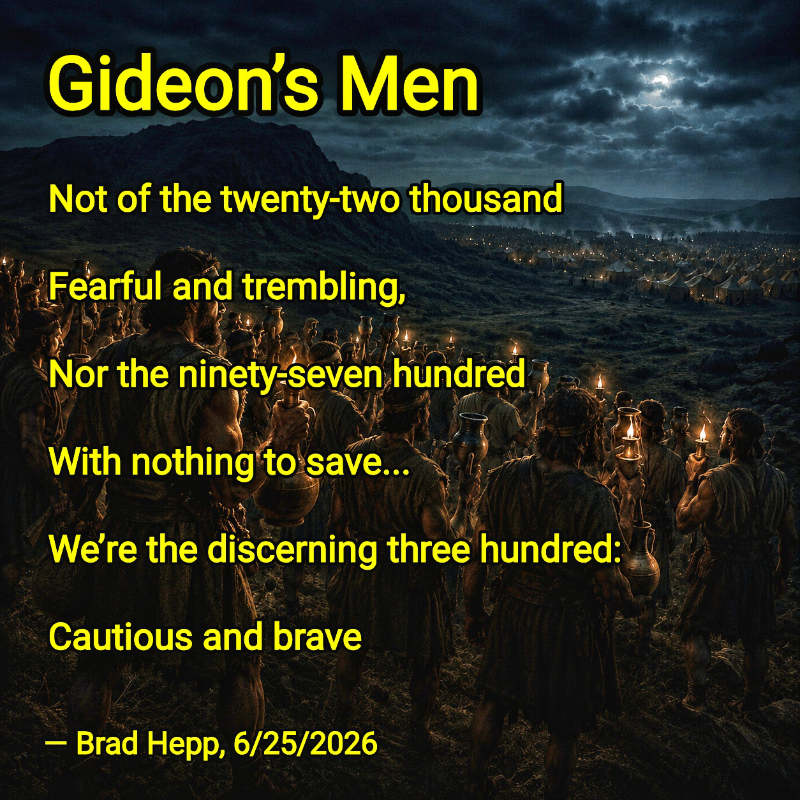
THE STORY In Judges 7, God makes it clear He doesn’t want anyone confusing their strength with His. So He has Gideon reduce his army of 32,000 to a mere 300 men. Now, are those 300 men going to win because of their strength? No. They’re going to win because they know how to shut up and follow orders. Their wisdom as soldiers begins with a healthy respect for God.
DISCERNING In writing the little poem about Gideon’s army reduction, I needed a single word to describe the select 300. For now, I’m happy with “discerning.” Their clear-eyed recognition of both the dangers and the utility of following uncommon orders made them cautious and brave. In following God’s way, they’d win the day.
A PERSONAL APPLICATION As a recovering perfectionist, I’m always torn. Getting things right is important. But success doesn’t ultimately depend on my perfect planning and execution. Rather, it sometimes relies on my willingness to “take chances.” More than the fear of failure, I must fear my independence, my smooth self-reliance, my silent perfectionism.
____________
(background image based on this prompt to ChatGPT: “Create a square-format, dark depiction of Gideon’s 300 soldiers from the Judges chapter seven story”)
(if you are viewing this via email, the website has a recording of this poem and commentary; click the title above)
Commentary
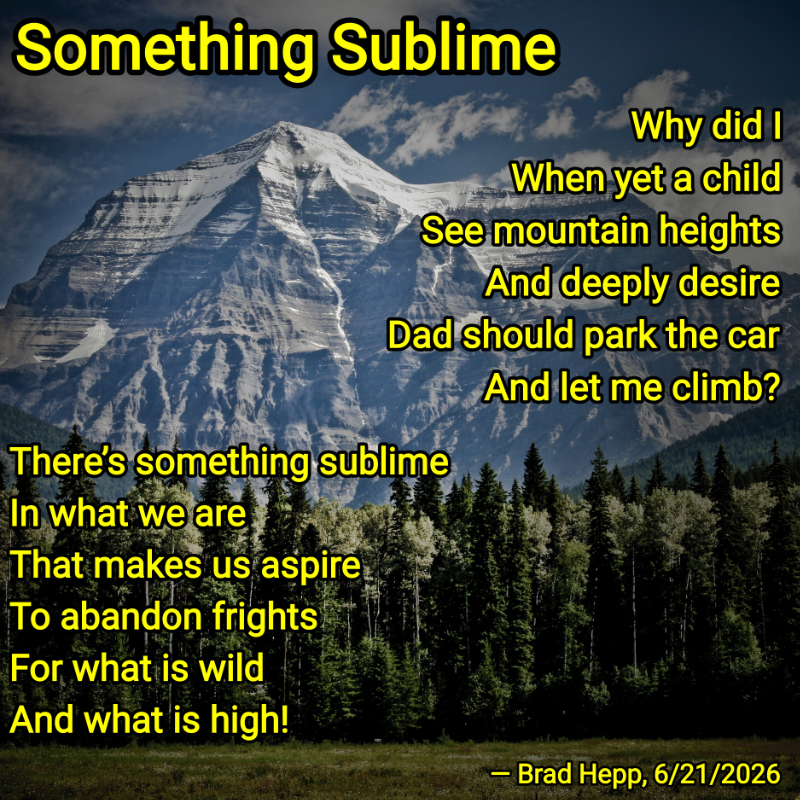
Seriously…. I never saw a mountain that I didn’t want to run up. My strength didn’t match my desire—I wouldn’t run far. But the wish was there, nonetheless. Why? I come at this question by asking first why we consider mountains beautiful. Why don’t we simply see them as big piles of rock? I suspect we recognize a destiny that’s bigger and better than what we now see. What do you think?
Did you notice the rhyme pattern? I don’t usually bother with that kind of challenge.
(if you are viewing this via email, the website has a recording of this poem and commentary; click the title above)
Commentary
These were the first thoughts out of my head this stormy June 19 morning. I’m thankful to have seen the “in Christ” way exemplified by a few remarkable people* (though rarely in the mirror).
(if you are viewing this via email, the website has a recording of this poem and commentary; click the title above)
Commentary
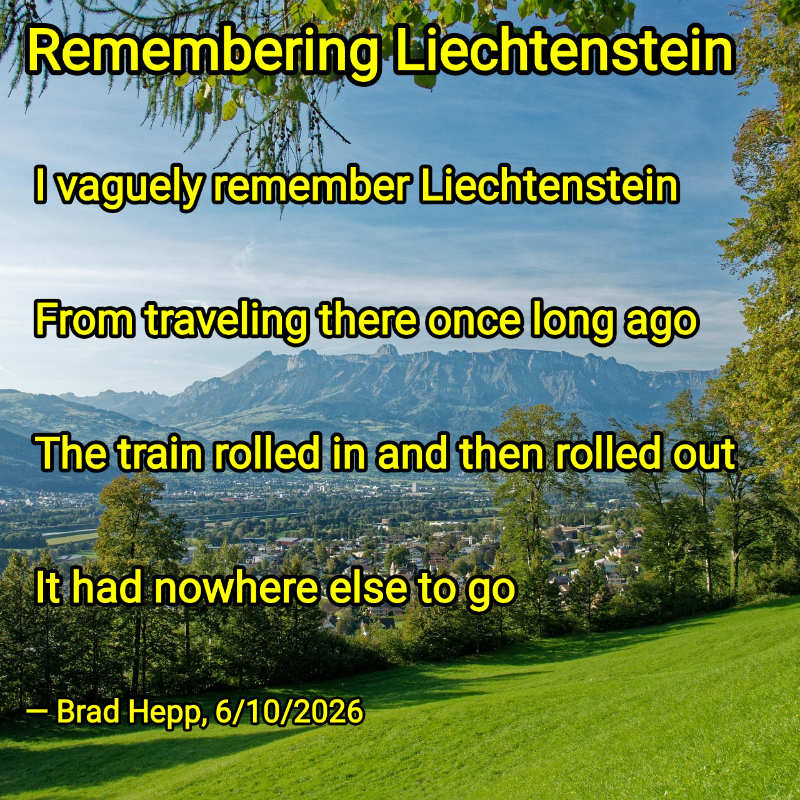
There was a time when I had a fairly detailed memory of places I have been… even mountain trails. Where was I? Oh yeah. There was a time when I had a fairly detailed memory of places I have been… Like Liechtenstein. My boss asked me how many countries I have been to. I had to think hard when it got to the small ones. Was it Luxembourg or Liechtenstein? I do remember sitting on the train waiting for it to back out.
(if you are viewing this via email, the website has a recording of this poem and commentary; click the title above)
Commentary
This early morning prayer/poem served as a “Thank You!” to the couple who treated us to lunch yesterday at their favorite Thai restaurant. But it also recognizes and acknowledges the MANY remarkable people God is allowing Susan and me to interact with these days: people who are generous, cheerful, intelligent, and—over it all—HOSPITABLE. I told my coworker (himself a hospitable man) that it’s a privilege to spend time with my superiors.
(if you are viewing this via email, the website has a recording of this poem and commentary; click the title above)
Commentary
I donated blood on Friday, flippantly agreeing to give “double reds.” Looking back in my records, it was at least 15 years since I last did that kind of donation…AND IT SHOWS! This reminds me of when I climbed the Blanca Massif (Southern Colorado) a second time 17 years after I first climbed it. What was I thinking? If maturing had kept pace with aging, I’d be wiser than that by now!
(if you are viewing this via email, the website has a recording of this poem and commentary; click the title above)
Commentary
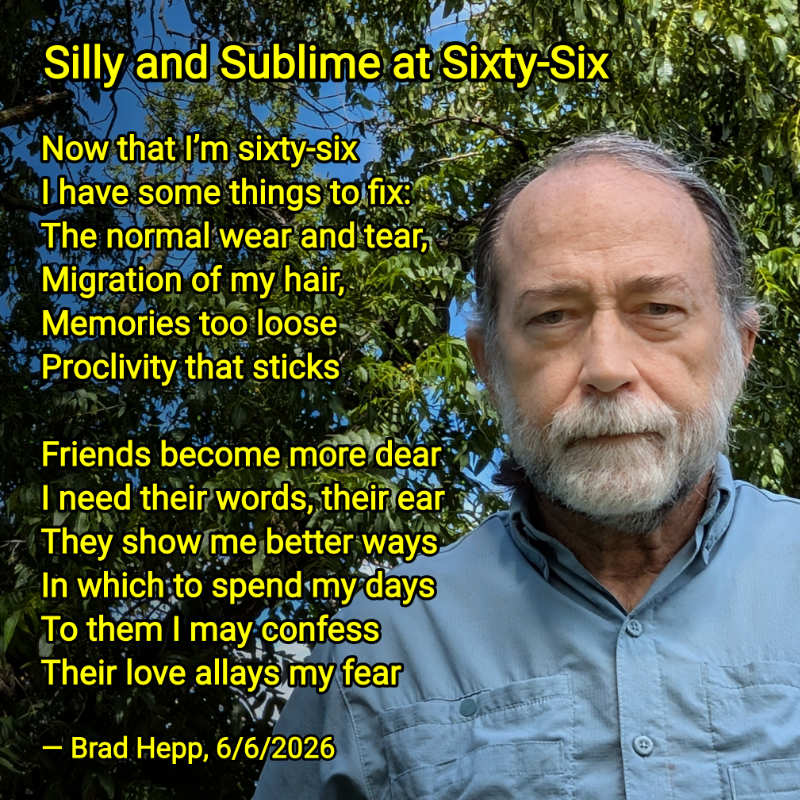
One of my favorite poems ever was a short one titled “Blurt Out Love.” That’s exactly what I’ve done in tossing down this birthday poem. I’ve experienced losses and gains over the last year. Enhancing old friendships and developing new ones has been the best gain. I am learning to invite friends into my experience, as they invite me into theirs.
(if you are viewing this via email, the website has a recording of this poem and commentary; click the title above)
Commentary
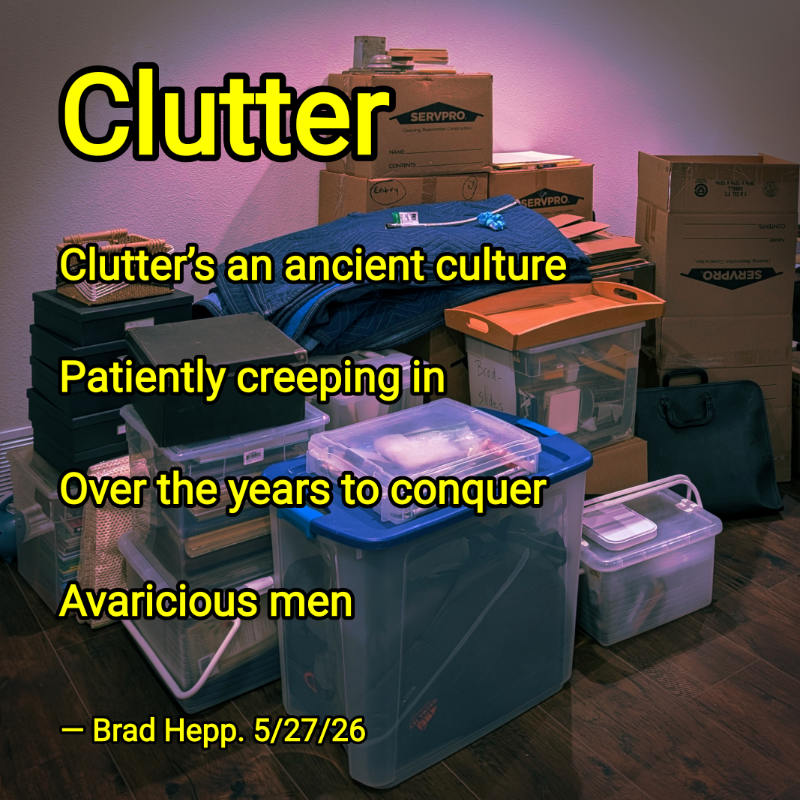
This poem goes in my “After Fire” series. It was suggested by the frustration of unboxing all our “stuff” in an erstwhile clean and tidy restored house.
My father warned me against “using big words when little words will do.” So I apologize for “avaricious.”* “Acquisitive” is arguably milder, though still a “big” word. I’d have chosen that adjective if it fit the poem.
Let’s be honest, it doesn’t matter how much money we make…. Most of us in our U.S. culture DO struggle with avarice.
The notion that ancient cultures have patience to conquer was suggested to me by recent news of America’s conflicts with Persia and China.
________
*Dictionary.com defines avaricious as “an adjective meaning having or showing an extreme, insatiable desire for wealth or material gain. It describes someone who is aggressively greedy, grasping, and often miserly—prioritizing the hoarding of money or possessions above all else.”
(if you are viewing this via email, the website has a recording of this poem and commentary; click the title above)
Commentary
I didn’t have forethought to provide for breakfast at home (moving back in a newly restored house is complicated enough!), so I had to grab breakfast at the drive-thru today. Have you ever watched the birds at a gas station or drive-thru and thought, “There’s something remarkable or sad about what I’m witnessing”?
(if you are viewing this via email, the website has a recording of this poem and commentary; click the title above)
Do You Find This Offensive?
Please read my partial defense below*
Commentary
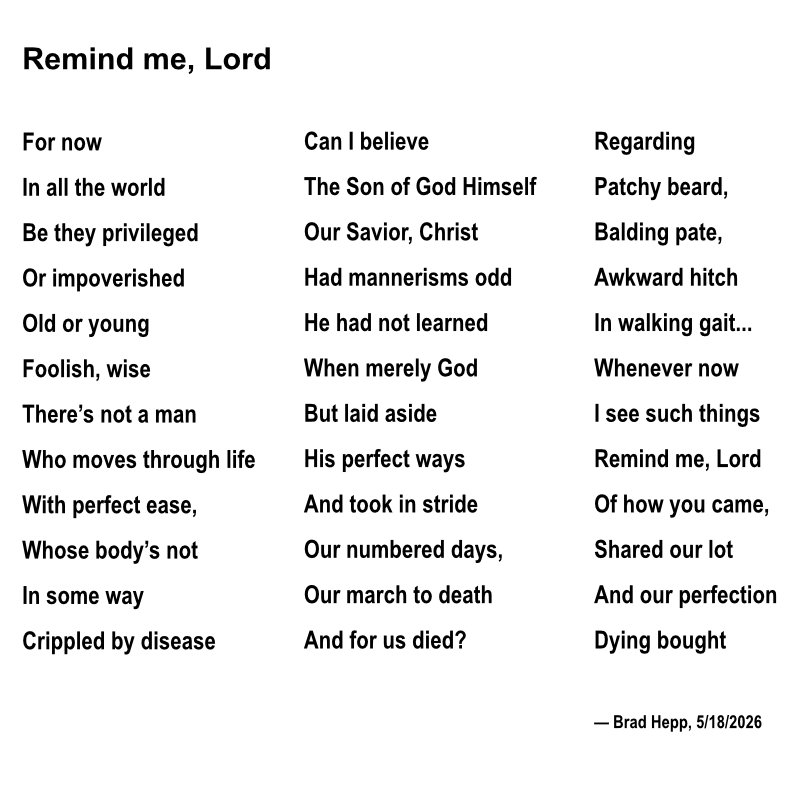
On a couple of occasions recently, I have seen short videos of myself walking—in checking the footage of security cameras I was setting up or reviewing church services I participated in. Seeing myself thus elicits embarrassment: “I look so ridiculous!” That response isn’t unusual. People often cringe to hear recordings of their own voice. As a photographer, I’ve had to put up with people rejecting perfectly representative photographs of themselves (“representative” isn’t always flattering!).
As I thought about this, it dawned on me that one could find ridiculous traits in just about anyone. We’re all just a little bit clownish.
From there my thinking went to that most profound event in the history of man: Jesus’ emptying himself, “by taking the form of a servant, being born in the likeness of man” (Philippians 2:7).
This poem is a prayer that Jesus will remind me of the glory He stooped to share with us despite our ridiculous state. ____________
*Although I wrote this poem very quickly, I hesitated to publish. It contains some words and concepts that are calculated to startle, to provoke thinking–in myself first and then in my readers. I asked seven of my very smart, theologically astute friends to comment, especially on the second stanza. Here’s what I wrote to one of them:
Ben,
I’m very interested in whether or not you see theological problems in the second stanza of this poem. Another friend (DTS prof) responded to me that “There are some implications that could be drawn from the second stanza that would compromise a classical understanding of Christology.” He didn’t elaborate.
If I understand Isaiah correctly, Jesus was not a classically beautiful human specimen. Per Hebrews, He learned obedience. You can probably think of other evidence of His thorough-going Incarnation. Can we go so far as to speculate that He might even have had some quirks like the rest of us?
I write poetry to plumb the depths of my confusion about man, including the Son of Man. I must confess being double-minded about the relationship of imperfection and sin. There’s a judgmental little jackass in my brain that always wants to attribute physical imperfection to moral imperfection. (It gets worse: I then take that inferred moral imperfection and use it as a basis for assigning relative authority. But enough about this dumb sinner….).
Thoughts?
None of the seven friends condemned me as a heretic. Most of them found the poem sufficiently thought-provoking to excuse some of its questionable wording.
One of the friends–a theologian and prolific poet–said that he’d grant me poetic license for “mannerisms odd.” But “merely God“? For him, that was a bridge too far. (His objection reminded me of my father, who protested when the word “awesome” was used to describe anything other than God.) My faltering defense: before the Incarnation, Jesus was “merely” God as opposed to God-Man.
Here’s my ultimate out: late in the writing process, I turned the whole second stanza into a question, not a statement: “Can I believe…?” In other words, is it appropriate to believe what follows? I hope you struggle a little with that, and that the struggle tips your heart toward loving God and loving your neighbor. That’s certainly what I hope for myself.
(if you are viewing this via email, the website has a recording of this poem and commentary; click the title above)
Commentary
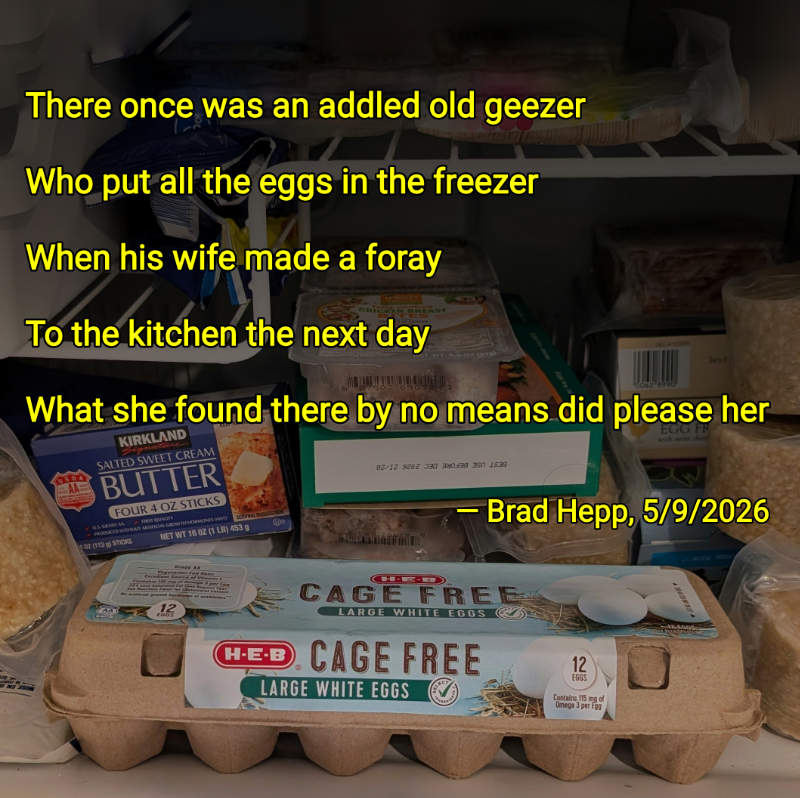
This is not autobiography. Prophecy? Perhaps. Just give me a few more laps.
Hey, I read about a big scientific study that suggests eating eggs five days a week correlates with reduced chances of developing Alzheimer’s. (And now the algorithm will feed me all kinds of nonsense about dementia: “Does your back side itch? That may be a sign of dementia!”)
(if you are viewing this via email, the website has a recording of this poem and commentary; click the title above)
Commentary
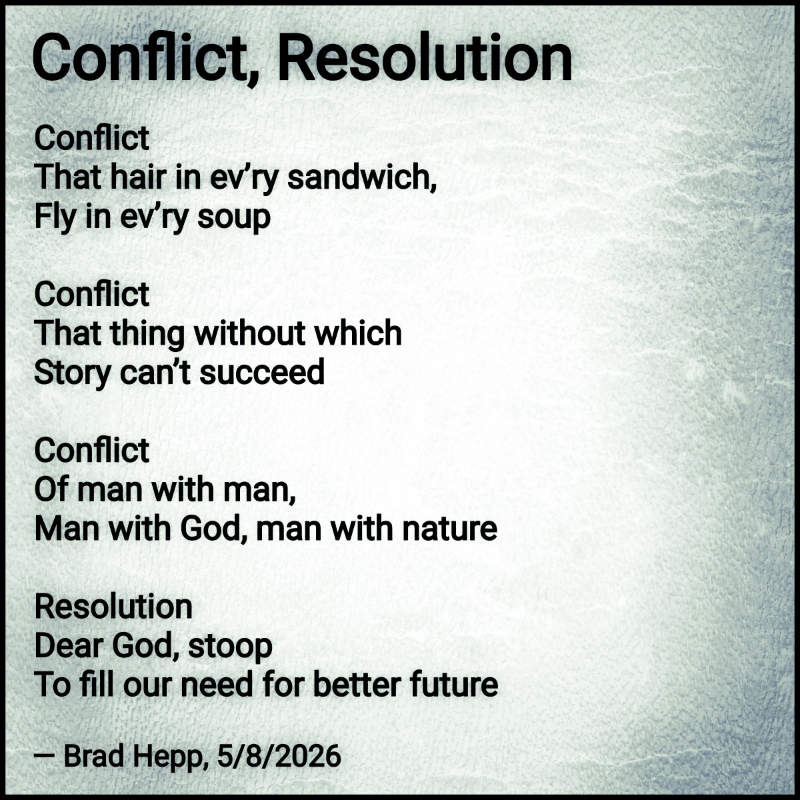
This morning, as I drove to work, I was reminded once again of a theme my mind keeps revisiting: pervasive conflict. I thought of literature classes in high school and college. There, I was taught to identify the conflicts in stories. What didn’t occur to me back then was that conflict is everywhere, at all times. At least for now.
Look, Ma… I Rhymed! Did you notice how the last lines of the first three stanzas have rhyming words in the fourth stanza? Wow! Well done, Bradley.
(if you are viewing this via email, the website has a recording of this poem and commentary; click the title above)
Commentary
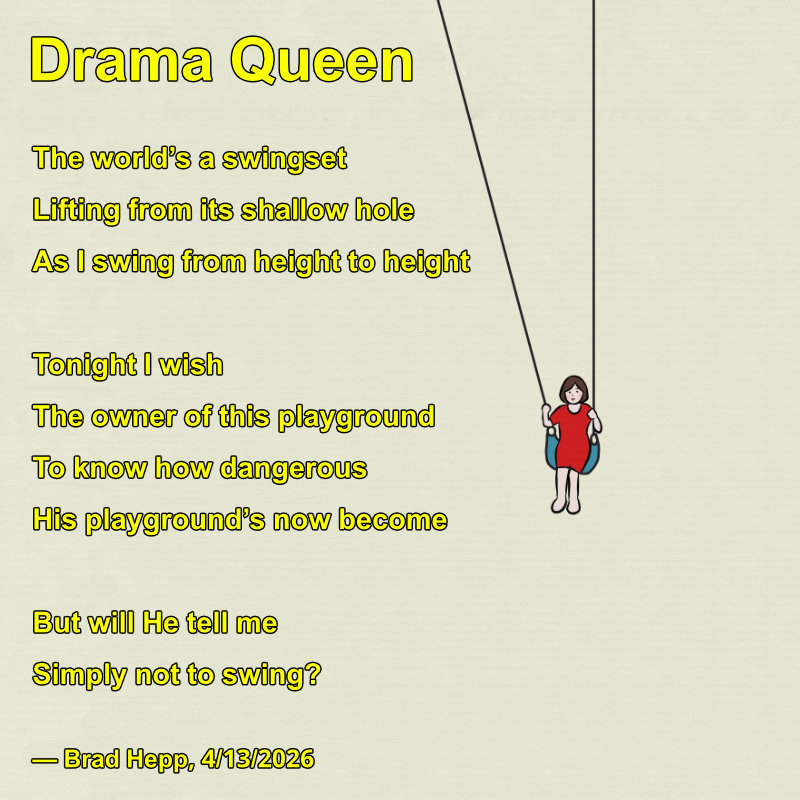
I really have no idea how to explain this poem. But I felt it must be written. Merciful God knows we are but dust.
The Title I’m probably more expressive than your average 65-year-old male. But I doubt anybody would call me a “Drama Queen.” Nevertheless, I sense (more than think) “big emotions” just under the surface as I deal with a mad world and my own stressors. (background image by 鹈鹂 夏 from Pixabay)
(if you are viewing this via email, the website has a recording of this poem and commentary; click the title above)
Commentary
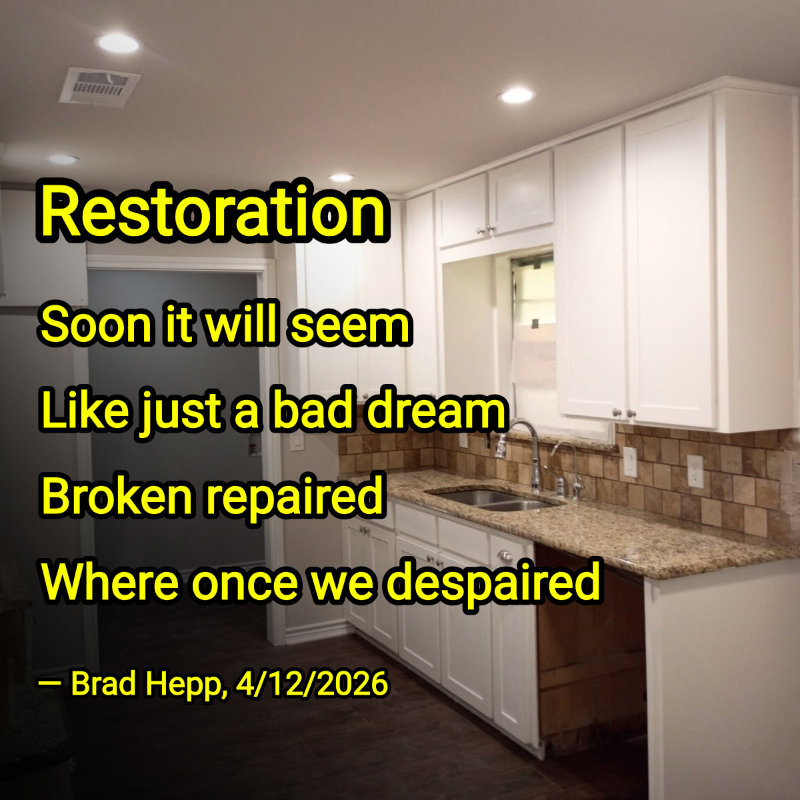
I told my siblings about progress in the restoration of our house after the fire last July. My oldest brother, always the philosopher, wrote, “Soon it will seem like just a bad dream.” I’m sure he’s right.
Last week, the electrician sent me a couple of photographs after he did a test connection to the all-new light fixtures on the all new electrical system in the all new ceiling. It was the first time I saw the house thus lit in nine months.
Did I ever really despair? No. I suppressed that response. But does that really count?
(if you are viewing this via email, the website has a recording of this poem and commentary; click the title above)
Commentary
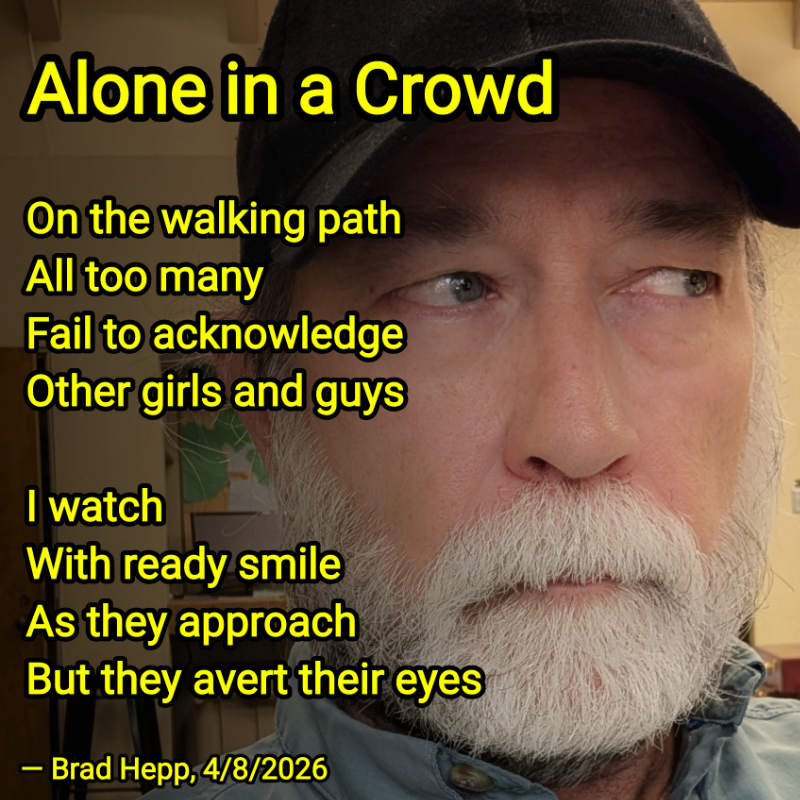
The apartments where we’re living until our house is restored (SOON!) has a great walking path around two ponds. It’s mainly young people there. The few older walkers make eye contact. The younger ones do not. Why?
(if you are viewing this via email, the website has a recording of this poem and commentary; click the title above)
Commentary
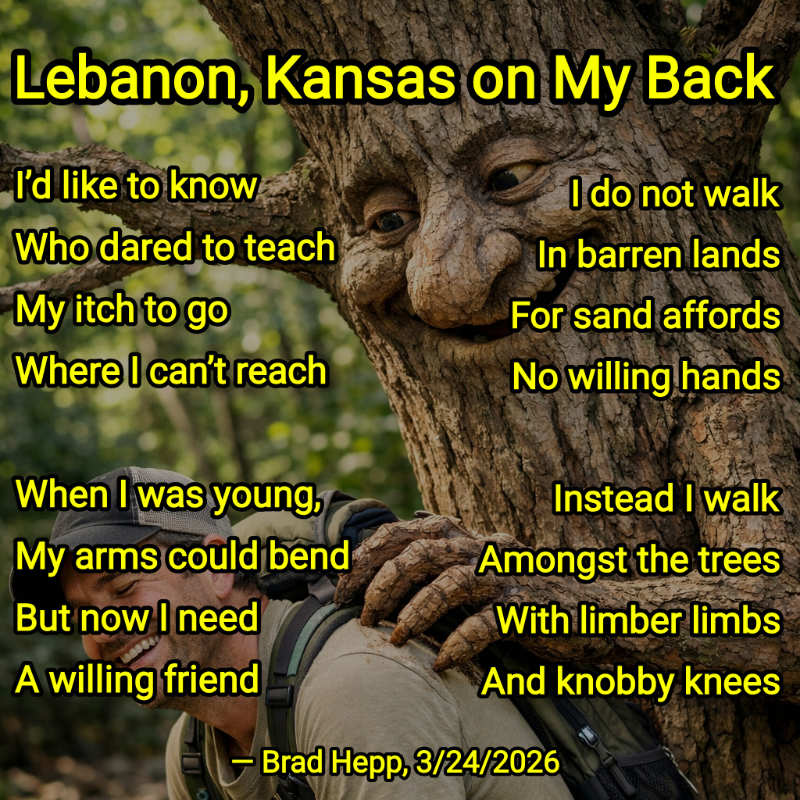
SOMEONE REQUESTED DOGGEREL?
The last few times I went for a walk, I got an itch right in the middle of my back. As you can imagine, I was looking around for a sign post or someone’s tree to “give me a hand” in scratching that inaccessible itch.
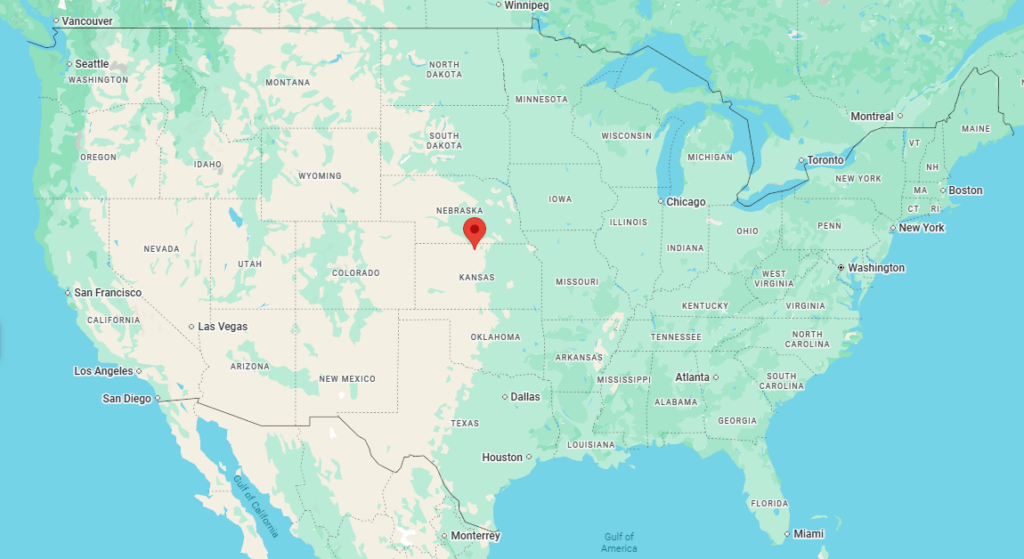
Lebanon, Kansas: geographical center of the 48 contiguous US states. If our country had an itch in Lebanon, Kansas it would have trouble reaching there to scratch.
(Image supplied by ChatGPT based on my prompt, “Make a picture of a tree scratching a hiker’s back to relieve an itch.”)