Doing Justice

(if you are viewing this via email, the website has a recording of this poem and commentary; click the title above)
Commentary

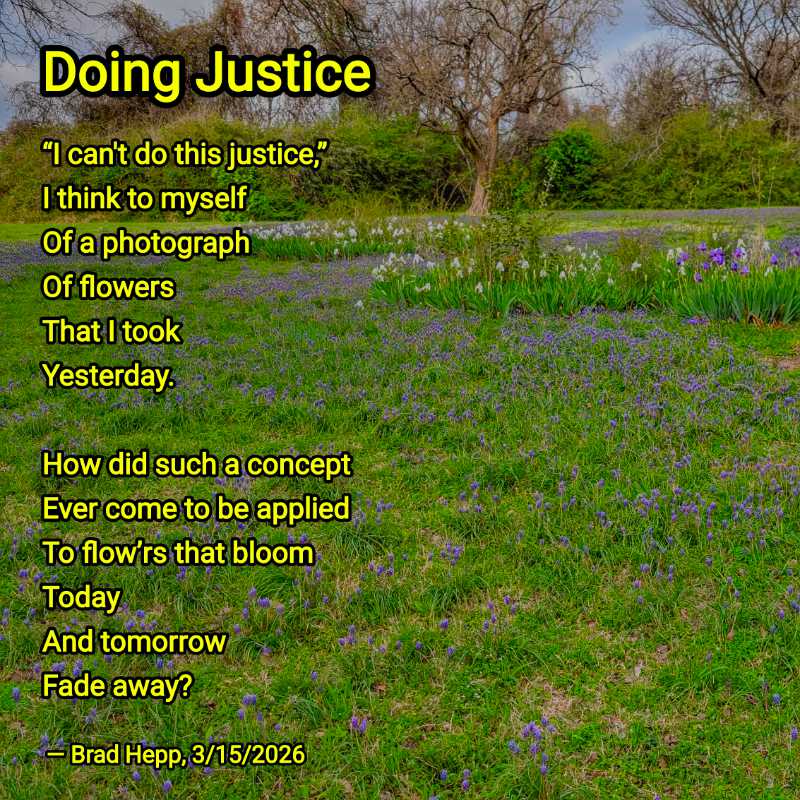
Yesterday, I walked up at White Rock Lake with my dear new friend Rich Milne. When we encountered a spectacular patch of Grape Hyacinths, Rich did what any good photographer does: he got down on the ground and shot the flowers on their own terms. His photo is surely better than mine, as I didn’t lower myself to record their glory. What can we learn from this about JUSTICE? Seriously… What?

In typical fashion, Rich responded with a quick poem of his own (I’d encourage you to read his poem out loud yourself, as I may not be doing it justice):

Poem for Brad 16 March 2026

If we would do justice
And we would love kindness
Then we would walk humbly with our God.

We too must lay down, looking up
To see even the underside of His glory.
But then, we too are like the grass,
Which today blooms and tomorrow is thrown
into the furnace of affliction.

When we do justice,
We treat things as they deserve
Not as a reward for how they serve us.
Yet it is He who withholds His justice
from us,
To treat us with grace, within the flow
of His blood
Which must cover us, until we know,
even in the bud,
Before the flower of His grace appears,
That He too lay down His life
Upon the Cross
That in His loss
He could do us justice.
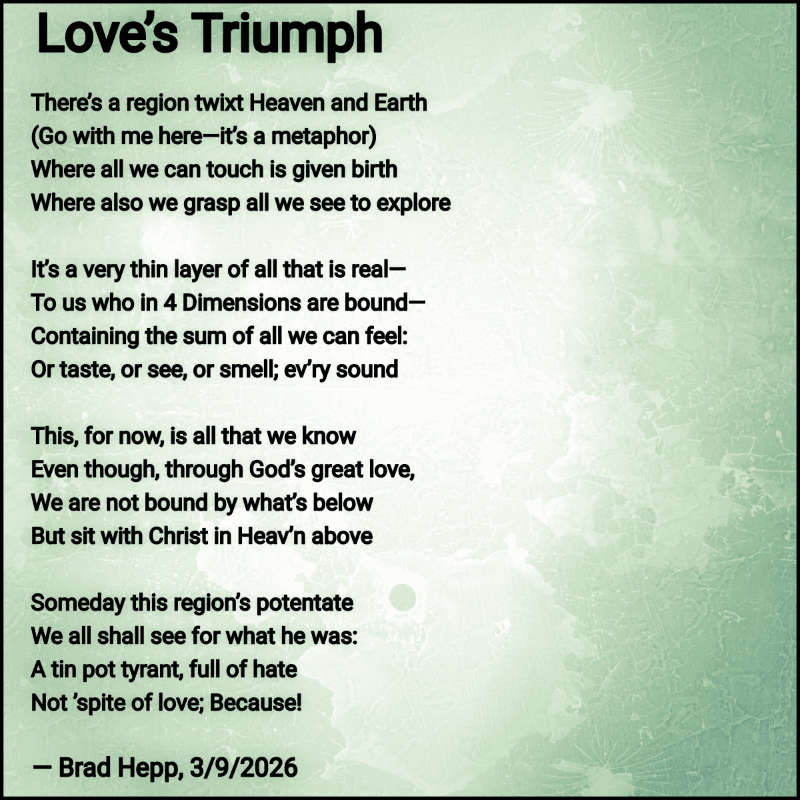
Love’s Triumph

(if you are viewing this via email, the website has a recording of this poem and commentary; click the title above)

Commentary

I’m trying to understand the Bible’s cosmology (esp. in Genesis, but also in the New Testament) as metaphor. Despite the fact that I’m a poet, that’s not easy for me. This poem is a pushing, a shoving, a determined attempt to see God’s loving.

Here’s the passage I was looking at when I wrote the poem:

[1] As for you, you were dead in your transgressions and sins, [2] in which you used to live when you followed the ways of this world and of the ruler of the kingdom of the air, the spirit who is now at work in those who are disobedient. [3] All of us also lived among them at one time, gratifying the cravings of our flesh and following its desires and thoughts. Like the rest, we were by nature deserving of wrath. [4] But because of his great love for us, God, who is rich in mercy, [5] made us alive with Christ even when we were dead in transgressions—it is by grace you have been saved. [6] And God raised us up with Christ and seated us with him in the heavenly realms in Christ Jesus, [7] in order that in the coming ages he might show the incomparable riches of his grace, expressed in his kindness to us in Christ Jesus.
Ephesians 2:1-7 NIV

Despite how it may sound, I don’t pretend to understand much of what I wrote in this poem. I’m playing by ear, attempting to work out God’s melody. When I was younger, I despised the pompous blather of “poets who, in fact, don’t mean a thing.” But I excuse it now as a “thinking out loud.” Pondering, not so proud.

ABOUT THE THIRD STANZA
I’m not real happy that I resorted to just mouthing what Scripture says as though I understand it. The already/not yet, de jure status of believers is every bit as mysterious to me as how to deal with a cosmology that is foreign.

ABOUT THE LAST LINE
I’m going to just admit…. I was pushing for a rhyme to “was.” But I do like the unintended puzzle that the last line presents, and it’s always possible that my subconscious was “on to” something.

As I Grow More Grey

(if you are viewing this via email, the website has a recording of this poem and commentary; click the title above)

Commentary

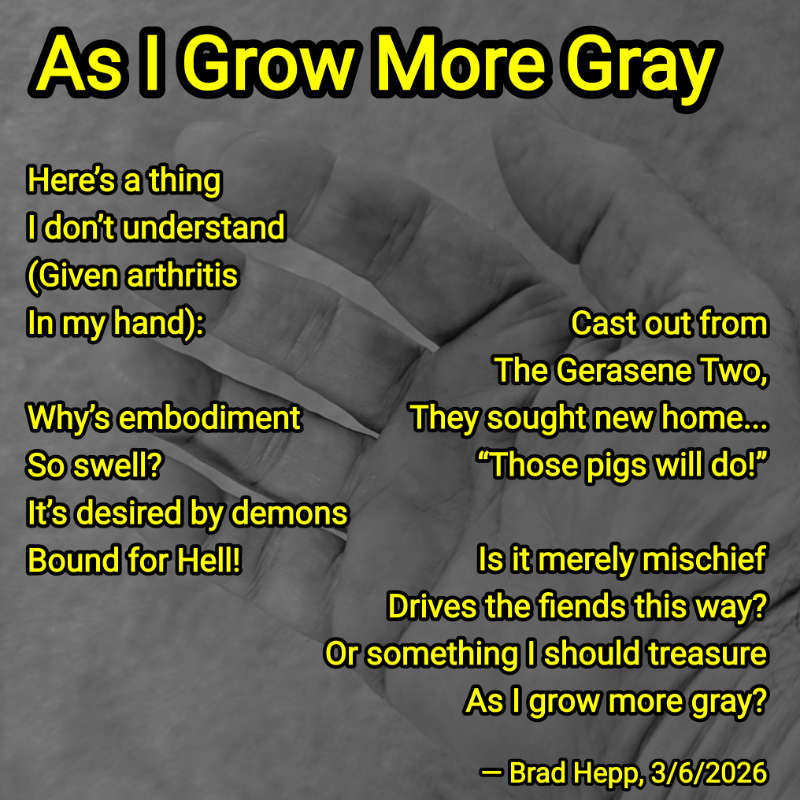
This is one of many questions I think of while listening to Michael Heiser’s “Supernatural.”*

Don’t worry too much about my hands. If I have arthritis, it hasn’t progressed very far. But there are plenty of other signs of aging!

______________
*Heiser is one of several Ancient Near East (ANE) experts I have been reading or listening to in order to better understand the Old Testament writers’ frame of reference. Some of Heiser’s ideas are “out there” but not without merit.

Elbow Room

(if you are viewing this via email, the website has a recording of this poem and commentary; click the title above)

Commentary

THIS MAY HURT YOUR FEELINGS

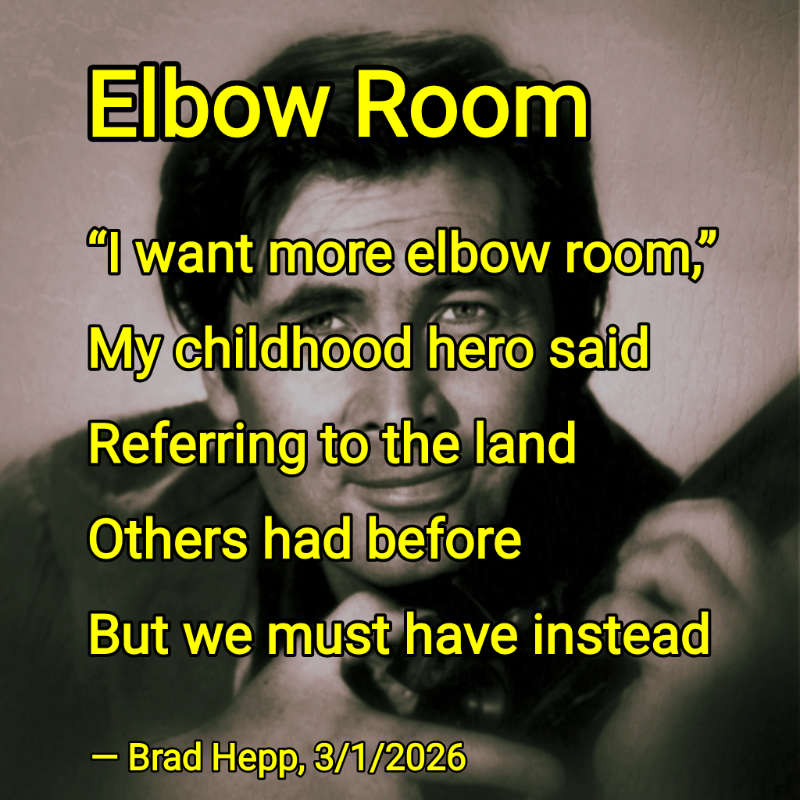
A few years ago, I started recognizing—and preaching to others—how profoundly we are influenced by culture. But it still surprises me to realize how blindly I accepted this or that propaganda as a child. The latest moment of clarity dawned on me as I was reading about the Indian Removal Act of 1830. Could this nation ever have been rich AND righteous?

In Adam’s Park

(if you are viewing this via email, the website has a recording of this poem and commentary; click the title above)

Commentary

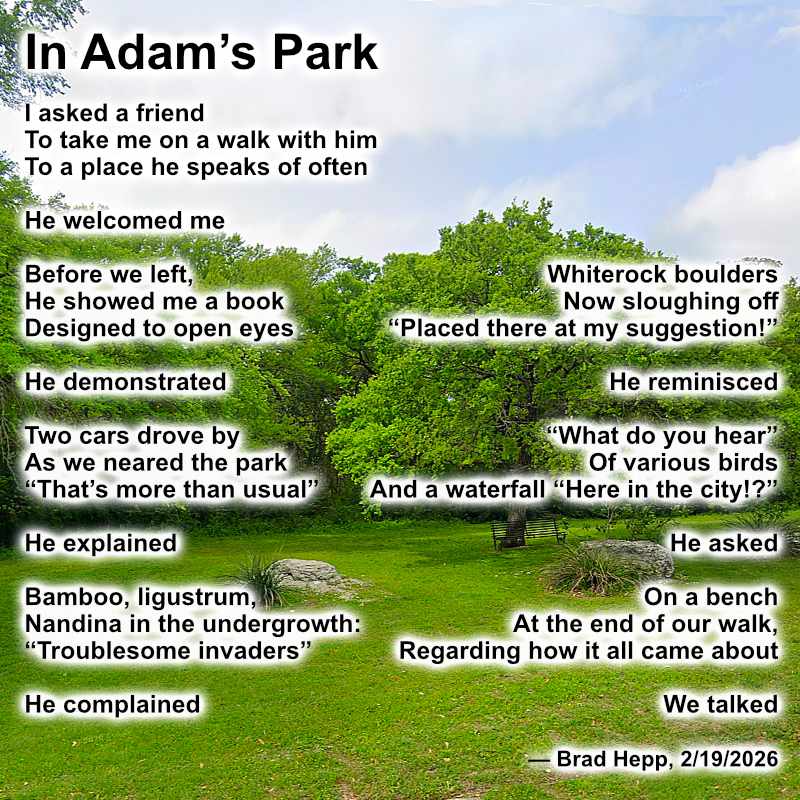
In Adam’s race
It’s an honored place
To see another’s world 

If you know someone who has a garden, or paints, or makes music, or decorates, or writes, ask them to show you their world. You’ll be glad you did.

March 11 Addition
When I sent this poem to my friend Rich Milne (“Adam” in the title), he wrote a quick response (Rich writes poetry as easily as most of us breathe). His response exemplifies friendship and hospitality. In my book, “hospitality” includes a bending of one’s mind to another’s thinking. And that is what Rich did by writing of the same occasion in a similar and complementary style. Here, with Rich’s permission, is his response:

Humble Frailty

(if you are viewing this via email, the website has a recording of this poem and commentary; click the title above)

Commentary

I was taught to leave off “I think that” in my writing. Supposedly, such qualifiers weaken one’s argument, and are—in any case—unnecessary. 

Okay… sure. Too much admission of incomplete knowledge is annoying. 

But consider this…. Thanks to the Dunning-Kruger effect, it’s likely that the people who are most confident and assertive in their proclamations are actually THE LEAST QUALIFIED to make those proclamations. So, for me at least, a teacher, preacher, writer or speaker of any sort who can SOMEHOW couch their assertions in an admission of incomplete knowledge or understanding is the person I’m most willing to listen to.

Orthotomeo

(if you are viewing this via email, the website has a recording of this poem and commentary; click the title above)

Commentary

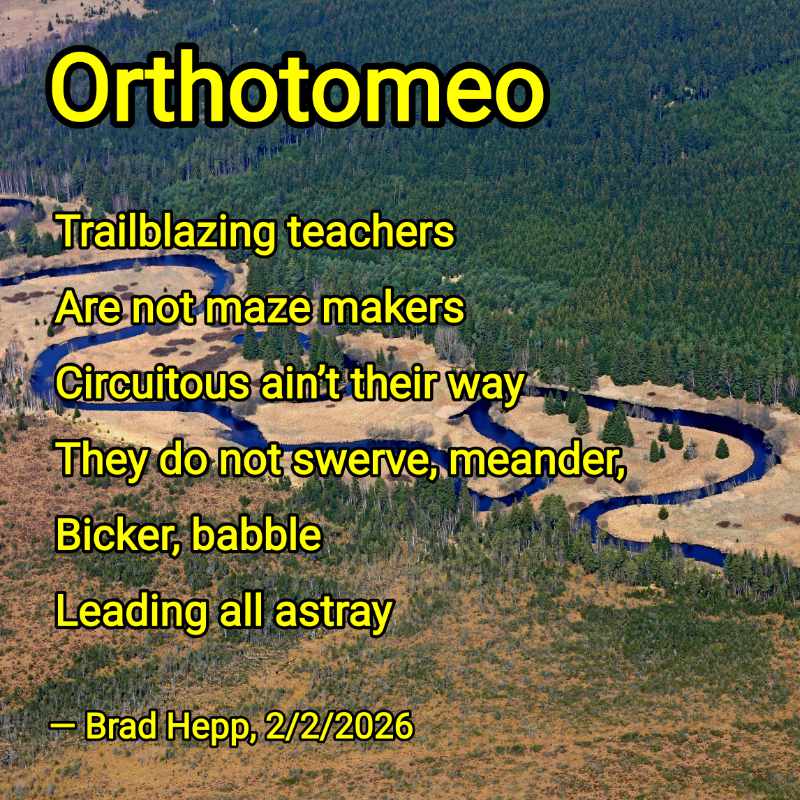
A friend was lamenting that he has met Christians who think the Sermon on the Mount does not apply to Gentile believers. Such people are sometimes emboldened by the KJV rendering of 2 Timothy 2:15, where orthotomeo is translated as “rightly dividing.” For them, that apparently suggests “chopping up” and effectively “cordoning off.” Modern translations are probably better with the idiom: “rightly handling” (ESV), “correctly handles” (NIV), “correctly teaching” (CSB).

What happens when you set aside Jesus’ teaching and example as if it doesn’t apply? We’re seeing so-called Christians in the U.S. throwing around the strangest term: “the sin of empathy.” How could anyone who claims to follow Jesus be so oxymoronic?

ABOUT THE POEM
I gave some thought to the three instances of orthotomeo in the Bible. Two are in the Septuagint (Proverbs 3:6 and 11:5), and the third is in 2 Timothy 2:15. Thinking about how the word is used in its context made me break out in poem.

AN ASIDE: “trailblazing” is a word whose etymology I had to study before using it here. I was surprised what “blaze” refers to in the word. It isn’t fire; it’s marking. If you have ever hiked on a path through the woods, you likely have seen “blazes” consisting of cuts in bark. They were left there by someone who wished to lead you in the most direct path possible, NOT in a meandering, circuitous path.

(background image by Imp5pa on Pixabay)

Kopi Luwak

(if you are viewing this via email, the website has a recording of this poem and commentary; click the title above)

Commentary

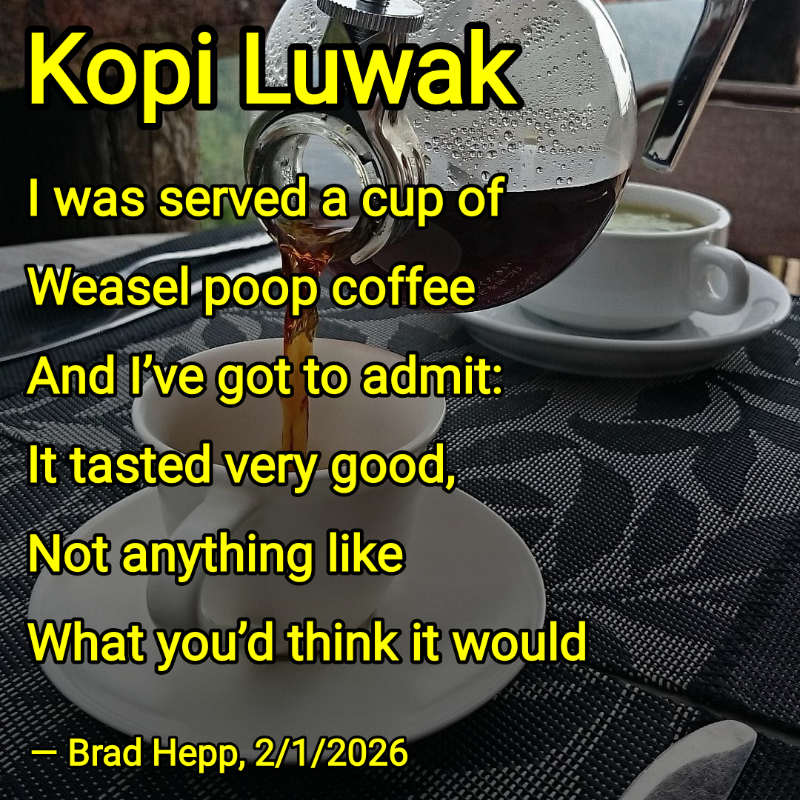
This naughty little poem celebrates good coffee and great hospitality.

True story! Our hostess had run out of regular coffee, but had a small bag of this VERY expensive coffee, called Kopi Luwak. So she brewed a pot and served it to us. I was suitably impressed… by the coffee and by her generous hospitality.

https://en.wikipedia.org/wiki/Kopi_luwak

(background image by leewei on Pixabay)

Leah’s Mandrakes

(if you are viewing this via email, the website has a recording of this poem and commentary; click the title above)

Commentary

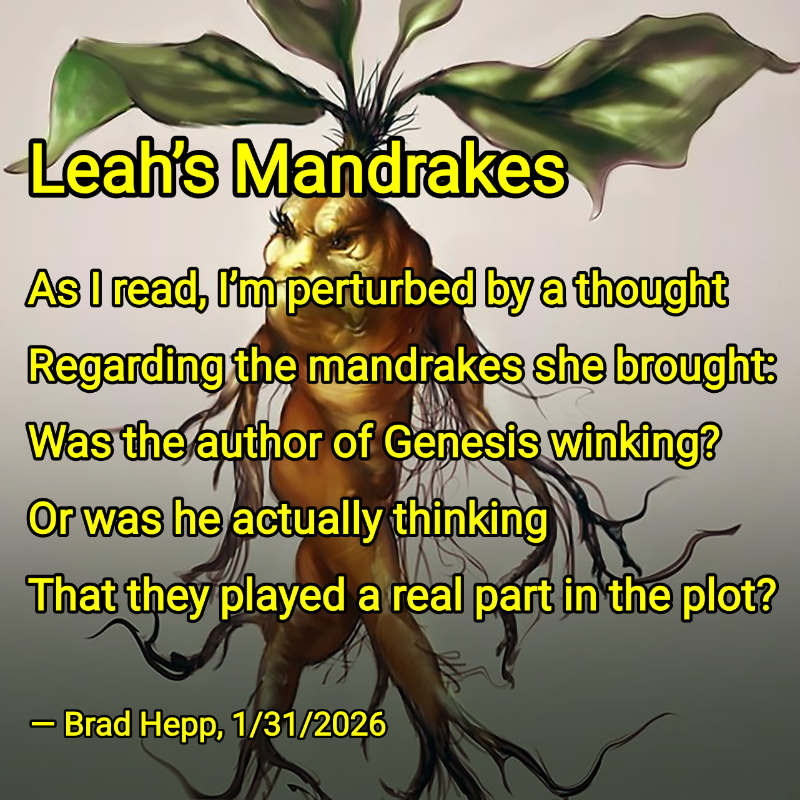
[This is an early morning response to Genesis 30]

More than likely, the author WAS winking. The mandrakes story gets us thinking how man’s devices are laughable in light of God’s sovereign choice. With or without fertility enhancers, God was going to grow Jacob’s family.
My lingering question is, where does Scripture comment on this and other stories to clearly indicate, “The moral of this story is this or that”? Some will pontificate while others will ponder where the truth is at.

(background image by Erik Llerena on Pixabay)

Esau, My Neighbor

(if you are viewing this via email, the website has a recording of this poem and commentary; click the title above)

Commentary

Every morning when I read the “Daily Office” (an Anglican thing I’m learning to use), I’m presented first with Malachi 1:11

For from the rising of the sun to its setting my name will be great among the nations, and in every place incense will be offered to my name, and a pure offering. For my name will be great among the nations, says the Lord of hosts.

I love passages like this, and hints in John (and elsewhere) that Jesus’ being glorified was tied to an ingathering of people from every nation.

I’m impressed that God cares for the foreigner, and wants believers to follow His example.

But nowadays, there are Christians(?) in the United States who think righteousness includes hating foreigners. I wonder if they read about God hating Esau and feel none of the tension that inspired my little poem?

NOTE: I know that teachers will generally downplay the “hating” of Esau as merely God *choosing* Jacob instead of him. But mere choice doesn’t describe what God does to Esau and his descendants (see the first few verses of Malachi).

Storm Watching

(if you are viewing this via email, the website has a recording of this poem and commentary; click the title above)

Commentary

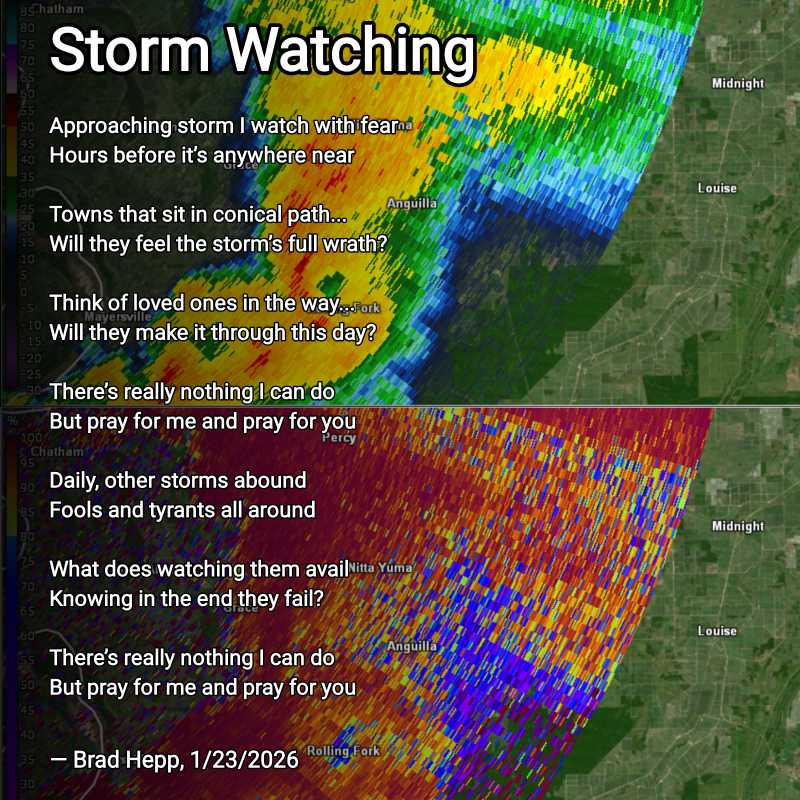
I’m struggling with mental and emotional exhaustion caused largely by being hyper aware of current events on the national and international stage. And I’m torn…. As a citizen in a representative democracy, I have some responsibility to be aware of what’s happening and to exercise what little power I have to influence the course of events. But just how much do I need to know? How often should I check the news? I strongly suspect the world—and certainly I—would be better off if I concerned myself less and prayed more, if I occupied myself more with beauty and less with ugliness.

(background image, from Wikimedia Commons, is of radar tracking of the Rolling Fork, MS EF4 tornado)

Coins on the Ground

(if you are viewing this via email, the website has a recording of this poem and commentary; click the title above)

Commentary

RETHINKING LOSS AND GENEROSITY

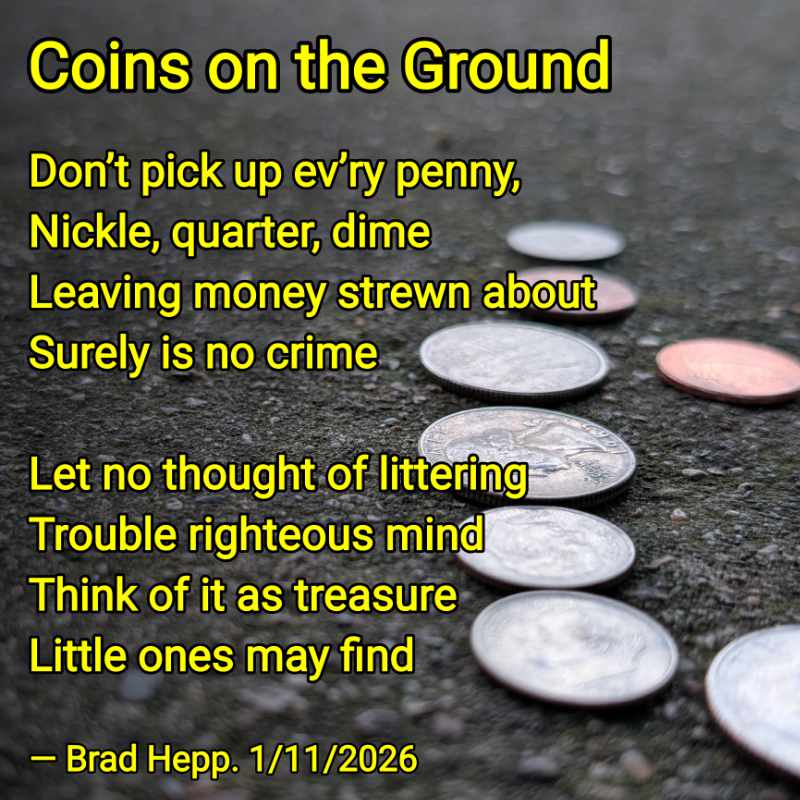
In my childhood—and somewhat to this day—I assumed that coins I found on the ground, or in a bubble gum dispenser, or in a telephone booth represented someone else’s loss. But could it be there are people who leave or drop their change not out of forgetfulness, but generosity?

My grandfather comes to mind. When he came down to visit us in Mexico, he took me on a walk to the summit of the hill where we lived. I was delighted to find money beside our path. Grandpa had been there before.

A friend–and fellow missionary kid–immediately responded with three passages from Scripture, including this one that I also had in mind:

And at your reaping the harvest of your land you must not finish reaping the edge of your field, and you must not glean the remnants of your harvest.

‭‭Leviticus‬ ‭19‬:‭9‬

In Light of Fellowship

(if you are viewing this via email, the website has a recording of this poem and commentary; click the title above)

Commentary

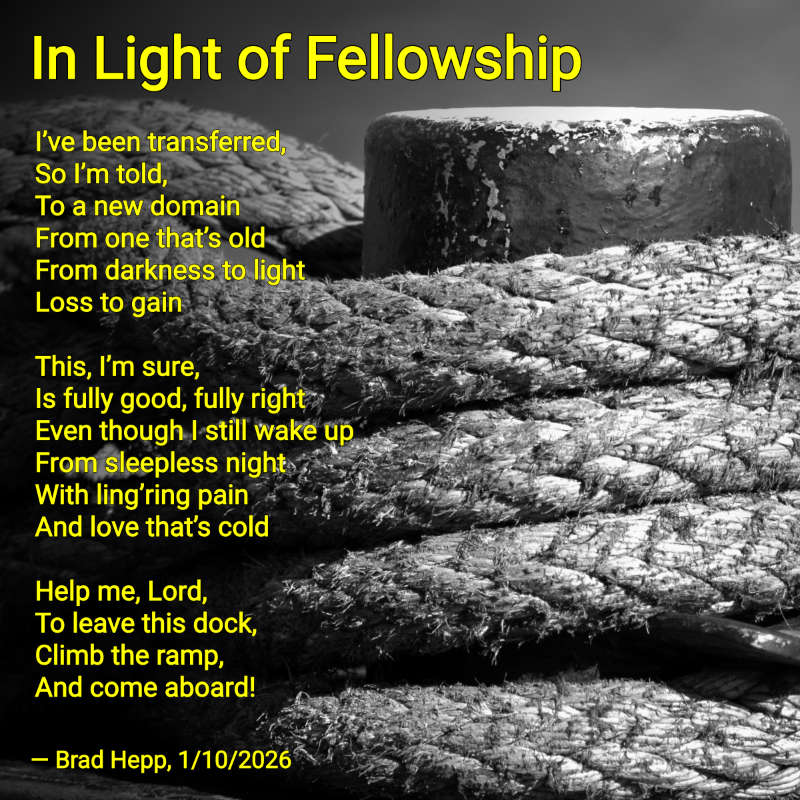
Forgive the sudden shift in the third stanza. I’ll admit to the opportunism of a rhyme with “Lord.” Hey… I haven’t even had breakfast yet!

Where was I? Oh yeah… Anglican Daily Office App: Morning Prayer: Colossians 1:12-14. Now, back to that!

(background image by Frauke Riether on Pixabay)

In Recovery

(if you are viewing this via email, the website has a recording of this poem and commentary; click the title above)

Commentary

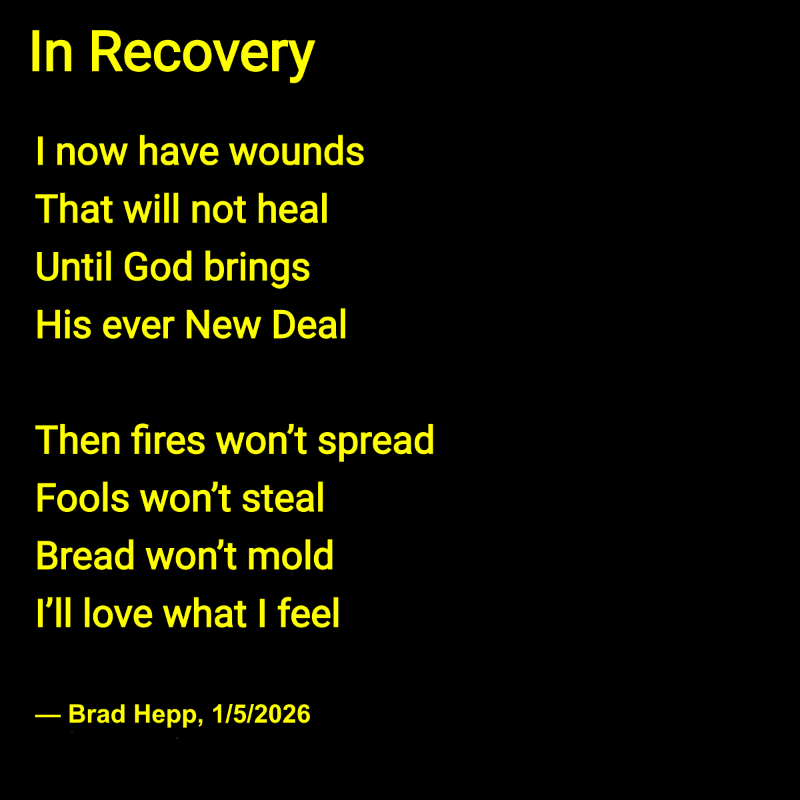
I know there are people who feel this far more than I. My pains in life have been few and slight. All the more, may we long for the One who will make things right!

I’m starting to see that our house fire was an inflection point. The process of recovery has forced me to evaluate possessions and my use of them. At many points, I ask myself questions like, “Do I need this now? Will I ever use this in the future?” One example I have mentioned elsewhere is the replacement of my desktop and laptop computers. The replacements are both more powerful than what I had before the fire. I can do more with these new computers than I could do with the old ones. But the excitement of creativity, e.g., of making and editing videos, has largely died away. I’m writing poetry more now than ever before. That’s creative, but low-tech. In general, my years before the fire are different than what I anticipate after the fire. I’m being forced to recognize and acknowledge that.

Living in an apartment has made us ask the question, “How much do we really enjoy home-ownership?” Yard work has lost its charm. Home maintenance in general has lost what little attraction it ever had. That change had already begun before the fire. But now I realize it all the more keenly. The fire was in early July. Even though we were living in an apartment, I still had to go over to the empty house and mow the lawn in Texas heat. That made me feel the futility of yard work: water and mow, water and mow. Although I cannot go into it here, the house still feels like a war zone, and I am engaged in daily skirmishes.

I’m tired.

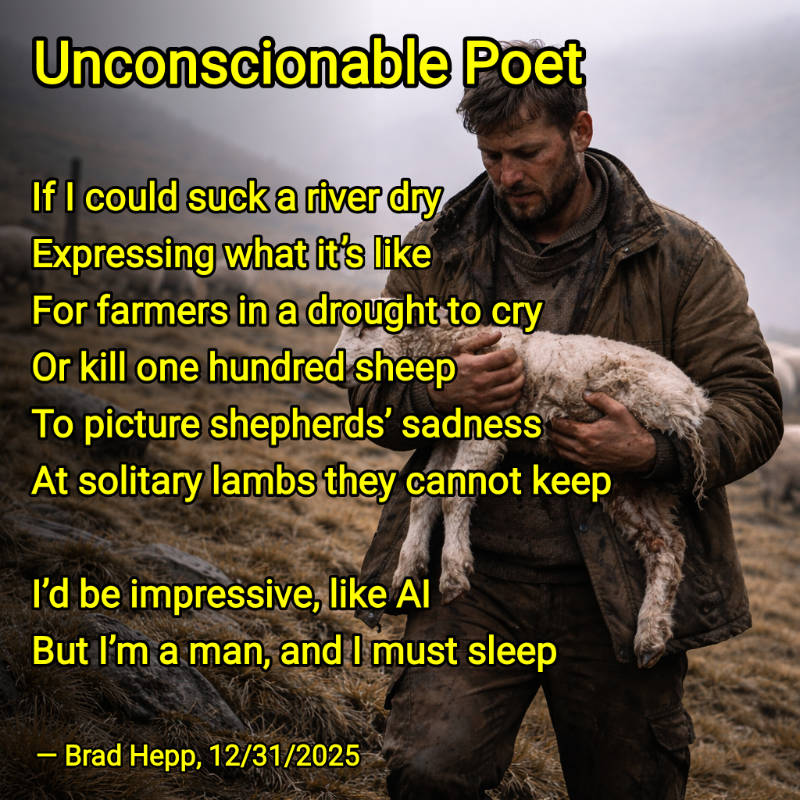
Unconscionable Poet

(if you are viewing this via email, the website has a recording of this poem and commentary; click the title above)

Commentary

This poem may not age well. Ten years from now, I may look back and laugh at the troglodyte I was in 2025. That has happened before. I recall complaining to my brother-in-law Don back in the late 1990s or early 2000s that clients were pressuring me to accept 50 MB files OVER THE INTERNET! Why couldn’t they just drive over with their files on portable media? Don was in a business that benefited from–and enabled–growth of the Internet. He wisely–and correctly–advised me to crawl out from under my rock.

So now, we are witnessing the rapid emergence of Artificial Intelligence. This poem is an expression of my struggle with how AI threatens a creative like myself. When AI can write three versions of a poem in the time it takes me to set down the first line of my own poem, I have to question the relevance of my work.
The poem is a protest. AI’s power comes at great expense. The data centers where AI performs its magic require vast resources–especially in terms of electricity and water for cooling. This is an expense born by all, but possibly rewarding just a few.
Artificial Intelligence pumps out poems with no regard for the costs. But we human poets work within limitations guided by decency and compassion. We have a conscience. Here’s some good news: in the exercise of that conscience, we can bring glory to the God who made us as we are. Our very limitations have value.

(CONFESSION: the background image was produced by AI based on my prompts)

Sky at Night in the City

(if you are viewing this via email, the website has a recording of this poem and commentary; click the title above)

Commentary

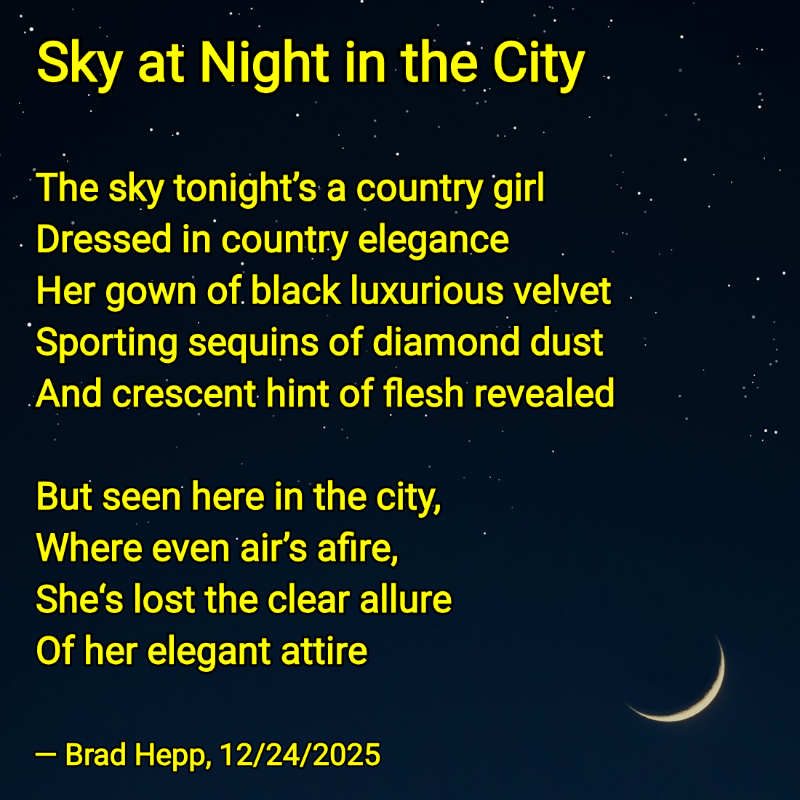
Last night, I worked late. Driving home on a busy road through this sprawling city, I saw the crescent moon low and big in the sky. It was fuzzy, which made me think there must be some high thin clouds. As I drove, I thought, “I have to describe this.” My first attempt was horrible: “A thin slice of moon, poking through the herniated sky.” Lovely, right?! That was clearly NOT going to do. How to describe the sky in a tasteful way?

Once I got home, I parked and stepped out to take a better look at the sky. It was cloudless! Here and there was a clear, but lonely star. It was just the light pollution of a big city that had given me the impression of clouds.

So I slept on it.

This morning, while I was waking up before sunrise, I thought of the night sky, and set out to describe it in this poem.

I suspect the last line of the first stanza is going to throw some people. Don’t settle too quickly on one picture in your mind. It’s the moon I’m describing, comparing it to that little flash of shoulder or leg showing through an elegant and modest gown.

By the way…. I wrote this quickly, trusting my brain to choose words well. That’s my approach to becoming a better poet: not belaboring any one poem, but pumping out many poems quickly. My theory is that I’ll become fluent in poetry, simply by speaking the language.

(background image by Rosario Gianní on Unsplash)

Morning Troubadour

(if you are viewing this via email, the website has a recording of this poem and commentary; click the title above)

Commentary

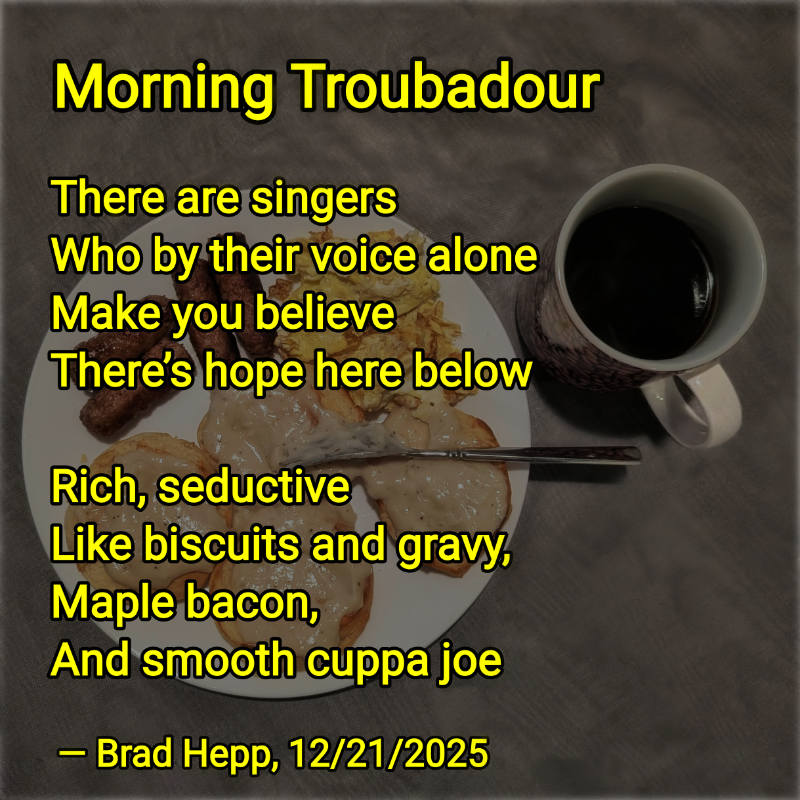
At first, I thought I’d title this poem “Gordon’s Not.” Let me explain….*

On a vacation day last week, I luxuriated by “sleeping” in. Before making my celebratory breakfast of biscuits and gravy, scrambled eggs, and pork sausage, I lay in bed watching a documentary about Gordon Lightfoot. The opening of that documentary is startling. An aged Gordon Lightfoot is explaining why he deeply regrets the words of one of his early hits: “For Lovin’ Me.” He explains that he was young, naive, and chauvinistic when he wrote it. As the documentary continued, I came to realize that I had never thought deeply about Lightfoot’s words in this and other songs. I had always just been mesmerized by his voice. That voice made everything he sang seem wholesome and true. But the man who wrote the words and sang them was not so wholesome, not so true! The documentary didn’t ruin his songs. But it was a reminder that a “a man may smile and be in pain” (Proverbs 14:13).

https://youtu.be/SBWpi5pGGMw?si=DlN73TE6-VLgkWjx

So, I finished the documentary, fixed my breakfast, and sat down to eat. That’s when I reflected on what I had just learned: Gordon’s not what you may have thought.

Does that shed light on my little poem?

_______________

*I make the common mistake of misremembering “Gordion Knot” as “Gordon’s Knot”

Until God Opens Our Eyes

(if you are viewing this via email, the website has a recording of this poem and commentary; click the title above)

Commentary

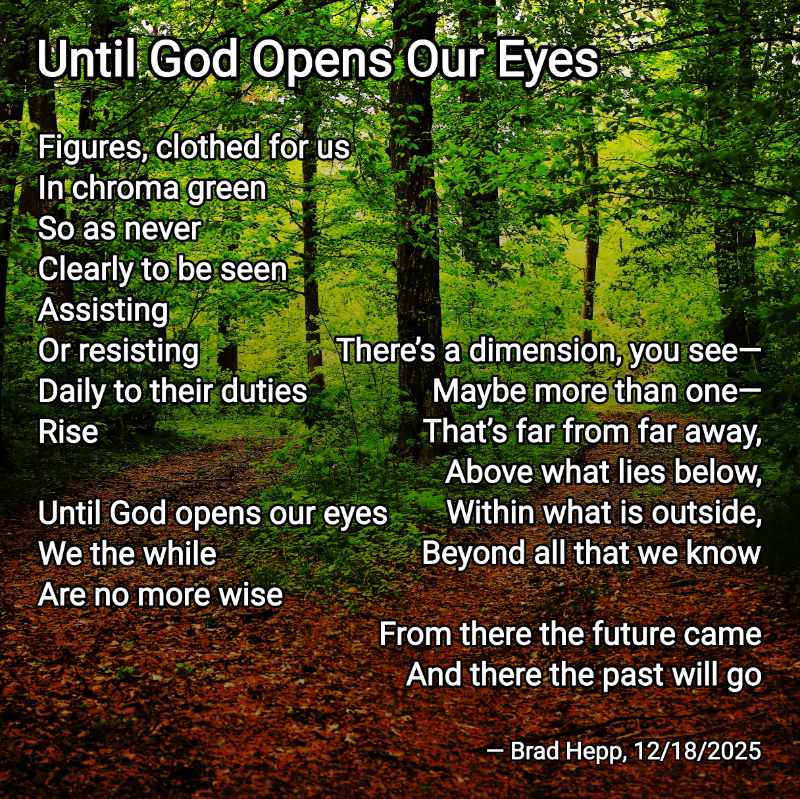
This was two poems, but I decided to combine them. The idea that there is an unseen realm interested me long before my current read: “The Unseen Realm,” by Michael Heiser. Thus far, Heiser’s book has not inspired me anywhere near as much as fantasies by George MacDonald. The Wise Woman is one MacDonald book that I should read again soon.

I’d be interested to know what comes to mind when you read that last line: “And there the past will go.” If you’re reading this on my website, comment below!

(background image by Valentin on Pixabay)

Remembering Our Walks

(if you are viewing this via email, the website has a recording of this poem and commentary; click the title above)

Commentary

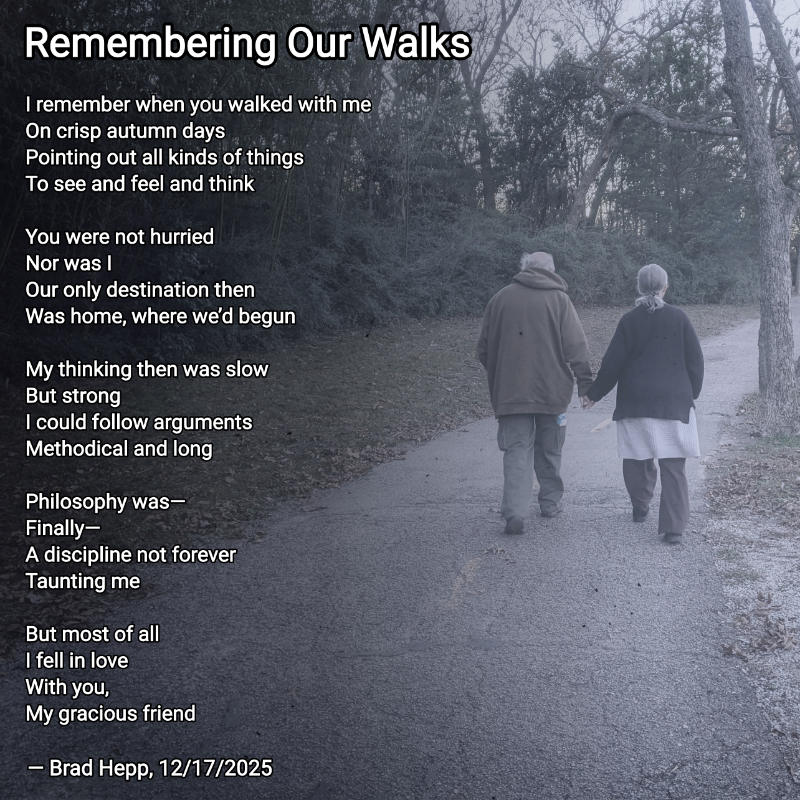
Something’s gotta change. My brain is turning to mush, and my heart isn’t far behind. Fortunately, I recall better days, so I know what’s possible. The One who walked with me then is merciful and kind. So, to Him goes this heartfelt prayer…. (the photo is one I took back in 2019, on one of my frequent long hikes)

Forks and Spoons

(if you are viewing this via email, the website has a recording of this poem and commentary; click the title above)

Commentary

The jury’s out on this one. I woke up the morning after posting it and thought, “Did I really write that?” For lack of a better category, I have put it under the themes “Experimental,” and “Self-Examination.”

Part of the problem is that I do not recall the context of this passing thought. Clearly, it struck me with enough force to elicit some lines of poetry. I think I must have been worried by the thought’s emptiness, its meaninglessness.

When you attend the theater of the absurd, then exit and encounter more absurdity outside, it warrants mentioning… or writing a few lines of poetry.

Patience in Mysteries

(if you are viewing this via email, the website has a recording of this poem and commentary; click the title above)

Commentary

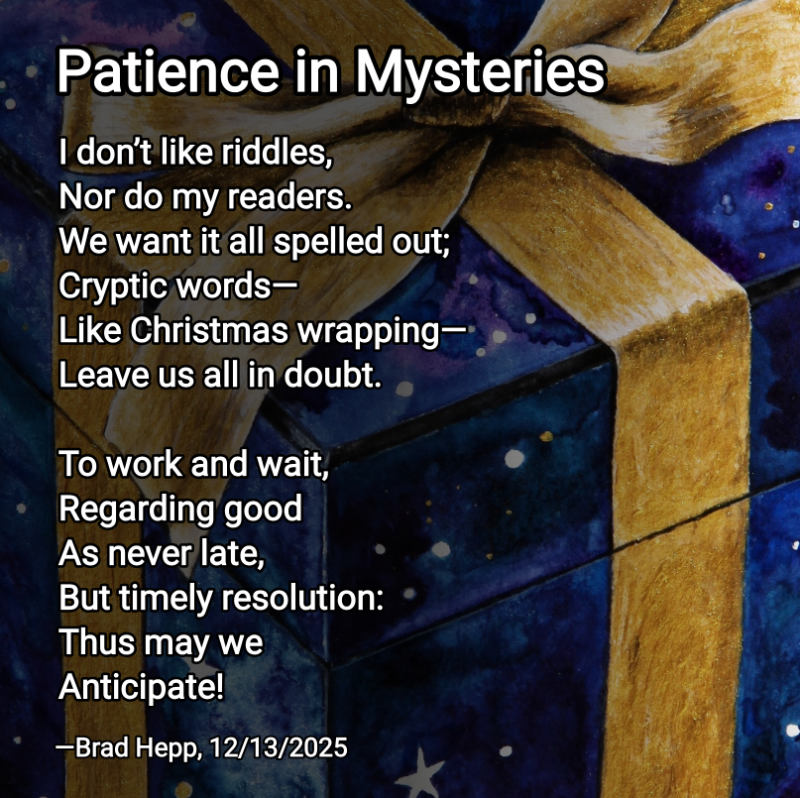
I have friends whose writing I sometimes don’t understand. Nor do they always understand my writing. I can’t blame them. In some cases, they may be pushing me for more clarity. However, just because something doesn’t make sense YET, that doesn’t mean it won’t make sense some day. Is the author good? Assume he or she will one day make sense. WORK at understanding, or—if it’s too hard—just wait. Your work—or patience—will be rewarded. 

I think this way about the Bible… and about myself and fellow writers. Or at least I try.

(background image from Nika Akin on Pixabay)

Facing Old Age

(if you are viewing this via email, the website has a recording of this poem and commentary; click the title above)

Commentary

I know that the second stanza is weak. But I felt a certain urgency in publishing it on the night when I wrote it. I wrote on Facebook, “I felt an urgency in getting this out there. Is it for you?”

A wise person would probably respond, “Make sure your ambitions align with God’s purpose.” More easily said than done.

Recovering Hoarder

(if you are viewing this via email, the website has a recording of this poem and commentary; click the title above)

Commentary

After the fire, we had a break-in at the empty house. The burglar seemed intent on finding some valuable document amongst the files we had stashed in my workshop. That helped us realize that we should pick up the pace of shredding old documents. Between paper shredding and file deletion, I have destroyed a lot of old documents in the last few days. The process leaves me feeling melancholy. Why? This poem explores that question.

(background image by Volodymyr on Pixabay)

My Backup Chute

(if you are viewing this via email, the website has a recording of this poem and commentary; click the title above)

Commentary

Tonight, I’m feeling ennui, hopelessness, a sense of futility. The feeling started intensifying yesterday as I set up a new, powerful computer, and explored how well it does with video editing. I noted to myself how I was doing this in a perfunctory manner, devoid of the excited expectation I once would have had that “I’ll do amazing things with this new capability! I’ll be creative and yet precise in communicating something via this medium.” That’s not likely to happen. People don’t turn to old men for fresh new expressions.

What did “The Preacher” do when he was feeling this way? He wrote Ecclesiastes. And Robert Browning wrote “Rabbi Ben Ezra”: 

Grow old along with me! 

The best is yet to be, 

The last of life, for which the first was made:

Embracing Incarnation

(if you are viewing this via email, the website has a recording of this poem and commentary; click the title above)

Commentary

Here’s a weird one, I know. It popped out of my mind as I listened to a haunting rendition of “Love Story” on trombone. I’ll not ruin music for you by spelling out the connection between what I heard and what I then wrote.

How can I defend writing something so strange? Well, I’ve noticed over the years that when I’m sitting under even the best teachers, I sometimes articulate questions that wake up my fellow listeners. It’s funny: I’ll ask a question, and two or three minutes later, someone else—who was asleep—asks the same question, as their mind clicks into action. When YOU read this poem, does it awaken anything finicky or easily grossed-out in your psyche? Perhaps you can then share my reliance on a patient, understanding Creator—a Creator who clearly likes messy, slobbery MATTER.

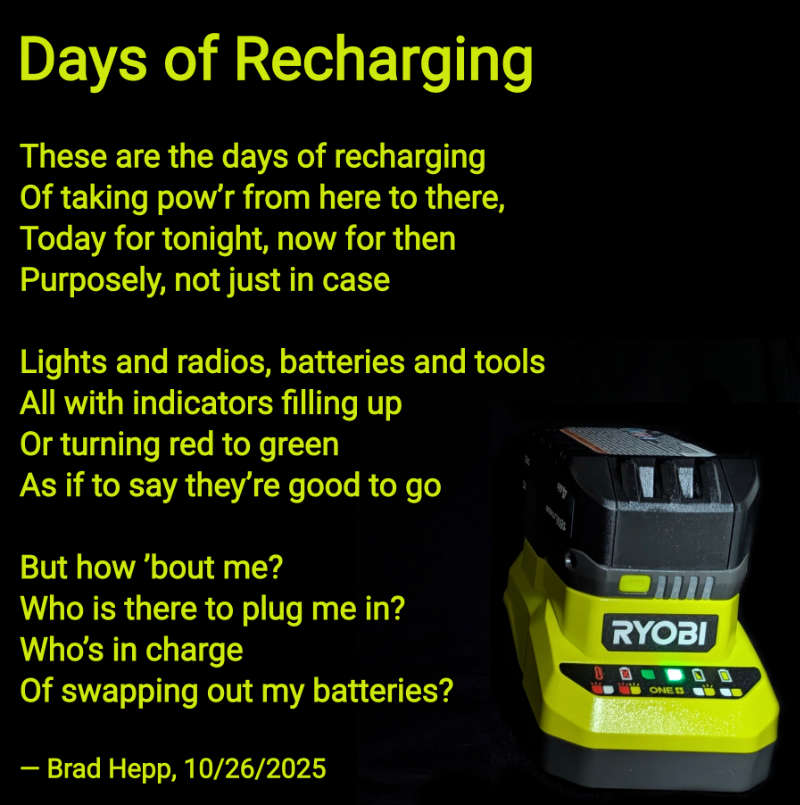
Days of Recharging

(if you are viewing this via email, the website has a recording of this poem and commentary; click the title above)

Commentary

[I have written this up, but decided it’s unwise to post the full explanation at this time; suffice it to say that this belongs in my “After The Fire” collection]

In my poem, I leave the question hanging out there: who is recharging ME? An unanswered question makes some people feel uncomfortable. I’m sure the day of answers will come.

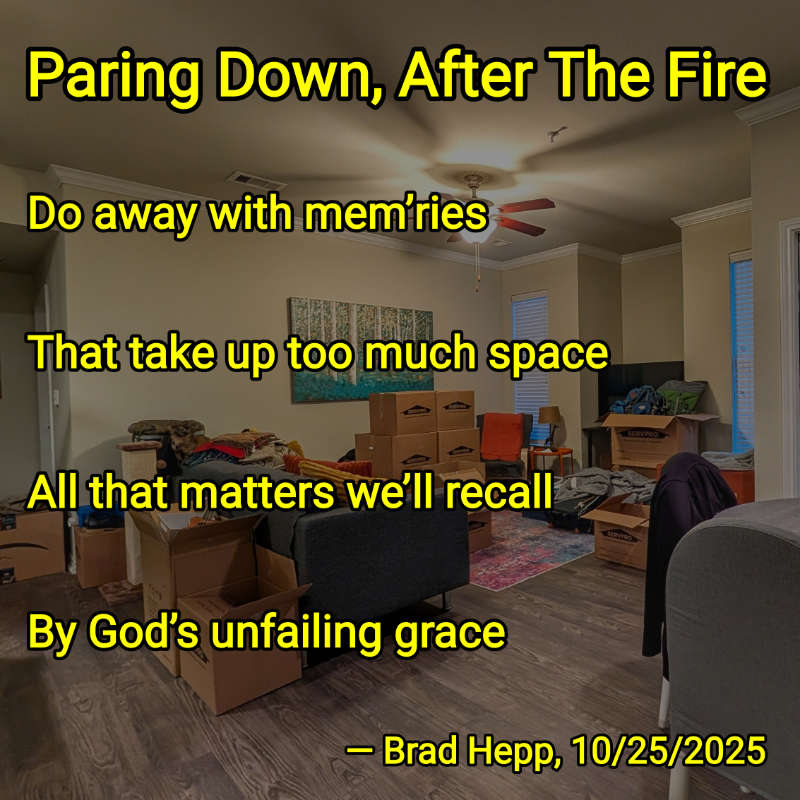
Paring Down, After The Fire

(if you are viewing this via email, the website has a recording of this poem and commentary; click the title above)

Commentary

Susan had the living room of our temporary housing looking pretty spiffy until yesterday. That’s when she brought upwards of 16 boxes home from the remediation company warehouse. It’s stuff that ServPro hauled off after the fire. We’re going through it deciding what to keep and what to toss. I just went through a box of materials from back when I served a church with graphics and newsletter layout. That all seemed important for many years. Maybe it was. God knows. If it was, its importance will not be diminished or lost by my throwing away samples I retained until now.

As I do this, I think of people who lose EVERYTHING in a fire or other disaster. What a mind-bender that must be!

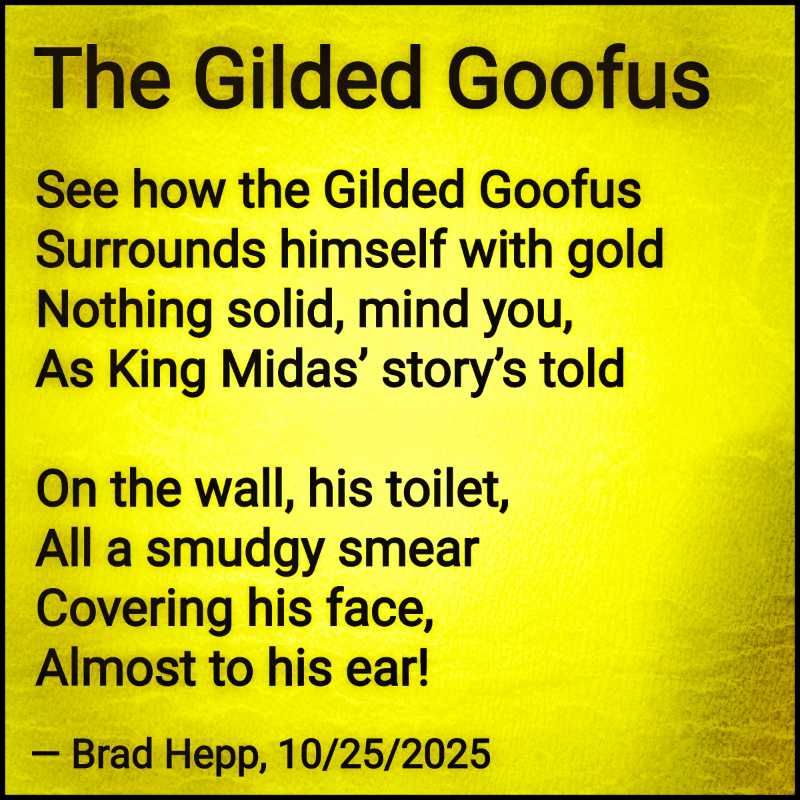
The Gilded Goofus

(if you are viewing this via email, the website has a recording of this poem and commentary; click the title above)

Commentary

We’re being undone by a man and movement that ANYONE should recognize as unserious, undeserving, and unworthy of power. But, as Hamilton said, “The masses are _______.” Evil likes to think of itself as elegant, but even the Devil’s unitard is baggy. I’m asking ChatGPT to illustrate that…. Here you go:

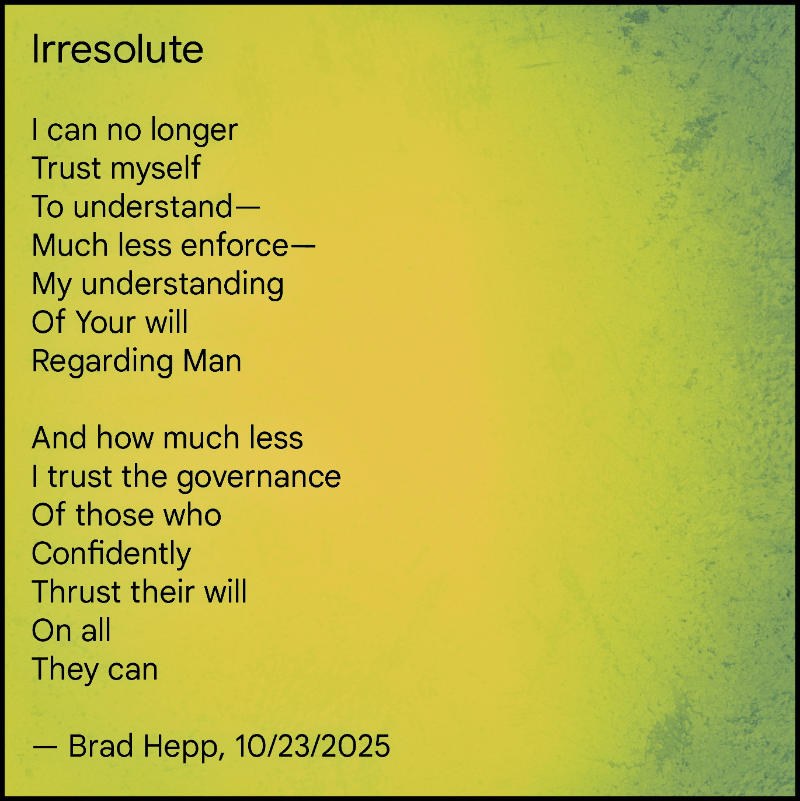
Irresolute

(if you are viewing this via email, the website has a recording of this poem and commentary; click the title above)

Commentary

I don’t set out to write seven-line stanzas. It just happens. How can I pretend to understand the mind of others, when I don’t understand my own? What I DO know is that selfishness and self-centeredness threaten any and all understanding of truth. God have mercy!

Insurance

(if you are viewing this via email, the website has a recording of this poem and commentary; click the title above)

Commentary

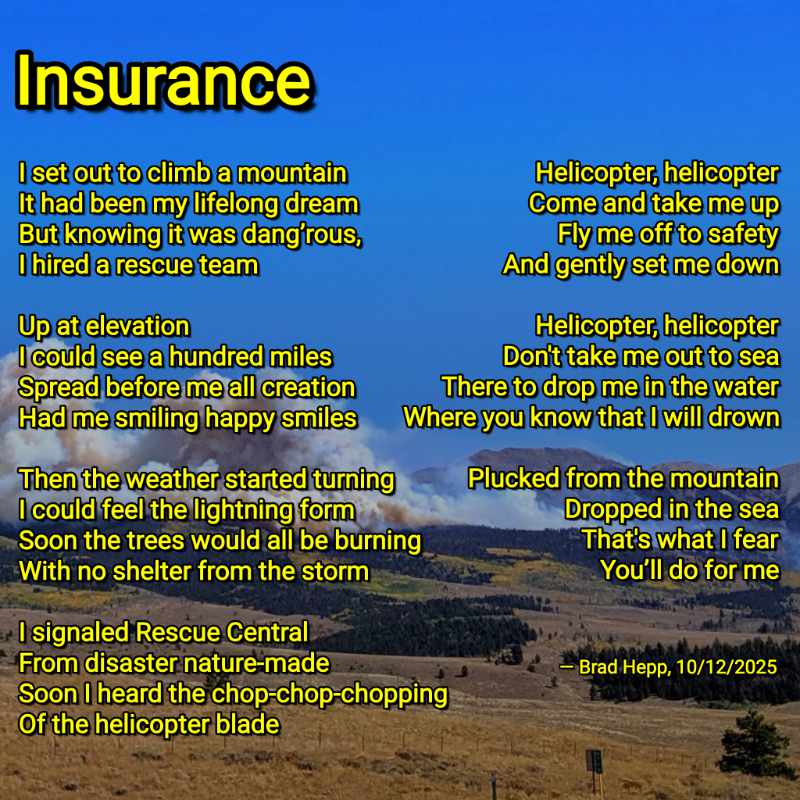
[sung to the tune of “Don’t You Dare Drop My Insurance Policy”]

Susan showed me something about our homeowner’s insurance that’s gonna have me feeling nervous until we figure out what’s going on. In this poem, think of the mountain climb as if it were buying a house at age 34 and paying for insurance 31 years before having to make a significant claim. Susan wants me to consider that the odd thing she showed me about the insurance may constitute a blessing. She may be right, but I’m Scottish, and penury is always just around the corner.

This poem will go in my “After The Fire” collection. The background photo is of a fire in the Sangre de Cristo range, which we witnessed on one of our mountain climbing trips.

Saved From Silence

(if you are viewing this via email, the website has a recording of this poem and commentary; click the title above)

Commentary

Some of us have great friends we’ve never met in person. Others’ friends are strictly flesh and blood. My wife understands that writers sometimes develop friendships afar. She and I have one mutual friend who has corresponded with a famous writer (Philip Yancey) over the decades. Knowing that friend—and the writer—it isn’t surprising at all.

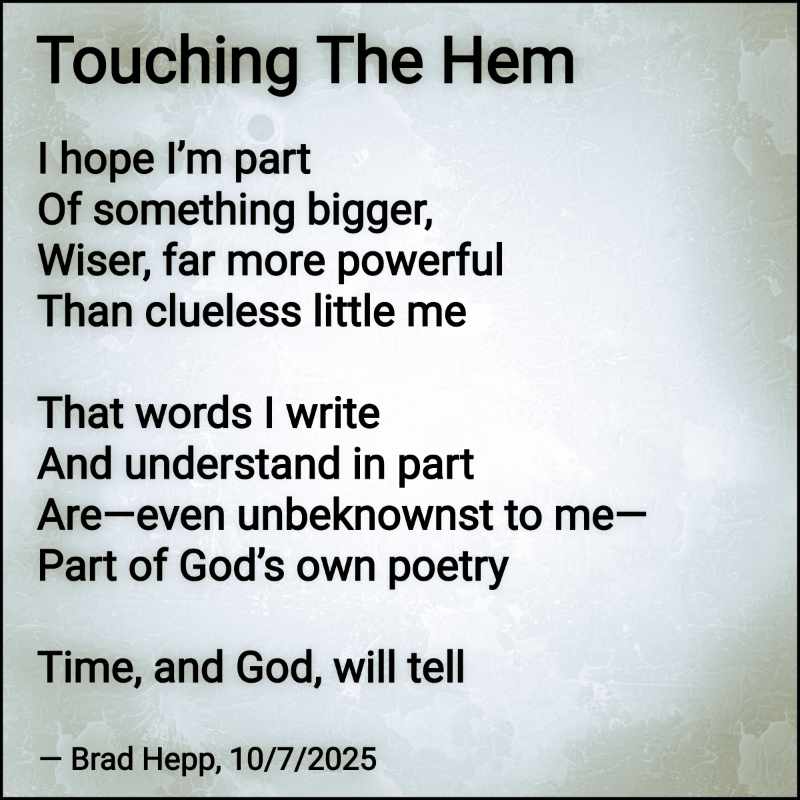
Touching The Hem

(if you are viewing this via email, the website has a recording of this poem and commentary; click the title above)

Commentary

The other day, I was in the living room of a friend. As we talked, I looked over at his bookshelves, and half of one shelf was devoted to books by the biographer William Manchester. Right in the middle was the three-volume biography of Winston Churchill, entitled, The Last Lion. That’s when I recalled with chagrin that I had mistakenly told someone recently about listening to the three-part “Last Lion of Manchester” (as though Churchill was from Manchester). I understand much of what I listen to or read, but accurately retain only a fraction of it. Despite this intellectual weakness, I feel compelled to write poetry, and harbor the fond hope of evoking important thoughts in others. It CAN happen, but only as God uses weak things to achieve powerful results.

Are You Good With His Glory?

(if you are viewing this via email, the website has a recording of this poem and commentary; click the title above)

Commentary

One of the most challenging, seeming non-sequiturs in the Gospels occurs in John 12. Why did Jesus care that Greeks wished to meet with Him? Do we? Or are we just looking out for “OUR PEOPLE” (“us,” but especially ME, MYSELF, and I… the unholy trinity)?

A Normal Reaction

(if you are viewing this via email, the website has a recording of this poem and commentary; click the title above)

Commentary

My apologies to you if you drive a Cybertruck. But even you have to acknowledge that your “truck” is an acquired taste… at best.

I was driving with someone far more circumspect than me the last time we were overtaken by a Cybertruck. I was moved to write this poem by her unusually frank reaction to the passing monstrosity.