(if you are viewing this via email, the website has a recording of this poem and commentary; click the title above)
Commentary
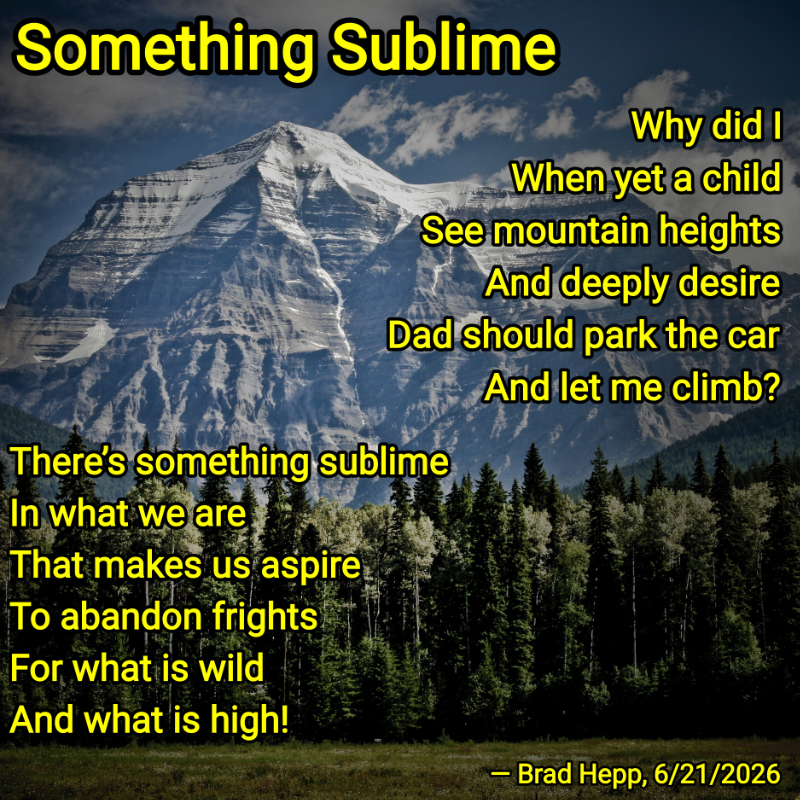
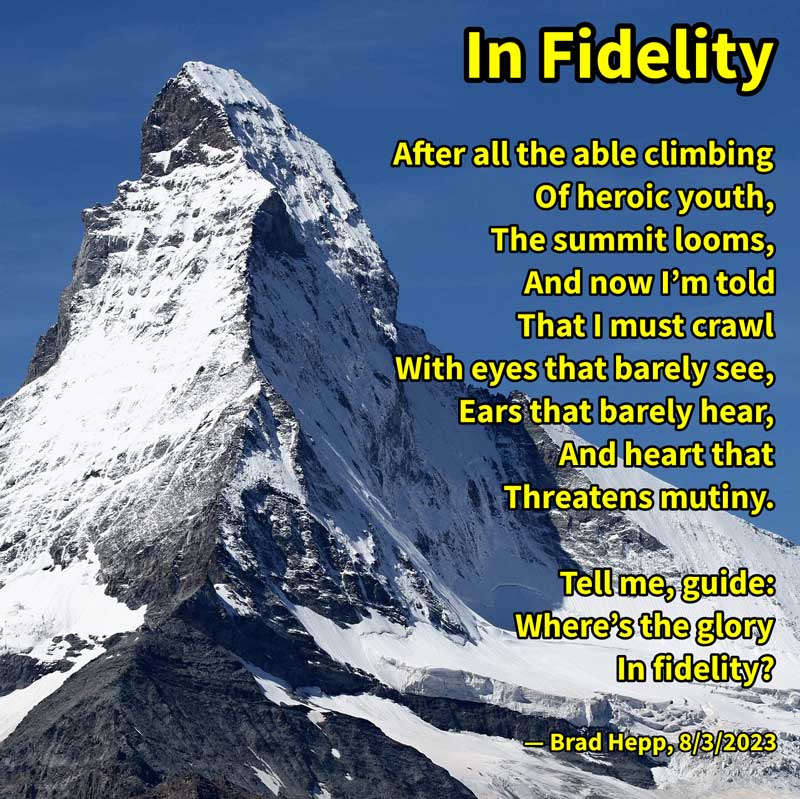
Seriously…. I never saw a mountain that I didn’t want to run up. My strength didn’t match my desire—I wouldn’t run far. But the wish was there, nonetheless. Why? I come at this question by asking first why we consider mountains beautiful. Why don’t we simply see them as big piles of rock? I suspect we recognize a destiny that’s bigger and better than what we now see. What do you think?
Did you notice the rhyme pattern? I don’t usually bother with that kind of challenge.
(if you are viewing this via email, the website has a recording of this poem and commentary; click the title above)
Do You Find This Offensive?
Please read my partial defense below*
Commentary
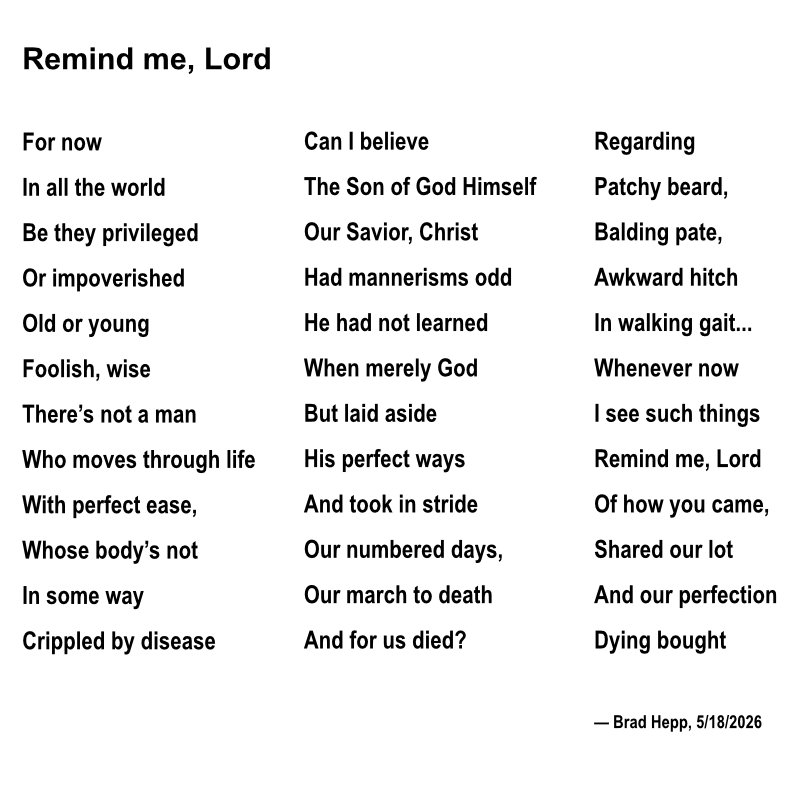
On a couple of occasions recently, I have seen short videos of myself walking—in checking the footage of security cameras I was setting up or reviewing church services I participated in. Seeing myself thus elicits embarrassment: “I look so ridiculous!” That response isn’t unusual. People often cringe to hear recordings of their own voice. As a photographer, I’ve had to put up with people rejecting perfectly representative photographs of themselves (“representative” isn’t always flattering!).
As I thought about this, it dawned on me that one could find ridiculous traits in just about anyone. We’re all just a little bit clownish.
From there my thinking went to that most profound event in the history of man: Jesus’ emptying himself, “by taking the form of a servant, being born in the likeness of man” (Philippians 2:7).
This poem is a prayer that Jesus will remind me of the glory He stooped to share with us despite our ridiculous state. ____________
*Although I wrote this poem very quickly, I hesitated to publish. It contains some words and concepts that are calculated to startle, to provoke thinking–in myself first and then in my readers. I asked seven of my very smart, theologically astute friends to comment, especially on the second stanza. Here’s what I wrote to one of them:
Ben,
I’m very interested in whether or not you see theological problems in the second stanza of this poem. Another friend (DTS prof) responded to me that “There are some implications that could be drawn from the second stanza that would compromise a classical understanding of Christology.” He didn’t elaborate.
If I understand Isaiah correctly, Jesus was not a classically beautiful human specimen. Per Hebrews, He learned obedience. You can probably think of other evidence of His thorough-going Incarnation. Can we go so far as to speculate that He might even have had some quirks like the rest of us?
I write poetry to plumb the depths of my confusion about man, including the Son of Man. I must confess being double-minded about the relationship of imperfection and sin. There’s a judgmental little jackass in my brain that always wants to attribute physical imperfection to moral imperfection. (It gets worse: I then take that inferred moral imperfection and use it as a basis for assigning relative authority. But enough about this dumb sinner….).
Thoughts?
None of the seven friends condemned me as a heretic. Most of them found the poem sufficiently thought-provoking to excuse some of its questionable wording.
One of the friends–a theologian and prolific poet–said that he’d grant me poetic license for “mannerisms odd.” But “merely God“? For him, that was a bridge too far. (His objection reminded me of my father, who protested when the word “awesome” was used to describe anything other than God.) My faltering defense: before the Incarnation, Jesus was “merely” God as opposed to God-Man.
Here’s my ultimate out: late in the writing process, I turned the whole second stanza into a question, not a statement: “Can I believe…?” In other words, is it appropriate to believe what follows? I hope you struggle a little with that, and that the struggle tips your heart toward loving God and loving your neighbor. That’s certainly what I hope for myself.
(if you are viewing this via email, the website has a recording of this poem and commentary; click the title above)
Commentary
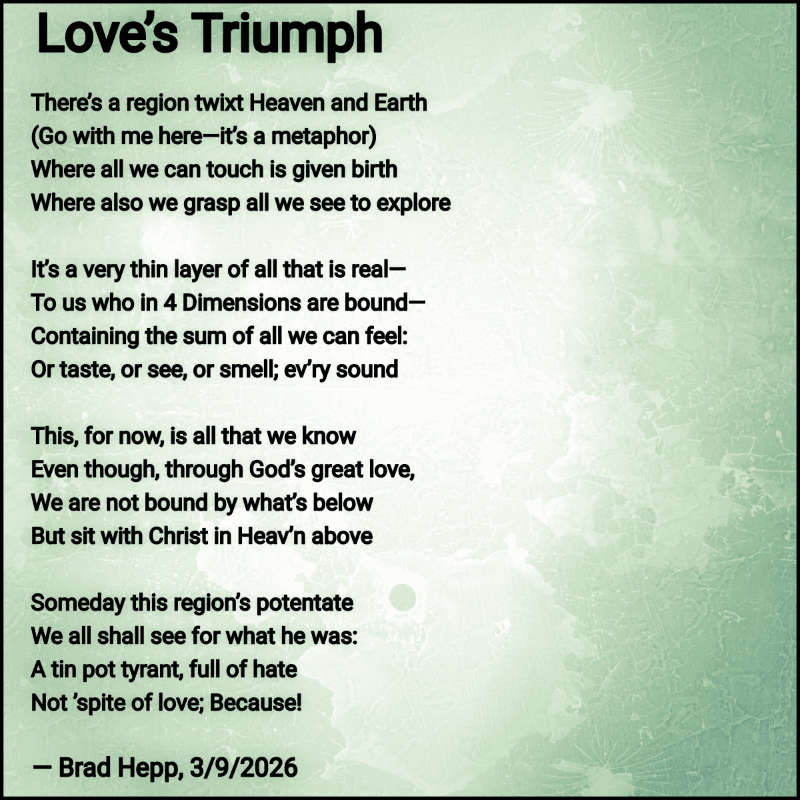
I’m trying to understand the Bible’s cosmology (esp. in Genesis, but also in the New Testament) as metaphor. Despite the fact that I’m a poet, that’s not easy for me. This poem is a pushing, a shoving, a determined attempt to see God’s loving.
Here’s the passage I was looking at when I wrote the poem:
[1] As for you, you were dead in your transgressions and sins, [2] in which you used to live when you followed the ways of this world and of the ruler of the kingdom of the air, the spirit who is now at work in those who are disobedient. [3] All of us also lived among them at one time, gratifying the cravings of our flesh and following its desires and thoughts. Like the rest, we were by nature deserving of wrath. [4] But because of his great love for us, God, who is rich in mercy, [5] made us alive with Christ even when we were dead in transgressions—it is by grace you have been saved. [6] And God raised us up with Christ and seated us with him in the heavenly realms in Christ Jesus, [7] in order that in the coming ages he might show the incomparable riches of his grace, expressed in his kindness to us in Christ Jesus. Ephesians 2:1-7 NIV
Despite how it may sound, I don’t pretend to understand much of what I wrote in this poem. I’m playing by ear, attempting to work out God’s melody. When I was younger, I despised the pompous blather of “poets who, in fact, don’t mean a thing.” But I excuse it now as a “thinking out loud.” Pondering, not so proud.
ABOUT THE THIRD STANZA I’m not real happy that I resorted to just mouthing what Scripture says as though I understand it. The already/not yet, de jure status of believers is every bit as mysterious to me as how to deal with a cosmology that is foreign.
ABOUT THE LAST LINE I’m going to just admit…. I was pushing for a rhyme to “was.” But I do like the unintended puzzle that the last line presents, and it’s always possible that my subconscious was “on to” something.
(if you are viewing this via email, the website has a recording of this poem and commentary; click the title above)
Commentary
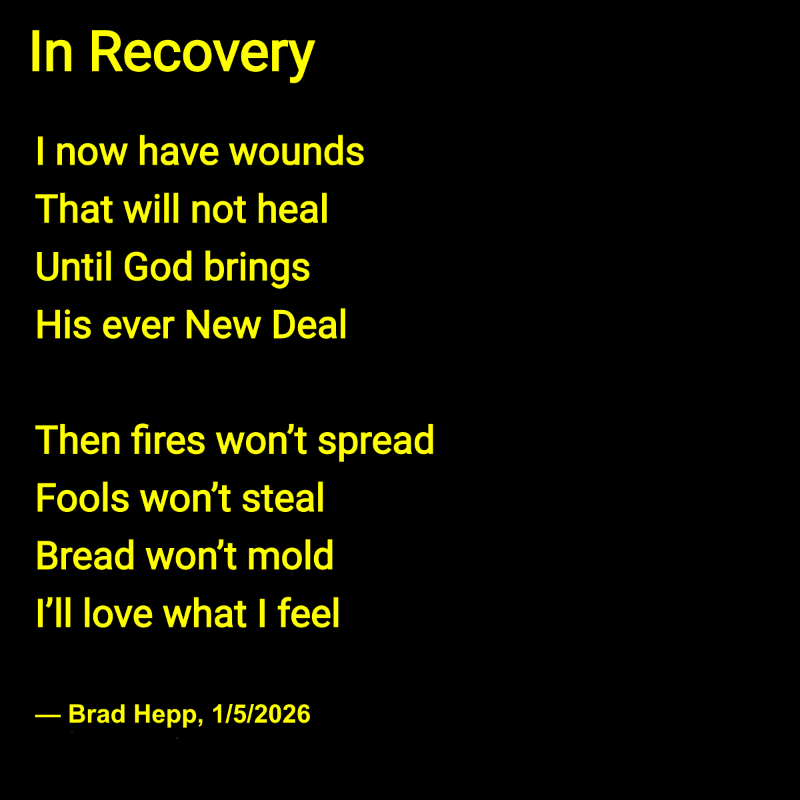
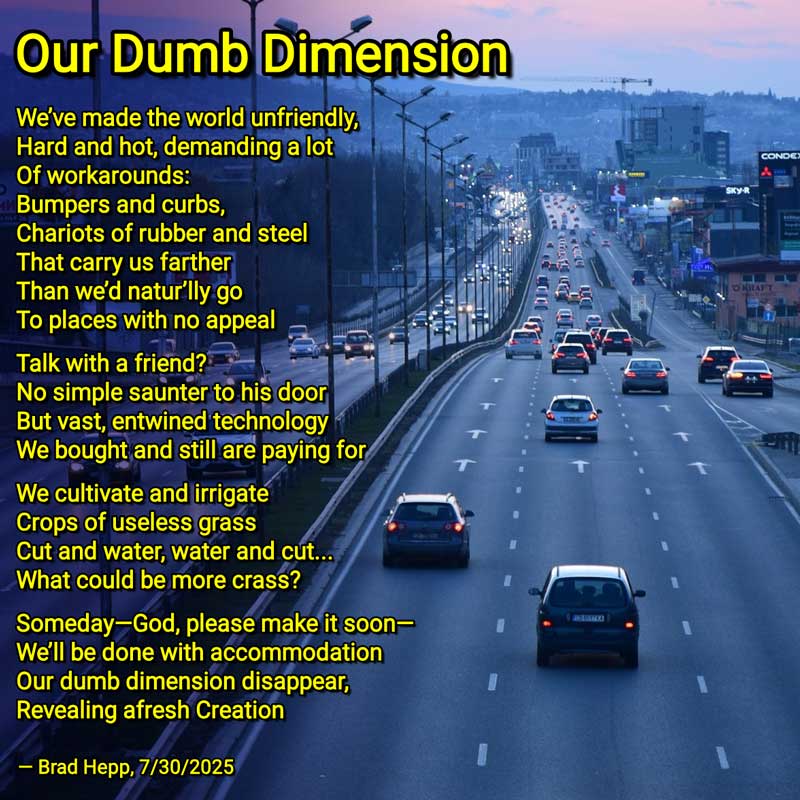
I know there are people who feel this far more than I. My pains in life have been few and slight. All the more, may we long for the One who will make things right!
I’m starting to see that our house fire was an inflection point. The process of recovery has forced me to evaluate possessions and my use of them. At many points, I ask myself questions like, “Do I need this now? Will I ever use this in the future?” One example I have mentioned elsewhere is the replacement of my desktop and laptop computers. The replacements are both more powerful than what I had before the fire. I can do more with these new computers than I could do with the old ones. But the excitement of creativity, e.g., of making and editing videos, has largely died away. I’m writing poetry more now than ever before. That’s creative, but low-tech. In general, my years before the fire are different than what I anticipate after the fire. I’m being forced to recognize and acknowledge that.
Living in an apartment has made us ask the question, “How much do we really enjoy home-ownership?” Yard work has lost its charm. Home maintenance in general has lost what little attraction it ever had. That change had already begun before the fire. But now I realize it all the more keenly. The fire was in early July. Even though we were living in an apartment, I still had to go over to the empty house and mow the lawn in Texas heat. That made me feel the futility of yard work: water and mow, water and mow. Although I cannot go into it here, the house still feels like a war zone, and I am engaged in daily skirmishes.
(if you are viewing this via email, the website has a recording of this poem and commentary; click the title above)
Commentary
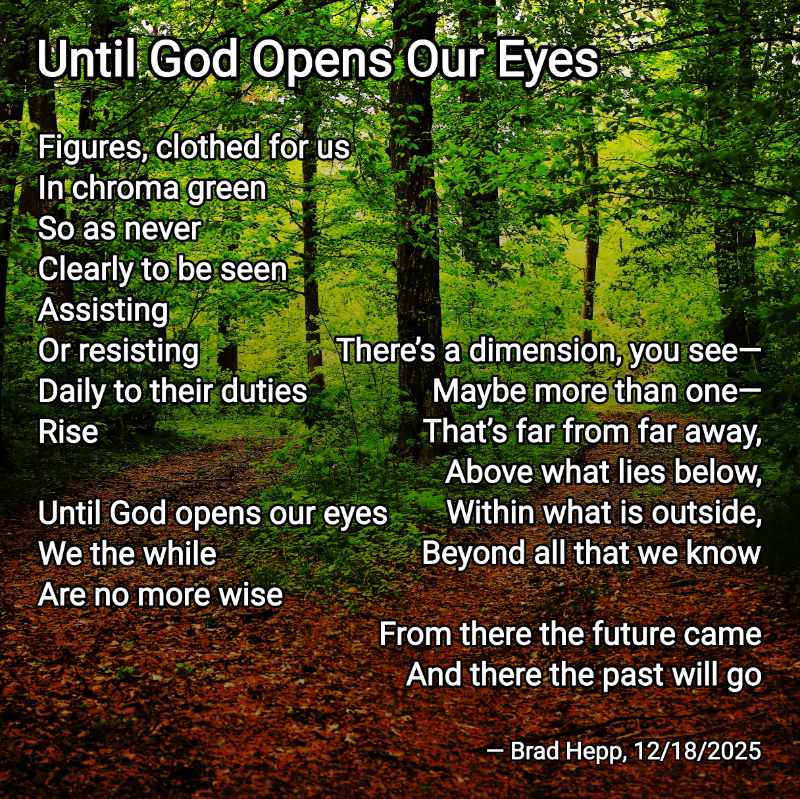
This was two poems, but I decided to combine them. The idea that there is an unseen realm interested me long before my current read: “The Unseen Realm,” by Michael Heiser. Thus far, Heiser’s book has not inspired me anywhere near as much as fantasies by George MacDonald. The Wise Woman is one MacDonald book that I should read again soon.
I’d be interested to know what comes to mind when you read that last line: “And there the past will go.” If you’re reading this on my website, comment below!
(if you are viewing this via email, the website has a recording of this poem and commentary; click the title above)
Commentary
On the one hand, there is self-awareness. On the other, there is theological conviction. This poem is a confession that the two are in conflict. I believe. Help Thou my unbelief!
(if you are viewing this via email, the website has a recording of this poem and commentary; click the title above)
Commentary
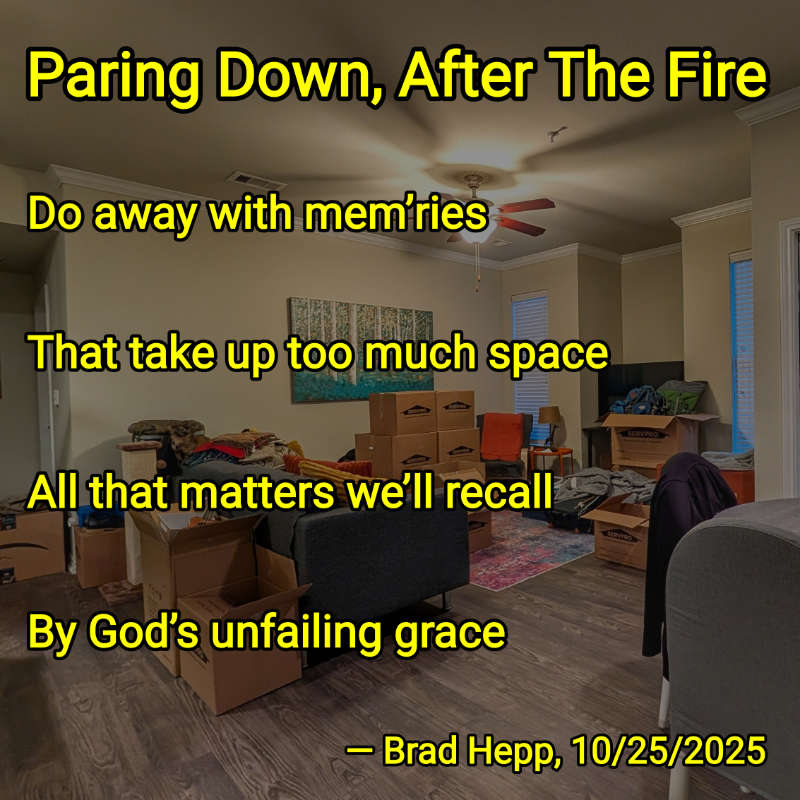
Susan had the living room of our temporary housing looking pretty spiffy until yesterday. That’s when she brought upwards of 16 boxes home from the remediation company warehouse. It’s stuff that ServPro hauled off after the fire. We’re going through it deciding what to keep and what to toss. I just went through a box of materials from back when I served a church with graphics and newsletter layout. That all seemed important for many years. Maybe it was. God knows. If it was, its importance will not be diminished or lost by my throwing away samples I retained until now.
As I do this, I think of people who lose EVERYTHING in a fire or other disaster. What a mind-bender that must be!
(if you are viewing this via email, the website has a recording of this poem and commentary; click the title above)
Commentary
Some of us have great friends we’ve never met in person. Others’ friends are strictly flesh and blood. My wife understands that writers sometimes develop friendships afar. She and I have one mutual friend who has corresponded with a famous writer (Philip Yancey) over the decades. Knowing that friend—and the writer—it isn’t surprising at all.
(if you are viewing this via email, the website has a recording of this poem and commentary; click the title above)
Commentary
The view out the living room window of our temporary housing* is parked cars, the pavement, other apartments, and above it all a hint of sky. This is my view as today’s reading takes me to the pastoral scene of young David—ruddy, with beautiful eyes, and a handsome appearance (1 Samuel 16:12). I can imagine him walking in soft meadows, cajoling the sheep, and strumming his harp. I can imagine the scene because I have been there—as a child in Mexico and as a man in the alpine meadows of Colorado mountains. THAT is my Father’s world. Not this.
“DIMENSION” Here I am playing with an idea that intrigues me. One prominent proponent of the idea is the Anglican theologian N.T. Wright. From an AI Overview:
N.T. Wright proposes that heaven and earth are not two separate locations, but rather two different dimensions of God’s creation. He suggests that heaven is not a distant realm to escape to, but rather an aspect of our present reality, the “God-dimension” that is interwoven with our earthly existence. The biblical vision, according to Wright, is the restoration of all things, with heaven and earth united in a new creation.
I don’t know enough about the concept and it strengths or weaknesses to say any more just yet. So I’ll leave it there….
___________ *this is another poem born of my experience living in temporary housing after our house fire earlier this month
(background image by Zdravko Shishmanov on Pixabay)
(if you are viewing this via email, the website has a recording of this poem and commentary; click the title above)
Commentary
When I walk at White Rock Lake, I often encounter young men playing chinlone, which I understand is the national sport of Myanmar (formerly known as Burma). Watching those young men use their heads and feet to keep a little rattan ball in play reminds me of the countless hours I spent doing the same with a soccer ball when I was a teenager.
I admire their athleticism, and miss the days when I myself could spin, reach up with my leg and intercept a ball with just the right extension and just the right force to keep it up in the air.
Here’s a short video of the guys playing chinlone at White Rock Lake. Music is from their boombox.
(if you are viewing this via email, the website has a recording of this poem and commentary; click the title above)
Commentary
TERRARIUMS*
When I was a boy, I wanted a terrarium. There, within the glass walls of that miniature world, little plants would thrive in healthy contentment.
In my adult years, I created terrariums** of various sorts, and I continue creating them. Some lasted a season. Some lasted decades. But all the terrariums eventually failed. Something always got out of balance. Too much of this, too little of that.
There’s something about knowing evil in a larger world that leaves me unsatisfied by terrariums. It’s not because terrariums fail. It’s because whatever success they have doesn’t fool me. Beyond the glass walls of every terrarium–be it literal or metaphorical–is a world dying in unhealthy discontent.
I don’t want another terrarium. I want a new world.
___________
*How dare ya Insist on “terraria”?
**I wondered if people would read the reference to terrariums literally. I haven’t ever had an ACTUAL terrarium, although I DID wish for a literal terrarium when I was young. Now, a very intelligent reader has let me know that s/he read all the references to terrariums as literal.
I thought “terrariums” was a powerful metaphor for projects that try to satisfy one’s deep-down desire for beauty and control in the midst of ugliness and chaos (likely even more than that).
So, the question is, how could I have retained the power of metaphor while tipping off the reader that I wasn’t being literal? Readers EXPECT metaphor in poetry, but are thrown by extended metaphor in prose. IDEAS??
One idea is a tiny addition to the penultimate sentence: “Beyond the glass walls of every terrarium [–be it literal or metaphorical–] is a world dying in unhealthy discontent.” I’m going to insert that now.
(if you are viewing this via email, the website has a recording of this poem and commentary; click the title above)
Commentary
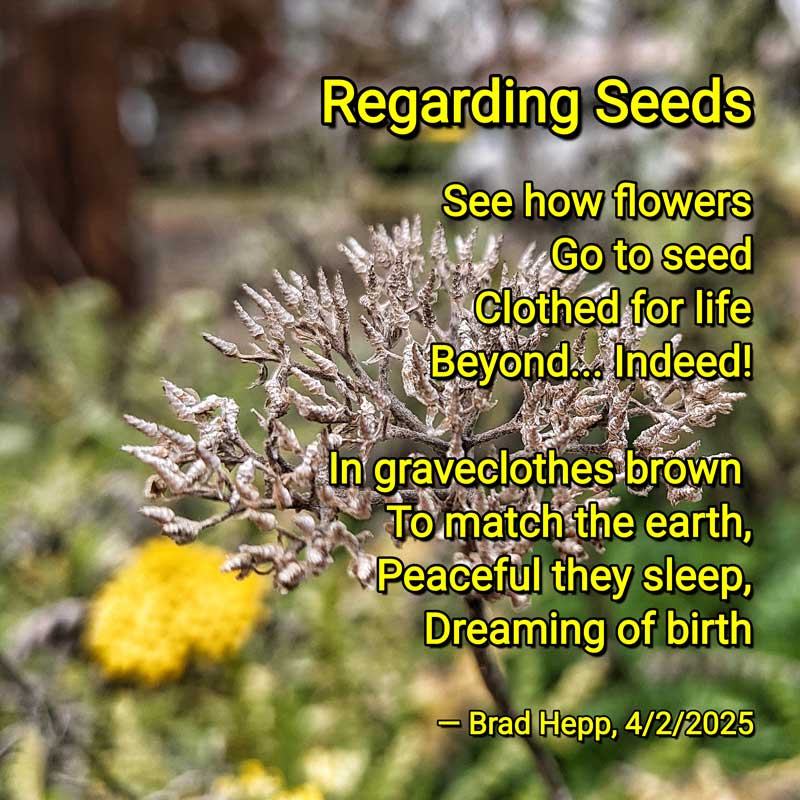
A friend’s photograph of blooming yarrow reminded me of this curiosity I photographed in December. I think now it too must have been yarrow. Where each small flower had once been, there was a neatly-wound gravecloth protecting the developing seed within. At least that was my best guess. I’m a poet, not a botanist.
Someday, I hope to publish chapbooks of my poetry. One of those short collections will probably be titled “Flourishing,” and it will draw from poems I currently group under the theme “Seeds” (see the poems in that section). I think we tend to miss out on the beautiful, fascinating, and inspiring lifecycle of plants, and how much more of it represents flourishing than the short time of flowering. Of course I’m thinking of more than plants.
(if you are viewing this via email, the website has a recording of this poem and commentary; click the title above)
Commentary
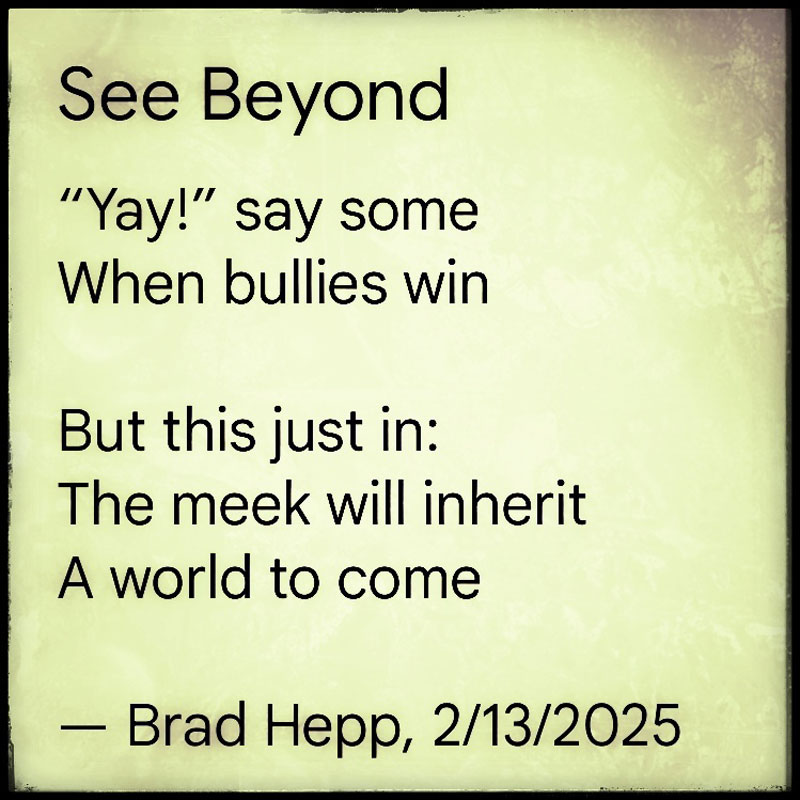
When I posted this on Facebook, I noted that “Sadly, this poem will anger some Christians.”
A new FB friend* responded, “If it angers believers, then they don’t want to follow the words of Jesus from Matthew 5. If they aren’t okay with this truth, then they shouldn’t claim to follow the way of Jesus.”
(if you are viewing this via email, the website has a recording of this poem and commentary; click the title above)
Commentary
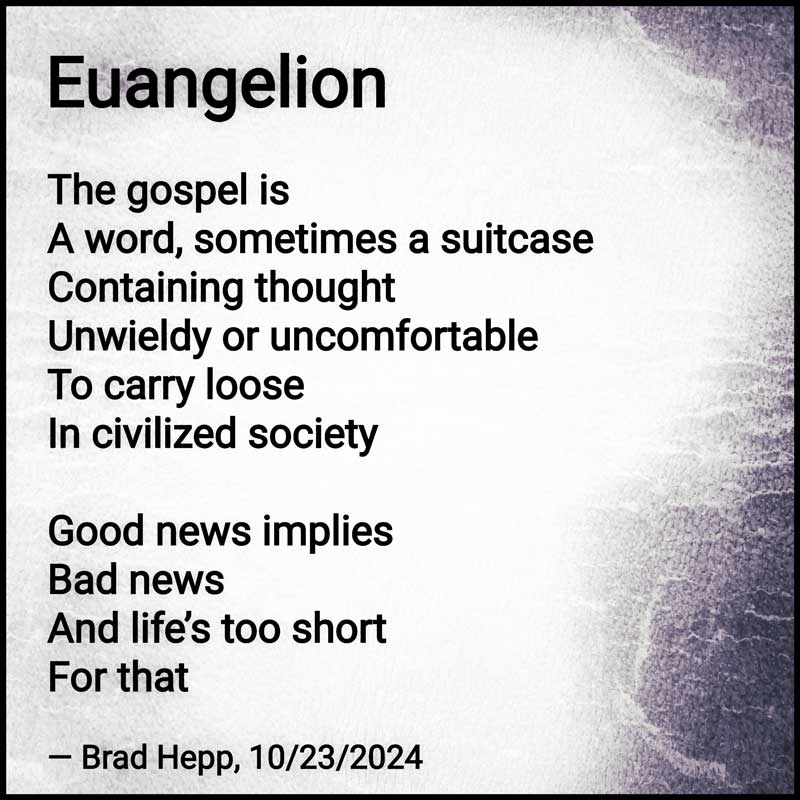
First, the occasion for this poem: I’m slowly working through Paul’s Epistle to the Romans, and I thought I should figure out if–and how–Paul actually defines the key word euangelion (usually translated “gospel” or more literally “good news”). He certainly goes a long way toward characterizing the word.
When I was a little boy, my father—ever the seminary professor—had no use for mere parroting. We’d read a passage of Scripture in family devotions, and then Dad would say, “Now put that in your own words.” I have written elsewhere how annoying that was… and how right he was!
Eugene Peterson would probably have done the same thing. He and Dad both knew that real understanding can be lost in overly familiar words.
If you do a search for “gospel” in the helpful (and FREE!) YouVersion app, you’ll find that most English versions choose that word–“gospel”–to translate euangelion (https://www.bible.com/search/bible?query=gospel). But specify Peterson’s “The Message” as the version in your query and you won’t find it used even once. Does that mean that Peterson didn’t value “the gospel”? I’m guessing the very opposite is true: It was because he valued the gospel SO MUCH that Peterson insisted on using his own words. He didn’t want its glory obscured by familiarity.
In this poem, I started out with the concept of words as suitcases of meaning. I began writing, and let the words take me where they would. As is often the case, it got a little dark.
If you ask around for people’s definition of “the gospel,” you’ll find there are different emphases concerning what the “good news” is about. Many will say it’s good news about God’s Kingdom. For some reason, I usually think of the gospel as “good news” about the availability of eternal life in a resurrected body in a restored creation. It’s very good news indeed! But that good news implies bad news, the news that apart from grateful reliance on God (my own words for “faith”), “life’s too short.”
(if you are viewing this via email, the website has a recording of this poem and commentary; click the title above)
Commentary
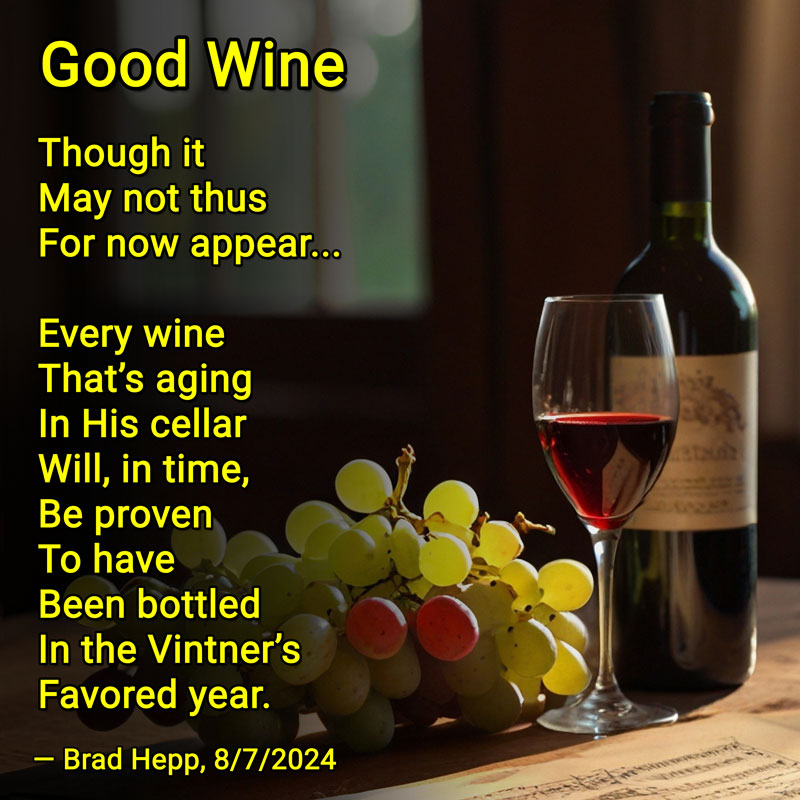
Do you ever feel like, “God isn’t pleased with me and never will be”? I suspect that is a thought that hangs over many of us, even those who are saved through faith in Jesus Christ. Well, every now and then, I just feel like saying “Go jump in a lake” to the accuser. In plain language, I suspect that in Heaven, God will express far more pleasure with us than Satan would have us anticipate.
There are two odd, but purposeful wording choices in this poem: 1) “be proven to have been” That could easily have been “prove to have been,” which would be far easier to read! But I wanted to steer clear of any mistaken notion that the “wine” will do the proving. It’s God who will prove anything. I can imagine Him saying “Here, look at this,” or “Here taste this,” or “Consider how this servant demonstrated my goodness.”
2) “favored year” was originally “favorite year.” But then I realized that was too exclusive, which was the opposite of my intent! More than one year can be favored. When God’s the one favoring, all the years can be favored. And again, “favored” suggests the year receives God’s grace and provision, not that it earns his approval. From my reading of Scripture, “favored” is closer to reality than “favorite.”
(if you are viewing this via email, the website has a recording of this poem and commentary; click the title above)
Commentary
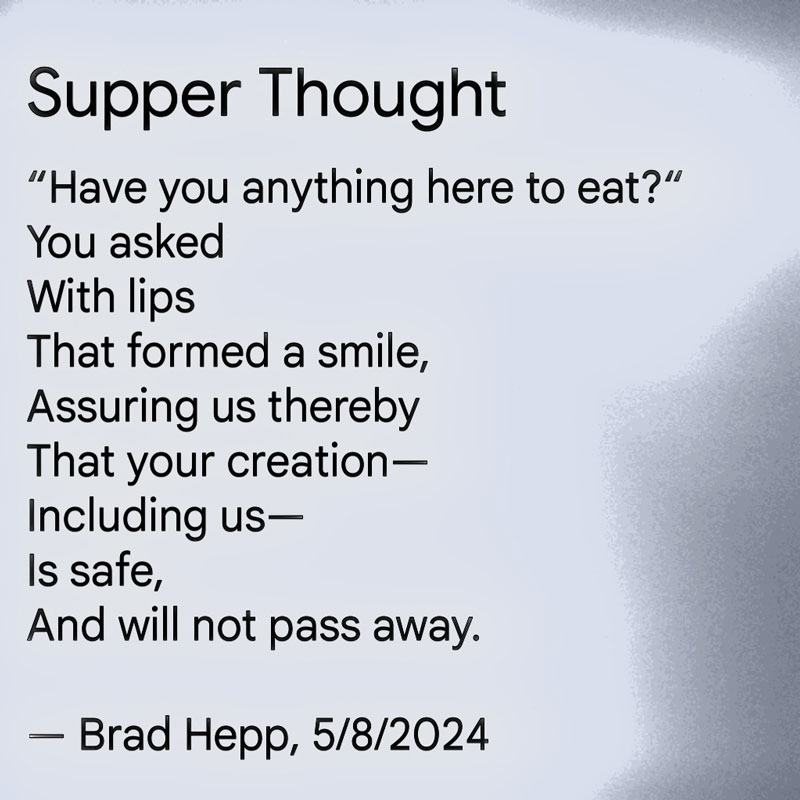
This poem was inspired by one of the accounts of Jesus’ interaction with his disciples after the Resurrection. Let me quote that at length:
While they were still talking about this, Jesus himself stood among them and said to them, “Peace be with you.”
They were startled and frightened, thinking they saw a ghost. He said to them, “Why are you troubled, and why do doubts rise in your minds? Look at my hands and my feet. It is I myself! Touch me and see; a ghost does not have flesh and bones, as you see I have.”
When he had said this, he showed them his hands and feet. And while they still did not believe it because of joy and amazement, he asked them, “Do you have anything here to eat?” They gave him a piece of broiled fish, and he took it and ate it in their presence.
Luke 24:36-43 (NIV)
I’m not going to write the book that could be written about this passage. For that, let me refer you to an excellent book I was reading when I wrote the little poem:
(if you are viewing this via email, the website has a recording of this poem and commentary; click the title above)
Commentary
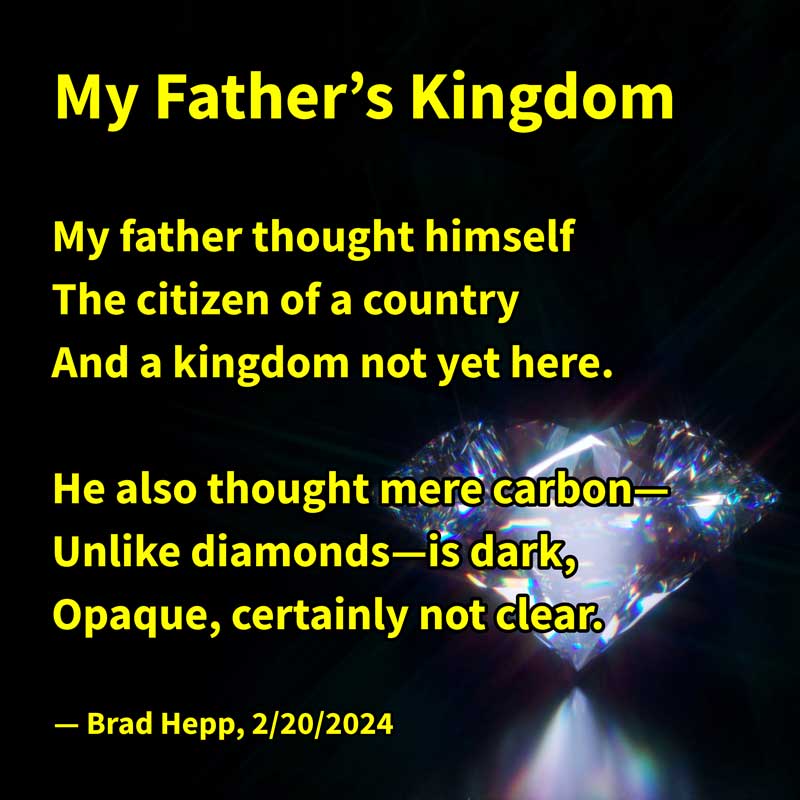
My father was a theologian who spent his entire adult life thinking and writing about the Kingdom of God. Was he right or wrong about the Kingdom’s current status? I don’t know.
Maybe it’s like the Queen in “Through The Looking Glass” would put it: “You think this is the Kingdom? I could show you a Kingdom compared with which you’d call this a pile of manure.”
(if you are viewing this via email, the website has a recording of this poem and commentary; click the title above)
Commentary
Slow music, even slow dance Are sometimes great But I’m sure you can relate: They’re not for me When I get up early And the night before, I stayed up late.
(if you are viewing this via email, the website has a recording of this poem and commentary; click the title above)
Commentary
This is one of those poems that seemed pretty good in the morning, but not so good later in the day. Oh well. I think its goodness–if any–is felt most keenly when you’re seriously contemplating the long wait for Jesus’ return. Below is what I wrote when I had just penned the poem:
In my crawl through Acts, I got to chapter 14. Here, Luke surprised me with one of his occasional references to Jesus’ direct participation in the “Acts of the Apostles.” The fact that I registered surprise got me thinking about this long period now where we’re waiting for Jesus’ return. How are we to think of his seeming absence? I know the usual answer; is there more?
Please notice something…. I don’t usually capitalize “divine pronouns.” In this poem, it seemed useful for exploring relationships.
(if you are viewing this via email, the website has a recording of this poem and commentary; click the title above)
Commentary
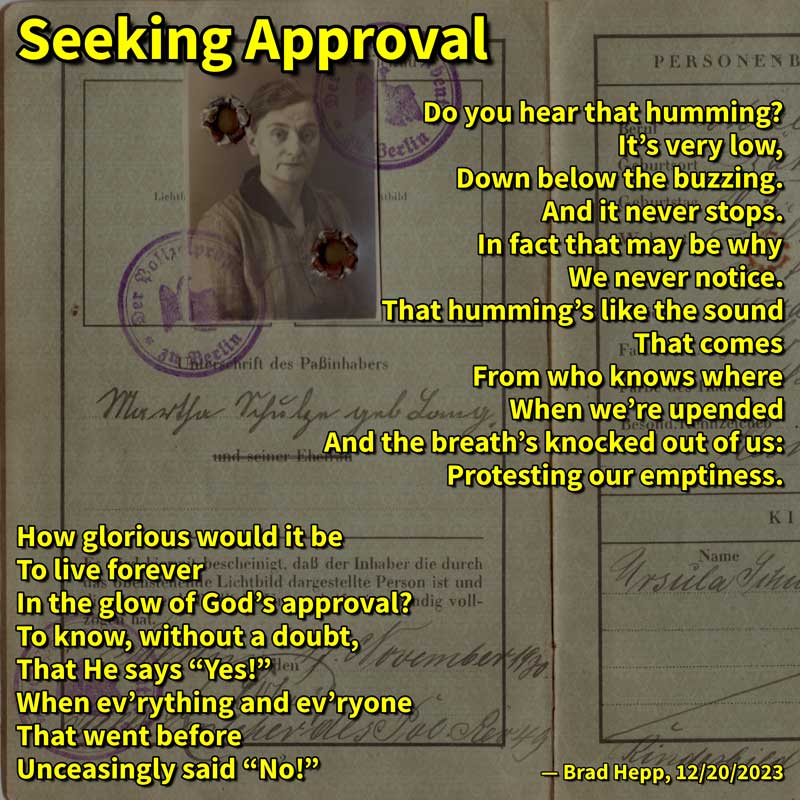
These days, I’m trying to get my head around Paul’s letter to the Romans. In the process, I’m trying to figure out how seeking glory is appropriate. What is glory? And what’s it like to attain glory? Is it “merely” God’s approval? It seems that would fall short of what we think of as glory. Or would it?
I know how horrible it feels to be accused, reproved, rejected. Can I imagine the opposite? This poem explores that notion. In short, I’m wondering if perhaps we all have a deep yearning for approval, and those who seek to satisfy that yearning by obtaining God’s approval are the ones Paul speaks of as seeking glory.
Consider these three verses from Romans 2:
To those who by persistence in doing good seek glory, honor and immortality, he will give eternal life.
Romans 2:7
[there will be] glory, honor and peace for everyone who does good: first for the Jew, then for the Gentile.
Romans 2:10
No, a person is a Jew who is one inwardly; and circumcision is circumcision of the heart, by the Spirit, not by the written code. Such a person’s praise is not from other people, but from God.
(if you are viewing this via email, the website has a recording of this poem and commentary; click the title above)
Commentary
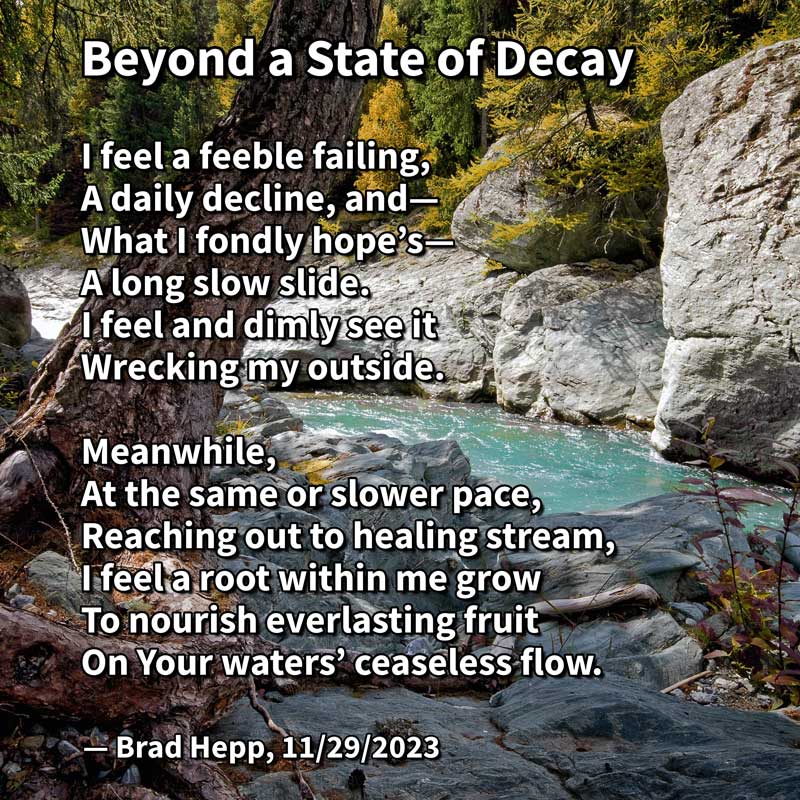
Here’s a little perspective on my rate of physical decay and spiritual growth. It was prompted by one of those slightly worried self-examinations: “Am I making any progress in becoming more like Jesus, or am I just fooling myself?” The answer–my answer, for what it’s worth–was this comforting poem.
AN EXCHANGE WITH SOMEONE VERY CLOSE TO ME HINTS AT THE CONTEXT:
THEM (regarding the poem): “Gut wrenching and amazing.”
ME: “Thanks. There’s something I really want to explore from my crawl through Acts. In giving his audience a summary of God’s dealing with Israel (Acts 13), Paul refers to Jesus’ resurrection as the fulfillment of His promise of a Son, who—unlike the first “son,” Adam—is no longer subject to decay. That, and any number of other reversals is what I look forward to in Eternity for myself and those I love.”
(if you are viewing this via email, the website has a recording of this poem and commentary; click the title above)
Commentary
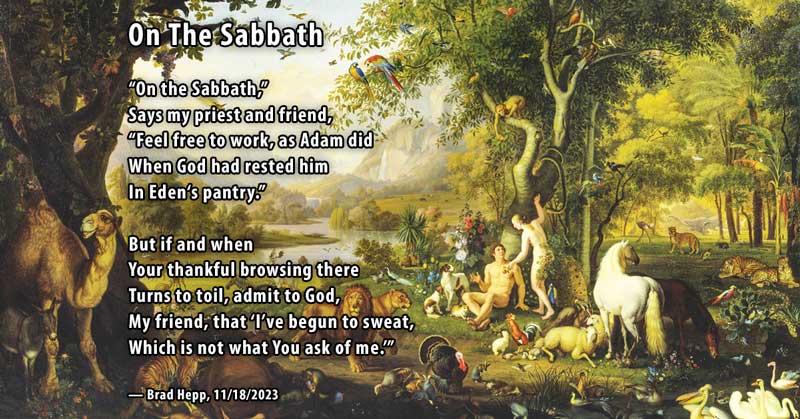
I’m going to lean heavily on the words of a theologian friend for this. Apparently, there are two words for “rest” that are often used in the Old Testament. One of those words is “nuach.” It was used in Genesis 2:15, where
The Lord God took the man and put him in the Garden of Eden to work it and take care of it.
Genesis 2:15
The words “put him” are that Hebrew verb nuach. (וַיִּקַּ֛ח יְהוָ֥ה אֱלֹהִ֖ים אֶת־הָֽאָדָ֑ם וַיַּנִּחֵ֣הוּ בְגַן־עֵ֔דֶן לְעָבְדָ֖הּ וּלְשָׁמְרָֽהּ׃).
The point my friend makes is that there is a difference between work–the kind of work that Adam did in the Garden before the Fall–and toil–the kind of work he did after the Fall.
The reference to sweat in this poem is misleading. As I understand it, we may sweat even when we’re celebrating God’s provision in Sabbath. Over the last several years, I did sweat a whole lot on the frequent long hikes that I took. But those hikes were as close as I’ve ever come to celebrating God’s provision in Sabbath. Because God had provided financially–was providing, and would provide–I was able to rest, to spend hours walking, thinking, listening through the Bible repeatedly, listening to many other edifying books, observing nature, and recording my observations. That’s when I began writing poetry… in those Sabbath hikes.
You can view my friend’s discussion of Sabbath here:
The background image for my poem is is a painting by 18th century artist Johann Wenzel Peter.
(if you are viewing this via email, the website has a recording of this poem and commentary; click the title above)
Commentary
By the end of his long life as a theologian, my father had concluded–like John Stott–that the Bible teaches what’s called “conditional immortality.” The comforting implication of conditional immortality is that men and women who do not accept God’s offer of salvation may suffer briefly at the Resurrection, but will not suffer for all Eternity. If you ask me, I’ll point you to his paper on the subject. I know how committed Dad was to the authority of Scripture, and to being intellectually honest. His paper on the subject is worth considering.
What Dad could not arrive at is Universalism–the eventual salvation of ALL people. That’s a position I and more than one of my best friends wish we could honestly arrive at. It’s what one of my main heroes in the faith, George MacDonald espoused.
This poem is an actual prayer. I have learned that poems in the form of prayer are read by God, if by nobody else. He knows how I struggle with this doctrine!
(if you are viewing this via email, the website has a recording of this poem and commentary; click the title above)
Stephen, full of faith, The Spirit, grace, and power, Served the Lord one glorious hour.
When Freedmen apprehended him, He spoke to them of Moses, Sent by God to set his people free.
He recounted how the Jewish slaves Rebuffed their would-be liberator, But let him lead them out, eventually.
Short-lived, this being led…. They got it in their head A cow could rescue them instead.
It’s no surprise, this people unwise Would not heed Moses when he said, “Watch for another like me to rise.”
Angry, the list’ners let rocks fly. Like risen Jesus, Stephen would die, A loud “Forgive them!” his final cry.
— Brad Hepp, 8/17/2023
Commentary
In my crawl through Acts, I just arrived in chapter seven, and pitched my tent there. This poem is an early reflection on what I’m seeing as I look around my new camping spot.
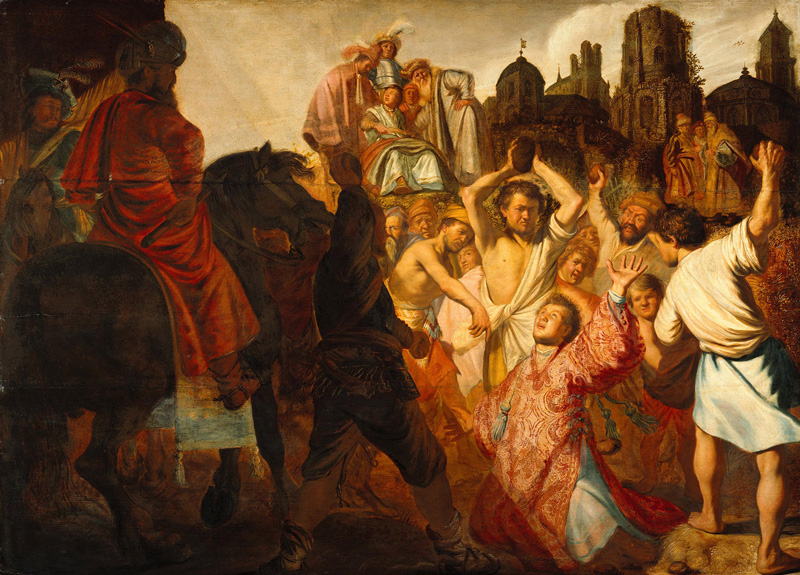
(background image is a photograph of Rembrandt’s “The Stoning of Saint Stephen.” That is one of Rembrandt’s earliest paintings.)
(if you are viewing this via email, the website has a recording of this poem and commentary; click the title above)
Commentary
I feel self-centered in the tears I shed at hearing of my friend’s death. I’m sad for his wife and children. But mainly, I’m sad for myself. Marco Ciavolino was one of my greatest, most faithful encouragers for over three decades. He knew how to point out my strengths, and downplay my weaknesses.
Back in seminary, Marco was recognized by students and professors as “Mr. Creativity.” I naturally attached myself to him, and spent many a long night working with him on his creative projects. While I was the beneficiary, he would never fail to recall our collaboration as though my self-interest were some kind of faithfulness.
Over the years, I could count on him calling me within minutes of my emailing or texting him with a question. From what I hear, that’s how he was with everyone (see Marco’s obituary).
So yeah…. I’m sad at my loss.
God, make me more like him.
ALSO THIS… Today, I was thinking of a crazy invention. There’s nobody who celebrated my crazy inventions quite like Marco. I WANT Eternity. I must have Eternity. Only in Eternity does Marco laugh approvingly. Only in Eternity does Jesus celebrate His little brother.
AND THIS: SURPRISED BY PIZZA (One of my many good Marco memories) Being stupid and forgetful has its charms. For instance, there was that Saturday afternoon many years ago….
I was working in my home office when the doorbell rang. I opened the front door, and there was the Domino’s guy, already removing a large pizza from his insulated delivery bag.
“Brad Hepp?” “That’s me.” “Here’s your pizza.” “I didn’t order pizza.” “Well, somebody ordered it for Brad Hepp and they already paid.” “Okay. Thanks!”
I set the pizza on the kitchen counter, wondering how this could have happened. Did I dare take a bite? What if someone was trying to poison me?
That’s when I remembered a phone call I’d had just 30 minutes before with my buddy Marco, who lives up in Maryland. Like me, he is a webmaster. He was calling to share the great news that he had just sold a domain name for $10,000.
“Wow!” I told Marco. “Congratulations!” Then I mindlessly added, “Pizza for everyone!”
(if you are viewing this via email, the website has a recording of this poem and commentary; click the title above)
Commentary
This evening, I texted what some might consider a disturbingly simple theological question to a trusted friend. He and I have talked about the good and necessary process of questioning a lifetime of assumptions. Sometimes, when you get old, you finally have the courage and wisdom to say, “WHY did I always make this assumption?” But then you realize there’s little time to come to new and settled conclusions. That’s why I wrote this poem. It doesn’t necessarily make sense. Actually, like the Preacher concluded, it doesn’t make sense at all apart from the prospect of eternal life.
(if you are viewing this via email, the website has a recording of this poem and commentary; click the title above)
I’m not your guy to explain eschatology (what happens in the future, according to Scripture). Frankly, I doubt anyone’s got that completely right. But one book I’m reading now fired up my imagination about the last trumpet, and what trumpets do—they gather.
Behold! I tell you a mystery. We shall not all sleep, but we shall all be changed, in a moment, in the twinkling of an eye, at the last trumpet. For the trumpet will sound, and the dead will be raised imperishable, and we shall be changed.
(if you are viewing this via email, the website has a recording of this poem and commentary; click the title above)
Commentary
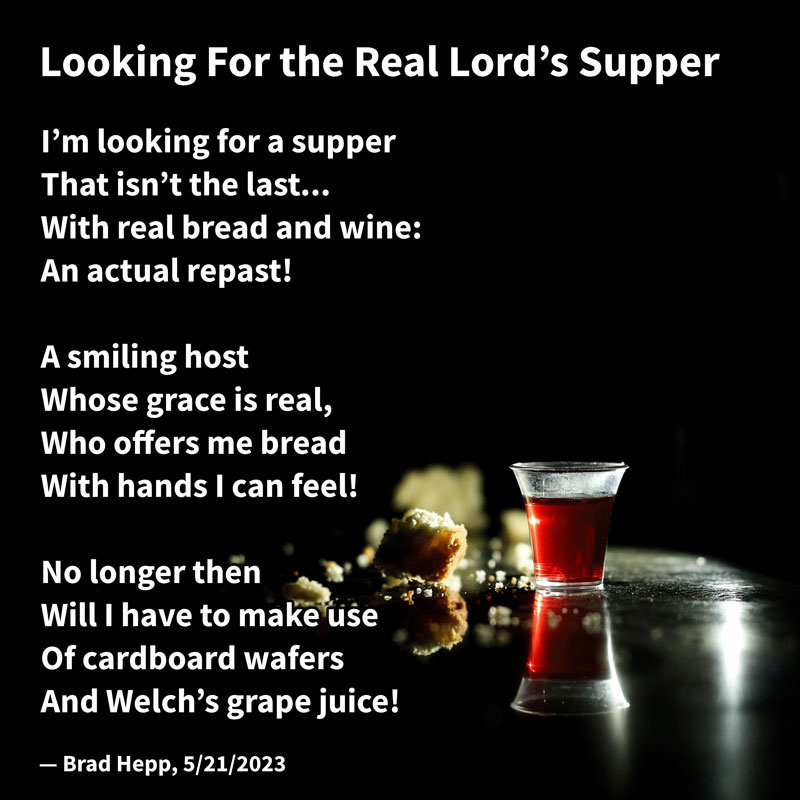
I serve two churches on Sunday mornings: a Bible church and an Anglican church. They both celebrate the Lord’s Supper each week. They do it differently. But in both cases, I think we must acknowledge—borrowing George MacDonald’s words—”the end of the Maker’s dream is not this.”
(if you are viewing this via email, the website has a recording of this poem and commentary; click the title above)
Commentary
I don’t know why I didn’t publish this back in April of last year. Maybe tomorrow I’ll wake up and remember why (maybe somebody will point out how knuckle-headed I am). Jesus’ radical identification with man, especially in suffering, changes everything. I love our Older Brother.
By the way, the preacher I refer to in this poem is one from long, long ago.
(if you are viewing this via email, the website has a recording of this poem and commentary; click the title above)
Commentary
“Beloved, we are God’s children now, and what we will be has not yet appeared; but we know that when he appears we shall be like him, because we shall see him as he is.”
1 John 3:2 ESV
I apologize for this poem’s opacity. It expresses a growing recognition of the gap between my story-reading and God’s story-speaking. As I told a new friend yesterday, my questions increasingly outpace my conclusions. Hopefully, God is pleased with this.
(background photo: 6:59 am, Monday, September 19, 2016; ascending La Plata Peak)
(if you are viewing this via email, the website has a recording of this poem and commentary; click the title above)
Commentary
I had a lot of this the last several years. And I’m better for it.
I suspect one reason God prescribed the Sabbath is so He can demonstrate HIS faithful provision. We tend to make it transactional: “Take this time off, and the reward is that you’ll be able to provide better for yourself by working harder and/more efficiently afterwards.” We say, “Here’s how I justify Sabbath….” I hear a murmur from the clouds: “They don’t get it yet!”
(if you are viewing this via email, the website has a recording of this poem and commentary; click the title above)
Commentary
ON THE PATH This early morning poetography is too personal, too idiosyncratic to be GOOD. But, like the dream from which I just awoke, it is TRUE.
The elements don’t go together for anyone outside my head. But for me, they all belong. I know when and where I took the background photo: December 22, 2019, west shore of White Rock Lake. I know what I was thinking then: I was beginning to recognize my judgmentalism, how unreliable I am in whether people are attractive or repulsive to me.
I’m still learning my place on the trail. What I think of—or feel toward—people I encounter on our respective paths is not what’s ultimately important.
THUS, THE TITLE: Wherever we go, See ourselves as sent: Not for our pleasure, but His.
(if you are viewing this via email, the website has a recording of this poem and commentary; click the title above)
Commentary
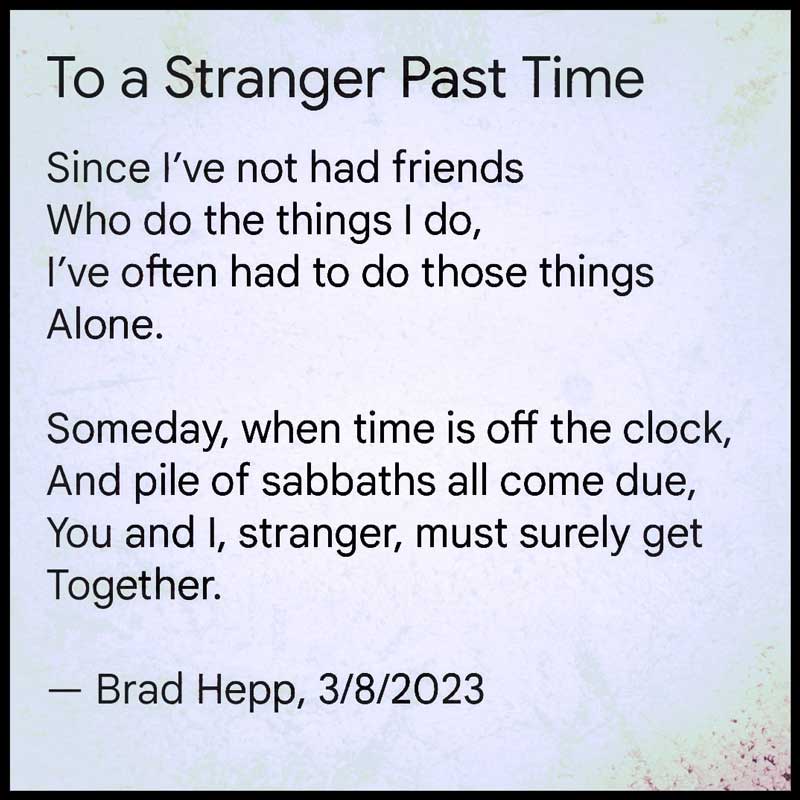
LUNCHTIME POETRY A coworker asked me how I spend my spare time. My answer felt weird and lonely.
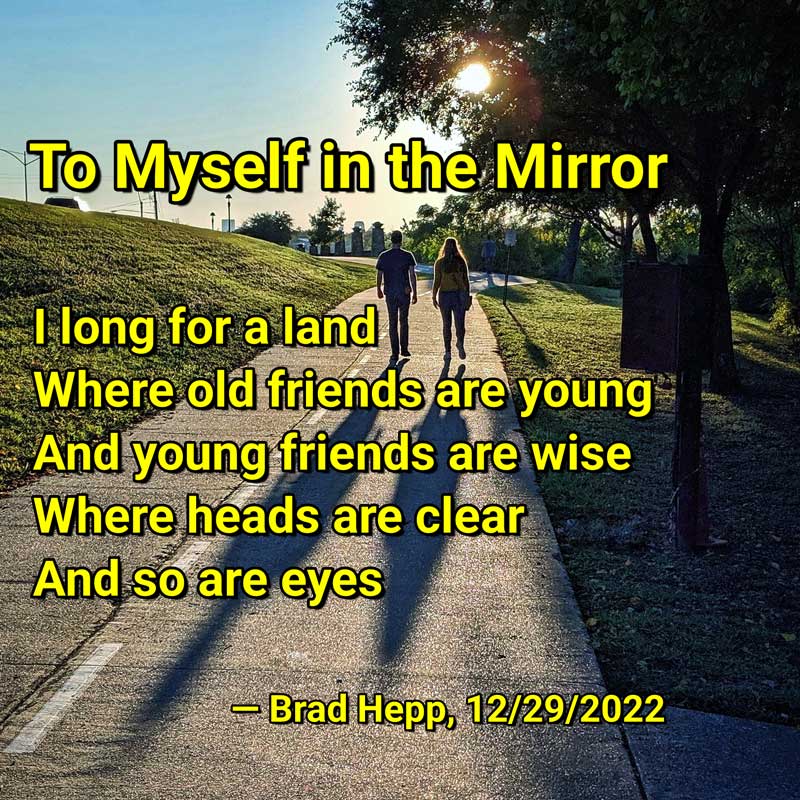
Thinking about this some more…. Actually, I DO have friends who enjoy things I enjoy (e.g., hiking, making music, photography), but I have failed to schedule doing these things WITH friends most of my adult life (especially after my 20s). I understand this is a common weakness of men. A counselor told me that men my age generally have very few close friends (he was surprised at the number I DO have). Plenty of acquaintances, sure, but they might as well be strangers. I had that in mind in the second stanza: we are sometimes strangers with those who could be friends, or are friends… close friends.
(if you are viewing this via email, the website has a recording of this poem and commentary; click the title above)
Commentary
I’m nearing the end of Michael Reeves’ “Delighting in the Trinity.” In the section I read this morning, he was trying to convince me that God’s love is not at odds with His wrath. I think Reeves might even say that God’s love and wrath are inseparable. I’ll have to keep thinking about this one, mainly by testing words in poetry.
To be honest, this is the sort of poem I might have written when I was young and thoughtless. The truth is that God’s wrath is something I don’t really understand. I think I understand his love, but not his wrath.
(if you are viewing this via email, the website has a recording of this poem and commentary; click the title above)
Commentary
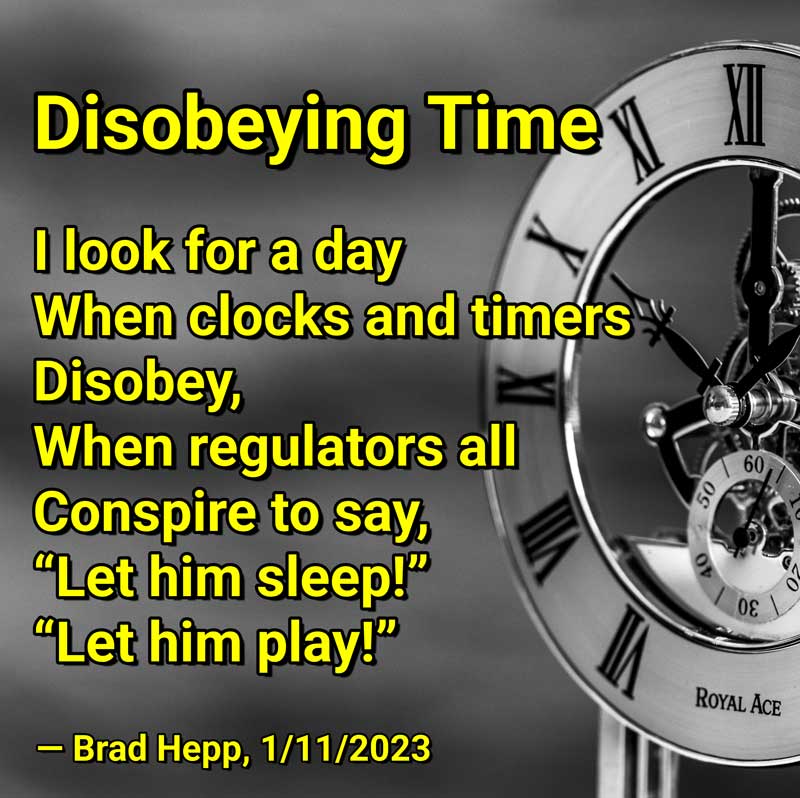
Most mornings, I set a timer on my phone for ten minutes. During that time, I read a chapter or two of some inspirational book while eggs cook in water that was brought to a boil. This morning, I was thoroughly enjoying reading Michael Reeves. Suddenly, I realized that I was in a magical zone of oblivion to the outside world, with no idea how much time had passed. My timer had failed to set. The eggs were fine, but I had to jot down this little poem.
(if you are viewing this via email, the website has a recording of this poem and commentary; click the title above)
Commentary
Now Jesus loved Martha and her sister and Lazarus. So, when he heard that Lazarus was ill, he stayed two days longer in the place where he was.
John 11:5-6 ESV
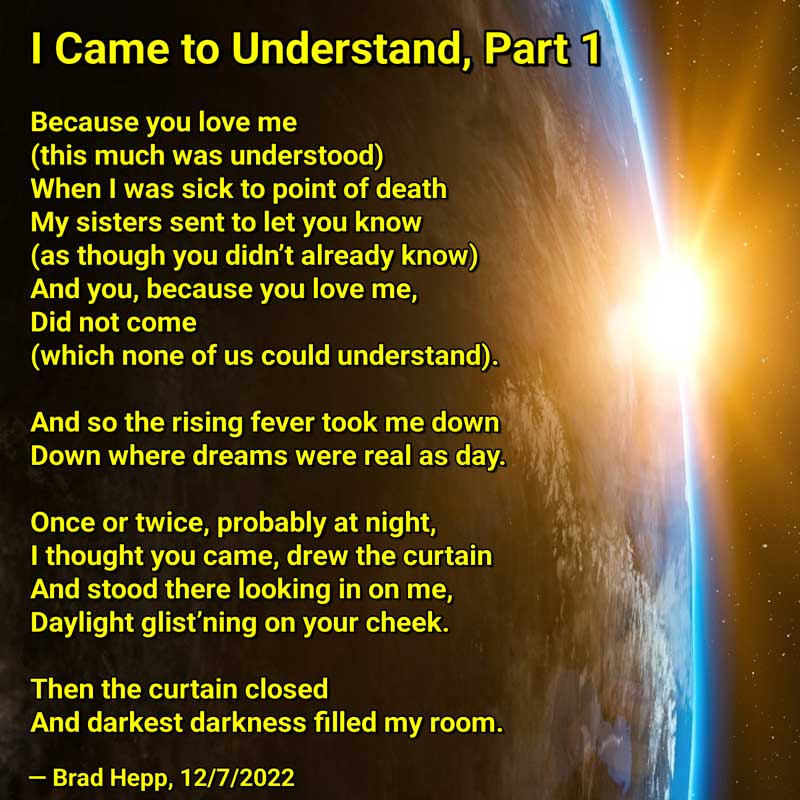
This morning, my crawl through John got me to chapter eleven. If it has been a while since you read that chapter, I urge you to read it now. You’ll realize that Jesus was about 20 miles (a good day’s walk) from Lazarus, and his sisters. That raises the question: why did Jesus stay where he was after being told that Lazarus was sick? John’s word choice is curious. He writes, “So he stayed two days longer.” You or I might have written “But he stayed two days longer.”
What I’m beginning to explore in this poem is the relationship between Jesus’ love for Lazarus and his staying away when he was summoned by Lazarus’ sisters. The question is an old one: “How does a loving God let his creation suffer?”
You’ll see that most of my poem is pure speculation, call it sanctified imagination. What was Lazarus experiencing as he neared death? What was actually happening?
I think I know where part two will land: On the shore of glory and love (then we’ll understand)
(if you are viewing this via email, the website has a recording of this poem and commentary; click the title above
Commentary
Here’s how I posted this on Facebook:
WITH SINCERE APOLOGIES TO ALL This opaque poem is an attempt to capture how many of us—maybe all of us—think of the fleeting now as all that matters.
In my crawl through John, I’m repeatedly impressed that Jesus is more interested in his listeners’ eternal life than they are.
The preacher said that God sets eternity in our hearts (Ecclesiastes 3:11). More often than not, we chase it out.
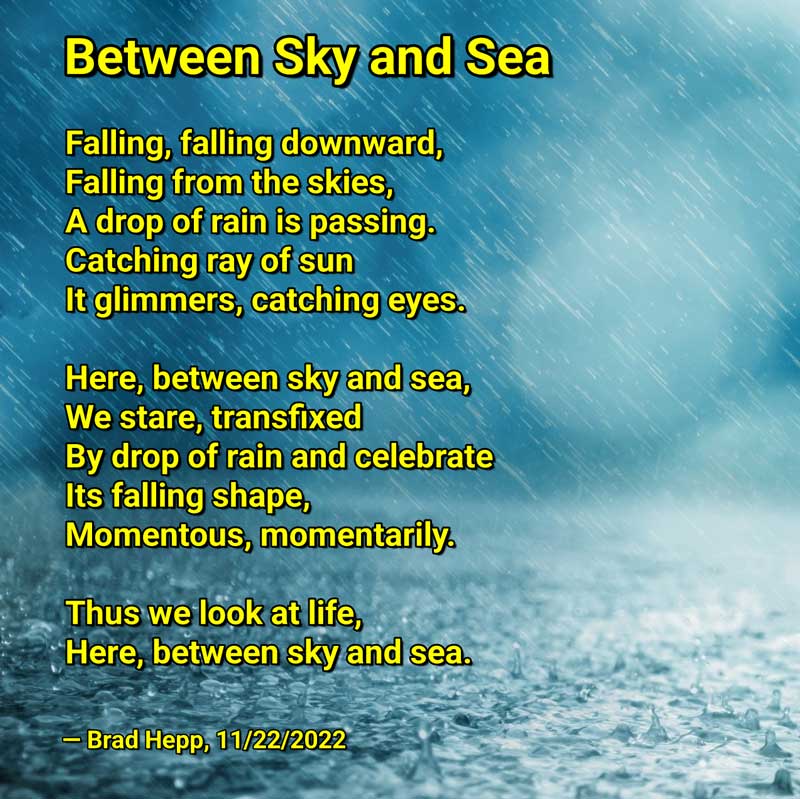
PERHAPS APOLOGIES WERE NOT REQUIRED I’ll probably never understand how others respond to poetry. There are poems I think are really good, but I know in advance that nobody else will respond to them–and I don’t blame them! I also publish poems that I’m not especially proud of, and they get a lot of positive response. I couldn’t tell with this poem. It seemed rather opaque (thus the apology). But I was honoring my intuition about repetition and line breaks. Here’s an example of the latter: “By drop of rain” was originally a continuation of the preceding line. So it was “We stare, transfixed by drop of rain.” Then, I thought, “Creating a new line elevates what’s on that line.” And I wanted to elevate the disconnect between the transience of the thing–“drop of rain” and “momentarily” on the one hand–and our response to it–“celebrate” and “Momentous” on the other hand. If my intuition about line breaks is right, then others WILL respond positively, whether or not they stop to identify what’s happening.
(if you are viewing this via email, the website has a recording of this poem and commentary; click the title above)
Commentary
In a sidebar of “Rejoicing in Christ,” Michael Reeves writes about the English Reformer John Bradford. He says, “Most Christians take mealtime as a chance to thank God and remember him as their provider, but Bradford saw every part of the day as a gospel reminder.”
That seems like a fitting response to God’s ubiquitous poetry.
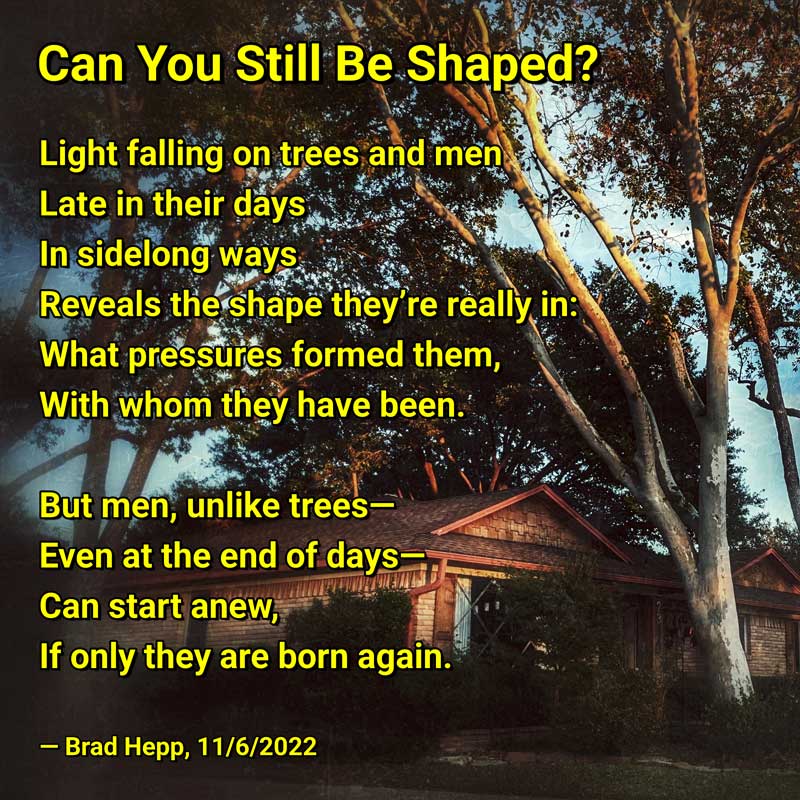
About the Background Image Two blocks over from where I live, there is a house with a tall, elegant sycamore. That’s the kind of tree that surrounded our house in East Texas. I thought they were fairly common, until I began looking for one to photograph for another poem. That’s when I discovered how rare they are, at least in Dallas.
This afternoon, as the sun set at its new, ridiculously early bedtime, I was out for a walk, and noticed how beautiful the light was. As I walked, I was supposedly listening to King David’s Psalms. But my mind was also occupied with how I myself should respond to beauty around me.