(if you are viewing this via email, the website has a recording of this poem and commentary; click the title above)
Commentary
I got a call late last night from a friend who—like me—struggles with righteous anger. When is it appropriate? What do we do with it? To what extent can we cooperate with vile men?
So this morning, I got up and re-read Psalm 37, which strikes me as one likely inspiration for Jesus’ statement that the meek will inherit the earth. That Psalm may clarify what it means to be meek. It doesn’t mean giving up on justice; rather, it means knowing by whom justice will surely be secured.
Psalms 37:10-11 NIV:
[10] A little while, and the wicked will be no more; though you look for them, they will not be found. [11] But the meek will inherit the land and enjoy peace and prosperity.
(if you are viewing this via email, the website has a recording of this poem and commentary; click the title above)
Commentary
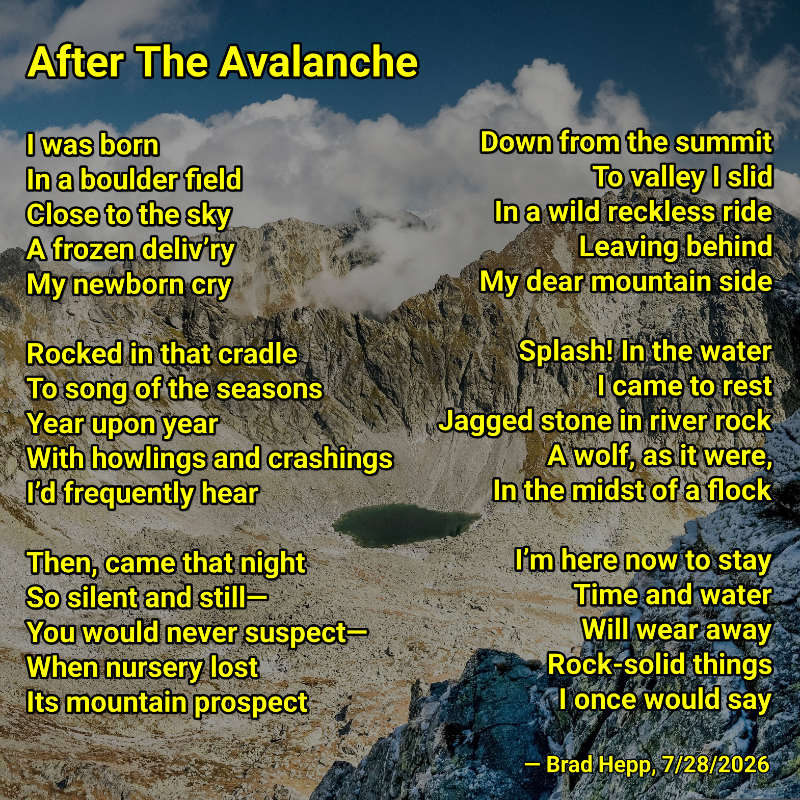
I APOLOGIZE This poem took on a silly, maudlin tone as I forced the rhyme pattern. That’s unfortunate. The inspiration was serious contemplation of how slowly I conform to new ways of thinking. The picture I meant to develop was of sharp granite being smoothed by running water after leaving its “birthplace.”
Here’s a case in point…. The more I write poetry, the more I realize I have tended to interpret Scripture with wooden-headed literalism. I wish to be more thoroughly poetic in my reading, as in my writing. But—and here’s my main point—I recognize that the necessary mental transformation is inevitably slow. So, I must be patient with myself.
(if you are viewing this via email, the website has a recording of this poem and commentary; click the title above)
Commentary
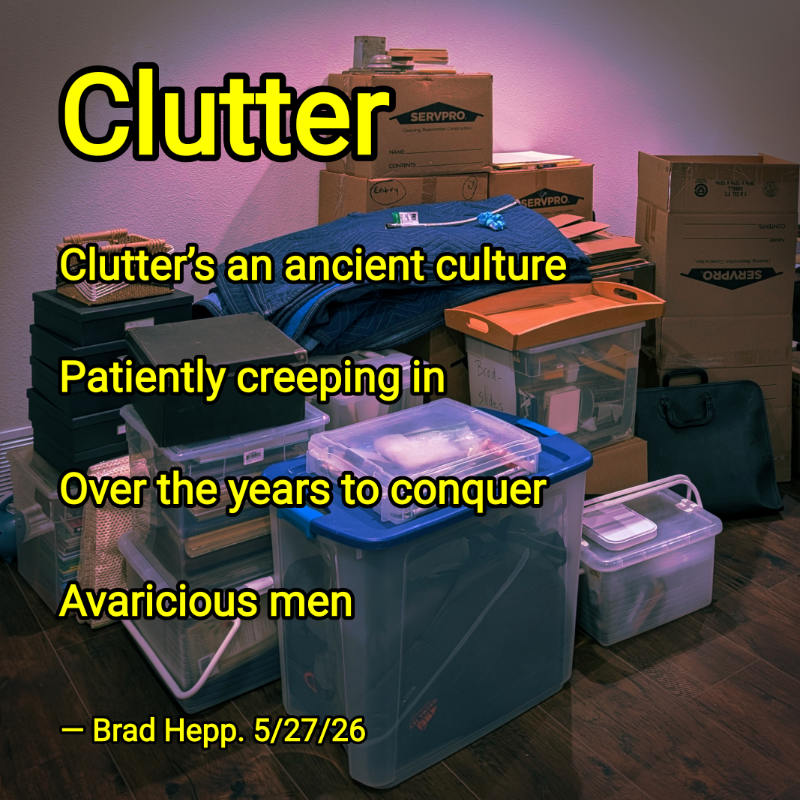
This poem goes in my “After Fire” series. It was suggested by the frustration of unboxing all our “stuff” in an erstwhile clean and tidy restored house.
My father warned me against “using big words when little words will do.” So I apologize for “avaricious.”* “Acquisitive” is arguably milder, though still a “big” word. I’d have chosen that adjective if it fit the poem.
Let’s be honest, it doesn’t matter how much money we make…. Most of us in our U.S. culture DO struggle with avarice.
The notion that ancient cultures have patience to conquer was suggested to me by recent news of America’s conflicts with Persia and China.
________
*Dictionary.com defines avaricious as “an adjective meaning having or showing an extreme, insatiable desire for wealth or material gain. It describes someone who is aggressively greedy, grasping, and often miserly—prioritizing the hoarding of money or possessions above all else.”
(if you are viewing this via email, the website has a recording of this poem and commentary; click the title above)
Commentary
This is probably true of everyone, but it has always pained me: I retain a small fraction of what I learn, and put an even smaller fraction to good use. What’s the solution?
(if you are viewing this via email, the website has a recording of this poem and commentary; click the title above)
Commentary
Every morning when I read the “Daily Office” (an Anglican thing I’m learning to use), I’m presented first with Malachi 1:11
For from the rising of the sun to its setting my name will be great among the nations, and in every place incense will be offered to my name, and a pure offering. For my name will be great among the nations, says the Lord of hosts.
I love passages like this, and hints in John (and elsewhere) that Jesus’ being glorified was tied to an ingathering of people from every nation.
I’m impressed that God cares for the foreigner, and wants believers to follow His example.
But nowadays, there are Christians(?) in the United States who think righteousness includes hating foreigners. I wonder if they read about God hating Esau and feel none of the tension that inspired my little poem?
NOTE: I know that teachers will generally downplay the “hating” of Esau as merely God *choosing* Jacob instead of him. But mere choice doesn’t describe what God does to Esau and his descendants (see the first few verses of Malachi).
(if you are viewing this via email, the website has a recording of this poem and commentary; click the title above)
Commentary
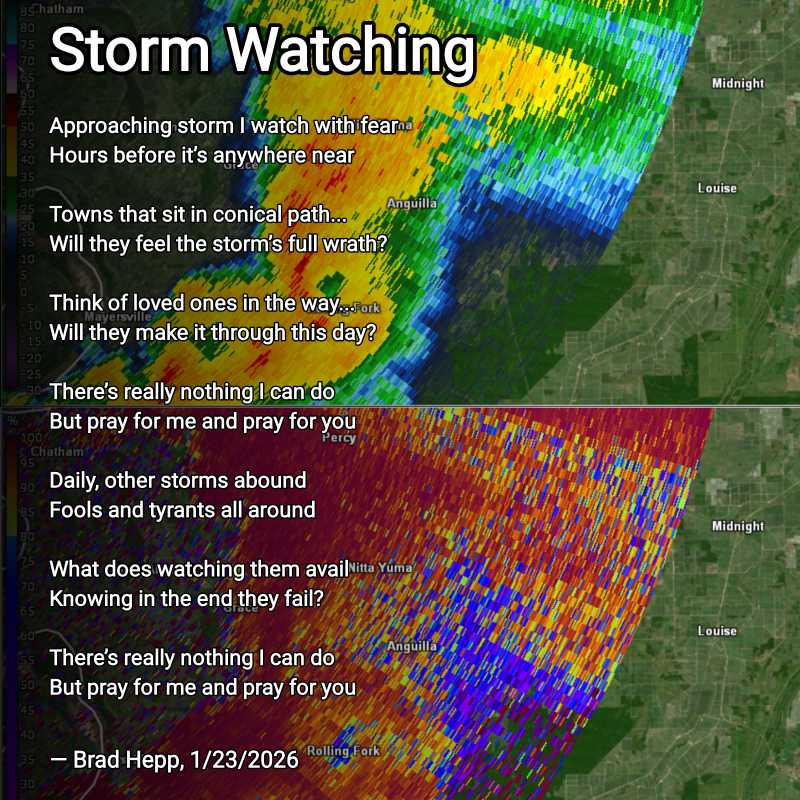
I’m struggling with mental and emotional exhaustion caused largely by being hyper aware of current events on the national and international stage. And I’m torn…. As a citizen in a representative democracy, I have some responsibility to be aware of what’s happening and to exercise what little power I have to influence the course of events. But just how much do I need to know? How often should I check the news? I strongly suspect the world—and certainly I—would be better off if I concerned myself less and prayed more, if I occupied myself more with beauty and less with ugliness.
(background image, from Wikimedia Commons, is of radar tracking of the Rolling Fork, MS EF4 tornado)
(if you are viewing this via email, the website has a recording of this poem and commentary; click the title above)
Commentary
At first, I thought I’d title this poem “Gordon’s Not.” Let me explain….*
On a vacation day last week, I luxuriated by “sleeping” in. Before making my celebratory breakfast of biscuits and gravy, scrambled eggs, and pork sausage, I lay in bed watching a documentary about Gordon Lightfoot. The opening of that documentary is startling. An aged Gordon Lightfoot is explaining why he deeply regrets the words of one of his early hits: “For Lovin’ Me.” He explains that he was young, naive, and chauvinistic when he wrote it. As the documentary continued, I came to realize that I had never thought deeply about Lightfoot’s words in this and other songs. I had always just been mesmerized by his voice. That voice made everything he sang seem wholesome and true. But the man who wrote the words and sang them was not so wholesome, not so true! The documentary didn’t ruin his songs. But it was a reminder that a “a man may smile and be in pain” (Proverbs 14:13).
So, I finished the documentary, fixed my breakfast, and sat down to eat. That’s when I reflected on what I had just learned: Gordon’s not what you may have thought.
Does that shed light on my little poem?
_______________
*I make the common mistake of misremembering “Gordion Knot” as “Gordon’s Knot”
(if you are viewing this via email, the website has a recording of this poem and commentary; click the title above)
Commentary
The jury’s out on this one. I woke up the morning after posting it and thought, “Did I really write that?” For lack of a better category, I have put it under the themes “Experimental,” and “Self-Examination.”
Part of the problem is that I do not recall the context of this passing thought. Clearly, it struck me with enough force to elicit some lines of poetry. I think I must have been worried by the thought’s emptiness, its meaninglessness.
When you attend the theater of the absurd, then exit and encounter more absurdity outside, it warrants mentioning… or writing a few lines of poetry.
(if you are viewing this via email, the website has a recording of this poem and commentary; click the title above)
Commentary
Here’s a weird one, I know. It popped out of my mind as I listened to a haunting rendition of “Love Story” on trombone. I’ll not ruin music for you by spelling out the connection between what I heard and what I then wrote.
How can I defend writing something so strange? Well, I’ve noticed over the years that when I’m sitting under even the best teachers, I sometimes articulate questions that wake up my fellow listeners. It’s funny: I’ll ask a question, and two or three minutes later, someone else—who was asleep—asks the same question, as their mind clicks into action. When YOU read this poem, does it awaken anything finicky or easily grossed-out in your psyche? Perhaps you can then share my reliance on a patient, understanding Creator—a Creator who clearly likes messy, slobbery MATTER.
(if you are viewing this via email, the website has a recording of this poem and commentary; click the title above)
Commentary
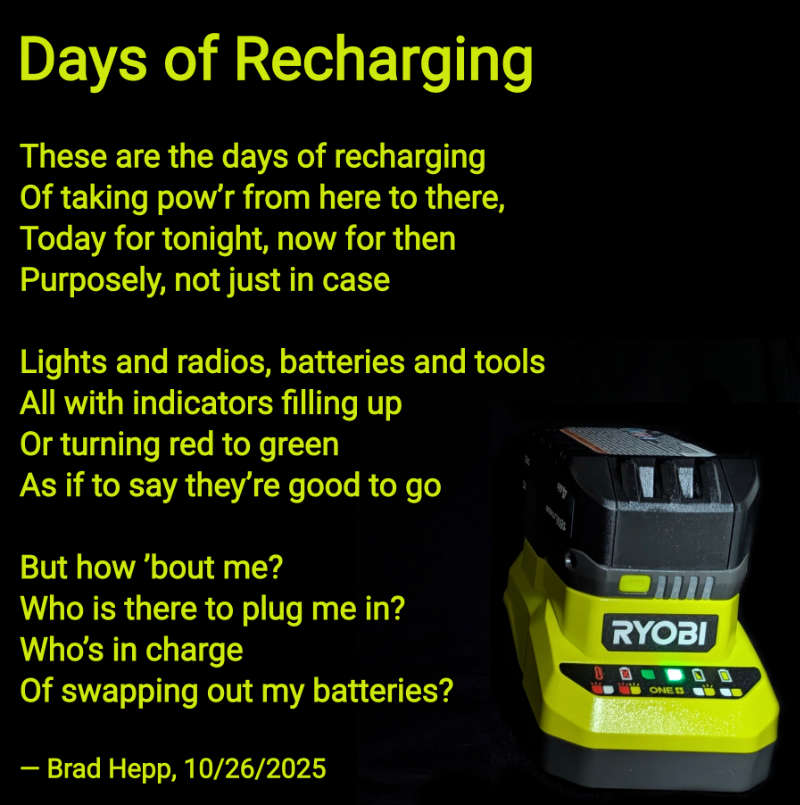
[I have written this up, but decided it’s unwise to post the full explanation at this time; suffice it to say that this belongs in my “After The Fire” collection]
In my poem, I leave the question hanging out there: who is recharging ME? An unanswered question makes some people feel uncomfortable. I’m sure the day of answers will come.
(if you are viewing this via email, the website has a recording of this poem and commentary; click the title above)
Commentary
I don’t set out to write seven-line stanzas. It just happens. How can I pretend to understand the mind of others, when I don’t understand my own? What I DO know is that selfishness and self-centeredness threaten any and all understanding of truth. God have mercy!
(if you are viewing this via email, the website has a recording of this poem and commentary; click the title above)
Commentary
The other day, I was in the living room of a friend. As we talked, I looked over at his bookshelves, and half of one shelf was devoted to books by the biographer William Manchester. Right in the middle was the three-volume biography of Winston Churchill, entitled, The Last Lion. That’s when I recalled with chagrin that I had mistakenly told someone recently about listening to the three-part “Last Lion of Manchester” (as though Churchill was from Manchester). I understand much of what I listen to or read, but accurately retain only a fraction of it. Despite this intellectual weakness, I feel compelled to write poetry, and harbor the fond hope of evoking important thoughts in others. It CAN happen, but only as God uses weak things to achieve powerful results.
(if you are viewing this via email, the website has a recording of this poem and commentary; click the title above)
Commentary
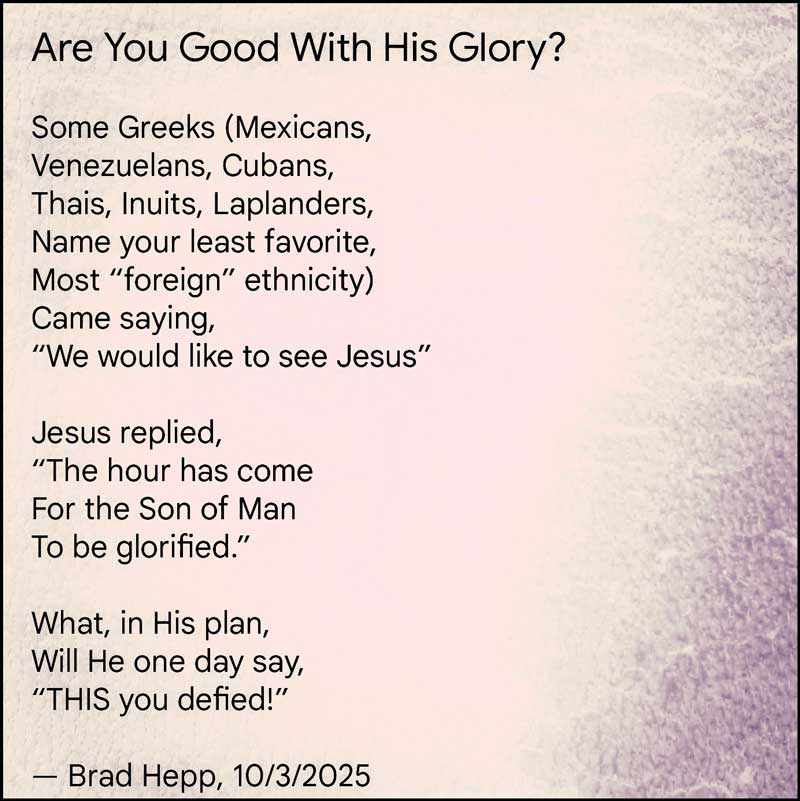
One of the most challenging, seeming non-sequiturs in the Gospels occurs in John 12. Why did Jesus care that Greeks wished to meet with Him? Do we? Or are we just looking out for “OUR PEOPLE” (“us,” but especially ME, MYSELF, and I… the unholy trinity)?
(if you are viewing this via email, the website has a recording of this poem and commentary; click the title above)
Commentary
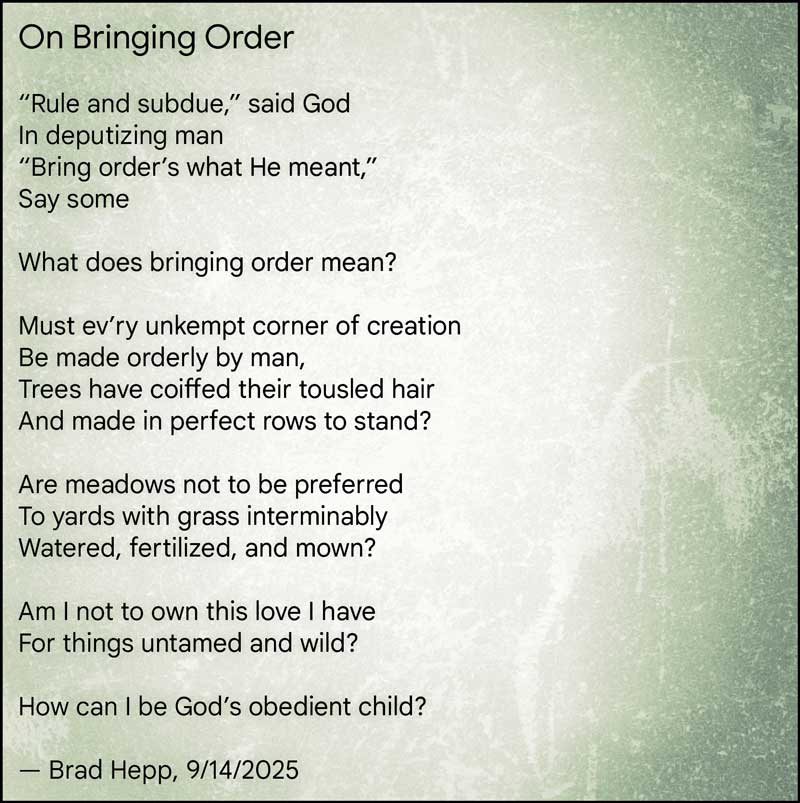
This poem explores implications of John Walton’s view of the “rule and subdue” mandate in the Genesis creation account. Here’s his view (from what seems like a good AI summary): “For Walton, therefore, the ‘rule and subdue’ mandate is humanity’s active participation in God’s ongoing work of bringing and maintaining order. The world is not ours to dominate, but God’s cosmic temple to be managed on his behalf.”
I like Walton’s attempt, but I’m having trouble understanding how man could be expected to bring any meaningful degree of further order to Earth, much less to the cosmos.
I suspect that Walton’s understanding of “rule and subdue” (as meaning “bring order”) leans heavily on his understanding of the context. On the other hand, I haven’t studied the Hebrew words in other contexts, so my suspicion is pretty flimsy.
When I posted the poem, two of my more savvy friends commented:
What if dominion isn’t as controlling as we like to think, but rather tending to the unique natural beauty, form, and function of God’s beautiful world. Prune here. Clear there. Thin elsewhere, taking part in how it’s shaped.
(This, of course, could apply to every sphere of authority.)
–Laurie Pearce Mathers
I agree. I think the best word is “stewardship.” And yes, our ability to steward well is surely hampered by the fall, but also, I hope, helped by the ongoing work of redemption.
Christine Renee Hand Jones
GETTING PERSONAL My interest in this subject isn’t just academic. We’re living in an apartment right now while our house is being restored after a fire broke out because a dying pecan tree dropped a limb on the electrical service. One could say I was negligent, since that pecan had dropped all its leaves. I could push back that the tree dropped all its leaves in the summer of a previous year and then roared back to life the following year, so I did not KNOW for sure that it was dying. But a look around the back yard would confirm that I am not the neat freak I once was. There is more disorder there than I’d have allowed when I was younger. Without going into details, I’m going to chalk that up to the down side of some healthy developments in my life. Put simply, I’m a recovering perfectionist. Order isn’t as important to me now as it used to be.
(if you are viewing this via email, the website has a recording of this poem and commentary; click the title above)
Commentary
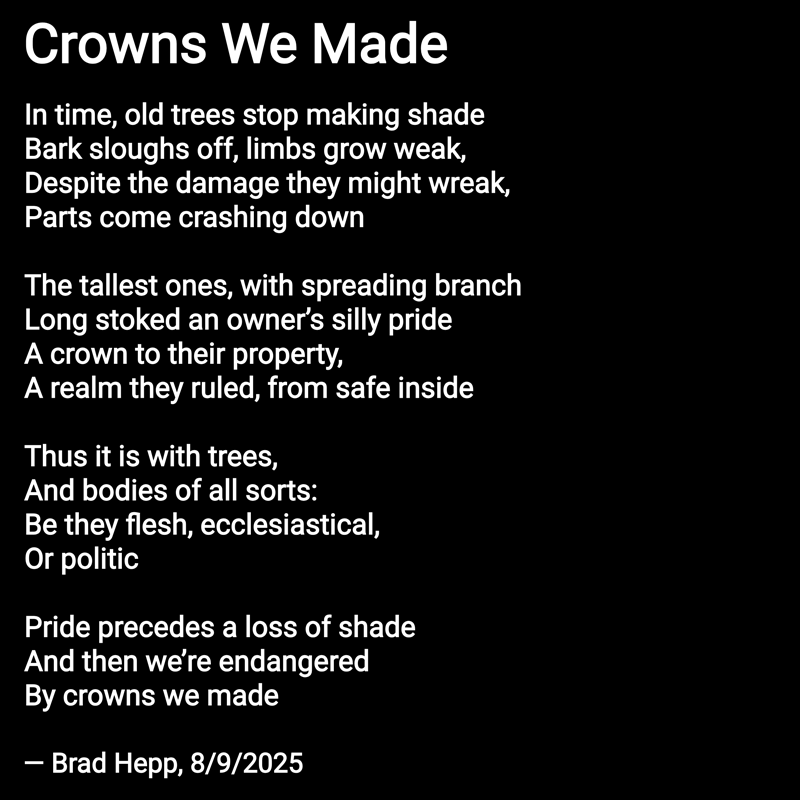
A more autobiographical poem has never been written. Like most of my white on black poems, this is the product of a dark night. It’s this simple: either in the middle of a sleepless night, or when I give up sleeping before dawn, I write a poem. My phone (where I write poems) is still in dark mode. That means white text on a black background. Sometimes I just do a screen capture and post. Other times, I recreate the effect in an editing program. The dark scheme seems appropriate.
Autobiographical This is one of the poems I wrote after a branch fell on our electrical service and caused a fire in our house. You can probably see the connection to that in the poem. But there are other things that I have to give up as I grow in wisdom and humility. That’s what I mean by “bodies of all sorts.”
The accuracy of the last stanza is debatable, but worth contemplating.
Here’s a picture of one of our actual old trees. Later this week, we’re meeting with an arborist to talk about that tree’s future.
(if you are viewing this via email, the website has a recording of this poem and commentary; click the title above)
Commentary
I am trying to capture my thoughts and impressions of moving into temporary housing after our home of 31 years was partially destroyed by fire. One night in friends’ houses, three nights in the home of a vacationing church family, eleven nights in a hotel, and—finally—moving into an apartment for the months to come…. It’s a recipe for broiled impermanence, for a taste of dwelling—but not indwelling.
Soon after we moved into the apartment, I reported maintenance issues to management. I had to wonder why the tenant who just moved out had not complained about an inoperable dishwasher, an obviously clogged dryer vent, and a stuck shower diverter. From the mail that continues flowing into the mailbox, I gather she was a young woman. Naturally, she would not have had the maintenance savvy and expectations of a 65-year-old homeowner. At my request, management jumped right on making repairs. In contrast, the young lady must have suffered in silence— living here, but barely.
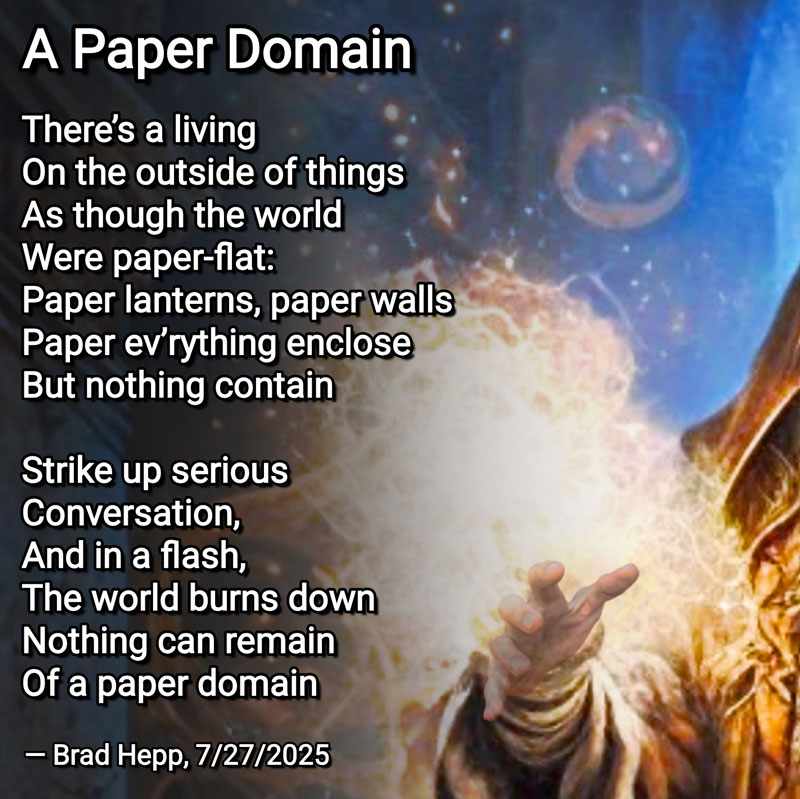
Our relationship with dwellings can serve as a metaphor and extension of our relationship with solid, abiding truths. If we don’t inhabit them fully, they are vapid, meaningless, and empty.
THREE TRICKY THINGS IN THIS POEM:
1). The sixth line of the first stanza has a word—“ev’rything”—that is doing double duty. It’s the subject AND the object.
2). In the second stanza, I’m picturing the flat, minimally inhabited world as a magician’s flash paper. From an AI overview:
“Flash paper, also known as nitrocellulose paper, is a type of paper that burns quickly and completely, leaving behind no ash or residue. It’s primarily used by magicians for dramatic effects in performances.”
3). Conversations reveal one’s depth… or lack thereof. When a shallow person engages in serious conversation, their world is revealed to be as insubstantial as a magician’s flash paper. I am blessed with family and friends of a better sort. Recently, I got together with my friends Jim and Darol at a wedding reception. Our conversation plunged immediately into deep waters. You would never guess it had been months since we had last seen each other. We had been longing to talk with a friend about the interior life, about living in homes richly furnished for eternity.
(background image cropped from one by Gordon Taylor on Pixabay)
(if you are viewing this via email, the website has a recording of this poem and commentary; click the title above)
Commentary
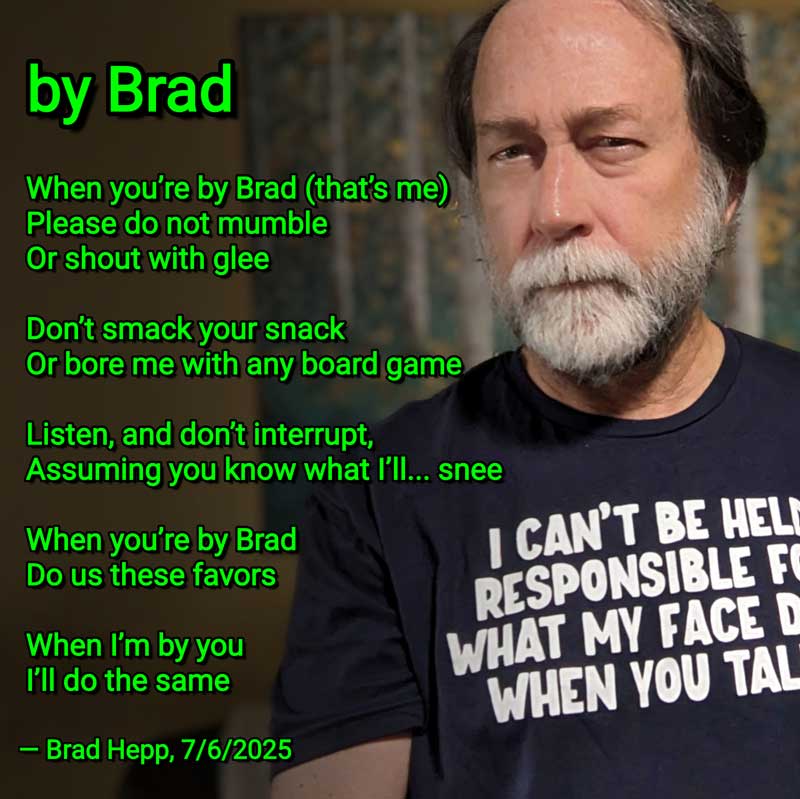
This poem is just poking fun at myself for what I described to a friend as my IBS. That’s irritable brain syndrome.
The Shirt One of the most thoughtful gifts I’ve ever been given was the shirt I’m wearing in the background image. By giving it to me, my friend Sten-Erik said, “Your face gives away everything you’re thinking. And we still love you.”
Snee I meant to come up with a nonsense word… something, anything other than what someone talking with me might assume I’d say at the end of that sentence. So, if you go look it up, don’t try to make sense of how it fits in the poem. That’s not the point. Rather, the point is “Hear me out, and don’t interrupt when you don’t know what I may say next!”
I have some friends who are spectacularly good listeners. See this poem I wrote about one of them: Silence, The Lingering Wisdom.
(if you are viewing this via email, the website has a recording of this poem and commentary; click the title above)
Commentary
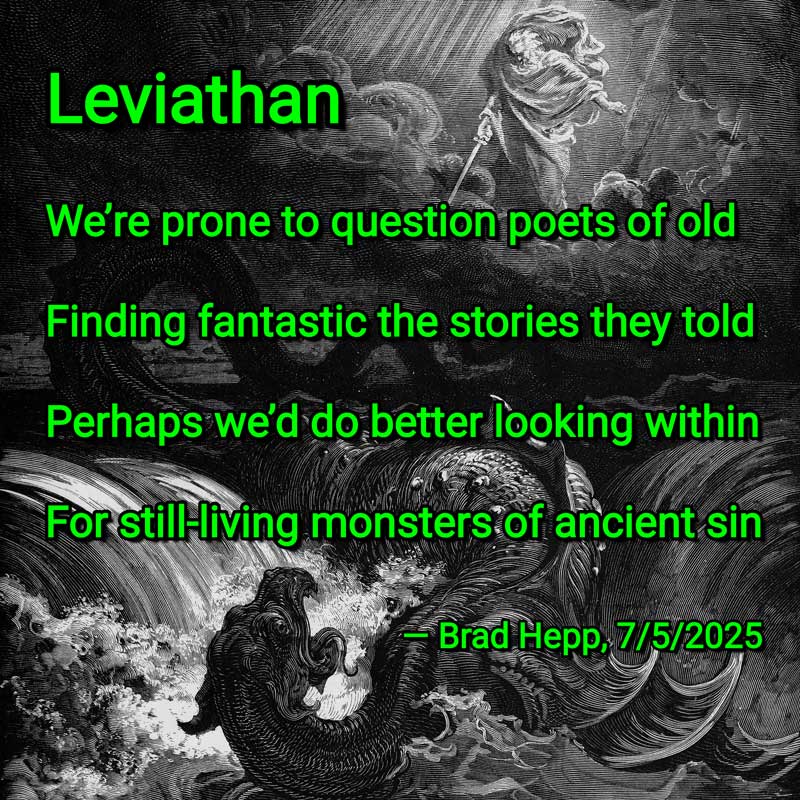
I sometimes joke that I’m a “wooden-headed literalist.” There’s some sting in the joke because it’s partly true. Combine having one foot “on the spectrum” (self-diagnosed), and another in a background of fundamentalist and dispensationalist thinking, and literalism is my unfortunate tendency. I struggle—am struggling—to properly appreciate the work of fellow poets from millennia past, as recorded in the Old and New Testaments. To correct this tendency, I have begun reading authors like Peter Enns and John H. Walton. Eventually, I’ll probably get to Walter Brueggemann.
Friends, what other authors do you recommend?
[background image: The Destruction of Leviathan by Gustave Doré (1865)]
See Job 41 (https://www.bible.com/bible/111/JOB.41.NIV)
(if you are viewing this via email, the website has a recording of this poem and commentary; click the title above)
Commentary
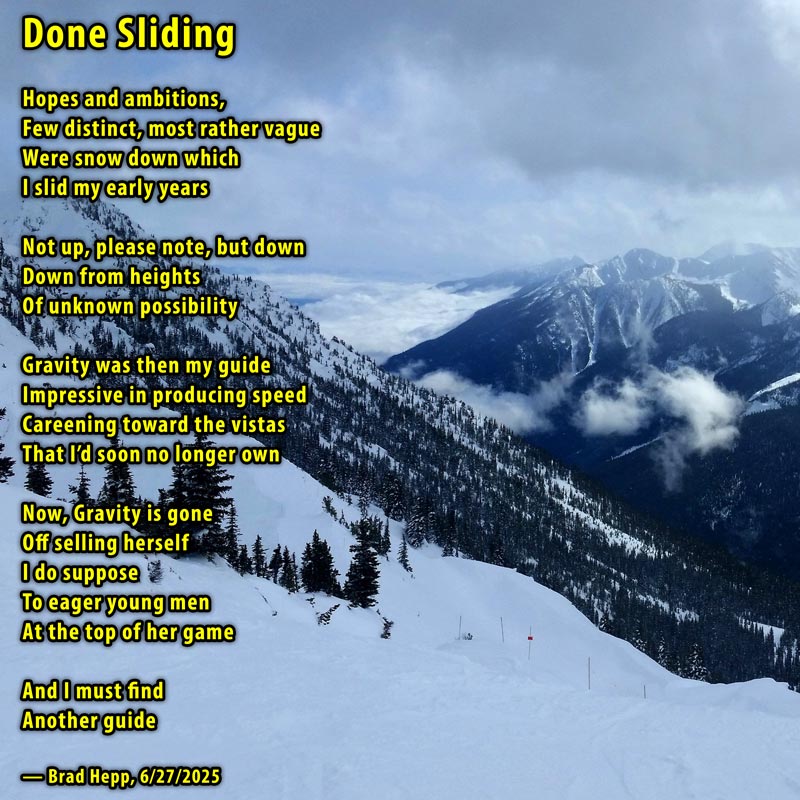
This was the first draft of an experimental stream-of-consciousness poem. So, don’t work too hard at making sense of the metaphors, unless you’re a therapist and really relish such puzzles!
The Occasion I wrote this poem the morning after an encouraging, highlight-of-the-year conversation with Darol, my mountain-climbing buddy of many decades, and after thinking about how young George Herbert was when he wrote his short poem “Hope.”
The Mood There is definitely some melancholy in recognizing that the myriad prospects of youth have dwindled down with the passing of years. But there is also a growing recognition that the number of prospects is far less important than the quality and reasonableness of prospects. If you know me well, you know what comes next: some lines from Robert Browning’s “Rabbi Ben Ezra” ….
What I aspired to be, And was not, comforts me: A brute I might have been, but would not sink i’ the scale.
Another Guide A few years ago, when I was already in my 60s, I wrote a poem and commentary that serve as the antidote to this melancholy. In that post, I suggest that even in old age, we can be “full of promise,” and we’re “never too old to grow.” But mere inertia, mere sliding, is an inadequate guide for this precious autumn of life.
Understand a Little Better? When I explain my poems to family and friends in person, I can see when the lights of understanding go on. But writing, I never know. That’s why I often ask for feedback. Did my commentary open any windows into this poem?
(if you are viewing this via email, the website has a recording of this poem and commentary; click the title above)
Commentary
This poem is the confluence of three streams:
First, I woke up one morning about a week ago and–seemingly out of nowhere–a phrase popped into my mind: “I’m not accustomed to dying.” This kind of early-morning inspiration accounts for a good number of my poems. Don’t ask me to identify this muse.
Second, sometime in the following days, my daily reading of George Herbert got me to his poem “Mortification.” In the last two lines of that poem, Herbert wrote
Yet Lord, instruct us so to die, That all these dyings may be life in death.
Third, I reviewed Jesus’ words to his disciples just before the Transfiguration. Notice that he first speaks of taking up a cross and losing life. Then, as he predicts the Transfiguration, he speaks of tasting death. Are all three expressions equivalent? Do they all refer to bodily death? That’s a question I ask in the poem. Here’s the passage:
[23] And he said to all, “If anyone would come after me, let him deny himself and take up his cross daily and follow me. [24] For whoever would save his life will lose it, but whoever loses his life for my sake will save it. [25] For what does it profit a man if he gains the whole world and loses or forfeits himself? [26] For whoever is ashamed of me and of my words, of him will the Son of Man be ashamed when he comes in his glory and the glory of the Father and of the holy angels. [27] But I tell you truly, there are some standing here who will not taste death until they see the kingdom of God.” Luke 9:23-27 ESV
As you can see from the poem, I tentatively conclude that there is a kind of dying that is short of bodily death. You may recall the Apostle Paul saying that he dies daily:
[31] I protest, brothers, by my pride in you, which I have in Christ Jesus our Lord, I die every day! 1 Corinthians 15:31 ESV
There is a kind of dying that is imposed on us by age. Our strength dies. Sometimes our lust and ambitions die. As I pass through my sixties (65 on Friday), I’m certainly experiencing this kind of dying. I’m slowly getting used to it, but maybe if I had exercised more self-denial and discipline over the years, I wouldn’t find myself waking up to the thought, “I’m not accustomed to dying.”
Does the poem make more sense after that explanation? I’d love to know! Leave your answer in the comments below.
(if you are viewing this via email, the website has a recording of this poem and commentary; click the title above)
Exclusion (self-imposed)
Some friends I admire From long ways off Limited portions Little doses
I grieve this regimen It’s self-imposed By sensing I’m Inadequate
A voluble joie de vivre I cannot match Even though I feel it too
An audience member, Silent hanger-on Applauding only Others’ show
— Brad Hepp, 5/19/2025
Commentary
[18] “There are three things that are too amazing for me, four that I do not understand: [19] the way of an eagle in the sky, the way of a snake on a rock, the way of a ship on the high seas, and the way of a man with a young woman. Proverbs 30:18-19 NIV
The fourth thing in this Proverb could apply to friendships in general. Sometimes, the process by which they’re initially established and then made solid is nothing short of miraculous.
God has performed this miracle several times for me. Against all odds, the beautiful man, the clever man, the popular, highly-regarded man has become my friend. I don’t mean a casual friend—a mere acquaintance admired “from long ways off”—but someone who is willing and able to share deep personal conversations.
The poem above explores why I sometimes doubt that God is ready to perform this miracle. Concentrating on my inadequacy, I forget His goodness. Pretending that I earn what comes my way, I neglect to ask for His favor. You may also notice that I sometimes assume things about potential friends, for instance that they always present with an energy (“voluble joie de vivre”) that I cannot match.
THE POEM STRUCTURE Did you notice how each stanza narrows down through its four lines? I knew I was doing that as I wrote, and I SUSPECT my subconscious was not just playing with a pattern. Perhaps one of my readers can articulate an effect the pattern produces….
(if you are viewing this via email, the website has a recording of this poem and commentary; click the title above)
Commentary
I can count my very best friends on a shop teacher’s hand.* That’s somewhere north of two but south of five. When I’m anticipating my next precious conversation with one of those friends, I often think back to previous conversations. What has developed in my thinking since last time we talked? What has changed? How do I think differently now? Such questions prompted this poem. The world—and much of my thinking—has been in turmoil the last few years. It’s hard to keep up with who the “good guys” are in thought and action. I have picked up, and then laid down, too many banners.
On the other hand, personal turmoil is probably better than personal stagnation. It is by God’s mercy that we grow and change. _________
* I know, that’s not a very good introductory sentence. But when will I ever get to say it again?
(if you are viewing this via email, the website has a recording of this poem and commentary; click the title above)
Commentary
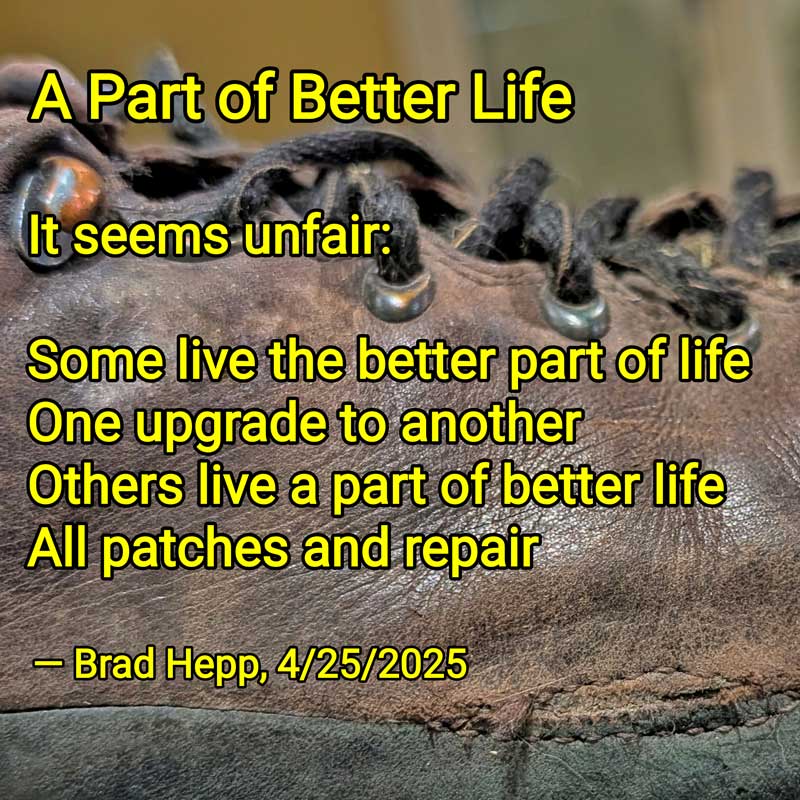
I woke up this morning with the realization that for some people, much of life–“the better part of life”–is just one upgrade after another: a new and better car, a promotion, a bigger house, more money in retirement funds…. So on and so forth. For others of us, life is not so rosy; we can feel like we got the short end of the stick. Something’s not right; something’s not fair. The Psalmist expressed this eloquently in Psalm 73, and included his resolution. I also hinted at resolution by rearranging my words from “better part of life” to “part of better life.” Was the Psalmist’s resolution the same as mine? That’s something for me to think about!
The background photo is of my patched Patagonia hiking shoes. I doubt a better shoe has ever been made! Unfortunately, they got out of the footwear business many years ago.
(if you are viewing this via email, the website has a recording of this poem and commentary; click the title above)
Commentary
I know this poem is hard to understand. Let me try to explain… or at least sympathize with the reader’s confusion.
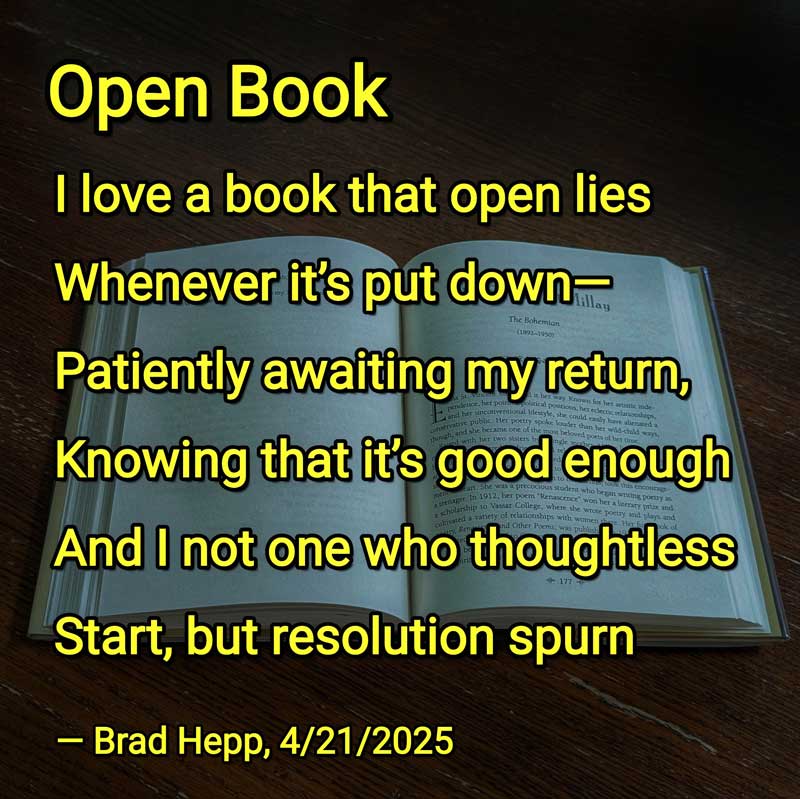
For a short time, I had a wonderful counselor who had me bring poems to our sessions as a basis for discussion. This poem, prompted by a literal book, would be an interesting one to discuss. I intentionally injected words suggesting conflict. Do you see them?
For what it’s worth, I do actually like books with relaxed binding. And such a book was actually the inspiration for this poem!
(if you are viewing this via email, the website has a recording of this poem and commentary; click the title above)
(background image by WikiImages on Pixabay)
Commentary
Robert Frost wrote that, “A poem begins as a lump in the throat, a sense of wrong, a homesickness, a lovesickness.” I think he meant that literally. The connection between a strong emotional state and the urge and inspiration to write poetry is palpable. But it isn’t just negative emotions that set us poets off! Euphoria will also do it. Oh yeah… speaking of Frost: for inspiring, euphoria’s also great and will suffice.
Enough generalities! The other night, I was sipping some whiskey. One ounce in and working on a second, I suddenly recognized this euphoric urge to write poetry. It’s a feeling that “Suddenly the world looks different; suddenly I see with new eyes. I must capture these realizations, I must net these butterflies!”
Trust me: very little of my poetry is whiskey-induced. In fact, most of it starts in the early-morning fog soon after rising. Perhaps my brain would like to go back to bed where it’s free to spin dreams.
Anyway, there it was… that feeling of euphoria, and the confidence that I could see new connections, find new analogies, devise new metaphors…. But I sensed danger: this is how writers turn into alcoholics. So I jotted down two lines and gave my thought a possible title:
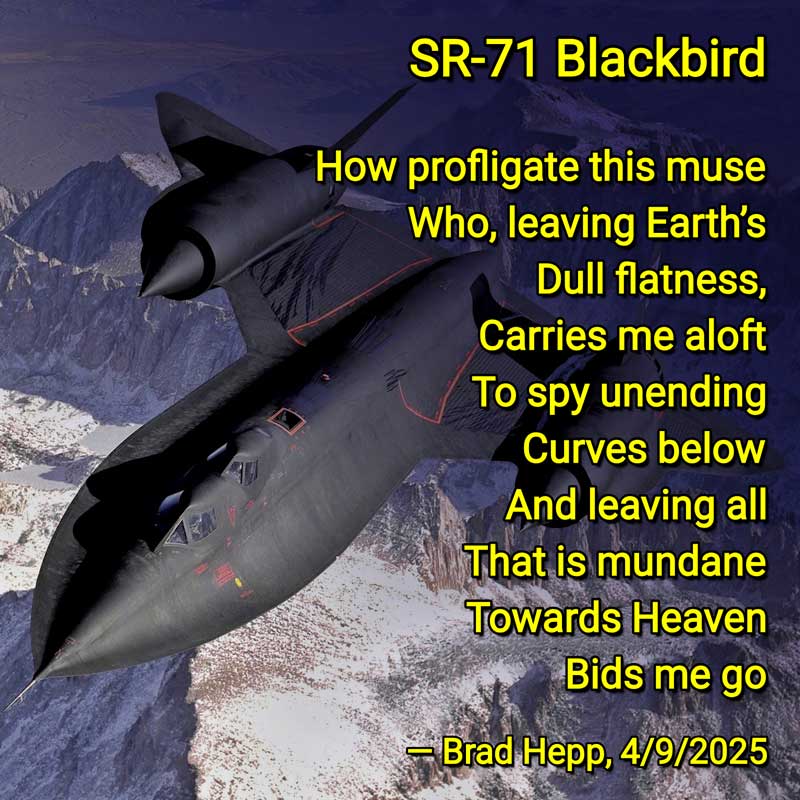
SR-71 Blackbird I really can’t afford this muse Who leaves my troubles all behind
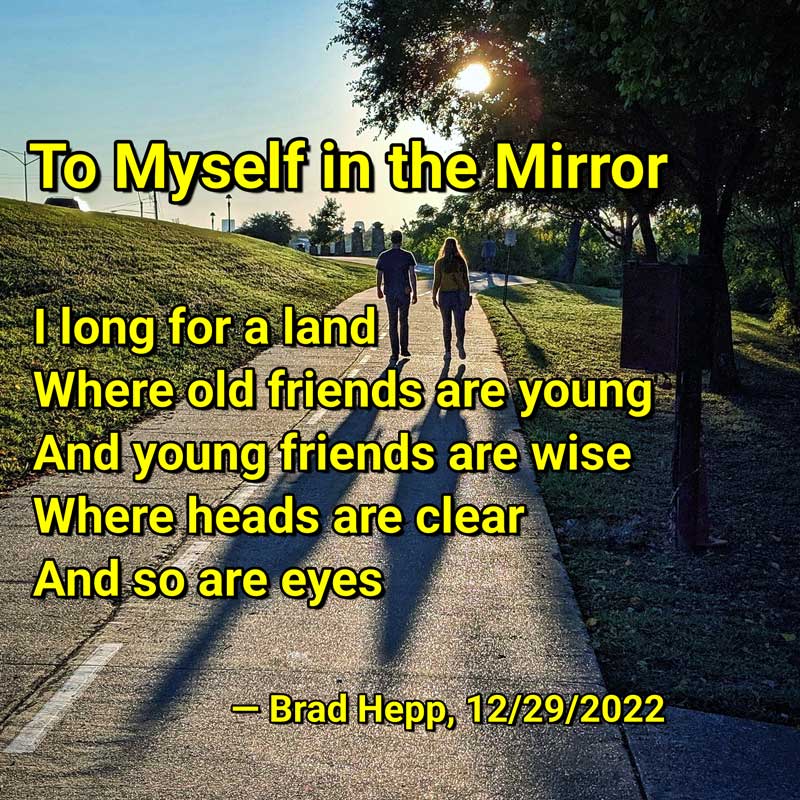
TOWARDS HEAVEN BIDS ME GO How can I write that line about something as dangerous as whiskey? Well, I’m convinced that God gives us many glimpses of Heaven, including intoxicants. I do long for a time when I can see things anew, with eyes unclouded by the cataracts of trouble and worry. As I said once before to myself in the mirror,
(if you are viewing this via email, the website has a recording of this poem and commentary; click the title above)
Commentary
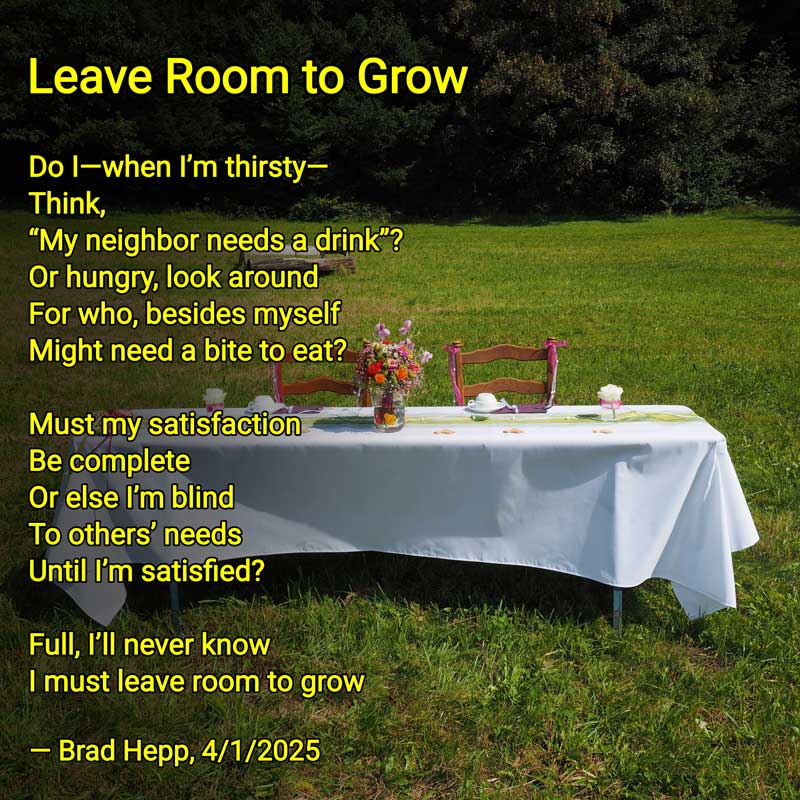
I began this poem in February, and I recall a keen insight then about my lingering selfishness. Today, I add the final two lines and title with a prayer that God will indeed cause me to grow more like Jesus as described in Philippians 2.
Being others-oriented with regard to the physical needs of food and drink is pretty elementary. When I grow up, I may extend the principles I learn here to other, less obvious aspects of life. But food and drink are a place to start. Even Jesus fasted. Could we say that fasting was part of him learning obedience? Recall Hebrews 5:8, which reads, “Though he was a son, he learned obedience through what he suffered.”
Where are you full, and need to leave room to grow?
(if you are viewing this via email, the website has a recording of this poem and commentary; click the title above)
Commentary
I know plenty of us experience this… at least the part about thinking of too many things at once. It may be less common to think long and deep about one thing.
(if you are viewing this via email, the website has a recording of this poem and commentary; click the title above)
Commentary
A TIME FOR TELLING, A TIME FOR BEING TOLD
Back when I was eagerly adding clients to my website business, there were three memorable occasions when I turned down the new business after an initial interview. In each case, the would-be client was some older gentleman who spent two solid hours talking about himself and never asking me a single question.
I expect to be each of my clients’ “webmaster for the long haul.” So, years and years of disrespect is something I avoid when I have the choice.
That being said, I am thankful for some other memorable occasions, when the Lord enabled me to serve someone else by listening and asking key questions. I imagine counselors are richly blessed in this way….
(if you are viewing this via email, the website has a recording of this poem and commentary; click the title above)
Commentary
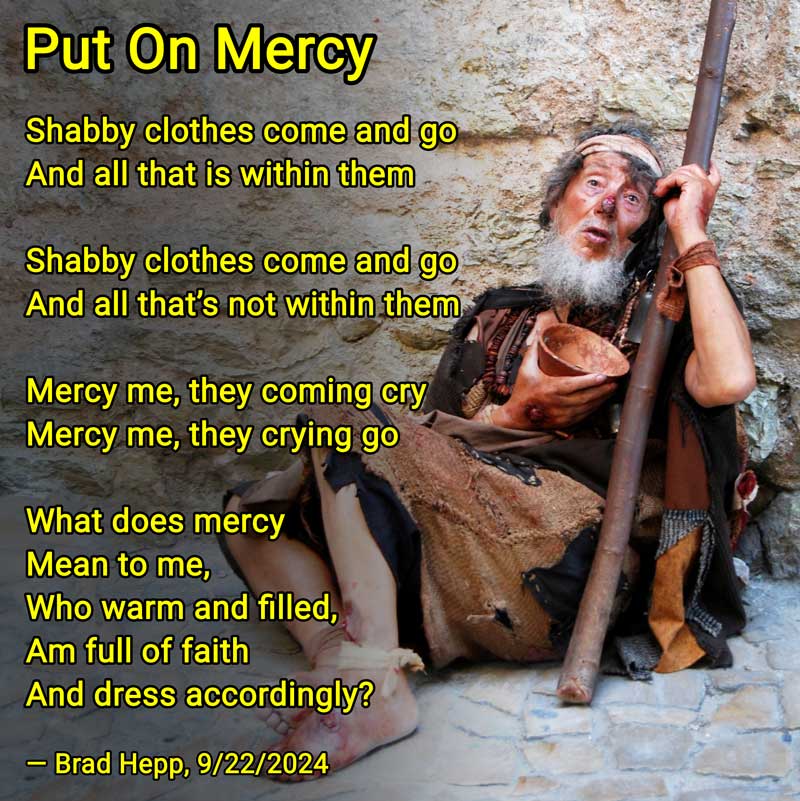
In his letter to Jewish believers scattered throughout the Roman Empire, James has his readers imagine their response to a poor man walking into their church. Something I hadn’t noticed until this morning is that James has the poor man coming in ANDgoing out in shabby clothes.
First the coming in:
For if a man wearing a gold ring and fine clothing comes into your assembly, and a poor man in shabby clothing also comes in…
James 2:2
And then the going out:
If a brother or sister is poorly clothed and lacking in daily food, and one of you says to them, “Go in peace, be warmed and filled,” without giving them the things needed for the body, what good is that?
James 2:15-16
The verses between this coming and going talk about impartiality. If you’re like me, you interpret that as “Don’t treat the rich visitor better than the poor visitor.” But James goes beyond such passive impartiality. He wants to know what you’ve done for that poor man between the welcome and dismissal, between the coming and the going. Are you sending him off just as poorly provisioned as when he came in? Notice the last of James’ examples of proper, faith-fueled hospitality:
And in the same way was not also Rahab the prostitute justified by works when she received the messengers and sent them out by another way?
James 2:25
Some Things to Notice in This Poem
First, the title “Put On Mercy” has two meanings. The Apostle Paul urges believers
Therefore, as the elect of God, holy and beloved, put on tender mercies, kindness, humility, meekness, longsuffering;
Colossians 3:12 (NKJV)
That’s the first meaning of “Put On Mercy”: be clothed in a virtuous manner of life.
But sometimes we fake it. Then our would-be virtue might just be put-on mercy: fake mercy.
In the last stanza, I cast doubt on whether or not the speaker is really putting on mercy. The speaker is assumed to have faith. Does he dress accordingly? Really? He’s warm and filled. Does merely wishing the same for the poor visitor amount to mercy?
Second, “shabby clothes” in this poem are an impersonal shell for the unloved, ignored visitor. The words don’t even acknowledge the person, but refer to him or her as “all that is–or, in poverty is not–within them.”
Third, “mercy me” is an odd phrase. We utter it to express alarm or agitation. But what if some non-standard English speaker thought that it constitutes an actual plea for mercy. Could we hear it that way? Would we respond with God’s mercy? Or would the mendicant leave without our response?
Finally, “all that is within” may serve as a faint bit of fake holy talk. It echoes a well-known Psalm:
Bless the Lord, O my soul, and all that is within me, bless his holy name!
Psalm 103:1 (ESV)
[Does that commentary help you understand the poem better? I’d love to hear from you! (If you received this poem via email, click on the poem title. That will take you to the blog where there is a comment form. If you’re shy in your response, just respond to the email!)]
(background image based on a photo by Gianni Crestani on Pixabay)
(if you are viewing this via email, the website has a recording of this poem and commentary; click the title above)
Commentary
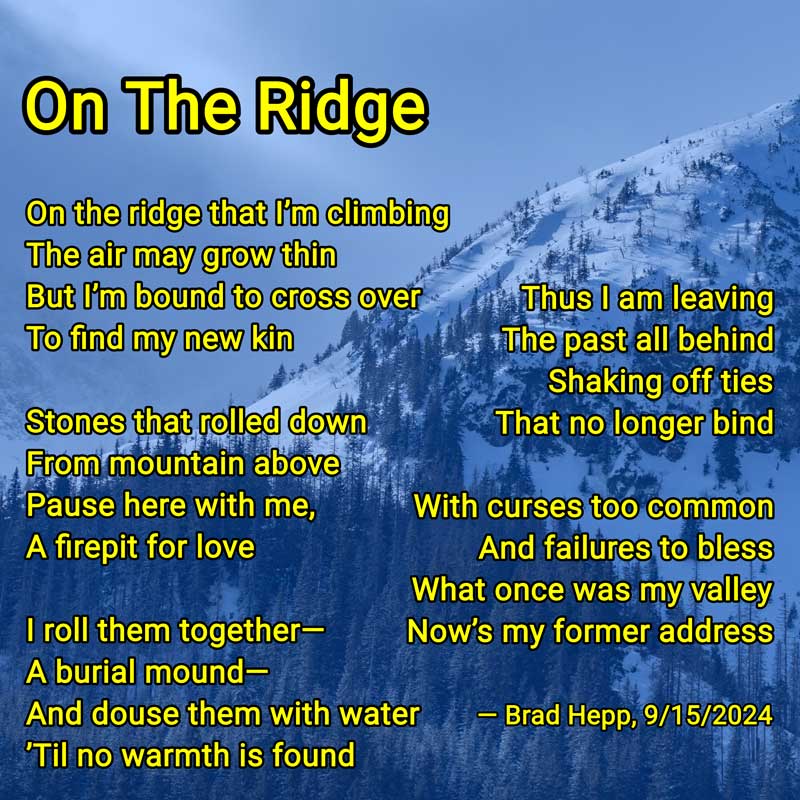
Isolation and alienation have probably affected my outlook on life far more than I consciously understand. Consider the following from my youth:
My first ten years, I was a gringo living in Mexico; I connected with the handful of other Anglo missionary kids far more than with the surrounding culture
When we moved to a little East Texas town, I didn’t connect with that culture either; my different life experience, religious and academic orientations were off-putting to others and a barrier to fitting in
In the advanced English course in my first semester of college, there were only three of us guys in a classroom of young ladies; that may sound wonderful for the guys, but it continued my theme of not fitting in (to this day, I find few men who appreciate poetry; even fewer who write poetry)
In the decades since, I got along fairly comfortably in white evangelical culture… until my late 50s. Beginning in 2016, and then rapidly accelerating in 2020, I began to distance myself from that culture. Now, I once again feel the isolation and alienation of my youth.
Here’s how that came about…. At the very time I began to recognize selfishness and racism in my own heart, a large majority of white evangelicals began to embrace and trumpet these sins.* When terrible events of 2020 and 2021 afforded opportunities to inspect our hearts and to repent and reform, too many doubled down instead on their love of power and privilege. Their hard hearts led them to hate good men and to love evil men. (Here’s a poignant poem I wrote at that time: “Lord’s Day Vision.”)
Am I blameless in all this? NO! I played a small part in promoting the drive for power and privilege until I saw what I had been doing. Even now, I keep having to bury my former affections, to douse the flame of former loves.
Does this poem make more sense to you now if you read it again with that background? I’d love to know! Comment below (click the poem title if you’re seeing this on email; there’s a comment form on the blog).
A related poem, especially with regard to God’s mercy in reforming us is “To A Misguided Cedar.“
__________
*I say “began to embrace and trumpet….” A better word may be “revealed.”
(background image cropped and tinted from a photograph by Peter Balog on Pixabay)
(if you are viewing this via email, the website has a recording of this poem and commentary; click the title above)
Commentary
I keep thinking about what I was trying to communicate in this poem. It may be this: we all have a different tolerance for assumptions. I have trouble with people who jump to conclusions with hardly any thought (the first stanza).
Others are better about checking their assumptions (the second stanza), but they still skate over many facts without considering them. Such people are efficient in their thinking (think of Daniel Kahneman’s “thinking fast”). Still, such people can get irritated when their assumptions are questioned. They don’t want to slow down to consider weaknesses in their thinking. I get along fine with such people… for the most part.
How about the third stanza? One cannot live without making millions of assumptions every day, so nobody REALLY lives fully in the third stanza. But some of us come closer than others. Just ask my wife. When something goes missing in the house, I am methodical in my search; I look in places where she doesn’t bother looking. She’s being efficient; I’m being thorough. I once found something valuable that was missing (keys, if I remember correctly) IN THE TRASH BIN IN THE ALLEY. Yeah, remember that? Boom! I’ll always have the keys in the trash can story to excuse my slow thinking!
(background image cropped and tinted from original by Albrecht Fietz on Pixabay)
(if you are viewing this via email, the website has a recording of this poem and commentary; click the title above)
Commentary
CONFESSION This last week has been unnecessarily tough for evangelical Christians. Some were deeply offended by the world.* Others were dismayed** that the first group took offense. I’m solidly in the latter camp. But I’m NOT PROUD of an unloving, disdainful edge in my own response. I must answer for my own response, not for others’.
(background image by Alberto Adán on Pixabay)
*For future reference, this was about the opening ceremony of the 2024 Olympics in Paris.
**There are good reasons for the dismay, but that’s not my point here.
(if you are viewing this via email, the website has a recording of this poem and commentary; click the title above)
Commentary
With our limitations of time, intelligence, and memory, each of us must choose carefully from the smorgasbord of information that is laid out for us daily.
I originally titled this poem “Why This Smattering?” It is a thinking out loud about my tendency to dabble idly in what’s likely too many areas of knowledge. Why do I do this? I could easily offer virtuous-sounding self-justification. But is there an unhealthy side to this?
(background image by LensPulse on Pixabay)
NOTE: While I have you here, let me invite you to check out some significant improvements on my website:
1) I created a page of my FAVORITE POEMS 2) I tagged most of the poems with themes so that you can find poems in that way
(if you are viewing this via email, the website has a recording of this poem and commentary; click the title above)
Commentary
For several weeks now, I have been camping out in the last several chapters of Acts and 1 Peter (before breakfast and on my lunch walk, respectively). Meanwhile, I am suffering some trials. This poem/prayer is a response to what I’m reading and thinking and living.
Here’s an exchange I had about this poem with someone I deeply respect:
Debbie Johnson: There is so much chaos, so much pain littering a landscape made for beauty & wonder.
Me: Well-put! And yet the suffering that results is—inscrutable to me—a major part of restoring that landscape.
Debbie Johnson: Yes! And as CS Lewis would add, recognizing the unsoothable ache is a reminder we were made for something beyond even our best here.
(if you are viewing this via email, the website has a recording of this poem and commentary; click the title above)
Commentary
[This strange little poem is a flight of fancy. Any connection with a Greek goddess, a Norwegian singer, or a school in Cusco, Peru is accidental.]
Tonight, I was thinking about a photo I edited this morning. I had shot a Peace Lily flower and then boosted the saturation. Was it too much saturation? Am I overly enamored with jewel tones? Then I thought about places on earth where jewel tones are extravagantly displayed. I’ve seen them in the clothes of Quechua in the Peruvian Andes; I’ve seen pictures of the Aurora Borealis. How is one like the other? I began writing about the harsh settings, and the comfort brought to those settings by brilliant displays of color….
By the way, here’s the photo that launched me on this flight of fancy. As I was walking by one of the Peace Lilies at the library where I work, I thought I’d stoop down and look at one of the flowers from a lower vantage point. The heavy timber framework of the library’s high ceiling provided an interesting background. So I snapped a photo, and then did a little editing.
(poem’s background image by Yolanda Coervers on Pixabay)
(if you are viewing this via email, the website has a recording of this poem and commentary; click the title above)
Commentary
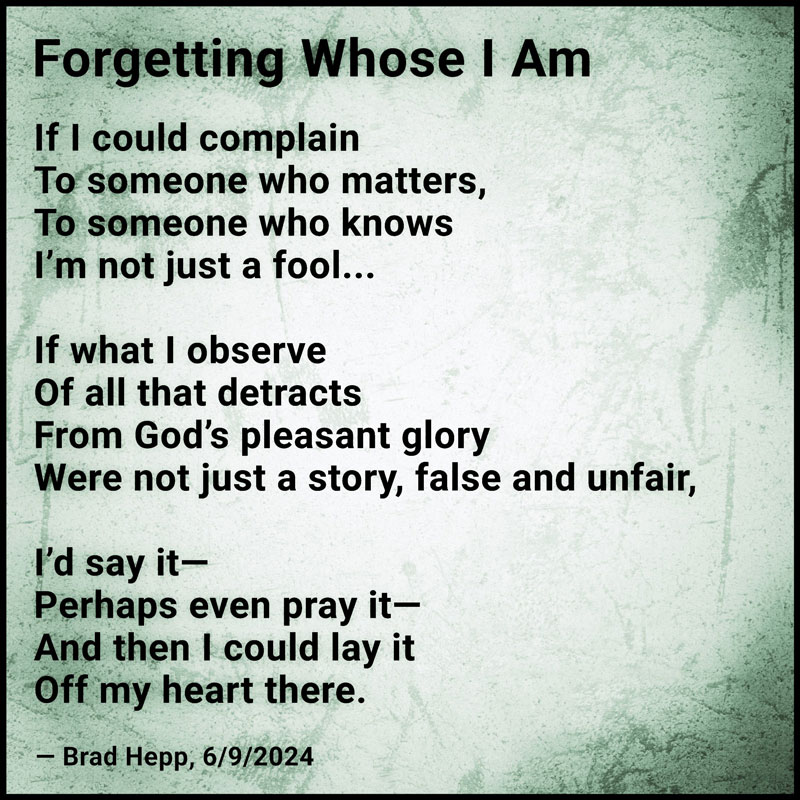
This may appear to be a depressing poem. Let me explain why it isn’t really….
A dear friend treated me to supper last night. This morning, I woke up and immediately wrote down what I had said to him, except that I put it in verse. Here goes:
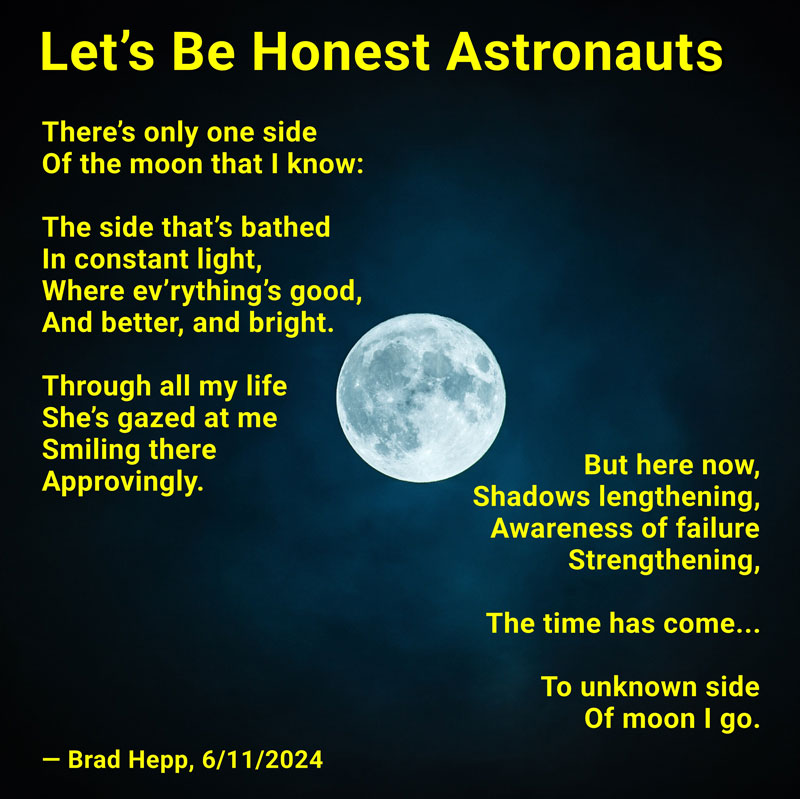
TO UNKNOWN SIDE OF MOON I GO Over the last several years, slowly at first, but gathering speed as time passes, I have been changing. At least I have been examining my life more carefully, and laying myself open to change.
RACISM First, I became aware of my own racism. In 2016, I was being considered for a job that would have involved ministering in the Hispanic world. But even though I am a missionary kid born in Mexico, I had by my mid-fifties developed significant antagonism toward the growing population of Hispanics in the U.S. We can all thank God that job didn’t pan out. Imagine the hypocrisy!
Just after that, I went full-time with my web design business. In all the spare time I had, I began taking long daily walks. On those walks, I listened to many books, including all of the Bible (several times through). I’d walk around White Rock Lake, listening, and pondering. I also began observing how I responded to each person that I encountered on the trail. Why was my heart immediately warm toward this person, but cold and distrustful toward that person? I noticed–once again–that racism was definitely involved.
SELFISHNESS Acknowledging and inspecting my antagonism toward Hispanics revealed a deep vein of selfishness in me. At one point, I had to admit, “I don’t like this influx of Hispanics in the US because it’s a drag on the economy.” In other words, I was thinking with my wallet–how a group of people affect my wealth–not with Jesus’ welcoming, hospitable love. (By the way, I wasn’t thinking very well in any case). It seemed obvious to me that I had to either follow Jesus or give up that way of thinking.
As the years passed, I began to see how that vein of selfishness was influencing my politics, my view of history, even my theology. It’s hard to be an honest interpreter of Scripture when you are motivated to find God giving you every advantage while denying it to others!
A SENSE OF SUPERIORITY This brings me to something I was finally able to articulate to myself last night just as I walked across the parking lot to meet my friend in the restaurant. One of my biggest struggles in life is the temptation and tendency to think of myself as superior to many others in many ways: smarter, wiser, healthier, more discerning, more talented. Not, of course, superior to everyone around me… I’m arrogant, not stupid!
A LONG SLOW COURSE OF MEDICATION When I recognized my selfishness and racism, I began reading extensively about the history of white supremacy in the US. There’s simply no way that I escaped inheriting some of the rottenness in that pervasive ideology! Talking with my friend at supper, I listed some of the authors I have read. As you read this list, you may be tempted to jump down my throat. But hear me out. The authors included Robin DiAngelo (White Fragility), Abram X Kendi (Stamped From the Beginning), Bryan Loritts (Insider Outsider), Jemar Tisby (How to Fight Racism), Luke Bobo (Race, Economics, and Apologetics), and Ta Nehisi Coates (We Were Eight Years in Power). With the exception of DiAngelo, these authors are all black men and skilled writers. Even if I question their analysis or solutions, I deeply appreciate their ability to articulate their perspective. Some of them are my brothers, and all are my friends in that regard. Reading these authors, and imbibing many related documentaries and podcasts has been like taking a long slow course of medication. I’m getting better, largely by understanding how bad off I am.
BACK TO THE POEM The dark side of the moon is a hostile, unfamiliar environment. If the moon we see every night is smiling on us approvingly, the dark side of the moon is indifferent at best, scowling murderously at worst. In its metaphorical eyes, we are not great. In its metaphorical eyes, any notion that I am superior to anything or anyone is laughable.
HAVE I SAID ENOUGH? If you go back and read the poem now, does it start to make sense? Can you see that it is hopeful, and not depressing? Let me know by commenting below!
[Note to my future self: I wrote this a day or two after watching an episode of The Crown, in which Prince Philip has a private interview with the Apollo 11 astronauts. Philip was experiencing a crisis at that point in his life, and he hoped that the astronauts would have some serious, helpful observations about life and faith. Alas, they were at that point just men of action, not contemplation.]
(if you are viewing this via email, the website has a recording of this poem and commentary; click the title above)
Commentary
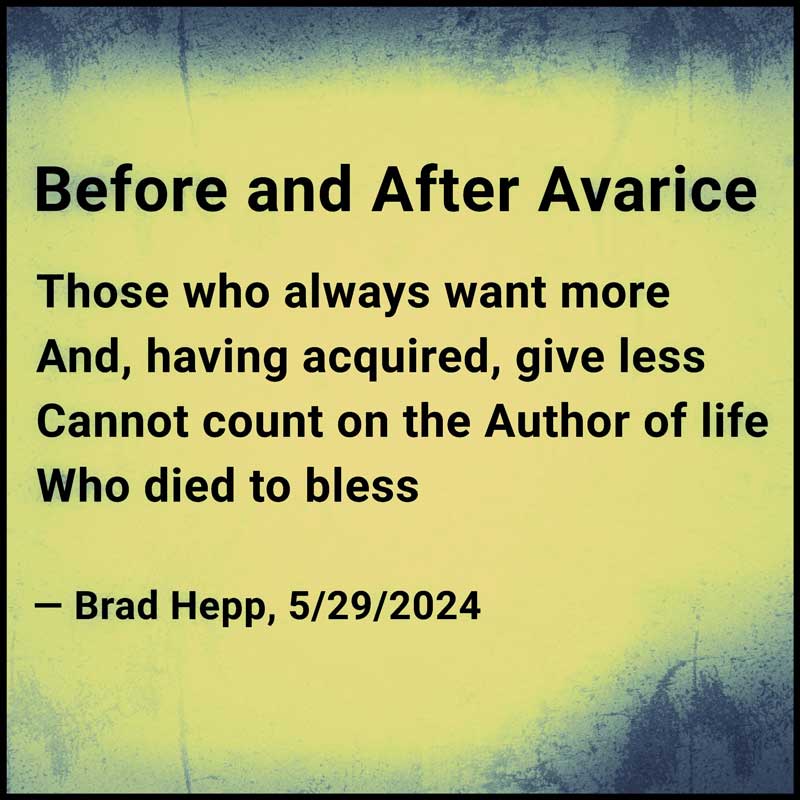
For some time now, greed and selfishness have held morbid interest for me. So, so much of life looks different once you recognize these sins in yourself. So, my eyes are wide open this evening as I read a chapter on “Greed vs. Generosity” in Brant Pitre’s helpful “Introduction to the Spiritual Life.”
The poem’s last line is a double-entendre. I have made enemies with double-entendres. But in my poetry I mean them for good.