(if you are viewing this via email, the website has a recording of this poem and commentary; click the title above)
Commentary
This vague notion settled over me tonight as I lay listening to songs I heard in my youth. The songs haven’t changed, but I HAVE changed—AM changing—especially in response to troubles. Like I said, though… it’s a vague notion, a lot more hope than sight.
(if you are viewing this via email, the website has a recording of this poem and commentary; click the title above)
Commentary
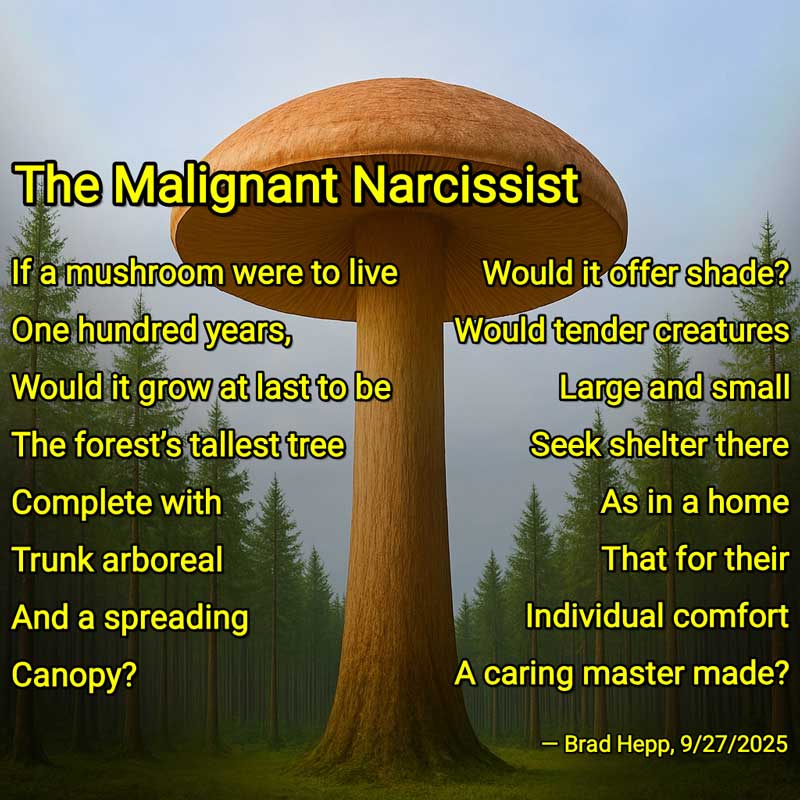
I paused a YouTube video to express this response. The psychologist in the video was talking about a certain malignant narcissist who threw rocks at babies when he was 10 years old. The psychologist lamented that there is no hope for the malignant narcissist, that one never outgrows that disorder.
No disrespect to mushrooms…. It was just the image that came to mind while I was watching the video. Probably for two reasons: 1) I associate degeneracy with fungi and 2) mushrooms have the general shape of miniature trees, but can never “grow up” to serve as trees serve.
ChatGPT obliged me with a background image (one prompt and three refinements).
(if you are viewing this via email, the website has a recording of this poem and commentary; click the title above)
Commentary
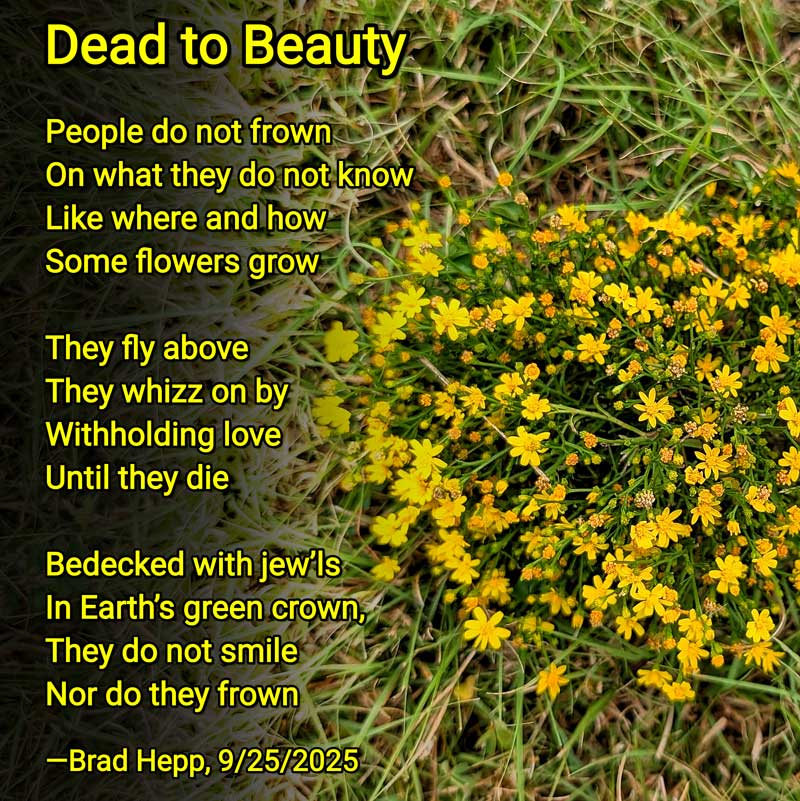
This poem took a dark turn when I rearranged lines in the third stanza. That’s when I changed the title from “Indifference” to its current title.
On a positive note…. One of my greatest frustrations in the months before I got cataract surgery was an inability to clearly see little flowers at my feet when I went for walks. Now, I can see them clearly. And I’m still undignified enough—and limber enough—to lie down on the ground for close-up photos of the little flowers. Better ON the ground than IN the ground. Better now than later.
A BONUS CONFESSION Let’s be honest: for every single thing I notice and appreciate in God’s creation, there are trillions of other things I take for granted. I’m as guilty of indifference as anyone else. That’s being honest. But here’s a vile habit I have; perhaps you recognize it in yourself: I find one small instance of goodness in myself (e.g., appreciating small flowers) and then I look around to see how that instance is not widely shared or practiced by humanity. Why make the comparison? To elevate myself, of course!
That’s my confession. Do you forgive me?
SPEAKING OF PERVERSITY I’m hyper aware of ambiguity. Sometimes that gets in the way of normal conversations. But it’s part of what I enjoy in writing poetry. Ambiguous words and phrases raise questions that nudge the brain off its timeworn trail.
Take, for instance, “they” in the last line of the second stanza. Does “they” refer to the people who do not appreciate the flowers, or to the flowers themselves? Which dies?
(if you are viewing this via email, the website has a recording of this poem and commentary; click the title above)
Commentary
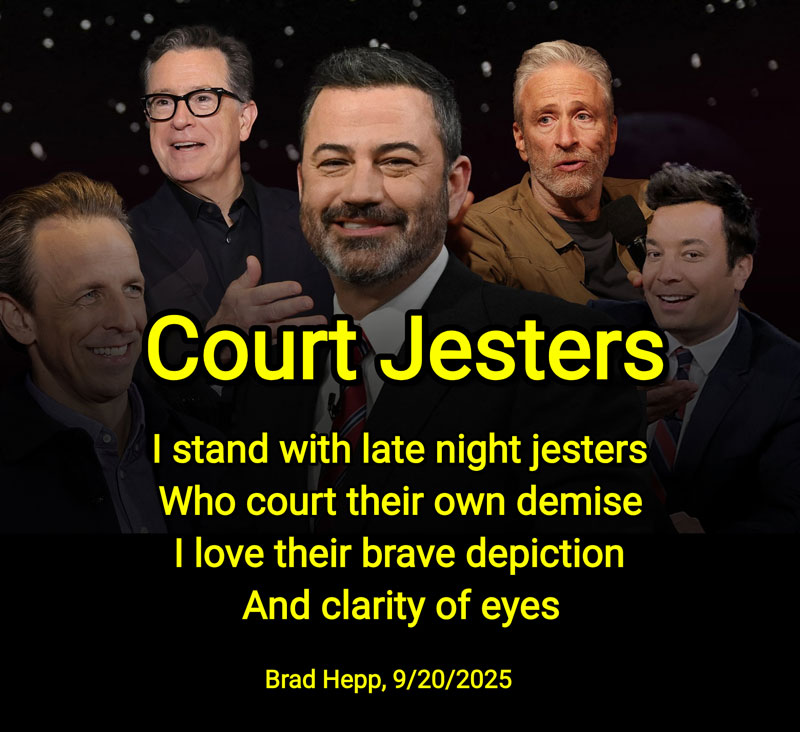
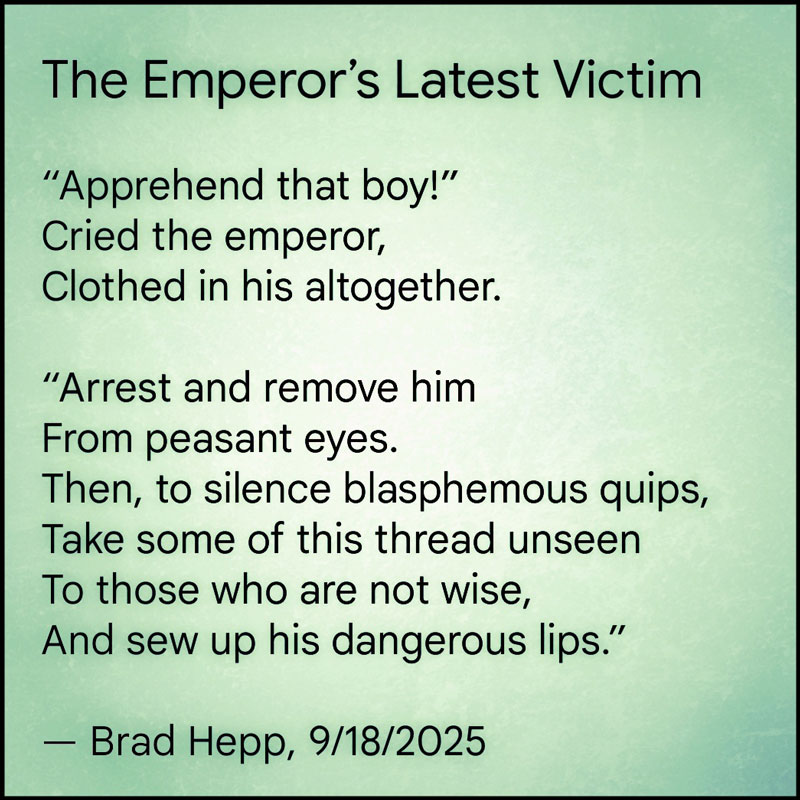
I know this will put me at odds with some friends and family. But who, better than these comedians, is telling the truth about the infantile idiocy in Washington? Prophets, poets, comedians… we have the same duty.
(if you are viewing this via email, the website has a recording of this poem and commentary; click the title above)
Commentary
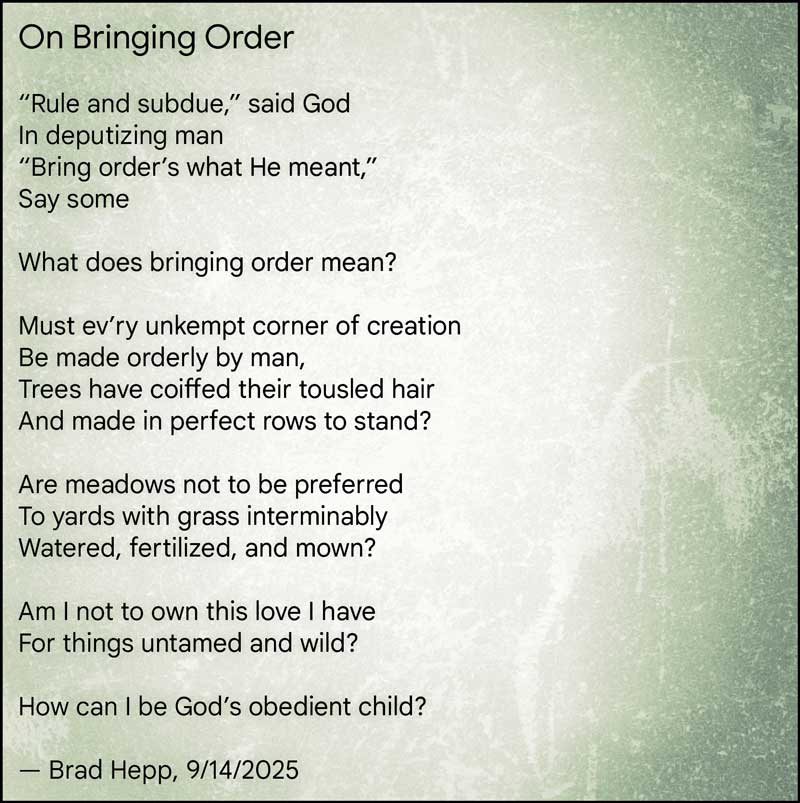
This poem explores implications of John Walton’s view of the “rule and subdue” mandate in the Genesis creation account. Here’s his view (from what seems like a good AI summary): “For Walton, therefore, the ‘rule and subdue’ mandate is humanity’s active participation in God’s ongoing work of bringing and maintaining order. The world is not ours to dominate, but God’s cosmic temple to be managed on his behalf.”
I like Walton’s attempt, but I’m having trouble understanding how man could be expected to bring any meaningful degree of further order to Earth, much less to the cosmos.
I suspect that Walton’s understanding of “rule and subdue” (as meaning “bring order”) leans heavily on his understanding of the context. On the other hand, I haven’t studied the Hebrew words in other contexts, so my suspicion is pretty flimsy.
When I posted the poem, two of my more savvy friends commented:
What if dominion isn’t as controlling as we like to think, but rather tending to the unique natural beauty, form, and function of God’s beautiful world. Prune here. Clear there. Thin elsewhere, taking part in how it’s shaped.
(This, of course, could apply to every sphere of authority.)
–Laurie Pearce Mathers
I agree. I think the best word is “stewardship.” And yes, our ability to steward well is surely hampered by the fall, but also, I hope, helped by the ongoing work of redemption.
Christine Renee Hand Jones
GETTING PERSONAL My interest in this subject isn’t just academic. We’re living in an apartment right now while our house is being restored after a fire broke out because a dying pecan tree dropped a limb on the electrical service. One could say I was negligent, since that pecan had dropped all its leaves. I could push back that the tree dropped all its leaves in the summer of a previous year and then roared back to life the following year, so I did not KNOW for sure that it was dying. But a look around the back yard would confirm that I am not the neat freak I once was. There is more disorder there than I’d have allowed when I was younger. Without going into details, I’m going to chalk that up to the down side of some healthy developments in my life. Put simply, I’m a recovering perfectionist. Order isn’t as important to me now as it used to be.
(if you are viewing this via email, the website has a recording of this poem and commentary; click the title above)
Commentary
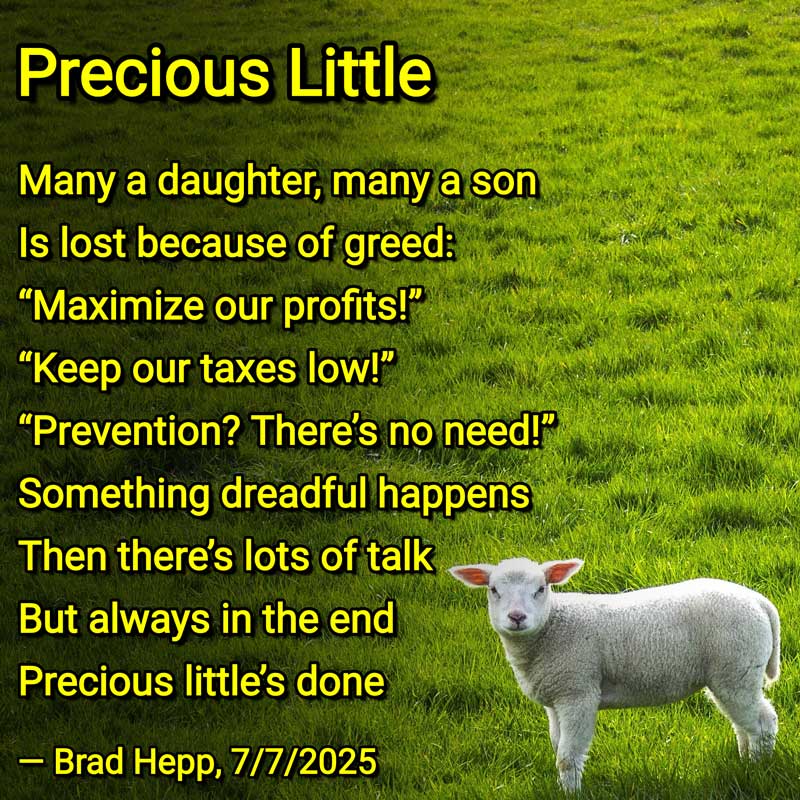
I have held off on posting this poem for two months now. When I wrote it, I was angry that 27 campers and counselors needlessly died when their Christian camp on the Guadalupe River was inundated by flood waters. I had watched news coverage and recognized flooding that happens frequently and predictably in that area of Texas. This time, the death toll rose to 135.
I have watched the response, and learned that people in the area have repeatedly refused to implement measures that would save lives. Now there’s lots of talk. State government has taken preliminary measures. Will anything change? I doubt it.
(if you are viewing this via email, the website has a recording of this poem and commentary; click the title above)
Commentary
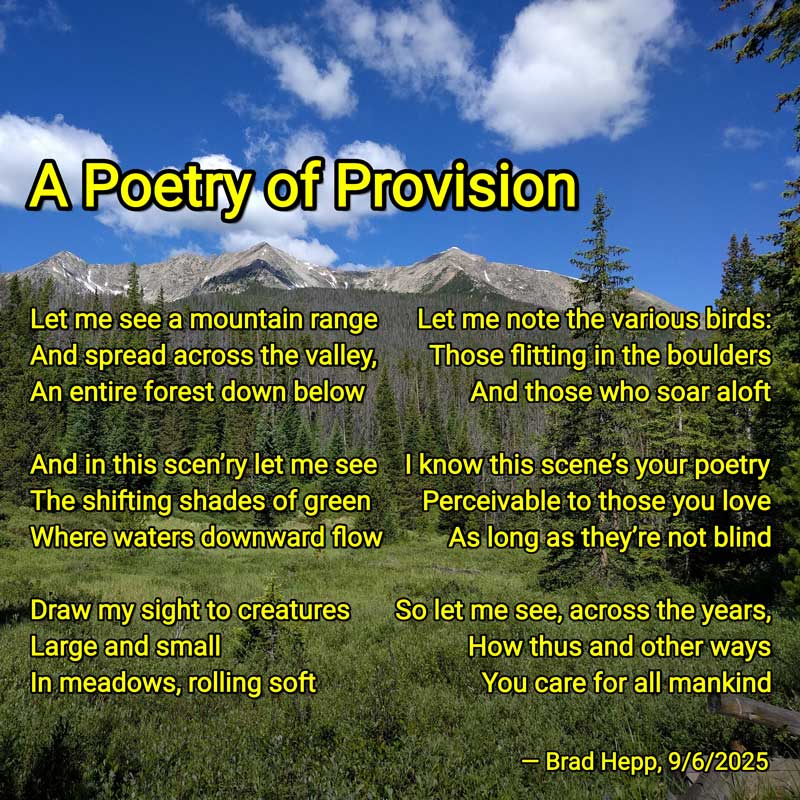
Lately, in reading the Bible and its interpreters, I have felt the need to better perceive God’s patterns of provision. In the big picture I hope to find strength for the grind of this day’s particulars.
(the background image is from a hike between Breckenridge and Frisco in Colorado)
(if you are viewing this via email, the website has a recording of this poem and commentary; click the title above)
Commentary
I sometimes joke that I’m a “wooden-headed literalist.” Well, the more I write poetry, and the more I examine myself, the more serious I get in this self-deprecation.
Lately, I have been considering the work of John Walton (Old Testament scholar and Professor Emeritus at Wheaton College). There may be others who have tried to account for metaphor in Genesis, but Walton’s is the first serious attempt that I have encountered. The hamster wheel in my cranium is spinning wildly—and wobbly—as I think through his propositions.
(if you are viewing this via email, the website has a recording of this poem and commentary; click the title above)
Commentary
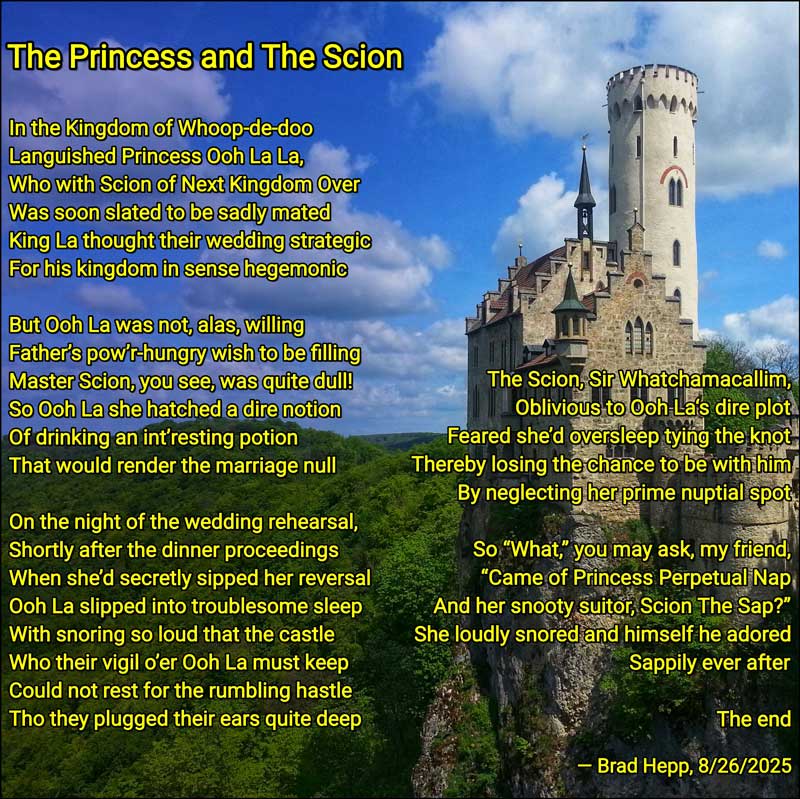
The other morning, while I was driving to work and listening to NPR, I had a bad reaction to some fantasy. An author of children’s books began reading his latest work, and it was too full of names for my liking. In protest–to nobody listening–I blurted out “In the Kingdom of Whoop-de-doo….” Then and there, I knew I had just saddled myself with writing a poem. It has taken several days. How was I going to get myself out of this? With one last night’s sleep, I figured out how to bring it to a swift and merciful end. So here you go.
(if you are viewing this via email, the website has a recording of this poem and commentary; click the title above)
Commentary
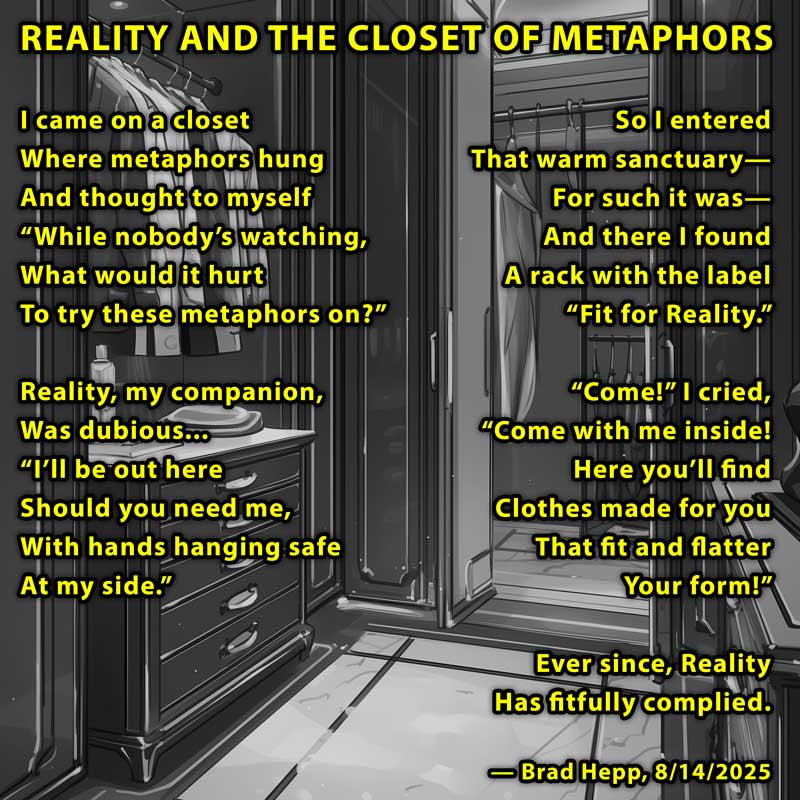
I hope that before reading this background, you will make sure you have entered the scene. Let your imagination picture my companion, Reality, and his reluctance to be clothed in metaphor.
I wrote this poem after reading various versions of Psalm 73:16-20. There must be some translation difficulties in this passage…. In the Modern English Version, verse 20 goes “Like a dream when one awakes, O Lord, when awakened, You will despise their image.” What if this translation is correct? What if Asaph really wanted to picture God having a nightmare but then waking up and scorning the characters in His nightmare?
“Oh no! Absolutely NOT,” a voice in my head insists. “God does not sleep. The Bible tells me so.” And I can imagine others–maybe you–saying the same thing. We limit how the poet is allowed to picture God. It must jibe with our systematic theology. Increasingly, I see this as a stilted and mistaken approach to understanding God’s words.
(AI-generated background image by Judas on Pixabay)
(if you are viewing this via email, the website has a recording of this poem and commentary; click the title above)
Commentary
At this rate, my first chapbook will be titled “After The Fire.” The last time I lived in an apartment was 1983. It takes getting used to. And it’s prompting some poetry!
(if you are viewing this via email, the website has a recording of this poem and commentary; click the title above)
Commentary
A more autobiographical poem has never been written. Like most of my white on black poems, this is the product of a dark night. It’s this simple: either in the middle of a sleepless night, or when I give up sleeping before dawn, I write a poem. My phone (where I write poems) is still in dark mode. That means white text on a black background. Sometimes I just do a screen capture and post. Other times, I recreate the effect in an editing program. The dark scheme seems appropriate.
Autobiographical This is one of the poems I wrote after a branch fell on our electrical service and caused a fire in our house. You can probably see the connection to that in the poem. But there are other things that I have to give up as I grow in wisdom and humility. That’s what I mean by “bodies of all sorts.”
The accuracy of the last stanza is debatable, but worth contemplating.
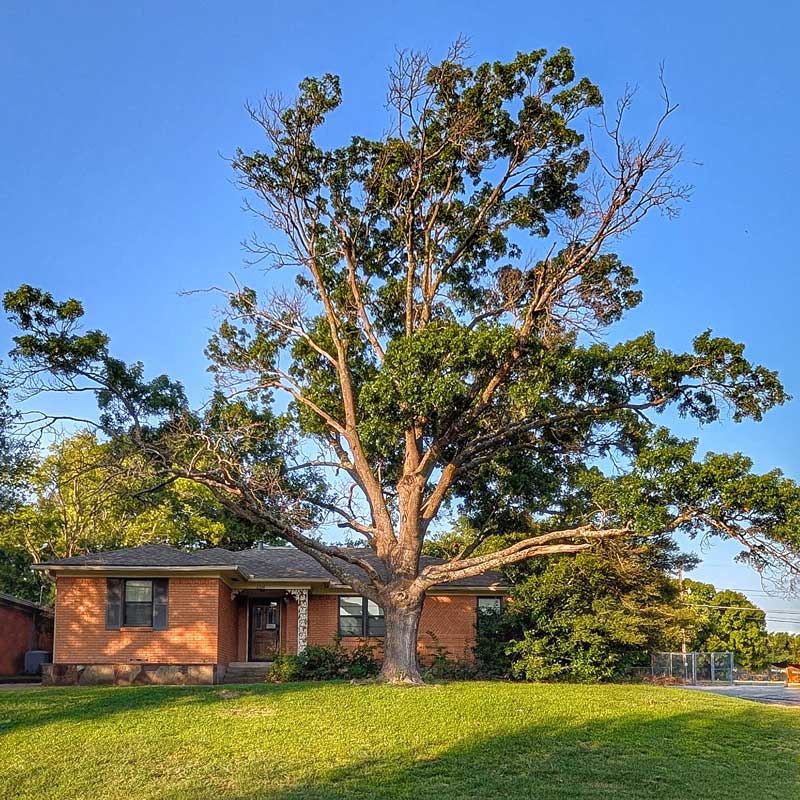
Here’s a picture of one of our actual old trees. Later this week, we’re meeting with an arborist to talk about that tree’s future.
(if you are viewing this via email, the website has a recording of this poem and commentary; click the title above)
Commentary
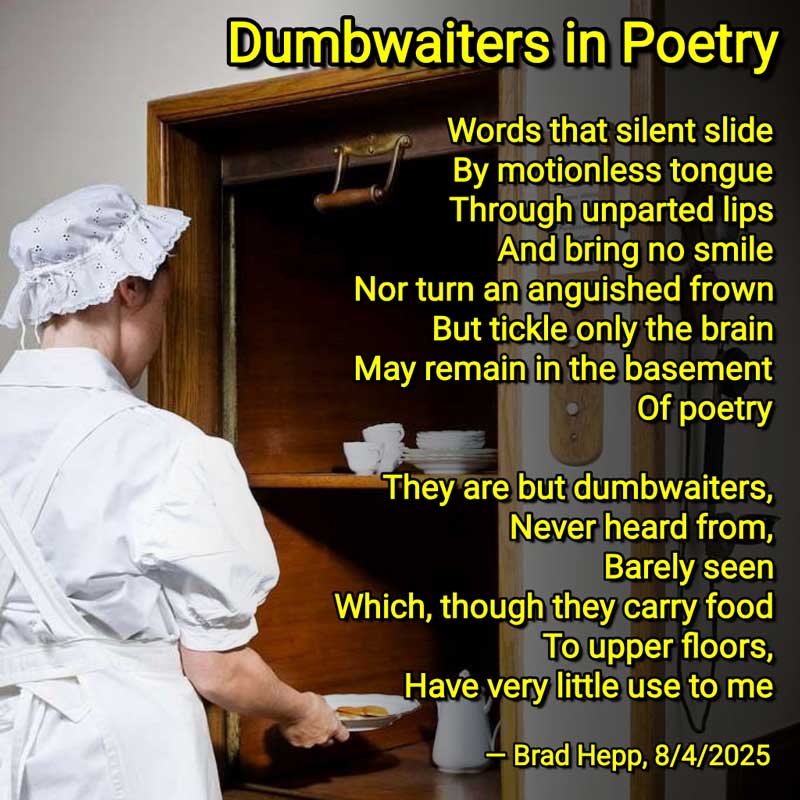
This poem has been percolating for several days. It addresses my growing recognition that poetry is physical, not just intellectual. That means two things:
1) the POET must choose words and rhythms that are fun, pleasing, or soothing to read out loud.
2) the poetry READER must be enticed to read the words out loud; sub-vocalization works for some, but it’s not ideal.
A Little More I think I’m making a little progress in #1 from above. It’s a bit like long-distance running. You run for weeks and months and then one day you seem to have found a new gear. It may not show up in times; you may not win more races. But you definitely feel it. In the case of poetry, your brain just lands more easily on choice words, phrases, and metaphors.
In case it didn’t occur to you, “carry food to upper floors” in the second stanza is a picture of writing for the mind only, a merely intellectual exercise. It parallels “tickle only the brain” in the first stanza.
So, do you read poetry out loud? Did my poem encourage you to keep at it?
For some related poems, put “Dancing” in the “Search This Site” tab.
(the background image is from https://commons.wikimedia.org/wiki/File:Mathiss_-Hallwylska_museet-_87002.tif)
(if you are viewing this via email, the website has a recording of this poem and commentary; click the title above)
Commentary
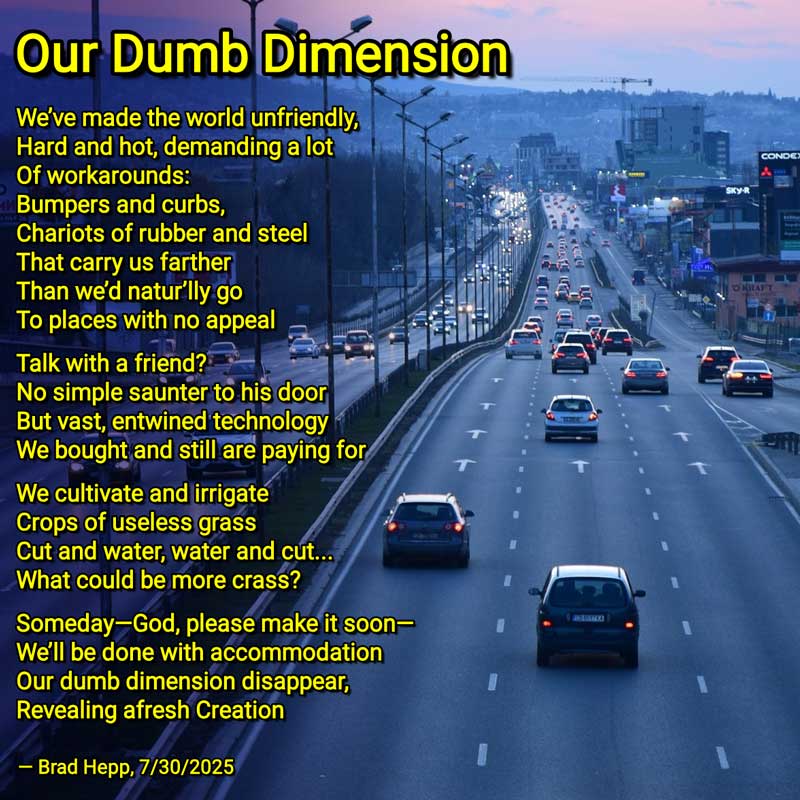
The view out the living room window of our temporary housing* is parked cars, the pavement, other apartments, and above it all a hint of sky. This is my view as today’s reading takes me to the pastoral scene of young David—ruddy, with beautiful eyes, and a handsome appearance (1 Samuel 16:12). I can imagine him walking in soft meadows, cajoling the sheep, and strumming his harp. I can imagine the scene because I have been there—as a child in Mexico and as a man in the alpine meadows of Colorado mountains. THAT is my Father’s world. Not this.
“DIMENSION” Here I am playing with an idea that intrigues me. One prominent proponent of the idea is the Anglican theologian N.T. Wright. From an AI Overview:
N.T. Wright proposes that heaven and earth are not two separate locations, but rather two different dimensions of God’s creation. He suggests that heaven is not a distant realm to escape to, but rather an aspect of our present reality, the “God-dimension” that is interwoven with our earthly existence. The biblical vision, according to Wright, is the restoration of all things, with heaven and earth united in a new creation.
I don’t know enough about the concept and it strengths or weaknesses to say any more just yet. So I’ll leave it there….
___________ *this is another poem born of my experience living in temporary housing after our house fire earlier this month
(background image by Zdravko Shishmanov on Pixabay)
(if you are viewing this via email, the website has a recording of this poem and commentary; click the title above)
Commentary
I am trying to capture my thoughts and impressions of moving into temporary housing after our home of 31 years was partially destroyed by fire. One night in friends’ houses, three nights in the home of a vacationing church family, eleven nights in a hotel, and—finally—moving into an apartment for the months to come…. It’s a recipe for broiled impermanence, for a taste of dwelling—but not indwelling.
Soon after we moved into the apartment, I reported maintenance issues to management. I had to wonder why the tenant who just moved out had not complained about an inoperable dishwasher, an obviously clogged dryer vent, and a stuck shower diverter. From the mail that continues flowing into the mailbox, I gather she was a young woman. Naturally, she would not have had the maintenance savvy and expectations of a 65-year-old homeowner. At my request, management jumped right on making repairs. In contrast, the young lady must have suffered in silence— living here, but barely.
Our relationship with dwellings can serve as a metaphor and extension of our relationship with solid, abiding truths. If we don’t inhabit them fully, they are vapid, meaningless, and empty.
THREE TRICKY THINGS IN THIS POEM:
1). The sixth line of the first stanza has a word—“ev’rything”—that is doing double duty. It’s the subject AND the object.
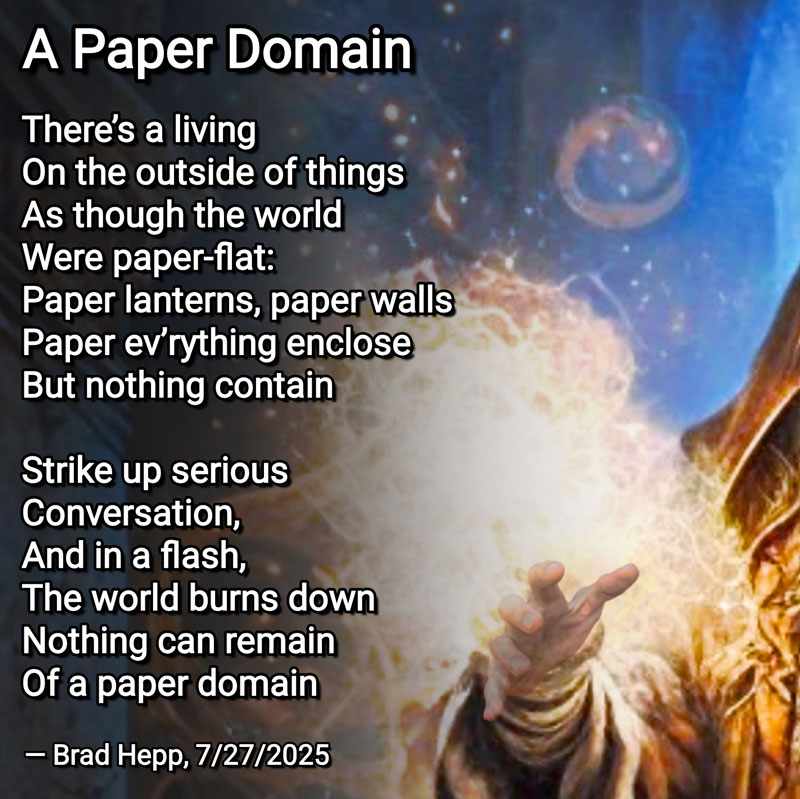
2). In the second stanza, I’m picturing the flat, minimally inhabited world as a magician’s flash paper. From an AI overview:
“Flash paper, also known as nitrocellulose paper, is a type of paper that burns quickly and completely, leaving behind no ash or residue. It’s primarily used by magicians for dramatic effects in performances.”
3). Conversations reveal one’s depth… or lack thereof. When a shallow person engages in serious conversation, their world is revealed to be as insubstantial as a magician’s flash paper. I am blessed with family and friends of a better sort. Recently, I got together with my friends Jim and Darol at a wedding reception. Our conversation plunged immediately into deep waters. You would never guess it had been months since we had last seen each other. We had been longing to talk with a friend about the interior life, about living in homes richly furnished for eternity.
(background image cropped from one by Gordon Taylor on Pixabay)
(if you are viewing this via email, the website has a recording of this poem and commentary; click the title above)
Commentary
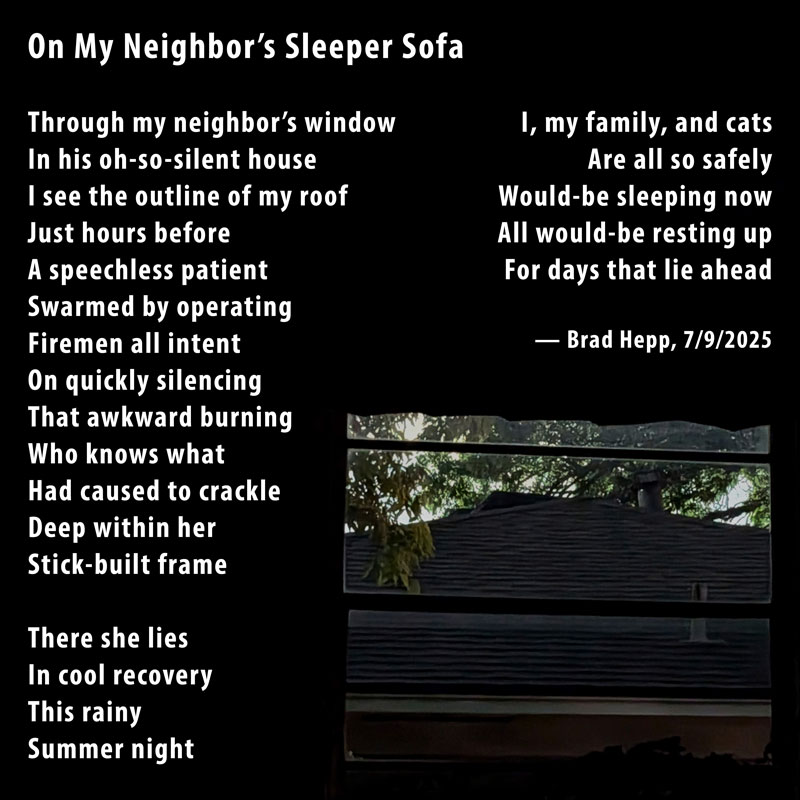
In case you didn’t read between the lines, we had a house fire. Our excellent neighbor Don put me and my son up for the night while Susan slept at her friend’s house. Jonathan slept in a guest room and I slept on a sleeper sofa in my neighbor’s den. I say “slept.” There was very little sleeping that night for any of us. As I lay there, I could look through Don’s kitchen window at the roof of our house. The background photo is one I took as I lay there, feeling compelled by my muse to memorialize the occasion in verse.
“Days That Lie Ahead” As I write this commentary, it has been one week since the house fire. I’m learning some new lessons and relearning old ones: 1. Don’t worry… 2. There are people who love in practical ways… 3. God was providing for us to pay insurance premiums all those years….
One highlight was the way St. Bart’s Anglican Church snapped into action. The Associate Pastor over Worship and Pastoral Care, Jen Crider found us a luxurious home to stay in for several days while the owners were on vacation. Friends and family extended offers of help, although I didn’t know how to take them up on their offers at first. A special new friend (he’s a fellow poet!) and his wife washed clothes for us. Others donated cash. We feel loved. We’re experiencing some anxiety and plenty of confusion about the process. But we’re confident this will all turn out for God’s glory and our growth as His children.
Below is a poem I wrote on the second night after the fire. By then, we were comfortably ensconced in the home Jen Crider found for us (the Darnells bravely welcomed us three humans and our three cats into their home while they finished out their vacation).
(if you are viewing this via email, the website has a recording of this poem and commentary; click the title above)
Commentary
This poem is just poking fun at myself for what I described to a friend as my IBS. That’s irritable brain syndrome.
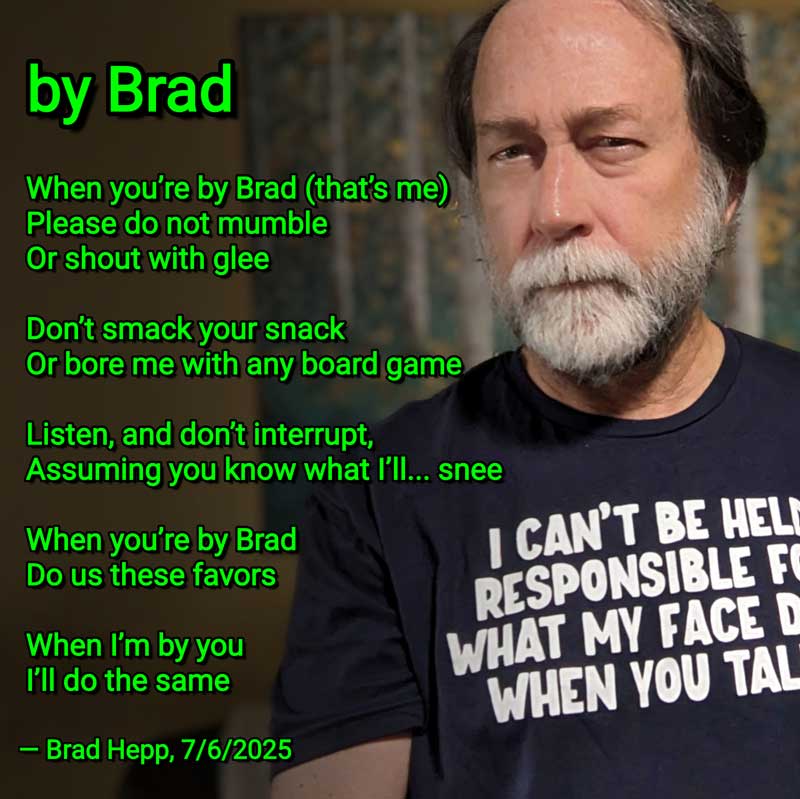
The Shirt One of the most thoughtful gifts I’ve ever been given was the shirt I’m wearing in the background image. By giving it to me, my friend Sten-Erik said, “Your face gives away everything you’re thinking. And we still love you.”
Snee I meant to come up with a nonsense word… something, anything other than what someone talking with me might assume I’d say at the end of that sentence. So, if you go look it up, don’t try to make sense of how it fits in the poem. That’s not the point. Rather, the point is “Hear me out, and don’t interrupt when you don’t know what I may say next!”
I have some friends who are spectacularly good listeners. See this poem I wrote about one of them: Silence, The Lingering Wisdom.
(if you are viewing this via email, the website has a recording of this poem and commentary; click the title above)
Commentary
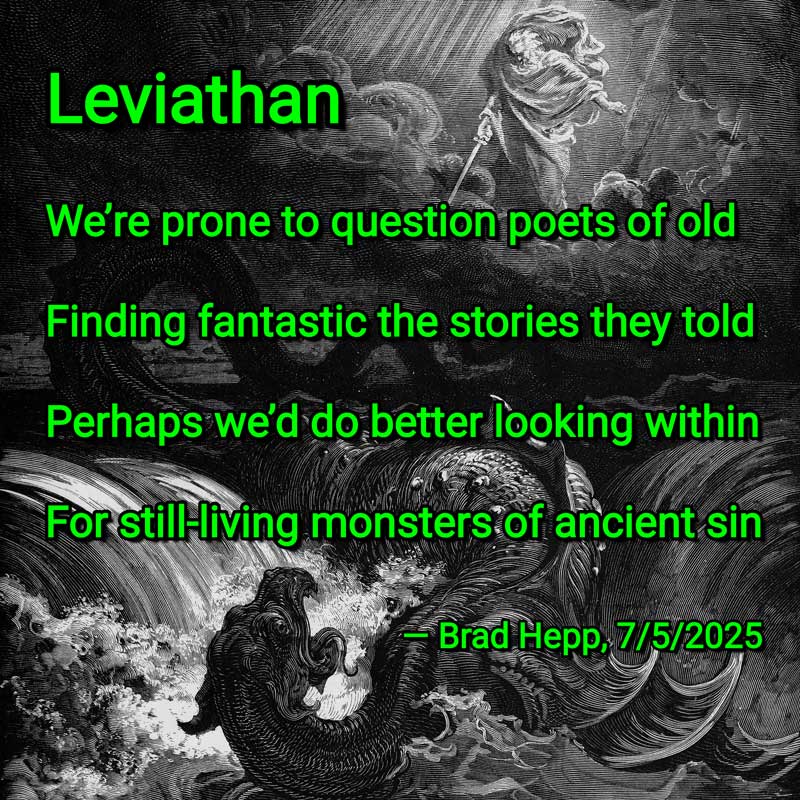
I sometimes joke that I’m a “wooden-headed literalist.” There’s some sting in the joke because it’s partly true. Combine having one foot “on the spectrum” (self-diagnosed), and another in a background of fundamentalist and dispensationalist thinking, and literalism is my unfortunate tendency. I struggle—am struggling—to properly appreciate the work of fellow poets from millennia past, as recorded in the Old and New Testaments. To correct this tendency, I have begun reading authors like Peter Enns and John H. Walton. Eventually, I’ll probably get to Walter Brueggemann.
Friends, what other authors do you recommend?
[background image: The Destruction of Leviathan by Gustave Doré (1865)]
See Job 41 (https://www.bible.com/bible/111/JOB.41.NIV)
(if you are viewing this via email, the website has a recording of this poem and commentary; click the title above)
Commentary
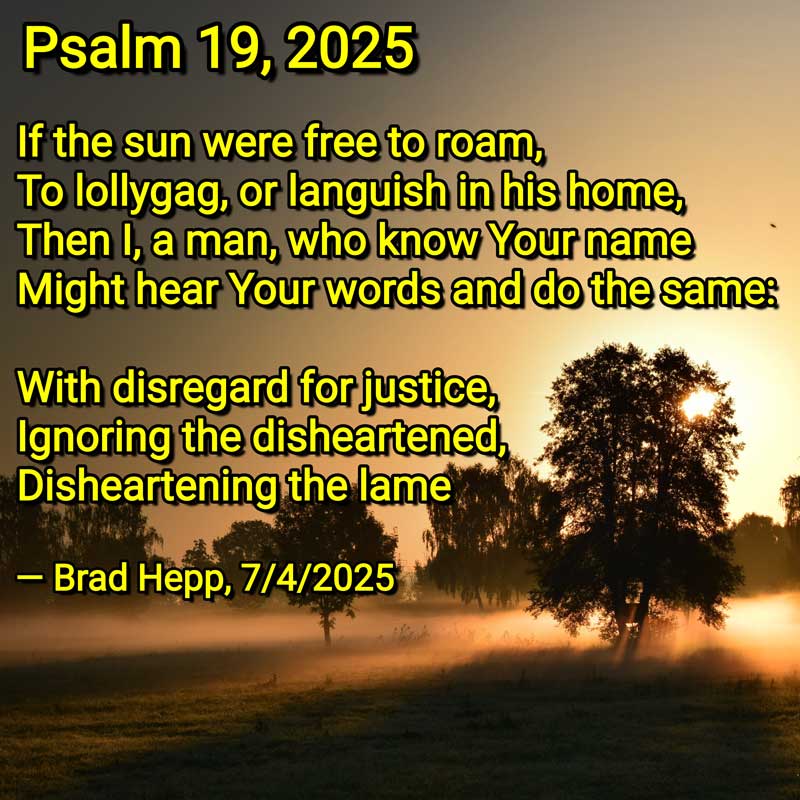
When I read Psalm 19 this morning, I was jarred by a seeming disconnect between the first 6 verses and the remaining 8 verses. What does the sun, in its dutiful, energetic, warming course across the skies have to do with us as we contemplate God’s words?
This poem expresses one possible connection between the parts of Psalm 19, namely that we could learn a thing or two from the sun. Perhaps I am just distressed by the context we’re living in right now. I see a disconnect between God’s words and the way many respond to them in the America of 2025.
(if you are viewing this via email, the website has a recording of this poem and commentary; click the title above)
Commentary
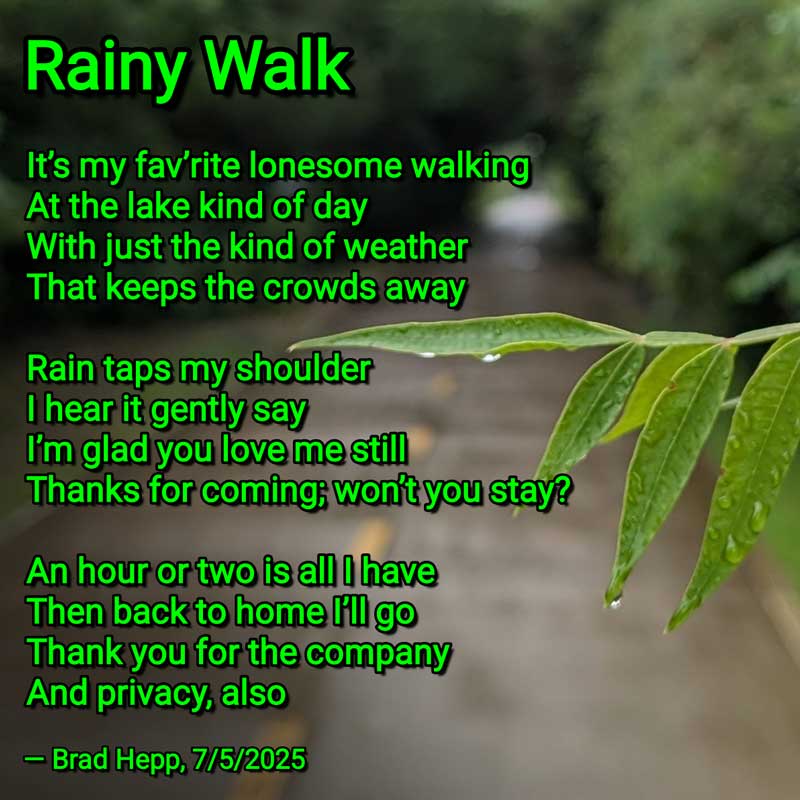
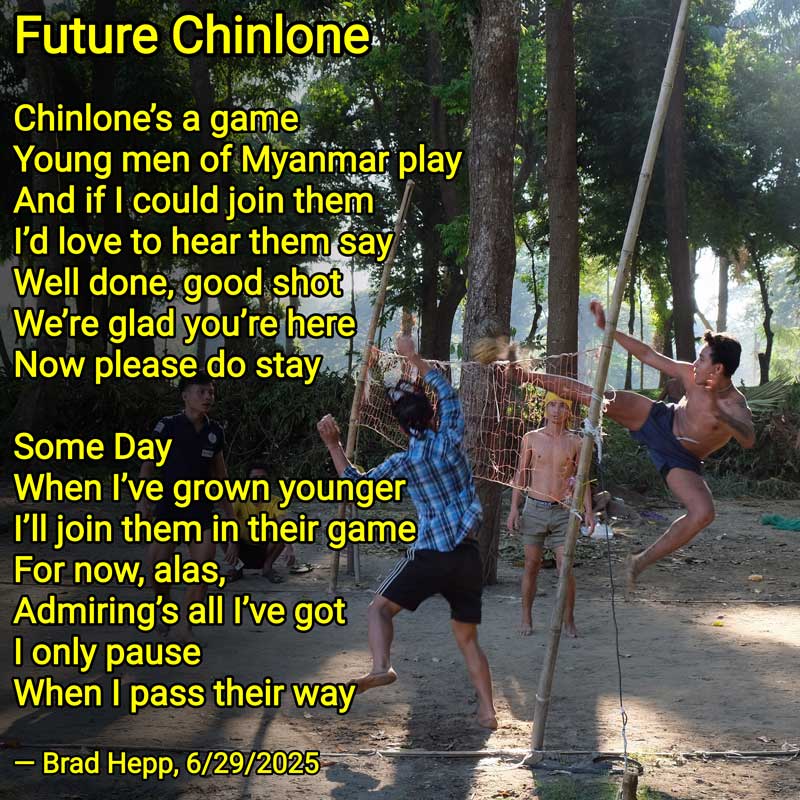
When I walk at White Rock Lake, I often encounter young men playing chinlone, which I understand is the national sport of Myanmar (formerly known as Burma). Watching those young men use their heads and feet to keep a little rattan ball in play reminds me of the countless hours I spent doing the same with a soccer ball when I was a teenager.
I admire their athleticism, and miss the days when I myself could spin, reach up with my leg and intercept a ball with just the right extension and just the right force to keep it up in the air.
Here’s a short video of the guys playing chinlone at White Rock Lake. Music is from their boombox.
(if you are viewing this via email, the website has a recording of this poem and commentary; click the title above)
Commentary
This was the first draft of an experimental stream-of-consciousness poem. So, don’t work too hard at making sense of the metaphors, unless you’re a therapist and really relish such puzzles!
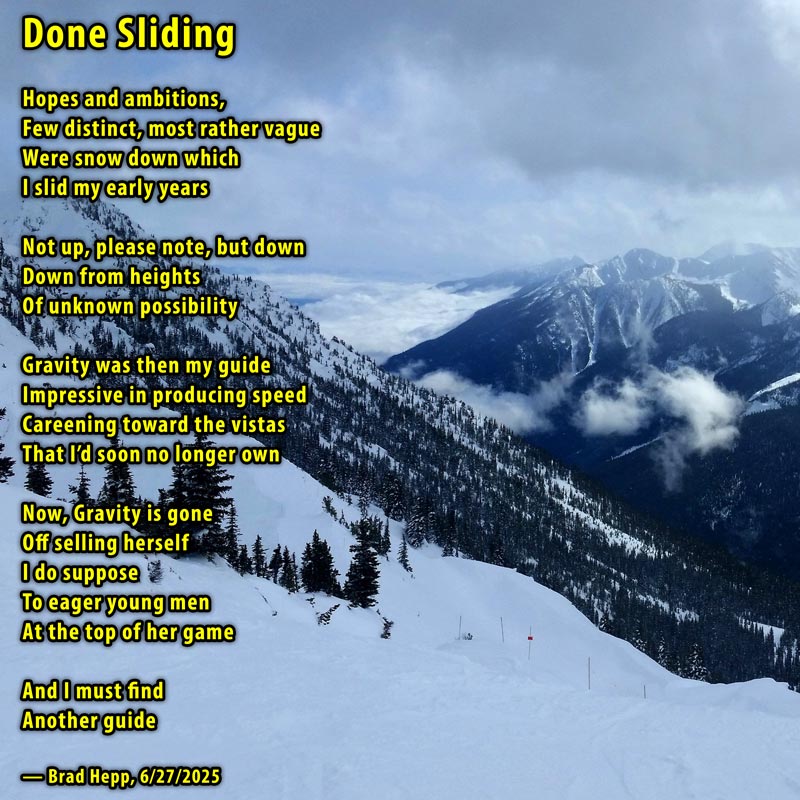
The Occasion I wrote this poem the morning after an encouraging, highlight-of-the-year conversation with Darol, my mountain-climbing buddy of many decades, and after thinking about how young George Herbert was when he wrote his short poem “Hope.”
The Mood There is definitely some melancholy in recognizing that the myriad prospects of youth have dwindled down with the passing of years. But there is also a growing recognition that the number of prospects is far less important than the quality and reasonableness of prospects. If you know me well, you know what comes next: some lines from Robert Browning’s “Rabbi Ben Ezra” ….
What I aspired to be, And was not, comforts me: A brute I might have been, but would not sink i’ the scale.
Another Guide A few years ago, when I was already in my 60s, I wrote a poem and commentary that serve as the antidote to this melancholy. In that post, I suggest that even in old age, we can be “full of promise,” and we’re “never too old to grow.” But mere inertia, mere sliding, is an inadequate guide for this precious autumn of life.
Understand a Little Better? When I explain my poems to family and friends in person, I can see when the lights of understanding go on. But writing, I never know. That’s why I often ask for feedback. Did my commentary open any windows into this poem?
(if you are viewing this via email, the website has a recording of this poem and commentary; click the title above)
Commentary
My assignment for this blog post is to mention – my father’s intellectual honesty – a sermon in Conclave that int’rested me – a book by Peter Enns – an exchange with one of my super-smart friends
Here goes….
What do we do when clouds pop up in the clear blue sky of our beliefs, be they beliefs about the natural or supernatural world?
I wrote this poem to myself while the question was troubling me more than usual.
Here’s the setting….
One of my newest friends is skilled in poetry, theology, and science. In conversations with him, it seemed like a perfect time to revisit the Genesis creation account. How do Genesis 1 & 2 shed light on reality? It’s a huge question, but I thought that with my friend’s help I might make a little progress in clearing up my confusion. We talked, and he loaned me a book with lectures on this topic by the esteemed Bruce Waltke.
So, I’m reading those lectures. At the same time, I’m listening to books by Peter Enns. Waltke and Enns both taught at Westminster Theological Seminary in Philadelphia. Although I haven’t accessed the source materials, I know they had a serious, respectful dialogue highlighting “fundamental questions about how to approach biblical interpretation, especially when dealing with apparent contradictions or historical and scientific challenges” (that’s an AI summary). The Enns book I’m currently listening to isThe Sin of Certainty.
I also heard certainty challenged from another quarter. In the movie Conclave, the Ralph Fiennes character preaches a sermon that includes these memorable lines:
Certainty is the great enemy of unity. Certainty is the deadly enemy of tolerance.
Criticisms of certainty resonate with me. My father was a theologian and writer. He “knew his stuff.” But he was also intellectually honest. That is, he recognized and readily acknowledged what he DIDN’T know. He was characterized more by humble faith than by certainty. Having grown up with that model, I am repulsed when people think they know more than they really know. I’m skeptical—and dismissive—of their certainty.
And now to my exchange with a super-smart friend—not the poet, not my father, but another friend…. We were discussing the question of whether or not heaven will always be distinct from earth. In part of my argument for a future unified Heaven/Earth, I mentioned my notion that
Jesus’ “going up” in the Ascension [might be] an accommodation to man’s limited apprehension of the unseen world. Hints of that world are sprinkled throughout the Bible. Think, for instance, of Elijah’s being whisked “away” in a chariot of fire. Or a passage nobody ever mentions: the 70 elders’ vision of God and His sapphire pavement in Exodus 24.
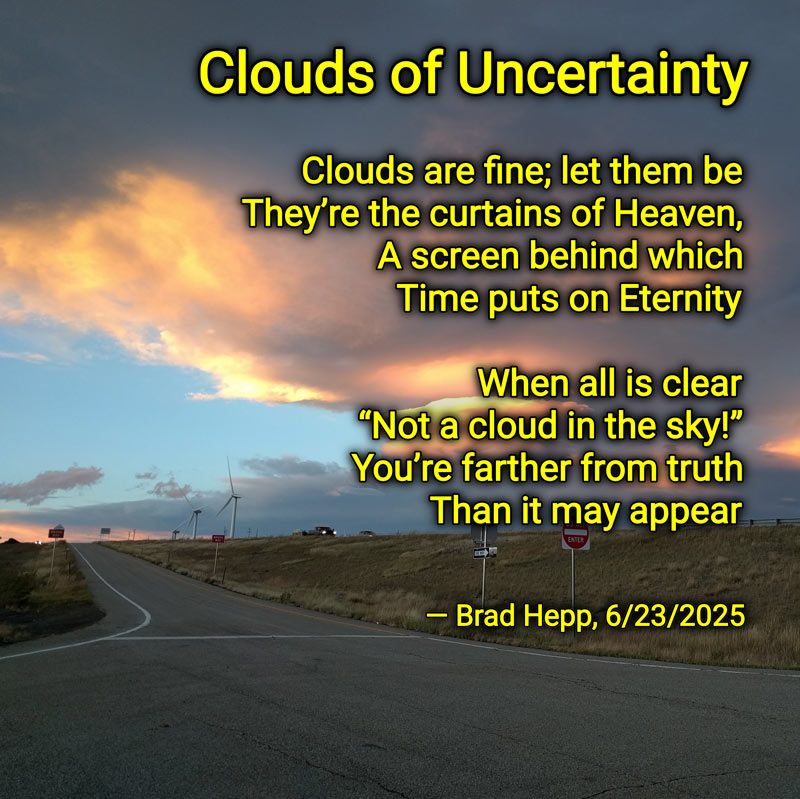
It was that argument where I got the idea for the metaphor in my poem. Jesus is received into the clouds and thereby hid from the disciples’ sight. The clouds are a transition between the seen and the unseen.
Clouds, like uncertainty, suggest that there’s more and better to know beyond, something ALMOST attainable. A certainty to which we’ll arrive—soon, eventually… just not yet. Another way of looking at this would be that when we cannot control our environment, God may be at work, changing our hearts, or changing our circumstances
A CONFESSION That last paragraph was supposed to be the clincher of this commentary. I had hoped to perfectly capture in prose what I intuitively wrote in verse. But I didn’t succeed. It turns out I am uncertain of my own meaning. Is that uncertainty fine? Can I let it be? It’s the perennial question of this growing poet.
(if you are viewing this via email, the website has a recording of this poem and commentary; click the title above)
Commentary
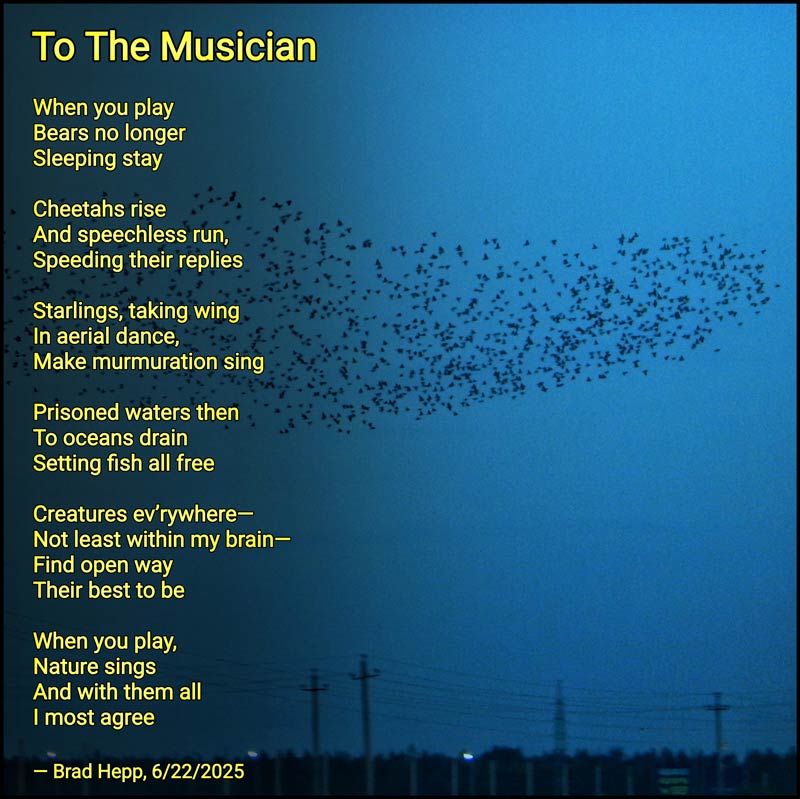
On Sunday mornings, I get up early to project lyric slides as instrumentalists and singers at St. Bart’s Anglican Church prepare for their service. My favorite Sundays are those rare ones when singers are accompanied only by the pianist Kevin Howard. While there are other exceptionally talented musicians, my old ears are happiest when I can clearly pick out Kevin’s playing. I don’t know how he does it, but his style opens doors to harmony—and I respond in worship. Today—during practice and in the service itself— this all struck me as a picture of Creation responding appropriately to God under the care of God’s vice-regent, man. Awake, and free to all do what we do best, and that harmoniously—it’s how we’re meant to be.
This poem is for Kevin, who opens the way to harmony.
NOTE: If you’re not accustomed to e. e. cummings’ odd syntax, you may find the last two stanzas especially difficult. So here’s a gloss: I couldn’t agree more with nature in its untrammeled and joyous response to a fine musician’s accompaniment.
About the “prisoned waters….” A fellow poet initially thought I might mean “poisoned waters.” I can’t blame him, since the word should actually be “imprisoned” or “imprisoning.” For what it’s worth, I was thinking about fish in aquariums, and wanted a quick way to suggest that when the musician plays, fish in a constraining environment find their own “open way” to swim free and thus be all the fish they’re meant to be.
(if you are viewing this via email, the website has a recording of this poem and commentary; click the title above)
Commentary
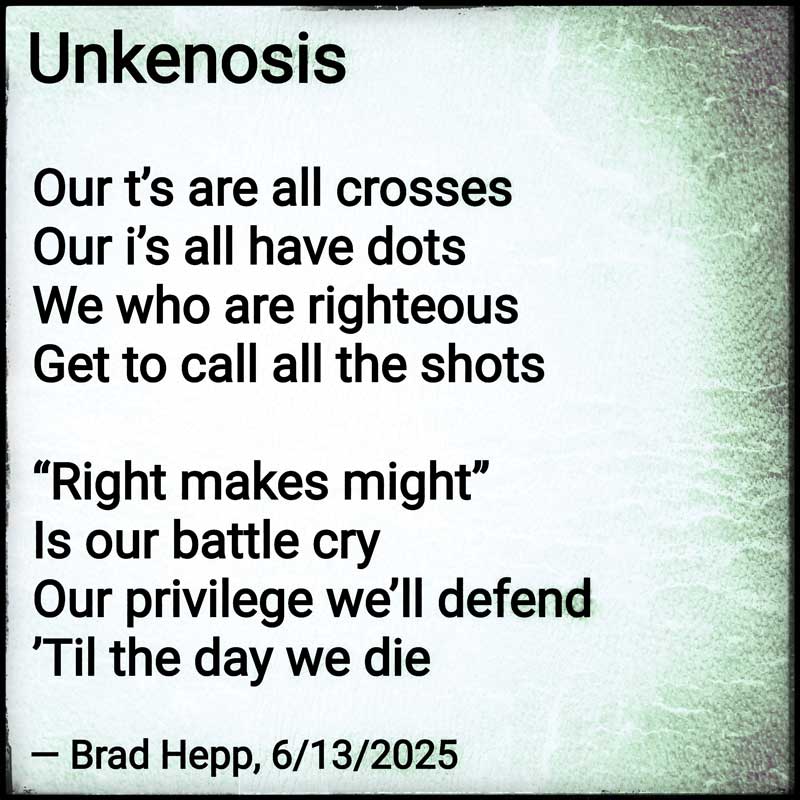
Let me say right off the bat–this poem is sarcastic. I suspect that many people identify with what they think of as good morals and right thinking NOT to please God, but because it puts them in a position of privilege and power over others.
The reason I titled the poem “unkenosis” is that the drive to attain POWER and PRIVILEGE from being “right” is the opposite of the “kenosis” that Jesus undertook in becoming a man and dying on the cross.
Do nothing out of selfish ambition or vain conceit. Rather, in humility value others above yourselves, not looking to your own interests but each of you to the interests of the others. In your relationships with one another, have the same mindset as Christ Jesus: Who, being in very nature God, did not consider equality with God something to be used to his own advantage; rather, he made himself nothing by taking the very nature of a servant, being made in human likeness. And being found in appearance as a man, he humbled himself by becoming obedient to death— even death on a cross!
Philippians 2:3-8 (NIV)
And why did Jesus’ “making himself nothing” (also translated “emptied himself” from the Greek ekenōsen heauton) result in death on a cross?
God made him who had no sin to be sin for us, so that in him we might become the righteousness of God.
2 Corinthians 5:21 (NIV)
It was for our advantage that Jesus was willing to die, taking on the mantle of guilt. We must imitate him, not power-hungry pretenders.
(if you are viewing this via email, the website has a recording of this poem and commentary; click the title above)
Commentary
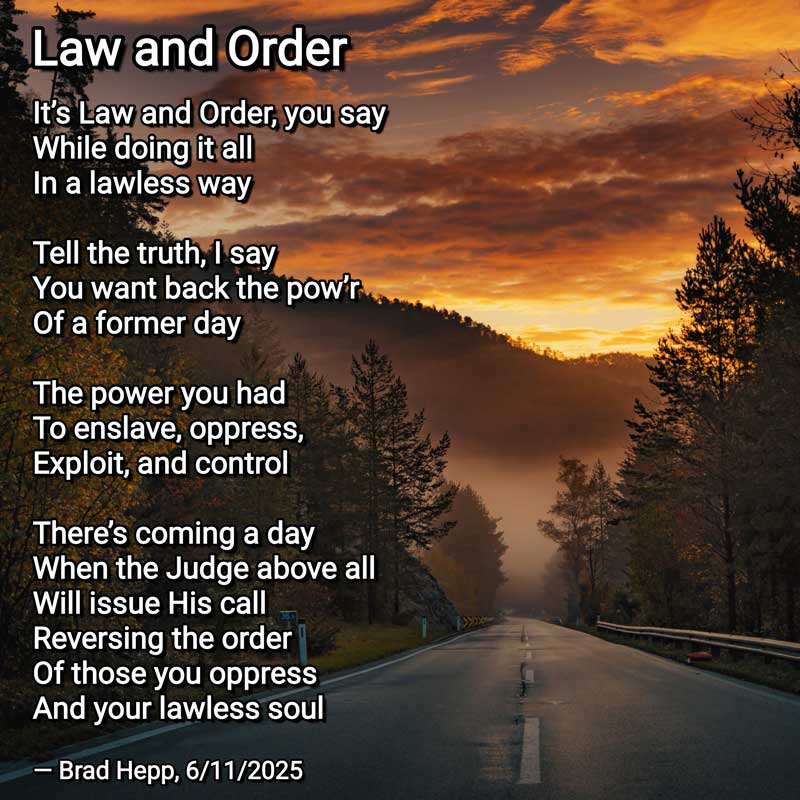
We’re headed for a great upending and reversal.
[2] and he began to teach them. He said: [3] “Blessed are the poor in spirit, for theirs is the kingdom of heaven. [4] Blessed are those who mourn, for they will be comforted. [5] Blessed are the meek, for they will inherit the earth. [6] Blessed are those who hunger and thirst for righteousness, for they will be filled. [7] Blessed are the merciful, for they will be shown mercy. [8] Blessed are the pure in heart, for they will see God. [9] Blessed are the peacemakers, for they will be called children of God. [10] Blessed are those who are persecuted because of righteousness, for theirs is the kingdom of heaven. [11] “Blessed are you when people insult you, persecute you and falsely say all kinds of evil against you because of me. [12] Rejoice and be glad, because great is your reward in heaven, for in the same way they persecuted the prophets who were before you. Matthew 5:2-12 NIV
__________________ (background image by Michael Pointner on Pixabay)
(if you are viewing this via email, the website has a recording of this poem and commentary; click the title above)
Commentary
Some people hold up protest signs. Some people march. I write poetry. This protest may resonate most with people who–unlike most Americans–speak English AND Spanish. An “idiota” is… well, I think you know what that is. There’s been a proliferation of them lately.
(if you are viewing this via email, the website has a recording of this poem and commentary; click the title above)
Commentary
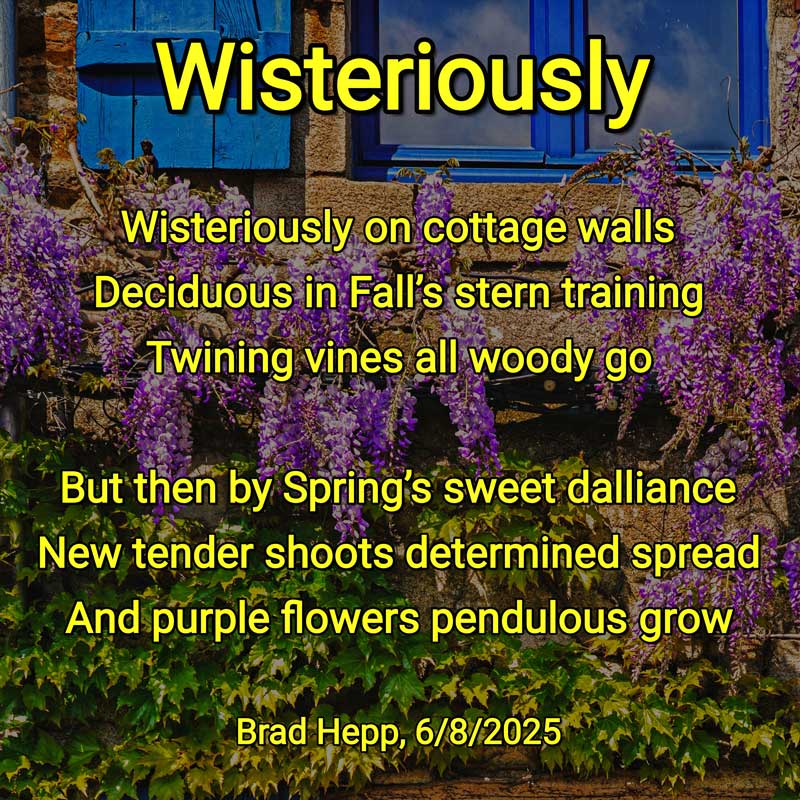
I had to write a few silly lines just to stake my claim on the neologism “wisteriously.” It popped into my weird brain as we watched the tortured romance Howard’s End. I wasn’t following all the story, but the flowers sure were pretty!
Scientific descriptions have amused me and inspired doggerel since I was a boy. For instance, there was that line in a Peterson field guide: “mantids are predacious.” Makes you want to write a poem, doesn’t it? No? Maybe it’s just me.
So, here’s the inspiring description: “Wisteria is a genus of woody, twining vines known for their long, fragrant, pendulous clusters of flowers, often purple or blue, but also white or pink. They are deciduous, meaning they lose their leaves in the fall. Wisteria is a popular ornamental plant, often used to decorate porches, walls, and arbors.”
The neologism, big words and odd syntax in this poem may remind you of Lewis Carroll’s Jabberwocky. That poem begins and ends with these enlightening words:
’Twas brillig, and the slithy toves Did gyre and gimble in the wabe: All mimsy were the borogoves, And the mome raths outgrabe.
(if you are viewing this via email, the website has a recording of this poem and commentary; click the title above)
Commentary
Suspecting that the Genesis creation account should not be taken literally can threaten one’s faith. I have held off thinking deeply about this threat for a long time now. Over the years, I’ve heard people I respect say something like “The Genesis creation account is poetry; don’t take it literally.” The main problem is that I have not heard a convincing exposition of the account as anything other than literal history. Rather, I have been exposed to many conservative defenses of a young-earth, somewhat literal understanding of Genesis. Since I do believe in an all-powerful, miracle-working God, the defenses often resonate, or even thrill!
Jesus and his Apostles seem to have taken the Genesis creation account literally. How are we supposed to understand their arguments if they’re wrongly based on a literal understanding of Genesis?
This poem is a naming and exploring of the threat. I want to deal with it instead of suppressing it. To that end, I’m enlisting the help of wise, intelligent, and faithful(!) friends and writers. It’ll be okay if I don’t get it all sorted out. That’s to be expected in a life of faith.
By the way…. I don’t usually say this publicly, but I’m pretty pleased with this poem. I especially like the second stanza, which tells a story in miniature. It’s odd though… being pleased with the expression of a troubling thought….
(background image adapted from one by OpenClipart-Vectors on Pixabay)
(if you are viewing this via email, the website has a recording of this poem and commentary; click the title above)
Commentary
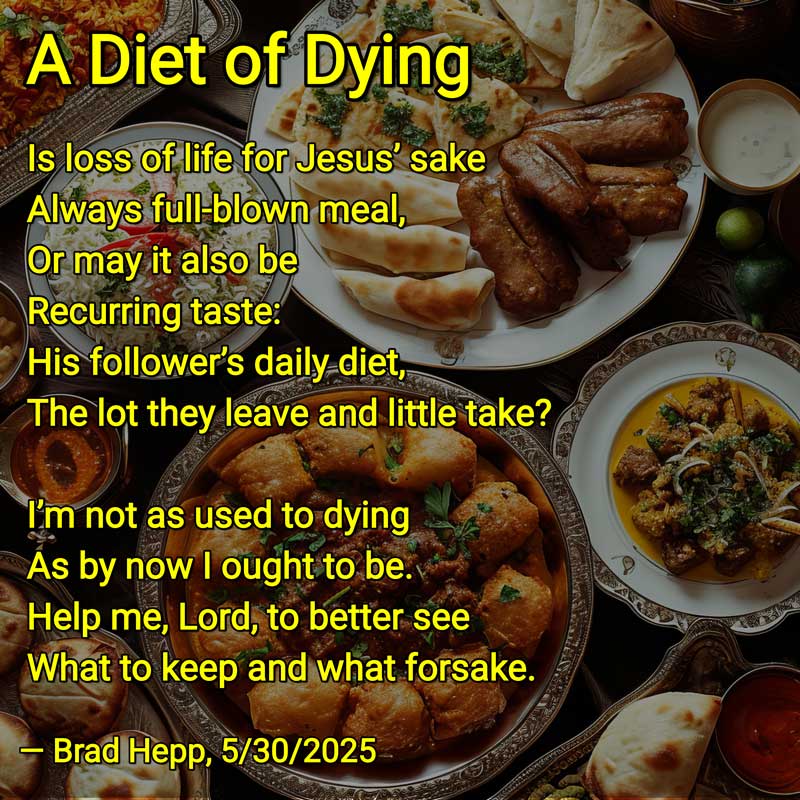
This poem is the confluence of three streams:
First, I woke up one morning about a week ago and–seemingly out of nowhere–a phrase popped into my mind: “I’m not accustomed to dying.” This kind of early-morning inspiration accounts for a good number of my poems. Don’t ask me to identify this muse.
Second, sometime in the following days, my daily reading of George Herbert got me to his poem “Mortification.” In the last two lines of that poem, Herbert wrote
Yet Lord, instruct us so to die, That all these dyings may be life in death.
Third, I reviewed Jesus’ words to his disciples just before the Transfiguration. Notice that he first speaks of taking up a cross and losing life. Then, as he predicts the Transfiguration, he speaks of tasting death. Are all three expressions equivalent? Do they all refer to bodily death? That’s a question I ask in the poem. Here’s the passage:
[23] And he said to all, “If anyone would come after me, let him deny himself and take up his cross daily and follow me. [24] For whoever would save his life will lose it, but whoever loses his life for my sake will save it. [25] For what does it profit a man if he gains the whole world and loses or forfeits himself? [26] For whoever is ashamed of me and of my words, of him will the Son of Man be ashamed when he comes in his glory and the glory of the Father and of the holy angels. [27] But I tell you truly, there are some standing here who will not taste death until they see the kingdom of God.” Luke 9:23-27 ESV
As you can see from the poem, I tentatively conclude that there is a kind of dying that is short of bodily death. You may recall the Apostle Paul saying that he dies daily:
[31] I protest, brothers, by my pride in you, which I have in Christ Jesus our Lord, I die every day! 1 Corinthians 15:31 ESV
There is a kind of dying that is imposed on us by age. Our strength dies. Sometimes our lust and ambitions die. As I pass through my sixties (65 on Friday), I’m certainly experiencing this kind of dying. I’m slowly getting used to it, but maybe if I had exercised more self-denial and discipline over the years, I wouldn’t find myself waking up to the thought, “I’m not accustomed to dying.”
Does the poem make more sense after that explanation? I’d love to know! Leave your answer in the comments below.
(if you are viewing this via email, the website has a recording of this poem and commentary; click the title above)
Commentary
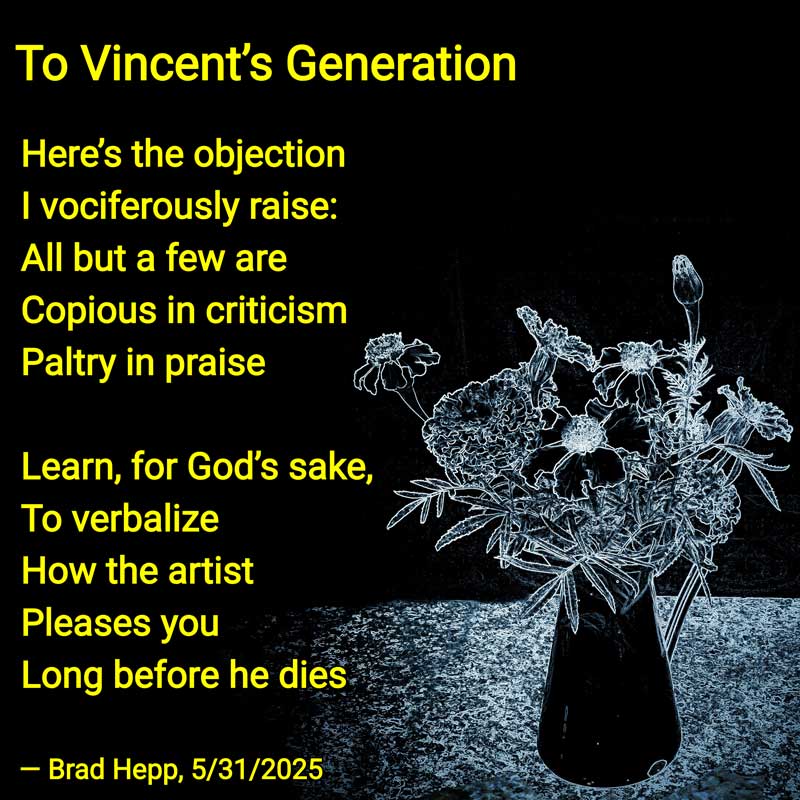
As a poet, I squeeze excess words out of sloppy speech. So my point is almost hypocritical: most of us need to EXPAND on our praise. Consider these scenarios:
The preacher crafts an insightful, well-structured, and persuasive sermon. All we can manage in response is “That was a good sermon.”
The painter captures subtle components of beauty, or depths of pain. We blurt out, “I like your picture.”
The novelist develops believable characters, who give us a mirror for our own unfinished selves. Our eloquent response: “That there’s some good writing.”
Why are we so inarticulate in our praise?
Several possibilities come to mind:
We are lazy or selfish
We don’t know much about the art form, and are afraid our ignorance will show (but we must manage appearances)
We are afraid of expectations: the artist will be sorely disappointed if we don’t lavish praise on her next effort
We are alert to ugliness, but unaware of beauty—when we say something’s good, it just barely cleared the threshold of our beauty detector
How can we do better? That’s not a rhetorical question.
(if you are viewing this via email, the website has a recording of this poem and commentary; click the title above)
Exclusion (self-imposed)
Some friends I admire From long ways off Limited portions Little doses
I grieve this regimen It’s self-imposed By sensing I’m Inadequate
A voluble joie de vivre I cannot match Even though I feel it too
An audience member, Silent hanger-on Applauding only Others’ show
— Brad Hepp, 5/19/2025
Commentary
[18] “There are three things that are too amazing for me, four that I do not understand: [19] the way of an eagle in the sky, the way of a snake on a rock, the way of a ship on the high seas, and the way of a man with a young woman. Proverbs 30:18-19 NIV
The fourth thing in this Proverb could apply to friendships in general. Sometimes, the process by which they’re initially established and then made solid is nothing short of miraculous.
God has performed this miracle several times for me. Against all odds, the beautiful man, the clever man, the popular, highly-regarded man has become my friend. I don’t mean a casual friend—a mere acquaintance admired “from long ways off”—but someone who is willing and able to share deep personal conversations.
The poem above explores why I sometimes doubt that God is ready to perform this miracle. Concentrating on my inadequacy, I forget His goodness. Pretending that I earn what comes my way, I neglect to ask for His favor. You may also notice that I sometimes assume things about potential friends, for instance that they always present with an energy (“voluble joie de vivre”) that I cannot match.
THE POEM STRUCTURE Did you notice how each stanza narrows down through its four lines? I knew I was doing that as I wrote, and I SUSPECT my subconscious was not just playing with a pattern. Perhaps one of my readers can articulate an effect the pattern produces….
(if you are viewing this via email, the website has a recording of this poem and commentary; click the title above)
Commentary
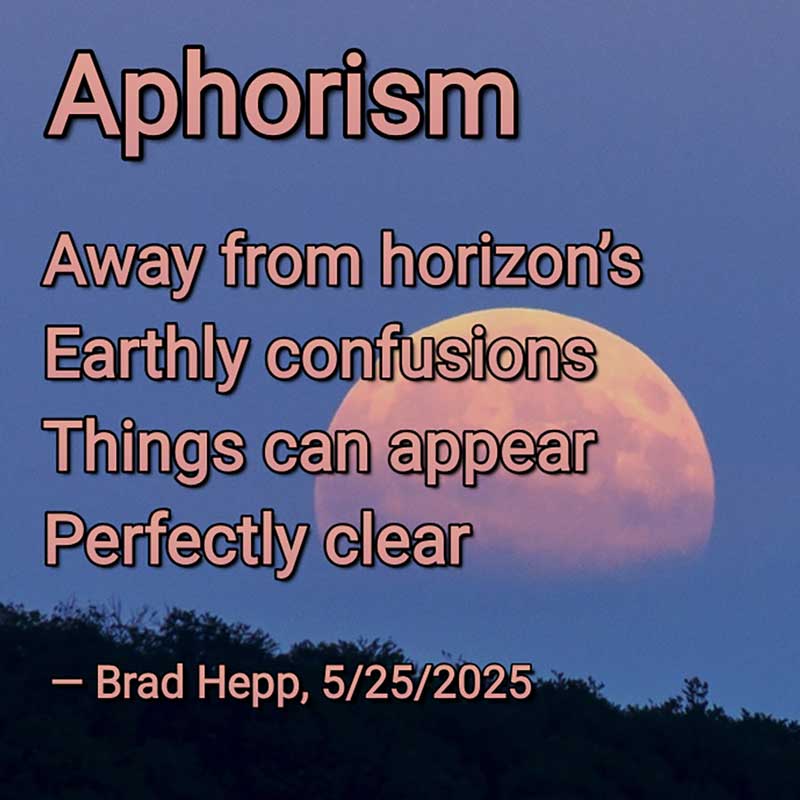
As I write this little poem, I can’t help but think of a friend who is really good with Greek and Latin sources of English words. Where I am CREATIVE in my etymology, he is CORRECT. So, take my poem with a grain of salt. My friend hasn’t weighed in yet. In any case, it is generally more fun than accurate to define a word by its origin (see “What Is the ‘Etymological Fallacy?‘”).
MORE FOR THE NERDS Another friend pointed out that many of my poems express aphorisms. What’s that? When I looked up the word, AI supplied the following overview (when you have read that, you may come up with a better mnemonic for yourself than my poem; feel free to share that in the comments):
Further back, ‘aphorizein’ comes from ‘apo’ (off)* and ‘horizō’ (I divide, bound), ultimately stemming from ‘horos’ (boundary). In essence, the term suggests a concise statement that clearly defines or marks off a truth or principle.
Here’s a more detailed breakdown:
Ancient Greek: The word “aphorismos” (ἀφορισμός) meant a concise, pithy statement, a definition, or a delimitation.
Etymology of ‘aphorismos’ ‘Aphorizein’ (ἀφορίζω): To define, mark off, or determine. ‘Apo’ (ἀπό): Off. ‘Horizō’ (ὁρίζω): To divide, bound. ‘Horos’ (ὅρος): Boundary. __________
*some people believe that “apo” more frequently means “away from.”
(if you are viewing this via email, the website has a recording of this poem and commentary; click the title above)
Commentary
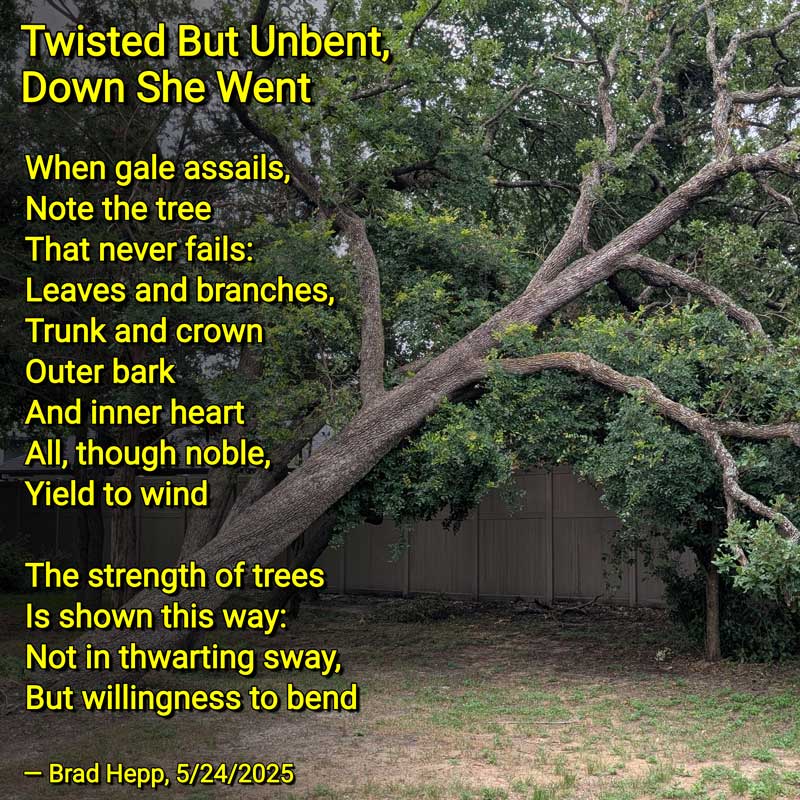
This poem is the first fruit of considering a deliciously ambiguous phrase: “make friends with compromise.”
Can I rehabilitate the various—mostly negative—meanings of “compromise”? How does one befriend it, or befriend with it?
Trees show us one way. Much of their strength is in their ability to compromise. They say, “I’m standing here. But if the wind insists, I can bend, and move over there. The wind will die down, and I will live.”
The tree that serves as this poem’s background is behind the library where I work. It got blown down by a strong wind. We’re probably right to guess that its roots were inadequate for the kind of bending it needed that stormy night.
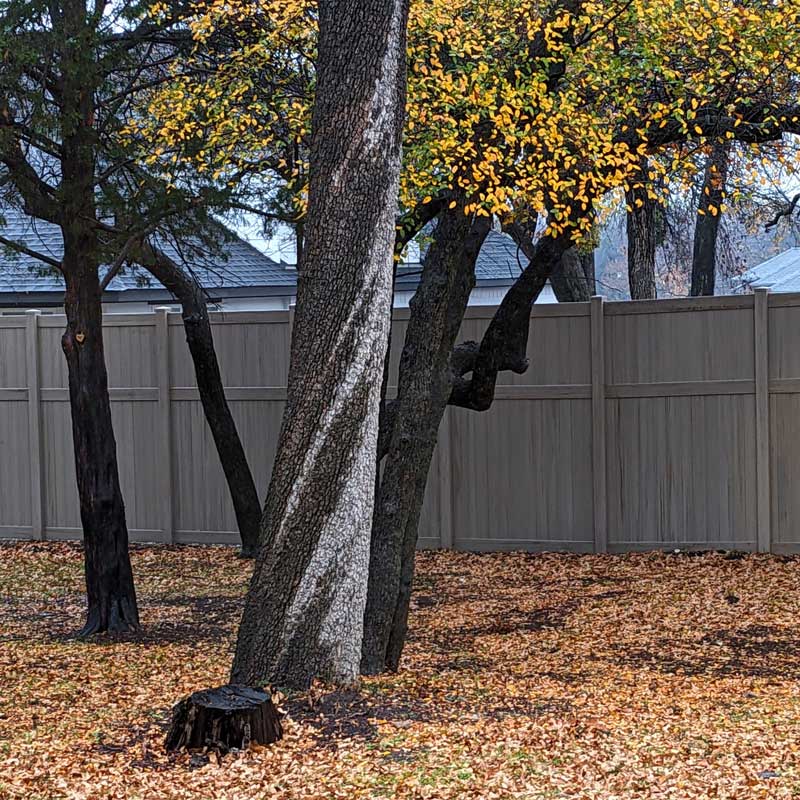
Below is a picture I took of the tree back when it was just twisted.
(if you are viewing this via email, the website has a recording of this poem and commentary; click the title above)
Commentary
Here’s one of those wake up, look in the mirror, and write what you first see poems. Oh well…. Make the most of becoming a ghost.
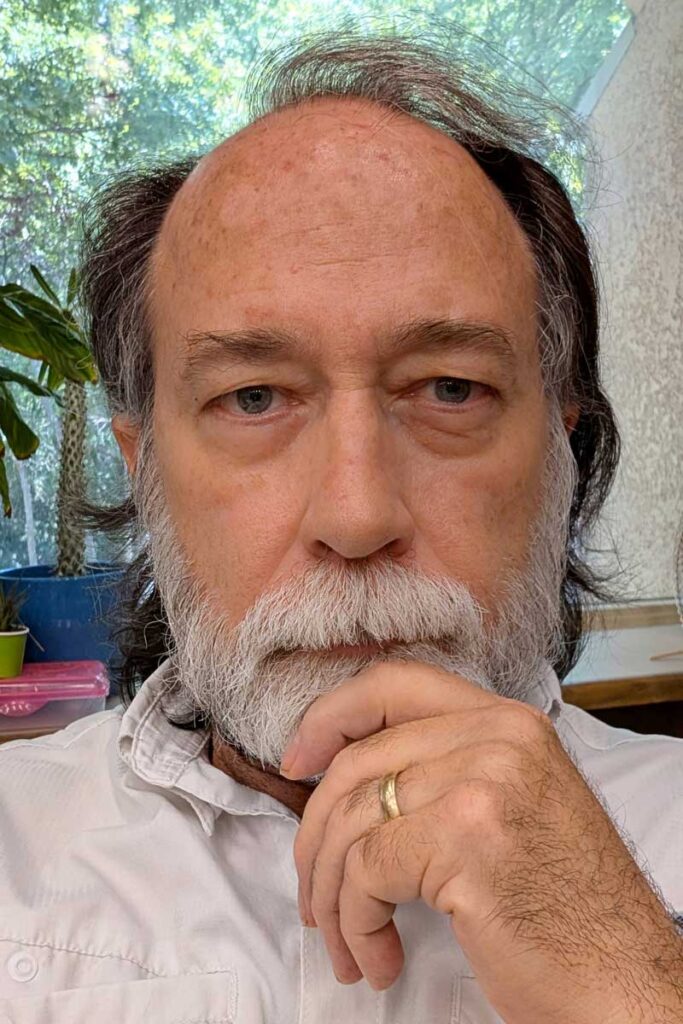
In case you’re imagining a younger me, here’s a selfie I took today. My friend the portrait photographer could find some beauty in this mug, and she’d capture it. She’s amazing.
(if you are viewing this via email, the website has a recording of this poem and commentary; click the title above)
Commentary
[This is a short piece I posted on Facebook back in July of 2020. The pandemic had taken away my cherished walks around White Rock Lake. I was trying to make the most of isolation, walking through neighborhoods from home to Flag Pole Hill. This post described a pair of encounters on one of those walks. But I decided to remove the post shortly after publishing. One of my readers had skewered me for being judgmental. I have learned that there is hardly anything more repellent to some people than what they perceive to be unfair judgment of others. That’s not all bad!]
On my walk today, I stopped briefly in front of a house to look at the red tube hanging from a crepe myrtle. I had seen such tubes before, but had no idea what they were.
The lady who was standing in the next yard walked over to me. “That’s a mosquito repellent.”
She seemed to be on a phone call, but started chatting with me instead. A minute in, she said to the phone, “Michael, I’ll have to call you back.”
She explained to me, “The call was breaking up. Hi, I’m Christy.” She and I talked for several more minutes, about owls and bees, coyotes and feral cats. She explained how surprisingly well the mosquito repellent works.
Finally, I said, “I better get back to my walk,” and left. This was the kind of pleasant conversation I often had when walking around the lake, back before the pandemic.
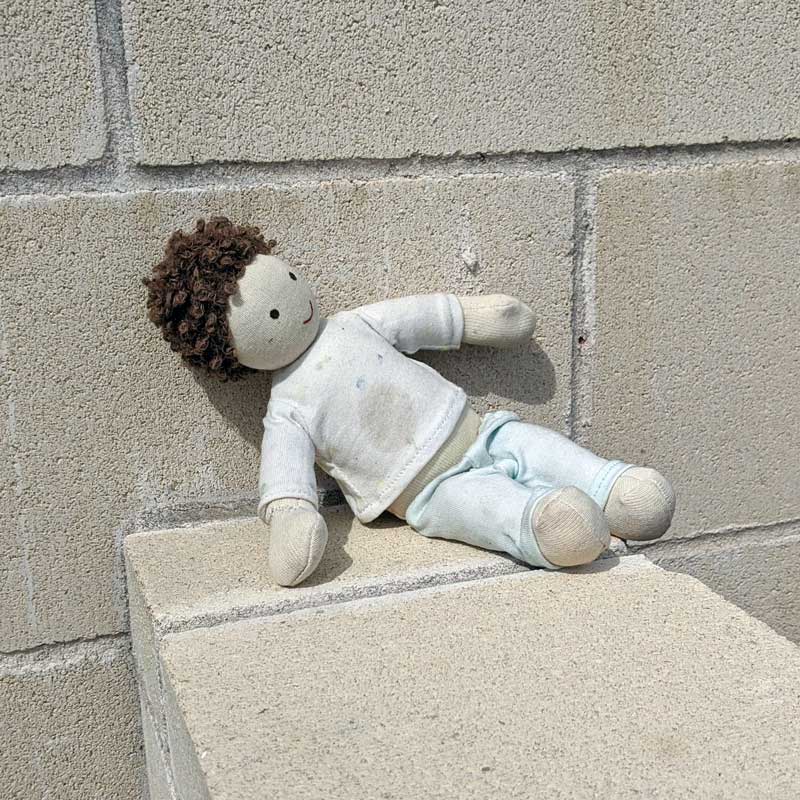
Three blocks later, I was about to pass by a house where I once took a picture of a forlorn rag doll, propped up on a planter made of cinder blocks. The doll had been there every time I walked past. And there was the lady I had seen once working in the planter. This time, she was edging the yard. “I’ll ask her about the doll,” I thought.
Once I got within talking distance, I said to her, “Say, what’s the story of that little doll? It’s sitting there every time I walk past.” I assumed she’d tell me how her daughter had left it there, and maybe even tell me some fanciful back story her daughter had made up about the doll.
Instead, she looked straight through me and said, “I don’t know. You can have it if you want. It’s just there.”
“Oh, no thanks. I was just curious.” I resumed my walk, repelled by her answer.* My questions and I were not welcome. And the doll? The doll is not loved. It’s not welcome. It’s just there.
_____________
* Why was the second woman so dour? There’s no telling. In this, as in so many other encounters, Wisdom urges me “Regard this person with sadness, not anger.”
(if you are viewing this via email, the website has a recording of this poem and commentary; click the title above)
Commentary
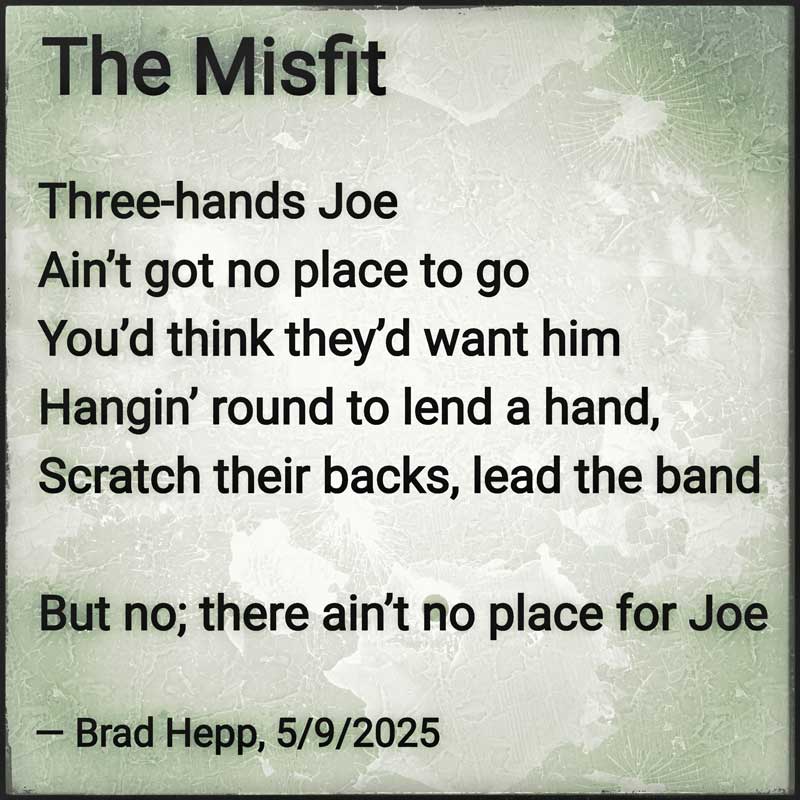
Over the years, I’ve observed something special that happens every now and then. There are people whose physical condition, social skills, or mental peculiarities set them apart as misfits. They don’t belong. So-called “normal” people don’t know what to do with them. Then, along comes someone who sees past problems to a precious person. They strike up a friendship. Digging just below the surface, they strike gold. Looking on, short-sighted society is envious. “Too late,” says the wise man. “He’s MY friend.”
I’ve been on every side of this story. How about you?