(if you are viewing this via email, the website has a recording of this poem and commentary; click the title above)
Commentary
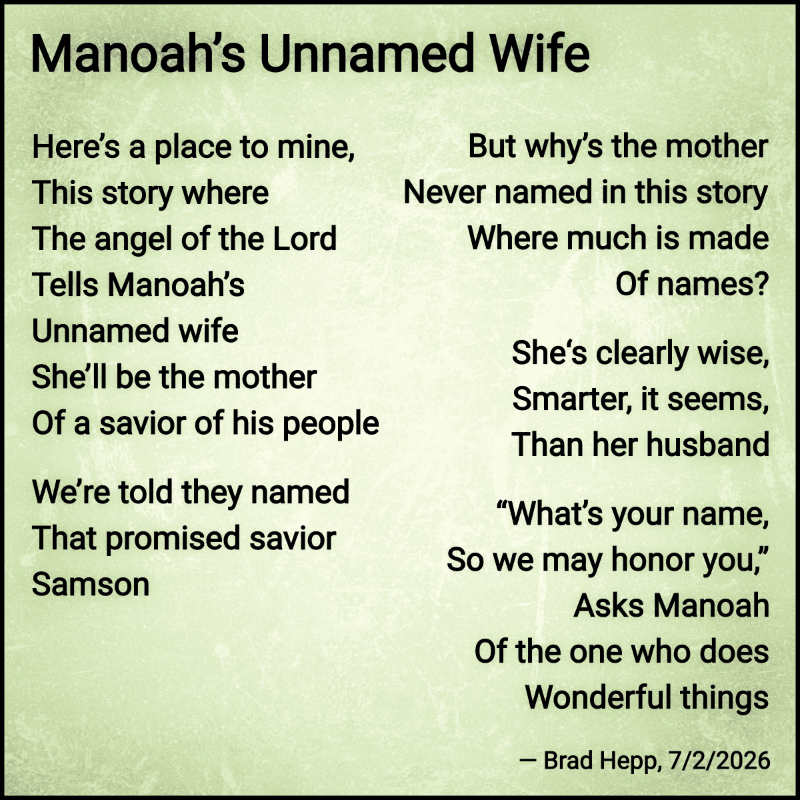
The “Day’s Readings” gets me to Judges 13. I paused to jot down something worth pondering. I can imagine bitter responses. I can imagine quick, all-knowing responses. How do you respond? Is putting your finger on a thing—naming it—as important as pondering its qualities? “Why do you ask my name, seeing it is wonderful?”
One of my great Facebook friends is Laurie Pearce Mathers. She is a skilled writer and Bible student. Here is her response to the poem:
When God “names” himself, the name itself is mainly an expression of being. Then he augments (defines?) it with a description of his character traits. His name is not merely Yahweh, as if to know that word is to have the talisman in hand (likewise with the name Jesus). God’s “name” is shorthand for all that he is. And he is more marvelous than we know.
As for that woman, I’ve often wondered why she isn’t named. It’s certainly by design. Perhaps to align her with the God who chooses not to name himself. Perhaps in honor of her faithful humility.
She certainly stands in stark contrast to her husband in this story. (He was not willing to accept the word of his wife. He had to get it from the horse’s mouth, so to speak. Yet God was merciful to him still and granted his request.)
It’s striking how Manoah’s wife is always the one approached by God, never her husband, even in response to the man’s prayer. In this I think she foreshadows the future mother of the ultimate Savior.
Passages like these are a comfort to women, and no doubt were intended to be, in this world dominated by sinful men. Named publicly or not, we matter to God and play important parts in his plan.
See less