(if you are viewing this via email, the website has a recording of this poem and commentary; click the title above)
Commentary
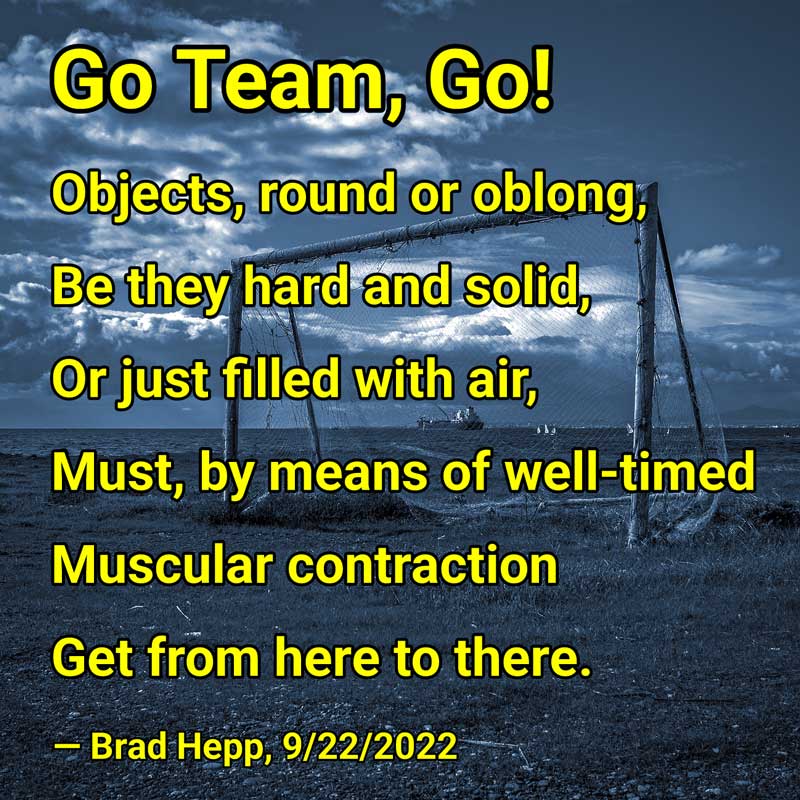
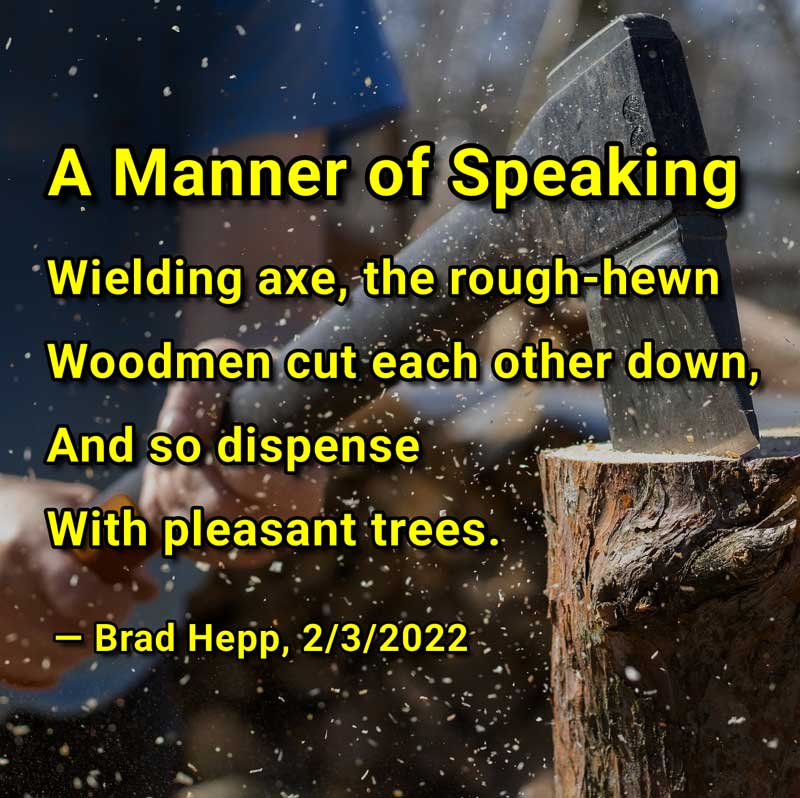
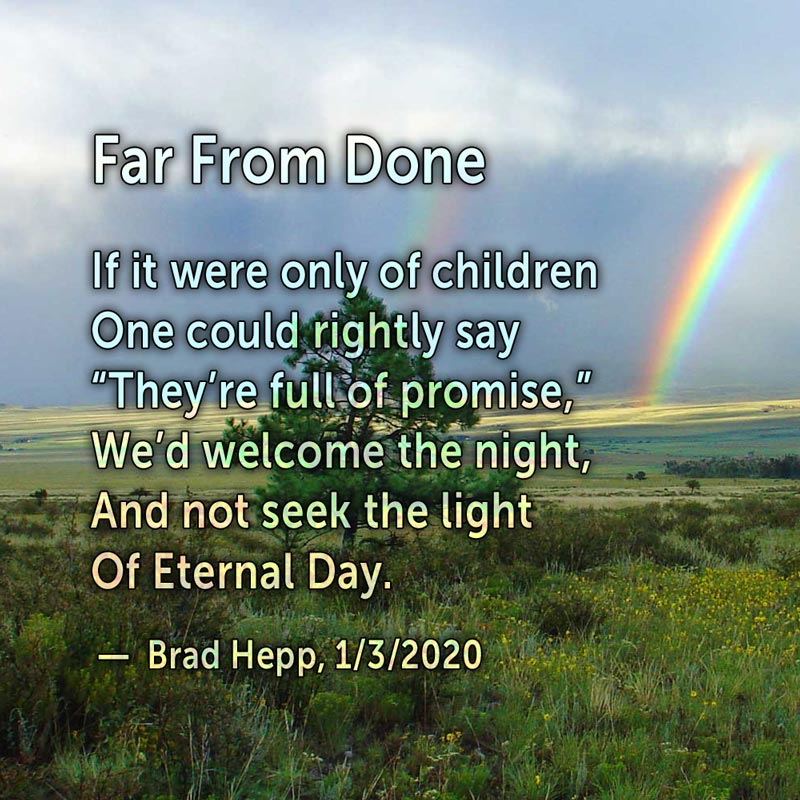
This poem is a lighthearted way of putting a serious problem: we humans often care more about being on the winning team than we do about accomplishing something that matters in the long run. We just want to win, to get our way, to come out on top. We race each other to the summit of Everest. There in the death zone, we plant our flag, and hasten to die.
(background image by Dimitris Vetsikas on Pixabay)
(if you are viewing this via email, the website has a recording of this poem and commentary; click the title above)
Commentary
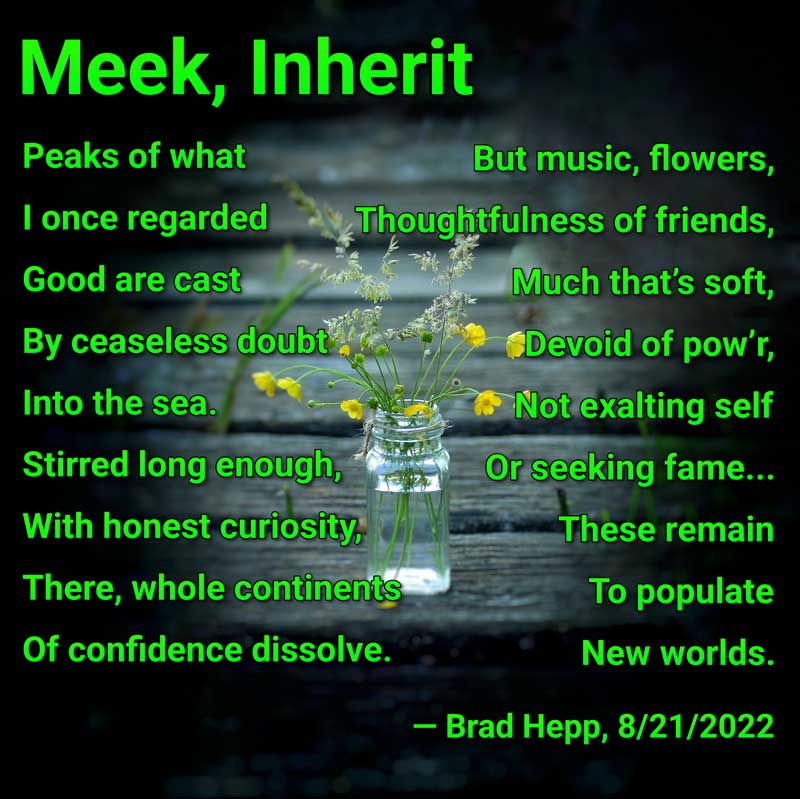
Blessed are the meek, for they will inherit the earth.
Matthew 5:5 NIV
It’s unsettling to look back on a lifetime of false confidence in man. I suspect most of us grow up thinking, “I’m one of the good guys. All that I possess was fairly earned, righteously taken.” But the more I learn about history, the more that fantasy is dispelled.
(if you are viewing this via email, the website has a recording of this poem and commentary)
Commentary
Sometimes when I can’t sleep, I listen to Anne Curzan’s The Secret Life of Words: English Words and Their Origins. This observation about capitalization is inspired by one of Curzan’s entertaining lectures. In talking about capitalization rules, she confesses that she has never figured out a good reason why “I” is the only pronoun that we routinely capitalize.
Linguists “keep it real” when it comes to language.
(if you are viewing this via email, the website has a recording of this poem and commentary)(background image by “Semevent” on Pixabay)
Commentary
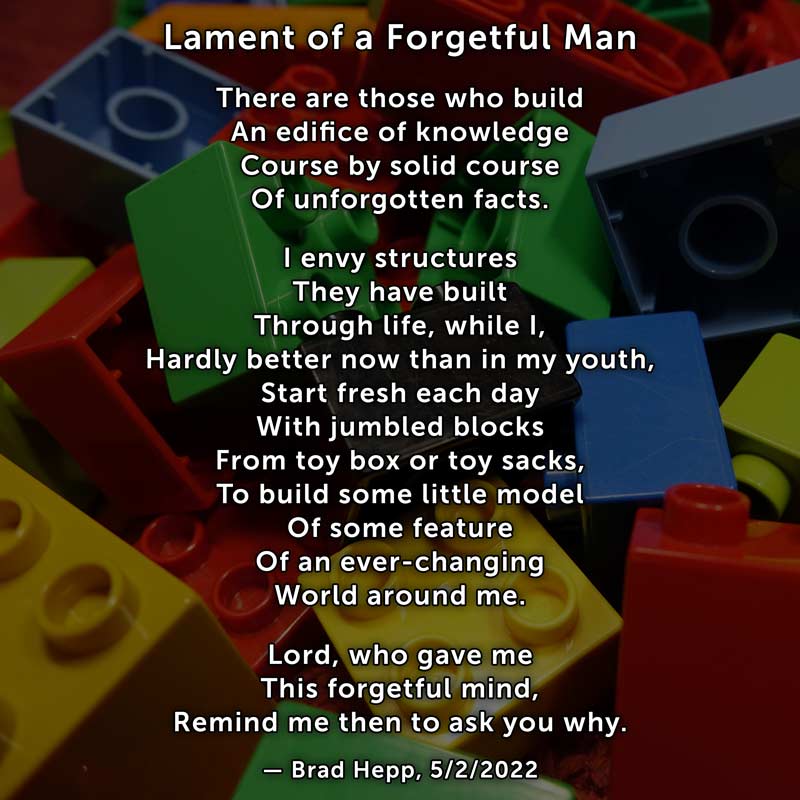
I treasure friends who can remember what they read and study. They serve well. But how about the rest of us? What’s the silver lining on a forgetful mind? This poem only poses the question, not an answer.
Teaching and Forgetfulness You’d think that by my age, I’d have come to terms with my limitations. But I haven’t, at least not fully. There are three things I ask God for on a regular basis: growth in 1) kindness, 2) discipline, and 3) ability to teach. How can I teach in any traditional sense, when I forget–or have trouble accessing–most of what I learn?! And If I DO remember, I discount my understanding so severely, that it’s practically useless. Nothing has convinced me that sure access to confidently-held facts is anything but a diminishing proposition. In other words, the more I learn, the more I recognize my ignorance!
Salvation and Forgetfulness I often think about what people mean by “salvation.” One element that stands out for me is being rescued from a descent into uselessness, meaninglessness. In the poem above, I allude to my hope that I will ultimately be rescued from this descent, that my Rescuer will restore meaning, explain the utility of current limitations, and set me on an eternally satisfying course. Then, salvation will be complete.
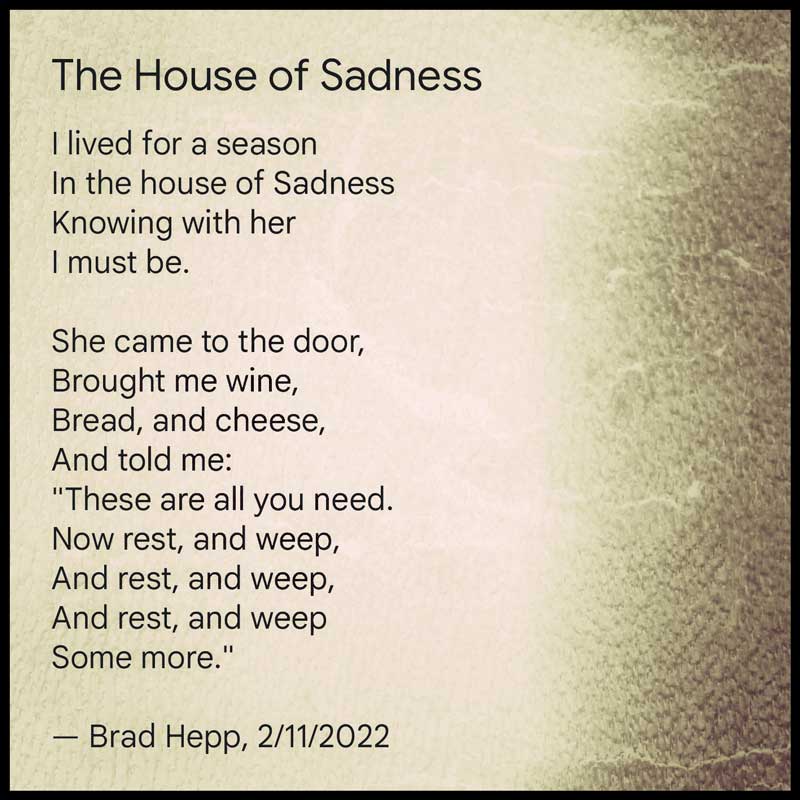
Recently, one of my ongoing projects has been peeling back layers of personal, church, and world history in order to better comprehend this world’s fallenness. I felt a certain compulsion about it. I needed to feel sadness about the many insults to God’s purpose and His image in man. I needed to feel sorrow about ways that I participate in those insults.
On a recent Sunday evening, I hit pause on the project. I thought, “Enough of this for now. I’m not feeling the compulsion.”
Was I done with exploring sadness? I don’t think so. It was just a rest. My heart still has chambers of ungodly anger that must be flooded instead with compassion. Like the Pharisees who despised the Lord of the Sabbath, I look for fault with His followers. I treasure offense at His disciples’ trespasses. Like the Pharisees, I need to understand what this means: “I desire mercy, and not sacrifice” (see Matthew 12). Then, perhaps, I will not be so quick to condemn.
SO, WEEP SOME MORE I had just finished writing this poem (and was pretty broken up by the process of writing it) when Susan came in and told me that an old friend — a GOOD and brilliant man — now has Alzheimer’s. My sadness turned to sobbing.
“Now rest, and weep, And rest, and weep, And rest, and weep Some more.”
I can’t help but think that this season in the house of Sadness is what I should expect as a follower of Jesus. It’s on the path to becoming compassionate, like He is compassionate.
He was despised and rejected by men, a man of sorrows and acquainted with grief; and as one from whom men hide their faces he was despised, and we esteemed him not.
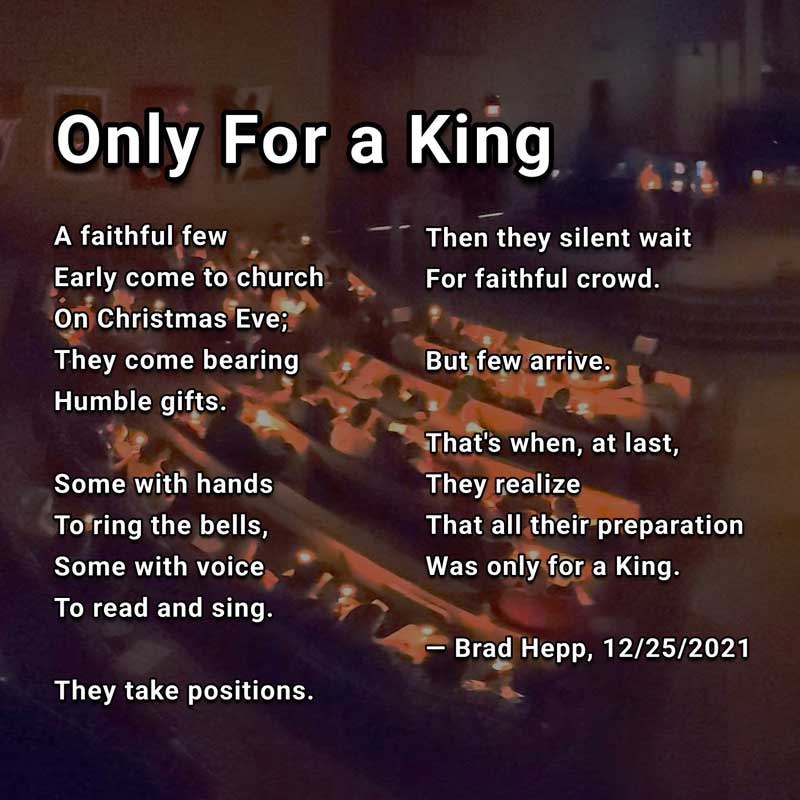
On Christmas Eve, I sat up in the soundbooth for two services. First, there was the heavily-attended service of St. Bart’s Anglican Church. I think there were 50 kids in their Christmas Pageant. As you can imagine, there were at least that many parents and grandparents. It was lovely.
Then, an hour after St. Bart’s was done, we had Redeemer’s Candlelight Service. One person counted about 40 people…max. The service went well. It was disheartening at first. Nevertheless, our handbell choir, who had already performed in the St. Bart’s service, played beautifully in this service as well. The readers and singers and preacher all did a great job. Someone said of our small crowd, “We sang gustily.” “With gusto,” I thought. Yes. A small crowd, fully aware of their Audience, will do so.
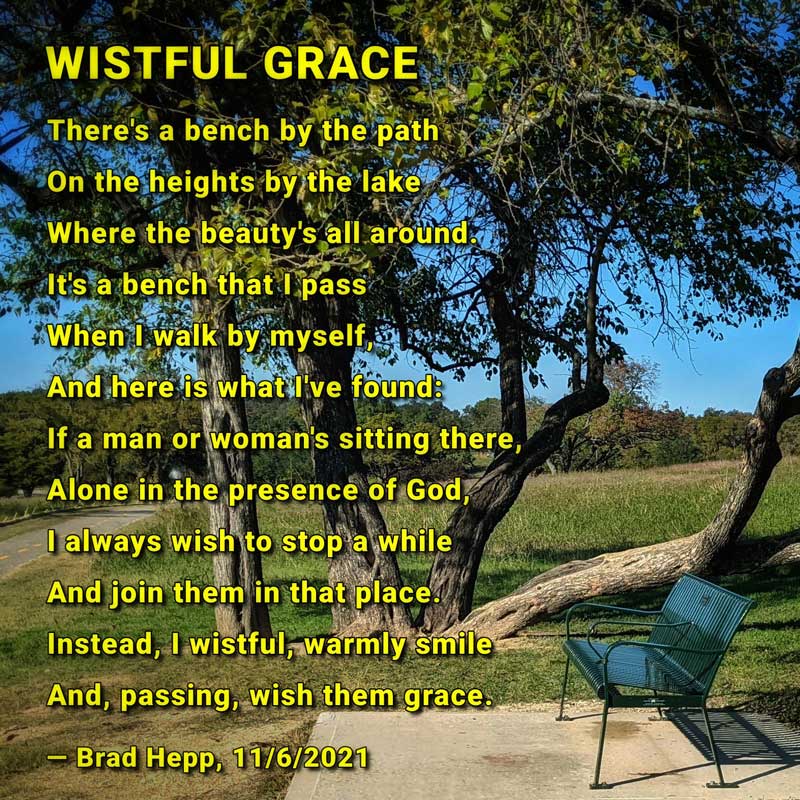
A few years ago, when I went full-time with my web business and suddenly had plenty of time on my hands, I began taking walks around White Rock Lake. Sometimes it was from a parking lot (a 9 miles hike) and sometimes from home (a 12 miles hike). That was the beginning of one of the best periods in my life. Here’s why….
Paying Attention On those long hikes, one of the things I did was pay close attention to how I was responding to people I encountered along the way: “The site of that elderly lady elicited warm feelings. Why? When I saw that young man, I felt disgust. Why? Why am I so ready to love some people, but not others?” Even after years of paying attention to my responses, it’s often still a mystery. But at least I’m a little more attuned to my emotional state now than I was before.
So I Asked Myself…. Yesterday, I walked by the bench in the background photo. Thanks to the habit of paying attention to my emotional state, I knew there was something I feel every time I pass by a person sitting on that bench. Could I put that feeling in words? Here’s what I initially wrote:
Often, when I’m walking at White Rock Lake and find someone sitting on this bench, I wish to sit with them, to share their experience. People taking in the beauty of a place like this are close to God, whether they realize it or not. But usually I just smile and walk on by.
Is it So? What I want to do (sit with them) is something I can report with more confidence than why I want to do so. In the prose explanation and subsequent poem, I connect my desire to a sense that God is somehow involved in the experience. That’s still just a theory of what’s going on in my head and heart. This theory may get support from a book I started into last night: “The Soul of Desire: Discovering the Neuroscience of Longing, Beauty, and Community,” by Curt Thompson.
Why Wistful? It makes me sad that I either cannot or do not always act on my good impulses. To sit and talk with a stranger? There’s nothing wrong with that impulse. But something usually stops me. What?
RELATED POST: “The Man From Valladolid” (based on meeting a fellow just yards from this bench).
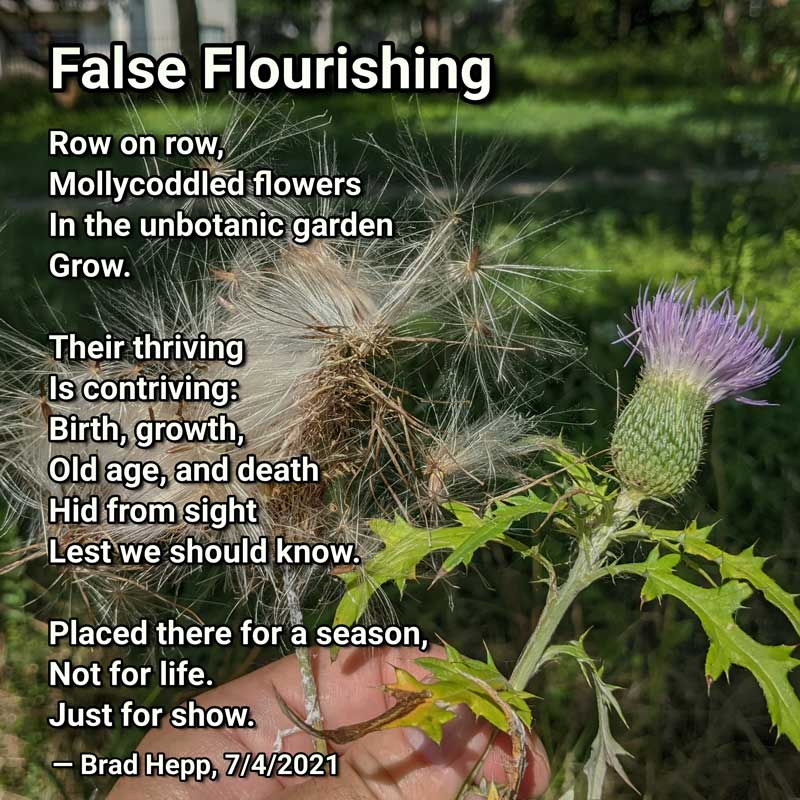
The photo in the background of this poem is of two stages in the full life of a thistle. On the right is the bloom that people admire. On the left is something less admired… what the same bloom will look like when it has gone to seed, and the wind begins tearing it apart.
This full life cycle is something I have been observing on my long walks. One late-summer day, I was lamenting that there were no more flowers to photograph. Then, I began looking more closely at the seeds that those flowers had produced. Their shapes, textures, even colors are every bit as fascinating as — and far more promising than — the blooms that preceded. Nowadays, while I enjoy walking with my wife at the Botanical Gardens, there’s something sad there about not seeing this great achievement of flowers: their seed.
Flourishing This poem arises from something I have been considering lately: the nature of flourishing. What does it mean to thrive, to prosper, to flourish? Here’s one hypothesis…. Flourishing is wrongly viewed as a short-term concentration of obvious vitality: the plant in bloom, never gone to seed; a dash, not the trek of a million miles; something exhausted in 80 years… or even less, in a life ‘cut short.’
I recently watched a conversation between Miroslav Volf and David Brooks. A friend had referred me to Volf’s “Joy and Human Flourishing,” in response to my question, “Who does a good job of tracing the concept of ‘flourishing’ through the Bible?” If I understood Brooks correctly, he objected that Volf needs to better account for suffering as a possible component of flourishing. That objection resonates with me.
In the Genesis 1 account, the first organisms are created on day three. Notice the prominence of “seed” in their description:
And God said, ‘Let the earth sprout vegetation, plants yielding seed, and fruit trees bearing fruit in which is their seed, each according to its kind, on the earth.’ And it was so.
Genesis 1:11
We tend to be so fixated on the blossom that we ignore what comes as a result: seed. But it was in reference to “plants yielding seed” that “God saw that it was good.” Who can seriously say that the thistle, gone to seed, then torn and scattered by the wind is not flourishing?
What’s Next? Where I seem to be going with this line of thought is that true flourishing requires eternity.
As I catch up with posting my poems on this blog, here’s one that I am especially eager to get “out there.” It was written on the day that my dear friend announced that he was resigning as our senior pastor. I had known for a couple of days that this was coming. I knew it was going to be painful. I knew that my friend would have other duties on that Sunday. It was Mother’s Day. This day was not all about him. In his typical humble fashion, he carried off his duties for the morning with graciousness. Then, at the end of the service, after he had concluded by announcing his resignation, I and the other elders stood with him and his wife on the stage and prayed for them. The tears came at last — I was close enough to see. And since I know what lead up to this resignation, it was especially painful for me. Here and there, my friend made strategic errors as a senior pastor. WHO DOESN’T?! But any such errors were dwarfed by his faithfulness to God, by all he had put in motion to make our church a place where shepherding and spiritual growth really happen. Let’s just say that two years of extremely painful personal circumstances were exacerbated by the pandemic and a handful of implacable opponents who made my friend their lightning rod.
My pastor’s benediction that day was the old Anglican “Go into the world in peace….” That afternoon, I took a long walk. This poem came to mind as I walked. Here’s how I introduced it on Facebook:
This poem was the fruit of a tearful Sunday walk. It refers to real friends and real expectations. We live now in a long, painful beginning. Someday, that beginning will have reached its end, in terms of time and purpose. For now, “Go into the world in peace; have courage; hold on to what is good.”
Hope Do you see the hope? It’s real. There’s something about selflessness that reminds me: Jesus triumphed over the grave. When a brother acts like Jesus, I’m reminded of what Jesus’ actions have put in motion. “Have courage. Hold on to what is good.”
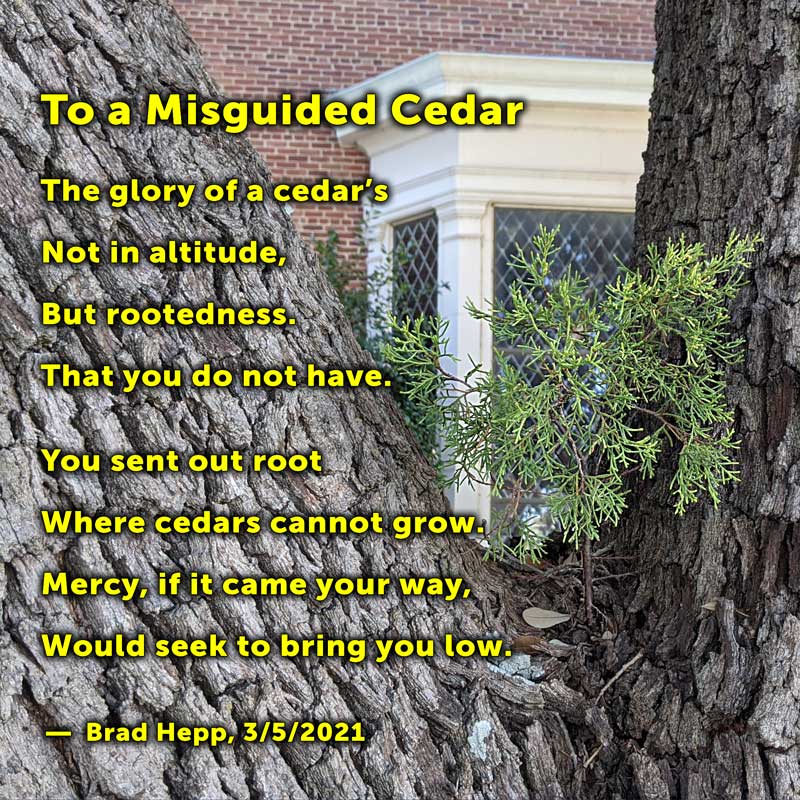
I saw this cedar growing in the crotch of a liveoak in front of Lakepointe Church. The poem is not about that church. But it does issue from thinking about churches. Every time a new church is planted, there are certain goals that the church planters are trying to achieve. While they may state a fine-sounding church “mission,” there is sometimes what Robert Schnase refers to as a “shadow mission,” the REAL mission of the church. If that shadow mission is some piece of idolatry like “having a form of worship that is comfortable to us,” the church may initially attract a lot of like-minded idolaters. Thus, it may grow rapidly. But such a mission can only carry the church so far; it contains the seed of its own eventual failure. A dedication to comfort rules out the willingness to change when change becomes necessary. There are probably as many “shadow missions” as there are sinners. I have just described one I see in myself.
As I was thinking about that, I remembered the photo above. Then I knew that the baby cedar may seem attractive in its current location, but it’s doomed to failure. The “shadow mission” of having “altitude” is no use to a cedar. As any cedar-burning Texas rancher will tell you, what cedars do exceptionally well is not to grow tall, but to send roots deep down into hard ground and draw up water for themselves, water that the ranchers need for other purposes! And so, they chop them down, and burn them.
MORE BROADLY, BECAUSE GOD IS MERCIFUL It isn’t sad when cedars miss their purpose in life. But how about us? What if we are wasting our strength on things that won’t last? Who will save us from such a bad investment? The poem concludes by pointing to the mercy of humbling, of being brought low. This seems to be what James had in mind in his powerful letter:
9Let the lowly brother boast in his exaltation, 10and the rich in his humiliation, because like a flower of the grass he will pass away.
James 1:9-10 (ESV)
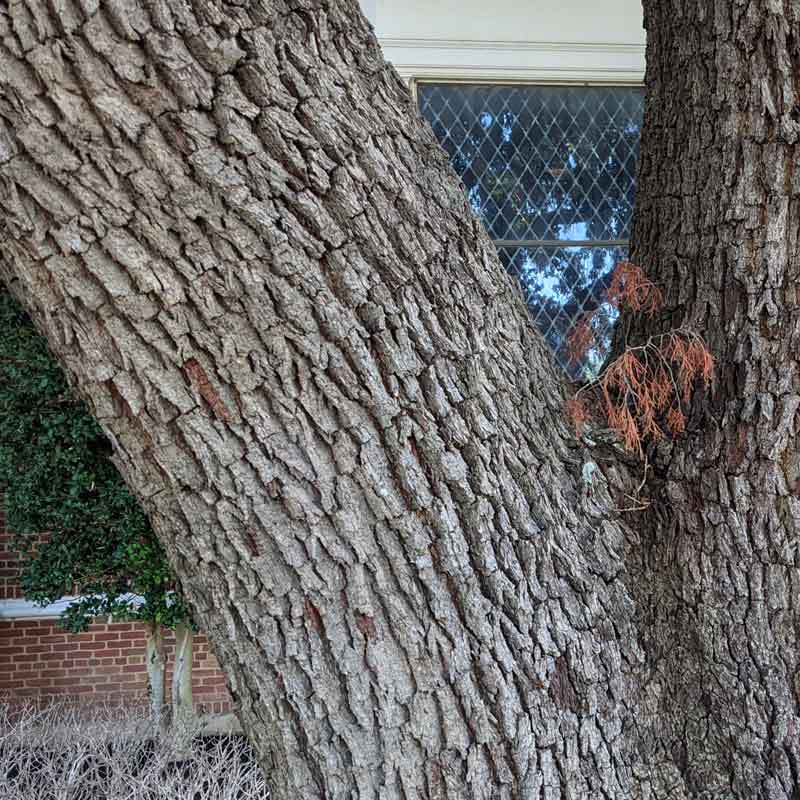
[September 4, 2021 Update]: Here’s a picture I took 9 months later, when folly gave birth to death:
My friend Scott Thibaut posted an insightful comment:
It’s nice to read a poem that recaps the song of Simeon in six lines.
[August 15, 2021 Note] I recently used this poem to illustrate another post:
NEVER TOO OLD TO GROW In my 60s, I don’t expect big career developments. But how depressing would it be if I don’t make major headway in spiritual/emotional growth in this decade? Fortunately, I’m surrounded by people who help me in this, including a professional counselor, immediate family who keep me honest, and a wise friend who regularly goes for long walks with me. Is growth painful? Maybe, but not as painful as a long slow slide into futility.
The background image
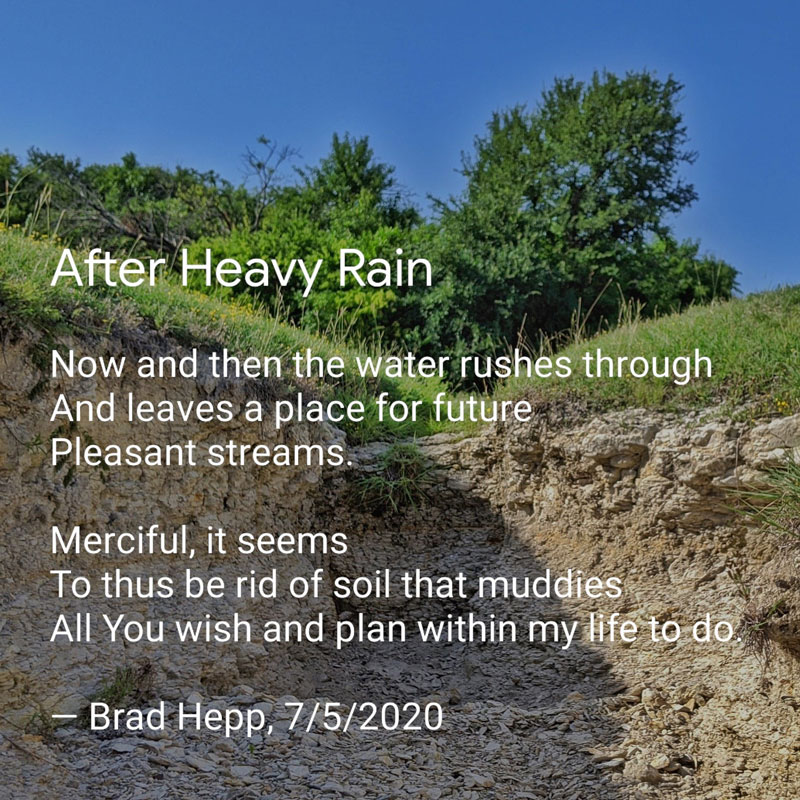
The background image is part of a photo I took of the Wetmore Valley July 21, 2004. I was staying with my family at Horn Creek Family Camp. In the late afternoon, after suppers, I’d go out driving with the family, as that was the magical time when light was especially interesting and animals were venturing out from the woods.
All day, I asked myself if I should refine a poem I tossed off earlier that morning. This struggle reminds me of when I was a teenage perfectionist, and the head cook told me to stop mixing the pancake batter already.
Well, it turns out that I did NOT refine the poem in question, partly because the poem was one of my most popular ever: “Let The Dishes Soak.” I ran it by another poet, and we both saw its weaknesses, but part of its strength was surely the immediacy — words that someone might speak on the spur of a loving moment.
I think the essence of poetry (at least my poetry) is compression with the goal of transformation.
In all my thinking, I try to get at the nub of things, to analyze and then articulate what I find as simply, honestly, and artfully as I can.
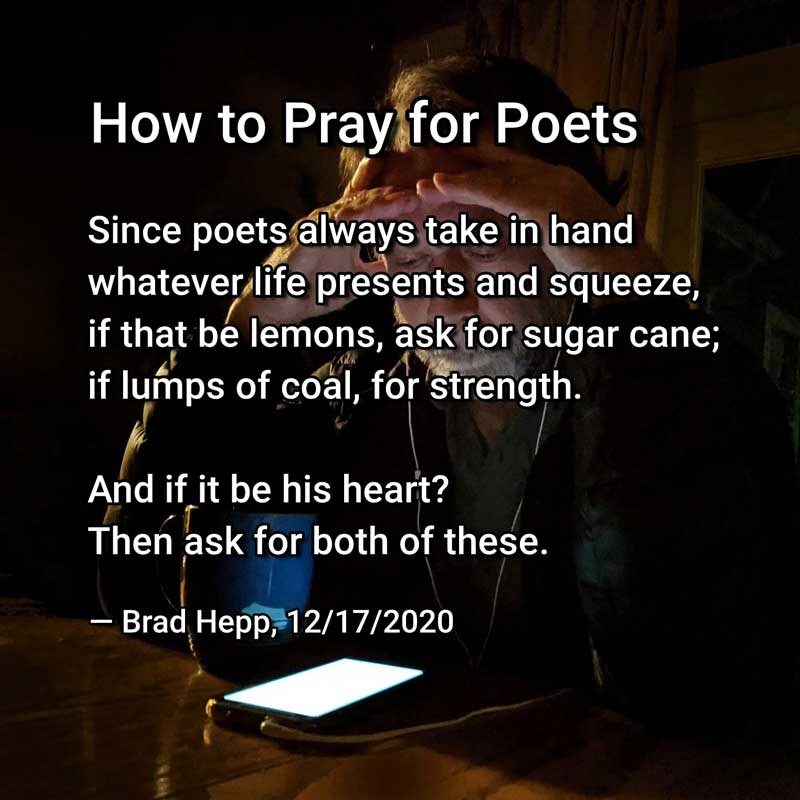
Diamonds and Lemonade When the thinking is introspective, my hope is that what I find will be something I am willing and able to submit to God for transformation. He’s in that process; I want to cooperate with Him… to the very end. Think of a sinful man being transformed to be like Jesus where this poem refers to the lump of coal. An old myth says that diamonds come from highly compressed coal.
Stepping back one thought…. One of the my character qualities seriously in need of transformation is kindness. Think of that where I refer to “sugar cane” in this poem. I regularly pray that God will sweeten my other attributes with kindness.
NOTE: I had Susan take this picture of me as I sat in the conservatory of the Blue Fern Inn where we were staying in Tahlequah when we were up there to bury Susan’s Mom.
I read that a writer comes alive by telling dead men’s tales. Here’s one such tale, though it’s not the *men* who died. This little poem was a lament. A dear friend had tried to persuade someone that his even-handedness in politics is NOT a retreat from righteousness. But the opponent was trapped in his or her allegiance to one end of the political spectrum.
December 20, 2021 Update: This problem has only grown worse over the last 17 months. I’m now reluctant to talk openly with people I once considered eminently reasonable. I fear being disappointed, and I fear opening the door to enmity where no enmity existed before. Now, more than ever, I live with this refrain: “Anything I say can and will be used against me.” I have a Christ-like friend who had to get off social media because there is someone out there — supposedly a Christian — literally building a case against him, misinterpreting anything he says, casting it in the worst possible light, and cataloging the supposed sins. Call that someone The Accuser.
You should probably never ask me to TALK about this little poem… too emotional! The background photo is of my mother when she was a little girl. The photo was taken in the early 1930s. Mom was taken in 2006. It occasionally becomes obvious that I’m not through grieving.
The setting when I thought of the words really was waking up from an afternoon nap. As is often the case, I was wearing ear buds, and had been drowning out the noises in the house by listening to one of my favorite Pandora stations. As I awoke, I was keenly aware of how beautiful the music was… something from Pat Metheny.
I listened to another piece, and then another. Each was as beautiful as the last.
My mind went back through the years to the experience of taking naps as a child, to the awareness of family in other rooms, their voices becoming distant and indistinct as I fell asleep. I cannot actually remember anything before that. However…
Traveling back in time, I arrived at the conviction that my exquisite experience of beauty — here in music — has always been rooted in the love of my mother. She herself was beautiful. She loved me, and she loved beauty. But she also pointed me farther back, to the Author of beauty.
Farther Back
Time did not begin with my birth. When a Christian like myself refers to “love from the beginning,” he or she inevitably alludes to our belief that God has loved his children and had kind purposes for them “from the beginning.” When the Apostle Paul writes about this, he gets into one of the long run-on sentences (in the Greek) that signal his excitement:
Blessed be the God and Father of our Lord Jesus Christ, who has blessed us in Christ with every spiritual blessing in the heavenly places, even as he chose us in him before the foundation of the world, that we should be holy and blameless before him. In love he predestined us for adoption to himself as sons through Jesus Christ, according to the purpose of his will, to the praise of his glorious grace, with which he has blessed us in the Beloved. In him we have redemption through his blood, the forgiveness of our trespasses, according to the riches of his grace, which he lavished upon us, in all wisdom and insight making known to us the mystery of his will, according to his purpose, which he set forth in Christ as a plan for the fullness of time, to unite all things in him, things in heaven and things on earth.
Ephesians 1:3-10 (ESV)
I’m convinced that knowing the Creator, and being confident that He loves me, enables me to better appreciate the beauty of His creation.
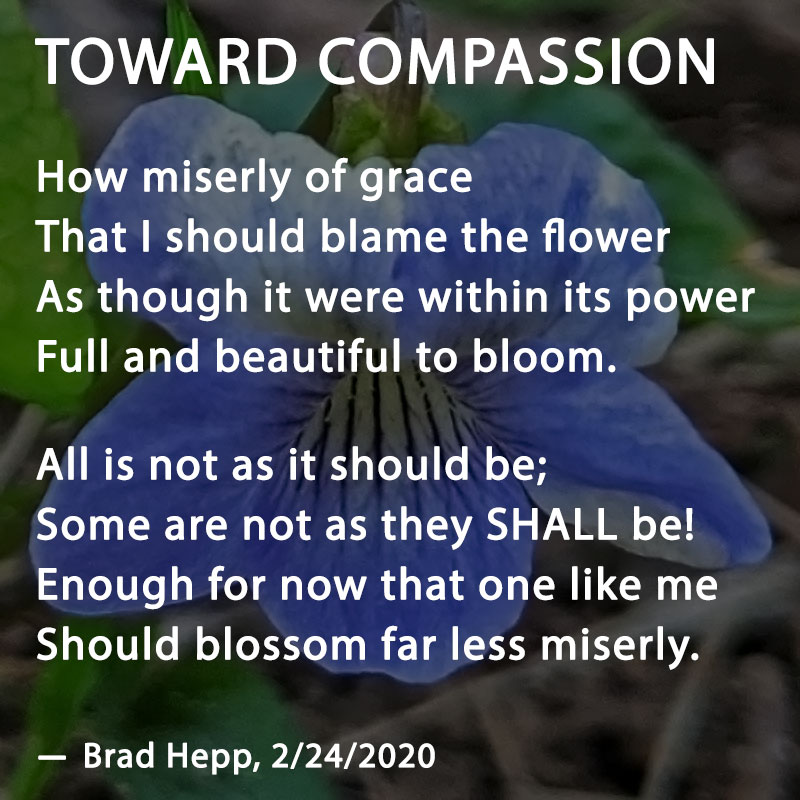
This poem is about judging others harshly, and the need to deal with my lack of grace.
“Miserly of grace” I may be leaning on questionable grammar here. The point is that I am being miserly in my exercise of grace.
“That I should blame the flower” This poem is about my attitude toward people, not toward flowers. But I draw on the analogy of judging flowers harshly. Ridiculous, huh? If I can see the folly of that, maybe I can extend the lesson to my harsh judgment of people.
A NOTE FOR THE CONTRARIAN: You may ask, “Don’t people have more control over their own behavior than flowers do over how well they bloom?” Yes and no. Since we have a will, we can choose to make progress in the refinement of our behavior. But progress can be slow. We all have backgrounds that predispose us to failure in particular areas. For example, a person who was abused as a child may WANT to be more trusting of their friends and partners, but the channels of mistrust run deep. We ALL have deep-rooted emotional baggage. Some of it results in easily-recognized behavioral problems. Some of it results in masked arrogance (or is that the mask of arrogance?).
“Some are not as they SHALL be” This line moves from the universal problem of a fallen creation (flowers and people) to a smaller set of people. Who are they? It refers to those who trust in Jesus Christ. They expect someday to be resurrected with a glorified body — and mind! — similar to what He has. Now, they are frustrated in their attempts to be better people. Then, their limitations will be lifted.
“Enough for now that one like me” Here, I look in the mirror. If I insist on judging and demanding change, I should demand it of myself.
“Should blossom far less miserly” Back to the flower metaphor…. If I’m going to judge how flowers — and people — bloom, I should make sure that I am blooming well, that I am being generous with grace.
I have been noticing recently that writing poetry is a way to access emotions and thoughts that have been suppressed in some way. So when I say that poets twist words to reveal the truth, I’m referring partly to the truth about what “lurks” in their hearts. Sometimes that truth is good, sometimes not so good! But at least the poet is getting closer to honesty.
At its best, poetry expresses beautiful truths in a way that helps both the poet and reader understand them better. That’s my goal.
It was dark in the living room. My wife and boys had already gone to bed, and I was left alone in the papa chair. By faint light coming from the kitchen, I could see Princess on a blanket we had set for her on the floor. She sat there, as peaceful and dignified as ever, probably purring. Two days before, she had stopped eating altogether, even when Joshua stroked her bony back and tried feeding her from his hand. The tumor in her stomach had won, and now she could barely walk, let alone jump or climb onto the couch.
In the morning, Joshua and Susan would take her to the vet. They’d ask the vet for some locks of her beautiful hair to remember her by. It seemed more appropriate than ashes.
Sitting there in the dark, I thought of how Princess’ well-being had been my responsibility for most of her seventeen years. Under my protection, neither hawks in the trees above nor the bitter cold of winter nights had ever touched her beautiful form. But now…. Now, tears began to stream. “I’m sorry, Princess. There’s nothing I can do for you this time.”
Up to this point in my life, I had never really understood corporate guilt. “Yes,” I could admit — only because good theology demands it — “I somehow share in the sin of Adam and Eve. But slavery and other atrocities? If neither I nor any of my relatives ever committed this or that sin, how can I — why should I — feel any guilt in the matter!”
That’s not what I was thinking about in the darkness of the night.
Looking at Princess across the room, I was sad. That much was clear, especially in the darkness. But then a little window opened. Through my tears, new light came streaming. It was sorrow, an emotion I barely recognize. “Princess,” I wept, “Not only am I unable to help you now, but in a very real — painfully real — sense, I am responsible for all that brought us to this dark night. I am truly sorry!” In that moment, for the first time ever, I was Adam. Once upon a time, God set me over His creation as its protector and provider. But I failed. And now, my Princess, like everything else under my charge, was dying.
A small window opened for me that night. Wisdom whispers, “Don’t let it close!”
Perhaps, in the light of that account, this poem I wrote the following day will make sense:
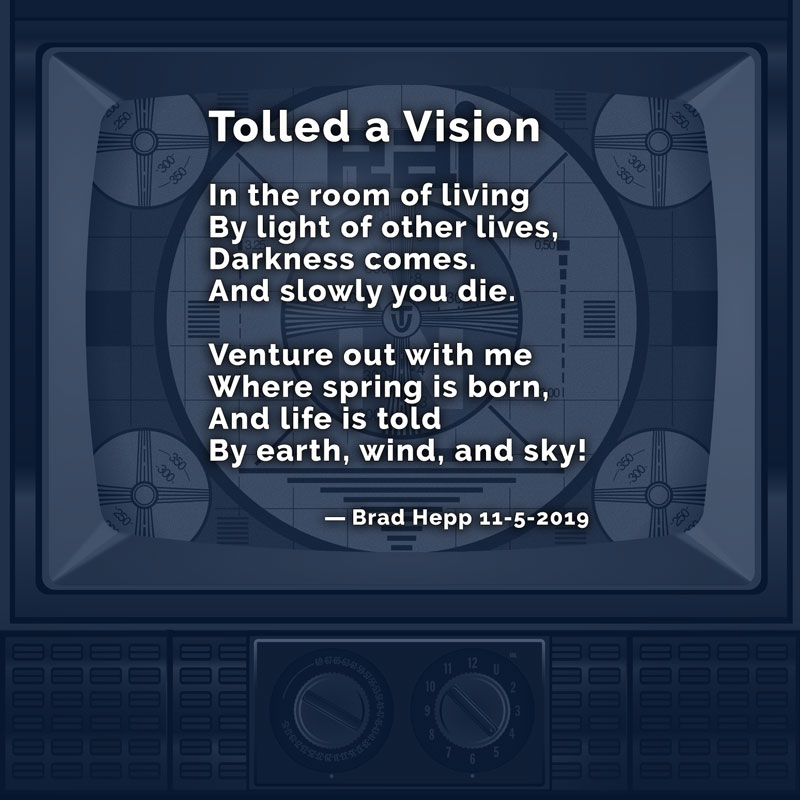
My pastor had this response: “I like it. Slowly we die as we are absorbed by the fictional lives of others dancing before our eyes when real life is just a power button and a glance away…” My riposte: “… and a good pair of sneakers if you’re so disposed!”
Despite my riposte, this poem is more about the first stanza than the second. Not everyone can don a pair of sneakers and join me on long hikes. But everyone can seek to live as directly as possible, fully appreciating their own God-given life and embracing God’s offer of rebirth, restoration, and eternal life. For most people, this appreciation and embracing requires a little — or a lot — of contemplation, meditation. Noise and distraction are the enemy. Compare my poem “Alone at the Lake.”
About the title: I’m not completely happy with the title. You can probably tell that I started with “Television.” From there, I started pushing on “Tele,” “Tell,” and finally landed on “Tolled.” It may be too far out there. But consider that “toll” is associated with death (“For Whom the Bell Tolls”). It also sounds like “told.” Even as the flitting and vapid* “lives” of fictional characters displayed on a television have “tolled” our dying, and have “told” us the bad news, nature itself has “told” us about better news, the hope of resurrection. A big stretch, I know! This is my blurry vision, and now I have told you.
*This needs work. I do think there is something of “the medium is the message” in this. In television, we have lives that are extinguished with the press of a button.
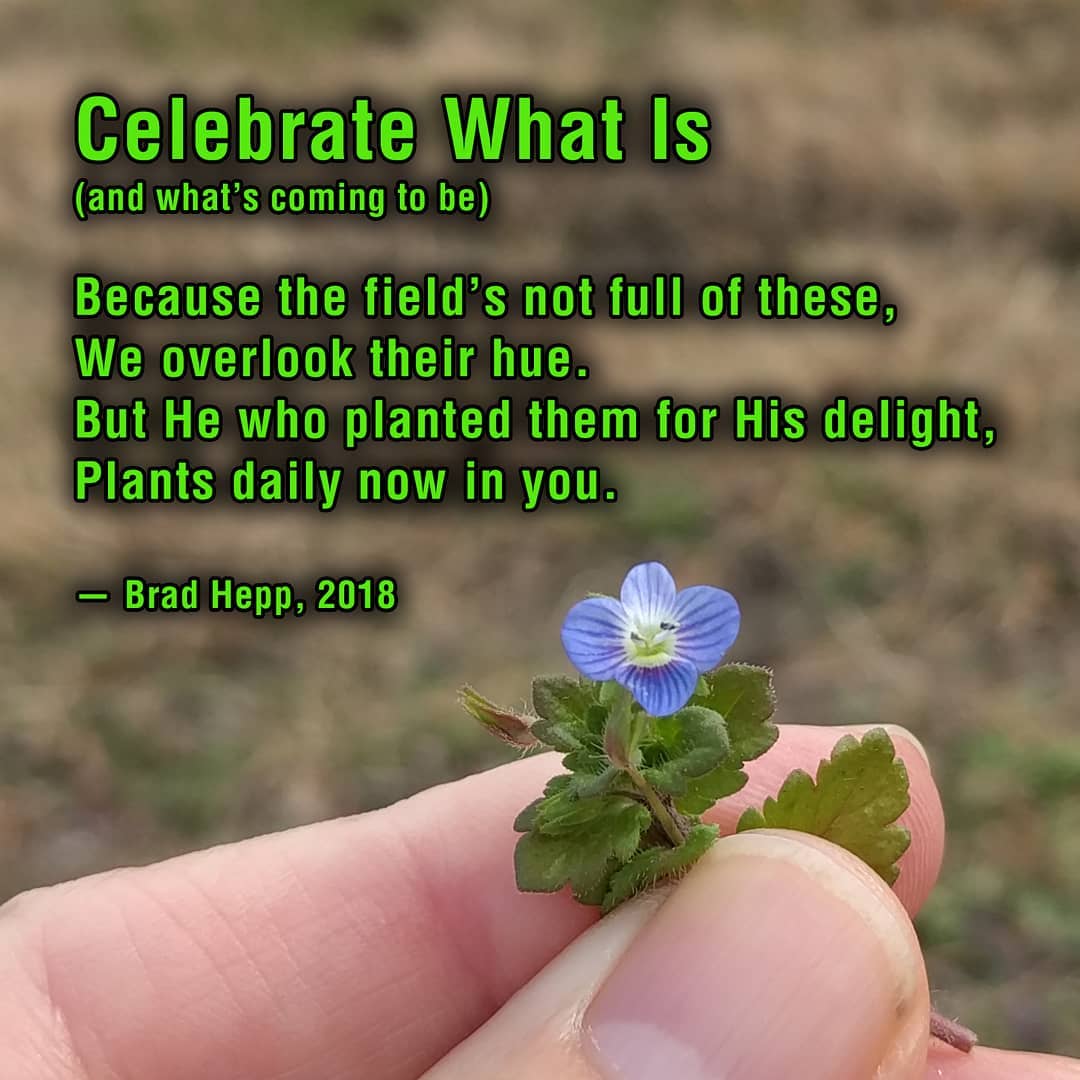
When I go for walks in the winter, I’m impressed with little flowers like this one: Buxbaum’s Speedwell. Now THAT’S a flower name for you! Its very name conveys a positive spirit.
In a Dallas Seminary Romans course we were in chapter 8, and Dr. Grassmick said to the class of about 20 seminarians, “Raise your hand if you are led by the Spirit of God.” Only three had the temerity to raise their hands. Three out of 20 SEMINARIANS, men (it would be men and women now) who were spending their lives studying God’s word and preparing to lead others in the spiritual life. Were the 17 who did not raise their hands REALLY not led by the Spirit of God? Were they simply humble? Or were they — what I suspect, and am trying to process — failing to recognize and celebrate the ways in which the Spirit was indeed leading them? Even in the dead of winter, buds begin to form. One can lament the cold, or one can notice and celebrate the signs of life. I want to CELEBRATE WHAT IS. Yes, I’m still a sinner. The glass IS sometimes four-fifths empty. But THANK GOD, the glass IS one-fifth full!