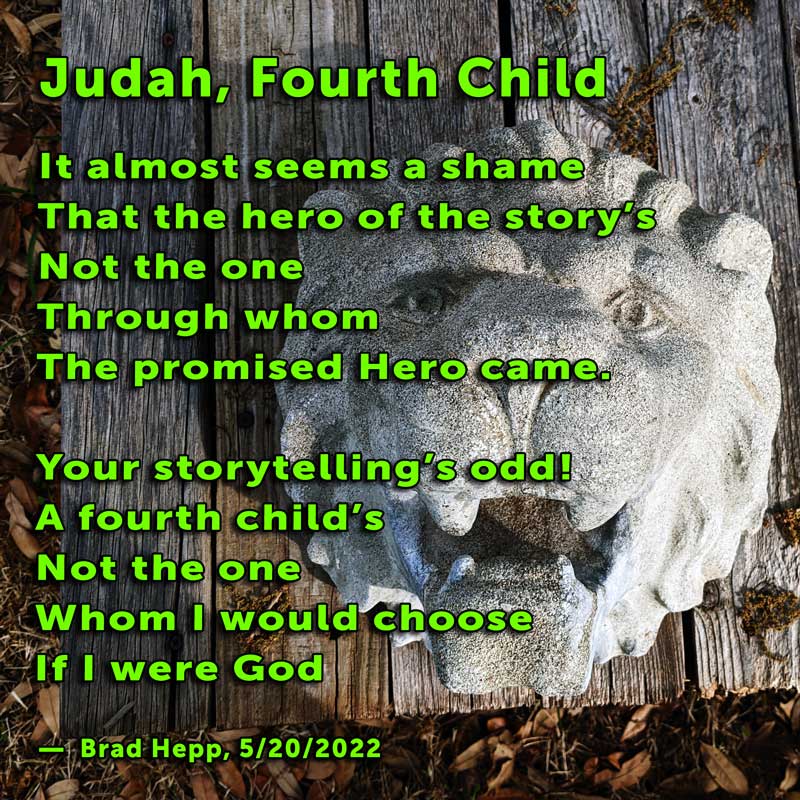
Judah, Fourth Child

(if you are viewing this via email, the website has a recording of this poem and commentary)

Commentary

I’m slowly working my way through Walter Kaiser Jr’s “The Messiah in the Old Testament.” It’s one of the books my father was thinking through at age 86, shortly before he died. The margins are graced with Dad’s notes. Naturally, I’m reminded often of him and his devotion to the Messiah. Some fine day….

This poem reflects on something at once puzzling and confirming about the Bible: God doesn’t operate as we would. If we were arranging things for the eventual coming of the Messiah, we’d probably make sure his ancestors were admirable characters. Read Genesis, and observe what kind of character Judah was. Jesus’ ancestor was a run-of-the-mill sinner. On the other hand, Judah’s younger brother Joseph was a remarkable, admirable character. He’s the hero through much of Genesis. Again, if I had been writing the story, I’d have made the promised Messiah come through Joseph’s line, not Judah’s.

God doesn’t operate that way. Through the story he created, He says, “I promise to bring this thing about, and lest anyone should get the idea that man is clever, and earns what I give him, I’ll bring it about through normal, undeserving sinners.”

(background photo: an artist’s castoff)

Private Psalms

Commentary

I wrote this poem in anticipation of talking with a fellow poet. One topic I wanted to discuss with him is the vulnerability of baring your breast through revealing words. Is it insanity or inspiration?

We didn’t get to the “inspiration” part, but the “insanity” part was almost funny…. My fellow poet read me one of several poems he has written while struggling with depression. He said that people have phoned him after reading such a poem to say, “I read your poem. Are you okay?” He answers, “Thanks. I’m doing better because I wrote that poem.”

I don’t enjoy listening to people complain. I’ve noticed that other people don’t enjoy listening to me complain. Sometimes, my public complaint is answered by a public rebuke, often with an underlying, “If you were as spiritual as I am, you wouldn’t have such thoughts.”

I don’t know a good workaround. One of my jobs as a poet is to express what’s hard to express. That can include negative thoughts, and problems whose solution hasn’t appeared.

Amazing Nonchalance

Commentary

When I was ten, we moved to the States from a country where practicing religion was always costly. Mostly, the cost was self-imposed, as many thought they could earn God’s favor. For a few, the cost was appropriate, and unavoidable, as they could not be comfortable with surrounding culture. IN CONTRAST, what I saw here in the States was that practicing religion seemed to cost nothing. That concerned me then, and it concerns me still.

Someone may respond, “I’m not comfortable with surrounding culture! So, wouldn’t you agree that I am paying a price to be a Christian!” My answer: maybe, maybe not. The thing about culture is that it is never merely “surrounding.” Rather, it works its way into much — if not all — of what we think and do. We’re part of it. It’s part of us.

Simply being upset at others’ immorality is not enough. Jesus’ prescription is not “Get mad at the world.” His prescription is, “You! You. If necessary, cut off your own arm. Gouge out your own eye. Renounce everything that YOU have.”

So therefore, any one of you who does not renounce all that he has cannot be my disciple.

Luke 14:33

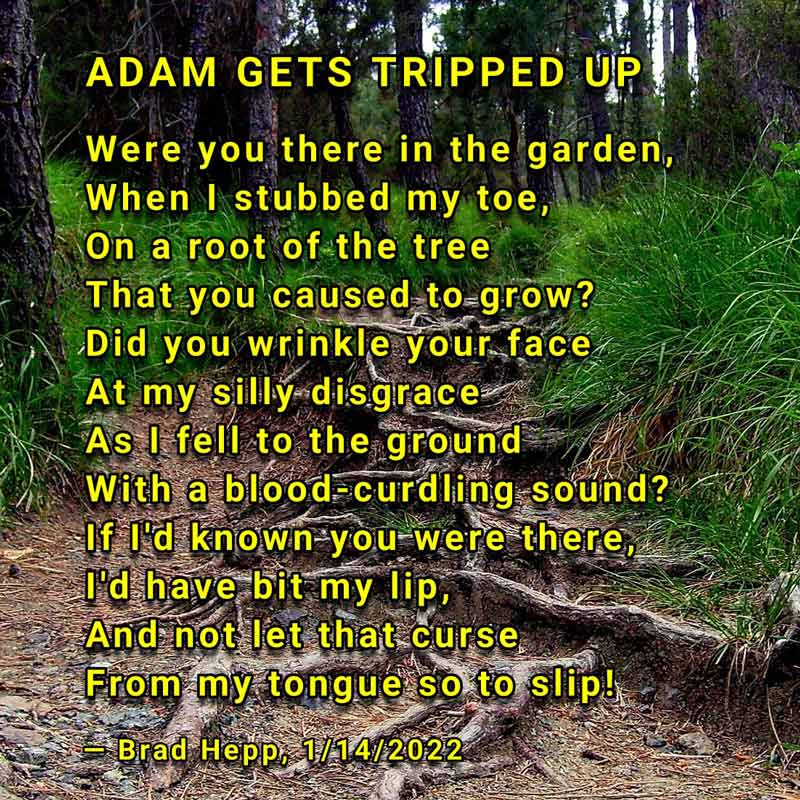
Adam Gets Tripped Up

Commentary

This light-hearted poem is a prequel to the more serious “The King’s Toast.” By the way, my initial commentary on that poem was pretty muddled. If you already read that commentary, do me the favor of reading the improved version.

It’s probably obvious that in this poem I’m exploring the idea that an awareness of God’s presence would help us regulate our behavior. Have a problem with foul language? What if Jesus were right there beside you in a physical, visible form? Would you curse then?

I don’t know.

Closely related poem: “The King’s Toast.

(background image by Adina Voicu on Pixabay)

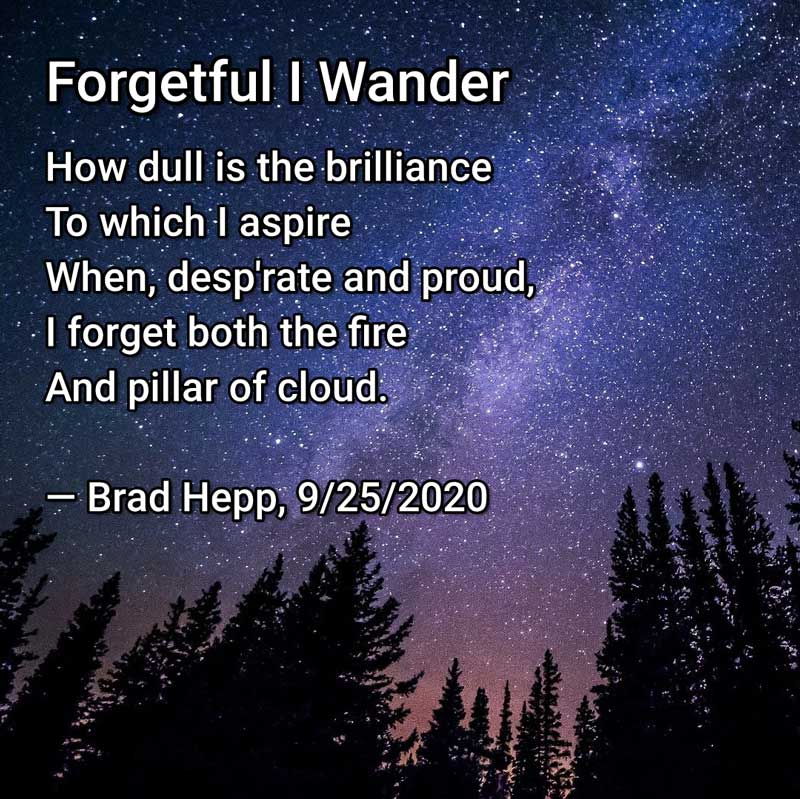
Forgetful I Wander

Thinking of Abraham, Moses, and others* who thankfully illumine even now.

(background image from Pixabay)

*Poem was my immediate response to a Facebook post by Sten-Erik Armitage, where he wrote

In my pride, I don’t need God. I know better, and I can do it on my own. In my despair, I don’t want God. He doesn’t care, and he couldn’t help me anyway. In cultivating thanksgiving, I recognize my total dependence upon him and grow in humility and peace.

Sten-Erik Armitage

Why Angels Wonder

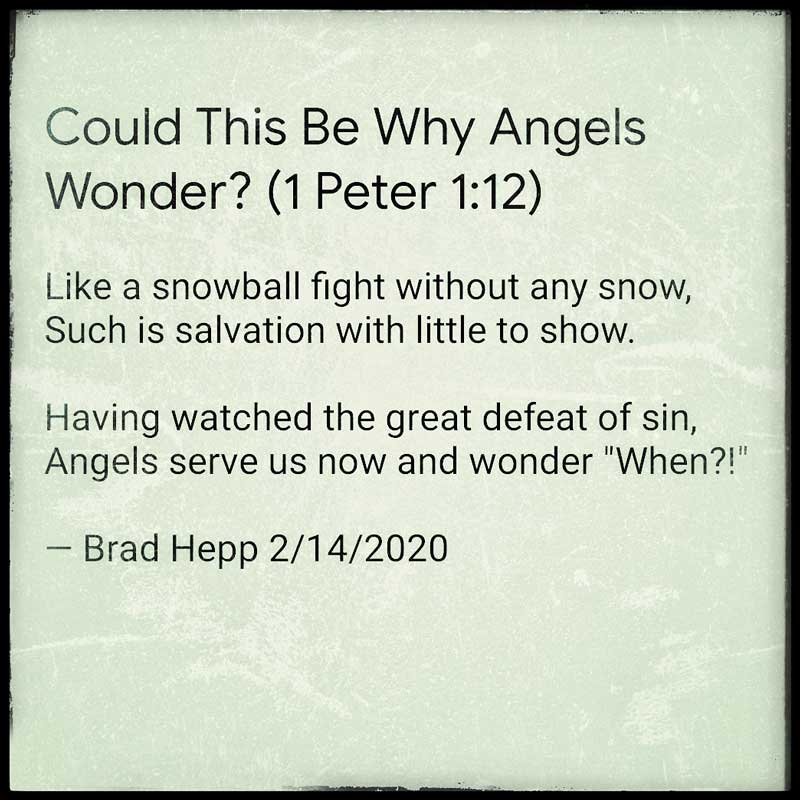
I didn’t get much sleep last night, pondering thoughts that wouldn’t pass muster in Angelology 101: Imagine for a moment the possibility that angels don’t possess our (humans’) imagination…. How odd we might seem to them. We philosophize, rhapsodize, and consistently compromise, imagining all along that thinking counts as doing, believing as obeying.

Job’s One Good Friend

Commentary

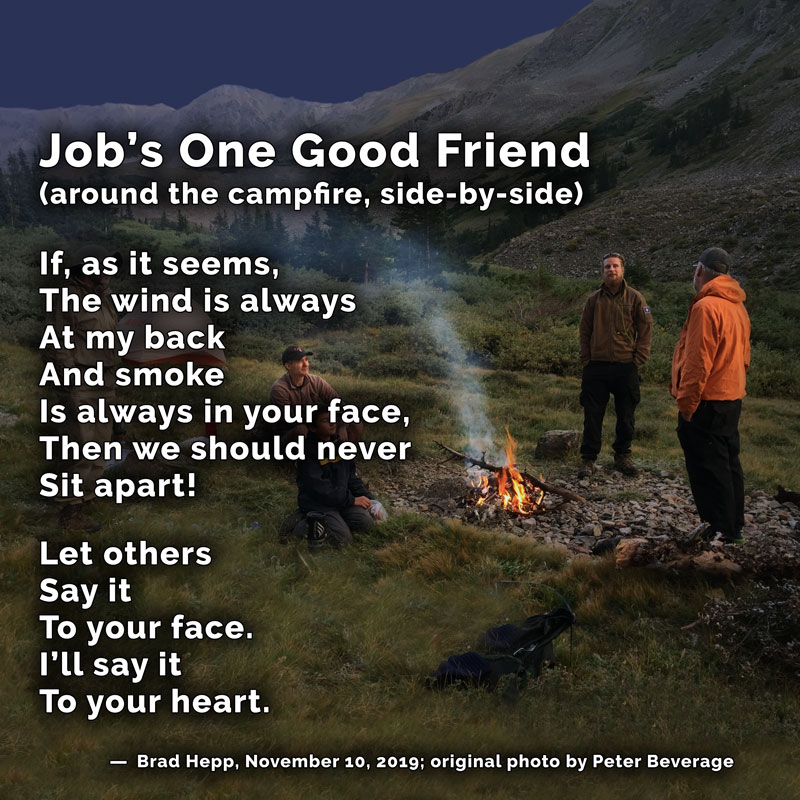
I wrote this after talking briefly with a friend who was struggling. It seemed to me that the friend needed nothing so much as a brother to share his burden — a brother who is willing to suffer alongside, to let the smoke blow in his own face. No lectures. No correction. Silent compassion can speak louder than words. At least that’s what I’m told.

Why “Job’s One Good Friend”? The biblical character Job had friends who sat with him for a while in silence. They had come together “to show him sympathy and comfort him.” But then they opened their mouths, and it wasn’t helpful. It seems that the one who came closest to being a true friend kept his mouth closed the longest.

And why a campfire? If you’ve ever sat around a campfire in the mountains, you know that as the wind direction shifts, the smoke sometimes blows in your face. Some guys feel that they are the target, no matter where they sit! I picture Job and his friends sitting around such a campfire, perhaps one that burned down to embers and then to ashes. “And he took a piece of broken pottery with which to scrape himself while he sat in the ashes.”