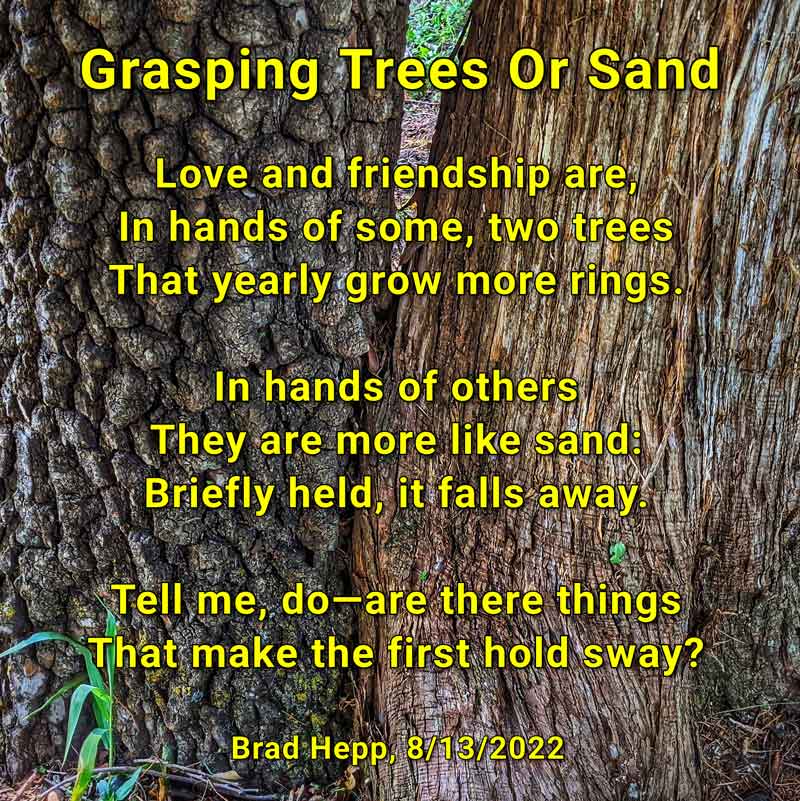
(if you are viewing this via email, the website has a recording of this poem and commentary; click the title above)
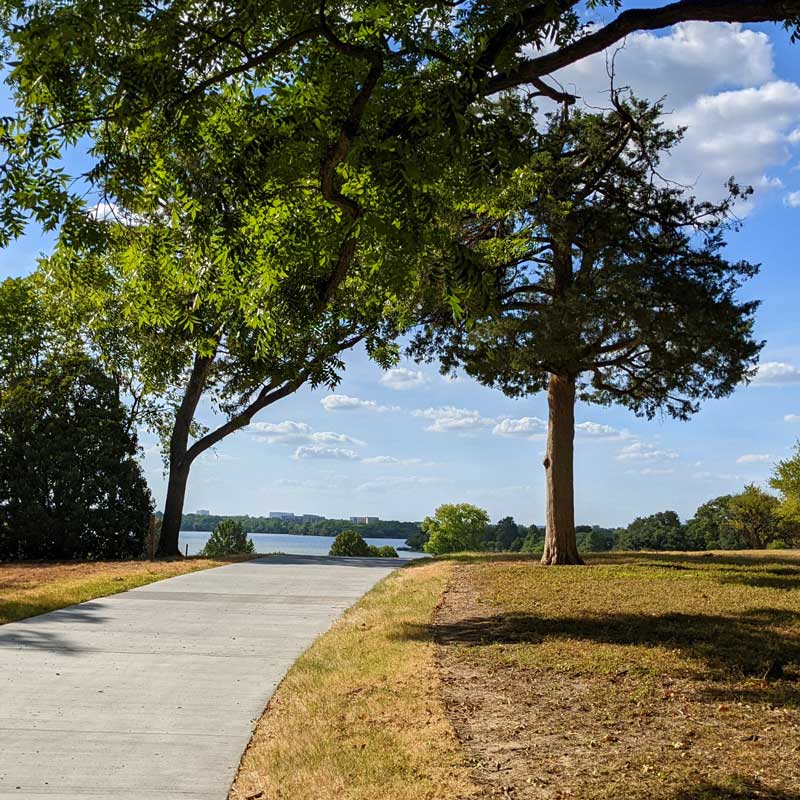
One of the things I love about walking is that it wakes up, or animates, my imagination. It does so especially when my walks are away from the humdrum, clattersplat of city life. That’s one reason I value the nearby White Rock Lake park. I was walking there the other day, and here’s how my mind took in some of what I saw….
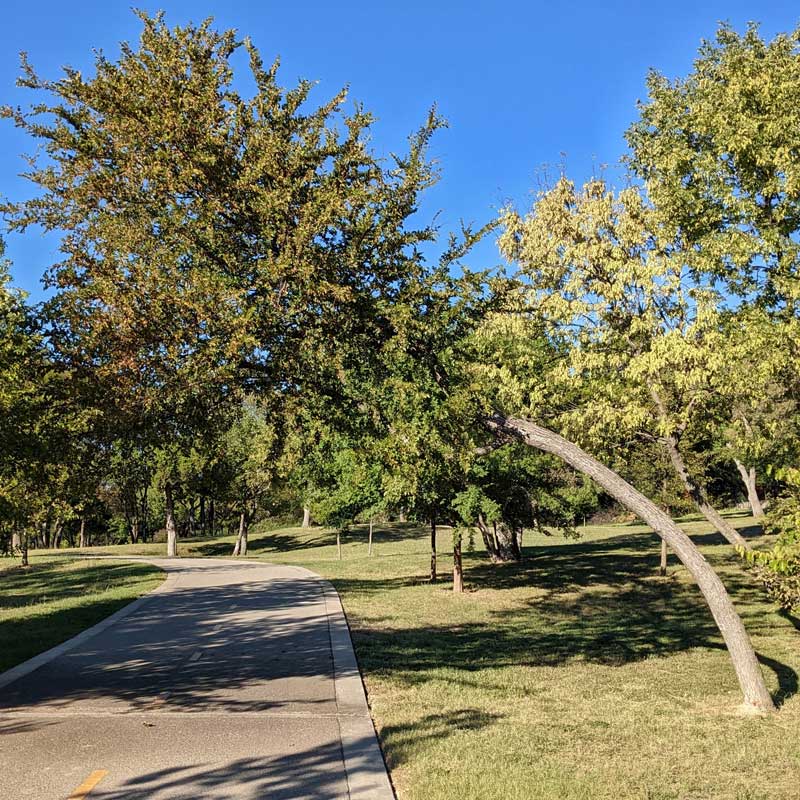
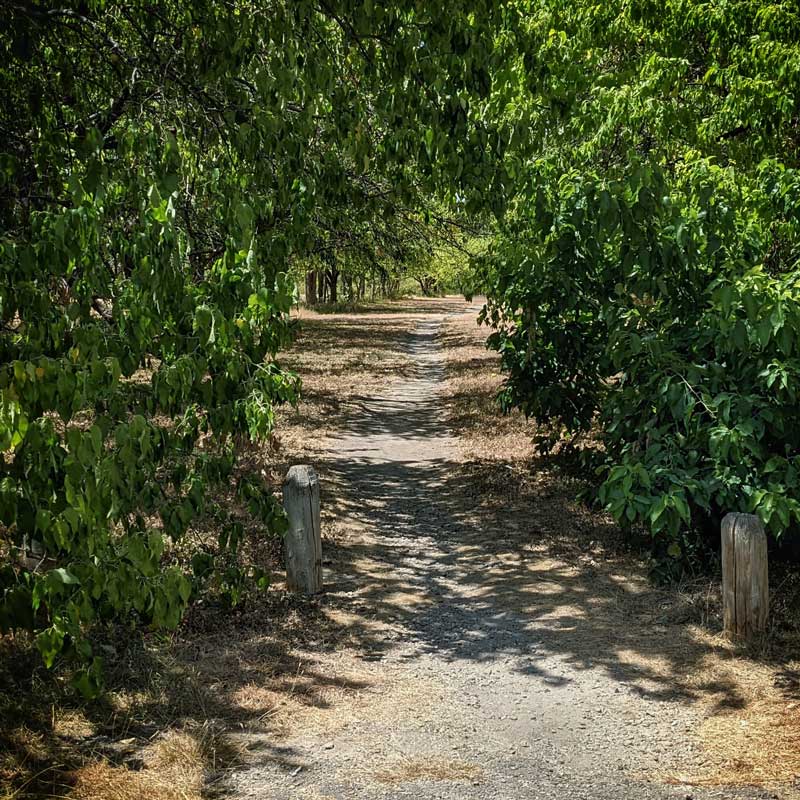
I call the above image “Serving Shade.” Generally, a tree that grows so crooked will get cut down. But I posted on Facebook, “DON’T REBUKE THIS TREE! What do you do with a tree that sees its purpose as providing shade for walkers? Make sure it’s watered!”
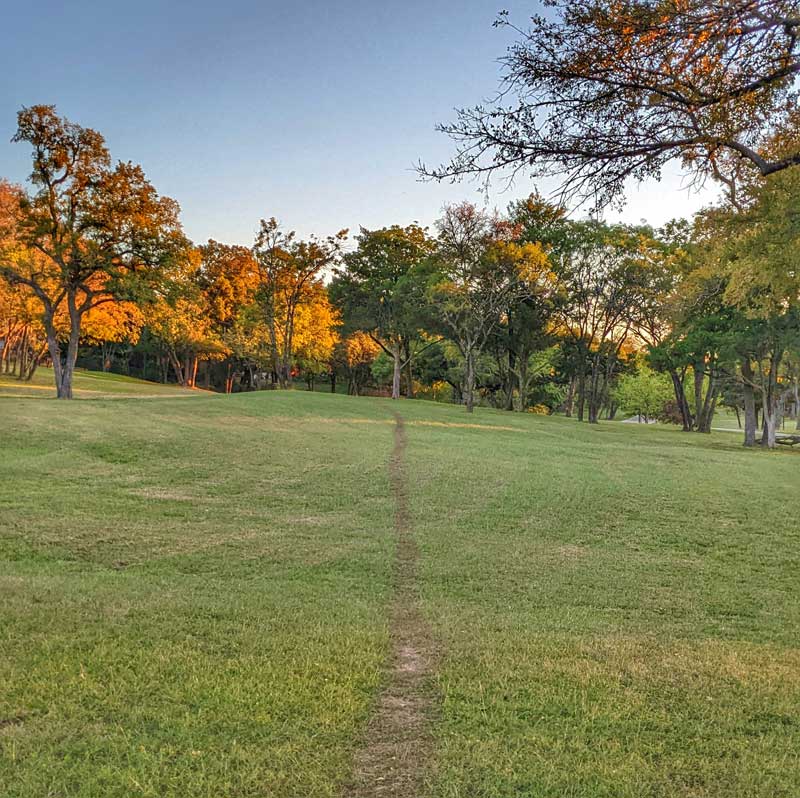
I call this image “Miscreant Path.” Here’s how I described it on social media….
There was a time when I resisted taking shortcuts in my walks around White Rock Lake. But the park service has replaced all the charming, narrow little paved paths with concrete paths so wide a car could drive on them. The best way now to feel like I’m in nature is to cut across country, taking the route that coyotes, opossums, and other fellow miscreants take.
Walking, Well Worth the Effort I keep running into stories of philosophers, theologians, poets, and other writers who testify to the high value of taking walks. Here’s an account that I recently read:
“Above all, do not lose your desire to walk. Everyday, I walk myself into a state of well-being & walk away from every illness. I have walked myself into my best thoughts, and I know of no thought so burdensome that one cannot walk away from it. But by sitting still, & the more one sits still, the closer one comes to feeling ill. Thus if one just keeps on walking, everything will be all right.”
― Søren Kierkegaard, from a letter to his favourite niece, Henriette Lund, in 1847
(if you are viewing this via email, the website has a recording of this poem and commentary; click the title above)
Commentary
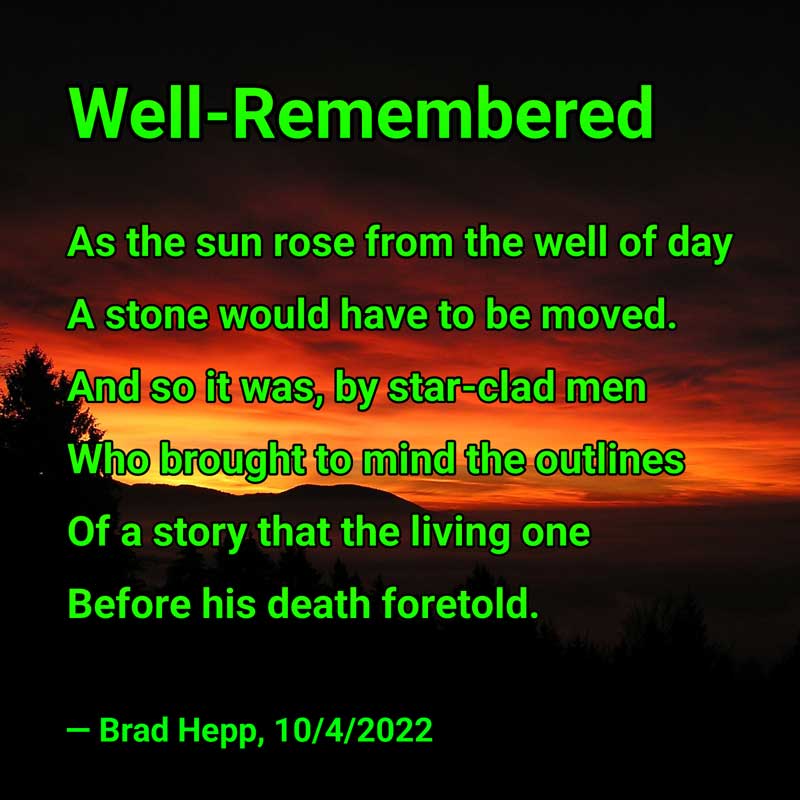
DON’T TRY THIS AT HOME In this poem, I’m doing two things that are generally discouraged. First, I’m playing with the Greek idioms that Luke used in his telling of the Resurrection. “At early dawn” in Luke 24:1 is literally “at deep dawn” (ορθρου βαθεωσ, orthou batheos). “In dazzling clothing” in 24:4 is literally “in clothing flashing like lightning” (εν εσθητι αστραπτουση, en estheti astraptouse). I pushed lightning to its root: aster = star. OF COURSE, THIS IS GENERALLY FOOLISHNESS. Translating idioms is not a matter of dissecting phrases down to their literal components. Imagine how “knock your socks off” would be translated into another language if the translator were translating word-for-word!
The second thing I’m doing — more successfully in my head than in the poem — is relating New Testament events to Old Testament events. Where, in the Old Testament, was a stone removed for a woman by a man? One place is Jacob’s initial meeting with his bride-to-be Rachel (Genesis 29:1-10). Does that story have anything to do with the Resurrection account? PROBABLY NOT. However, probably not isn’t the same as definitely not.
I say “don’t try this at home.” Don’t make too much of literal meanings of words, or of slight coincidence. But DO THIS: read the Bible with heightened vigilance and imagination. When you encounter stories with wells, or stones, or swords, or angels, or fire remember: the Author was there; often, if not always, He was a character in the story. And He has a long memory.
(if you are viewing this via email, the website has a recording of this poem and commentary; click the title above)
Commentary
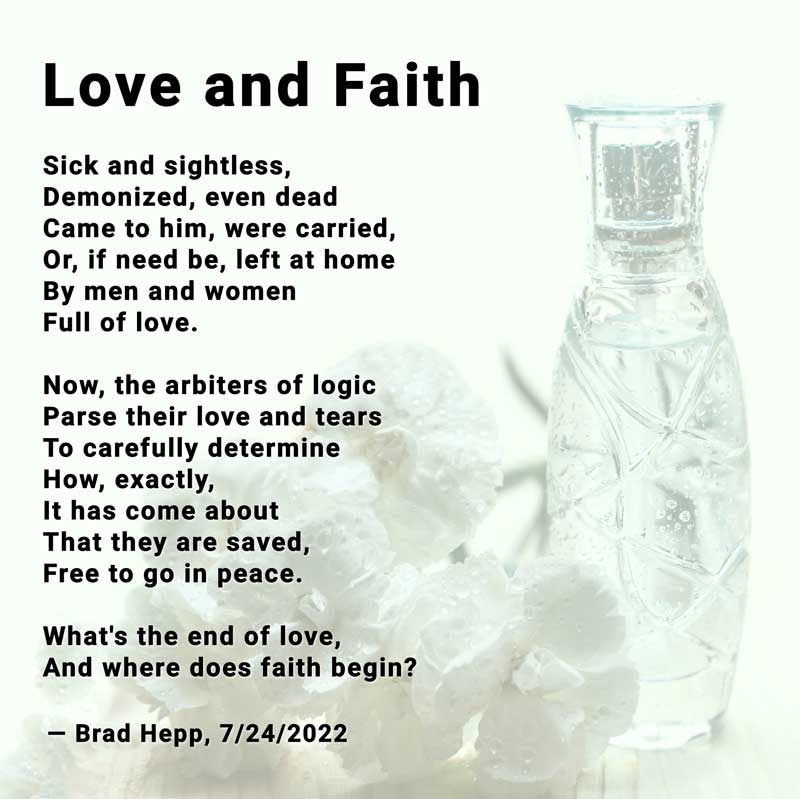
As I try to get caught up with posting poems here on my blog, I’m encountering some poems written so long ago that I don’t recall what I was thinking! I do remember that this poem was an emotional response to Luke 7. One of the questions that’s often on my mind when I read the Gospels is “What did Jesus and his listeners think that salvation means?” Of course we can read the accounts with the benefit of systematic theology, but I’m uneasy about that process. A theological grid can obscure as much as it reveals.
(if you are viewing this via email, the website has a recording of this vignette; click the title above)
When I moved to the States from Mexico, my second language was a novelty. At a certain point, fellow fifth graders pressed me so much for samples of Spanish that it got annoying.
To slow down the requests, I stated my terms: “A penny per word.” That worked.
One of my friends, Glen, offered his own phrase in lieu of pennies: “Cole day ron.” Unfortunately, that didn’t mean anything to me. “No deal.” But the phrase lodged in my memory.
One day, two or three years later, I was mowing the lawn at Kaleo Lodge. Mowing has always been a promised land of creative thinking. It’s where I dream of better things.
As I rounded a curve in the island of grass, it came to me:
“Sana, sana, colita de rana.”*
“Oh!!! THAT’S what Glen was trying to say: ‘colita de rana’.”
It was too late for Glen’s exchange; the novelty of Spanish had worn off by then.
___________
*A literal translation of this saying would be “Heal, heal, little frog’s tail.” I could be wrong, but I think it’s what parents might say about their children’s boo-boos, kind of like “Let’s kiss it and make it better.”
(if you are viewing this via email, the website has a recording of this vignette; click the title above)
Two weeks had passed and I still hadn’t figured out how to feed my horny toad. It was time to let him go. What an expensive mistake!
Late summer was when the older boys started hanging around the athletic field next door. After several weeks of tossing hay bales, they were ready to prove how tough they were tossing a football. I was too young for that. Besides, we had just moved here from the mission field, and I didn’t know the first thing about football. Everything in a little East Texas town was new to this little boy from a big city in Mexico.
Including the horny toads. I had spotted more than one of them at the edge of the football field. They were exotic, and I just had to have one. But horny toads are scary, what with the spikes all over their sturdy little bodies, and the blood…. I was told that they’ll squirt you with blood from behind their eyes if they see that you’ve got them cornered.
Let’s call the older boy Biff. He saw the commotion of me chasing one of the little monsters and came over to investigate. “Ain’t you gonna catch him?” asked Biff.
“I’m scared,” I admitted. “Can you catch it for me?”
“You sissy!” Biff was partly right. I’ve exercised plenty of courage in my day, but reptiles and their sort still make me squeamish.
“I’ll pay you,” I offered.
“How much you got?”
“Three dollars.” I had left Mexico with eight dollars in my little toy safe, and three of them were now in my pocket.
“Three dollars!” hooted Biff. “I’m a wheeler and a dealer!” That’s exactly what he said; I remember like it was yesterday. “A wheeler and a dealer!”
Biff caught the horny toad, and took it next door to my house for me. There, for some reason, I already had a five gallon fish tank.
The horny toad sat on some rocks I had placed in the tank for him, along with a saucer of water. I watched him through the glass, and he watched me. He must have been wondering what I’d bring him for dinner. He watched… and waited. Nothing. Two weeks is a long time to wait.
(if you are viewing this via email, the website has a recording of this poem and commentary; click the title above)
Commentary
KEEP THE LIGHT ON
[NOTE: Luke 8:4-18 has far more to it than I deal with in the following commentary. Also, one of my Facebook friends mentioned that she had dealt with the same passage, and largely come to the same conclusion as I did. You should read Laurie Mather’s well-written blog post.]
I didn’t always pay close attention in Sunday school. But if memory serves right, the “light under a bushel” motif was always taught either as a prod to keep witnessing, or as an encouragement to recognize and use our gifts and talents. It was all about what we can and should do with the good things we possess. They taught us a catchy little tune that probably did more damage than good.
Despite our Sunday school teachers’ excellent intentions, I currently doubt that they got Jesus’ meaning right, or that they understood how Luke uses the motif. Here’s what changed my thinking….
Recently, as I struggled through the Greek1 in Luke 8, a word kept popping up: ακούω. Hear! Listen! Luke points out that while telling the parable of the soils (that immediately precedes the “light under a bushel” illustration), Jesus interjected a word of urgency:
“As he said these things, he called out, ‘He who has ears to hear, let him hear.’”
Luke 8:8 ESV
Notice that “he called out.” That must have caught his listeners’ attention. It should catch ours as well. Let us hear.
Listening And Receptivity In Jesus’ explanation of the parable of the soils, some form of “listen” or “hear” is recurring. The characters in the parable hear the word with varying levels of receptivity.2 We’ve already seen that Jesus emphasized the need for his listeners to hear what he was saying.
After telling about the parable of the soils (Luke 8:4-15), Luke relates something Jesus said about lights, containers, beds, and lampstands (Luke 8:16-17). Given the way I had typically understood this “light under a bushel” motif, its use in these two verses struck me as a non-sequitur. That’s always a good sign that I’m missing the point. So I kept reading….
The form of the following verse suggests that the soils parable and the light under a bushel illustration were not disparate thoughts, but were supposed to be one cohesive section. Luke brings us to a logical conclusion of the section with verse 18 (notice my bolding):
“Take care thenhow you hear, for to the one who has, more will be given, and from the one who has not, even what he thinks that he has will be taken away.”
Luke 8:18 ESV
In the concluding verse, we’re back to the matter of hearing, and a stern warning to those who aren’t listening well.
In “light” of this, how does the “light under a bushel” motif fit in Jesus’ flow of thought? Is he suddenly, inexplicably talking about witnessing or using our hidden talents?
My tentative conclusion is that Jesus has not interrupted himself. When he talks about lights and how they are either minimized or maximized, he’s still talking about receptivity. Our hearts, like various soils, can receive or reject God’s life-changing word. We need to LISTEN well. Similarly, when the light of God’s word is illuminating our hearts, we need to LOOK well. We need to receive—respond to—what we’re being shown.
Am I ready for God to shed light on my heart? Am I receptive to his correction? Am I prepared to remove the rocks and weeds that he reveals so that better things can grow?
Maybe that’s the flow of thought in Luke 8. I could be wrong. I’ll keep the light on.
ABOUT THE POEM The Luke 8 account has two settings: outside and inside. Outside, there’s the soils by the path; inside, there’s the room that’s being illumined. That’s one of two reasons why I used “without, within” in my poem. It’s also the case that some of our sin is externally obvious (rocks, weeds), and some is less obvious (like shallow soil).
Since I always doubt myself…. Here’s a question for future consideration: is the soils parable really about sinful responses?
1 I rarely ever admit to having any facility with Greek. Two reasons: 1) despite having studied Greek three years in seminary, I don’t consider myself anything above a “beginner” and 2) even if I were fluent, I wouldn’t mention it because my real goal is to encourage others to study the Bible in whatever their mother tongue might be. I don’t want anyone getting the impression that Greek is necessary. Frankly, the only reason it helps me at this point is that it slows my brain down enough to notice things. I could probably turn the text upside down and read it in a mirror and get the same benefit!
2 The fact that “believe” and “be saved” are used in Jesus’ explanation of the soils parable may seem to limit its meaning or application to evangelism. I suspect that’s too narrow, that the parable applies at any point in the run up to producing good fruit. [This begs for exploration: the relationship of being fruitful and salvation, or of not being fruitful and needing salvation. Helpfully, the cursing of the fruitless fig tree may challenge, deepen, and expand our understanding]
(if you are viewing this via email, the website has a recording of this poem and commentary; click the title above)
Commentary
On my walk yesterday, listening through Exodus, I heard this fascinating snippet:
And they saw the God of Israel. There was under his feet as it were a pavement of sapphire stone, like the very heaven for clearness. And he did not lay his hand on the chief men of the people of Israel; they beheld God, and ate and drank.
Exodus 24:10-11
When I encounter passages like this one, I want to explore, to stop and study. Not necessarily to study in an academic way… more to gaze intently until my senses have taken in the scene, so that like Mary I may ponder in my heart. But there are voices—do I only imagine them?—who murmur “Move along, and stay behind the railing.”
The Poem’s Structure I woke up this morning and initially wrote the last five lines. As often happens with me, something subconscious was giving the poem physical structure by creating a pattern of line lengths. When I see that happening, I try to follow through. The poem was taking the form of a mountain, but it needed a summit. So I inserted the first seven lines.
Docents I have toured many a museum, and been thankful to many a docent for guiding me there. I mean no disrespect by picturing them in this poem as dripping clouds who live only to put out sparks of curiosity. What am I actually picturing? Dull, strangling systematic theology, at least as practiced by some.
One of my favorite types of work is photo retouching. Recently, a client learned that I have some expertise at this, and she’s been paying me to perform magic like turning dirt into asphalt parking lots, and carefully removing live power lines from in front of buildings. Don’t tell her, but I enjoy this work so much that I’d do it for free. Take the one below. On one of my walks, I snapped a photo of this 1932 Packard and posted on Facebook.
My sister commented, “That’s my favorite car era…only mine would be deep emerald green.” So I obliged her:
(if you are viewing this via email, the website has a recording of this poem and commentary; click the title above)
Commentary
I don’t think I’ve ever written a poem that stirred up as much emotion as this one stirs up in me. Today, I began reading a book* about a theologian who wrote extensively about beauty. This is a subject whose extreme importance I sense but cannot intellectually grasp. I thought maybe an introduction to Hans Urs Von Balthasar would help. So far, this book only serves to remind me once again how far my reach exceeds my grasp. I want to understand something essential in God, but the mind he has given me is insufficient for the task.
On the flip side of that frustration, there is this: Our beautiful Savior imprisoned himself in our limitations for a time in order to remove the worst of those limitations forever.
*The Cambridge Companion to Hans Urs Von Balthasar. It looks like I may have better luck with another book once I get my hands on a copy: A Key to Balthasar: Hans Urs von Balthasar on Beauty, Goodness, and Truth by Aidan OP Nichols
(if you are viewing this via email, the website has a recording of this poem and commentary; click the title above)
Commentary
My commentary here is in two parts.
My Original Confusion (what I was thinking when I wrote the poem) In Luke 12, the tone of Jesus’ parables switches from reassuring to threatening. Just as the tone changes, Luke throws in a question from Peter:
Peter said, “Lord, are you telling this parable for us or for all?”
Luke 12:41
This is one of those seeming non-sequiturs that makes me sit up and ask, “What’s going on here!?” Luke doesn’t give us Jesus’ answer. Or does he? I don’t know yet. But I know that the passage makes me uncomfortable. Perhaps that’s exactly as it should be.
On Further Reflection (what I wrote on a subsequent day) You know, as I read through Luke 12 again this morning, I am getting a really different picture. How does Jesus describe the master (Himself) who returns at an unexpected hour and finds his servants being good to one another?
Blessed are those servants whom the master finds awake when he comes. Truly, I say to you, he will dress himself for service and have them recline at table, and he will come and serve them.
Luke 12:37 ESV
The picture is grim not for those good, Christ-like servants but for those who selfishly look out only for themselves.
Jesus doesn’t ask us to do anything more than He has done… or anything less.
(if you are viewing this via email, the website has a recording of this poem and commentary; click the title above)
Commentary
Inflection points in life can be very good… or very bad. I experienced a major inflection point back in 2017, when I became my own boss. The years since then have been years of remarkable spiritual growth. My new freedom afforded ample time for frequent long walks where I listened through the Bible repeatedly, along with other inspiring literature. I spent more time with people who influence me for good. My eyes were opened to beauty I had never noticed in the world around me. I began writing poetry, which means that I began listening more closely to my heart. I watched my responses to fellow human beings, and noticed some deep-seated problems in myself. God has been fixing those problems, changing my heart. So the inflection point in 2017 was very good.
Right now, I seem to be at another major inflection point in life. Once again, it has to do with a career change. As I move through the coming five years, will I continue growing more like Jesus? If so, it will have been a very good inflection point. If not, it will have been very bad.
(background adapted from an image by “domeckopol” on Pixabay)
(if you are viewing this via email, the website has a recording of this poem and commentary; click the title above)
Commentary
This poem is a lighthearted way of putting a serious problem: we humans often care more about being on the winning team than we do about accomplishing something that matters in the long run. We just want to win, to get our way, to come out on top. We race each other to the summit of Everest. There in the death zone, we plant our flag, and hasten to die.
(background image by Dimitris Vetsikas on Pixabay)
(if you are viewing this via email, the website has a recording of this poem and commentary; click the title above)
Commentary
IT’S FRIDAY
My crawl through Luke brings me this morning to chapter nine. As everywhere in Luke, this passage is replete with metaphor, allusions, and strong undercurrents.
Although the word “sabbath” is not even mentioned in Luke 9, I am reminded of it in reading the account of the feeding of the five thousand.
On their return the apostles told him all that they had done. And he took them and withdrew apart to a town called Bethsaida. When the crowds learned it, they followed him, and he welcomed them and spoke to them of the kingdom of God and cured those who had need of healing. Now the day began to wear away, and the twelve came and said to him, “Send the crowd away to go into the surrounding villages and countryside to find lodging and get provisions, for we are here in a desolate place.” But he said to them, “You give them something to eat.” They said, “We have no more than five loaves and two fish—unless we are to go and buy food for all these people.”
Luke 9:10-13
People seem to generally think of Sabbath merely as a time of rest. Sometimes, they think of it as a time to get rested up for coming labor. I like to think of it as a celebration of God’s miraculous provision, a time when you relax and receive God’s bounty.
The Sabbath seems to be an inexhaustible subject. One thing I puzzle about is whether and how the Sabbath is supposed to inform everything that comes before. How does knowing that God will provide color the time before His provision?
AS FOR THIS FRIDAY
I’m glad that life’s challenges are not — and will not be — wasted on me. The Teacher brings those lessons lovingly.
(if you are viewing this via email, the website has a recording of this poem and commentary; click the title above)
Commentary
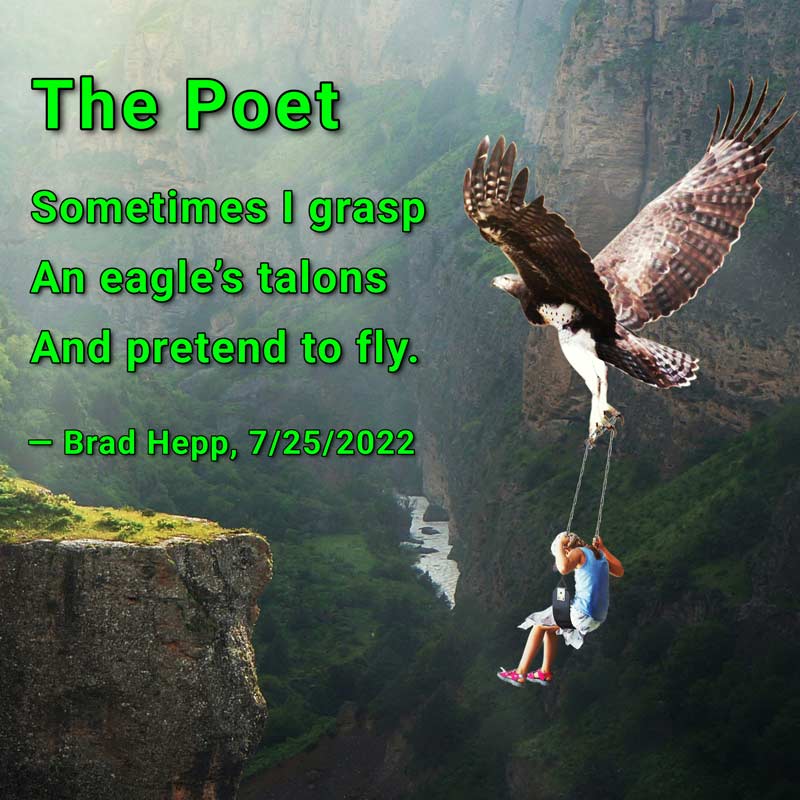
Don’t be fooled by the playful image. The key word in this poem is “pretend.” There are many times when I realize that I’m not fully conscious of meaning in my own poems. That seemed like a sorry excuse for sloppy writing when I was younger. Now, I increasingly recognize that I don’t grasp so much as I am grasped.
(if you are viewing this via email, the website has a recording of this poem and commentary; click the title above)
Commentary
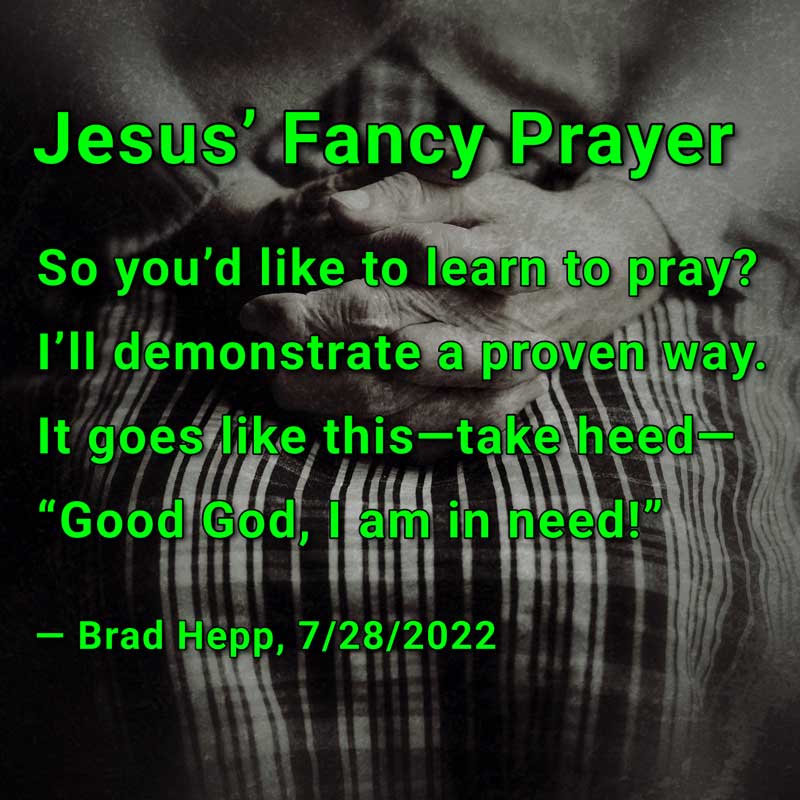
In my crawl through Luke, I got to chapter eleven today. Jesus’ disciples seem a little concerned that they might miss out on God’s blessing if they don’t have the right technique. They say to Jesus, “Lord, teach us to pray, like John taught his disciples.” We sometimes concentrate on the components of “the prayer” that Jesus taught them, but the bigger point (as seen in the illustrations Jesus follows up with) seems to be, “God is good; just do it!”
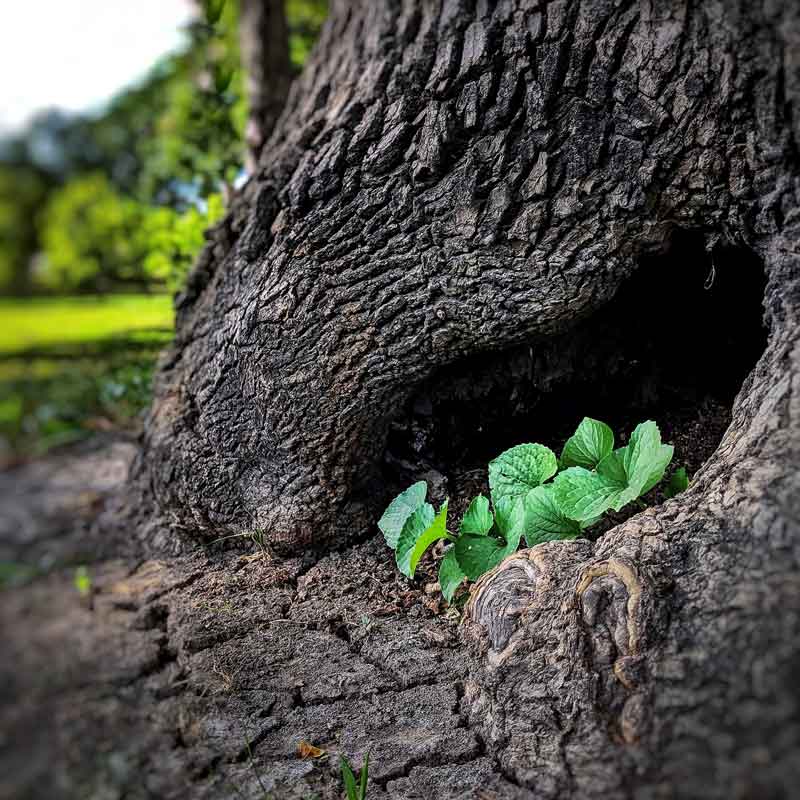
(if you are viewing this via email, the website has a recording of this poem and commentary; click the title above)I titled this photograph “L’Abri,” which is French for “the shelter.”
Commentary
In the years when I walked frequently around White Rock Lake, I increasingly recognized outcroppings of beauty as expressions of a wordless language. Its grammar was unrecognizable, but its vocabulary was everywhere — in flowers, sunsets, paintings, music, and human kindness.
For several years, I have been trying to grasp and define something that I sense, but cannot identify about BEAUTY. Beauty strikes me as a fundamentally important quality, something closer than almost anything else to the nature of God. I may ultimately find this to be above my mental pay grade. Two of my friends who have done PhD-level work on the subject of beauty have referred me to the writings of Hans Urs von Balthasar. This 20th-century Swiss theologian wrote a 15-volume trilogy focusing on beauty, goodness, and truth. Since I’m such a slow reader, I’ll probably resort to someone else’s introduction to Balthasar’s thinking.
Here’s what prompted me to revisit the photograph above, and reflect on its significance. I was going through my large collection of Instagram posts, and got to a section from about three years ago where almost every image was of something that struck me as beautiful. If you click the image below, and then scroll down through the results, I think you’ll see what I’m talking about (it’s especially easy if you have an Instagram account):
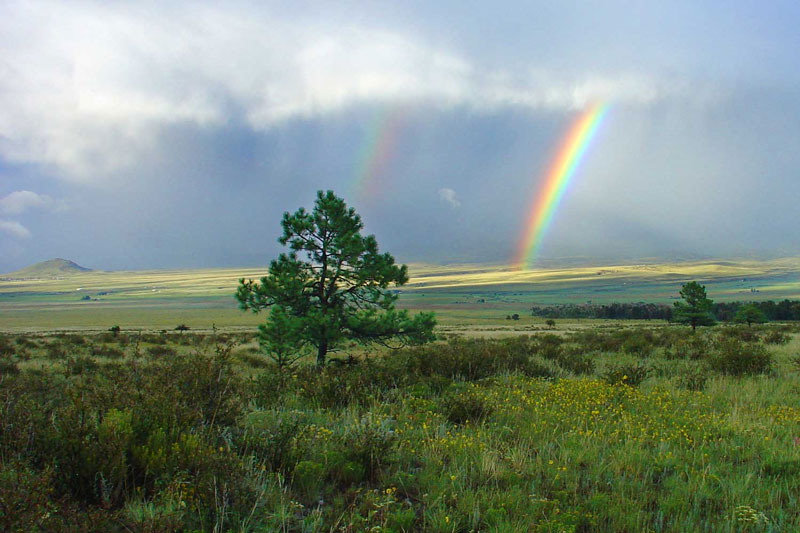
(if you are viewing this via email, the website has a recording of this poem and commentary; click the title above)One of my favorite photos: the Wetmore Valley in Colorado, taken on a family trip to Horn Creek Ranch
“Meaningful! Meaningful! Everything is meaningful.” That’s what was running through my head early yesterday morning. I couldn’t go back to sleep. As I lay in bed, I planned a web page exploring BEAUTY: WHAT IT IS, AND WHAT IT POINTS TO. I listened to an interview of Sara Groves. Her song “Why it Matters” also explores this subject. I noticed that as she spoke to the interviewer, much of her thought was carried in metaphors. Since I keep trying to improve as a poet, I pay attention to metaphor—how to use it, and how to recognize it being used. And so, I went through the day thinking about how so many things point to something else, and ultimately to qualities of the Creator. “This flower is meaningful. That kindness is meaningful.”
Then, I went for a walk. The Bible listening plan I do on walks had me go through Ecclesiastes this time. In Ecclesiastes, the preacher exclaims “Meaningless! Meaningless! Everything is meaningless.” This was the opposite of what I had been thinking all day!
How could I resolve the contradiction?
The preacher in Ecclesiastes seems to be talking mainly about the meaninglessness of a life lived AS THOUGH there is no eternity. Two or three places in his sermon, he touches briefly on the judgment. Most prominently, he does so in the conclusion:
“Now all has been heard; here is the conclusion of the matter: Fear God and keep his commandments, for this is the duty of all mankind. For God will bring every deed into judgment, including every hidden thing, whether it is good or evil.”
Ecclesiastes 12:13-14 NIV
The judgment implies an afterlife. Otherwise, judgment itself would be meaningless.
So live meaningfully—with Eternity in your heart. Otherwise—as the preacher took pains to demonstrate—it will all have been meaningless.
(if you are viewing this via email, the website has a recording of this poem and commentary; click the title above)
Commentary (A Facebook Exchange)
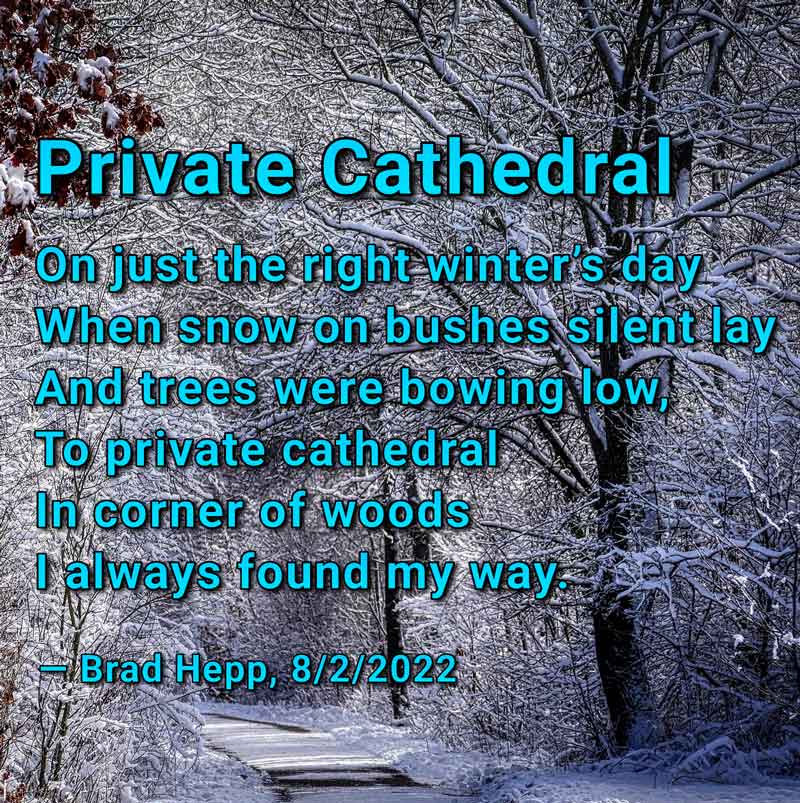
ME: (referring to the photograph above) No matter how many times I walk under these bois d’arc trees on my shortcut to the lake, it feels like I’m entering a special place, or embarking on an adventure. What are the magical places and moments in your life?
JOSH VAJDA: When I was a teen, we had 10 acres of forest and brush behind the house, with paths winding through. My favorite part of the walk was in the back corner on just the right winter’s day. After a hairpin turn in the brush, you walked along the side of a patch of older trees, which soon sharply turned right, inviting you inside, and winding so you could not see too far ahead. With a fresh blanket of heavy, wet snow, it was truly magical. The frosted pine and birch towered above, while the brush heavy laden hugged the path. The sun lit the chamber like a cathedral, and the snow smothered every sound except the crunch beneath your boots and the swish of your winter coat. Sometimes I would just stand in the center and soak it in as long as I could.
ME: Josh, you have written elsewhere about the importance of imagination. In the space set apart, the cathedral, we begin to imagine how everything could be different. As you describe that magical place from your youth, I want to map it out in my head. If I were sitting with you, I’d ask you to sketch the scene. I want to locate that cathedral and enter it myself. Those of us who have read Lewis think immediately of a wardrobe in an old professor’s house. But we should probably find our own wardrobes. Then, what is it we encounter in the set-apart space? To define it seems only to diminish it.
JOSH VAJDA: As usual, you are correct. I couldn’t help feeling it had a certain Narnian magic to it.
ME: This one’s for Josh Vajda (an echo of your elevated prose):
[Note: Josh Vajda kindly gave me permission to include our Facebook exchange in this post. Josh is an excellent thinker and writer. Check out his blog. For instance, this study of “The Sin of Sodom.”]
(if you are viewing this via email, the website has a recording of this poem and commentary; click the title above)
Commentary
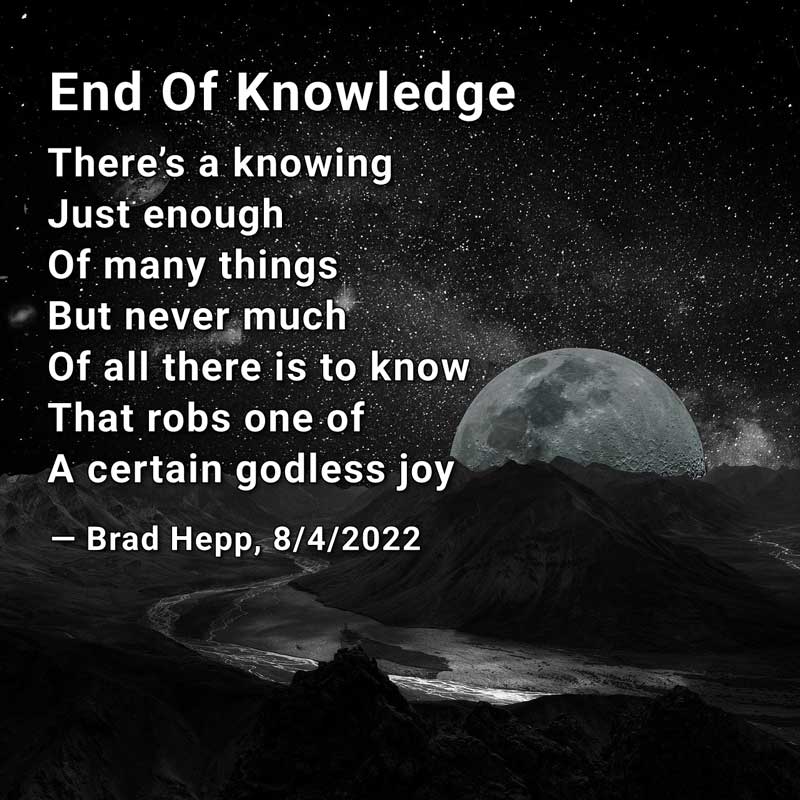
[NOTE: this could also be called “End of the Internet.” Anyone who has ever sought comfort in doom-scrolling may know what I mean]
I struggled for an hour to express this feeling and realization. I almost captured it in another poem, but that poem was too much of an abstraction. The simple truth is that I try to fill too much of my life with useless knowledge, and too little with useful service. It’s one hazard of being a poet, but I’ll not pretend that’s an adequate excuse.
So I hated life, because what is done under the sun was grievous to me, for all is vanity and a striving after wind.
Ecclesiastes 2:17 ESV
[NB: I almost always try to stuff more than one meaning into my poem titles. “End” in this title is intended to suggest two questions: where does knowledge get you, and what’s it for?]
(if you are viewing this via email, the website has a recording of this poem and commentary; click the title above)
Commentary
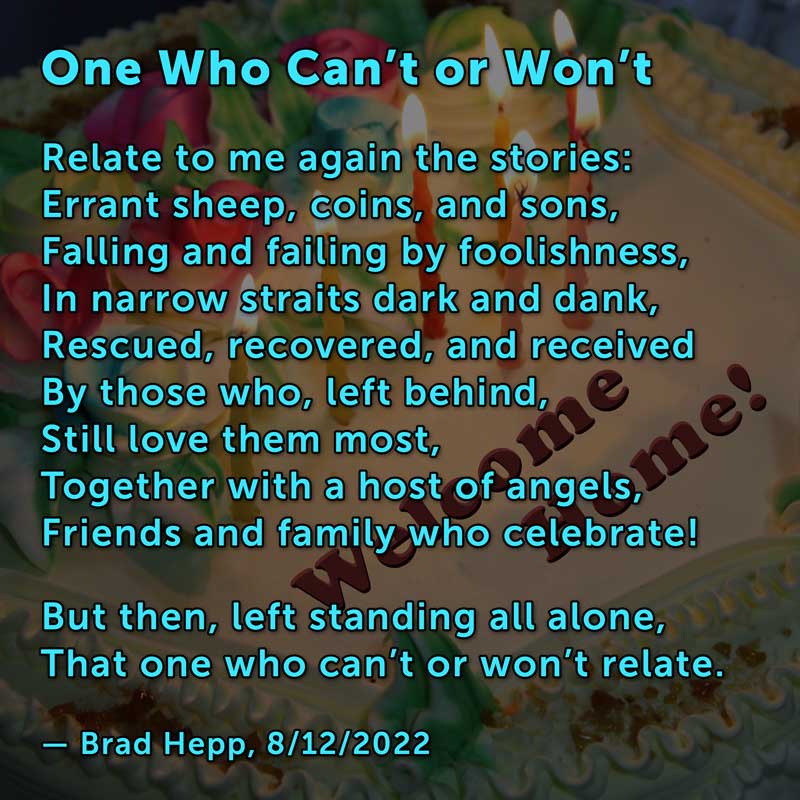
FROM SASSY BOY TO CAKE DECORATOR
In my crawl through Luke, I’m to chapter fifteen. There are several celebrations in this section—and some people who don’t care to celebrate.
This morning, I’m reminded of family devotions at the Hepp house in Puebla. Before heading off to the seminary to teach, Dad would lead us in considering a portion of the Bible. We took turns reading. Then Dad would often say, “Now tell us what you just read in your own words.” If it was my turn, I’d just as often sass, “Why should I do that, given that it’s already in the best possible words?!”
Now, I’m grown up. I’m forever trying to put things in my own words, often in the form of poetry. Much of what I hear, read, or experience gets compressed and squeezed through the piping cone of my poetic mind. I’m like a cake decorator in training, looking for celebrations, looking for something to squeeze decoratively into my own words.
(if you are viewing this via email, the website has a recording of this poem and commentary; click the title above)
Commentary
I woke up thinking, “It’s Saturday again. Already. Time is fleeting.” Then, I thought about other things that are sometimes fleeting, but should not be. Love and friendship make the passage of time tolerable. Their loss make its pain more intense.
(if you are viewing this via email, the website has a recording of this poem and commentary; click the title above)
Commentary
Rest is not negligence, but it sometimes requires neglect.
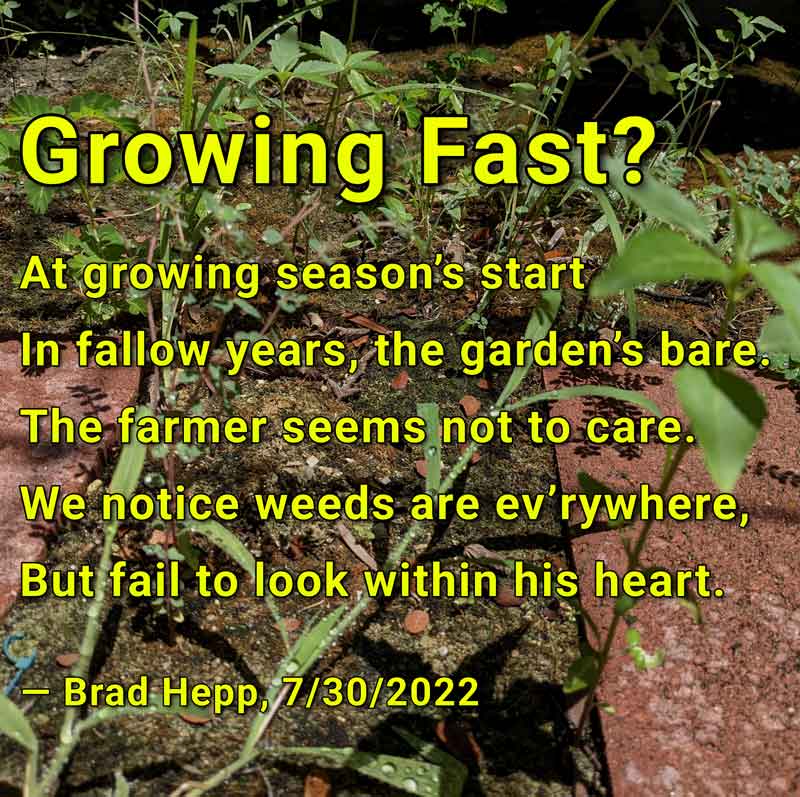
This poem was inspired in part by looking at my cherished moss garden. Right now, it’s a mess. In fact, nothing worked right this year in the gardens I look out upon from my office window. I had to replace most of the moss in the garden because something killed it last year. Then, I didn’t keep up with weeding it. You see the results in the background photo. I failed to plant the annual vines that grow up on the trellis that covers the moss garden and is supposed to shade my office windows. The wildflowers that I planted this year didn’t bloom as they have in past years. It was a different brand. So, nothing worked. Soon the year will be done, and I’ll try again.
This is not my idea of how a fallow year should look. But maybe it is how a fallow year does look!
Is my garden a reflection of my heart? I hope not. In fact, I know that I have been paying closer attention than ever to what grows in my heart. I’ve been pulling weeds, amending soil, watering. The effects aren’t obvious yet, but maybe by next year, the gardens outside and the garden inside will both reflect the hidden growth of a fallow year.
(if you are viewing this via email, the website has a recording of this poem and commentary; click the title above)
Commentary
Seriousness, kindness, and criticism. These are currents I negotiate in my daily swim. Always swim with a buddy.
Here’s how I explained this poem to an old friend: “Who you’re becoming matters for all eternity, so I will spend time and effort on our friendship now.” That’s the perspective I want to fully embrace.
(if you are viewing this via email, the website has a recording of this poem and commentary; click the title above)
Commentary
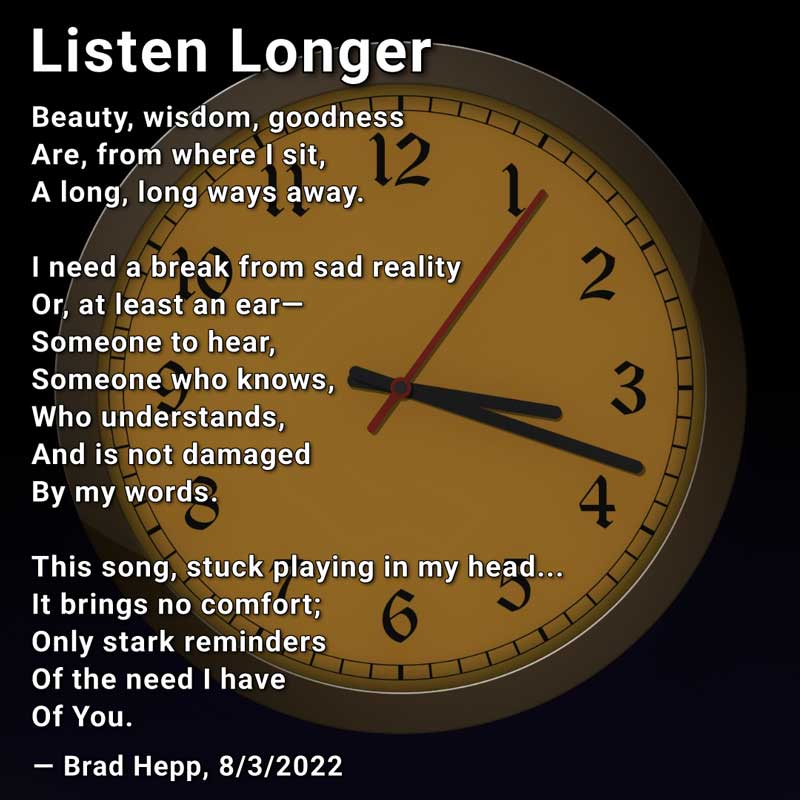
Here’s the occasion for this poem…. I woke up in the middle of my night to a son coming home from a miserable shift bedeviled by a horrible manager. In my sadness for him, and my anger at the manager, I could not get back to sleep. So why “Listen Longer”? Deep down I know the Good Teacher never stops teaching.
When I wrote this, I was working through Luke 12. The returning master in Jesus’ parable wants to serve his servants, and is angered when his servants respond with selfishness, looking out for themselves and not each other. I begin to understand the master’s anger.
Also, the song that had been playing in my head is “Why It Matters” by Sara Groves: https://youtu.be/D32dlKv2x38
Here are the lyrics of that song:
Sit with me and tell me once again Of the story that’s been told us Of the power that will hold us Of the beauty, of the beauty Why it matters
Speak to me until I understand Why our thinking and creating Why our efforts of narrating About the beauty, of the beauty And why it matters
Like the statue in the park Of this war torn town And it’s protest of the darkness And the chaos all around With its beauty, how it matters How it matters
Show me the love that never fails The compassion and attention Midst confusion and dissension Like small ramparts for the soul How it matters
(if you are viewing this via email, the website has a recording of this poem and commentary; click the title above)
Commentary
I wrote this poem in response to what I was seeing in Luke chapter twelve.
Luke wants us to pay attention to several things. Some of them I haven’t figured out (e.g., Luke’s repeated mention of the growing crowds). Some of them, I THINK I’m starting to figure out, like how Jesus valued the anticipated gift of the Holy Spirit. How much do I value—and rely on—that gift? What outcomes do I seek to ensure by other means? What storehouses am I foolishly building?
(if you are viewing this via email, the website has a recording of this poem and commentary; click the title above)
Commentary
One of the better things about Facebook is that it brings up posts from the past. Today, it brought up this post from September 14, 2020. I had posted the photo with the question “Today, will I see beauty, or will I be blinded by ugliness?” That prompted me to think about how I have been answering that question over the last two years. Here’s what I wrote today:
In the two years since I posted this question, I have have become far more aware of ugliness. In fact, I’d say that it has been necessary for me to remove blinders about the evil in my culture. Already in 2020, I was asking myself, “Why do I so readily identify sins on ‘their side’ and don’t recognize sins on ‘my side’?” Major events in the US took care of that naïveté, as did some of my reading. Pride, ambition, selfishness, arrogance, shortsightedness… these are equal opportunity sins and weaknesses that afflict both ends of the political spectrum, and everything between. I’m left with profound sadness about the prospects for my nation. On the other hand, I no longer despise people on “their side” as I once did. I’m able to pray prayers of blessing for people on “their side.” Sadness is better than hatred.
“The end of the Maker’s dream is not this” … or that, or that, or that.
(if you are viewing this via email, the website has a recording of this poem and commentary; click the title above)
Commentary
I understand that guitarists are sometimes told to “Shut up and play guitar!” This happens when they dare to express something that strings alone can’t convey. There’s a beauty so dazzling or darkness so diminishing that they must use words to SAY.
I recently posted a so-so snapshot* that was liked and shared more than just about anything else I have ever posted. The contrast between this and more heartfelt efforts was puzzling but predictable…. Every time I write a poem that I especially like, I can be sure there will be hardly any response. It’s as though I’m being told to “shut up and play.” But I won’t.
(background photo by Dionne Hartnett on Pixabay)
*Here’s the photo. It is not one of my better shots. Maybe what I wrote (below), or the hashtags caught people’s attention, resulting in it being shared 9 times.
What I wrote: This vista has lost a little of its charm since the trail was recently “upgraded,” but it’s still a highlight of every walk around White Rock Lake. If you’re walking around counter-clockwise, you haven’t seen the lake since you left Sunset Bay (a mile back). You have gained elevation after the Stone Tables. Then you round this curve, and start to see the lake ahead and below. For me, it’s like a first glimpse of the Rockies on a roadtrip from Texas to Colorado. You’re getting to the best part!
(if you are viewing this via email, the website has a recording of this poem and commentary; click the title above)
Commentary
I wrote this for someone who worries that eternity would get old. Exploring isn’t the only source of lasting joy. Getting to know is good. So is having come to know.
(if you are viewing this via email, the website has a recording of this poem and commentary; click the title above)
Commentary
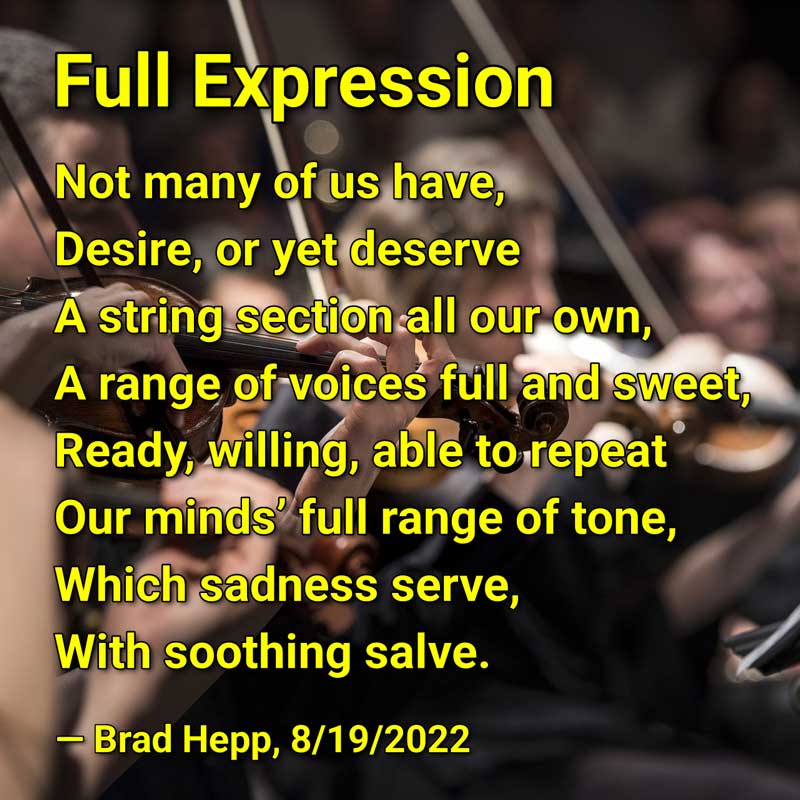
I sometimes envy composers and conductors. But even they must long for a fuller, more perfect expression of what it means to be made in God’s image.
I don’t usually bother with rhyme patterns. For this one, I pushed myself a little, and it probably shows in the last two lines. “Which sadness serve” can be read in two ways: 1) music can convey sadness (“serve it up” as it were), and 2) music can serve to comfort sadness with its soothing salve.
(if you are viewing this via email, the website has a recording of this poem and commentary; click the title above)
Commentary
The poem above really was occasioned by my frustration that I cannot brag on my wife Susan on social media. She won’t have it. I’d get banned. Oh well, I believe a day is coming when Someone better than me will sing her praise. Good luck banning Him!
Recently, my slow reading through the New Testament has me in the last few days of Jesus’ earthly ministry. Specifically, I’m in Luke 22, where I’m observing how Jesus prepared for — and carried out — what we now call the Last Supper. One of the elements that Luke describes is Jesus’ sharing a cup of wine with his friends the Apostles and saying to them
Take this, and divide it among yourselves. For I tell you that from now on I will not drink of the fruit of the vine until the kingdom of God comes.
Luke 22:17b-18
We see what took place at what we call the Last Supper. What will the Next Supper be like? There are hints. It seems that wine will be involved. If there’s wine, I like to imagine there may be some toasting. And in my flight of fancy, I can picture Jesus toasting us. That may sound shocking. Let me tell you why I go there….
God Brings Us To Glory
Here’s one of my favorite passages in the Bible:
In bringing many sons and daughters to glory, it was fitting that God, for whom and through whom everything exists, should make the pioneer of their salvation perfect through what he suffered. Both the one who makes people holy and those who are made holy are of the same family. So Jesus is not ashamed to call them brothers and sisters.
Hebrews 2:10-11 NIV
Far from being ashamed to call them brothers and sisters, Jesus gave his very life to accomplish God’s goal of bringing believers to glory. Is glory a state or place where God alone shines, a state or place where humans who have been brought there merely witness God’s glory, but do not partake in it?
It may seem cheeky, maybe even blasphemous to contemplate Jesus sharing glory, praising mere mortals. But give it some thought, and I think you’ll come up with plenty of passages that point to this amazing reality. Let my hashtags bring a few to mind….
(if you are viewing this via email, the website has a recording of this poem and commentary; click the title above)
Commentary
In my crawl through Luke, I have spent several days in chapter 22. It may just be my imagination, but it seems like Luke WANTS us to slow down here, like he has put a video in slow motion.
Verse 7 caught my attention, as though it were a title page in Luke’s video: “Then came the day of unleavened bread, on which the passover had to be sacrificed.” Since I have been watching for thoughts shared by Dr. Luke and his companion the Apostle Paul, I asked myself, “Is Luke consciously comparing Jesus to the sacrificial lamb of Passover?” I knew Paul does that.
I looked up the occurrences of “sacrifice” (θυω, thuo), that Luke used in verse 6. That led me to a passage in 1 Corinthians 5 where Paul is urging his readers to guard their moral purity:
Cleanse out the old leaven that you may be a new lump, as you really are unleavened. For Christ, our Passover lamb, has been sacrificed. Let us therefore celebrate the festival, not with the old leaven, the leaven of malice and evil, but with the unleavened bread of sincerity and truth.
1 Corinthians 5:7-8 ESV
Two things jumped out at me in the 1 Corinthians passage:
1) Luke’s friend Paul certainly thought of Jesus as the sacrificed Passover Lamb (I know that’s not news to most of my readers), and
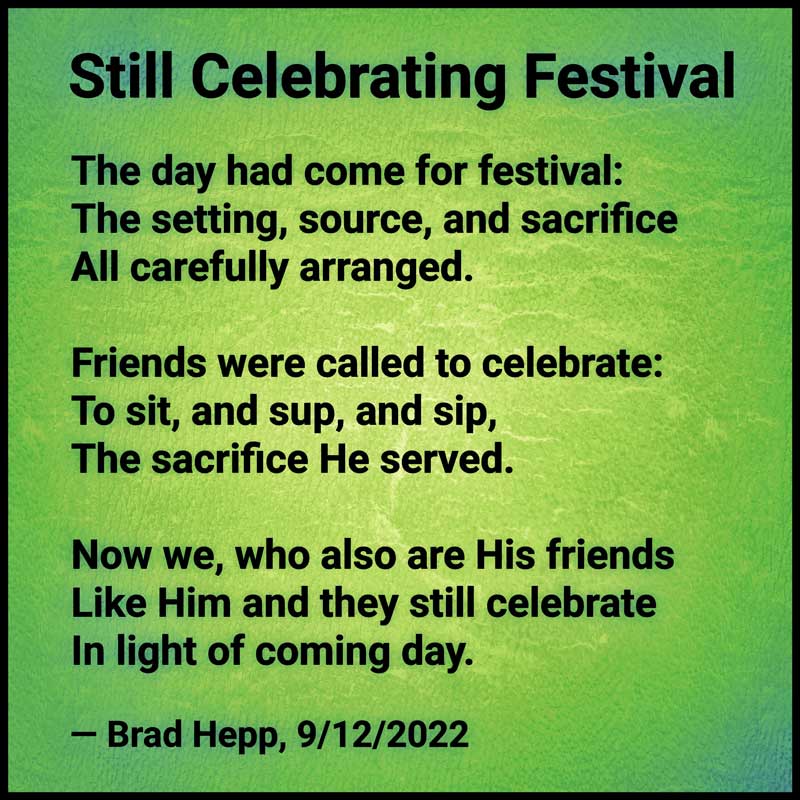
2) There is a sense in which we are still celebrating the festival of Passover that Jesus and His disciples celebrated just before His death (“let us therefore celebrate”). That’s what prompted my poem.
So, I slow down in Luke 22. The story is still happening, monthly, weekly, daily. As long as it takes.
NOTE: I’m aware that the second-to-last line mixes pronoun case: “Him” and “they” can’t both be right here. So, do I fix it? For now I’ll let it go. Maybe there’s something to be gained by considering which case was correct!
(if you are viewing this via email, the website has a recording of this poem and commentary; click the title above)
Commentary
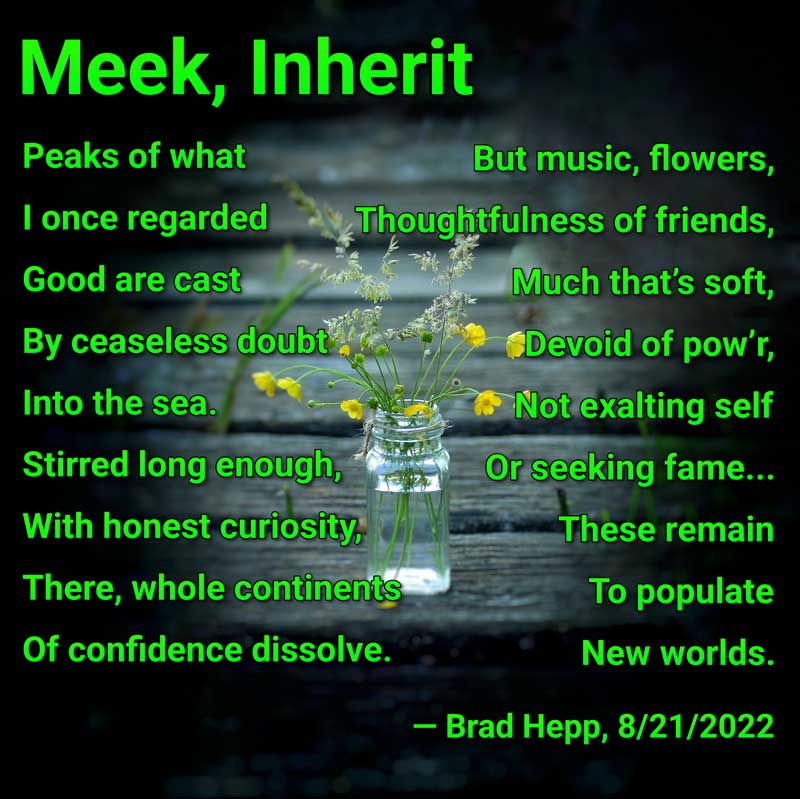
Blessed are the meek, for they will inherit the earth.
Matthew 5:5 NIV
It’s unsettling to look back on a lifetime of false confidence in man. I suspect most of us grow up thinking, “I’m one of the good guys. All that I possess was fairly earned, righteously taken.” But the more I learn about history, the more that fantasy is dispelled.
(if you are viewing this via email, the website has a recording of this poem and commentary; click the title above)
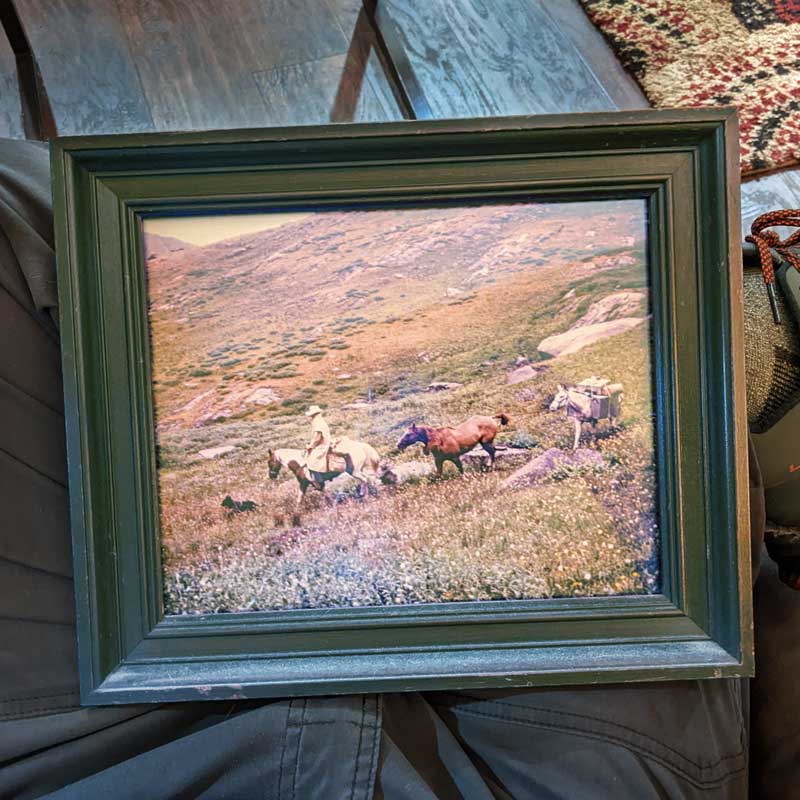
There’s a print that hangs in my hallway, mostly never seen. It’s a photograph I took when I was young, hiking through the mountains. Just now, I went and grabbed the photograph, to reflect on how it pictures a man who, in one way, was very like me.
Taciturn, the prospector, his dog, two horses, and a mule passed by below, heedless of the trail. He halfway turned to acknowledge my presence in his domain. I lifted my camera and captured the moment for later consideration.
It’s later now. The man was looking for something… gold I assume. He was not one to announce his quest. Talk, and words were not his way. A boy with a camera didn’t need to hear his story.
Gold: that’s all the prospector sought.
I don’t have two horses, a mule, and a dog. I am not taciturn.
But the prospector and I are alike in one way. Gold is all I seek. That’s why I dig with words. It’s the reason for my poetry.
(if you are viewing this via email, the website has a recording of this poem and commentary; click the title above)
Commentary
LET LAMENT BE
When we suffer loss, people often reach for metaphor, supposing it will comfort: windows being opened, gold refined of dross. But the view out a window is sometimes bleak, and gold in finished form not always something we would seek.
In plain terms, one of the themes I keep returning to in my poetry is a sense of loss, and how to deal with it. I think of Paul’s claim
12 I know what it is to be in need, and I know what it is to have plenty. I have learned the secret of being content in any and every situation, whether well fed or hungry, whether living in plenty or in want. 13 I can do all this through him who gives me strength.
Philippians 4:12,13
Paul isn’t self-sufficient. Jesus’ provision of strength comes at least partly through fellow believers. The immediate context of Paul’s claim seems to be his thankfulness for financial support from the church at Philippi. But in the rest of the letter to the Philippians, Paul mentions other kinds of support. Notice the words and phrases in chapter 2: encouragement, compassion, comfort, looking to the interests of others, concern, having mercy, sparing from sorrow.
How do we participate in this mutual encouragement? What I’m suggesting in the poem above is that it starts with acknowledging difficulties. In order for any of us to support others in their grieving or loss, we need to first acknowledge grief or loss in ourselves, and let others do the same.
(if you are viewing this via email, the website has a recording of this poem and commentary)
Commentary
I am woefully behind in posting poetry to this blog. I wanted to go ahead and post this one while the emotion underlying it is still fresh.
My morning routine these days includes reading through the New Testament in Greek. It’s a slow process because I’m frankly not very good at it. But that has its benefits. Mainly, I’m slowed down by the process, and my mind has more time to mull over what’s being said. Luke has occasioned a lot of mulling. His Greek has struck me as more refined and elevated than what I encountered in Matthew and Mark. Even when I can’t pin down the reasons for his careful word choice, I can see that he’s doing SOMETHING interesting, generally to develop a theme.
When I write about my routine, I refer to it as “my crawl through Luke.” It’s slow, and it often feels like I’m a baby in my understanding. At least I won’t run out of things to explore in this lifetime!
My crawl through Luke brings me to the end of chapter 18 and the beginning of chapter 19. Luke is doing SOMETHING with this juxtaposition of two stories. One happens outside Jericho, and the other happens inside Jericho. Both involve men who cannot see. I have tried to imagine what it might have been like for those two men to become friends. In this poem, Zacchaeus is talking with the unnamed blind beggar….
(if you are viewing this via email, the website has a recording of this poem and commentary; click the title above)
Commentary
Most dreams can be tossed. This one, I thought I’d better save. What does it mean?
The longer I write poetry, the more it seems to be a revealing of the subconscious. I had no control over the dream. But I did have control over how I described it. That the ghostly figure was “removed,” and that I experienced this as “loss” probably points to a sense of loss that haunts me these days.
What have I lost? What am I losing? Plenty. If it weren’t for the promise of eternal life, and a restoration of good things, maybe even the gold would have disappeared. But the gold remained.
(background adapted from image by Andrew Martin on Pixabay)
(if you are viewing this via email, the website has a recording of this poem and commentary; click the title above)
Commentary
Slowly, slowly it dawns on me what artists, musicians, and dancers have been doing all along. Some of them speak a language I never learned. But I start to catch their drift.
I’ll try to expand on that…. King David wrote that
The heavens declare the glory of God; the skies proclaim the work of his hands.
Psalm 19:1 (NIV)
When we witness something beautiful or magnificent, it points us to God. I’m not enough of a philosopher or theologian to defend that statement. It’s just something I sense or intuit, and increasingly so. Somehow, I am becoming more appreciative of beauty. It’s subtle: I watch someone dancing, or view a painting, and something deep inside me responds with joy. Even though I myself don’t speak the language of dance or of painting, I begin to recognize its words.
(if you are viewing this via email, the website has a recording of this poem and commentary)(background photo adapted from one by “ilamag” on Pixabay)
Commentary
When I try to shock myself and others out of our complacency, I usually discover that we’re well insulated.
I get the impression that the Gospel author Luke wanted to shock his readers. In story after story, he illustrates Jesus’ absolute demands on his disciples… and the disciples’ absolute compliance. The central passage may be this one:
So therefore, any one of you who does not renounce all that he has cannot be my disciple.
Luke 14:33
In Luke’s account of how the disciples followed Jesus, we see that renouncing of everything. For instance, when Jesus calls Simon, James and John away from their career as fishermen, here’s how they respond
And when they had brought their boats to land, they left everything and followed him.
Luke 5:11
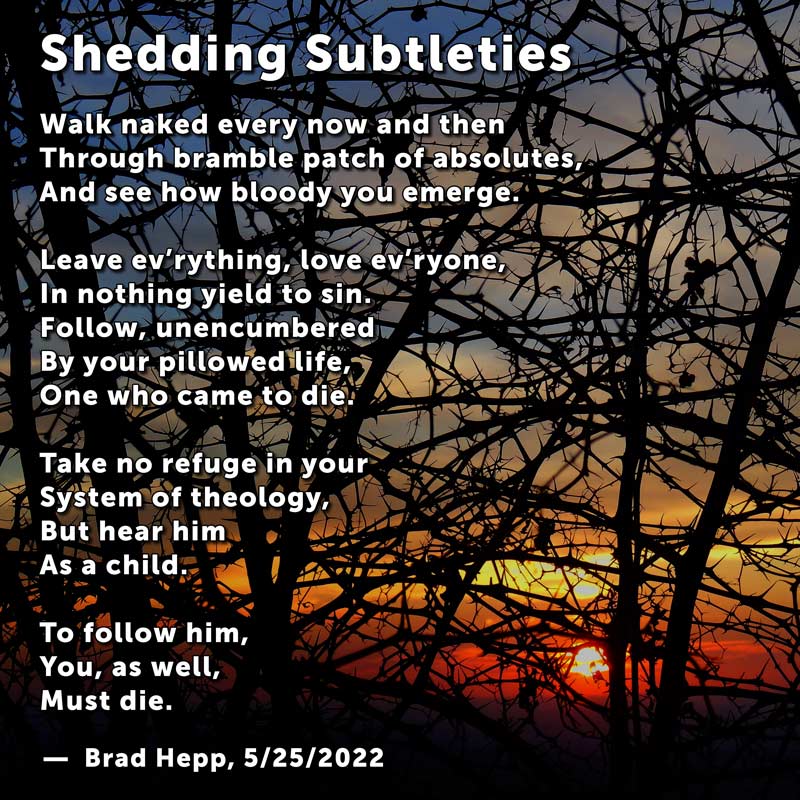
“Everything” — that’s more than I have renounced. And that makes me uncomfortable. What also makes me uncomfortable is how quickly my mind tries to supply excuses. You know, stuff like decorum, not being a burden on others, being “wise.”