(if you are viewing this via email, the website has a recording of this poem and commentary; click the title above)
Commentary
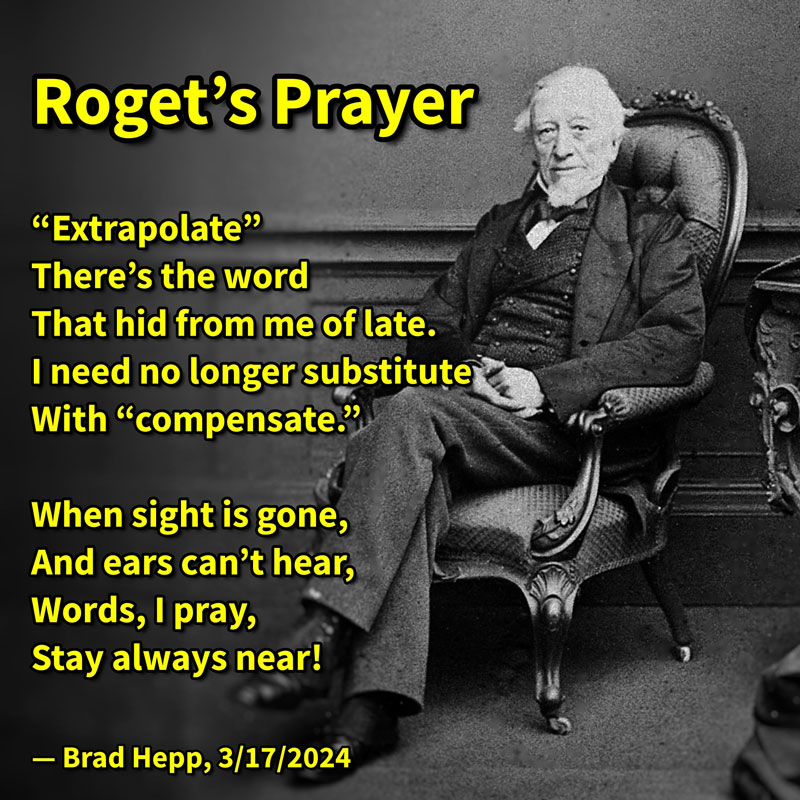
On two or three recent occasions, I have needed the word “extrapolate,” but couldn’t think of it. So, I had to resort to “compensate.” This morning, the word I was seeking popped into my mind, and I was so happy I wrote a poem.
It is said that Peter Mark Roget (1779–1869) made lists of related words partly to combat his persistent depression. Which of us hasn’t benefited from the resulting Roget’s Thesaurus? As you can probably guess, he was a brilliant and accomplished man. He also lived a long life. He was deaf by the time he died at age 90. I didn’t know that yet when I attributed my own prayer to him in the title of this poem.
(if you are viewing this via email, the website has a recording of this poem and commentary; click the title above)
Commentary
Yesterday I read an article exploring why lay people often insist that we should not end sentences with prepositions. Linguists say we CAN do so in English, and that the rule came from a wrong-headed attempt to conform English to Latin.
I like French and other Romance languages. But I don’t like silly rules, such as the one that says you can’t end a sentence with a preposition, or that you can’t start a sentence with “but.”
(if you are viewing this via email, the website has a recording of this poem and commentary; click the title above)
Commentary
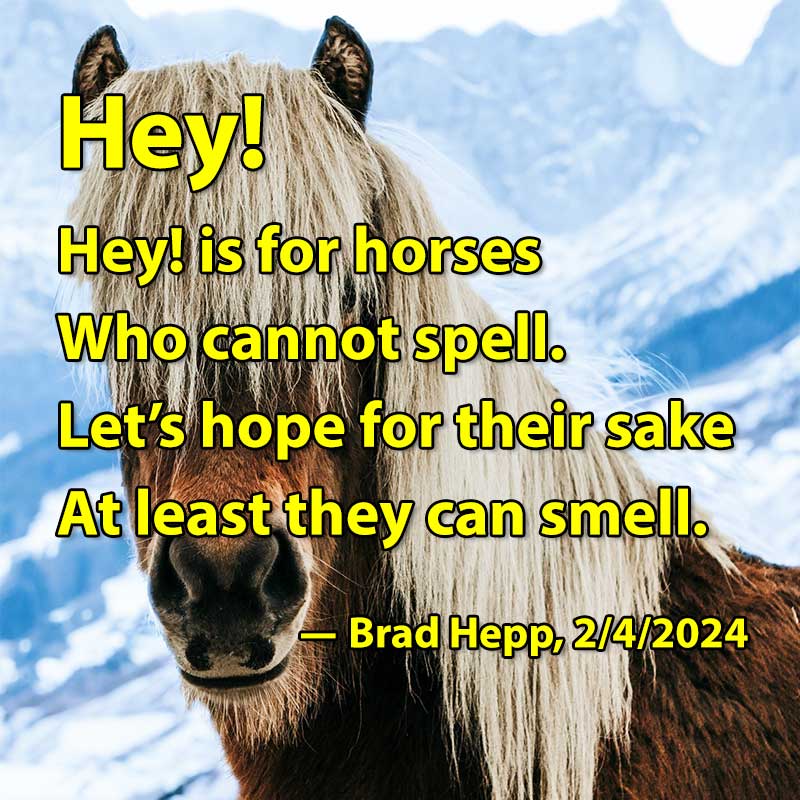
On my way to church this morning, I was listening to “A Way With Words” on the car radio. One caller was asking about the interjections “Say!” and “Hey!” It dawned on me that my imagination has always shut down when someone says “Hay is for horses.” In my mind’s eye, I spelled out the homonyms: “hay” and “hey.” That’s when this poem was born.
(background image based on one by “12019” on Pixabay… with a little generative fill behind the horse)
(if you are viewing this via email, the website has a recording of this poem and commentary; click the title above)
Commentary
Slow music, even slow dance Are sometimes great But I’m sure you can relate: They’re not for me When I get up early And the night before, I stayed up late.
(if you are viewing this via email, the website has a recording of this poem and commentary; click the title above)
Commentary
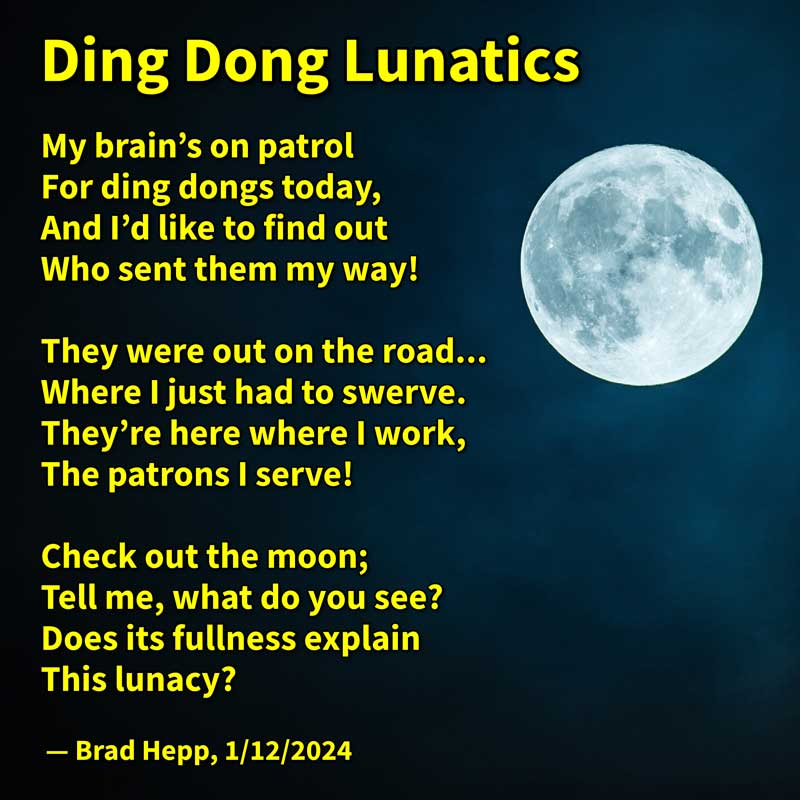
Once, long ago a hospital chaplain told me that the hospital is extra busy when there’s a full moon. I believe it. That’s why I looked up the moon phase when I wrote this poem. I was seriously thinking that maybe there was a full moon out there. But there wasn’t. So that’s not it!
Here’s a confession. That first line–My brain’s on patrol–is a clue that the real problem is in my mind. I went to work today dreading the return of a difficult patron. I’ll spare you the details so as to keep my job. Don’t worry…. I maintained my professionalism… on the outside.
It’s a good thing that Monday is a federal holiday, and that I work at a place that observes all holidays….
(if you are viewing this via email, the website has a recording of this poem and commentary; click the title above)
Commentary
In my crawl through Acts, I have just about made it through chapter 8. Once again, Luke is telling a story that contrasts GENEROSITY (God’s generosity, reflected in selfless servants) with GREED (here it is Simon the Magician’s apparent desire to exploit God’s generosity).
Question: is it possible Simon was a true believer? Was he saved in Luke’s account? Does Luke actually want us to struggle with this question? He leaves off with Simon declining to do the one thing Peter requires of him: personally repent and pray for God’s forgiveness.
When you go to poke fun And the response isn’t glee, Make your very next words An apology. — Brad Hepp, 9/7/2023
Commentary
I have often observed a kind of bullying behavior: a man or woman, girl or boy is easily stressed; less easily stressed jerks take advantage of that person by “kidding” them and then criticizing them when the “kidding” is not taken in stride.
Perhaps this is why I so much appreciate the Geigerism “Kid Up!”
(if you are viewing this via email, the website has a recording of this poem and commentary; click the title above)
I sit on a rock on the bank of the stream, by the light of the moon methodically washing my midnight snack.
I’m thinking back to an earlier time, when darkness fell on the farmer’s shack….
Seated on a well-worn balustrade, I watched the farmer through slits in a dusty window shade. He sat on a chair at the kitchen table. By light of a lantern, he methodically penned. Poetry, I suppose.
With far less writing than scratching of head, he’d occasionally put pencil to paper and thoughtful compose.
Finally, he set down his pencil, snuffed out the lantern, and waddled to bed.
My careful ablutions are now complete.
It’s “Good night” to you, and to me, a pensive “Bon appétit.”
— Brad Hepp, 8/9/2023
(image adapted from original by Wolfgang Deckers on Pixabay)
(if you are viewing this via email, the website has a recording of this poem and commentary; click the title above)
Commentary
When I posted this on Facebook, I kept having to add comments to clarify my intent:
1. Is there anything more pathetic than an opinionated old audiophile with bad hearing?
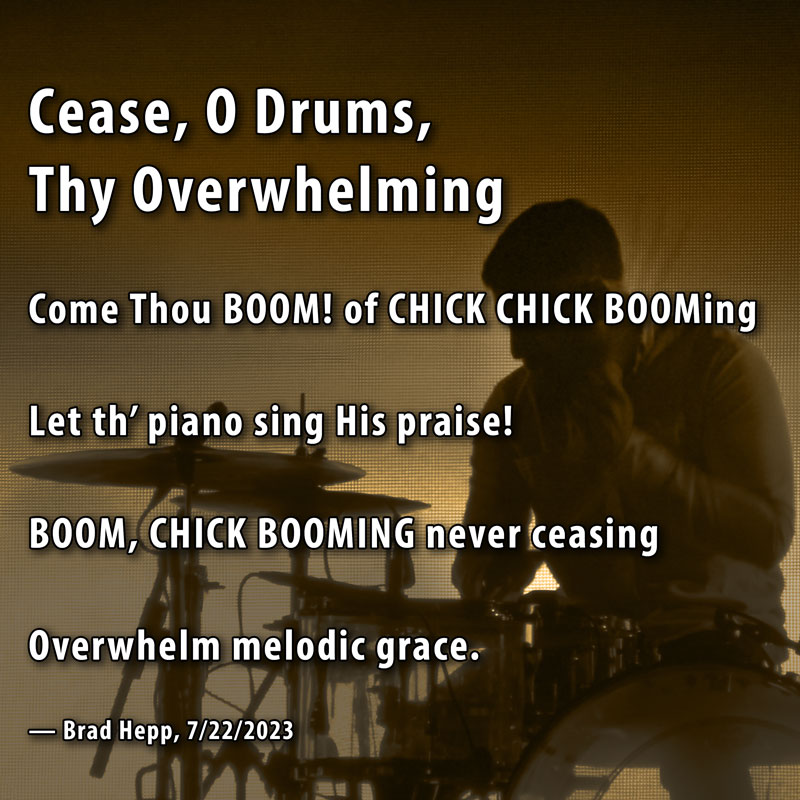
2. In my experience, drums can be played in a way that complements the other instruments and voices, or they can be played in a way that draws attention to themselves. That’s just a matter of skill. Additionally, since I’m losing hearing in the higher frequencies, poorly-played drums (with their lower frequencies) can easily dominate and muddy up the whole ensemble. But hey, I torture people in my home with very bad accordion playing, so who am I to talk?
3. I want to be crystal clear…. I have nothing against drums, including as part of worship. As I sit here now, I’m reading theology while listening to one of my favorite Pandora stations. It features electronic dance music by artists like Tiesto, ATB, Armin Van Buren (much of it is built on driving beats). All I meant to say in the poem is “be skillful; be aware of how your instrument complements—or detracts from—other instruments.” One of my nephews is a top-notch drummer. I think he studied under a jazz drummer. When I talked with him about this, he expressed opinions very similar to my own.
(background image adapted from one by Carlos Rocha on Pixabay)
(if you are viewing this via email, the website has a recording of this poem and commentary; click the title above)
Commentary
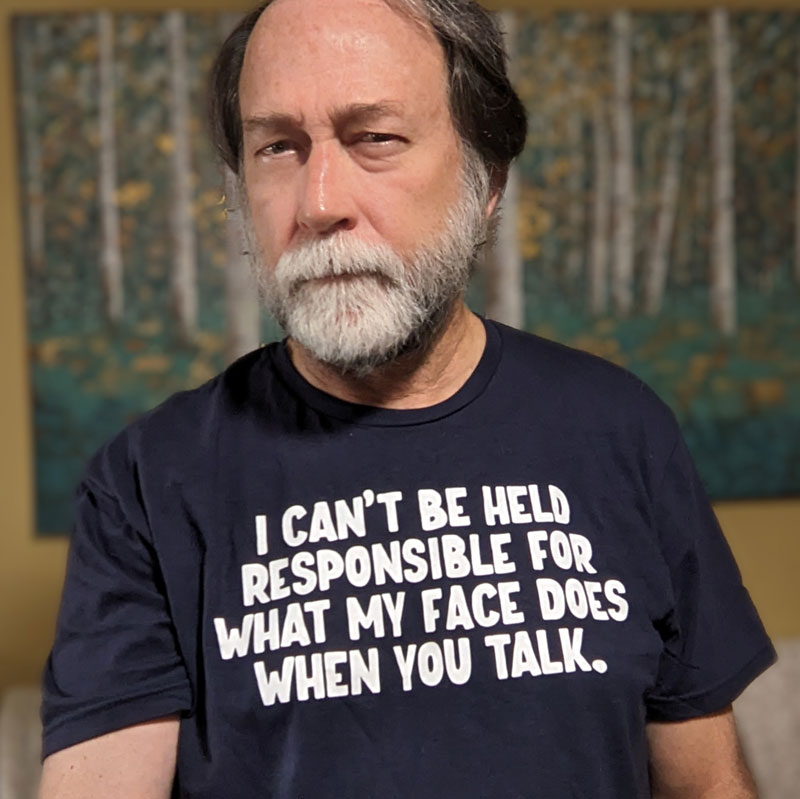
I sent this poem to a dear friend, saying “I think of you when I write this, with thankfulness that you use my guilelessness FOR me, and not AGAINST me.”
Having strong emotions is a blessing. Not being able to fully control them or mask them can be a curse.
MY FRIEND’S RESPONSE My friend wrote: “You are allowed to have feelings and initial reactions. I would hope people would understand that and give you time to process.”
“That said, stay away from the poker tables. 😂 “
ALSO MY FRIEND’S RESPONSE My friend also sent this shirt…
(if you are viewing this via email, the website has a recording of this poem and commentary; click the title above)
Commentary
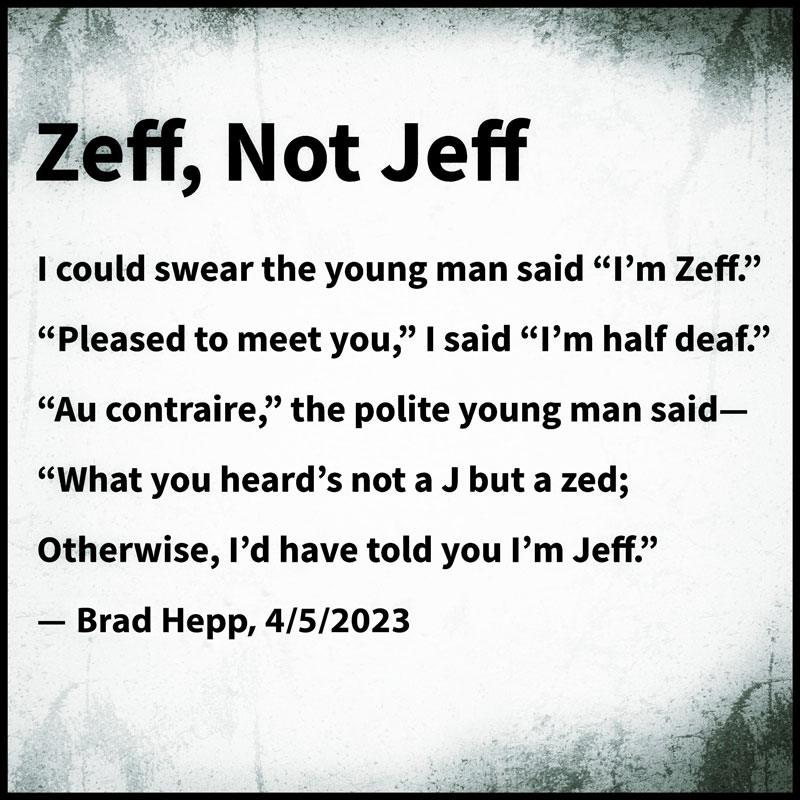
I did actually meet a Zeff today. We talked about the origin of his name (Hebrew?), tools one can borrow at the library, and turning every lawn into a meadow. He didn’t seem to think I’m crazy, so maybe I have a new friend. Just don’t tell him about this limerick.
EDIT, 2/1/2024: Although I haven’t gone back and worked on this new friendship, I have since learned from someone else that the Zeff in question is a brilliant young man.
(if you are viewing this via email, the website has a recording of this poem and commentary; click the title above)
Commentary
FIRST, MY STATE OF MIND IN WRITING THIS POEM Occasionally, I lie awake for hours, struggling with the consequences of being an obvious sinner. Then, the sun rises and I must go forth, in hope that the Spirit will channel this expressive energy God gave me.
The sins of some people are obvious, going before them into judgment, but for others, they show up later. Similarly good works are also obvious, and the ones that are not cannot remain hidden.
1 Timothy 5:24-25 NET
NOW THE EXCELLENT FEEDBACK OF TWO WISE FRIENDS First, from Jim Powell: “You probably already know this, but Tony Campolo famously began one of his sermons by saying: ‘I have three things I’d like to say today. First, while you were sleeping last night, 30,000 kids died of starvation or diseases related to malnutrition. Second, most of you don’t give a shit. What’s worse is that you’re more upset with the fact that I said shit than the fact that 30,000 kids died last night.'”
Jim added, “For the record, I do not use profanity, though I occasionally will quote it if there is a reason to do so. I probably wouldn’t even use it the way that Tony Campolo did, however, he is right about his priorities. While we sleep tonight, thousands of children will die of hunger, malnutrition, and curable diseases. And we don’t get as energized about doing something about it, because we don’t see any angle in which we would be fighting against sin. In fact, too many Christians would turn away those very children if they showed up at our southern border. Because right-wing news media have convinced many that they are a grave threat to our national security.”
Then, this from David Lewis: “I read in a (now out-of-print) book a line about a woman who was poisoning her husband little-by-little. She distilled the poison out of sweet words, loving words, gentle words, all of them withheld.”
(if you are viewing this via email, the website has a recording of this poem and commentary; click the title above)
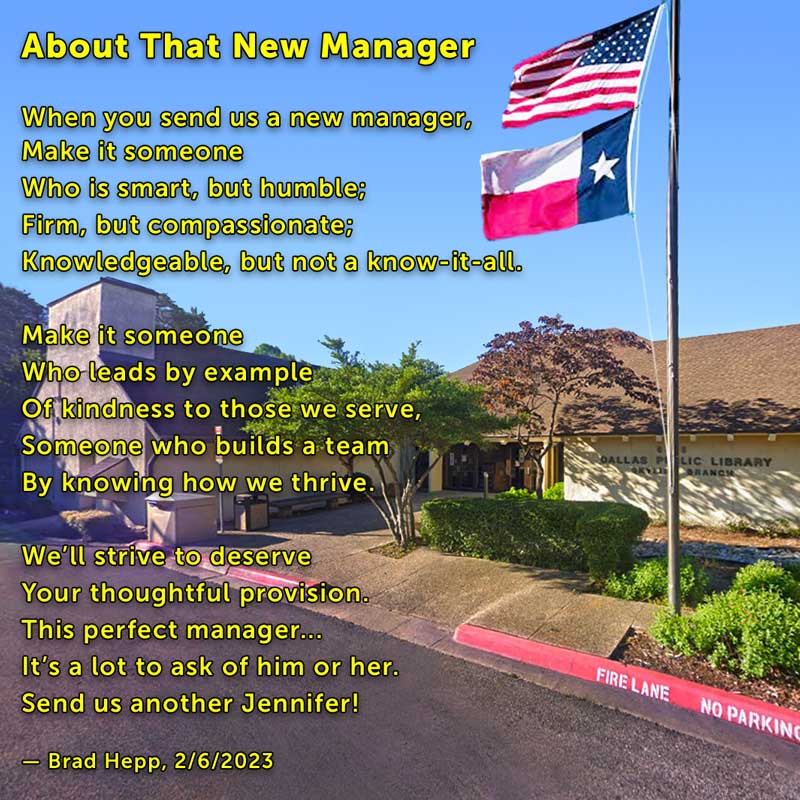
Less than two months into my new job at the library, and I’ll be getting a new manager. I wrote this poem for Jennifer’s going-away party (I also sent it to the Dallas Public Library Director and to the relevant District Manager). Back when I was hired, I had marveled with a friend that Jennifer has a background that’s ideal for the areas in which I want to grow. I think the two months DID set me on a good course. We’ll see what a new manager brings into the mix….
February 2024 update: We did get a new manager a couple of months later, and he has been SUPERB!
(if you are viewing this via email, the website has a recording of this poem and commentary; click the title above)
Commentary
From worldhistory.org: “Sisyphus (or Sisyphos) is a figure from Greek mythology who, as king of Corinth, became infamous for his general trickery and twice cheating death. He ultimately got his comeuppance when Zeus dealt him the eternal punishment of forever rolling a boulder up a hill in the depths of Hades.”
(if you are viewing this via email, the website has a recording of this poem and commentary; click the title above)
Commentary
Live long enough (or thoughtfully enough), and we all have to consider the words Jesus spoke shortly before his own death:
Truly, truly, I say to you, unless a grain of wheat falls into the earth and dies, it remains alone; but if it dies, it bears much fruit. Whoever loves his life loses it, and whoever hates his life in this world will keep it for eternal life.
(if you are viewing this via email, the website has a recording of this poem and commentary; click the title above)
Commentary
Long before I needed to shave, I felt this desperate need to be creative. The trick was finding the right outlet. I’d imagine all of us have this affliction… though some without beards.
(if you are viewing this via email, the website has a recording of this poem and commentary; click the title above)
Commentary
Word to the wise: Don’t take Claritin-D shortly before going to bed, especially when you really need to sleep. Your sinuses will be clear, but you’ll just lie there with racing thoughts. The “D” in Claritin-D apparently stands for doggerel.
On the night I wrote this poem, I messed up, and took the wrong medication. As a result, I was wide awake, and I started doing something I often do when I first wake up in the morning: in my head I was taking words and arranging them in various orders, looking for an arrangement that pleased me. In the end, the only way I could get this out of my head was to get out of bed and write down the results. It’s not a great poem, but at least I DID get to sleep after writing it.
(if you are viewing this via email, the website has a recording of this poem and commentary; click the title above)
Commentary
In my dream two nights ago, my friend and I were stealing large tables from a church. We spotted a police officer, and my friend said, “We’ll rent that box truck!” Quickly, I threw my table into the back of the truck and leaped in after it. WHAM! I had launched myself out of bed and landed on my knees. Crime doesn’t pay, even in my sleep.
In trying to come up with appropriate hashtags for this poem that I wrote last night, I did a search for “moving in dreams.” I’m not going to dignify the results. As with most searches I make these days for “what does it mean if I [fill in the blank],” Google supplied articles suggesting that I am in the early stages of senescence. I suspect the little boys and girls at Google are having a good laugh at my expense.
Back to reality…. Obviously, Susan woke up and asked why I had landed on the floor. I spared her the details of the dream until morning. But she went and got some arnica cream for me to rub on my knee caps along with an ice pack to prevent swelling. I lay there feeling the chill on my knees and contemplating the end of my walking days. Two days later, I think I’ll be fine. But Susan has mentioned a guard rail. And she definitely wants me to keep a pillow on the wooden chest that my face would hit if my knees don’t hit first. She isn’t worried that I’d lose my good looks. It’s my cranium that concerns her.
(if you are viewing this via email, the website has a recording of this poem and commentary; click the title above)
Commentary
This poem is a lighthearted way of putting a serious problem: we humans often care more about being on the winning team than we do about accomplishing something that matters in the long run. We just want to win, to get our way, to come out on top. We race each other to the summit of Everest. There in the death zone, we plant our flag, and hasten to die.
(background image by Dimitris Vetsikas on Pixabay)
(if you are viewing this via email, the website has a recording of this poem and commentary; click the title above)
Commentary
In my crawl through Luke, I got to chapter eleven today. Jesus’ disciples seem a little concerned that they might miss out on God’s blessing if they don’t have the right technique. They say to Jesus, “Lord, teach us to pray, like John taught his disciples.” We sometimes concentrate on the components of “the prayer” that Jesus taught them, but the bigger point (as seen in the illustrations Jesus follows up with) seems to be, “God is good; just do it!”
(if you are viewing this via email, the website has a recording of this poem and commentary)
Commentary
I’m slowly working my way through Walter Kaiser Jr’s “The Messiah in the Old Testament.” It’s one of the books my father was thinking through at age 86, shortly before he died. The margins are graced with Dad’s notes. Naturally, I’m reminded often of him and his devotion to the Messiah. Some fine day….
This poem reflects on something at once puzzling and confirming about the Bible: God doesn’t operate as we would. If we were arranging things for the eventual coming of the Messiah, we’d probably make sure his ancestors were admirable characters. Read Genesis, and observe what kind of character Judah was. Jesus’ ancestor was a run-of-the-mill sinner. On the other hand, Judah’s younger brother Joseph was a remarkable, admirable character. He’s the hero through much of Genesis. Again, if I had been writing the story, I’d have made the promised Messiah come through Joseph’s line, not Judah’s.
God doesn’t operate that way. Through the story he created, He says, “I promise to bring this thing about, and lest anyone should get the idea that man is clever, and earns what I give him, I’ll bring it about through normal, undeserving sinners.”
(if you are viewing this via email, the website has a recording of this poem and commentary)
Commentary
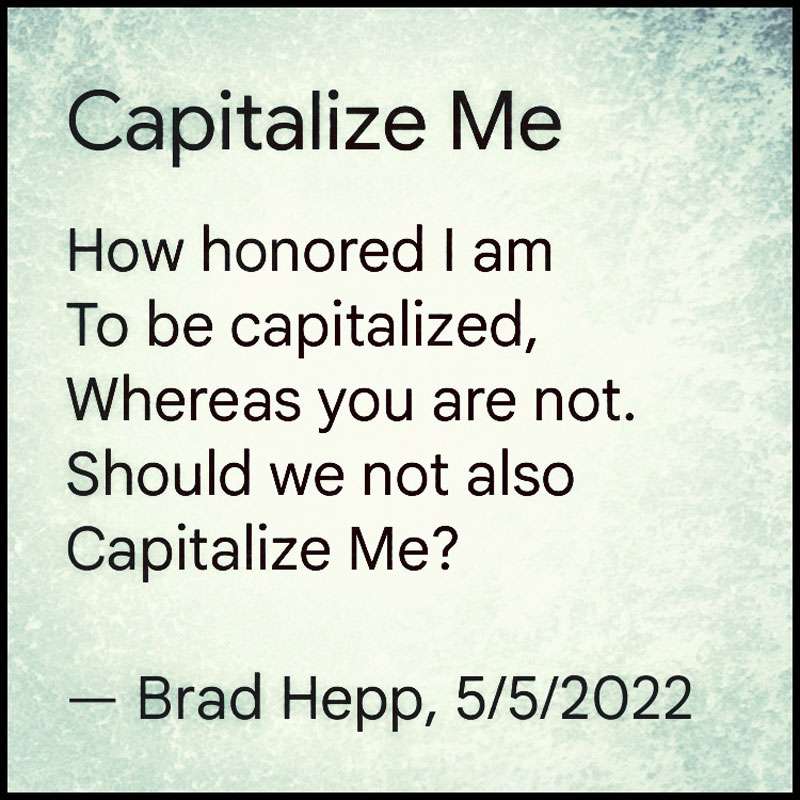
Sometimes when I can’t sleep, I listen to Anne Curzan’s The Secret Life of Words: English Words and Their Origins. This observation about capitalization is inspired by one of Curzan’s entertaining lectures. In talking about capitalization rules, she confesses that she has never figured out a good reason why “I” is the only pronoun that we routinely capitalize.
Linguists “keep it real” when it comes to language.
(if you are viewing this via email, the website has a recording of this poem and commentary)
Commentary
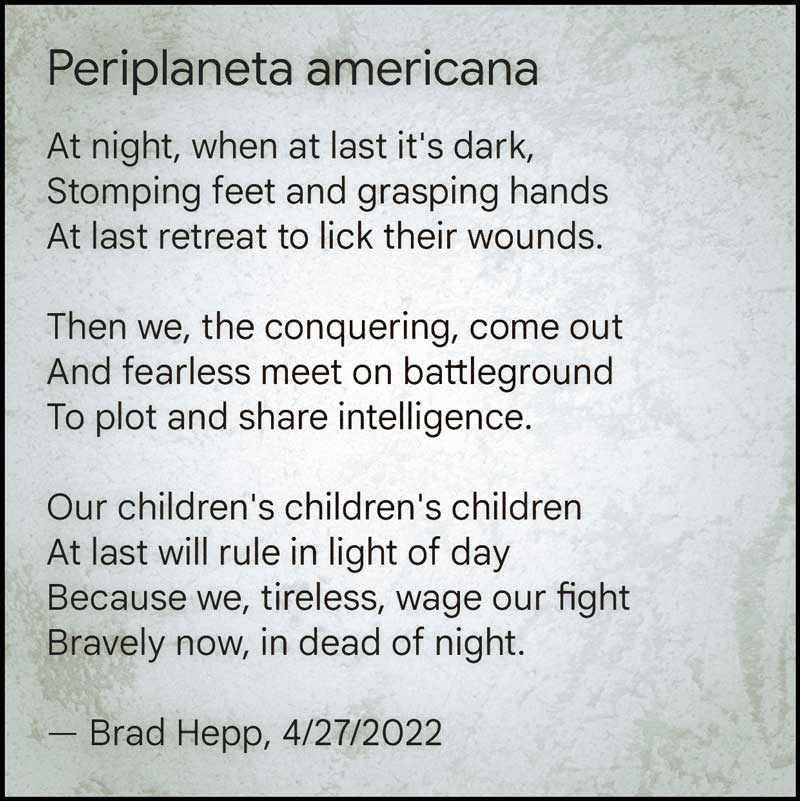
It should come as no surprise that a poet thinks by analogy. This morning, I had some worrisome things in mind as I plodded through the end of Matthew. In the events surrounding the Crucifixion (as in countless other settings), Psalm 2 is played out:
Why do the nations rage and the peoples plot in vain? The kings of the earth set themselves, and the rulers take counsel together, against the Lord and against his Anointed, saying, ‘Let us burst their bonds apart and cast away their cords from us.’
Psalm 2:1-3 ESV
The analogy? I sat reading in the living room, facing the kitchen, and imagining how roaches would conspire at night (if we had them). They’d gather there on the kitchen floor and hiss their hateful plans. In the end, it isn’t about roaches, but about man. He’s meant to reflect a good, loving God, but often comes closer to reflecting despicable crawling creatures.
The Title I originally meant to title this “Night Crawlers.” But then I looked that up. Worms? No, that’s not sufficiently despicable. So I looked up “roaches” and found the scientific name for the ones we encounter here in Texas: Periplaneta americana. Perfect. The divisiveness, the constant warring, the plotting…. There’s definitely an American species of this global phenomenon.
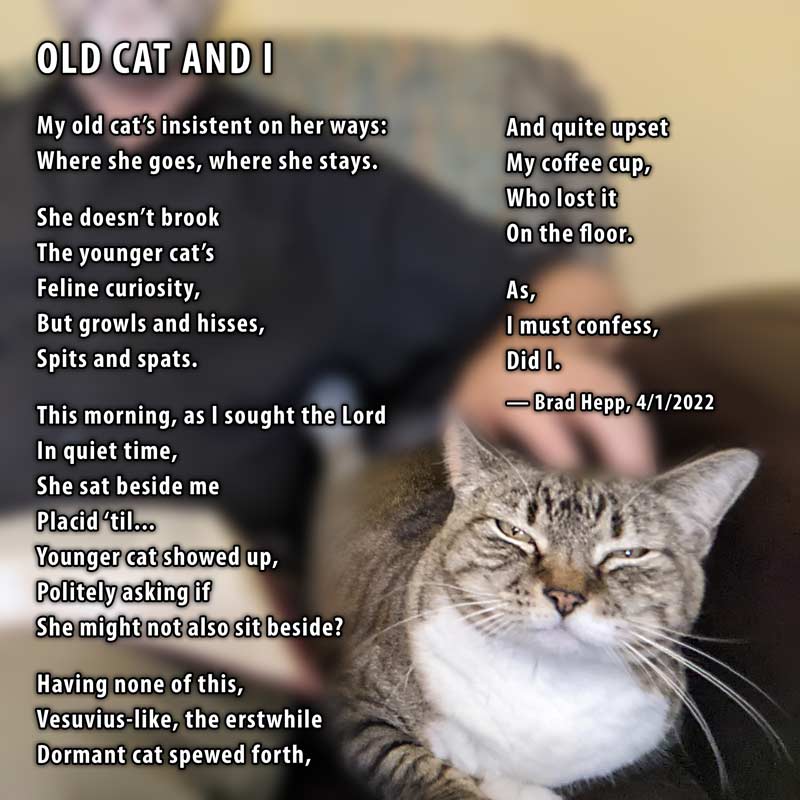
We both calmed down, and I took a photo to prove it. But not before I wrote a poem* about the vicissitudes of duty. You see, I grew up with the following proverb:
A righteous man cares for the life of his beast. But the tender mercies of the wicked are cruel.
Proverbs 12:10
For the Grammar Nerds Should it be “Old Cat and I,” or “Old Cat and Me“?
I or Me Some say the pronoun should be I, Some say me. From what I know of how I act, I hold with those who favor I. But if I could choose otherwise, I think we know enough of cats To say that their effect Is quite extreme On mortals such as me.
with apologies to Robert Frost
* That poem, “Duty in Retrospect,” was pretty raw, and I haven’t decided if it’s safe to publish. My response to bothersome cats brings up other bothersome issues.
Increasingly, I find myself turning even simple statements into poems. Perhaps I’m as annoying in this as Fezzik was to Vizzini in “The Princess Bride”:
Inigo: That Vizzini, he can fuss. Fezzik: Fuss, fuss … I think he like to scream at us. Inigo: Probably he means no harm. Fezzik: He’s really very short on charm. Inigo: You have a great gift for rhyme. Fezzik: Yes, yes, some of the time. Vizzini: Enough of that. Inigo: Fezzik, are there rocks ahead? Fezzik: If there are, we all be dead. Vizzini: No more rhymes now, I mean it. Fezzik: Anybody want a peanut?
From “The Princess Bride”
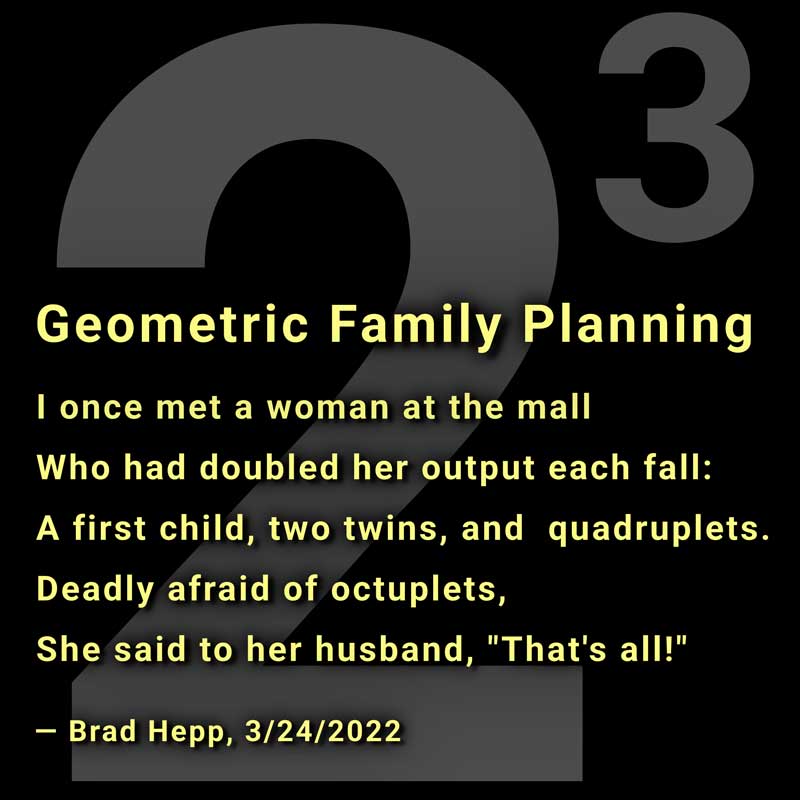
The Poem’s Inspiration I don’t recall the context of the exchange, but one of my Facebook friends wrote the following, and her first two sentences seemed like the beginning and premise for a limerick:
I once met a woman at the mall who had seven children in tow: an oldest child, a pair of twins, and, youngest of all, a set of quadruplets. Each pregnancy subsequent to the first doubled the outcome the one prior. If I were in her shoes, I think I’d probably put my foot down regarding future pregnancies.
This light-hearted poem is a prequel to the more serious “The King’s Toast.” By the way, my initial commentary on that poem was pretty muddled. If you already read that commentary, do me the favor of reading the improved version.
It’s probably obvious that in this poem I’m exploring the idea that an awareness of God’s presence would help us regulate our behavior. Have a problem with foul language? What if Jesus were right there beside you in a physical, visible form? Would you curse then?
Back in college, I developed a nervous habit of looking at my watch every minute or so. I doubt anyone else noticed the habit, but I sure did!
My wristwatch was a cheap old Timex, so here was my solution…. I took the back off and removed the movement and face. Then I disassembled the movement, threw the loose gears in the case, and closed it up. The useless watch went back on my left wrist.
True to form, I’d look down at the watch every minute or so. Every time I looked, I had to laugh at myself. There, under the crystal, were a bunch of loose gears, telling me absolutely nothing. Nothing except, “Hey dumb dumb. Stop looking down here!”
The Background Image That’s not my watch. Who knows where my “Hey dumb dumb” watch got off to. Somewhere between college and now, I lost it (I really did). I’m tempted to buy a cheap old watch to recreate the college timepiece. Its photograph would replace the background image, created in Photoshop from a couple of Pixabay downloads.
The Limerick When I first thought of writing this limerick, I immediately came up with lines 1, 2, and 5 (the “A A… A” lines). That left me lines 3 and 4 (the “B B” lines) to tell the whole “how I fixed it” story. Believe it or not, that was the hard part. In the prose above, it took me thirty-six words to say what the limerick says in twelve words! That’s one of the main things I love about writing poetry: the challenge and charm of compression.
Have you ever read the most compressed poem of all? Even I can remember this one: