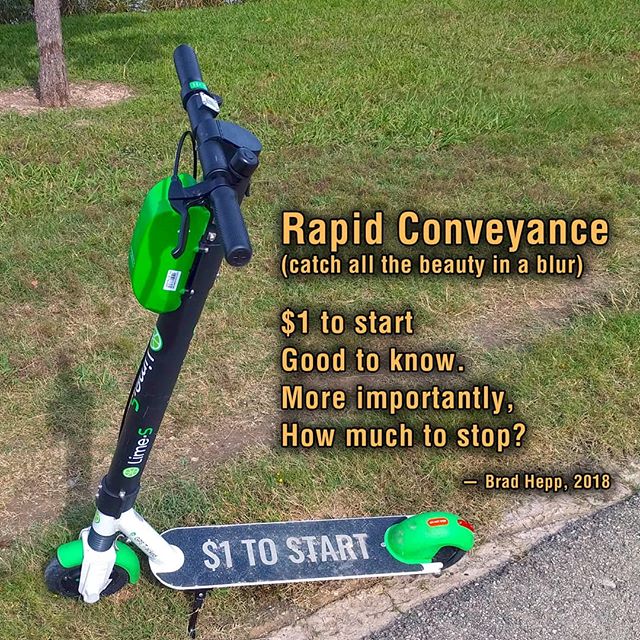
This poem is a defense of how I often wake up in the morning. My brain starts the day by trying to dress thoughts in presentable words. The thoughts may be silly. They may be as bizarre or disordered as the dreams from which I woke. But I clothe those thoughts with orderly words: poems, if you like.
“Surging Ugliness” is like a sergeant who barks out orders, the duties of the day. He isn’t interested in the silly private’s search for beauty and meaning. I mistakenly thought that “sergeant” was etymologically related to “surging” (my French isn’t that good). Nevertheless, “surging” does suggest the nature of a real conflict, a real battle between ugliness and beauty. We’re easily fooled by which of these combatants is winning. Beauty seems often to be overwhelmed by surging ugliness. It takes careful reconnaissance to find the truth. Sometimes it takes the silliness that I call poetry.
This is my second silly poem in one day. When I was young, that’s the only kind of poem I wrote.
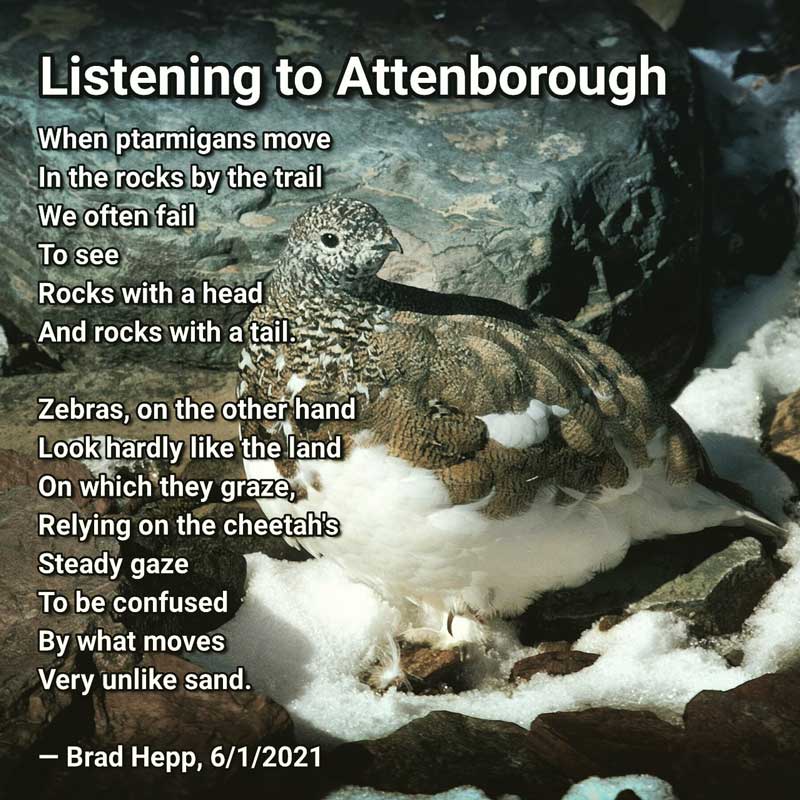
The inspiration was watching one of the beautiful nature documentaries that David Attenborough put together. While I have never seen Zebras in the wild, I HAVE seen — or barelyseen — ptarmigans on mountain climbs in the Rockies. It’s amazing how close you can get to these birds before you recognize that they are birds, and not just rocks!
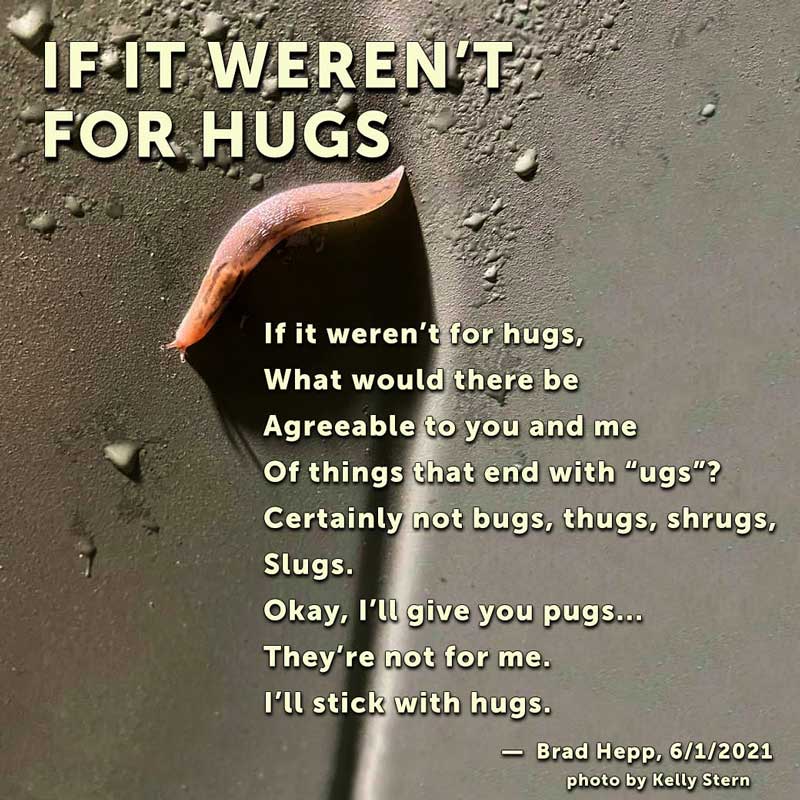
This, like another poem I wrote on this day, is just silly. My friend Kelly Stern posted a picture of a slug on her Facebook page, and my imagination went immediately to “work.” Just chalk it up to the brain making new connections….
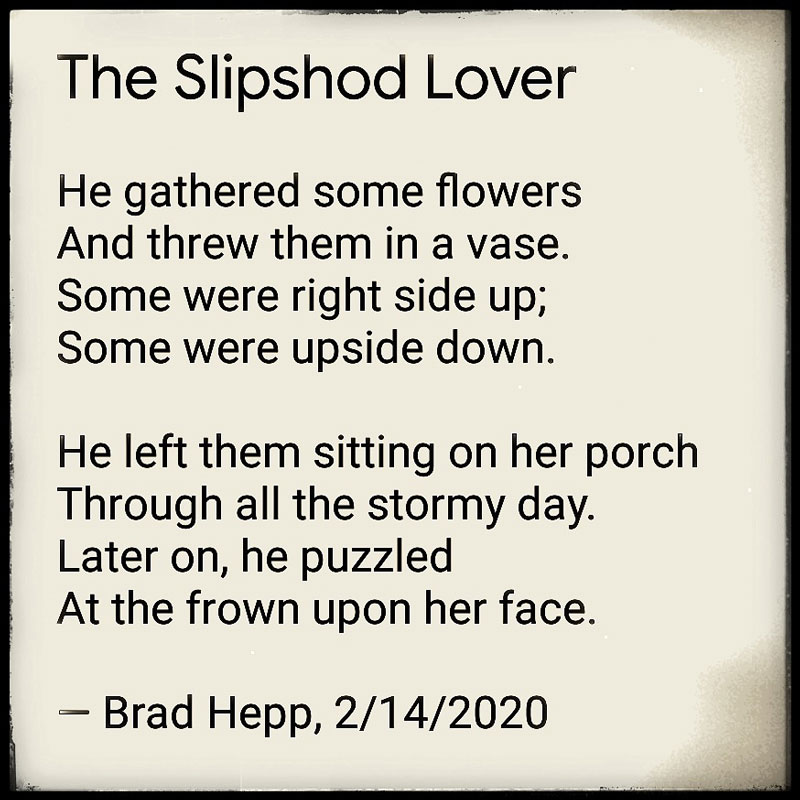
Actually, in the careless way I built this poem, I WAS THIS GUY. I can do better with my poetry — and occasionally do. The almost comical reality in my life is that practically every time I point to “someone else’s” failings, it is my own failing that quickly comes into view. I have seen this so often when criticizing grammar! Point out someone else’s poorly-constructed sentence, and I’m sure to blunder within two or three of my own sentences.
I’ll never forget the illustration my friend Jim Adams gave us for the blemished sacrifices passage in Malachi. He brought the class a big bouquet of wilted flowers. That was over thirty years ago. That’s how good a teacher he is!
I guess every poet comes up with this one eventually.
This “poem” is not silly. In fact, I have never been more serious or intentional in anything I have written. It is not that I have no thoughts. Nor is it that I don’t want to share my thoughts with others. It is that there is no such thing as thoughts I have while “alone.” It may drive me to insanity, but I am determined to become consistent in my belief in an all-knowing and very present God. One of the worst hidden hypocrisies in my life has been holding the belief that I have “the ear” of the most powerful being (God) but not voicing my thoughts about others to Him. How many times I have scrolled through Facebook and thought this or that about my friends and acquaintances without “voicing” those thoughts to the One who can do something about my concerns? Do I see someone who is filling his or her life with hatred? Why would I not voice my concern about that to all-powerful God, the one best able to teach them love? Do I see someone hurting and reaching out to friends for comfort? Why would I not voice my sympathy to the great Comforter? Hypocrisy is usually associated with action. My hypocrisy has consisted of inaction.
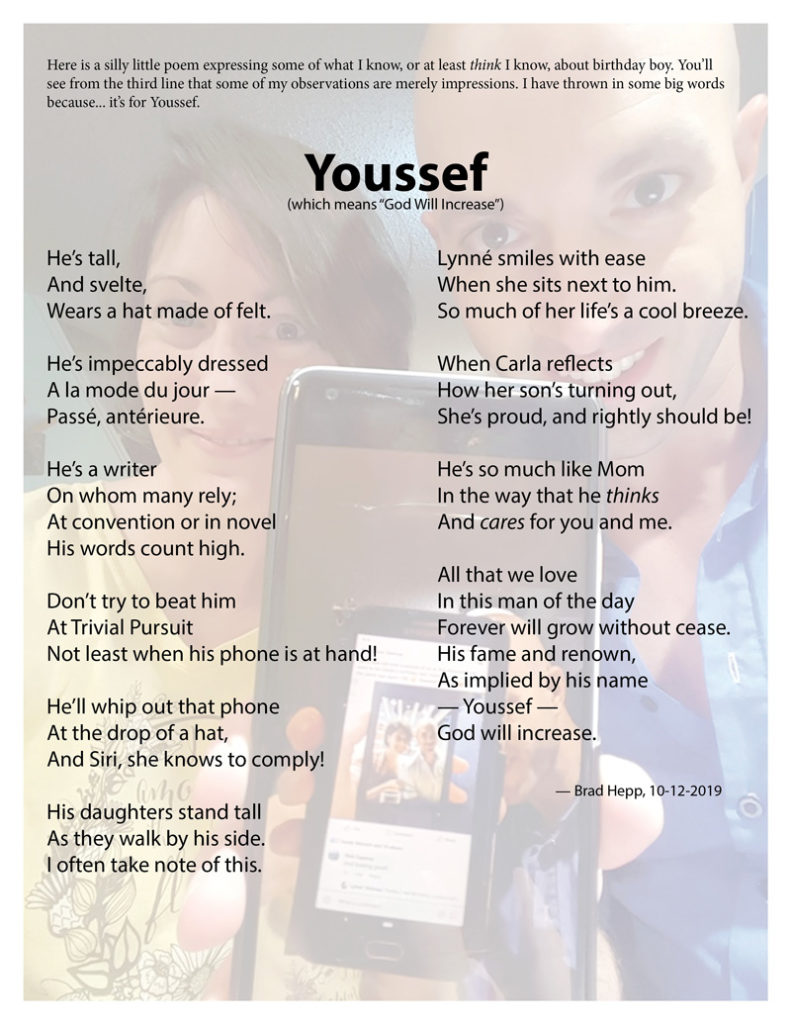
Yesterday, I attended a birthday party for Youssef Sleiman. All who attended were given the opportunity to read something they had written, or to extemporize about how God has uniquely crafted this man to bring Himself glory. It was something like a memorial service, where the eulogies went on for over two hours. But in this case, the eulogee — the dearly not departed — was sitting there right beside us laughing and occasionally weeping.
I wrote a poem for the occasion, and was happy to see that much of what I wrote matched the reflections of people who have known Youssef far longer than I:
Background image stolen from Lynné Sleiman’s Facebook feed, where it was titled “Meta.”
He filled his pack with bubble wrap
And set off on the trail.
Thus equipped, the carefree sap
Was sure he could not fail.
So light his step,
Straight his back,
His shoulders fresh and strong…
Up steepest trail he fairly floated
Warbling his song:
“For times like these I was set free,
So tell me not that I must care
For all your drudgery.
La di da, twiddle dee!
Like all the birds that sing above
For this I was set free!”
Just as the sun
Behind the mountain
Took her cooling plunge,
Approaching alpine glade he sang, “So high and far I’ve come;
Dee dum, dee dum, dee dum!”
Feasting eyes on matted grass
The clever lad observed,
“Here the elk bed down to sleep,
And therefore, so shall I.”
Lying there, in bubbles wrapped,
The lad soon fell asleep.
But wasn’t long into the night
That hunger pains began to gnaw,
Bitter cold to creep.
He reached into his empty pack
In search of something, any? thing?
Of all he did not bring
To serve as food and warmth.
Somewhere
In that frigid night
His soul above him floated,
Warbling her song:
“For times like these I was set free
So tell me not that I must care
For all your drudgery.
La di da, twiddle dee!
Like all the birds that sing above
For this I was set free!”
Then, looking down from whence she’d come, “Die dumb, die dumb, die dumb!
On matted grass, eternal bed,
La he died — twiddle dead.”
– Brad Hepp (2019)
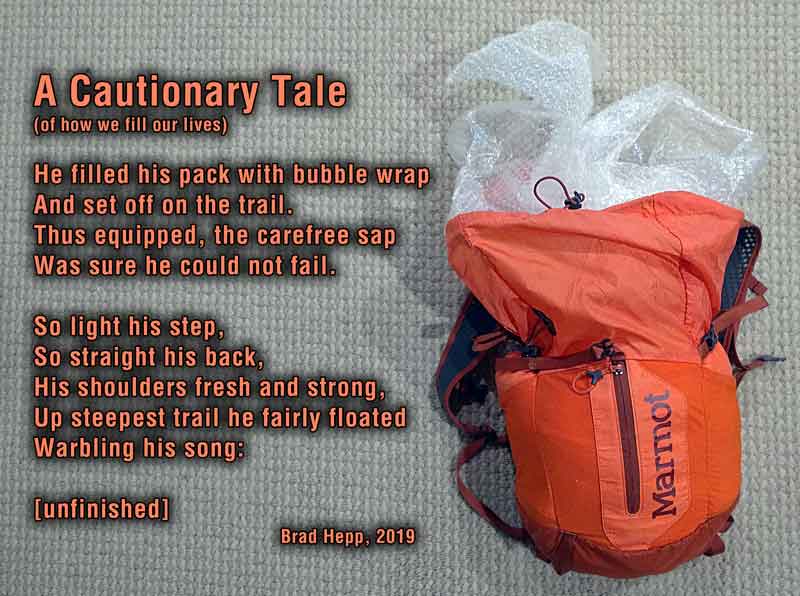
This silly poem was inspired by Psalm 16:2: “I say to the LORD, ‘You are my LORD; I have no good apart from you.'” How much of my day is spent pursuing “good” apart from the Lord, doing things that seem pleasant, but which He has not given me to do? Such folly invites the fate of a mountain climber who chooses to pack only what lightens his load.
As much as he’d probably prefer to deny it, Don Regier helped me with a few of the lines.