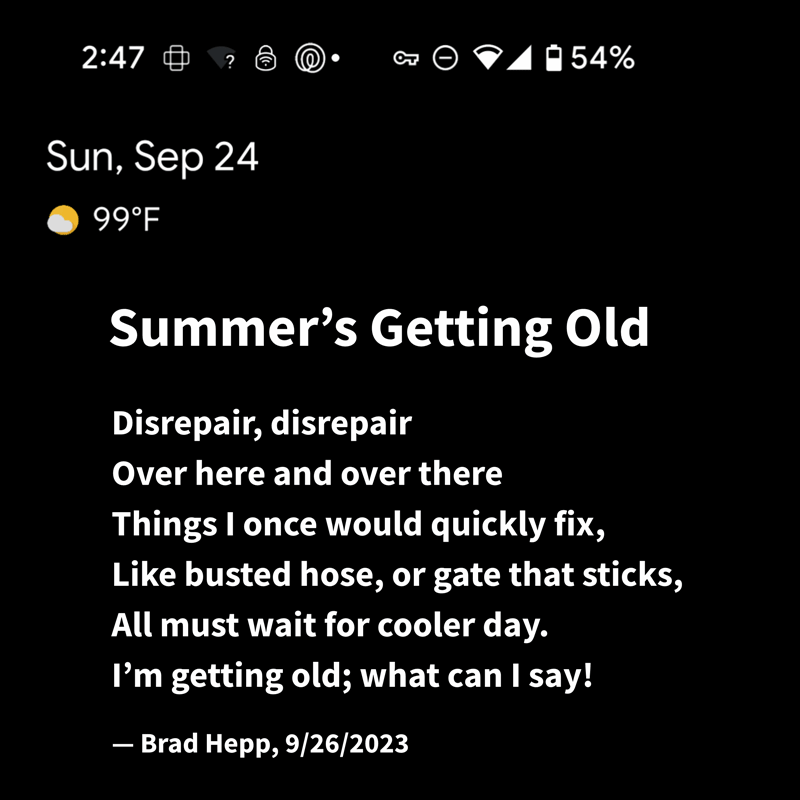
(if you are viewing this via email, the website has a recording of this poem and commentary; click the title above)
Sometimes I refer to my brain as a filing cabinet. But let’s be honest: it’s more like a chest of drawers. File folders would turn their nose up at the jumble of odd-shaped trinkets and treasures lodged in my sexagenarian* mind.
AND NOW, A STORY
This morning, someone left one of my drawers open. I could tell they’d been rummaging around. Stuff wasn’t evenly distributed. What were they looking for? Mismatched socks? My cache of chocolate? That thingamabob I found on the trail?
I’m not a practicing archaeologist, but I could tell where the drawer-opener stopped digging. It was over on the right side, at the back. Everything was cleared away. It sat there smiling up at me with fixed admiration.
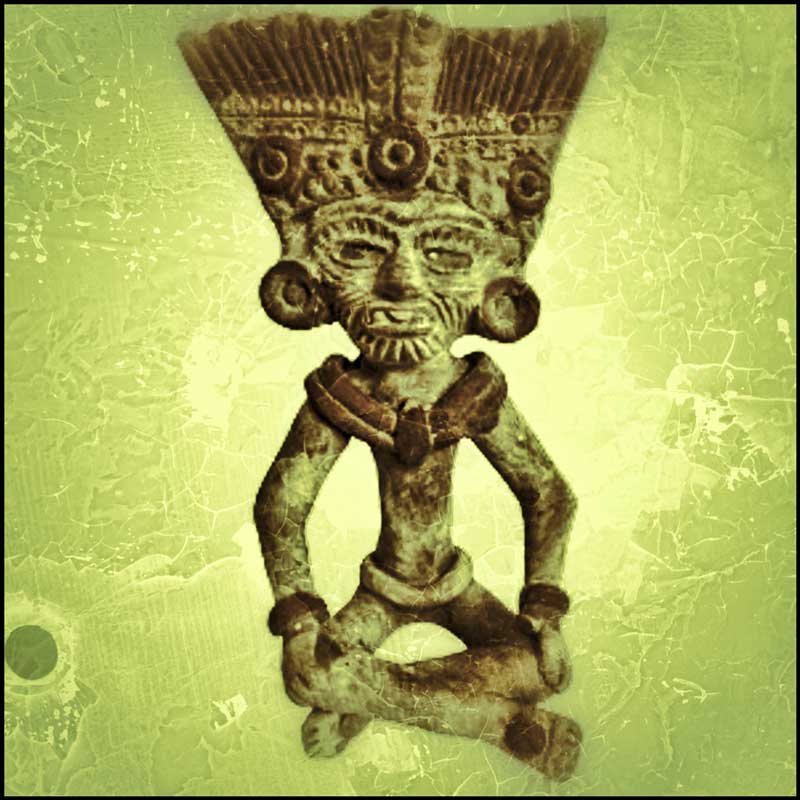
It’s a clay figurine. I’ve had it ever since I was a little boy, down in Mexico. Back then, my eyes were sharp. When we visited ancient Aztec sites, I sometimes found artifacts that everyone else had overlooked. I was good at it… the best. In fact, I think you should know: I almost made a career of it. In college, the academic advisor asked what I’d like to study. “Archaeology,” I said.
“Are you independently wealthy?”
“No sir.”
“Well then forget about it!”
And I did. But I held onto that thought: “I’m good at it… the best!” And I kept the clay figurine as a reminder. It never fails to look up at me, and smile.
“You’re good at it… the best. You found me when nobody else could.”
_____________
*That’s the word; don’t blame me!
(The image here is of someone else’s figurine. Most of mine are mere memories.)
(if you are viewing this via email, the website has a recording of this poem and commentary; click the title above)
Before I start my sermon, here’s a little context. What I’m going to say is the very opposite of what some very intelligent, very wise people say. Am I right, or are they? This may be like the Proverbs, where two seemingly opposite things can both be true. Okay, now for my sermon….
DON’T DESERVE LOVE? THINK AGAIN! I was recently reminded of something a hard-nosed old teacher once said: “I teach my students that they aren’t entitled to anything in life except life itself.” The students in view were little children.
I beg to differ (to put it politely).
RESPECT AND LOVE Every creation of God is entitled to respect, at the least. Imagine saying to God, “I have no respect for this thing you made.” That doesn’t work, does it?! And since God LOVES the world, His creations are entitled to love as well. Those of us who wish to follow and please Him must be learning to love the world as He does. “The world….” That’s billions of people who are “unlovable” only insofar as WE are unable to love them.
HOW ABOUT YOU? Don’t live under the misconception that you’re unlovable, that you don’t deserve love. If someone doesn’t love you, it’s their problem, not yours.
THE END OF THE MAKER’S DREAM A great reversal is coming. “Trust God! See all, nor be afraid.” (Thanks, George MacDonald and Robert Browning).
[December 25, 2023; file this under “Sermons to Self”]
(if you are viewing this via email, the website has a recording of this poem and commentary; click the title above)
Commentary
This is one of those poems that seemed pretty good in the morning, but not so good later in the day. Oh well. I think its goodness–if any–is felt most keenly when you’re seriously contemplating the long wait for Jesus’ return. Below is what I wrote when I had just penned the poem:
In my crawl through Acts, I got to chapter 14. Here, Luke surprised me with one of his occasional references to Jesus’ direct participation in the “Acts of the Apostles.” The fact that I registered surprise got me thinking about this long period now where we’re waiting for Jesus’ return. How are we to think of his seeming absence? I know the usual answer; is there more?
Please notice something…. I don’t usually capitalize “divine pronouns.” In this poem, it seemed useful for exploring relationships.
(if you are viewing this via email, the website has a recording of this poem and commentary; click the title above)
Commentary
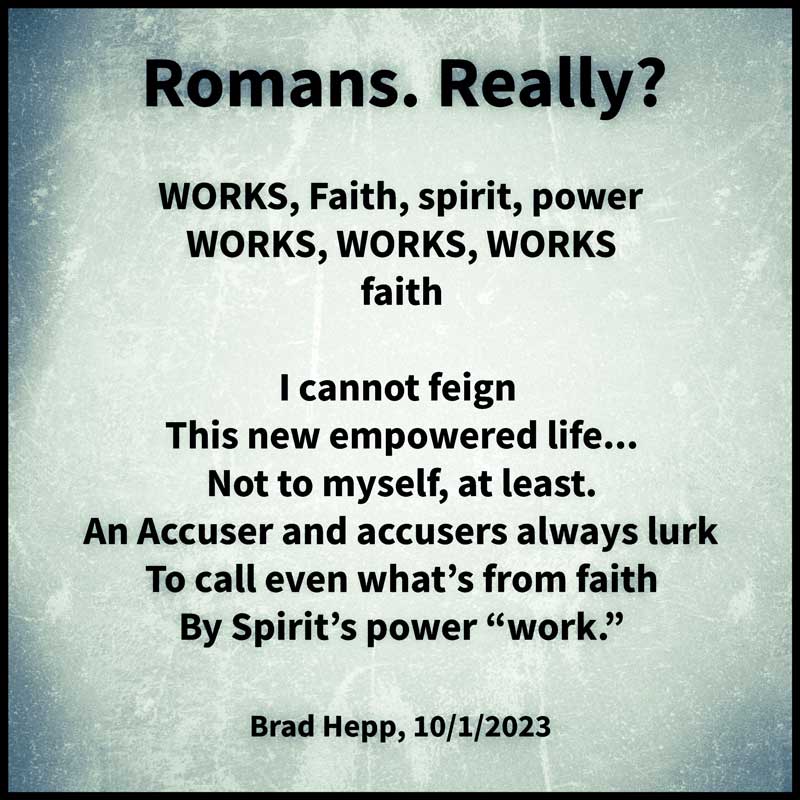
These days, I’m trying to get my head around Paul’s letter to the Romans. In the process, I’m trying to figure out how seeking glory is appropriate. What is glory? And what’s it like to attain glory? Is it “merely” God’s approval? It seems that would fall short of what we think of as glory. Or would it?
I know how horrible it feels to be accused, reproved, rejected. Can I imagine the opposite? This poem explores that notion. In short, I’m wondering if perhaps we all have a deep yearning for approval, and those who seek to satisfy that yearning by obtaining God’s approval are the ones Paul speaks of as seeking glory.
Consider these three verses from Romans 2:
To those who by persistence in doing good seek glory, honor and immortality, he will give eternal life.
Romans 2:7
[there will be] glory, honor and peace for everyone who does good: first for the Jew, then for the Gentile.
Romans 2:10
No, a person is a Jew who is one inwardly; and circumcision is circumcision of the heart, by the Spirit, not by the written code. Such a person’s praise is not from other people, but from God.
(if you are viewing this via email, the website has a recording of this poem and commentary; click the title above)
Commentary
I don’t recall posting this piece before, probably because back in 2021, I would not have considered this poetry. But, who cares.
The idea came up in a conversation I had recently with one of my most brilliant friends. He was telling me how he had messed up when he participated in a book club at work. His purpose in joining the club was partly to foster relationships with coworkers so he could introduce them to Jesus.
The first three books they read were about racism. My friend welcomed insights he got from the first two. But the third book was written from a Marxist perspective.
I told my friend, “I read that book and could tell it was heavily influenced by Marxism. However, I welcomed the incisive criticisms and descriptions of white supremacist behavior. Without such keen criticism I might never see some of how I myself participate in that evil.
My friend responded (this is a paraphrase), “That’s exactly what I figured out later on. But in the short run I messed up by railing against the Marxist non-solutions.”
By focusing his energy on what was wrong in the book’s perspective, my friend shut down what could have been fruitful discussion with fellow book club members. Fighting a temporary enemy, he endangered eternal influence.
NOT EASY Getting this right isn’t easy. We live in a society where everything is made out to be a crucial battle in a desperate war. “Our guys” are always right and “their guys” are always wrong. We cannot be civil. There’s no compromise, no nuance. Rather than talking, we must throw grenades. At least that’s the model we live with.
Because he is humble in addition to being highly intelligent, my friend was able to see his error.
SEEDS GERMINATING? There were other topics in our conversation where I was thinking, “Oof! Let’s not go into detail there; I’m not sufficiently humble yet to acknowledge my need for growth in that area!” But at least there was that “Oof!” One can hope it’s the sound of a seed cracking. Maybe soon a root will emerge. Then a shoot. Then leaves….
Those of you who receive my poems via email from my blog are having to put up with a TORRENT of poems these days. Forgive me for that. I’m trying to get caught up with posting everything I have written and posted on social media this last year.
But… I would be remiss if I didn’t thank God for the progress I am making in writing. I just spent an hour reading back through my Facebook posts. I was looking for a particular poem that worked its way into a conversation with one of my smartest friends (I haven’t found the poem yet; it had something to do with limes, scurvy, and helping others grow without offending them). Amongst all the fluff, there are a few gems. At least they reflected on gems as I beheld them.
(if you are viewing this via email, the website has a recording of this poem and commentary; click the title above)
Commentary
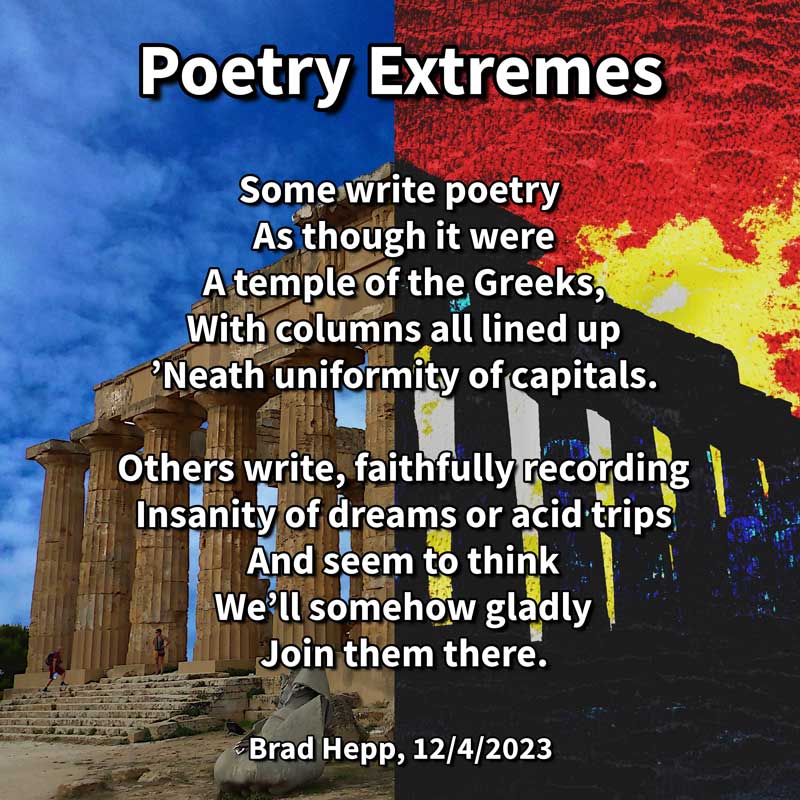
Let me get this out of the way…. I’m probably just not smart enough to understand a great deal of poetry. So this little poem of complaint may say more about me than about those poets I don’t “get.”
On the other hand, I really wonder sometimes if poets want to be understood. I DO want to be understood. That’s why I read my poems out loud, and write these commentaries. Does this mean everything I write is intelligible? Not yet, but that’s where I’m headed.
(background illustration based on a photo by Rene Rauschenberger on Pixabay)
(if you are viewing this via email, the website has a recording of this poem and commentary; click the title above)
Commentary
Recently, I have been thinking about what it means to seek glory.* I frankly haven’t made much progress other than beginning to shed some presuppositions. I suspect that God has far better plans for us than we think possible or even appropriate. If my suspicions are right, this would affect not only how we see ourselves, but also how we see others.
And now, a confession…. This poem is my complaint directed at some imaginary critic of my thinking, some person who is more faithful to their systematic theology and sense of propriety than they are to what God may or may not have meant when he communicated with us via Scripture.
*see Romans 2:7, 10, 29
(background adapted from a photograph by Brent Hammond on Pixabay)
(if you are viewing this via email, the website has a recording of this poem and commentary; click the title above)
Commentary
I read somewhere that mental health experts have noticed a pandemic of loneliness in 2023. What happens in society happens to us. We’re not exempt. I certainly feel a sharp loneliness at times. Where does this come from? Can I fix it in my own life?
As I look around for answers, I am determined to be more strategic about friendships. There is just so much energy and time. I must work on what’s valuable, and resist what merely sucks.
(background image adapted from a photo by Peter H on Pixabay)
(if you are viewing this via email, the website has a recording of this poem and commentary; click the title above)
Commentary
I was inspired to write this by a Facebook friend’s comment on my rambling, “thinking-out-loud” post about Acts 13:46, Romans, and how saving faith must surely be a faith that is thankful for eternal life. I’m telling you, the post was as rambling as that last sentence. But the Facebook friend bent her mind to my rambling and said, “Brad, I see what you’re doing here….” She went on to offer some tight restatements.
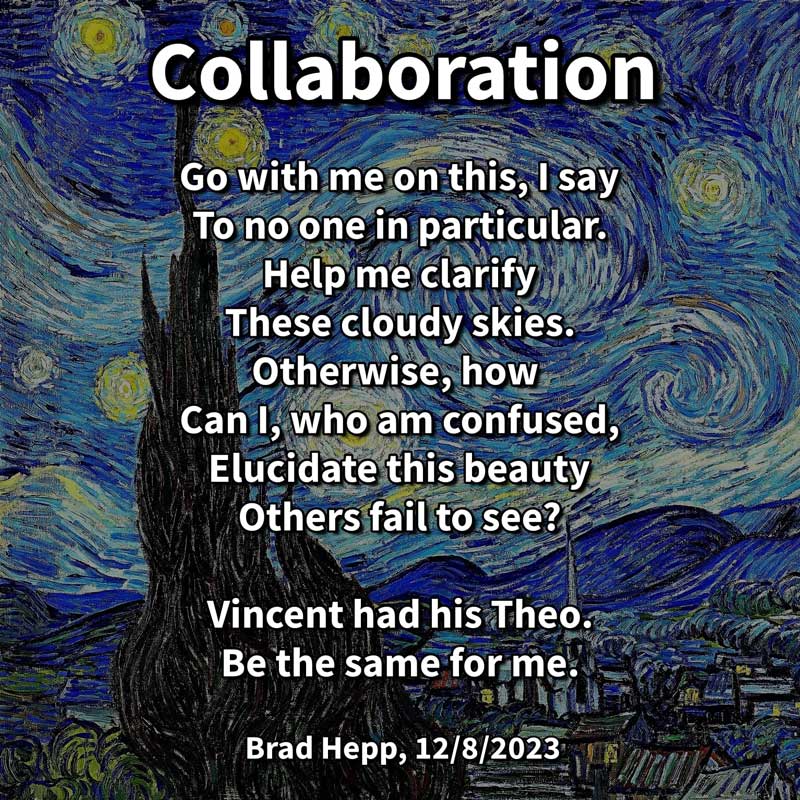
I sometimes think that God has given me exceptional eyes for beauty, and wants me to develop exceptional means to describe that beauty. Poetry and photography have been my go-to in fulfilling God’s purpose for me. But I recognize that my thinking is muddy. I don’t remember things. My vision of beauty is blurry. I need friends who can help me develop my descriptions of the beauty I see.
As I wrote this poem, I thought of two local friends, in addition to the Facebook friend. I texted them about how thankful I am for their collaboration. And I wrote the following to accompany the poem on Facebook:
I’m not sure there’s anything more beautiful than one person bending his or her mind to think WITH another person. The product may be all wrong, but the process is all right!
(if you are viewing this via email, the website has a recording of this poem and commentary; click the title above)
Commentary
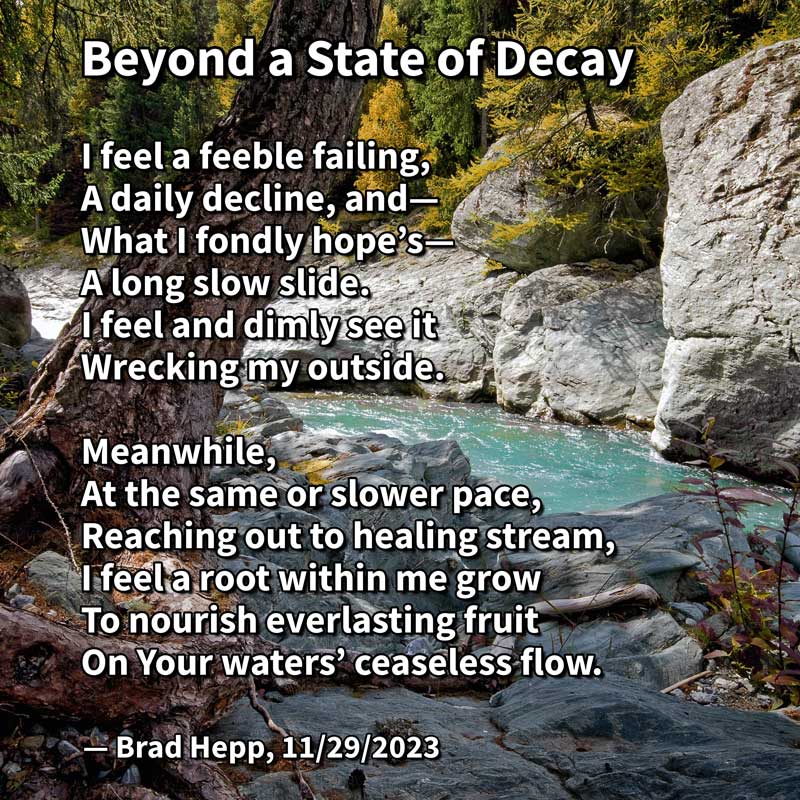
Here’s a little perspective on my rate of physical decay and spiritual growth. It was prompted by one of those slightly worried self-examinations: “Am I making any progress in becoming more like Jesus, or am I just fooling myself?” The answer–my answer, for what it’s worth–was this comforting poem.
AN EXCHANGE WITH SOMEONE VERY CLOSE TO ME HINTS AT THE CONTEXT:
THEM (regarding the poem): “Gut wrenching and amazing.”
ME: “Thanks. There’s something I really want to explore from my crawl through Acts. In giving his audience a summary of God’s dealing with Israel (Acts 13), Paul refers to Jesus’ resurrection as the fulfillment of His promise of a Son, who—unlike the first “son,” Adam—is no longer subject to decay. That, and any number of other reversals is what I look forward to in Eternity for myself and those I love.”
(if you are viewing this via email, the website has a recording of this poem and commentary; click the title above)
Commentary
Recently, I have been reading or listening through Romans repeatedly. I’m trying to understand this epistle independently, largely ignoring all I have been taught by others. I DID purchase a book* that surveys views of Romans across the centuries, but I’m hopeful that reading that book will leave me still capable of honest, independent thinking. Don’t be alarmed… I have a conservative hermeneutic, so I’ll almost certainly land on orthodox ground.
Paul gives us a severe assessment of man. But he also acknowledges those “who by persistence in doing good seek glory, honor, and immortality.” We know such people. Some—perhaps many—of them are not followers of Jesus Christ. Yet they outshine many Christians in their goodness. How does this reality affect our understanding of Romans and the power of salvation?
[Note] Below is a stanza I thought of after signing this poem. It’s a poet looking for a sharper metaphor. There’s a slim chance I’ll try to fit it in some day:
Sipping whiskey and vermouth, A liar cries out, “Liars, tell the truth!”
(if you are viewing this via email, the website has a recording of this poem and commentary; click the title above)
Commentary
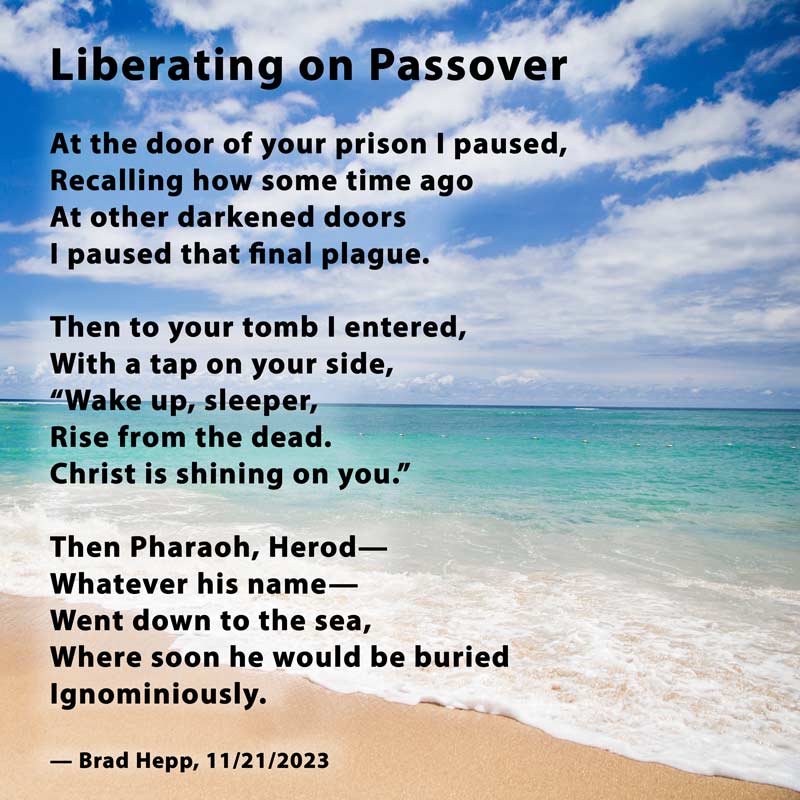
First of all, forgive the big word at the end. “Ignominiously” means something like “with no honor,” or–more to the point–“without a great name.”
This poem is based on connections I am exploring between the story of Peter’s release from prison at the hands of Herod Agrippa I (Acts 12) and Israel’s release from slavery in Egypt (Exodus).
Luke points out that the events of Acts 12 occurred around the time of the Passover Festival.* In fact, it looks like Peter’s release from prison happened on the culminating night of Passover. That may not mean much to us, but it would have meant a lot to Peter’s contemporaries.
Maybe it should mean more to us….
(background image by Somchai Sumnow on Pixabay)
*OOPS. When I wrote this, I was assuming that Passover came at the end of the Feast of Unleavened Bread. I had it backwards. The saving grace for me is that the whole week was also called Passover. Here’s a helpful web page on the subject: https://www.lehigh.edu/~gdb0/simcha/firstf00.htm
(if you are viewing this via email, the website has a recording of this poem and commentary; click the title above)
Commentary
I’m going to lean heavily on the words of a theologian friend for this. Apparently, there are two words for “rest” that are often used in the Old Testament. One of those words is “nuach.” It was used in Genesis 2:15, where
The Lord God took the man and put him in the Garden of Eden to work it and take care of it.
Genesis 2:15
The words “put him” are that Hebrew verb nuach. (וַיִּקַּ֛ח יְהוָ֥ה אֱלֹהִ֖ים אֶת־הָֽאָדָ֑ם וַיַּנִּחֵ֣הוּ בְגַן־עֵ֔דֶן לְעָבְדָ֖הּ וּלְשָׁמְרָֽהּ׃).
The point my friend makes is that there is a difference between work–the kind of work that Adam did in the Garden before the Fall–and toil–the kind of work he did after the Fall.
The reference to sweat in this poem is misleading. As I understand it, we may sweat even when we’re celebrating God’s provision in Sabbath. Over the last several years, I did sweat a whole lot on the frequent long hikes that I took. But those hikes were as close as I’ve ever come to celebrating God’s provision in Sabbath. Because God had provided financially–was providing, and would provide–I was able to rest, to spend hours walking, thinking, listening through the Bible repeatedly, listening to many other edifying books, observing nature, and recording my observations. That’s when I began writing poetry… in those Sabbath hikes.
You can view my friend’s discussion of Sabbath here:
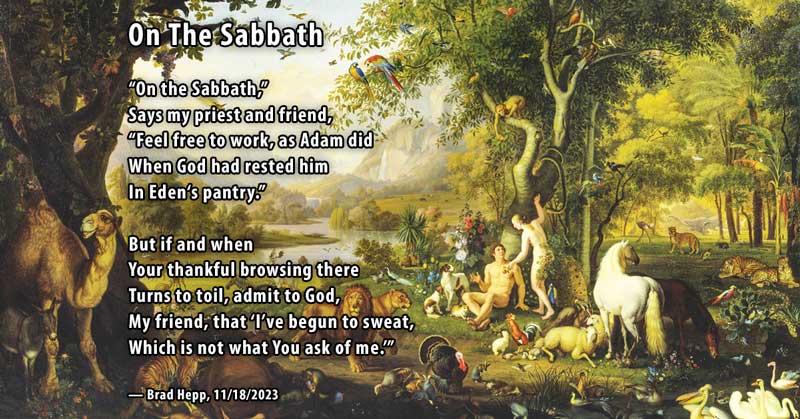
The background image for my poem is is a painting by 18th century artist Johann Wenzel Peter.
(if you are viewing this via email, the website has a recording of this poem and commentary; click the title above)
Commentary
THIS IS ACTUALLY A SERIOUS POEM
Let’s see if I can explain it as well as I did to my wife….
I’m aware of a tendency to arrange the facts as I perceive them in a self-serving way. This is dangerous when it comes to Bible interpretation. It leads to distortions. For example, consider how a white, slave-holding Christian(?) man in the antebellum South interpreted Scripture. Naturally, he interpreted Scripture in a way that justified his evil ways. We are constantly in danger of doing the same thing, not about slavery, but in other ways where we elevate ourselves at others’ expense.
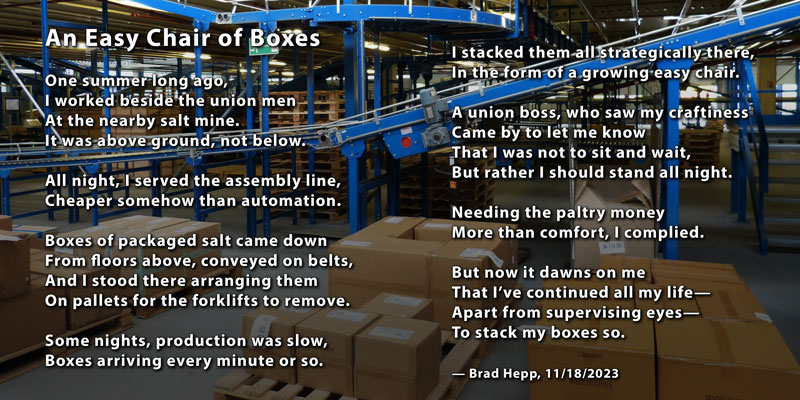
So, whenever my Bible interpretation has me smelling like a rose—or sitting pretty in an easy chair—I ask if I may be arranging the boxes to my own advantage. That’s the theory; God make it fully so!
(if you are viewing this via email, the website has a recording of this poem and commentary; click the title above)
Commentary
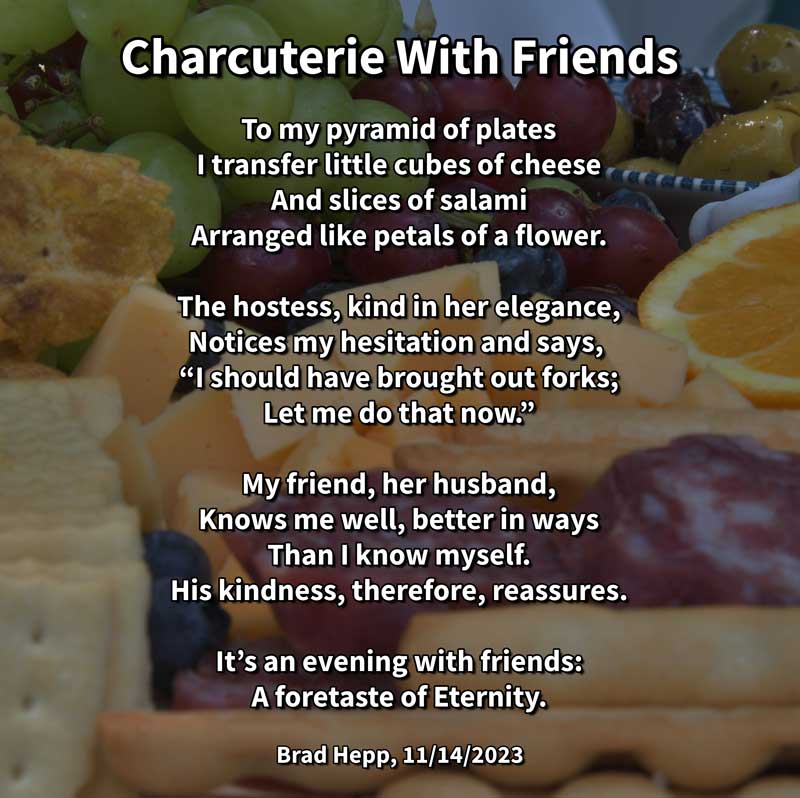
Last Sunday evening, Susan and I had supper with two friends we both had known since back when we were all singles (the 1980s). I was best man in the husband’s wedding, and he was best man in mine. Over the years, he and I have climbed dozens of mountains together. For that and other reasons, my friend has gone from best man to even better man. Once, I was more mature than him. I’m pretty sure that has flipped… and I couldn’t be more happy!
(background image by Ricardo Dominguez on Pixabay)
(if you are viewing this via email, the website has a recording of this poem and commentary; click the title above)
Commentary
The idea behind this poem still needs a lot of work. In the meantime, maybe it will make sense to you and even resonate….
When I was young, I sometimes dreamed of being a mountaineering guide. And I had definite ideas about how kind and understanding a guide should be to the slowest and weakest of his clients.
Just now, I had a vision (not literal, but almost so) of myself as that slowest and weakest one on the trail. Is there comfort in my perception of the Good Guide?
The trail is real, and physical, and hard. But there is a reality just out of sight, a realm of rest and realization. It parallels the trail, but is permanent, and more real than the trail. The Good Guide will transfer me to that realm at the perfect time. Not too soon, and not too late.
(if you are viewing this via email, the website has a recording of this poem and commentary; click the title above)
Commentary
By the end of his long life as a theologian, my father had concluded–like John Stott–that the Bible teaches what’s called “conditional immortality.” The comforting implication of conditional immortality is that men and women who do not accept God’s offer of salvation may suffer briefly at the Resurrection, but will not suffer for all Eternity. If you ask me, I’ll point you to his paper on the subject. I know how committed Dad was to the authority of Scripture, and to being intellectually honest. His paper on the subject is worth considering.
What Dad could not arrive at is Universalism–the eventual salvation of ALL people. That’s a position I and more than one of my best friends wish we could honestly arrive at. It’s what one of my main heroes in the faith, George MacDonald espoused.
This poem is an actual prayer. I have learned that poems in the form of prayer are read by God, if by nobody else. He knows how I struggle with this doctrine!
(if you are viewing this via email, the website has a recording of this poem and commentary; click the title above)
Commentary
My crawl through Acts is very slow these days. Sometimes I only make it a verse or two before something blows my mind. This morning it was Acts 10:38, where Peter is talking with Cornelius about the widely-known good report about Jesus. What God did for Jesus, in enabling that ministry, Jesus secured for his followers as well. Thus, He turned servants into friends and family. I consider Jesus’ sharing of status and power an incomparable generosity.
Look at Acts 10:38, and then recall Luke 24:49. I’m bolding the words that popped out for me.
how God anointed Jesus of Nazareth with the Holy Spirit and power, and how he went around doing good and healing all who were under the power of the devil, because God was with him.
Acts 10:38
I am going to send you what my Father has promised; but stay in the city until you have been clothed with power from on high.”
(if you are viewing this via email, the website has a recording of this poem and commentary; click the title above)
Commentary
In this poem, I imagine how Cornelius (Acts 10) may one day tie together the promises to Abraham (Genesis 17-21) with how he himself came to be part of Abraham’s promised lineage.
THE FEAST: Here’s one of the passages that was in my mind when I was reading Acts 10:
I say to you that many will come from the east and the west, and will take their places at the feast with Abraham, Isaac and Jacob in the kingdom of heaven.
Matthew 8:11 (NIV)
“Soar” in the last line has two meanings: take flight and increase.
(if you are viewing this via email, the website has a recording of this poem and commentary; click the title above)
[Note: this was partly a writing exercise, for which I requested and received(!) encouraging feedback on Facebook]
“Can you show me how to write a letter where people can read it?”
The patron seemed to be mentally competent, so I sat her down at a computer and launched Word with a blank new page.
The cursor blinking in the upper left didn’t mean anything to her. “Where do I start writing?”
“See this thing blinking here? It shows you where you are on the page. Just start typing.”
She started pecking with two fingers. “I don’t spell very well. Can you help me with that?”
“I’ll come back and check on you in a couple of minutes. And I’ll help you with spelling.” I returned to the reference desk.
A few minutes later, I checked in on her. She had typed about three lines, all upper case, and with no space between many of the words.
“Do you really want to write that in all capital letters?”
“Yes.”
“Okay. How about if we put spaces between these words?”
“Do words need spaces between them?”
“Yeah, most of the time. You can move the cursor around with the mouse or with these arrows. Yep, just like that. And you can start a new paragraph by pushing this key. You’re doing great.”
I headed back to the reference desk. “Amazing,” I thought. The patron was doing exactly what I have urged highly educated people to do when they have a hangup with writing: she was writing the words she’d say if she were speaking to someone. But in all caps…. Oh well.
An hour passed. The patron called me over. “I’m finished. Can you take a look?”
She had me sit in front of the computer, and pulled up a chair to sit beside me.
“You changed it all to lower case! That looks better. Shall I read it and make some corrections?”
“Please do.”
I read out loud, just loud enough for her to hear me, and corrected some spelling and punctuation as we went along. “I’m not going to correct everything, okay?” It needed to be her voice, not the voice of an old white guy with more education than brains.
This was the patron’s account of a traumatic event. She needed it for a court appearance. Now and then, I’d get to a part where I felt it necessary to say, “I’m going to read this part under my breath.” I think she understood why I was doing that, although she clearly didn’t require as much privacy as I do.
Close to the end, she wrote something along these lines: “I wasn’t going to let them do this to me… not after God had turned my life around.”
Having corrected as much as I felt was appropriate, I printed and stapled two copies for her to take.
“God bless you,” said the patron. I could tell she meant it. “And God bless you,” I answered.*
— Brad Hepp, 10/21/2023
March 19, 2024 Update: This morning, just as I was leaving the reference desk, a lady came up and said she’d need help on the computer. Since my fellow PSS was starting his shift, I told her that he’d be assisting her. She said, “You may not remember me, but I remember when you helped me write a letter.”
“Oh yeah,” I said, “It’s coming back to me. I do remember you!”
“I won the case!” Then, reaching her hand out to shake mine, she reminded me of her name. “I’m Pamela.”
“Pamela, I’m Brad.” Thank you so much for letting me know how that turned out. What a blessing!”
______________
*I generally don’t engage in “God talk.” But I’m willing to do so to a limited extent when a patron initiates it.
(if you are viewing this via email, the website has a recording of this poem and commentary; click the title above)
Commentary
I posted this on social media without any commentary, and there was absolutely NO response. How appropriate! It’s a lament about the loneliness I sometimes feel as a poet. My efforts to find a poetry writers group have thus far failed. I was part of a superb writers group a few years ago. Back then, though, I didn’t have enough confidence to make use of their generous and keen criticism. And meeting with that group became overly inconvenient.
So now, I’m living out what my father experienced much of his life: writing for an audience that never responds.
(if you are viewing this via email, the website has a recording of this poem and commentary; click the title above)
Commentary
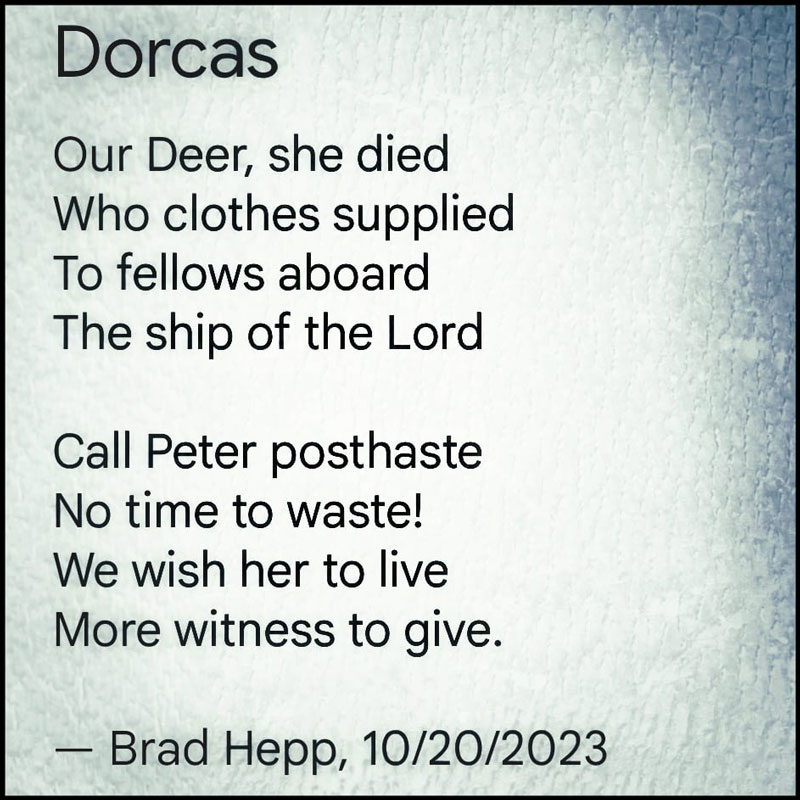
WHAT’S THE DEAL WITH DORCAS?
In my crawl through Acts, I just made it through chapter 9. Here we encounter the story of a generous disciple named Tabitha. Her name is Dorcas (meaning deer or gazelle) in Greek. She dies, and her fellow disciples send for Peter, who successfully petitions the Lord to raise her back to life.
I suspect part of Luke’s point in telling this story is to highlight God’s pleasure in disciples’ generosity. Earlier in Acts, we saw the Ananias and Sapphira story, where greed resulted in death. In their case, there was no resuscitation. Peter played a part in that story as well.
By the way, my doggerel notwithstanding, I see evidence that Dorcas’ generosity was not limited to fellow believers, to those in the Lord’s “fellowship.”
I keep forgetting Barnabas. Somehow, his name catches me by surprise when it crops up here and there in Acts. He shows up as a counterpoint to greed, a calmer of fear, a believer of the best. People say, “Let’s hear from Barnabas… oh, and Paul too.” Those who don’t know him can tell he’s someone special, someone god-like. His real name is Joseph. But his friends insist on calling him “Son of Encouragement.” As Jesus showed us what the Father is like, Barnabas showed us what encouragement is like.
I keep forgetting Barnabas. I’m sure God hasn’t forgotten him.
I love this picture I took of the patterns cast by the October 14, 2023 annular eclipse. The reason I love it is that despite the fact that *I took the photo,* it surprises me every time I look at it. First, I see the crescent shapes. THEN, I see my own shadow. Something has to shift in my perspective each and every time.
(if you are viewing this via email, the website has a recording of this poem and commentary; click the title above)
Commentary
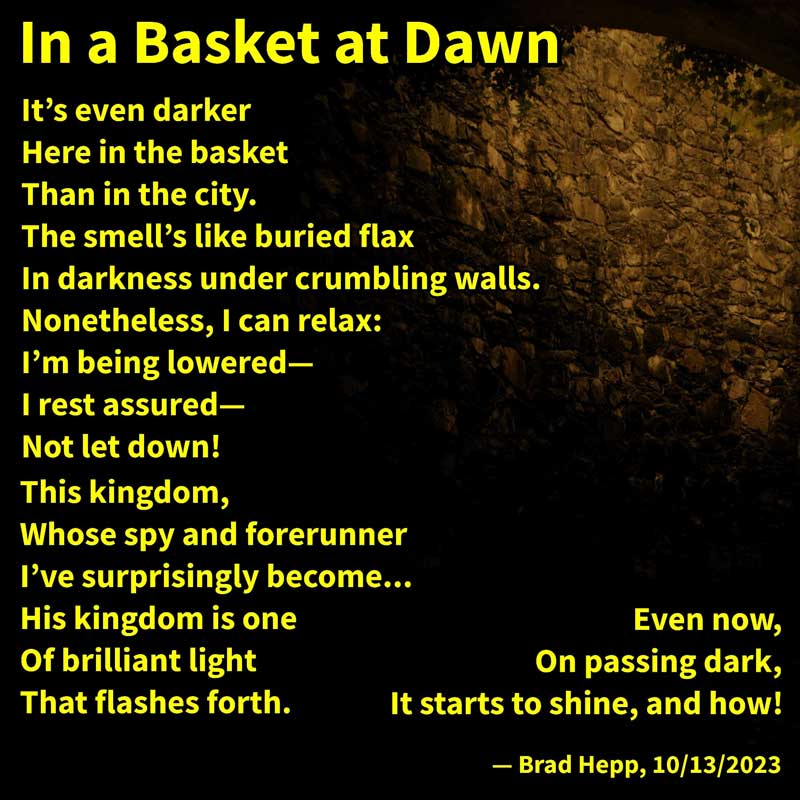
In my crawl through Acts, I’m to chapter 9. Paul had gone to Damascus to capture believers, but new plans were revealed by a blinding light. In a great reversal, he left Damascus* in the darkness of night, lowered out the city wall in a basket to avoid being captured. This was the dawn of his exciting and unexpected new life mission.
My observation of parallels with the conquest of Jericho probably doesn’t mean much. But it’s there to consider. We should always be asking, “Where have I seen this before?” God’s kingdom (realm and rule) has a long history.
SERENDIPITY (BASKET-FLAX-LINEN) I’m thinking about what kind of basket would be large enough to hold Paul when he was lowered from the wall…. I’m guessing such a basket would generally carry something light. What could that be? Grain? Flax? Naturally, the Joshua 2 account of the spies hidden under flax stalks(?) comes to mind. So I looked up flax, and found this fascinating article (is it good scholarship?): https://blog.fabrics-store.com/2022/12/25/biblical-accounts-of-linen-and-flax-seed/
(background image adapted from one by “M W” on Pixabay)
*I hate to break it to myself, but in the Luke 9 account Luke may have left out Paul’s time in the wilderness. Apparently, Paul entered Damascus blind from his conversion encounter with Jesus. He started preaching, but also went out into the wilderness for a period of three(?) years, and then returned to Damascus. It was after the return to Damascus that this escape happened. That’s what happens when you read a passage AS IT IS WRITTEN, and don’t try to bring in information from other passages (Galatians, in this case). The upside is great, but occasionally I have to backtrack. Oh well…
(if you are viewing this via email, the website has a recording of this poem and commentary; click the title above)
Commentary
I wrote this poem as I was finally reading Anne Frank’s diary. This reading coincided with a time in my life when I was–am–very deliberately re-forming my theology. I am reading Scripture with the assumption that it is authoritative, but also with the assumption that everything I have grown up thinking may be wrong. I want desperately to understand how a God who loves people infinitely more than I do, and calls me to forgive… how this God will deal with feeble, fragile men and women in Eternity.
I have friends, beautifully kind and loving friends–oh, I wish you knew them–who are committed Calvinists. I know how hard they must work at honoring God as they understand Him. I have another friend, an elderly lady, who grew up in Bible churches. She recently sent me a letter stating her deep struggle with God’s wrath, and eternal punishment. So, I don’t write this poem lightly, or judgmentally.
(if you are viewing this via email, the website has a recording of this poem and commentary; click the title above)
In my crawl through Acts, I’m finishing up chapter 8. One of my observations here and elsewhere in Acts is that many of the stories feature bigshots—people we tend to think of as “important.” I find that curious, to say the least. It’s not what one might expect from reading the Gospels. It’s not what we see in the Epistles. Consider James, Peter, and Paul. You can probably think of many passages in their writing where the proud are brought down and the humble lifted up.
Maybe this focus has something to do with Luke’s target audience: “most excellent Theophilus….” I’ll have to bear his excellency in mind as I continue my crawl. How would Theophilus have understood the stories Luke was telling?
LA-DI-DA, ONCE LONG AGO Back in seminary, we occasionally heard from renowned evangelists in our daily chapel. On one such occasion, the speaker was so famous that we had to use overflow seating in a second auditorium. I gladly joined my fellow miscreants there. In this unsupervised setting, we could loosen our ties, remove our uncomfortable jackets, and grab a bite to eat.
On the big screen, the evangelist in his pinstripe suit was talking about evangelizing in sub-Saharan Africa.
“Picture this heathen,” said the evangelist. “One day he’s wearing a loincloth. Then, he converts to Christianity. Before long, he’s wearing a 3 piece suit!”
I hear a groan from the next table.
Another student and I look at each other in dismay. Our eyes roll. In unison we exclaim, “Well, la-di-da!”
(if you are viewing this via email, the website has a recording of this poem and commentary; click the title above)
Last night, I took my first ever nap with a grizzly bear. How it all got started was fuzzy, as such things often are. Anyway, there I was, lying on my side with my head pillowed on the grizzly’s massive chest. My nose and eyes were within inches of the grizzly’s maw.
The grizzly seemed to be more interested in sleep than in this defenseless human delicacy. But I wasn’t taking chances. My only other experience with clawed monsters involves kittens. I know from them to not make any sudden movements. So I limited myself to the slow rise and fall of my chest. In fact, I tried to coordinate my breathing with the grizzly’s, hoping that would pacify the beast.
“So what happened next?” you ask. Remarkably, nothing! I survived without a scratch and am here to tell this tale.
Oh, one more thing…. You’re probably wondering, “What does a grizzly’s fur feel like?” You’d think it’s coarse and bristly, right? Not at all. I can tell you, it’s as soft and smooth as a silk pillowcase!
(if you are viewing this via email, the website has a recording of this poem and commentary; click the title above)
Commentary
In my crawl through Acts, I have just about made it through chapter 8. Once again, Luke is telling a story that contrasts GENEROSITY (God’s generosity, reflected in selfless servants) with GREED (here it is Simon the Magician’s apparent desire to exploit God’s generosity).
Question: is it possible Simon was a true believer? Was he saved in Luke’s account? Does Luke actually want us to struggle with this question? He leaves off with Simon declining to do the one thing Peter requires of him: personally repent and pray for God’s forgiveness.
(if you are viewing this via email, the website has a recording of this poem and commentary; click the title above)
Commentary
Halfway through my second year in college, I went through a period of questioning my faith. Actually, I was questioning “my inherited faith,” since Christianity was what I grew up with. The questioning was a healthy process. I came out of it with a recognition that I could not–and need not–prove anything about God definitively.
One book that I read at that time was In two minds: The dilemma of doubt & how to resolve it by Oz Guinness. Since it has been over forty years since I read the book, I can’t swear to this, but I seem to recall Guinness suggesting that doubt often arises from ingratitude. Over the years, that seems to have been borne out in my own life: stop thanking God for all He supplies, and soon I’m struggling with doubt.
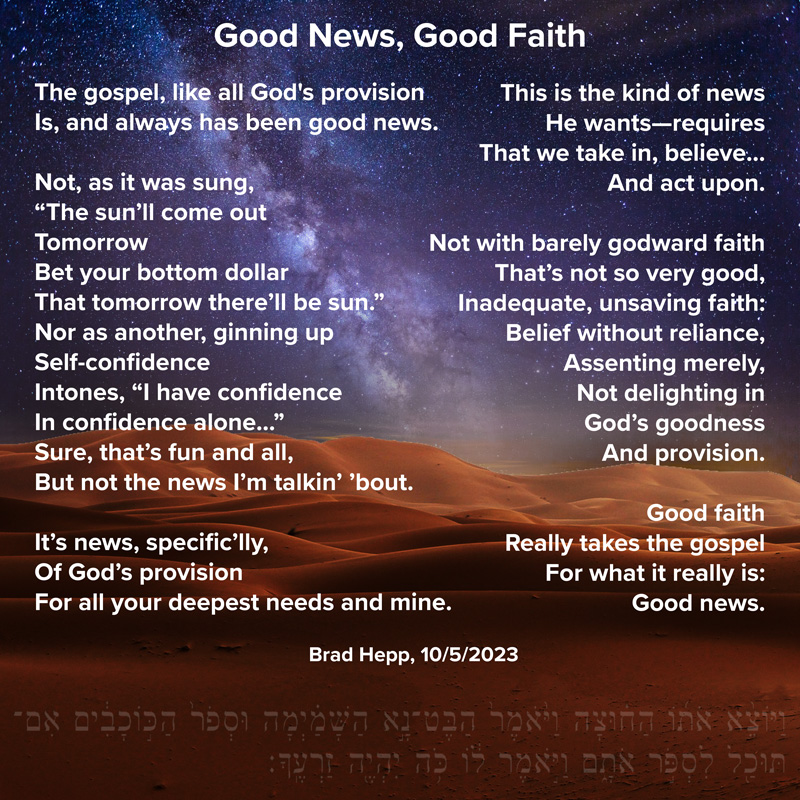
With that background, you’ll understand why, when I recently tried to throw out all my presuppositions about Romans and come to my own fresh understanding, there’s one presupposition I wasn’t willing to throw out just yet: that the kind of faith Paul is talking about could be characterized as “grateful reliance.” That’s really what this poem is about. When I posted the poem on Facebook, here’s what I wrote:
My flight through the Bible has my little plane struggling for elevation to clear the mountain range called Romans.
This little poem is me thinking “out loud” about how Abraham’s exemplary(?)* saving faith may have differed from the faith of his descendants.
*Caution: the QUALITY of Abraham’s faith may not be Paul’s point. I look at it because many of those whose condemnation Paul mentions surely had their own measure of faith. Was it different? Is that important? I don’t know yet.
(the background image combines a night sky photo by Chemnitz/Deutschland on Pixabay; a desert scene by Greg Montani, also on Pixabay; and Genesis 15:5 in Hebrew)
(if you are viewing this via email, the website has a recording of this poem and commentary; click the title above)
Commentary
Someday I’ll learn how to ask thought-provoking questions. I want people to join me in a quest for answers, to brainstorm with me.
Unfortunately, prompting thoughtful responses is a tricky thing. My father was a seminary professor in Mexico. He got in trouble with fellow professors for provoking students to think. Apparently he didn’t get the memo that he was only supposed to spoon-feed those poor, defenseless students. The really good ones loved him. He set them up for a life of productive thinking.
(if you are viewing this via email, the website has a recording of this poem and commentary; click the title above)
Commentary
Well, this is embarrassing! This is probably a lousy poem. I wrote it as flow of consciousness while studying Romans. And now, I don’t recall what I was thinking. Wow. That’s lame.
I do recognize a perennial lament of mine: that there’s always someone out there interpreting our efforts in the worst possible light.
Here, for what it’s worth, is what I wrote when I first posted the poem:
Sometime it would be nice to ask of Jesus, “Are we really friends? When you look straight through me, do you see anything of yourself?”
(if you are viewing this via email, the website has a recording of this poem and commentary; click the title above)
Commentary
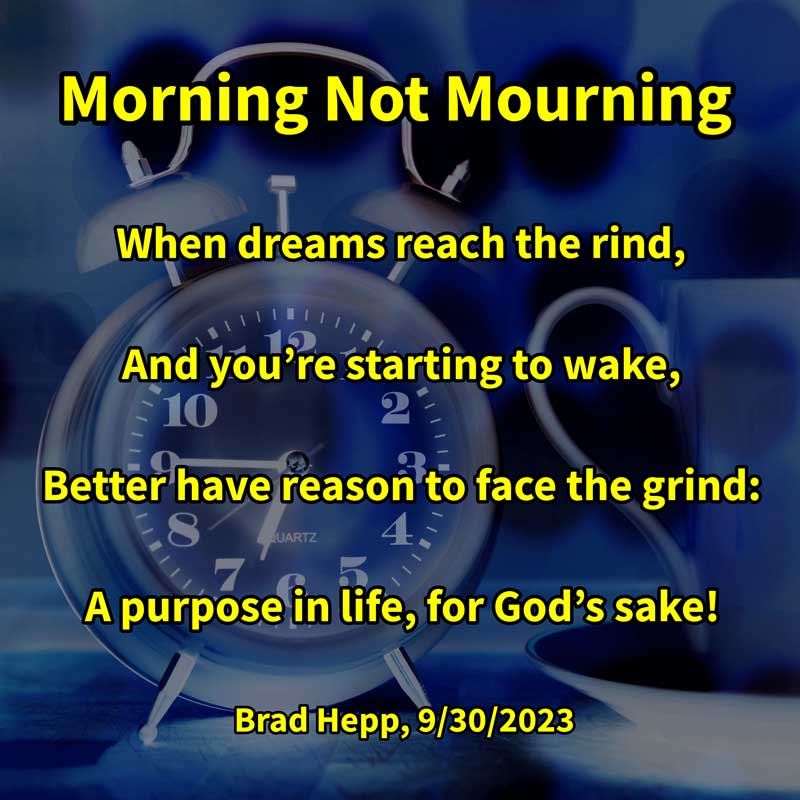
When morning comes, I can’t hold on to my dreams, or get them back.
Why write a dumb little poem like this? Honestly, as I woke up, I was trying to come up with an analogy for that frustrating time of morning when dreamworld yields to waking day. You’ve made it through your slice of watermelon, and all that’s left now is rind.
(background image adapted from one by NoName_13 on Pixabay)
(if you are viewing this via email, the website has a recording of this poem and commentary; click the title above)
Commentary
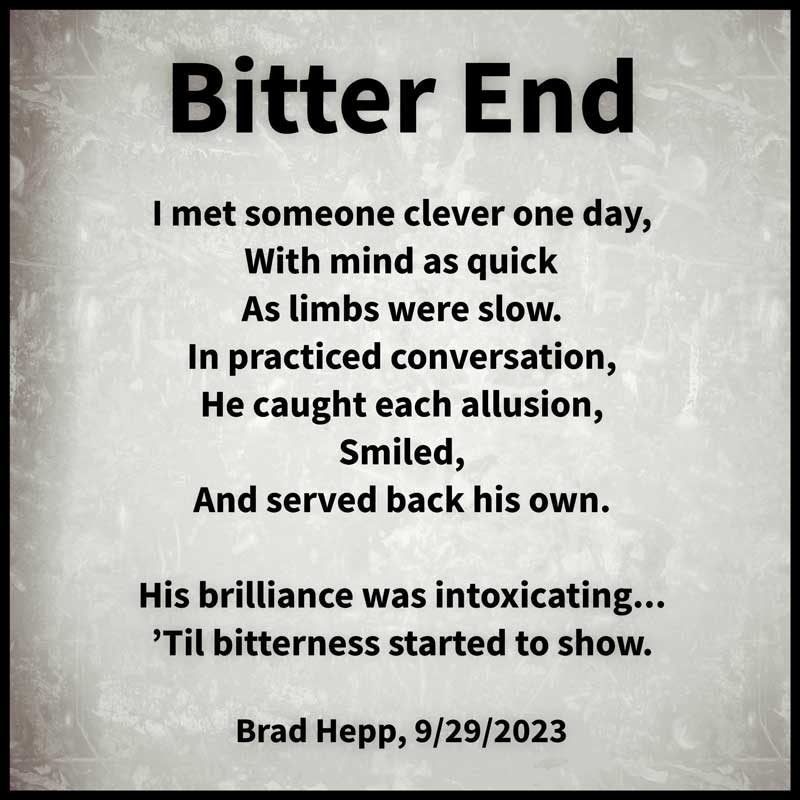
Some conversations serve as a warning: “Make sure you’re not on this path!”
This poem was inspired by a conversation I had with an elderly patron at the library where I work. Ever since that conversation, I have avoided him. Otherwise, I’d have to deflect his political jibes, misogyny, and racism. It would be terrible if other patrons thought I agree with him!
In the 10 months since I started working at the library, I have learned the names of 40-50 patrons, and can usually greet them by name when they come in.
In contrast, I have written 100s of poems, but can quote only three or four of the simplest ones from memory.
In a happy note to a friend, I shared that I’m actually starting to appreciate my leaky memory when it comes to Bible study. It’s my honest companion on the journey. It often lets me see passages with fresh eyes, my vision not clouded by years of listening to teachers and preachers.
(if you are viewing this via email, the website has a recording of this poem and commentary; click the title above)
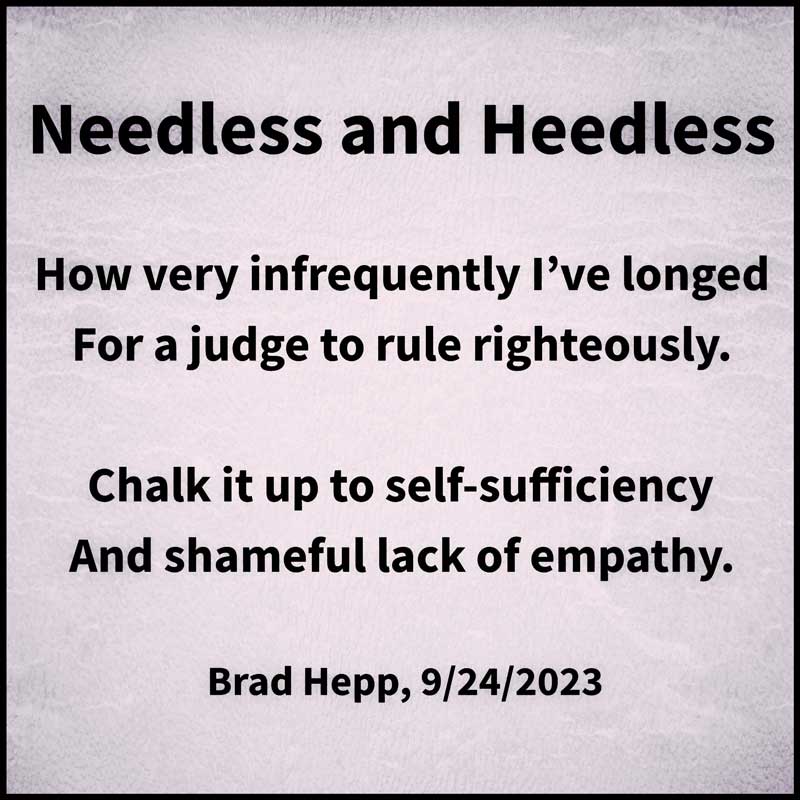
SERMON TO SELF
This morning, I was writing a preachy little piece about how many of us think of judges only in terms of punishment, and not in terms of protection. I was exploring what this may say about us.
Then I turned from cleverness to the mirror. If I don’t grieve for the oppressed, what does that make me?
You save the humble but bring low those whose eyes are haughty.