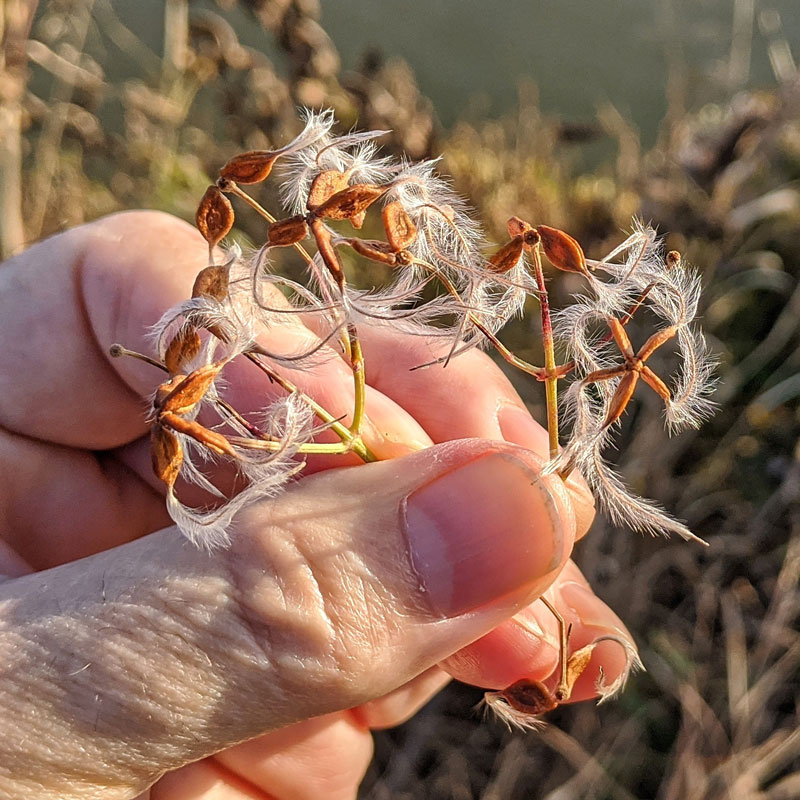
See another photograph of Clematis, showing the flower and an earlier stage of going to seed.
a digital commonplace book
See another photograph of Clematis, showing the flower and an earlier stage of going to seed.

Here’s what my friend Jon wrote when I posted the photo on Instagram: “One spring evening in 1989, I sat on the wall in front of that home with Chris and asked her to marry me. Hard to believe it was 30 years ago.” So, I went back and reshot the house WITH the retaining wall and posted it for Jon and Chris. This time, it was an overcast day, so the light is very different!

Although I often forget it, the most beautiful and magnificent of all I encounter at the lake is my fellow man.

Below is the original image. I’m putting it here to exemplify the sort of thing I often have to do in post-processing to make an image look right. In the original, the sky is much brighter than the subject, although my eyes adjusted to that when I was standing there. For this image to serve well, I had to darken the sky behind the subject, open shadow areas, and increase saturation just a little. That was all done with Snapseed on my Pixel phone.


When I posted this on Facebook and Instagram last night, I wrote, “I hope I don’t wake up tomorrow and realize this was nothing more than fluff!” That sounds like I didn’t know what I meant by the words, right?
Increasingly, I find myself able to write poetry and prose in an honest way, where the words express my actual thoughts and feelings, not some bogus sentiment that I concoct to suit a clever turn of phrase. Did you ever suspect that of poetry? Welcome to the skeptics club! How about this one?
Earlier in the day, yesterday, I thought of dryer lint and fluff in a metaphoric sense while writing a cover note to a silly little poem (one which I will not quote for the general public!):
Here’s a bit of doggerel that I cannot share with anyone else. It’s fluff that comes out of the deep appreciation I have for how God has caused our paths to cross.
Cover note for “Heaven is a Haven”
So I thought, “Can I push that metaphor?” What could represent deep appreciation or deep affection and related fluff? A coat of many colors thrown into a clothes dryer might do it!
The part about “when my color’s grey?” That MAY have a deeper referent than I can yet identify and articulate. Sometimes poetry does come out of the subconscience. There’s a fine line between that justification and saying that it’s just a concocted sentiment. Time will tell which this is. Hang on to your skeptic’s hat.
I had just read Malcolm Gladwell’s Outliers, and was eager to discuss the book with my climbing buddies on our trip to Colorado. Gladwell explores the question of what makes some people — outliers — wildly successful in their particular quests. Jon Klaus had also read the book.
“Being an outlier isn’t always good,” he said.
Jon’s quick response was surprising. I assumed he was speaking from experience. Jon is a successful serial entrepreneur. However, over the course of our trip, it became clear that Jon’s concern was not for himself but for his son.
Joshua Klaus was with us on this mountain-climbing trip. In the seven years since he last went climbing with his dad and the rest of us, he had turned from a fun-loving boy to a brilliant, thought-loving man… a serious “outlier.”
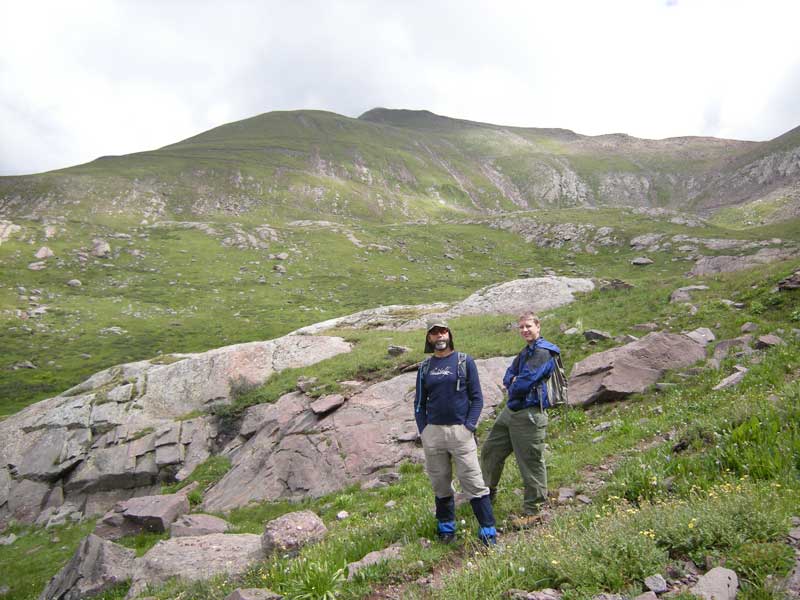
In the thin air of mountain campsites, we always have interesting conversations. But nothing had prepared us for the conversations that Joshua would engage us in. Because he is brilliant, and intellectually honest, Joshua had followed certain true ideas to what he thought were their logical conclusions. Neither his dad nor the rest of us were comfortable with those conclusions. We perceived them as dangerous.
I’m not going to tell you the ideas, because I cannot do justice to Joshua’s reasoning. In any case, as you’ll see below, it was not the ideas themselves that were at issue.
Among the veteran mountain climbers on that trip, two of us are seminary graduates, one is a corporate lawyer, and perhaps the smartest guy is an electrical engineer who devises spy gear for the military. Sitting around the campfire, we tried to punch holes in Joshua’s reasoning. Now, you or I might have been convinced by our arguments, but Joshua was not. This wasn’t his first intellectual rodeo.
We climbed the mountain and then headed back to Dallas. Something happened on the return trip. Here’s how Jon describes it:
Both Joshua and I look back to our 2017 climb with y’all as pivotal in numerous ways. We had cracks in our relationship, but there was healing because of your input on the drive back to DFW. That has continued, and both Josh and I are growing in grace.
Jon Klaus
I think I saw it happening.
On the drive back, all of us had made what I considered thoughtful, wise comments to Joshua. But then, I listened and watched as one of us made comments that were almost otherworldly in their kindness, love, and wisdom. These comments were an outlier among all the words we’d spoken, and this outlier was very good indeed! The words were full of grace. Like the words of everyone else on that trip, they were gracious. But they were more than that…. God’s grace is His kind provision of what one needs to respond well to Him. Such were the words in this comment. The speaker seemed to be empowered by God’s Spirit and Joshua seemed suddenly better able to hear and respond well. God’s grace was on display. In that moment Joshua teared up and bowed his head.
Our conversation ended, and another, silent one began. I like to think that God was speaking to Joshua’s heart.
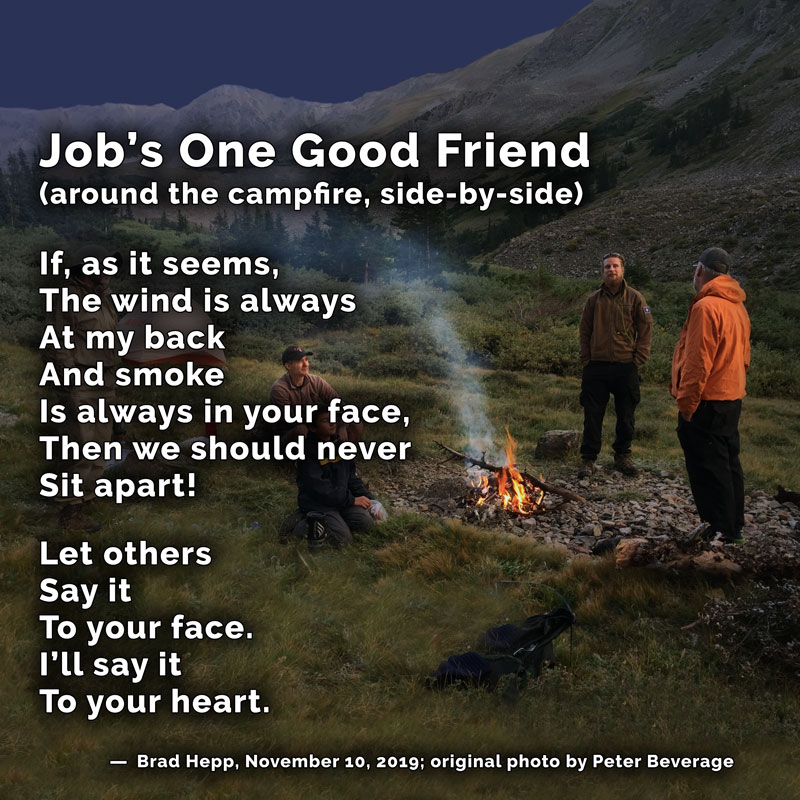
The poem below was not written with this incident in mind, but it might as well have been. The background photo is from the mountain-climbing trip where I saw God’s grace on display. Joshua and Jon are the two standing to the right of the campfire.
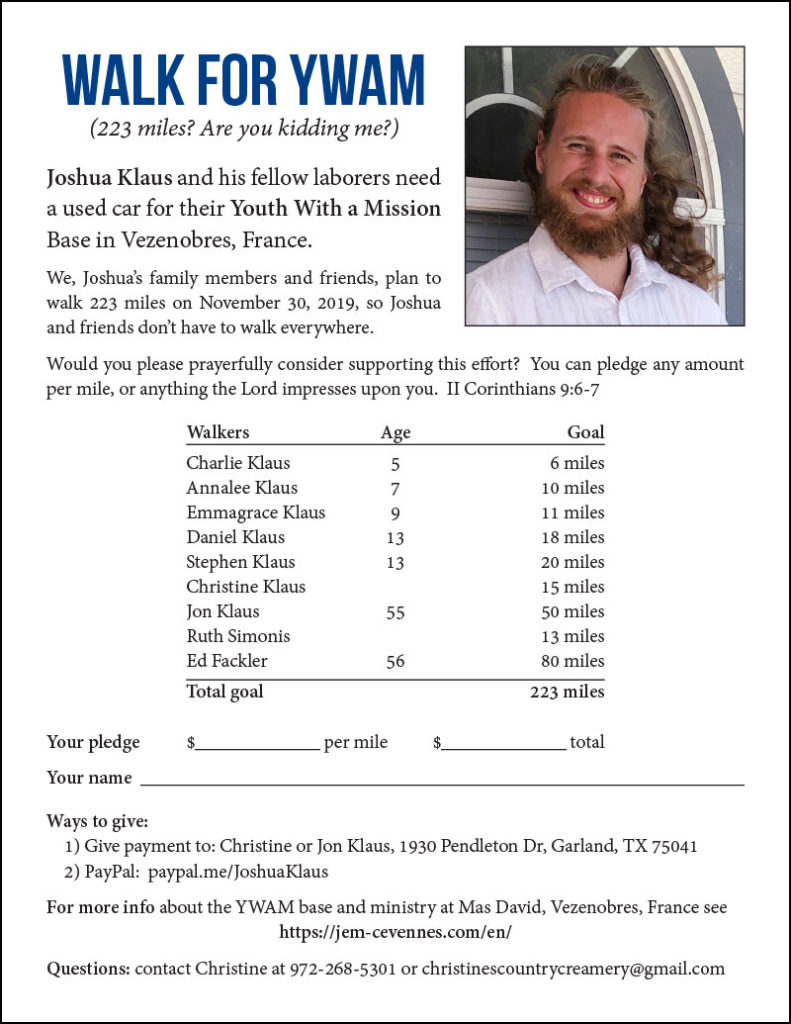
*It’s two years later. You have read Jon’s description of how cracks in his relationship with Joshua began to heal as a result of the gracious input I described. This coming weekend, Jon and his family are doing a walkathon to help the mission organization that Joshua works with in France. I’ll be contributing a modest sum to that effort in recognition of how God allowed me to see His grace on display, and the encouraging reminder I was given two years later.
If you’d like to join me in recognizing God’s grace, go to the fundraiser page: https://www.gofundme.com/f/support-walk-for-ywam
Or, click the image below for a PDF of the fundraiser flyer:
He walked along the shore pouring out a large bag of feed (50lb?) for the hundreds of ducks at Pelican Bay and then sat to feed whole grain bread to the geese. He told me he’s been doing this every day for years. Next time, I’ll get his full name, which probably includes “Saint” and “Francis.”
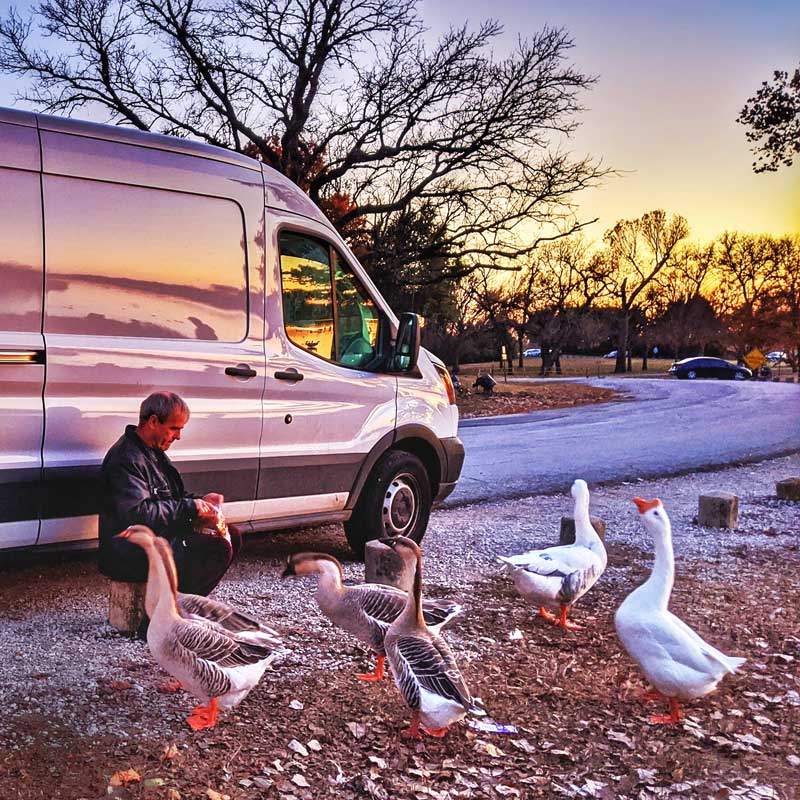
Below is a video I took of those hundreds of ducks on another day. Now I know part of the reason that they all congregate here. “Saint Francis of White Rock” tells me that he used to feed them over at the Bath House. When he began feeding them at Pelican Bay instead, the ducks somehow spread the news of where to find him.
I wrote this after talking briefly with a friend who was struggling. It seemed to me that the friend needed nothing so much as a brother to share his burden — a brother who is willing to suffer alongside, to let the smoke blow in his own face. No lectures. No correction. Silent compassion can speak louder than words. At least that’s what I’m told.
Why “Job’s One Good Friend”? The biblical character Job had friends who sat with him for a while in silence. They had come together “to show him sympathy and comfort him.” But then they opened their mouths, and it wasn’t helpful. It seems that the one who came closest to being a true friend kept his mouth closed the longest.
And why a campfire? If you’ve ever sat around a campfire in the mountains, you know that as the wind direction shifts, the smoke sometimes blows in your face. Some guys feel that they are the target, no matter where they sit! I picture Job and his friends sitting around such a campfire, perhaps one that burned down to embers and then to ashes. “And he took a piece of broken pottery with which to scrape himself while he sat in the ashes.”
This poem is about photography AND learning from older people. See the commentary below.

The thought in this poem crystalized as I was looking at a friend’s Instagram photos. The friend is not a photographer, just someone who understands and appreciates the great outdoors. I was looking at one of his early-morning mountain scenes. The sky was literally grey and the trees had no green in them. The photographer in me always aches to edit such photos so that they match my ideal of beauty, and I often excuse my own editing as an attempt to make sure the photo depicts the scene as our magnificent human eyes would have seen it. This all assumes or suggests the conceit that I am the expert, that my vision is the standard.
But my photography and poetry are expressions of something far more important: the desire to fully appreciate and reflect the beauty inherent in a world created by God. In this pursuit, I revel in the wisdom that is both longed for — loudly insisted on — by youth and quietly attained in old age.
Perhaps what I wrote on Facebook will clarify:
Here’s a book that needs to be written: “removing THE BARNICLES OF CHRONIA.” I say this partly in jest, partly “en serio.” As I age, and come to important new realizations about life, I think of my older friends. Many have been down this road already, but were not inclined to chronicle the journey. It seems that we could serve others by offering an honest, thankful, hopeful account. Thoughts?
[Edit, 11/8/2019: Last night, I discussed the project above with fellow creative writers. It’s still on my mind. The poem and photograph below ponders the subject by different means.]
By the way, I know the last stanza is difficult. I’m using “prove” in the sense of “testing so as to find what works.” I think that a full appreciation of beauty is attainable. I fancy that is one of the things that God is even now perfecting in His children. But we all have false or incomplete ideas about beauty in its various manifestations (visual, physical, emotional, intellectual, theological, etc.). For instance, I highly suspect that I still have a false idea about the relationship of beauty and suffering: “Suffering is bad, not suffering is good!” How can suffering have anything to do with beauty?
The answer to the question I just posed is one which I suspect people older than I — and some younger than I — understand far better than I currently understand it. The answer surely goes something like this: through suffering, we are prepared for the beauty that is coming. The answer is somewhere in Romans 8. Perhaps in this passage:
16 The Spirit himself testifies with our spirit that we are God’s children. 17 Now if we are children, then we are heirs—heirs of God and co-heirs with Christ, if indeed we share in his sufferings in order that we may also share in his glory. 18 I consider that our present sufferings are not worth comparing with the glory that will be revealed in us. 19 For the creation waits in eager expectation for the children of God to be revealed.
Romans 8:16-19 (ESV)
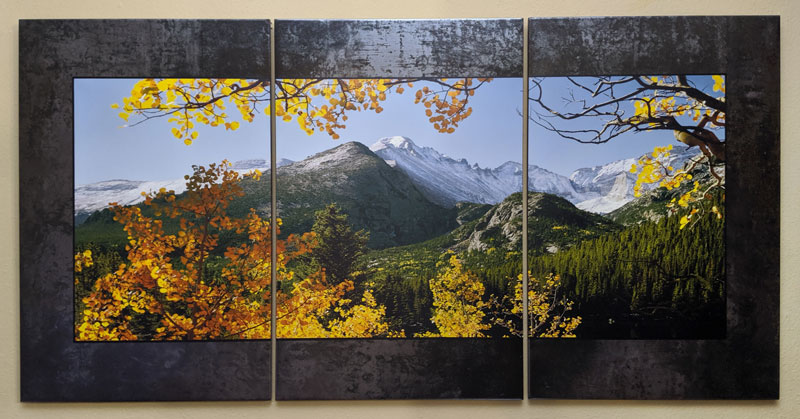
As I gave my guest a tour of our little house, we got to the dining room. There I showed off my print of Longs Peak in Colorado. A photograph of the snowy mountain, framed by evergreens and golden Aspen, is spread across three panels. It takes up the better part of the wall by our dining room table. My guest said, “That’s a nice triptych!”
“What?!”
“A nice triptych!”
“I know the word, but you’re the only person I’ve ever heard say it!”
I explained to my guest…. Long ago, a grader in seminary gave me a bad mark for using “triptych” in an exegetical paper. I chose the word because it illustrated the structure of a certain Bible passage. But the grader was having none of it. “No big words for you!” The word Nazi had a point. Long before, my father had taught me to never use big words when little words serve just as well. But dadgummit! Nothing served as well as “triptych” in this case.
I admitted to my guest, “As you can see, I’m not bitter about what the grader said to me twenty-five years ago!”
“Clearly!” he laughed.
I wrote this late one night after following a Facebook thread where two elderly people on Facebook seemed to think their conversation was private. One was denigrating worship in a particular church as vacuous. I begged to differ, and wanted badly to enter the conversation (which I later did, with extreme care). Instead, I prepared the post below. It was designed to offer a gentle refutation. Practically everything I say in the post is intended as subtle corrective.
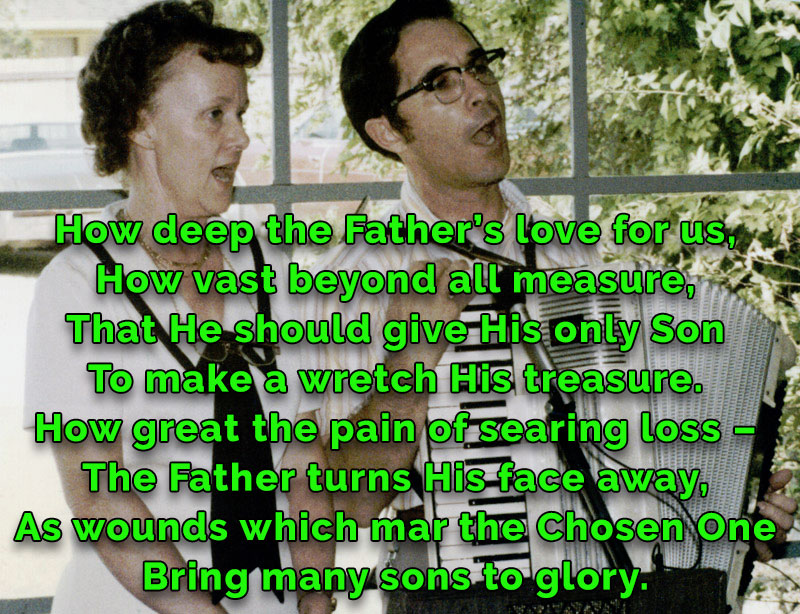
Almost daily, I pick up an old accordion my Dad used on the mission field, and squeeze out a wide variety of tunes, from Pachelbel, Bach, and Dvorak to Martin Luther, Fanny Crosby, and Mungo Jerry. Although I can READ music, I am thoroughly enjoying learning to play without musical notation, to FEEL the music. Dad was a first-rate theologian and Bible teacher. More importantly, he was a humble follower of Jesus. He’d have been very happy to see me playing his accordion and soaking up the deep truth in one of the contemporary hymns we sing at Redeemer: “How Deep the Father’s Love.” Tonight, as I was meditating on Romans 8, I couldn’t get one phrase from that hymn out of my head: “Bring many sons to glory.” I love the influence in that direction (glory) that the sermons and music ministry at Redeemer are having on me. Thanks, Joel Hergert, Sten-Erik Armitage, and all you elders who aren’t satisfied with the status quo, but push us toward wholehearted devotion to God alone.
It was dark in the living room. My wife and boys had already gone to bed, and I was left alone in the papa chair. By faint light coming from the kitchen, I could see Princess on a blanket we had set for her on the floor. She sat there, as peaceful and dignified as ever, probably purring. Two days before, she had stopped eating altogether, even when Joshua stroked her bony back and tried feeding her from his hand. The tumor in her stomach had won, and now she could barely walk, let alone jump or climb onto the couch.
In the morning, Joshua and Susan would take her to the vet. They’d ask the vet for some locks of her beautiful hair to remember her by. It seemed more appropriate than ashes.
Sitting there in the dark, I thought of how Princess’ well-being had been my responsibility for most of her seventeen years. Under my protection, neither hawks in the trees above nor the bitter cold of winter nights had ever touched her beautiful form. But now…. Now, tears began to stream. “I’m sorry, Princess. There’s nothing I can do for you this time.”
Up to this point in my life, I had never really understood corporate guilt. “Yes,” I could admit — only because good theology demands it — “I somehow share in the sin of Adam and Eve. But slavery and other atrocities? If neither I nor any of my relatives ever committed this or that sin, how can I — why should I — feel any guilt in the matter!”
That’s not what I was thinking about in the darkness of the night.
Looking at Princess across the room, I was sad. That much was clear, especially in the darkness. But then a little window opened. Through my tears, new light came streaming. It was sorrow, an emotion I barely recognize. “Princess,” I wept, “Not only am I unable to help you now, but in a very real — painfully real — sense, I am responsible for all that brought us to this dark night. I am truly sorry!” In that moment, for the first time ever, I was Adam. Once upon a time, God set me over His creation as its protector and provider. But I failed. And now, my Princess, like everything else under my charge, was dying.
A small window opened for me that night. Wisdom whispers, “Don’t let it close!”
Perhaps, in the light of that account, this poem I wrote the following day will make sense:

My pastor had this response: “I like it. Slowly we die as we are absorbed by the fictional lives of others dancing before our eyes when real life is just a power button and a glance away…”
My riposte: “… and a good pair of sneakers if you’re so disposed!”
Despite my riposte, this poem is more about the first stanza than the second. Not everyone can don a pair of sneakers and join me on long hikes. But everyone can seek to live as directly as possible, fully appreciating their own God-given life and embracing God’s offer of rebirth, restoration, and eternal life. For most people, this appreciation and embracing requires a little — or a lot — of contemplation, meditation. Noise and distraction are the enemy. Compare my poem “Alone at the Lake.”
About the title: I’m not completely happy with the title. You can probably tell that I started with “Television.” From there, I started pushing on “Tele,” “Tell,” and finally landed on “Tolled.” It may be too far out there. But consider that “toll” is associated with death (“For Whom the Bell Tolls”). It also sounds like “told.” Even as the flitting and vapid* “lives” of fictional characters displayed on a television have “tolled” our dying, and have “told” us the bad news, nature itself has “told” us about better news, the hope of resurrection. A big stretch, I know! This is my blurry vision, and now I have told you.
*This needs work. I do think there is something of “the medium is the message” in this. In television, we have lives that are extinguished with the press of a button.

This was at Pelican Bay near sunset.



Below is the original photo that I edited with Snapseed to produce the above.

This morning, I was beginning to read a poem by Gerard Manley Hopkins. He’s a poet I know little about, but am confident he will be worth getting to know. His poem, “The Windhover” begins
I caught this morning morning’s minion, kingdom of daylight’s dauphin…
The effort to unravel “morning morning’s minion,” and the delight I felt as a result, suggested my own “morning catch,” which morphed quickly into “meaning’s catch:”
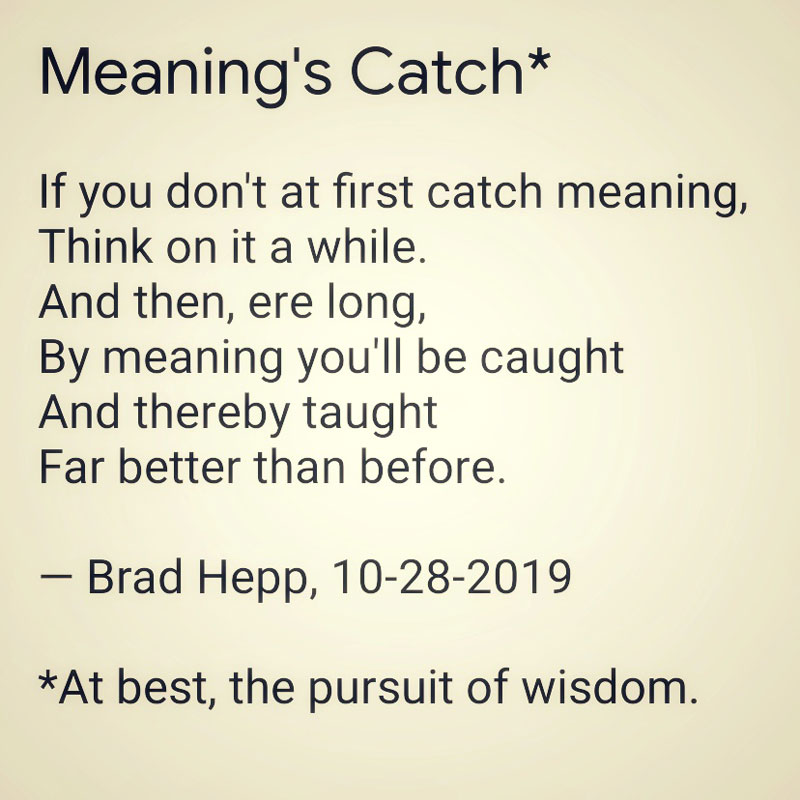
Here is how I commented on my own poem on Facebook:
The creative writers I recently began meeting with spent much of our first few sessions grappling with the PURPOSE of our writing. In the case of poetry, one question is “Why use metaphors when plain words could express the thought?” One of the best answers for me is that truth has more impact on a person when he or she puts effort into understanding it (this applies to the author and reader alike). My father and I spent years puzzling through Robert Browning’s “Rabbi Ben Ezra” (Grow old along with me…). I’m convinced that Browning’s insight has had far more positive effect in my thinking BECAUSE of that puzzling than it would have had Browning “just said what he meant!”

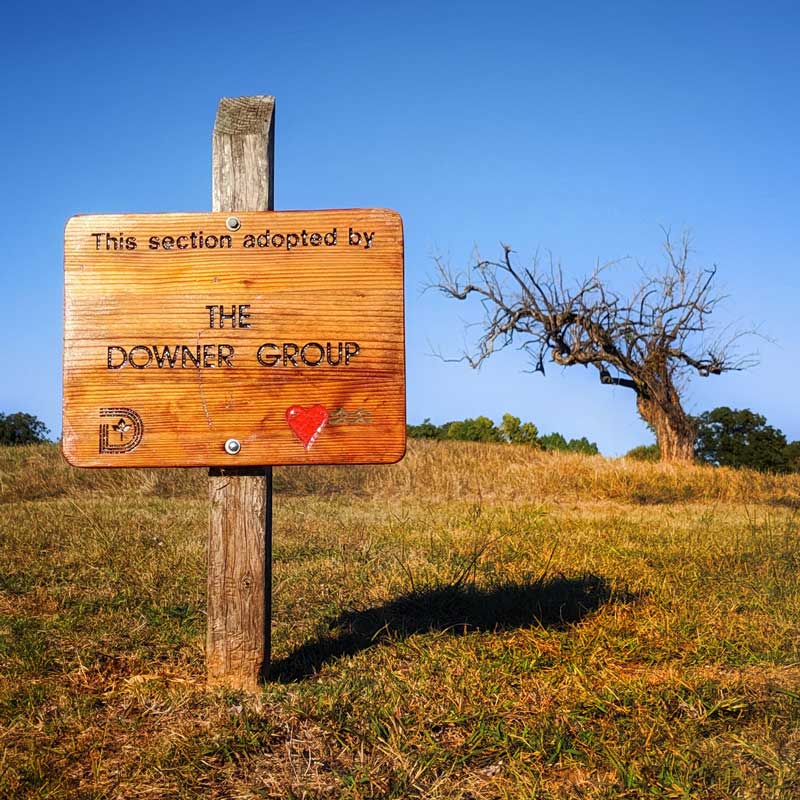
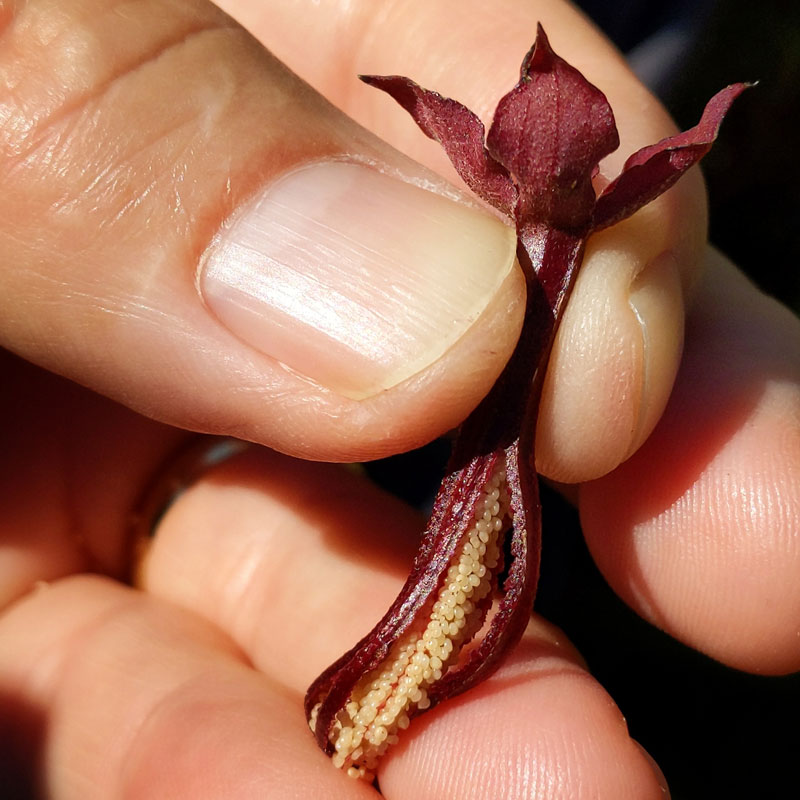
At first, I thought this was the whole flower. Then I realized it’s the sepals and developing seed pod remaining after the parts we THINK of as the flower had done their job and fallen off.
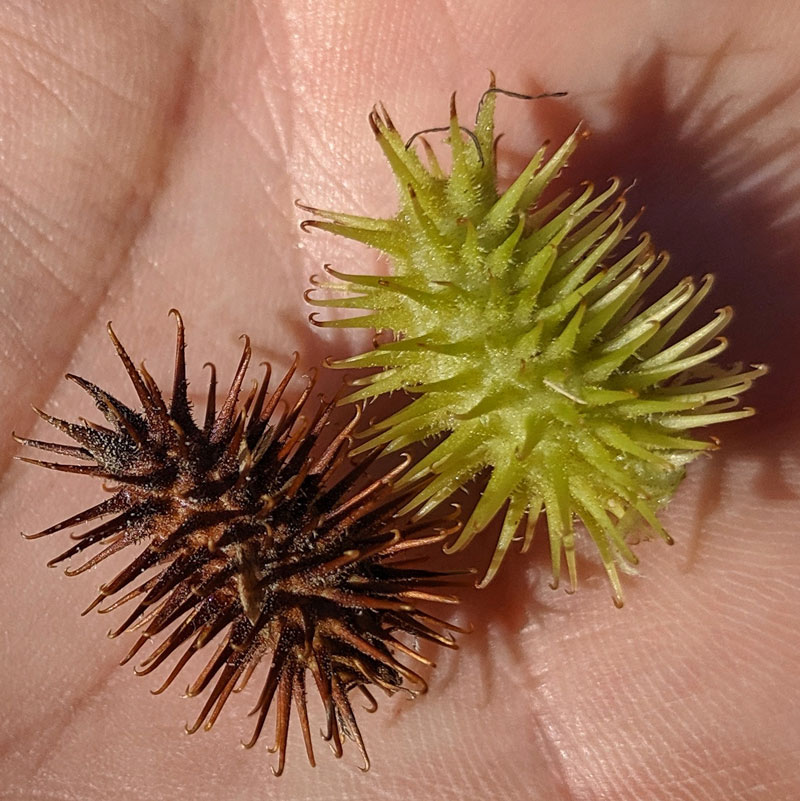
Burs are really amazing. Look at all those sharp little hooks!

Until recently, I had to preface any verbal commands to my phone with “Okay, Google!” Now, all I have to do is give my phone a gentle squeeze and talk lovingly to it. Just now, I was in the kitchen preparing boiled eggs. Susan was in the living room wearing earbuds and carefully studying her laptop screen.
ME: “Set timer for 11 minutes”
SUSAN: “Were you talking to me?”
ME: “No. I was talking to my phone. When I wish to speak to you, I will preface with ‘Okay, Susan!'”
We both laughed. Good thing!

Part of wholehearted devotion to the King is recognizing which pretenders we have come to honor in His place. For me, that currently includes pondering David Koyzis’ “Political Visions and Illusions.” So far, I haven’t made it out of the first chapter, where he describes a slope that virtually ALL Americans find ourselves on, whether we consider ourselves libertarians, conservatives, or (modern) liberals. He depicts the stages in that slope with the figure below. I THINK THE SLOPE COULD ALSO BE INVERTED: Given the inherent instability in an ideology (Liberalism) where the individual is autonomous and the state is based on a supposed social contract, the slope could be thought of as a SLIPPERY slope. Libertarians and conservatives keep trying to claw their way back up that slippery slope while they denounce their (fellow!) “liberals” who are further down, and seem to embrace the slide. What doesn’t occur to us (I include myself) self-righteous conservatives is that we should not merely claw our way to a “higher” point on the slippery slope, but seek to get off the slope altogether! What does that mean? I don’t know yet. I’m a slow thinker. Koyzis could rightly point out that I’m a slow reader! I understand that he proposes a solution by the end of the book. Will I agree with his solution?

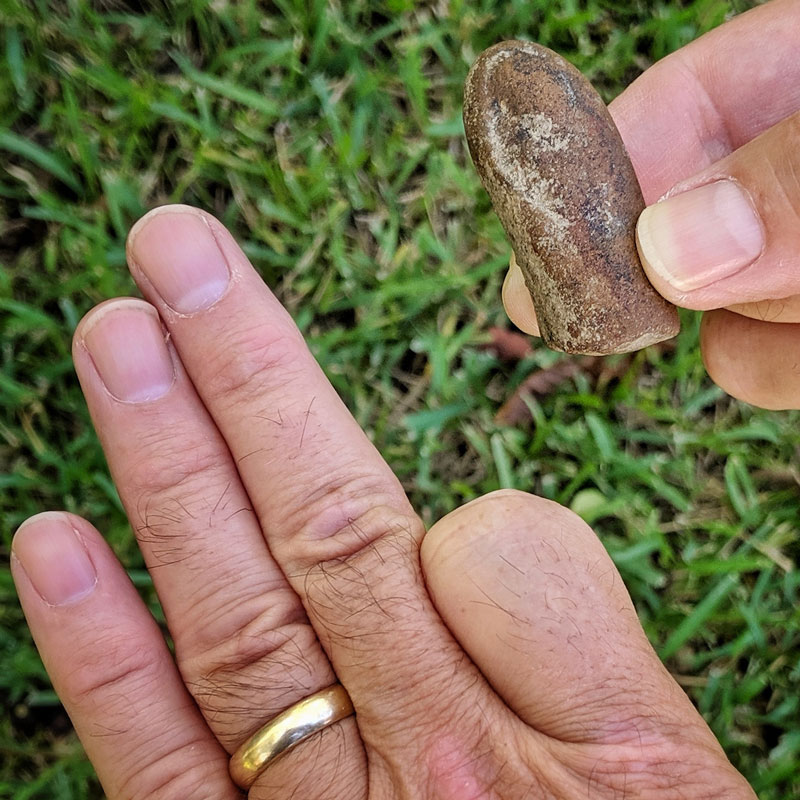
I asked friends to give me the caption or story behind this stone finger that I found long ago. Joshua helped me by snapping the photo.
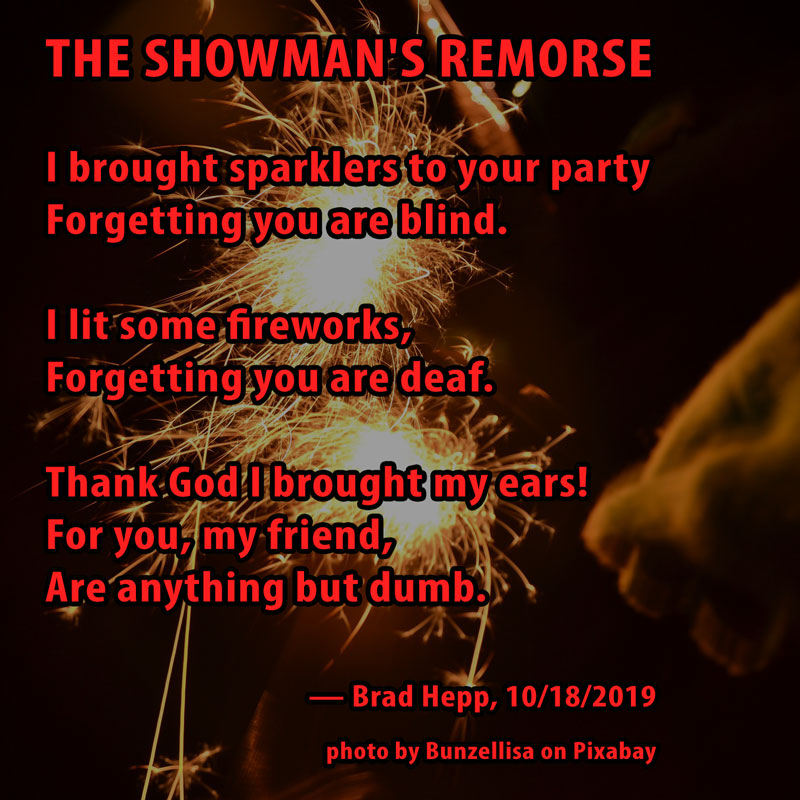
I started with a relatively silly presentation: Fifty-three feet now I’ve grown, reaching straight across the lawn. A few more years, five feet or so, and then I’ll reach my goal: to poke the people passing by. Believe me, I can hardly wait! Haughty men will shriek, teenage punks will yell, and snotty brats will cry. Oh brothers, that will be so great!
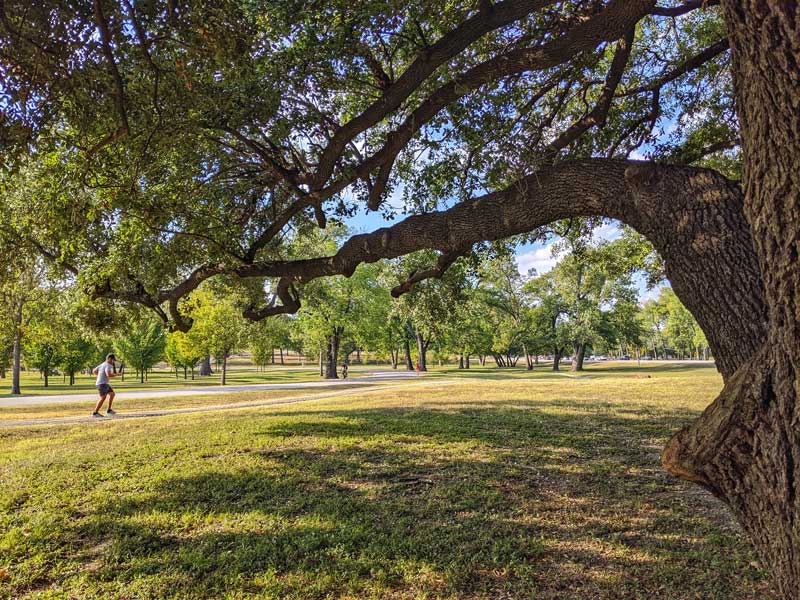
Half-way through the same night, after reading a troublesome Facebook thread (rude remarks from John MacArthur and others, concerning Beth Moore), a more serious presentation:
*When I first noticed this giant, with its long-reaching branch, I thought, “What an admirable tree, in a row of admirable trees! Brothers, as it were.” But then, one stormy night, one of his brothers was felled by a mighty wind. What once stood proud, and seemingly sound, was broken off three feet above the ground. Walking there soon after, I stopped to puzzle how this had come to be. Standing next to the fallen giant, I looked down and saw the cause: a hollow core. Not mere rottenness, but a wholly missing heart, whose absence left a void far below the surface. What happened? The wind held court and a shattering hulk was the verdict. A sad, but thought-provoking end!
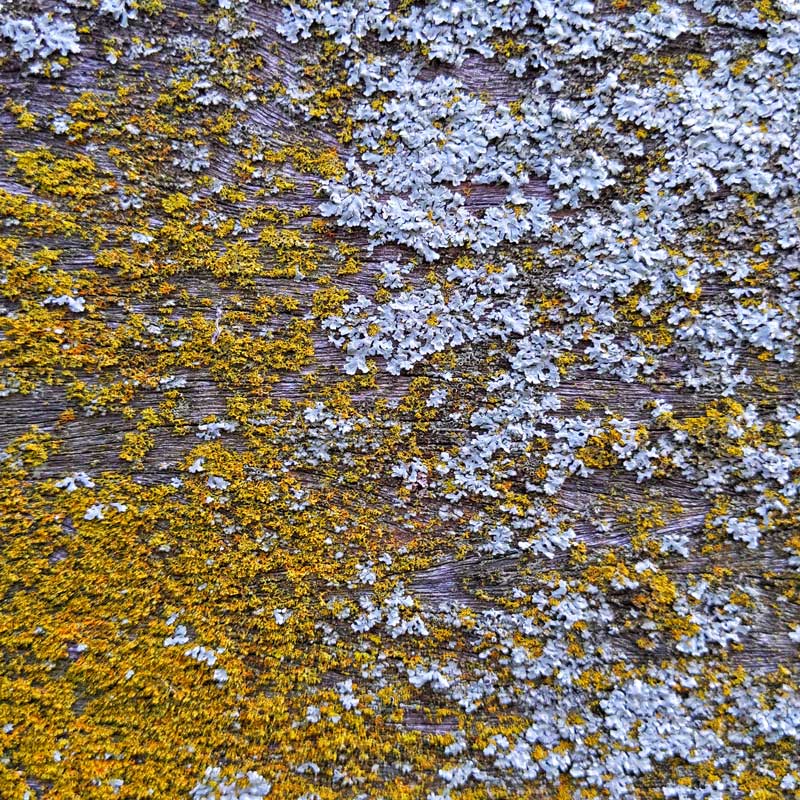
Cindy: What’s not to lichen?
Me: I liken this to a mockery of polarization. THAT is what I’m especially likin’
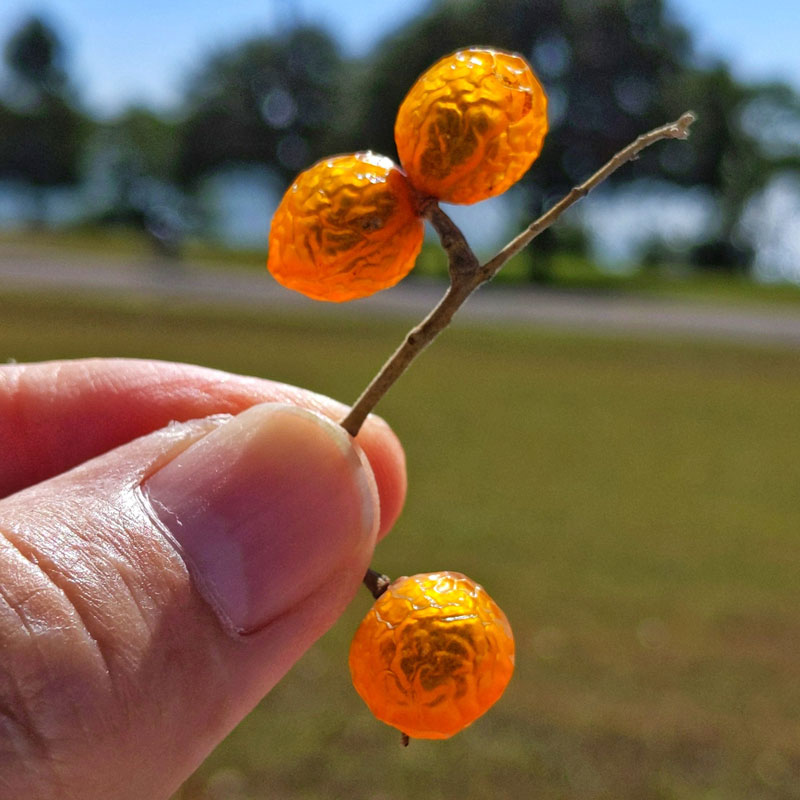
Soapberry (similar to Chinaberry tree, but I THINK it’s distinguished by these translucent orange berries in the Fall). See https://haysfreepress.com/…/11/12/soapberry-versus-chinabe…/ After taking this photo, I looked at several Chinaberry trees along the path, and in every case, their berries are still white at this point.
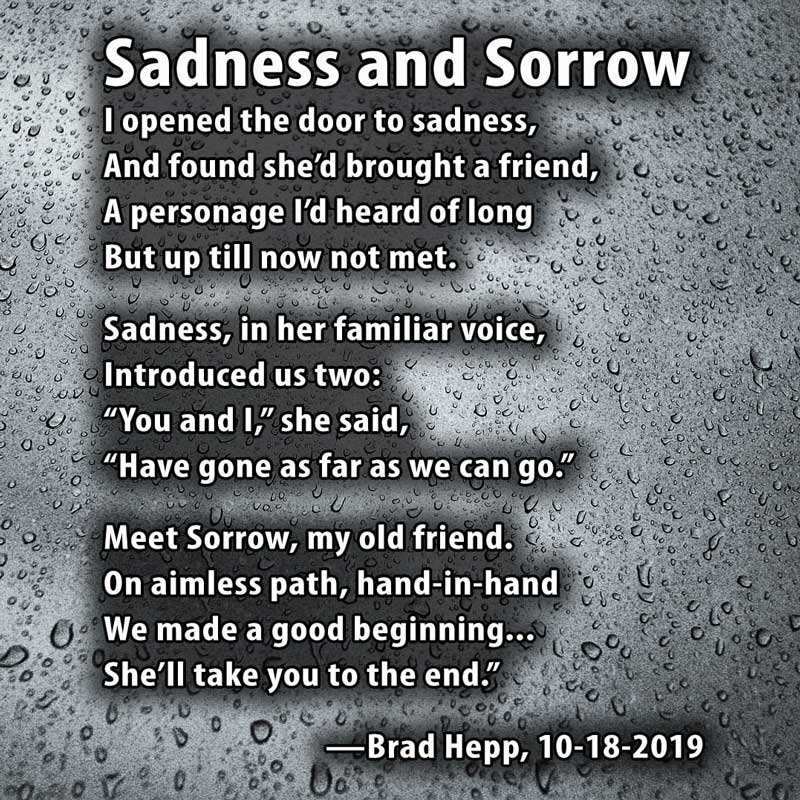
This morning, we had the vet put down our old cat, Princess. The last few days have been painful for us, as we knew this was coming. It was especially painful for Joshua.
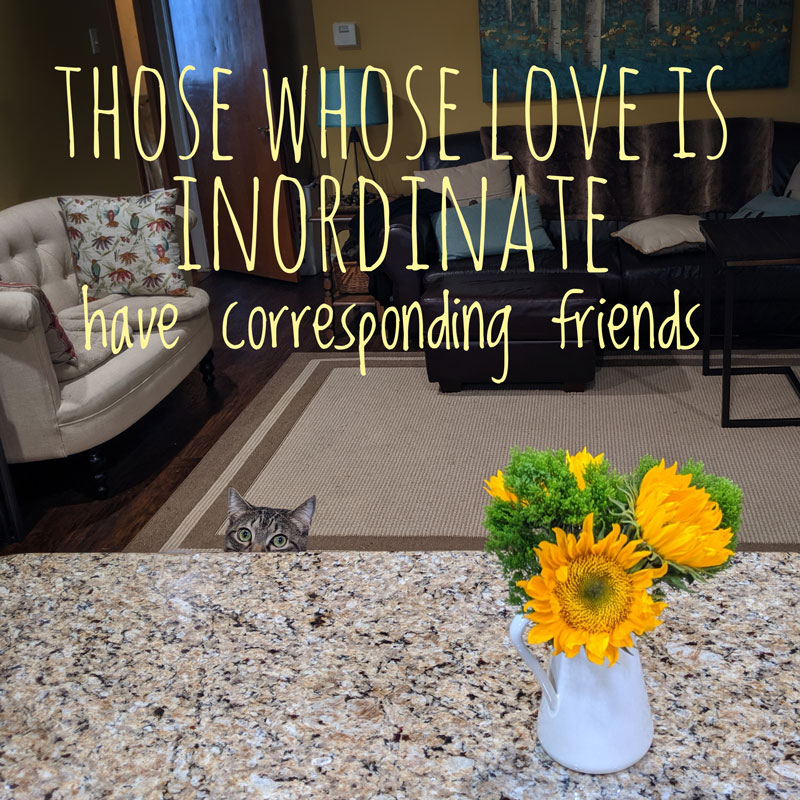
Yesterday, when I picked him up from work, he was holding a bouquet of flowers that his girlfriend had brought him. Later that same afternoon, her parents had dropped by his work to express their sympathy as well. I can hardly contain myself even now, when I think of the kind of love that Joshua expresses to others, and which they express to him in return. My words on the image describe a virtuous cycle.
Here’s what I wrote on Facebook: I’m thankful for special friends along the way. [EDIT: I was knee-deep in poetry when I wrote that. In plain words, “Those who are unusually good at showing love tend to have friends who love them back in equal measure.” Photo bomb is by Rascal, who has a lot to learn in this regard.]
Our oldest cat, Princess, has a tumor, and has weakened to the point she can barely walk. Tomorrow, we’ll have the vet put her down. As anyone who loves their pets knows, this is extremely painful. The picture below is one I took about 13 years ago, shortly after I bought a Sony DSC-V1 with “Nightshot” infrared capability. I have several other shots of her sleeping on the bed with a very young Joshua. He has always loved her well, and this is especially hard for him.

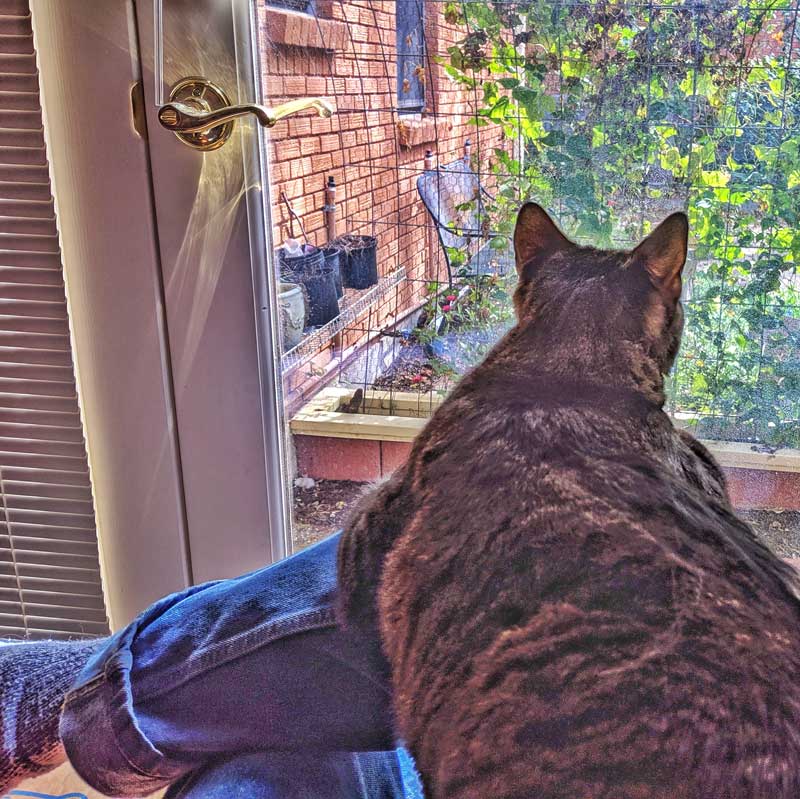
*Rascal is not really a good cat, at least in regard to his sister cats. Nevertheless, he has his moments. Today he said, “Can’t work with me sitting here? Yeah, well, you didn’t pray yet today. So here’s your opportunity, Mr. Hepp!”

I was photographing this tree against the evening sky when a hawk flew into it, apparently unaware of my presence. It would have remained unaware if I had not intentionally walked around to position myself to get a little clip of it flying. The video is slowed down to half speed.
I thought the whole scene was comical. Here are dozens of young beauties and this young fellow has to stand there in a kilt, playing an odd instrument and watching them as they ignore him. Is it a reward? Torture? The only thing better would have been if he were playing a jaw harp. I’m Scottish. My people are odd.
I think he’s well on his way to making the instrument sound like a cat fight. What more can one ask of a piper?

IT’S ALWAYS DANGEROUS to admit your faults in public. But here goes…. I’m occasionally an idolater. Not just any idolater, but one whose idol is himself. HOWEVER, God is merciful. He knows that I want to leave idolatry behind, and — with the patience of one who knows the end from the beginning — He’s working on me. I wrote this several weeks ago, and have not had the courage to post it until now, except to some other creatives who intimately understand the struggle.

Yesterday, I attended a birthday party for Youssef Sleiman. All who attended were given the opportunity to read something they had written, or to extemporize about how God has uniquely crafted this man to bring Himself glory. It was something like a memorial service, where the eulogies went on for over two hours. But in this case, the eulogee — the dearly not departed — was sitting there right beside us laughing and occasionally weeping.
I wrote a poem for the occasion, and was happy to see that much of what I wrote matched the reflections of people who have known Youssef far longer than I:
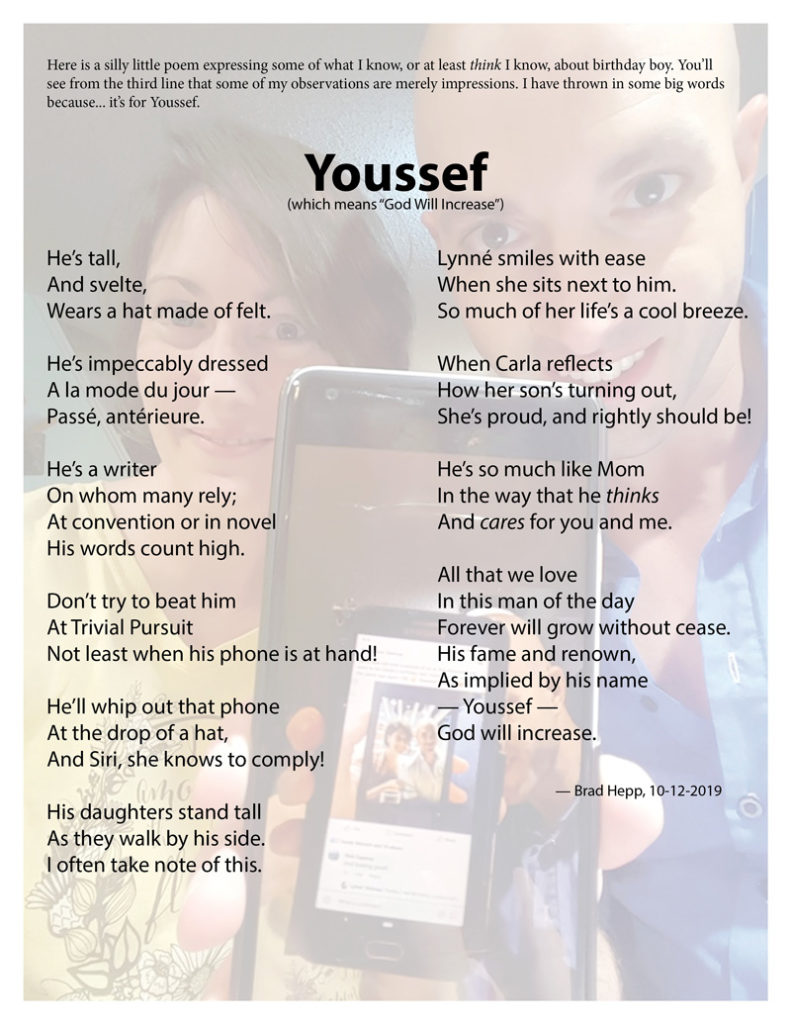
Background image stolen from Lynné Sleiman’s Facebook feed, where it was titled “Meta.”