(if you are viewing this via email, the website has a recording of this poem and commentary; click the title above)
Commentary
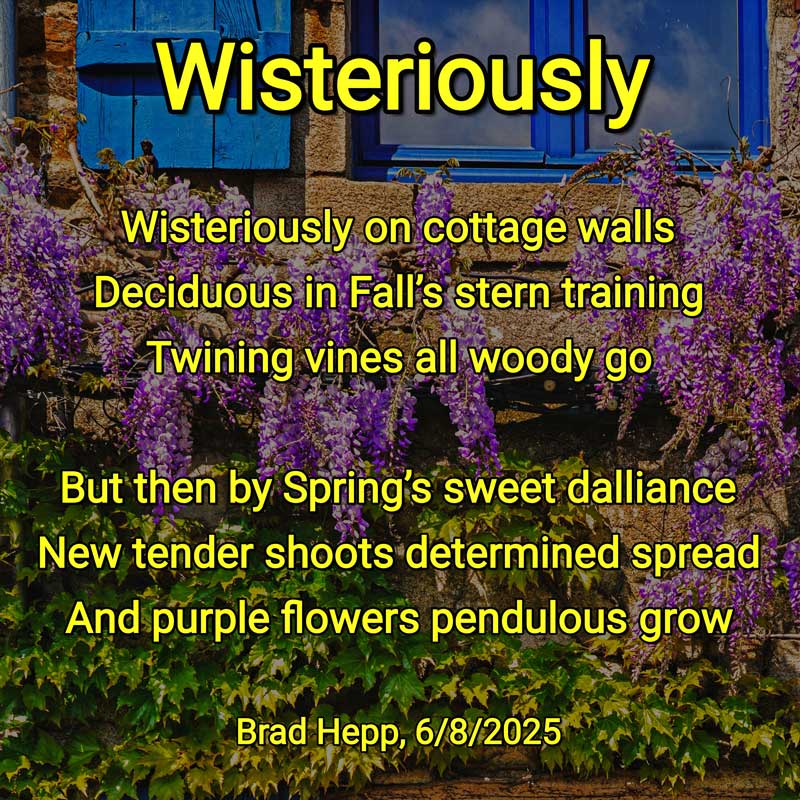
I had to write a few silly lines just to stake my claim on the neologism “wisteriously.” It popped into my weird brain as we watched the tortured romance Howard’s End. I wasn’t following all the story, but the flowers sure were pretty!
Scientific descriptions have amused me and inspired doggerel since I was a boy. For instance, there was that line in a Peterson field guide: “mantids are predacious.” Makes you want to write a poem, doesn’t it? No? Maybe it’s just me.
So, here’s the inspiring description: “Wisteria is a genus of woody, twining vines known for their long, fragrant, pendulous clusters of flowers, often purple or blue, but also white or pink. They are deciduous, meaning they lose their leaves in the fall. Wisteria is a popular ornamental plant, often used to decorate porches, walls, and arbors.”
The neologism, big words and odd syntax in this poem may remind you of Lewis Carroll’s Jabberwocky. That poem begins and ends with these enlightening words:
’Twas brillig, and the slithy toves Did gyre and gimble in the wabe: All mimsy were the borogoves, And the mome raths outgrabe.
(if you are viewing this via email, the website has a recording of this poem and commentary; click the title above)
Commentary
Suspecting that the Genesis creation account should not be taken literally can threaten one’s faith. I have held off thinking deeply about this threat for a long time now. Over the years, I’ve heard people I respect say something like “The Genesis creation account is poetry; don’t take it literally.” The main problem is that I have not heard a convincing exposition of the account as anything other than literal history. Rather, I have been exposed to many conservative defenses of a young-earth, somewhat literal understanding of Genesis. Since I do believe in an all-powerful, miracle-working God, the defenses often resonate, or even thrill!
Jesus and his Apostles seem to have taken the Genesis creation account literally. How are we supposed to understand their arguments if they’re wrongly based on a literal understanding of Genesis?
This poem is a naming and exploring of the threat. I want to deal with it instead of suppressing it. To that end, I’m enlisting the help of wise, intelligent, and faithful(!) friends and writers. It’ll be okay if I don’t get it all sorted out. That’s to be expected in a life of faith.
By the way…. I don’t usually say this publicly, but I’m pretty pleased with this poem. I especially like the second stanza, which tells a story in miniature. It’s odd though… being pleased with the expression of a troubling thought….
(background image adapted from one by OpenClipart-Vectors on Pixabay)
(if you are viewing this via email, the website has a recording of this poem and commentary; click the title above)
Commentary
This poem is the confluence of three streams:
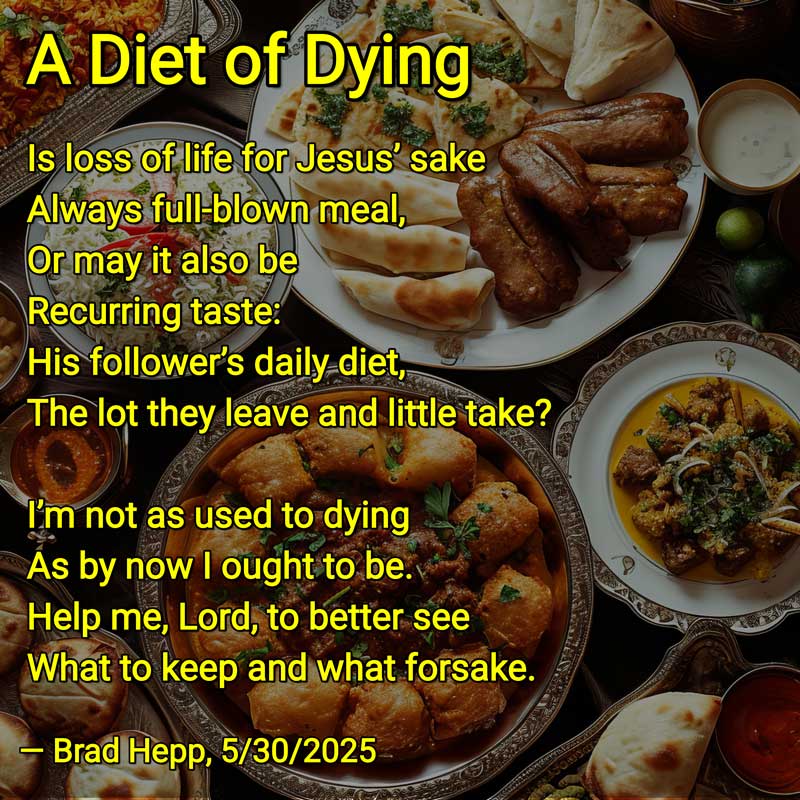
First, I woke up one morning about a week ago and–seemingly out of nowhere–a phrase popped into my mind: “I’m not accustomed to dying.” This kind of early-morning inspiration accounts for a good number of my poems. Don’t ask me to identify this muse.
Second, sometime in the following days, my daily reading of George Herbert got me to his poem “Mortification.” In the last two lines of that poem, Herbert wrote
Yet Lord, instruct us so to die, That all these dyings may be life in death.
Third, I reviewed Jesus’ words to his disciples just before the Transfiguration. Notice that he first speaks of taking up a cross and losing life. Then, as he predicts the Transfiguration, he speaks of tasting death. Are all three expressions equivalent? Do they all refer to bodily death? That’s a question I ask in the poem. Here’s the passage:
[23] And he said to all, “If anyone would come after me, let him deny himself and take up his cross daily and follow me. [24] For whoever would save his life will lose it, but whoever loses his life for my sake will save it. [25] For what does it profit a man if he gains the whole world and loses or forfeits himself? [26] For whoever is ashamed of me and of my words, of him will the Son of Man be ashamed when he comes in his glory and the glory of the Father and of the holy angels. [27] But I tell you truly, there are some standing here who will not taste death until they see the kingdom of God.” Luke 9:23-27 ESV
As you can see from the poem, I tentatively conclude that there is a kind of dying that is short of bodily death. You may recall the Apostle Paul saying that he dies daily:
[31] I protest, brothers, by my pride in you, which I have in Christ Jesus our Lord, I die every day! 1 Corinthians 15:31 ESV
There is a kind of dying that is imposed on us by age. Our strength dies. Sometimes our lust and ambitions die. As I pass through my sixties (65 on Friday), I’m certainly experiencing this kind of dying. I’m slowly getting used to it, but maybe if I had exercised more self-denial and discipline over the years, I wouldn’t find myself waking up to the thought, “I’m not accustomed to dying.”
Does the poem make more sense after that explanation? I’d love to know! Leave your answer in the comments below.
(if you are viewing this via email, the website has a recording of this poem and commentary; click the title above)
Commentary
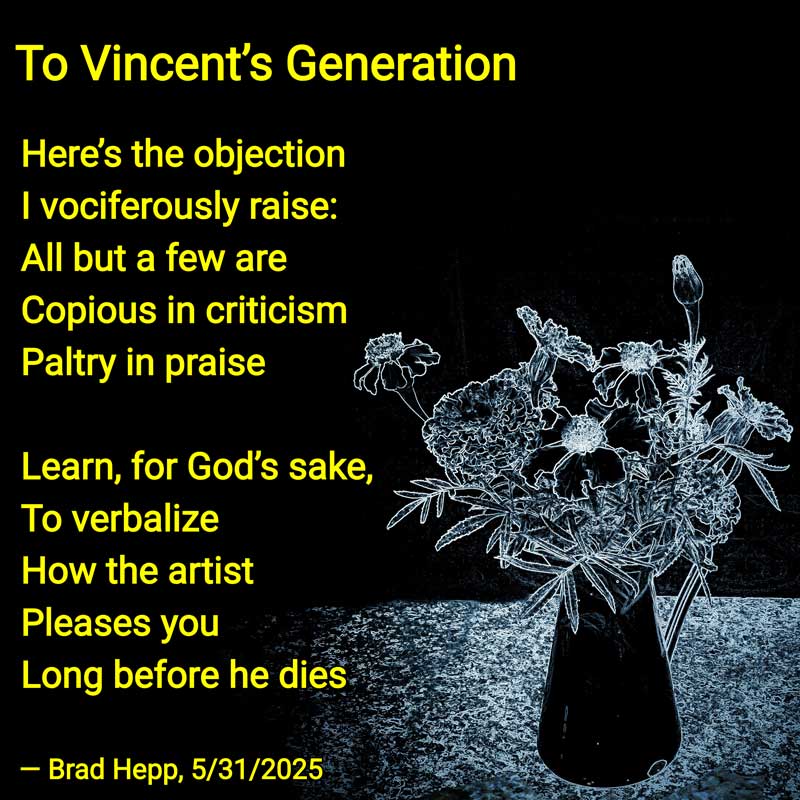
As a poet, I squeeze excess words out of sloppy speech. So my point is almost hypocritical: most of us need to EXPAND on our praise. Consider these scenarios:
The preacher crafts an insightful, well-structured, and persuasive sermon. All we can manage in response is “That was a good sermon.”
The painter captures subtle components of beauty, or depths of pain. We blurt out, “I like your picture.”
The novelist develops believable characters, who give us a mirror for our own unfinished selves. Our eloquent response: “That there’s some good writing.”
Why are we so inarticulate in our praise?
Several possibilities come to mind:
We are lazy or selfish
We don’t know much about the art form, and are afraid our ignorance will show (but we must manage appearances)
We are afraid of expectations: the artist will be sorely disappointed if we don’t lavish praise on her next effort
We are alert to ugliness, but unaware of beauty—when we say something’s good, it just barely cleared the threshold of our beauty detector
How can we do better? That’s not a rhetorical question.
(if you are viewing this via email, the website has a recording of this poem and commentary; click the title above)
Exclusion (self-imposed)
Some friends I admire From long ways off Limited portions Little doses
I grieve this regimen It’s self-imposed By sensing I’m Inadequate
A voluble joie de vivre I cannot match Even though I feel it too
An audience member, Silent hanger-on Applauding only Others’ show
— Brad Hepp, 5/19/2025
Commentary
[18] “There are three things that are too amazing for me, four that I do not understand: [19] the way of an eagle in the sky, the way of a snake on a rock, the way of a ship on the high seas, and the way of a man with a young woman. Proverbs 30:18-19 NIV
The fourth thing in this Proverb could apply to friendships in general. Sometimes, the process by which they’re initially established and then made solid is nothing short of miraculous.
God has performed this miracle several times for me. Against all odds, the beautiful man, the clever man, the popular, highly-regarded man has become my friend. I don’t mean a casual friend—a mere acquaintance admired “from long ways off”—but someone who is willing and able to share deep personal conversations.
The poem above explores why I sometimes doubt that God is ready to perform this miracle. Concentrating on my inadequacy, I forget His goodness. Pretending that I earn what comes my way, I neglect to ask for His favor. You may also notice that I sometimes assume things about potential friends, for instance that they always present with an energy (“voluble joie de vivre”) that I cannot match.
THE POEM STRUCTURE Did you notice how each stanza narrows down through its four lines? I knew I was doing that as I wrote, and I SUSPECT my subconscious was not just playing with a pattern. Perhaps one of my readers can articulate an effect the pattern produces….
(if you are viewing this via email, the website has a recording of this poem and commentary; click the title above)
Commentary
As I write this little poem, I can’t help but think of a friend who is really good with Greek and Latin sources of English words. Where I am CREATIVE in my etymology, he is CORRECT. So, take my poem with a grain of salt. My friend hasn’t weighed in yet. In any case, it is generally more fun than accurate to define a word by its origin (see “What Is the ‘Etymological Fallacy?‘”).
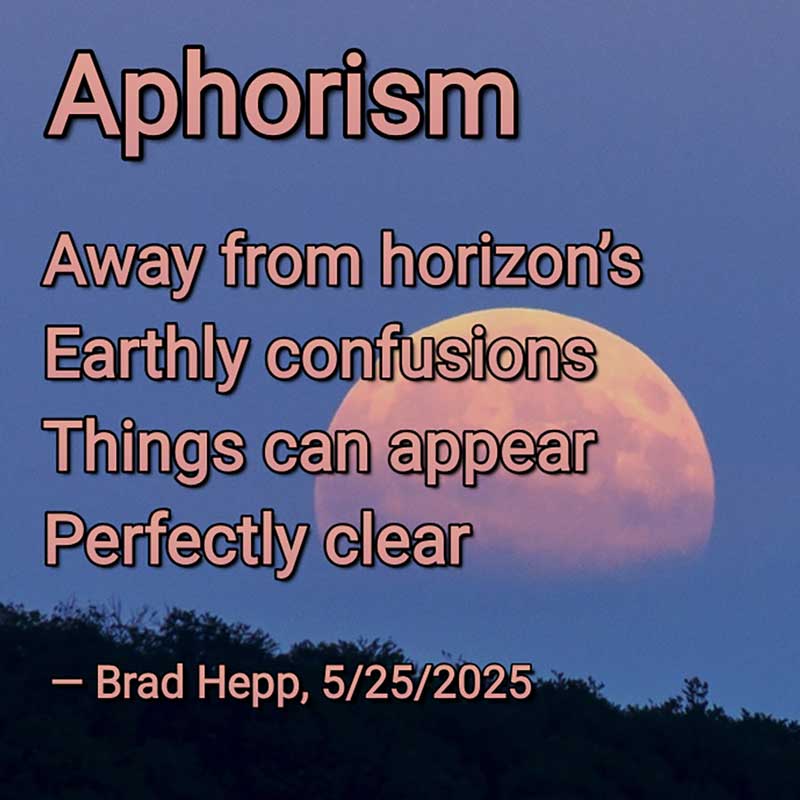
MORE FOR THE NERDS Another friend pointed out that many of my poems express aphorisms. What’s that? When I looked up the word, AI supplied the following overview (when you have read that, you may come up with a better mnemonic for yourself than my poem; feel free to share that in the comments):
Further back, ‘aphorizein’ comes from ‘apo’ (off)* and ‘horizō’ (I divide, bound), ultimately stemming from ‘horos’ (boundary). In essence, the term suggests a concise statement that clearly defines or marks off a truth or principle.
Here’s a more detailed breakdown:
Ancient Greek: The word “aphorismos” (ἀφορισμός) meant a concise, pithy statement, a definition, or a delimitation.
Etymology of ‘aphorismos’ ‘Aphorizein’ (ἀφορίζω): To define, mark off, or determine. ‘Apo’ (ἀπό): Off. ‘Horizō’ (ὁρίζω): To divide, bound. ‘Horos’ (ὅρος): Boundary. __________
*some people believe that “apo” more frequently means “away from.”
(if you are viewing this via email, the website has a recording of this poem and commentary; click the title above)
Commentary
This poem is the first fruit of considering a deliciously ambiguous phrase: “make friends with compromise.”
Can I rehabilitate the various—mostly negative—meanings of “compromise”? How does one befriend it, or befriend with it?
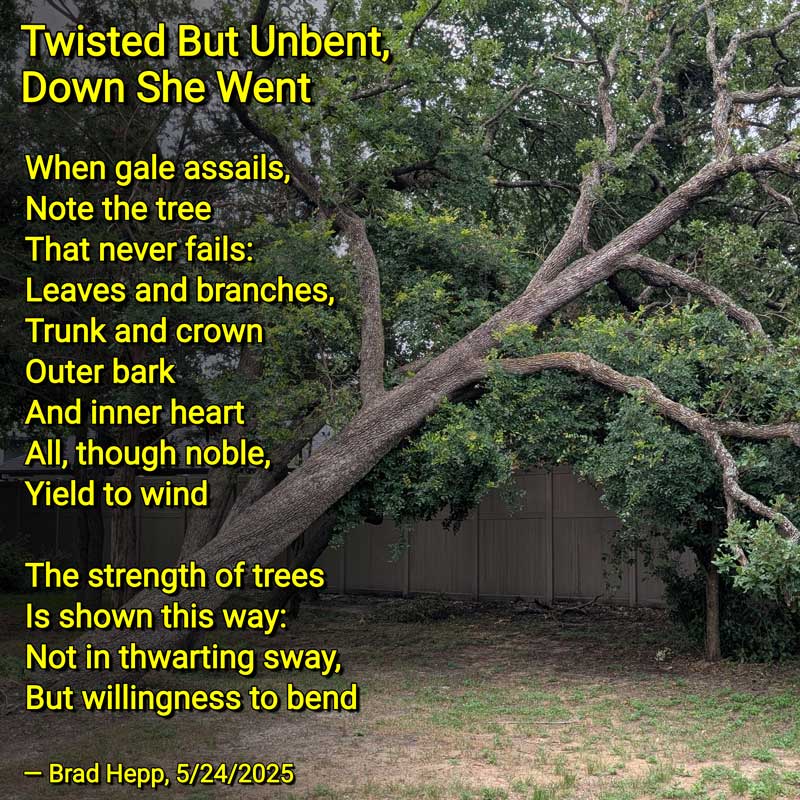
Trees show us one way. Much of their strength is in their ability to compromise. They say, “I’m standing here. But if the wind insists, I can bend, and move over there. The wind will die down, and I will live.”
The tree that serves as this poem’s background is behind the library where I work. It got blown down by a strong wind. We’re probably right to guess that its roots were inadequate for the kind of bending it needed that stormy night.
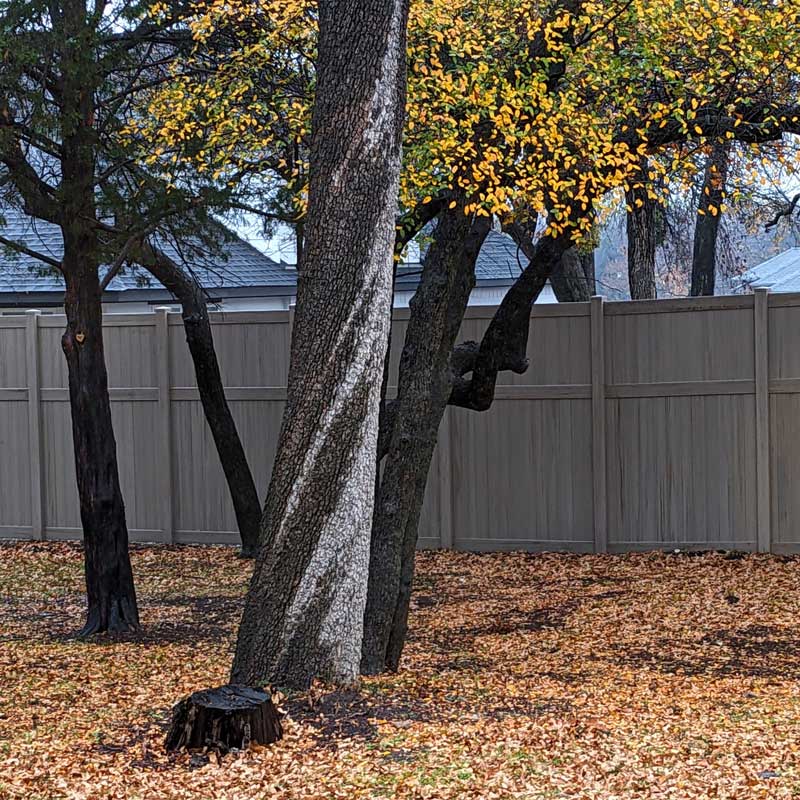
Below is a picture I took of the tree back when it was just twisted.
(if you are viewing this via email, the website has a recording of this poem and commentary; click the title above)
Commentary
Here’s one of those wake up, look in the mirror, and write what you first see poems. Oh well…. Make the most of becoming a ghost.
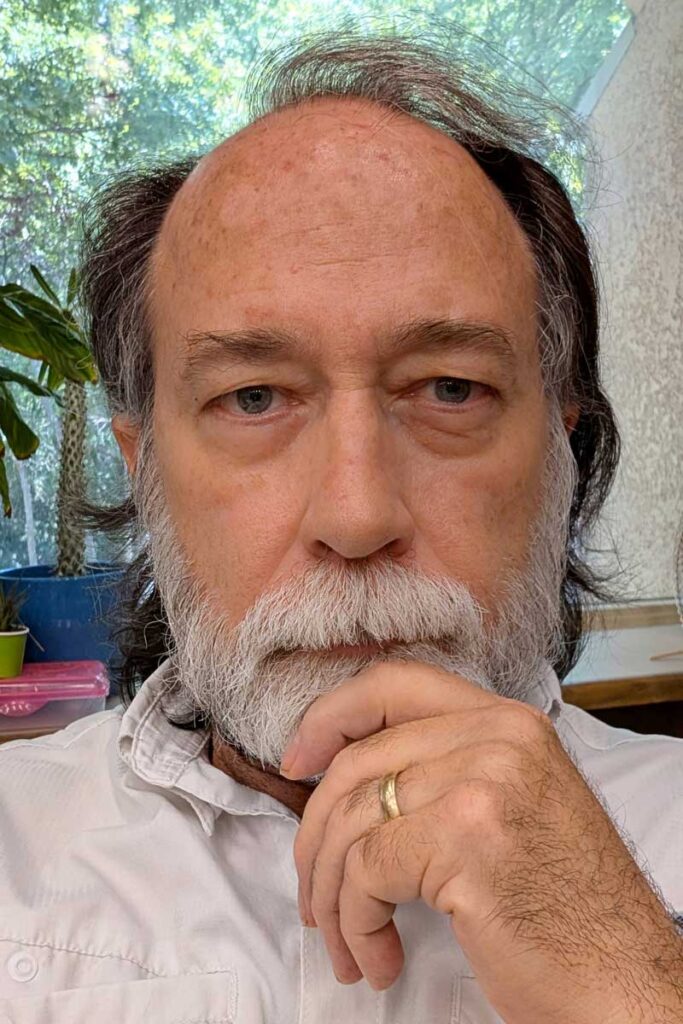
In case you’re imagining a younger me, here’s a selfie I took today. My friend the portrait photographer could find some beauty in this mug, and she’d capture it. She’s amazing.
(if you are viewing this via email, the website has a recording of this poem and commentary; click the title above)
Commentary
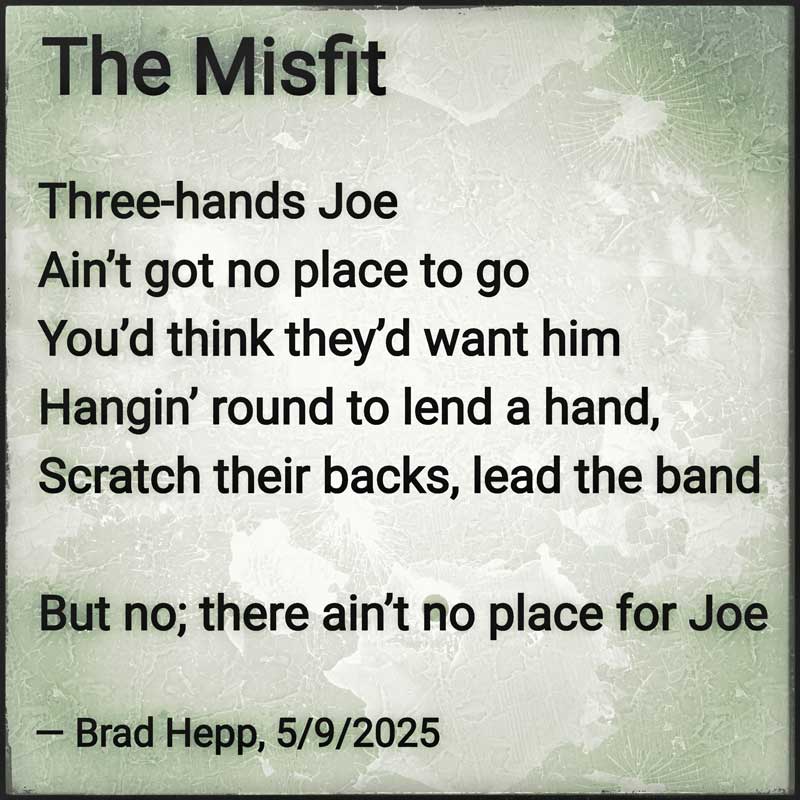
Over the years, I’ve observed something special that happens every now and then. There are people whose physical condition, social skills, or mental peculiarities set them apart as misfits. They don’t belong. So-called “normal” people don’t know what to do with them. Then, along comes someone who sees past problems to a precious person. They strike up a friendship. Digging just below the surface, they strike gold. Looking on, short-sighted society is envious. “Too late,” says the wise man. “He’s MY friend.”
I’ve been on every side of this story. How about you?
(if you are viewing this via email, the website has a recording of this poem and commentary; click the title above)
Commentary
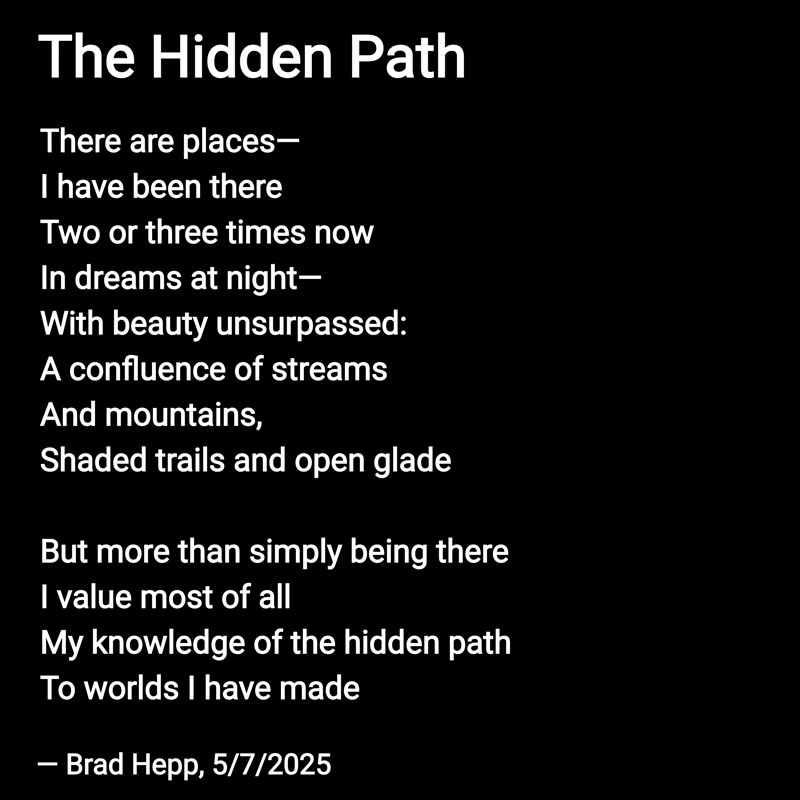
I had one of those fantastic dreams last night, in which the scenery is indescribably beautiful. As I woke up from the dream and reflected on it, I recognized a feature common to dreams of this sort: in the dream, I am always recalling the path to a place I imagined and traveled to before. It’s not the being there, but the getting there I dream of.
This was insight into the nature of my dreams. I have had the same insight before about my waking thought. See “Through Clouds.”
(if you are viewing this via email, the website has a recording of this poem and commentary; click the title above)
Commentary
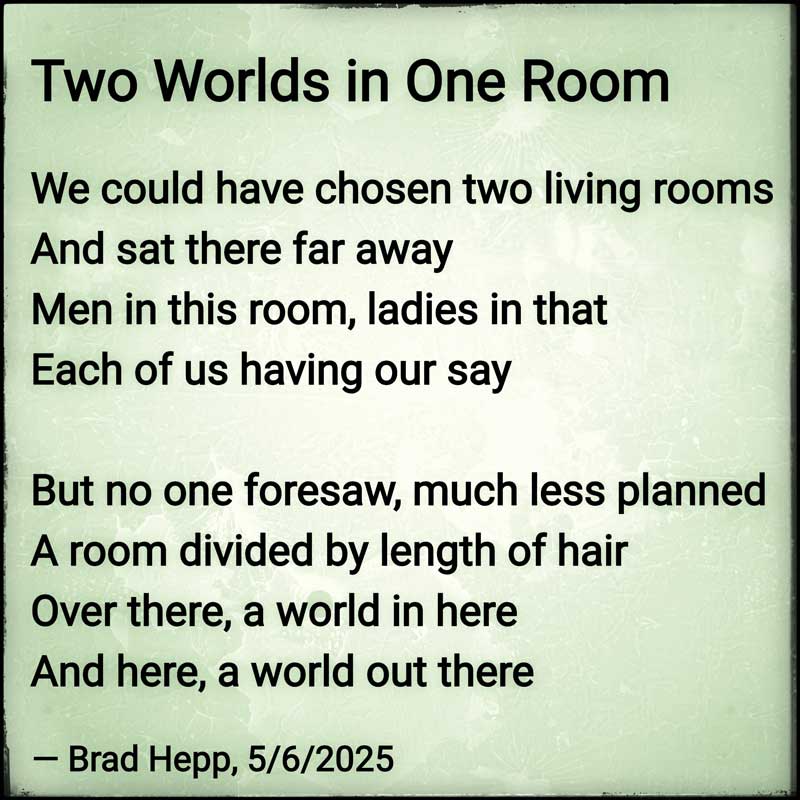
My wife and I attended a lovely party the other day. It was a gathering of dear friends, who have known, loved, and admired each other for many decades. The conversations were encouraging and inspiring. But during much of the party there were two conversations going: men talking with men on one side of the room and women with women on the other. On the drives home, the wives probably all asked their husbands, “So, what were you guys talking about?”
This is not necessarily ideal. Men need women’s wisdom and insights, and vice versa. But it IS interesting to observe how conversations sometimes differ between groups of men and groups of women. Is it nurture or nature? Or both?
(if you are viewing this via email, the website has a recording of this poem and commentary; click the title above)
Commentary
I can count my very best friends on a shop teacher’s hand.* That’s somewhere north of two but south of five. When I’m anticipating my next precious conversation with one of those friends, I often think back to previous conversations. What has developed in my thinking since last time we talked? What has changed? How do I think differently now? Such questions prompted this poem. The world—and much of my thinking—has been in turmoil the last few years. It’s hard to keep up with who the “good guys” are in thought and action. I have picked up, and then laid down, too many banners.
On the other hand, personal turmoil is probably better than personal stagnation. It is by God’s mercy that we grow and change. _________
* I know, that’s not a very good introductory sentence. But when will I ever get to say it again?
(if you are viewing this via email, the website has a recording of this poem and commentary; click the title above)
Commentary
TERRARIUMS*
When I was a boy, I wanted a terrarium. There, within the glass walls of that miniature world, little plants would thrive in healthy contentment.
In my adult years, I created terrariums** of various sorts, and I continue creating them. Some lasted a season. Some lasted decades. But all the terrariums eventually failed. Something always got out of balance. Too much of this, too little of that.
There’s something about knowing evil in a larger world that leaves me unsatisfied by terrariums. It’s not because terrariums fail. It’s because whatever success they have doesn’t fool me. Beyond the glass walls of every terrarium–be it literal or metaphorical–is a world dying in unhealthy discontent.
I don’t want another terrarium. I want a new world.
___________
*How dare ya Insist on “terraria”?
**I wondered if people would read the reference to terrariums literally. I haven’t ever had an ACTUAL terrarium, although I DID wish for a literal terrarium when I was young. Now, a very intelligent reader has let me know that s/he read all the references to terrariums as literal.
I thought “terrariums” was a powerful metaphor for projects that try to satisfy one’s deep-down desire for beauty and control in the midst of ugliness and chaos (likely even more than that).
So, the question is, how could I have retained the power of metaphor while tipping off the reader that I wasn’t being literal? Readers EXPECT metaphor in poetry, but are thrown by extended metaphor in prose. IDEAS??
One idea is a tiny addition to the penultimate sentence: “Beyond the glass walls of every terrarium [–be it literal or metaphorical–] is a world dying in unhealthy discontent.” I’m going to insert that now.
(if you are viewing this via email, the website has a recording of this poem and commentary; click the title above)
Commentary
GRACE, ANYONE?
I was telling someone how striking it is that some live life from upgrade to upgrade while others live a life of patches and repairs. Their immediate response: “Life choices.” Now, honestly, I don’t know if that response was made with disdain or compassion, but it felt like an accusation, one that so-called friends leveled at Job.
Here’s what I’m suggesting in this poem: accounting for all our circumstances as something we deserve treads dangerously on grace.
The title is intentionally misspelled… and deliciously ambiguous.
See my comment below for more poetry with this theme.
(if you are viewing this via email, the website has a recording of this poem and commentary; click the title above)
Commentary
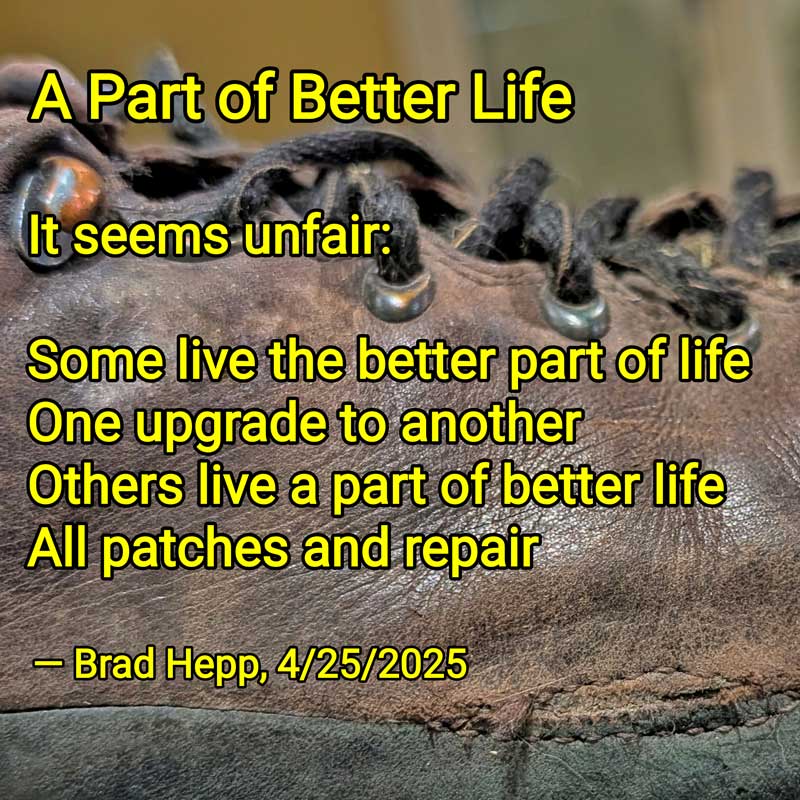
I woke up this morning with the realization that for some people, much of life–“the better part of life”–is just one upgrade after another: a new and better car, a promotion, a bigger house, more money in retirement funds…. So on and so forth. For others of us, life is not so rosy; we can feel like we got the short end of the stick. Something’s not right; something’s not fair. The Psalmist expressed this eloquently in Psalm 73, and included his resolution. I also hinted at resolution by rearranging my words from “better part of life” to “part of better life.” Was the Psalmist’s resolution the same as mine? That’s something for me to think about!
The background photo is of my patched Patagonia hiking shoes. I doubt a better shoe has ever been made! Unfortunately, they got out of the footwear business many years ago.
(if you are viewing this via email, the website has a recording of this poem and commentary; click the title above)
Commentary
How long has it been since you read Carl Sandburg’s “Fog”:
The fog comes on little cat feet.
It sits looking over harbor and city on silent haunches and then moves on.
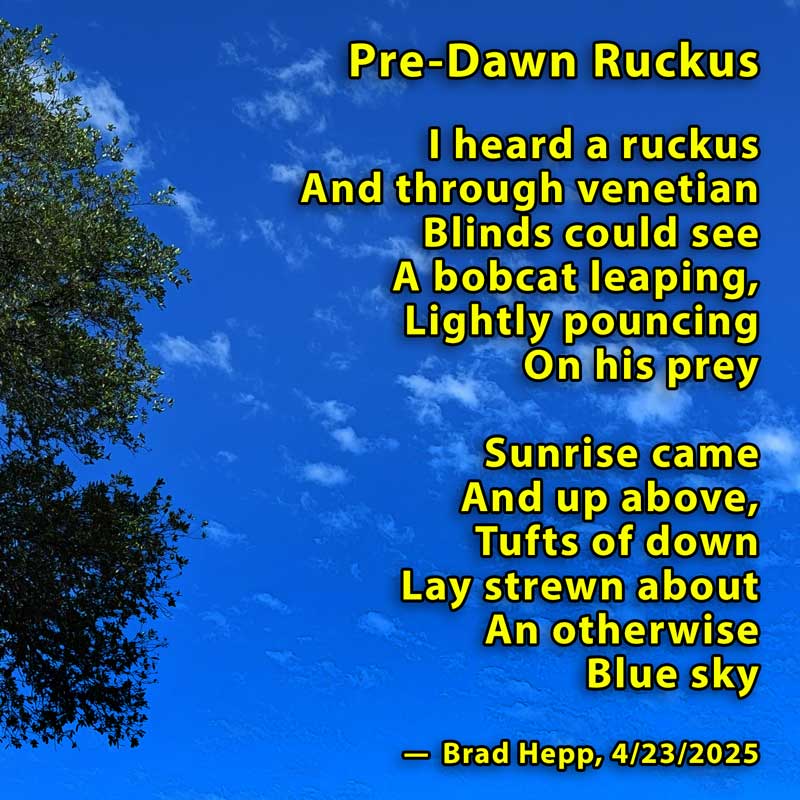
I’m no Sandburg, but my poem was probably inspired by his. Last night, we had a thunderstorm, and on my walk today, the sky reminded me of the many times I have seen wool or downy feathers scattered where some predator had supper the night before.
Do you hear the thunder in that first stanza? Do you see the lightning? And with my explanation above, can you see the remains of the bobcat’s meal in the sky above?
Does it bother you that I didn’t try harder to rhyme in this poem? It would have been fairly easy to rhyme “prey” and “day” or “die” and “sky.” But I didn’t want to do that here. I’m ornery that way, and refuse to comply.
(if you are viewing this via email, the website has a recording of this poem and commentary; click the title above)
Commentary
The coworker I refer to here is really great with patrons, including the eccentric ones who challenge my patience. For example, if “Coin Guy” shows up when I’m on the desk, I go get her to swap places with me for a while. It’s the other way around on Mystery Book Club day.
(if you are viewing this via email, the website has a recording of this poem and commentary; click the title above)
Commentary
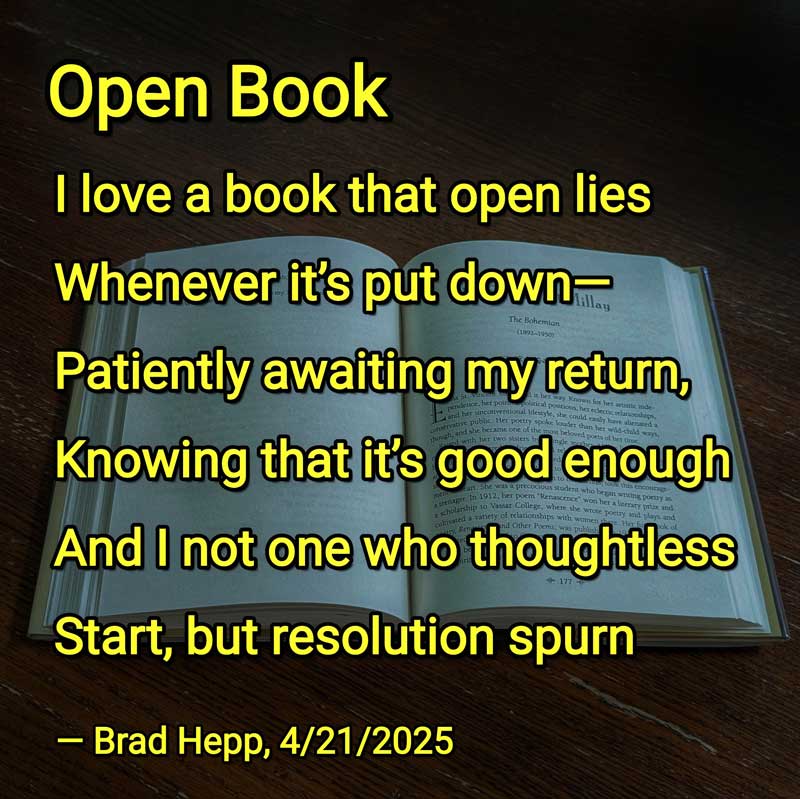
I know this poem is hard to understand. Let me try to explain… or at least sympathize with the reader’s confusion.
For a short time, I had a wonderful counselor who had me bring poems to our sessions as a basis for discussion. This poem, prompted by a literal book, would be an interesting one to discuss. I intentionally injected words suggesting conflict. Do you see them?
For what it’s worth, I do actually like books with relaxed binding. And such a book was actually the inspiration for this poem!
(if you are viewing this via email, the website has a recording of this poem and commentary; click the title above)
Commentary
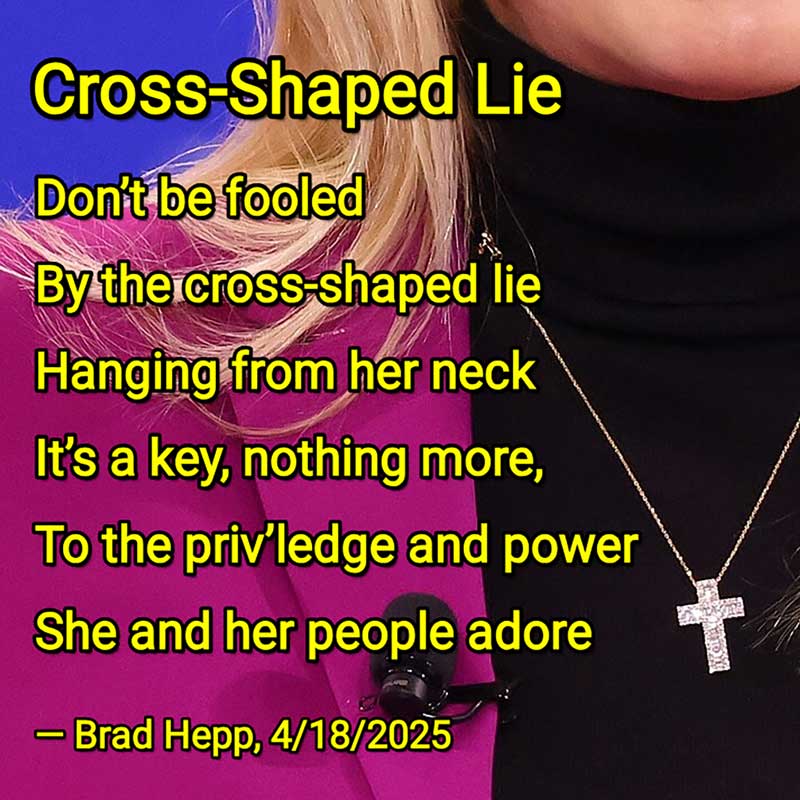
“She” in this poem is “Christian” Nationalism. She was revolting to me when I first came to the United States as a ten-year-old, fresh off the mission field. She’s every bit as revolting to me now. Christianity that’s in control, that dominates society, soon ceases to be Christianity. Lord Acton explained it: “Power tends to corrupt, and absolute power corrupts absolutely.”
If you don’t know what “Christian” Nationalism really is, there’s plenty of good literature out there. I personally learned a lot from Matthew Taylor’s “The Violent Take it By Force.“
(if you are viewing this via email, the website has a recording of this poem and commentary; click the title above)
Commentary
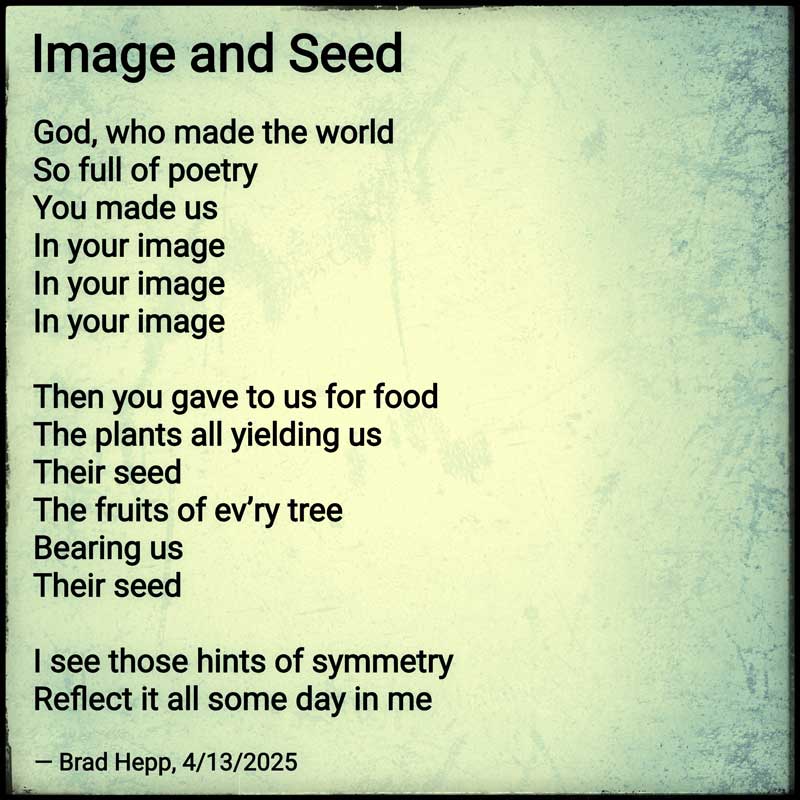
REPRODUCTION? REPLICATION? REPLENISHMENT?
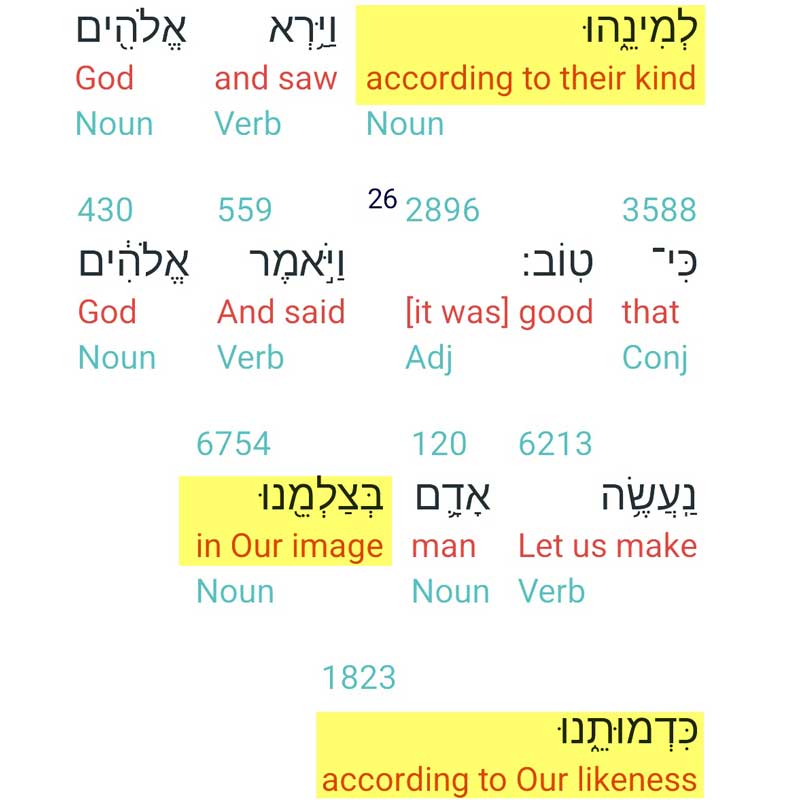
If you read the first chapter of Genesis with fresh eyes,* you may notice an insistent, almost annoying repetition of the phrase “according to its kind.” Then you get to the creation of man, and the phrase in English translations is usually “in our image.” Was the author’s intent to draw our attention to a SIMILARITY or to a DIFFERENCE in God’s creation of man vis-a-vis the creation of all other things? [Look at the Hebrew and ask yourself—or better yet, ask a Hebrew scholar—if the words are radically different]
If you look at some commentaries on the passage, you’re likely to find that they consider the mention of plants’ SEED as an indication of God’s provision for replenishment. Are they correct?
So what’s in view here? Reproduction? Replication? Replenishment? All the above? And how does this affect our behavior in the world today?
__________
*for example, eyes unclouded by a debate over creation and evolution
(if you are viewing this via email, the website has a recording of this poem and commentary; click the title above)
Commentary
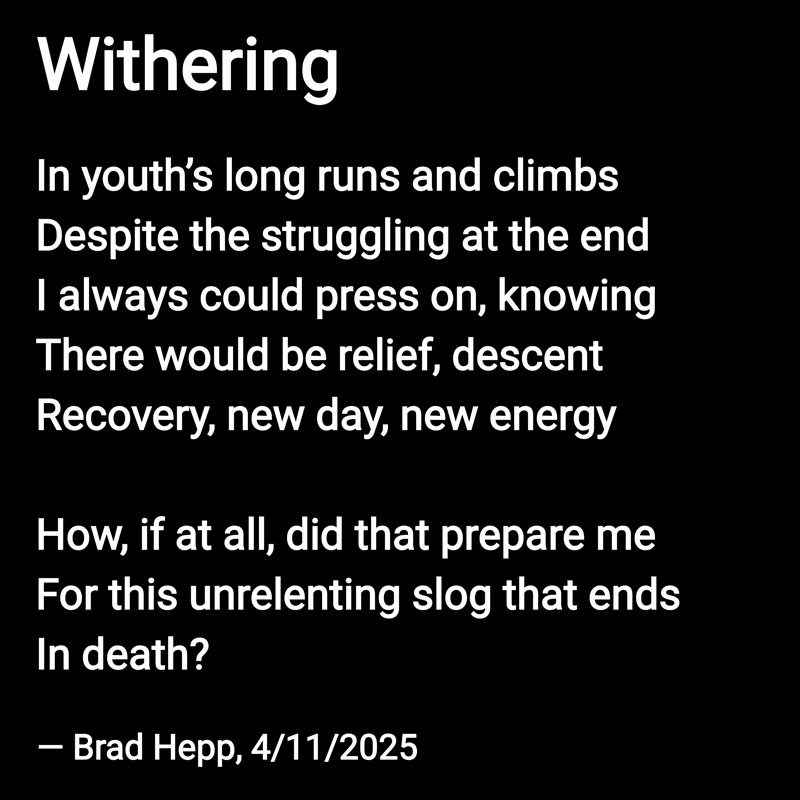
“Where does it hurt? asks the doctor. “In this area,” says the patient, putting a hand on his neck. The doctor starts probing, trying to narrow down the exact location and source of the pain.
This poem is me saying the equivalent of “My neck hurts.” It could be my knee, or my foot, or my shoulder. But the pain is even more general than any of those vague locations. It’s a dull emotional pain that mutters a self-important, “My God, my God, why have you forsaken me?”*
The poem hardly qualifies as a poem, but it prompted responses from wise friends. They read between the lines and reminded me that old age and its pain are not meaningless, and certainly not abandonment.
One incisive friend wrote
As our natural vigor declines, the “slog” provides opportunities to reveal God’s presence with a strength that cannot be easily written off as merely the fruit of happy circumstances. “My power is made perfect in weakness.”
My friend was the doctor saying “Maybe your neck hurts because you’ve been straining to keep an eye on this mirror. Put the mirror down and look up!”
I wrote back, “This may be too out-of-context to make sense, but you remind me of some lines toward the end of one of my favorite poems:
Look not thou down but up! To uses of a cup, The festal board, lamp’s flash and trumpet’s peal, The new wine’s foaming flow, The Master’s lips a-glow!
from “Rabbi Ben Ezra” by Robert Browning
In other words, the emotional component of this painful slog comes in part from forgetting that God takes pleasure in us… not in our pain, but in our loving, grateful, and Spirit-enabled response.
As I grow up, maybe I’ll come to really understand that.
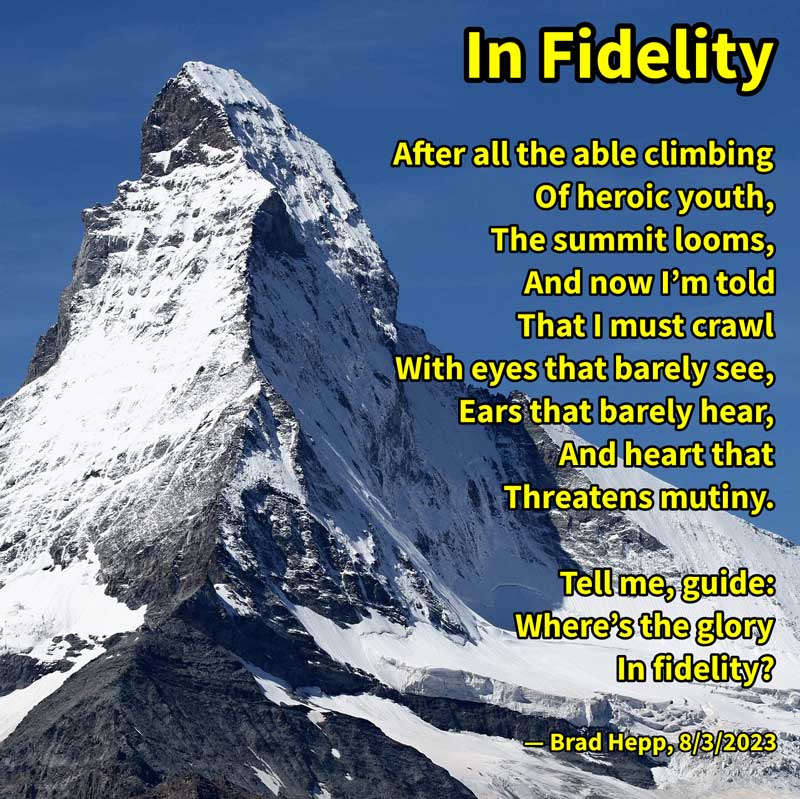
Here’s another poem that expressed the same frustration I experience with aging:
_________
*I don’t mean any kind of blasphemy by what I wrote here. What I intended is actually self-deprecation. I’ll have to give this more thought….
(if you are viewing this via email, the website has a recording of this poem and commentary; click the title above)
(background image by WikiImages on Pixabay)
Commentary
Robert Frost wrote that, “A poem begins as a lump in the throat, a sense of wrong, a homesickness, a lovesickness.” I think he meant that literally. The connection between a strong emotional state and the urge and inspiration to write poetry is palpable. But it isn’t just negative emotions that set us poets off! Euphoria will also do it. Oh yeah… speaking of Frost: for inspiring, euphoria’s also great and will suffice.
Enough generalities! The other night, I was sipping some whiskey. One ounce in and working on a second, I suddenly recognized this euphoric urge to write poetry. It’s a feeling that “Suddenly the world looks different; suddenly I see with new eyes. I must capture these realizations, I must net these butterflies!”
Trust me: very little of my poetry is whiskey-induced. In fact, most of it starts in the early-morning fog soon after rising. Perhaps my brain would like to go back to bed where it’s free to spin dreams.
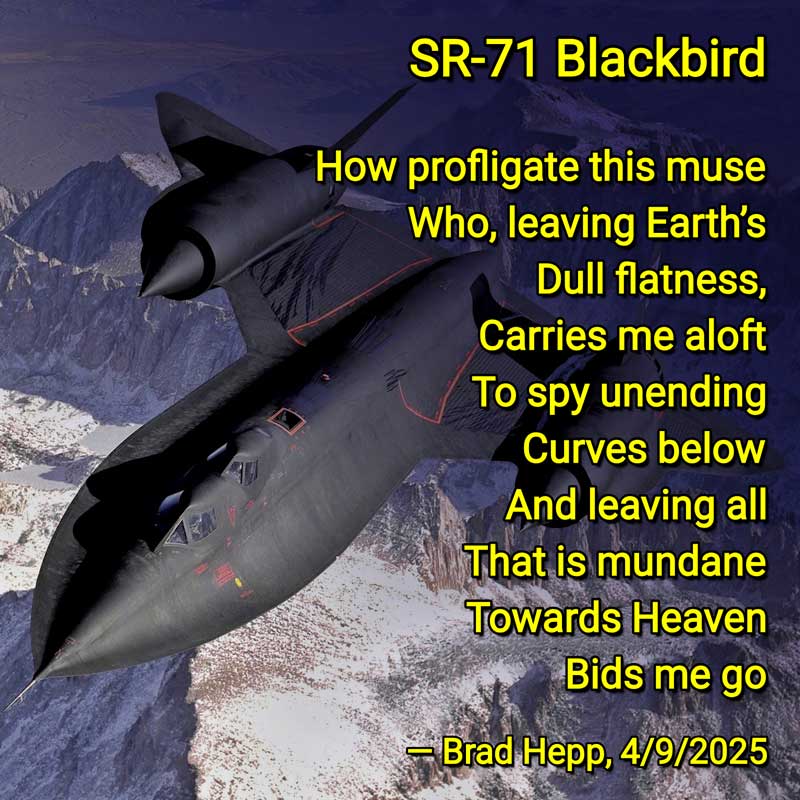
Anyway, there it was… that feeling of euphoria, and the confidence that I could see new connections, find new analogies, devise new metaphors…. But I sensed danger: this is how writers turn into alcoholics. So I jotted down two lines and gave my thought a possible title:
SR-71 Blackbird I really can’t afford this muse Who leaves my troubles all behind
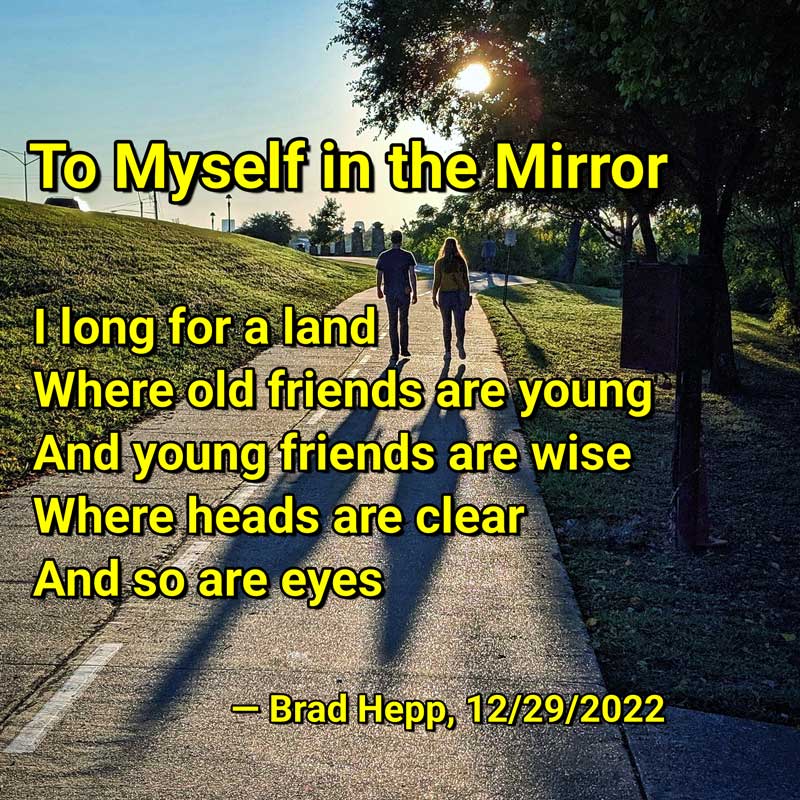
TOWARDS HEAVEN BIDS ME GO How can I write that line about something as dangerous as whiskey? Well, I’m convinced that God gives us many glimpses of Heaven, including intoxicants. I do long for a time when I can see things anew, with eyes unclouded by the cataracts of trouble and worry. As I said once before to myself in the mirror,
(if you are viewing this via email, the website has a recording of this poem and commentary; click the title above)
Commentary
CHILDISH AND CHILDLIKE
I think I’ll start a new theme in this poetry blog: Protestation. The truth is, my muse has thin skin, and she always starts spitting out ideas when something offends her. She needs to grow up.
Don’t get me wrong—my muse isn’t all bad. She also takes childlike delight in things that are rarely ever recognized or celebrated… but should be.
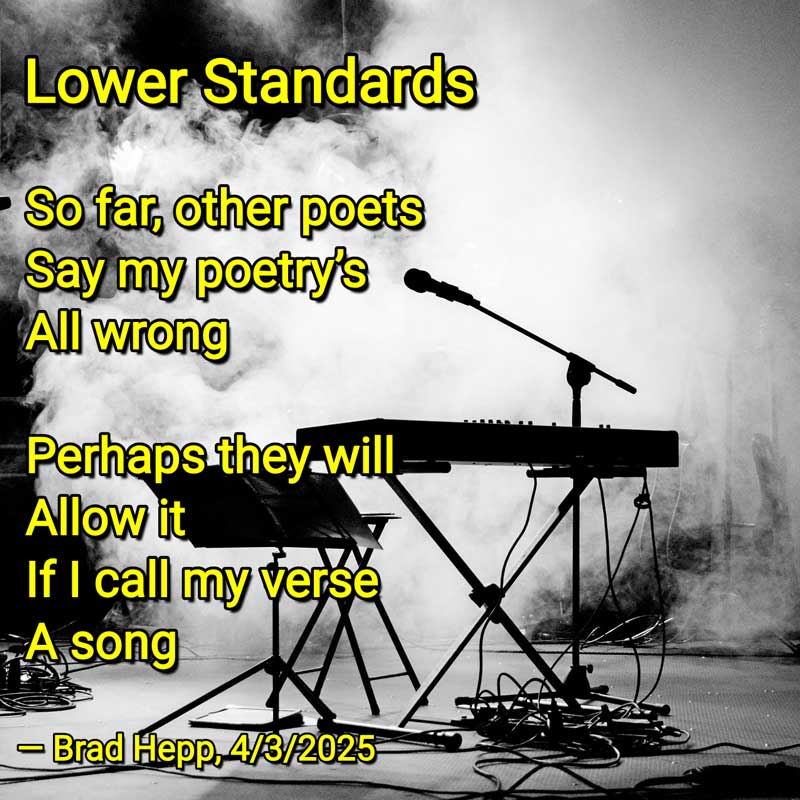
By the way, I don’t believe that song lyrics are inherently inferior to other poetry. But I bet some poets do.
(background image by HubertPhotographer on Pixabay)
(if you are viewing this via email, the website has a recording of this poem and commentary; click the title above)
Commentary
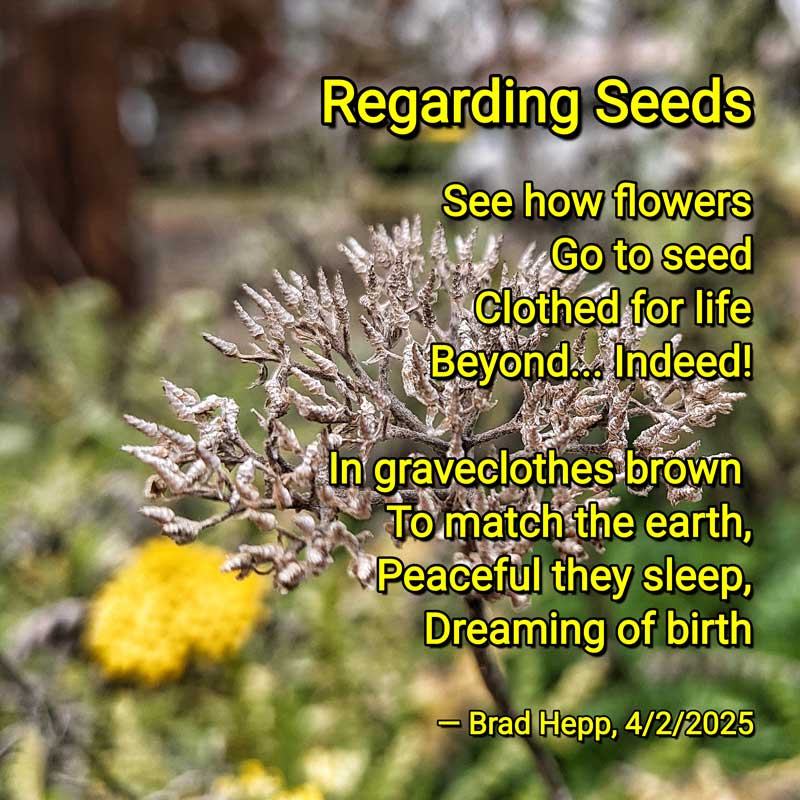
A friend’s photograph of blooming yarrow reminded me of this curiosity I photographed in December. I think now it too must have been yarrow. Where each small flower had once been, there was a neatly-wound gravecloth protecting the developing seed within. At least that was my best guess. I’m a poet, not a botanist.
Someday, I hope to publish chapbooks of my poetry. One of those short collections will probably be titled “Flourishing,” and it will draw from poems I currently group under the theme “Seeds” (see the poems in that section). I think we tend to miss out on the beautiful, fascinating, and inspiring lifecycle of plants, and how much more of it represents flourishing than the short time of flowering. Of course I’m thinking of more than plants.
(if you are viewing this via email, the website has a recording of this poem and commentary; click the title above)
Commentary
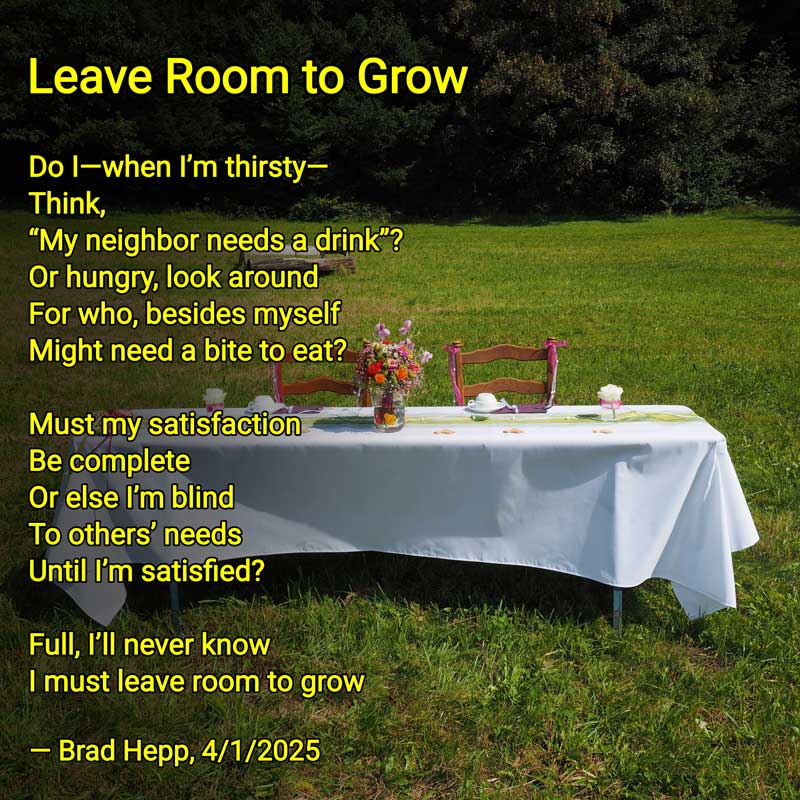
I began this poem in February, and I recall a keen insight then about my lingering selfishness. Today, I add the final two lines and title with a prayer that God will indeed cause me to grow more like Jesus as described in Philippians 2.
Being others-oriented with regard to the physical needs of food and drink is pretty elementary. When I grow up, I may extend the principles I learn here to other, less obvious aspects of life. But food and drink are a place to start. Even Jesus fasted. Could we say that fasting was part of him learning obedience? Recall Hebrews 5:8, which reads, “Though he was a son, he learned obedience through what he suffered.”
Where are you full, and need to leave room to grow?
(if you are viewing this via email, the website has a recording of this poem and commentary; click the title above)
Commentary
I try to always write poetry quickly, sign my name, and NOT go back to edit. My official, virtuous-sounding excuse is that I believe that to be the way I’ll become more fluent as a poet. If I’m always questioning my muse, she’ll become shy and hesitant. Right? It doesn’t hurt that this approach perfectly fits with my laziness! See another poem where I do some other self-justifying: “Socks Like Poetry.”
Today’s poem is one that I edited TWICE after publishing it on social media. In some respects, it’s better… otherwise I wouldn’t have bothered. But it has one downside: it runs the risk of suggesting that I think of myself as more enlightened than some who read my poetry. That’s generally not the case. When I write poetry, I’m usually grasping at things I barely understand! We’re all benighted, to one degree or another. We all need each other’s help to see the light, and experience God’s delight.
As for the overall concept…. The revelatory power of poetry is something I am increasingly experiencing in other poets (George Herbert comes to mind!), and hereby pray for regarding my own poetry.
(if you are viewing this via email, the website has a recording of this poem and commentary; click the title above)
Commentary
I think I should start a new category under Poetry Themes. I’ll call it “Experimental.” This poem belongs in that category.
Recently, I noticed that specific locations get attached to my memory of significant conversations (see “Entertaining Possibilities“). In today’s poem, I explore how an object gets attached in the same way, in this case, “walking shoes.” There’s a particularly poignant memory I have of a conversation with a friend. He/she had come to the realization that they must leave–“walk away from”–something they loved. We were meeting for a casual stroll, but as I approached our rendezvous point, I could tell from a distance that something was amiss. My friend was wearing dress shoes, not walking shoes.
I set out to write a poem about that memory, not knowing where it was going to go, except that I must guard my friend’s privacy. By the end of the third stanza, I had told all I felt safe telling. Was it enough? Would the reader be upset that I ended so abruptly, and without resolution? I don’t know. I’m still thinking about that. Comment below, if you have an opinion.
Here’s another question that this poem raises for me: Does the mind routinely intermingle literal and figurative meanings (in this case, two uses of “walk”)?
Children explore their world and the questions it raises by playing. I’m “all grown up,” but I still explore my world by playing in a sandbox called poetry.
(if you are viewing this via email, the website has a recording of this poem and commentary; click the title above)
Commentary
THE PLACE OF HOSPITALITY IN CONVERSATION
Terrible and terrific conversations are both so notable to me that my mind stores them with a seemingly unimportant fact: precisely WHERE those conversations took place.*
I was standing over there when the young lady shut down brainstorming by proclaiming, “That is impossible!”**
I was sitting at my desk when the young man ended all exploration with his boast, “I have studied computers, so I can confidently say you are wrong.”***
The old professor and I were both sitting in recliners in his den when he allowed, “I hadn’t thought about that interpretation of the poem we’re discussing; let’s see what additional support we can find for your idea….”
What is it about PLACE that attaches to the memory of hospitable—and inhospitable—conversations?
(if you are viewing this via email, the website has a recording of this poem and commentary; click the title above)
Commentary
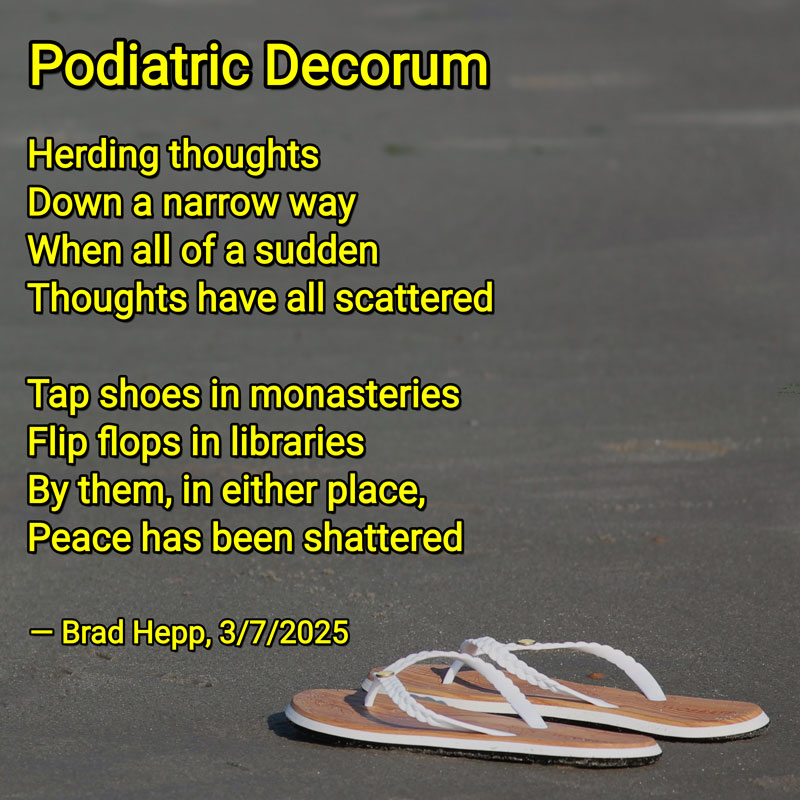
It’s probably just distractible little me who feels this way….
For some reason, my sieve of a memory recalls occasions when I was trying to concentrate in a library, but could not because of one or another distraction. In college, it was students who walked around in flip flops: “Flip, flop; flip, flop, flip, flop.” There were also the ones who were struggling with term papers. They would loudly wad up one sheet after another to protest their own bad writing. Then there was that librarian in seminary. He always sat in his office with the door wide open, cheerfully whistling his library tunes.
I’ve never tried to concentrate in a monastery… or do anything else there, for that matter. But I’m guessing that tap shoes are frowned on in that sacred place.
(background image adapted from one by Manfred Richter on Pixabay)
(if you are viewing this via email, the website has a recording of this poem and commentary; click the title above)
Commentary
Let’s see if I can explain this one to you as successfully as I explained it to my wife….
I think most of us heard this little rhyme sometime in our youth: “Step on a crack, break your mother’s back.” Of course that’s superstitious nonsense. But for some reason, it sticks in my head all these years later. It’s an intrusive thought that needles me every time I stroll down a city sidewalk. I can be listening to a narration of George MacDonald, or C. S. Lewis, or Dostoevsky. My head can be in the clouds, but my eyes don’t miss those cracks, and I’m repeatedly tempted to adjust my pace to match their spacing.
I wish I were free of this nonsense. I wish I were on a mountain path, where the disorder of roots and rocks may fix my attention, but more in the way of a friendly conversation with companions. I’d gladly go that way. I’d gladly submit to the slight difficulty they impose. There, I’d gladly undergo.
(if you are viewing this via email, the website has a recording of this poem and commentary; click the title above)
Commentary
Last night, I sorted three piles of junk into five piles of junk. Susan assured me that this was progress. Then, in my dream, a math professor was mumbling his way through a problem I couldn’t understand, or even care about.
And that’s just on my carpet, in my house, in my head. These are small problems…. In the larger world, we’re being conquered by chaos.
(background image adapted from one by congerdesign on Pixabay)
(if you are viewing this via email, the website has a recording of this poem and commentary; click the title above)
Commentary
[NOTE: This was a visceral response to reading an early, immature work of one of my favorite authors. I have experienced that profound disappointment before, with other authors, especially those of whom I had high expectations.]
SEETHING AND SOOTHING
I sometimes SEETHE when authors expect me to import a world of authority or beauty into their writing. Here are some things they do….
Their chapters always begin with quotes that the reader is supposed to relate to what the author is going to say. Occasionally, that’s helpful; more often it’s DISorienting.
They make too many references and allusions: “As Karl Barth wrote, ‘In the words of Anselm’….” If they must document their source or authority, I wish they’d use footnotes. It’s less distracting. Keep the text clean and simple.
They overstuff with metaphors. Nothing against metaphor—I’m a poet for God’s sake*—but too much is cloying.
But good writing? Really good writing? It SOOTHES me. My brain says “Thank you!”
Now, where’s a mirror?
*Yes, I thought about this, and decided I was NOT being flippant with God’s name.
(background image loosely adapted from an original photograph by Deborah Hudson on Pixabay)
(if you are viewing this via email, the website has a recording of this poem and commentary; click the title above)
Commentary
When I posted this on Facebook, I noted that “Sadly, this poem will anger some Christians.”
A new FB friend* responded, “If it angers believers, then they don’t want to follow the words of Jesus from Matthew 5. If they aren’t okay with this truth, then they shouldn’t claim to follow the way of Jesus.”
(if you are viewing this via email, the website has a recording of this poem and commentary; click the title above)
Commentary
President Donald Trump, with his usual bombast, has declared that his second term will be a new “golden age” for the country.
CNN, January 21, 2025
One of the few comforting thoughts these days is that we’re witnessing the death throes of a dying beast.
Within a week of the recent inauguration, I wrote the following:
I’m seeing first-hand evidence that foreigners, here in the United States on a thoroughly LEGAL basis, are now hiding. One can say they’re being unreasonable. But imagine what it would be like to have to carry YOUR proof of citizenship or legal status with you everywhere and at all times lest some over-zealous authority arrest you and detain you until… until… until what?!. Wouldn’t happen to you? Why? Because of your skin color?
Have you paid attention to how the recently-installed administration has appealed to fear of the foreigner, of the stranger? How have foreigners–especially people of color–been characterized? (answer: in RIDICULOUS, OUTLANDISH WAYS that appeal to people’s unreasonable fear). Fear breeds brutality breeds fear.
(if you are viewing this via email, the website has a recording of this poem and commentary; click the title above)
Commentary
I know plenty of us experience this… at least the part about thinking of too many things at once. It may be less common to think long and deep about one thing.
(if you are viewing this via email, the website has a recording of this poem and commentary; click the title above)
Commentary
I wrote this poem in the pre-dawn darkness as I struggled once again with a passage in Romans. It’s so easy to think I understand something… until I think again.
I have always struggled with remembering the “right” answers. So I turn my mind again and again to solving the same problems. It can feel like defeat. It can even feel like moral failure. However, I am slowly but surely learning to not beat myself up for this weakness, but to celebrate its advantage. Better to be continually seeking the truth than to proudly give up the search, having arrived at half-truths.
(if you are viewing this via email, the website has a recording of this poem and commentary; click the title above)
Commentary
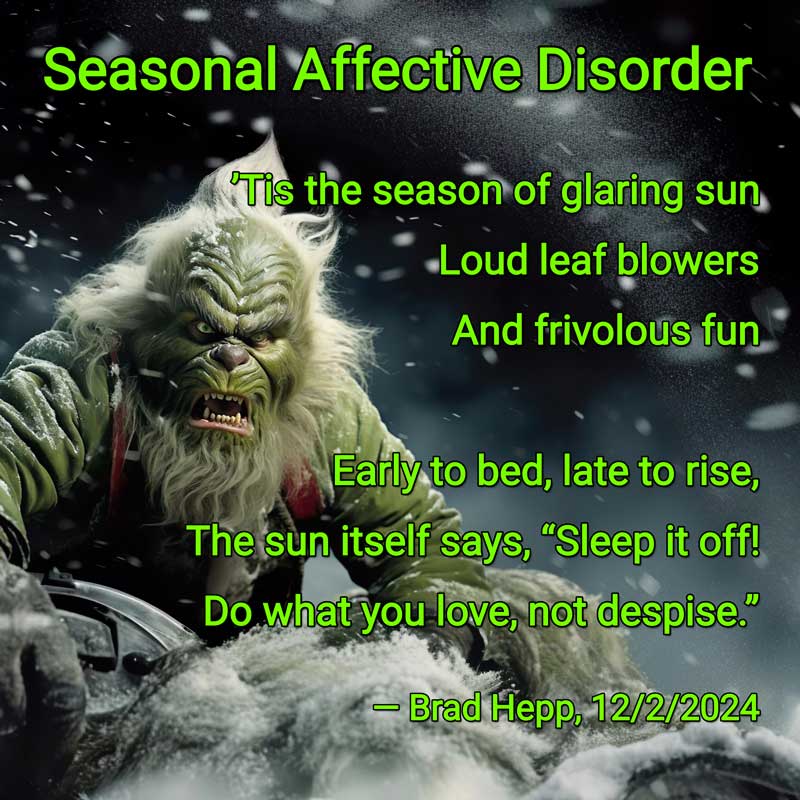
My recent writing probably makes it obvious: I’m struggling with disappointment and irritability. I’ll not bore you with the many, many irritants that swirl around me. Just know they are there, and some of them are even real!
Anyway, I thought I’d better have a little chat with my boss, the library manager. When I’m struggling internally, paranoia kicks in and I falsely assume that any smart observer can see right through me. What a relief to learn that my boss completely understands–and sympathizes with–my stress. In fact, he himself had recently published a blog post specifically dealing with holiday stress. That doesn’t mean I’m free to be a Grinch. I still have to be polite to patrons and coworkers. But if I’m feeling irritated, at least I’m not afraid of a secret and powerful judge of “mere” FEELINGS.
(background image is AI-generated and submitted to Pixabay by Jeanette Atherton)
(if you are viewing this via email, the website has a recording of this poem and commentary; click the title above)
Commentary
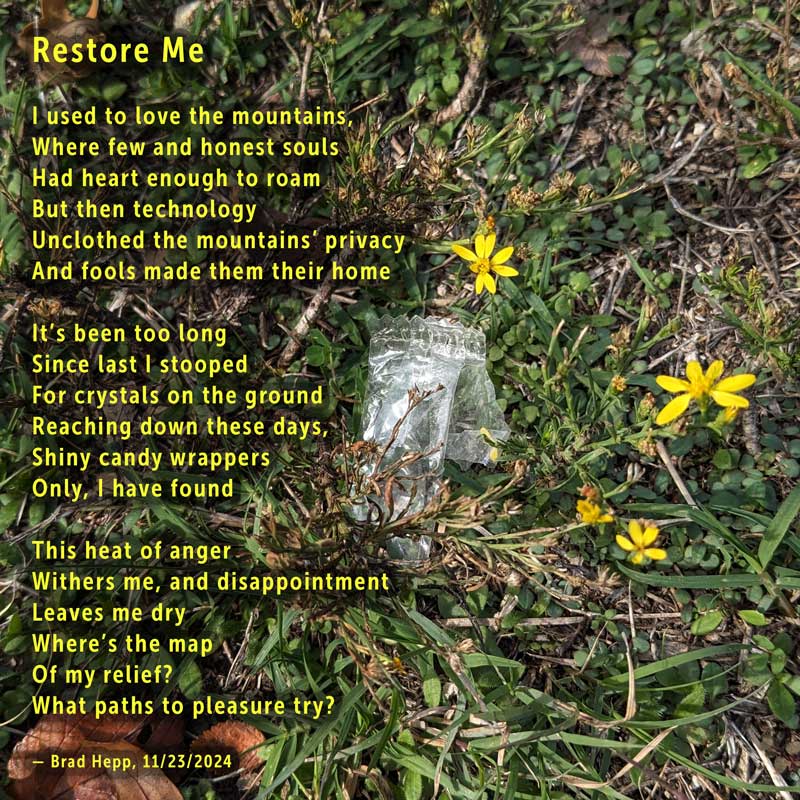
This poem is not about mountain climbing,* or litter, or relief maps. Rather, it is an indirect way of expressing the anger and disappointment that chatters persistently in my thoughts. While I do have much to be thankful for–it IS Thanksgiving morning as I write–I’m finding it hard to escape or ignore disappointments and annoyances. But let me explain the imagery in the poem….
I started climbing mountains over forty years ago. Back then, we didn’t have the Internet to help us plan routes. In the weeks before a climb, I’d take trips down to the Dallas Public Library and spend time with topo maps prepared by the U.S. Geological Survey. I’d spread several maps on the big tables, stand to the side, and view them together to familiarize myself with the general contours of the land surrounding my destination and chosen route. I’d pick out likely camping spots, based on the terrain and water supply. Then I’d mark up my own copies of the maps, circling key points, including landmarks I could use on the trail for triangulating my approximate location.
Climbing mountains was an exciting adventure. There was mystery and danger, even though I prepared in advance. When I got to the mountains–generally with two or three companions–there was also solitude. We’d find evidence of prospectors and hunters who preceded us there by many decades. But we generally had the place to ourselves. The few fellow climbers we did encounter–particularly at higher elevations–were immediately recognizable as kindred spirits. They were honest, hard-working fellow climbers.
As the years passed, the Internet, and GPS, and smart phones opened up the mountains to a whole new group of casual adventurers. When we reached the summit of mountains in latter years, it was not uncommon to encounter a gaggle of college girls in yoga gear, doing yoga poses… bless their hearts. While man–including precious young ladies–is the height of God’s creation, it was vistas of another sort I had climbed the mountain to admire.
Nowadays, the closest I get to mountain climbing is taking long hikes through neighborhoods, fording a busy stream of traffic, and cutting across the fields around White Rock Lake. Bad hearing isolates me from the few birds, but not from the ridiculous rumble and roar of traffic. A terrible floater in one eye and cataracts in both eyes have robbed me of the clear eyesight I have always treasured. Addressing these annoyances is delayed by tight finances. Maybe next year I’ll be a bionic man, but for now I am an active mind shackled in a deteriorating body.
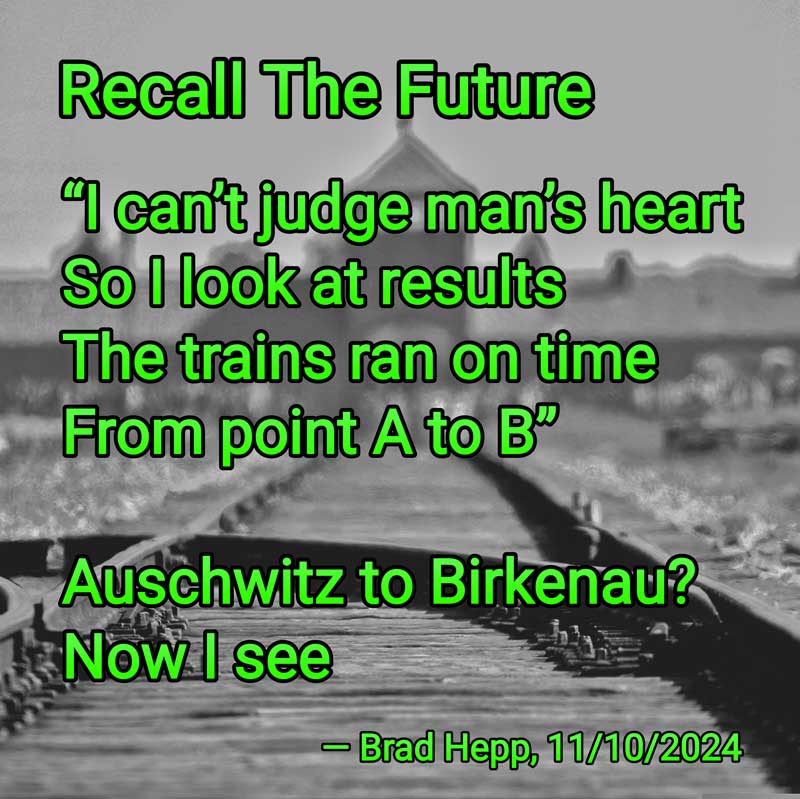
The annoyances I complained about above may be the most manageable of all my annoyances. Last week, I wrote a short poem of complaint about the direction our country seems to be taking: “Recall the Future.” The recent presidential election was extremely disappointing.
BUT BRAD… ISN’T IT THANKSGIVING?! As I mentioned above, it is Thanksgiving morning as I write this. I feel the pressure to end this lament like most of David’s Psalms, with an answer to all my complaining. But right now, I think it’s best to acknowledge where I’m “at”. Perhaps I can consider and even take consolation from a paradox that occurred to me on one of my long walks:
To be increasingly content in this world is a virtue. To be increasingly satisfied with this world, not so.
*[To understand how mountains form the backdrop of my thinking, check out some of my other poems in the category “MOUNTAINS”.]
(if you are viewing this via email, the website has a recording of this poem and commentary; click the title above)
Commentary
This is a bit of conflation, and I’m not going to apologize for that. It’s what we poets do.
[NOTE: I am truly sorry that the following will likely offend some of my friends. If it helps, let me say that this post is NOT about Democrats versus Republicans, or even about Liberals versus Conservatives. Both sides have serious problems!]
I am extremely disappointed that the United States just elected Donald Trump for a second time. The man is a narcissist, rapist,* felon, and shameless liar with fascistic tendencies. I cannot erase the picture of him twiddling his thumbs for three hours while his violent minions brutalized police and ransacked our nation’s Capitol on January 6, 2021. I cannot forget his juvenile insults of everyone who opposes him. I cannot forget how he claims that everything is rigged against him unless he prevails. I cannot forget how he denigrates immigrants (especially if they are people of color), always appealing to our latent racism. I cannot forget the number of times he has claimed that he knows more about any number of things than anyone else. I cannot forget how many cabinet members from his first administration warned us that the man does not belong in the White House. But we know better, right?!
The Poem He’s a bully, and a wannabe “strong man” like those who ruled Germany, Italy, and the Soviet Union in the 1930s. But what percentage of our population know even the basics of pre-World War II history? What percentage of our population recognize how history is repeating itself as we give up freedom and pave the way for tyranny?
I suspect many, if not most politicians DO know the relevant history. But they turn a blind eye to how history is repeating itself. It is their duty to stand up for the rule of law, to uphold the Constitution. But how can they stand up when they are spineless in their self-seeking exercise of power?
*While he was convicted of “sexual abuse,” Federal Judge Lewis Kaplan ruled that E. Jean Carroll’s rape allegation was “substantially true.”
(background image from a photo by Ron Porter on Pixabay)