My work is done for the day. His work may now proceed.
a digital commonplace book
My work is done for the day. His work may now proceed.
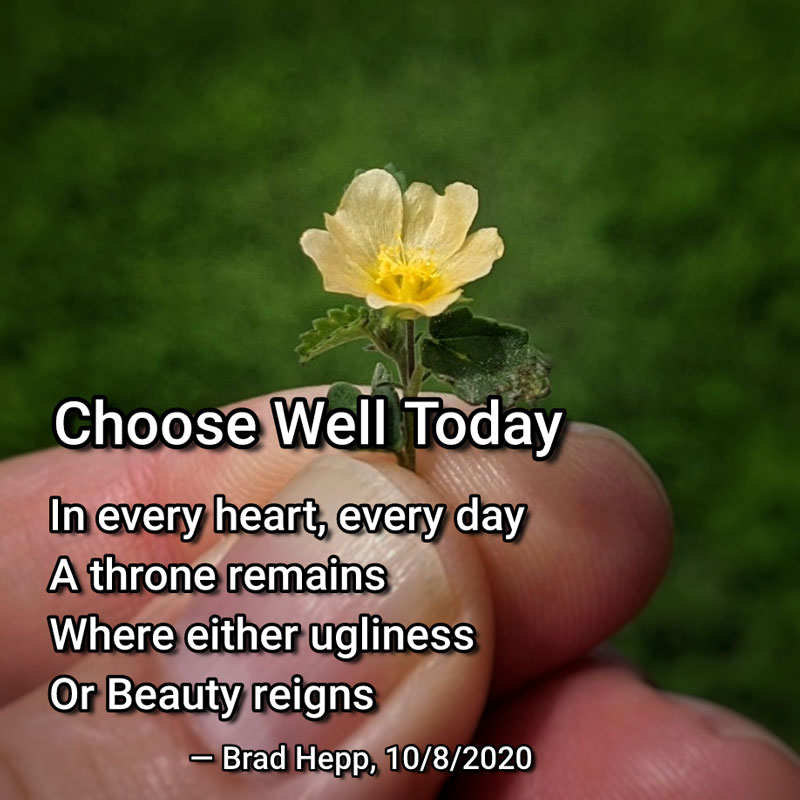
Most days I take time to reflect on beauty. No king anywhere has more of this than you or I.
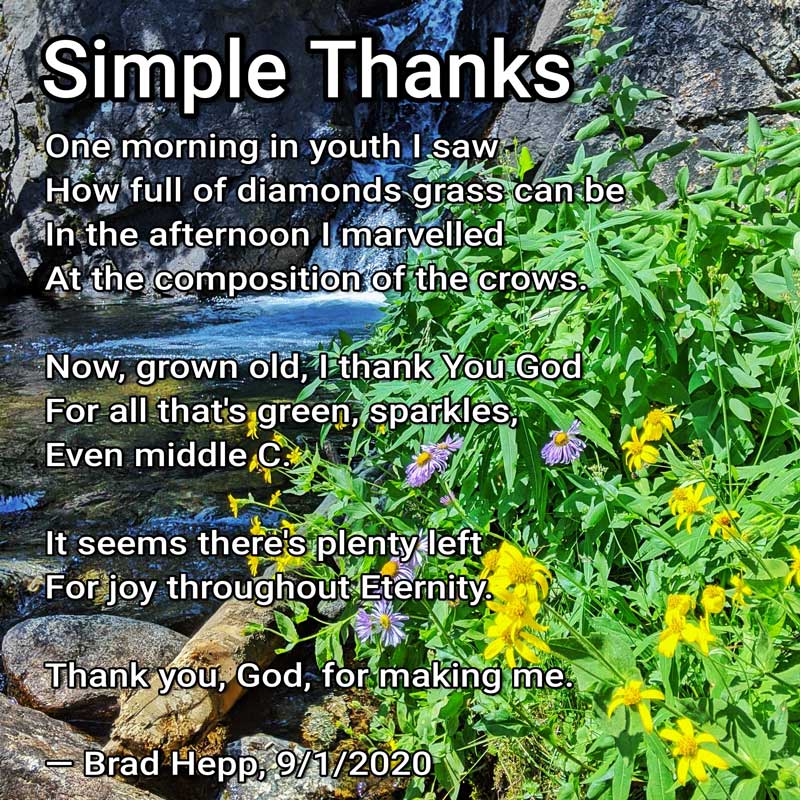
Background image: Willow Creek Falls near Silverthorne, Colorado
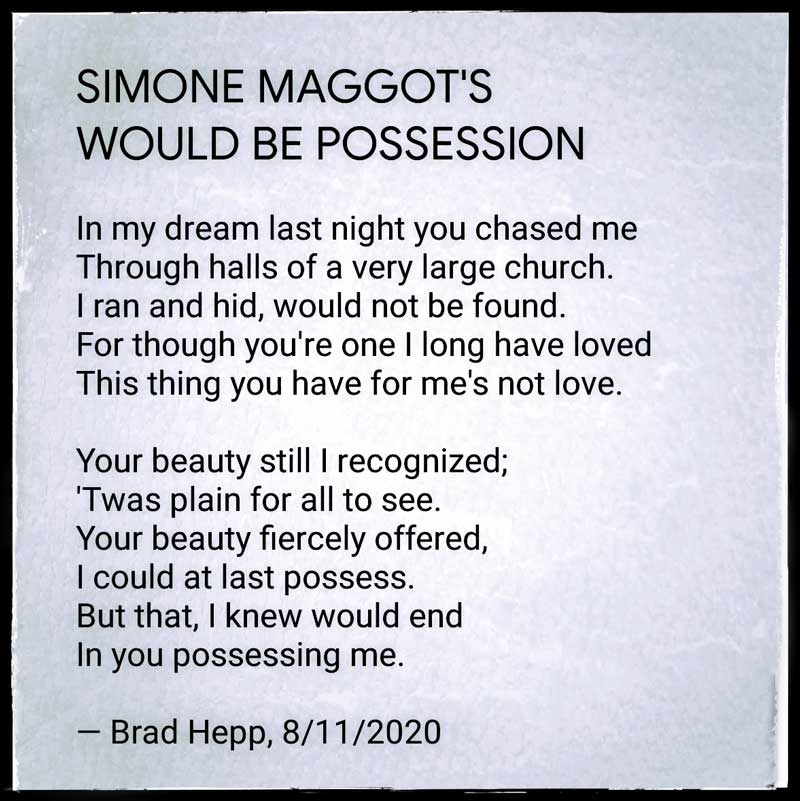
This strange poem is the nightmare I had last night. I *think* it wove two strands: contemplating Acts vis-a-vis evangelical triumphalism (really!), and reflecting on the vulnerability young people have to passions (I’m a father, who once was young).
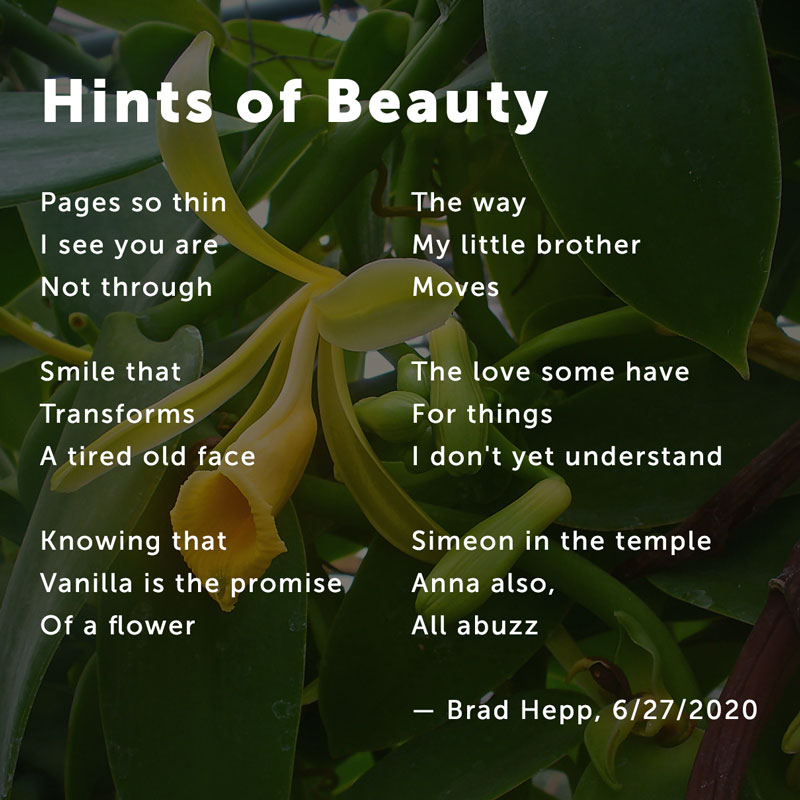
At Christmas, we often hear a child recite the first 20 verses of Luke, chapter 2. That’s beautiful. But it’s the section immediately following that affects me most deeply. When the child Jesus is presented at the temple, Simeon and Anna recognize that they are witnessing something that will change the course of history. They have both waited a lifetime for the “consolation of Israel,” the “redemption of Jerusalem.” And here He is!
This is the least emotionally honest of the stanzas. On those rare occasions when I pick up a printed copy of the Bible to read (my go-to is digital text), I can see through the thin pages to printing on the other side. I am not actually moved by BEAUTY when I see that. Rather, what that points to in this stanza is thematic. What all the other stanzas have in common is the anticipation of beauty replacing ugliness. MacDonald said it well: “The end of the Maker’s dream is not this.” I think that anticipation of beauty is what affects me.
One day, my son and I were waiting at Sonic for the waitress to bring our order out to the car. As we waited, Jonathan commented, “She doesn’t seem very happy.” I responded, “When she comes out, give her a big smile, and watch what happens.”
She came out, holding our tray of burgers and fries. Jonathan flashed a big smile at her, and her tired old face twisted into a responding smile. After we rolled up the window, I asked Jonathan if he had seen the transformation. He had!
I am looking forward to the smile of God, in the restoration of all things (see “Violets”).
Last year, I had spent months photographing flowers on my walks. In Autumn, the flowers were spent, and I wondered what was left to photograph. Then I started looking closely at what had become of the flowers. Seeds, of course. And some of the seeds were also beautiful and fascinating. But what really grabbed me was the realization that seeds are not the end of beauty, but its beginning (see “Dawn of Eternity”).
I love to watch young children moving to music. There is one video in particular that comes to mind. I believe it may be a young Malawi boy moving subtly to music. His smile and movement are enchanting. So why “my little brother”? I’m the youngest of my family. I don’t literally have a little brother. Rather, I look forward to a day when barriers are removed and we can fully enjoy the brotherhood of man — with all its cultural diversity and beauty.
I have had several exchanges about language with my Ethiopian friend Yohannes. When he points to beautiful speech and ideas expressed in Amharic — a language I do not know — I tell him I’m jealous. His response: “That’s beautiful my friend. It speaks of a lot of good things. The wonderful thing is that one day we shall all understand!”
I wrote above that the accounts of Simeon and Anna in Luke 2 affect me deeply. Here’s how deeply…. Once, I was walking around the lake listening to an audio version of the Bible. When I got to the account of Simeon and Anna, tears started streaming down my face. It was a good thing nobody else was out walking that day. Why was I so moved?
Simeon and Anna were both very old. They would soon die. But this child filled them with hope. Perhaps it was “merely” hope for their people. But you and I know the rest of the story. Thirty-something years hence, Jesus would die a death that will forever put an end to death and ugliness. His Resurrection from the grave demonstrated God’s power and pleasure in restoration. Like all who believe, Simeon and Anna will once again embrace their beautiful Creator.
This is a companion piece to Music: Beauty’s Channeling
This is a second attempt to understand beauty as preceeding its so-called production. Although it may seem that I am empasizing the heavy task of the artist, the real point is that the artist is unveiling beauty from the time he or she begins the project. As one who believes that creation is full of beauty put there by God, I am trying to appreciate his role… without diminishing the role of the artist.
Michelangelo said something similar long ago:
The sculpture is already complete within the marble block, before I start my work. It is already there, I just have to chisel away the superfluous material.
Michelangelo Buonarroti
Every day, when I lie down for a nap, I listen to beautiful music and try always to think of where beauty was born. This may sound silly to some, but I’m trying to put myself in a place where I can better appreciate beauty. So — brace yourself — I picture myself sitting on the edge of a cliff, looking out over a beautiful creation. The creator himself is sitting next to me. I am listening with him. That’s how I fall asleep.
After several weeks of doing what I just described, I was sitting one evening listening to beautiful music. Suddenly, I had a different perspective: the music struck me as a capturing of the beauties of sound, not their mere production. So I thought of an orchestra:
The strings “pluck it from the air.”
Percussion releases it from drums in all its vigorous exclamations.
Brass and woodwinds kiss it with their lips.
Strings express the tension of pent up beauty with their bows.
And then, the point: God can’t help but express (voice) beauty, and loves to share it with us, his creatures.
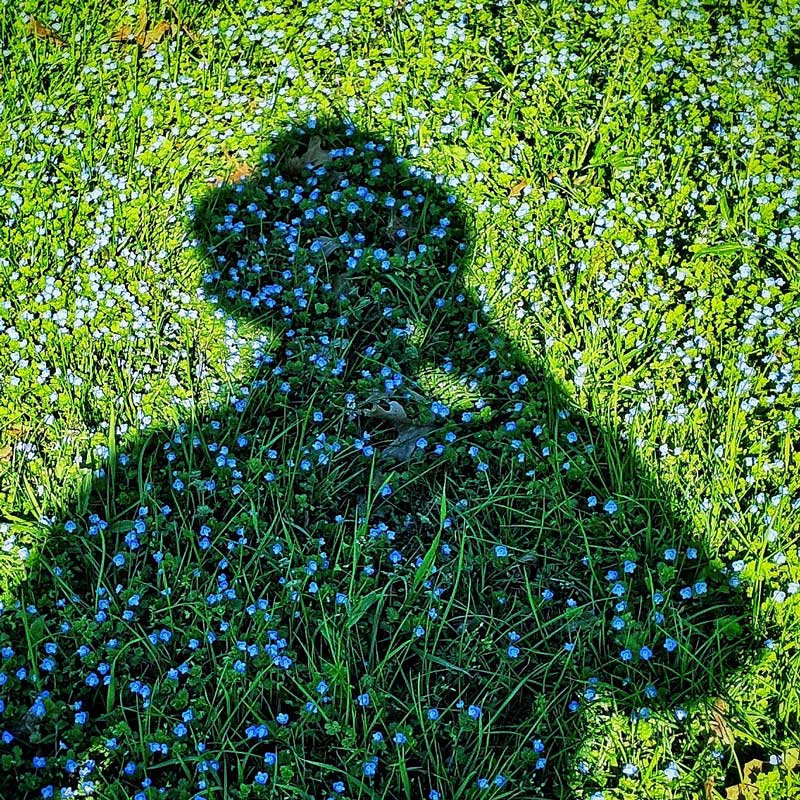
UNJAUNDICE VISION
Only in the shadow
Was the yellow light
Sufficiently subdued
For us to welcome
Beauty unforeseen.
— Brad Hepp, 2/22/2020
There, now I have tied this to the conversation I was having with a friend when I took the photo. We were pondering how weakness and inadequacy may actually be celebrated as part of the suffering that precedes restoration and exaltation in the Divine economy. See James 1:9-18
This poem is about photography AND learning from older people. See the commentary below.
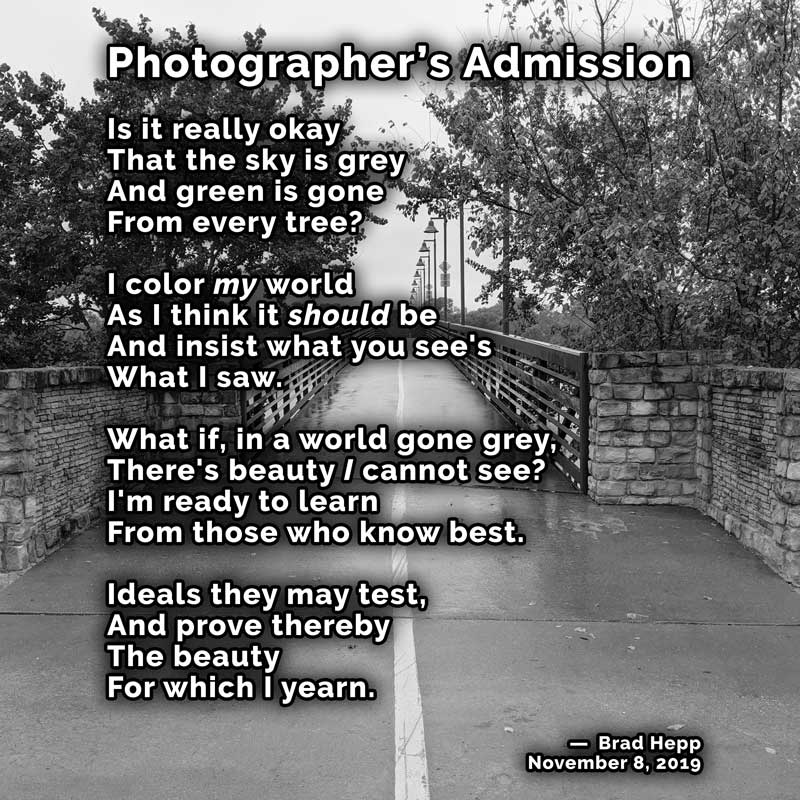
The thought in this poem crystalized as I was looking at a friend’s Instagram photos. The friend is not a photographer, just someone who understands and appreciates the great outdoors. I was looking at one of his early-morning mountain scenes. The sky was literally grey and the trees had no green in them. The photographer in me always aches to edit such photos so that they match my ideal of beauty, and I often excuse my own editing as an attempt to make sure the photo depicts the scene as our magnificent human eyes would have seen it. This all assumes or suggests the conceit that I am the expert, that my vision is the standard.
But my photography and poetry are expressions of something far more important: the desire to fully appreciate and reflect the beauty inherent in a world created by God. In this pursuit, I revel in the wisdom that is both longed for — loudly insisted on — by youth and quietly attained in old age.
Perhaps what I wrote on Facebook will clarify:
Here’s a book that needs to be written: “removing THE BARNICLES OF CHRONIA.” I say this partly in jest, partly “en serio.” As I age, and come to important new realizations about life, I think of my older friends. Many have been down this road already, but were not inclined to chronicle the journey. It seems that we could serve others by offering an honest, thankful, hopeful account. Thoughts?
[Edit, 11/8/2019: Last night, I discussed the project above with fellow creative writers. It’s still on my mind. The poem and photograph below ponders the subject by different means.]
By the way, I know the last stanza is difficult. I’m using “prove” in the sense of “testing so as to find what works.” I think that a full appreciation of beauty is attainable. I fancy that is one of the things that God is even now perfecting in His children. But we all have false or incomplete ideas about beauty in its various manifestations (visual, physical, emotional, intellectual, theological, etc.). For instance, I highly suspect that I still have a false idea about the relationship of beauty and suffering: “Suffering is bad, not suffering is good!” How can suffering have anything to do with beauty?
The answer to the question I just posed is one which I suspect people older than I — and some younger than I — understand far better than I currently understand it. The answer surely goes something like this: through suffering, we are prepared for the beauty that is coming. The answer is somewhere in Romans 8. Perhaps in this passage:
16 The Spirit himself testifies with our spirit that we are God’s children. 17 Now if we are children, then we are heirs—heirs of God and co-heirs with Christ, if indeed we share in his sufferings in order that we may also share in his glory. 18 I consider that our present sufferings are not worth comparing with the glory that will be revealed in us. 19 For the creation waits in eager expectation for the children of God to be revealed.
Romans 8:16-19 (ESV)
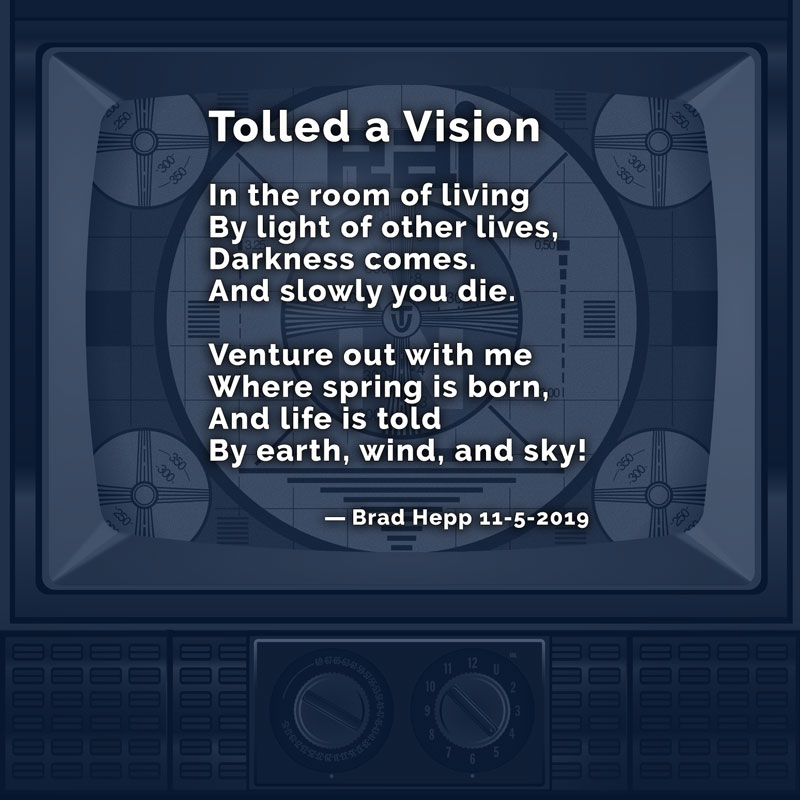
My pastor had this response: “I like it. Slowly we die as we are absorbed by the fictional lives of others dancing before our eyes when real life is just a power button and a glance away…”
My riposte: “… and a good pair of sneakers if you’re so disposed!”
Despite my riposte, this poem is more about the first stanza than the second. Not everyone can don a pair of sneakers and join me on long hikes. But everyone can seek to live as directly as possible, fully appreciating their own God-given life and embracing God’s offer of rebirth, restoration, and eternal life. For most people, this appreciation and embracing requires a little — or a lot — of contemplation, meditation. Noise and distraction are the enemy. Compare my poem “Alone at the Lake.”
About the title: I’m not completely happy with the title. You can probably tell that I started with “Television.” From there, I started pushing on “Tele,” “Tell,” and finally landed on “Tolled.” It may be too far out there. But consider that “toll” is associated with death (“For Whom the Bell Tolls”). It also sounds like “told.” Even as the flitting and vapid* “lives” of fictional characters displayed on a television have “tolled” our dying, and have “told” us the bad news, nature itself has “told” us about better news, the hope of resurrection. A big stretch, I know! This is my blurry vision, and now I have told you.
*This needs work. I do think there is something of “the medium is the message” in this. In television, we have lives that are extinguished with the press of a button.
Go fast! Get there! It’s fine now and then. Mainly then.