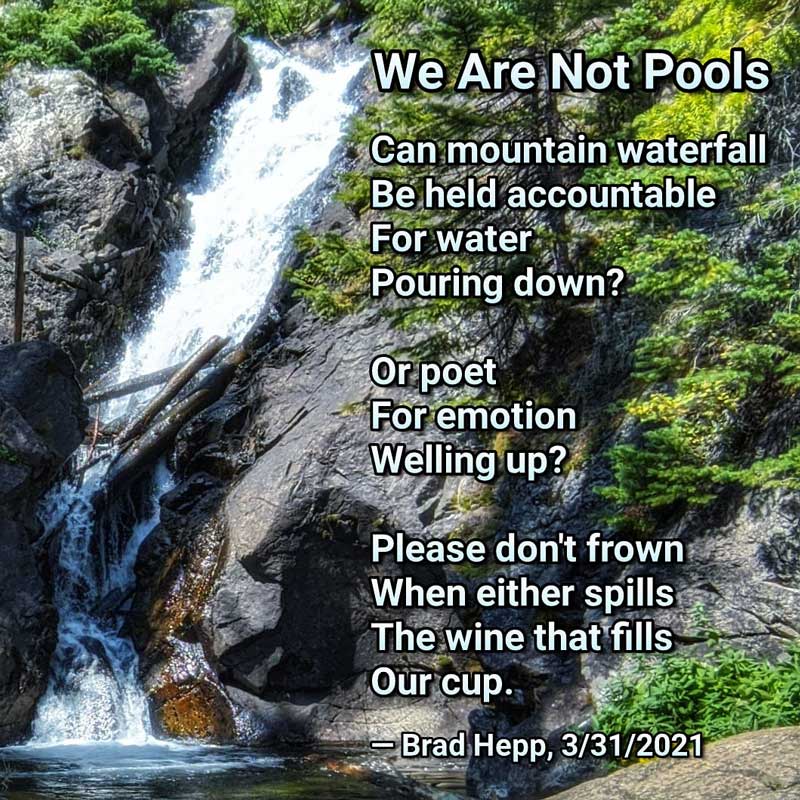
We Are Not Pools

Commentary (Thoughts Running Amok)

Ever since I began writing poetry on a regular basis, I have also pondered what this activity indicates about me: what are the weaknesses a poet needs to acknowledge, and what are the strengths he can celebrate?

A Sample Weakness
[EDIT: I originally wrote and published this late at night, but woke up before dawn with the realization that I had to UNpublish the post and come back with some edits. I had revealed more than I ought to reveal, which is the very tendency I lament in a paragraph below. Someday, the world will suit a poet like me. But not today]

Today, I had a conversation with the senior pastor of a local church. Before I headed over to his church, Susan cautioned me: “Don’t reveal more than you should.” She knows me well. I said, “Pray that I’ll control my mouth, and that I’ll be a blessing to him.”

So, I met the senior pastor at the back door of his church. We walked in, and I immediately began pelting him with questions about his church: how they interact with the neighborhood, how well that is working, etc. After looking at his sanctuary, and talking about how it has served during the pandemic, we went to a more private setting downstairs. I began….

“These last few years, I have been developing as a poet. While some think that poets conceal, their actual drive is to reveal. That’s my natural inclination. But today, I need to control that. I’ll be talking about [something private], and there are things I should not say. Forgive me.” The pastor was understanding, and we talked for another 40 minutes. I believe that by God’s grace I did not tell him more about [the private matter] than I should. Reflecting on what I shared, the pastor gave me hope that I 1) am not alone and 2) serve a God who is changing lives.

The Poet as a Lithe Cat Who Loves Counselors
The little story above is about how I deal with the downside of being a poet: I have to be extra careful about not revealing what’s in my heart. But I usually am not so guarded. Think about it…. A poet is always digging into his own heart to surface emotions and thoughts that would rather stay hidden. He drags them up and exposes them to the light of day where they can be dealt with, sometimes by the poet himself, but more often by the reader, by wiser souls, by counselors. That’s why the poet is a friend of counselors. Like a domestic cat, he brings his daily offering of lizards and rats, and lays them at their door. “Here’s a rat that was running through my heart. What’s its name, and how do we deal with it?”

“Wine That Fills Our Cup”
In the poem I refer to “wine that fills our cup.” Believe me, I like wine, and wine’s not a dead rat. Forget about rats and death. A poet at least this poet celebrates life in his expression of emotion. It is not despair that drives me, but hope. Even when speaking of negative, deadly emotions, there is an essential optimism: “This emotion is not my master. I discovered it, am revealing it, and by God’s grace I will see its cure. He will make me whole.”

Even the Wine of Lament
I have been seeking lately to replace anger and bitterness with sadness and sorrow. In essence, to learn lament. Here’s what’s great about lament (at least as I understand it): it is sorrow felt and expressed in the presence of One who can change things, who will change things. When I move to lament, I move closer to hope. Wine is that which dulls, but also cheers.
Poet’s Daydream

Here’s What I Wrote About This

DON’T HATE ME FOR THIS
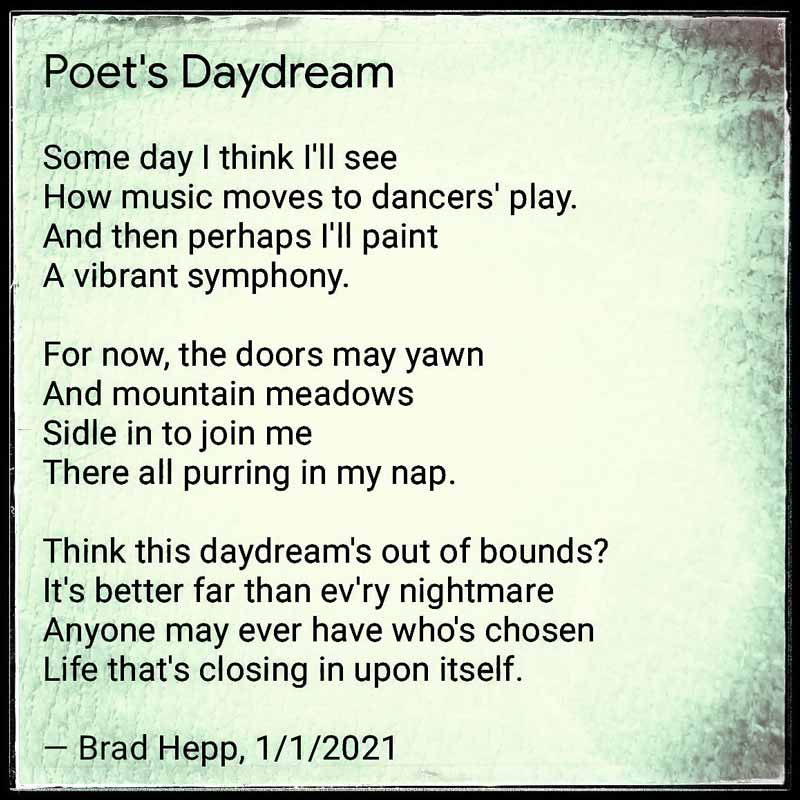
Almost every day, I take an afternoon nap while listening to music. I try hard then to let my imagination wander free. Often, I think of other artists, and the grasp they have of beauty. I, too, have known beauty. Someday, all of us who know the Author of beauty will have unbridled joy in His creation. Nap time is a good time to savor that hope. In Him, we rest.

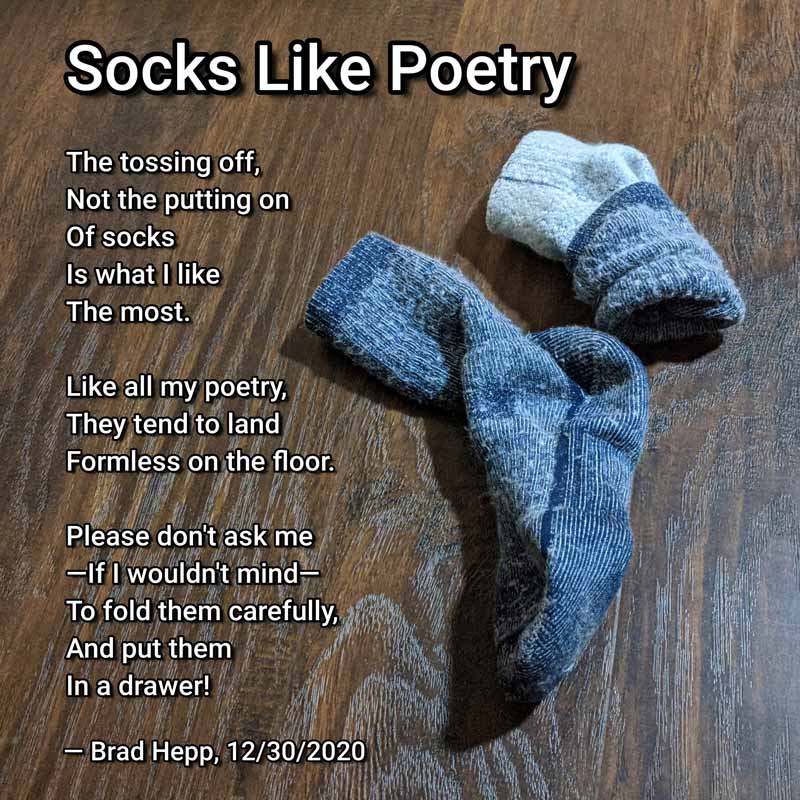
Socks Like Poetry

All day, I asked myself if I should refine a poem I tossed off earlier that morning. This struggle reminds me of when I was a teenage perfectionist, and the head cook told me to stop mixing the pancake batter already.

Well, it turns out that I did NOT refine the poem in question, partly because the poem was one of my most popular ever: “Let The Dishes Soak.” I ran it by another poet, and we both saw its weaknesses, but part of its strength was surely the immediacy — words that someone might speak on the spur of a loving moment.

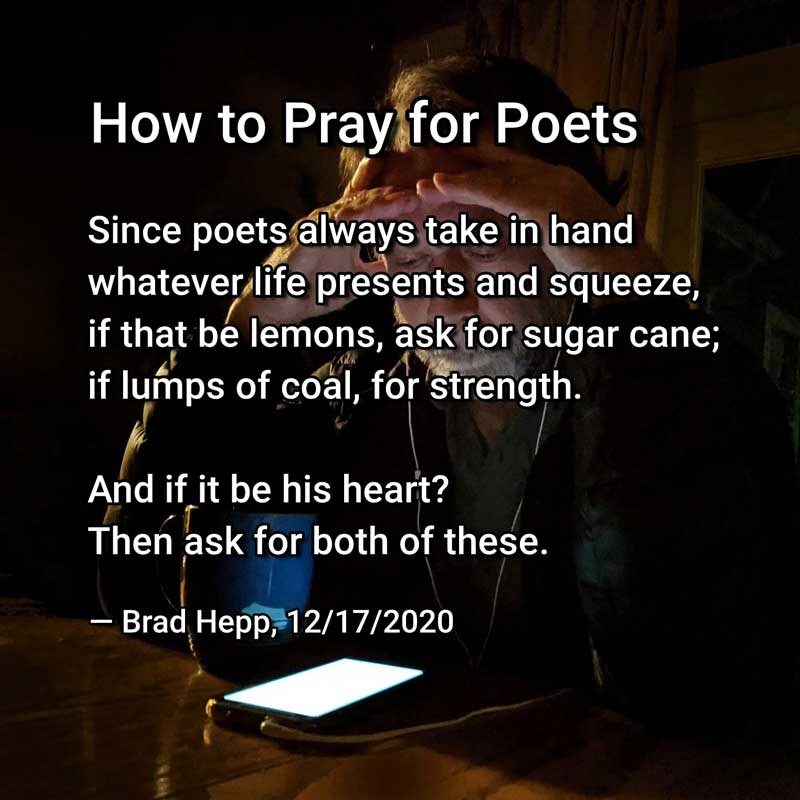
How to Pray for Poets

(photo by Susan Hepp, edited with Snapseed)

Commentary

I think the essence of poetry (at least my poetry) is compression with the goal of transformation.

In all my thinking, I try to get at the nub of things, to analyze and then articulate what I find as simply, honestly, and artfully as I can.

Diamonds and Lemonade
When the thinking is introspective, my hope is that what I find will be something I am willing and able to submit to God for transformation. He’s in that process; I want to cooperate with Him… to the very end. Think of a sinful man being transformed to be like Jesus where this poem refers to the lump of coal. An old myth says that diamonds come from highly compressed coal.

Stepping back one thought…. One of the my character qualities seriously in need of transformation is kindness. Think of that where I refer to “sugar cane” in this poem. I regularly pray that God will sweeten my other attributes with kindness.

NOTE: I had Susan take this picture of me as I sat in the conservatory of the Blue Fern Inn where we were staying in Tahlequah when we were up there to bury Susan’s Mom.

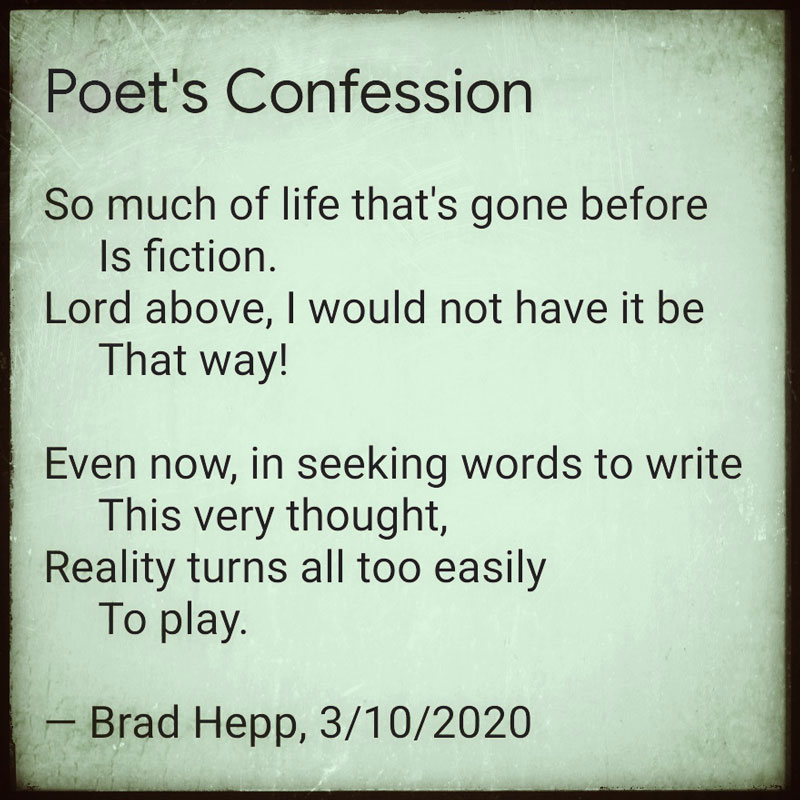
Poet’s Confession

Commentary

I recently began listening to the Audible recording of Augustine’s “Confessions.” Last night, before falling to sleep, I was watching a lecture by James K.A. Smith on “Augustine Our Contemporary.” Just as I got too sleepy to watch anymore, he was talking about authenticity, and how that resonates with modern thinkers.

So, when I woke up this morning, my mind went immediately into writing this poetic response. The subject occupies a large part of my thinking. What is real in my everyday behavior, and what is fakery? By God’s grace, I believe there HAS been progress in becoming sincere, authentic, genuine. But the cost of that transformation is a clearer view of what remains untransformed.

Side Note on Pain and Pleasure in Writing Poetry

Writing poetry is a strange activity for me. My recall of language is spotty. In fact, it would be rare for me to be able to quote even one of my own poems. I look back on them and wonder, “How did that come out of my feeble mind? I can’t put the words together now; how did I do it then?” Words are often just beyond reach. Simple words. It’s a little painful. Just now, I needed to look up the video I reference above, and for a few seconds, I could not think of the word “YouTube.” If this had not been a weakness of mine since youth, I’d be worried.

So, you may be able to understand why writing poetry is a special pleasure for me. It is a small triumph, a pleasure to balance the pain of a language deficit. It is very much like the pleasure I experience in reading Scripture for a worship service, or even in recording my poems. There was a period in my life (Junior High through High School) when I had a speech impediment that interfered with smooth reading and speech. To be able to pull off a reading or recitation now without major hickups is a small triumph. It’s pleasure to balance pain.

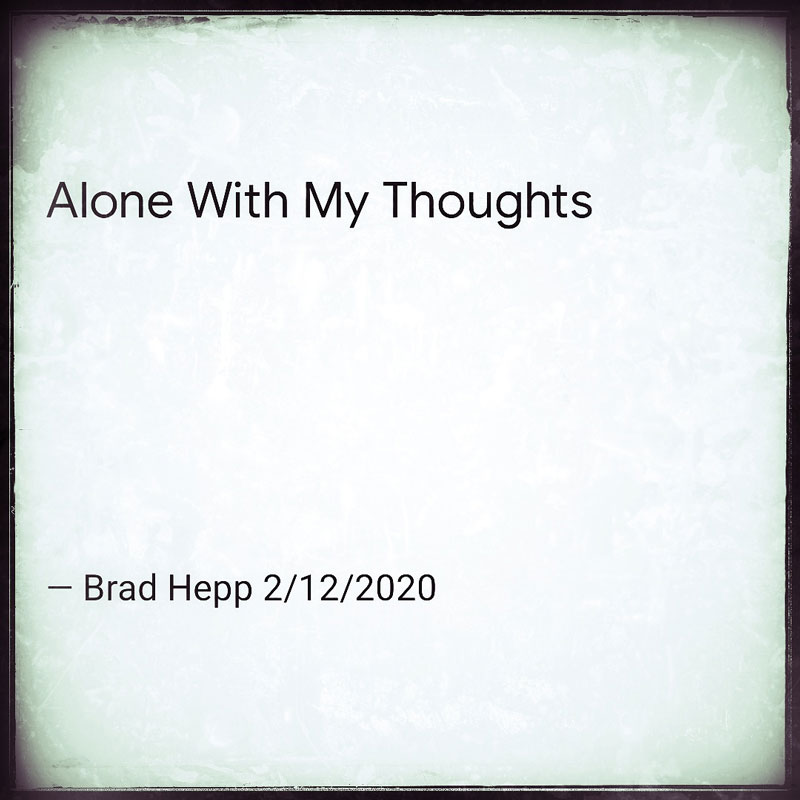
Alone With My Thoughts

I guess every poet comes up with this one eventually.

This “poem” is not silly. In fact, I have never been more serious or intentional in anything I have written. It is not that I have no thoughts. Nor is it that I don’t want to share my thoughts with others. It is that there is no such thing as thoughts I have while “alone.” It may drive me to insanity, but I am determined to become consistent in my belief in an all-knowing and very present God. One of the worst hidden hypocrisies in my life has been holding the belief that I have “the ear” of the most powerful being (God) but not voicing my thoughts about others to Him. How many times I have scrolled through Facebook and thought this or that about my friends and acquaintances without “voicing” those thoughts to the One who can do something about my concerns? Do I see someone who is filling his or her life with hatred? Why would I not voice my concern about that to all-powerful God, the one best able to teach them love? Do I see someone hurting and reaching out to friends for comfort? Why would I not voice my sympathy to the great Comforter? Hypocrisy is usually associated with action. My hypocrisy has consisted of inaction.

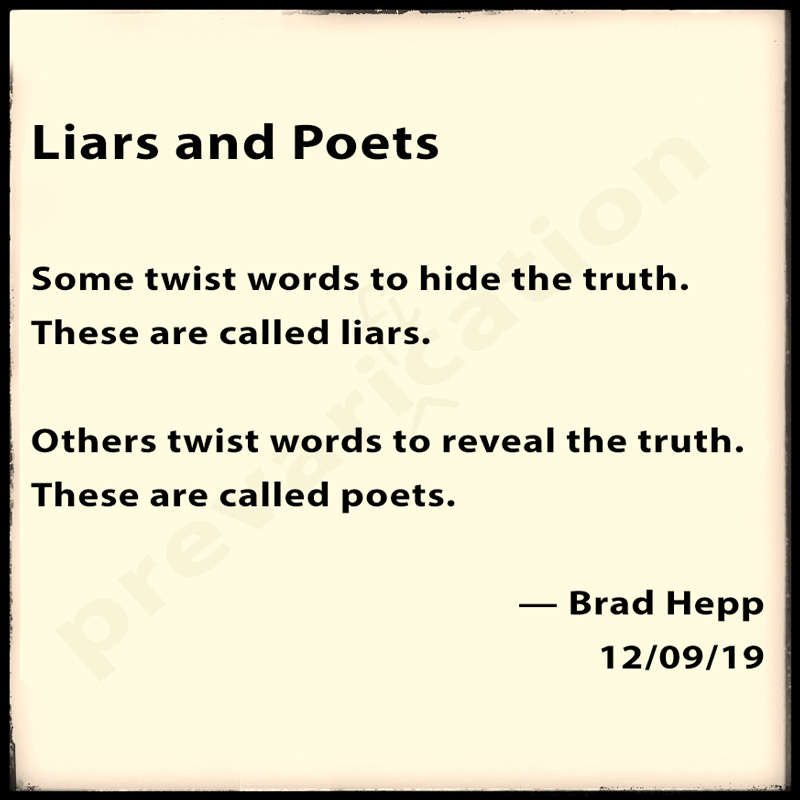
Liars and Poets

Commentary

I have been noticing recently that writing poetry is a way to access emotions and thoughts that have been suppressed in some way. So when I say that poets twist words to reveal the truth, I’m referring partly to the truth about what “lurks” in their hearts. Sometimes that truth is good, sometimes not so good! But at least the poet is getting closer to honesty.

At its best, poetry expresses beautiful truths in a way that helps both the poet and reader understand them better. That’s my goal.

Poetry: Why Bother?

This morning, I was beginning to read a poem by Gerard Manley Hopkins. He’s a poet I know little about, but am confident he will be worth getting to know. His poem, “The Windhover” begins
I caught this morning morning’s minion, kingdom of daylight’s dauphin…
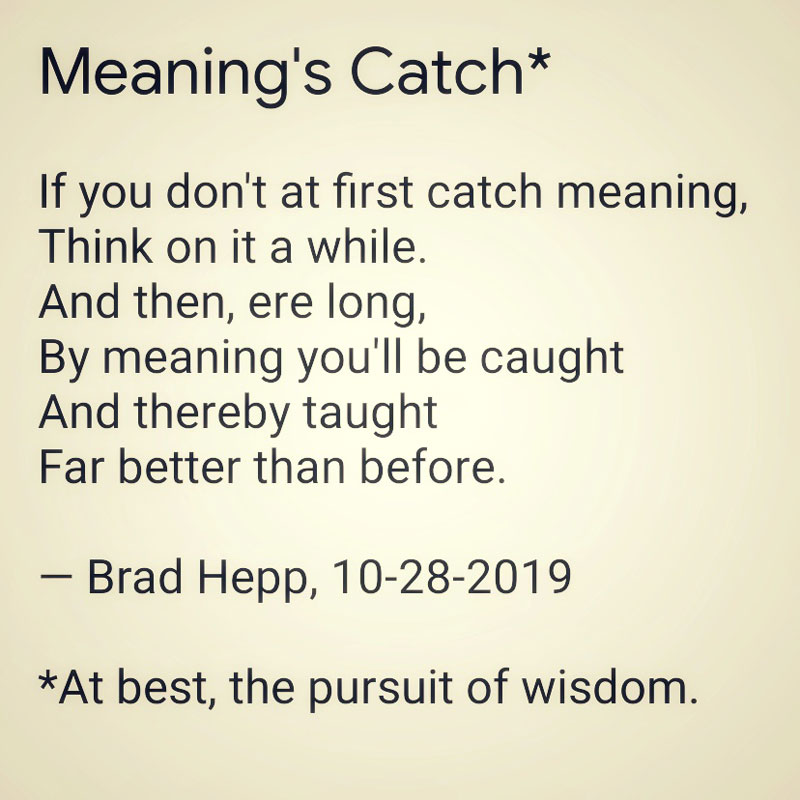
The effort to unravel “morning morning’s minion,” and the delight I felt as a result, suggested my own “morning catch,” which morphed quickly into “meaning’s catch:”

Here is how I commented on my own poem on Facebook:

The creative writers I recently began meeting with spent much of our first few sessions grappling with the PURPOSE of our writing. In the case of poetry, one question is “Why use metaphors when plain words could express the thought?” One of the best answers for me is that truth has more impact on a person when he or she puts effort into understanding it (this applies to the author and reader alike). My father and I spent years puzzling through Robert Browning’s “Rabbi Ben Ezra” (Grow old along with me…). I’m convinced that Browning’s insight has had far more positive effect in my thinking BECAUSE of that puzzling than it would have had Browning “just said what he meant!”